|
DIRAC, PAM (PAUL ADRIEN MAURICE). - THE RADIATION THEORY, THE BIRTH OF QUANTUM ELECTRODYNAMICS P A M
The Quantum Theory of Emission and Absorption of Radiation. The Quantum Theory of Dispersion. 2 Papers.
London Harrison And Sons Ltd. 1927. Royal8vo. Contemp. full cloth. A small stamp on verso of titlepage. In: "Proceedings of the Royal Society of London" Series A Vol. 114. VIIX748 pp. entire volume offered. Dirac's papers: pp. 243-265 a. pp. 710-728. Clean and fine. <br/><br/><em>First appearance of these milestone papers in Quantum Physics constituting the first step in Quantum Field Theory and the invention of the Second Quantifization Method. By these papers Dirac "gave the foundation for that theory quantum electrodynamics"Pais."A New Radiation Theory. Dirac liked his transformation theory because it was the outcome of a planned line of research and not a fortuitous discovery. He forced his future investigations to fit it. The first results of this strategy were almost miraculous. First came his new radiation theory in February 1927 which quantized for the first time James Clerk Maxwell’s radiation in interaction with atoms. Previous quantum-mechanical studies of radiation problems except for Jordan’s unpopular attempt retained purely classical fields. In late 1925 Jordan had applied Heisenberg’s rules of quantization to continuous free fields and obtained a light-quantum structure with the expected statistics Bose Einstein and dual fluctuation properties. Dirac further demonstrated that spontaneous emission and its characteristics—previously taken into account only by special postulates—followed from the interaction between atoms and the quantum field. Essential to this success was the fact that Dirac’s transformation theory eliminated from the interpretation of the quantum formalism every reference to classical emitted radiation contrary to Heisenberg’s original point of view and also to Schrödinger’s concept of as a classical source of field.This work was done during Dirac’s visit to Copenhagen in the winter of 1927. Presumably to please Bohr who insisted on wave-particle duality and equality Dirac opposed the "corpuscular point of view" to the quantized electromagnetic "wave point of view." He started with a set of massless Bose particles described by symmetric waves in configuration space. As he discovered by’ playing with the equations ’ this description was equivalent to a quantized Schrödinger equation in the space of one particle; this’ second quantization’ was already known to Jordan who during 1927 extended it into the basic modern quantum field representation of matter. Dirac limited his use of second quantization electromagnetic to radiation: to establish that the corpuscular point of view once brought into this form was equivalent to the wave point of view."DSB. </em> hardcover
書籍販売業者の参照番号
: 47023
|
|
|
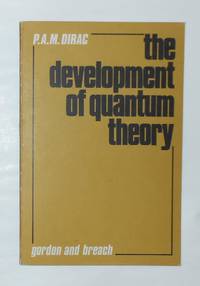
DIRAC, Paul Adrien Maurice (P A M) intro by Behram Kursunoglu
Development of Quantum Theory - J Robert Oppenheimer Memorial Prize Acceptance Speech
Gordon & Breach New York London & Paris 1971. 1st Edition. SOFTCOVER. 1st printing. Small 8vo. in white and black printed stiff card covers frontispiece vi pp prelims 66pp main text and 14 full page photos __CONDITION : An exceptionally well preserved FINE very clean and tight unmarked and barely read copy. . NOTE: Depending on destination this item may require an extra payment for insurance. If so orders made by card will be completed only after you have approved any such extra cost. __We always ship in PROTECTIVE CARD PARCELS Gordon & Breach, New York, London & Paris paperback
書籍販売業者の参照番号
: T203316 ISBN : 0677029705 9780677029702
|
|
|
Dirac, Paul Adrien Maurice; Hora, Heinrich & Shepanski, John Richard
Directions in Physics: Lectures Delivered During a Visit to Australia and New Zealand August/September 1975
New York: John Wiley & Sons 1978. Classic text presents a selection of lectures given by the distinguished physicist Paul Dirac in 1975. Topics include the development of quantum mechanics; quantum electrodynamics; magnetic monopoles; a positive-energy relativistic wave equation; cosmology and the wave constant. 95 pgs. Illustrated. Prior owner's name on front and rear endpapers. Corners slightly rubbed. Minimal shelfwear. . First Edition. Hard Cover. Fine. 8vo - over 7¾" - 9¾" tall. John Wiley & Sons Hardcover
書籍販売業者の参照番号
: PH-375 ISBN : 0471029971 9780471029977

|
|
|
DIRAC, Paul Adrian Maurice (1902-1984).
Homogeneous variables in classical dynamics. WITH: KAPITZA Piotr Leonidovich 1894-1984 & Paul Adrian Maurice DIRAC 1902-1984. The reflection of electrons from standing light waves.
In: Proceedings of the Cambridge Philosophical Society Vol. XXIX 1 October 1932 - 30 September 1933. Cambridge:: Cambridge University Press 1933. 1933. 219 x 147 mm. 8vo. 389-400; 297-300 pp. Entire volume: vii 1 blank 545 3 pp. 1 fig. Kapitza & Dirac. Quarter navy morocco morocco corners marbled boards raised bands gilt spine. Blind-stamp of the Carnegie Institution of Washington Mount Wilson Observatory. Fine. FIRST EDITIONS. "Dirac's occupation with the problems of quantum electrodynamics may be further illustrated by two papers of a mainly mathematical character written in the spring of 1933. Both were concerned with the possibility of generalizing the mathematical basis of quantum mechanics in order to overcome the difficulties of the existing quantum electrodynamics and secure its connection with classical dynamics. Dirac pointed out that in exceptional cases which turned up in the theory of Heisenberg and Pauli ordinary Hamiltonian methods were not applicable. In order to remove such 'irregularities' and obtain 'greater elegance' he proposed a reformulation of classical Hamiltonian dynamics by introducing homogeneous variables." Kragh Dirac pp. 138-139. Kragh Dirac 1933C; 1933B. Cambridge University Press, 1933. hardcover
書籍販売業者の参照番号
: S5117
|
|
|
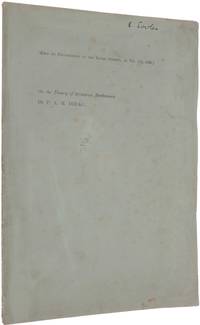
DIRAC, Paul Adrien Maurice
On the theory of quantum mechanics. Offprint from Proceedings of the Royal Society A vol. 112 1926
London: Harrison & Sons for the Royal Society 1926. First edition. <p>First edition extremely rare offprint of Dirac's paper which "is justly seen as a major contribution to quantum theory" Kragh. It introduced his quantum mechanical derivation of what is now called Fermi-Dirac statistics and also contained Dirac's first steps towards quantum electrodynamics. The paper "will be remembered as the first in which quantum mechanics is brought to bear on statistical mechanics" Pais.</p>. FERMI-DIRAC STATISTICS AND THE FIRST STEPS TOWARDS QUANTUM ELECTRODYNAMICS. <p>First edition extremely rare offprint of Dirac's paper which "is justly seen as a major contribution to quantum theory" Kragh p. 36. It introduced his quantum mechanical derivation of what is now called Fermi-Dirac statistics which describes a distribution of particles now known as fermions a name coined by Dirac in 1945 in certain systems containing many identical particles that obey the Pauli exclusion principle-meaning that no two of the particles can occupy the same quantum state simultaneously. It also contains Dirac's first steps towards quantum electrodynamics. The paper "will be remembered as the first in which quantum mechanics is brought to bear on statistical mechanics. Recall that the earliest work on quantum statistics by Bose and by Einstein predates quantum mechanics. Also Fermi's introduction of the exclusion principle in statistical problems though published after the arrival of quantum mechanics is still executed in the context of the 'old' quantum theory. All these contributions were given their quantum mechanical underpinnings by Dirac who was in fact the first to give the correct justification of Planck's law which started it all: 'Symmetrical eigenfunctions . give just the Einstein-Bose statistical mechanics . . . which leads to Planck's law of black-body radiation'" Pais p. 6. Dirac's paper is credited "for having laid the foundations of the integration of quantum mechanics and quantum statistics because they introduced the quantum-mechanical expression of the symmetry of a system under exchanges of equal particles. The quantum formalism of exchange symmetry is regarded as having solved at once long-standing difficulties regarding the statistical properties of both equal particles and light quanta by clarifying and legitimizing the previously foggy notion of indistinguishable particles" Monaldi p. 125. The second part of the present paper contained the seed of Dirac's invention of quantum electrodynamics which was brought to fruition a few months later in 'The Quantum Theory of the Emission and Absorption of Radiation'. In the present paper "Dirac considered a system of atoms subjected to an external perturbation that could vary arbitrarily with the time . Dirac obtained results 'in agreement with the ordinary Einstein theory' that is with the quantum mechanical derivation of the B coefficients that occurred in Einstein's theory of 1917 that gave the probability of absorption and stimulated emission of radiation. Since he made use of a classical description of the electromagnetic field Dirac was not at the time able to proceed further and he noted 'One cannot take spontaneous emission i.e. the A coefficients into account without a more elaborate theory.' This more elaborate theory was ready less than half a year later" Kragh pp. 120-121. OCLC lists University of Florida only where Dirac spent his last years. No copy in auction records.</p> <br /> <p>Provenance: Bertha Swirles 1903-99 signature on front wrapper extensive annotations to lower margins of last two pages of text including several equations. As an undergraduate at Cambridge Swirles attended lectures by J. J. Thomson and Rutherford. She remained at Cambridge in 1925 to undertake research in mathematical astronomy under the supervision of Ralph Fowler; another of Fowler's research students a couple of years ahead of Swirles was Paul Dirac. After periods at Bristol Imperial College London and Manchester Swirles took up a lectureship in mathematics at Girton College Cambridge in 1938 where she remained for the rest of her career.</p> <br /> <p>The present paper was "Dirac's first published response to Schrödinger's theory i.e. wave mechanics. He had corresponded with Heisenberg while completing his PhD thesis in Cambridge in the spring of 1926. Many years later he wrote in his recollections that he did the present work on many-particle systems after Heisenberg convinced him of the usefulness of wave mechanics. Dirac felt 'at first a bit hostile' to this theory because it seemed to him that it represented a regress to 'the pre-Heisenberg stage.' In a non-extant letter to Heisenberg he criticized Schrödinger because 'the wave theory of matter must be inconsistent just like the wave theory of light'. Heisenberg agreed with this criticism but nonetheless saw Schrödinger's theory as progress. Thanks to Heisenberg's detailed explanation of the relation between the two formal schemes Dirac could see that wave mechanics 'would not require us to unlearn anything that we had learned from matrix mechanics' but rather 'supplemented the matrix mechanics and provided very powerful mathematical developments which fitted perfectly with the ideas of matrix mechanics'.</p> <br /> <p>"In Dirac's retrospective account it was the study of Schrödinger's formalism that suggested to him the possibility of symmetric and antisymmetric wave functions for a system of similar particles. These 'symmetry questions' in turn 'brought in the possibility of new laws of Nature' .</p> <br /> <p>"Instead of confronting Schrödinger's undulatory interpretation Dirac set out to reformulate Schrödinger's formal apparatus in general terms according to his own mathematical approach. He deduced the expression of the general solution of a quantum-mechanical problem as a linear expansion with arbitrary constants in 'a set of independent solutions' which he called eigenfunctions p. 664. This formal milestone enabled him to develop a quantum-mechanical treatment of multiparticle systems and to reach three lasting results. He arrived at the symmetry and antisymmetry of the wave functions formulated the statistics that we now know as Fermi-Dirac statistics and derived a calculation of Einstein's coefficients of absorption and stimulated emission .</p> <br /> <p>"Dirac adopted 'an atom with two electrons' as the simplest multiparticle system. In his atom however all interactions between electrons could be neglected. He did not resort to the analogy with the classical phenomenon of resonance as a theoretical tool but used only the symmetry of the two-electron system supplemented by the methodological principle for which he credited Heisenberg:</p> <br /> <p>'Heisenberg's matrix mechanics enables one to calculate just those quantities that are of physical importance and gives no information about quantities such as orbital frequencies that one can never hope to measure experimentally. We should expect this very satisfactory characteristic to persist in all future developments of the theory' p. 667.</p> <br /> <p>"Dirac indicated with 'the state of the atom in which one electron is in an orbit labelled and the other in the orbit .' He then asked: Were the 'physically indistinguishable' states and to be counted as distinct or as identical This question was inconsequential in classical mechanics but in the matrix formalism it implied a choice between two different matrix representations. In one the matrix elements corresponding to the transitions → m'n' and → n'm' would be represented by two separate matrix elements in the other they would be represented by the same element . Dirac asserted that the two transitions → m'n' and → n'm' were 'physically indistinguishable' and that 'only the sum of the intensities for the two together could be determined experimentally' p. 667. From this proposition he drew the answer:</p> <br /> <p>'Hence in order to keep the essential characteristic of the theory that it shall enable one to calculate only observable quantities one must adopt the second alternative that and count as only one state' p. 667.</p> <br /> <p>"Having so fixed the matrix formalism Dirac applied his formula for the general solution of the two-particle model. He formed the eigenfunctions of the whole system as linear combinations of products of the eigenfunctions of the single electrons; then he imposed the condition that they correspond to the matrices. This condition could be satisfied only by combinations that were symmetrical or antisymmetrical under exchange of the electrons. Either one of these two possibilities gave 'a complete solution of the problem' and quantum mechanics did not dictate which was the correct one p. 669. The choice Dirac stated was to be made by appealing to Pauli's exclusion principle:</p> <br /> <p>'An antisymmetrical eigenfunction vanishes identically when two of the electrons are in the same orbit. This means that in the solution of the problem with antisymmetrical eigenfunctions there can be no stationary states with two or more electrons in the same orbit which is just Pauli's exclusion principle' pp. 669-670.</p> <br /> <p>"The symmetrical solution however could not be correct for 'the problem of electrons in an atom' because it allowed any number of electrons in the same orbit p. 670. These results could be straightforwardly extended to any system composed of similar particles in particular to an assembly of molecules. Dirac thus applied them to the ideal gas. He obtained the eigenfunction of the assembly by multiplying the single-molecule eigenfunctions and choosing either the symmetrical or the antisymmetrical linear combinations. At this point he turned to statistical considerations. He implicitly made the assumption that the new states represented by symmetrical and antisymmetrical wavefunctions represented the energy distributions or macrostates of statistics. Then he explicitly adopted as a 'new assumption' the simplest extension of Bohr's rule namely that 'all the stationary states of the assembly each represented by one eigenfunction have the same a priori probability' p. 671. In the case of symmetrical eigenfunctions this rule corresponded to the Bose-Einstein statistics. In the case of the antisymmetrical eigenfunctions whereby the number of molecules associated with each single-particle eigenfunction could only be 0 or 1 it led to the new statistics that is now known as the Fermi-Dirac statistics. Dirac concluded:</p> <br /> <p>'The solution with symmetrical eigenfunctions must be the correct one when applied to light quanta since it is known that the Einstein- Bose statistical mechanics leads to Planck's law of black-body radiation. The solution with antisymmetrical eigenfunctions though is probably the correct one for gas molecules since it is known to be the correct one for electrons in an atom and one would expect molecules to resemble electrons more closely than light quanta' p. 672</p> <br /> <p>"Despite having just derived the two quantum statistics from the same set of assumptions with the difference of the Pauli principle Dirac separated them starkly in their applicability. His integration of quantum statistics and quantum mechanics was thus sealed with an uncompromising rejection of Einstein's analogy between light quanta and material corpuscles .</p> <br /> <p>"The fact that Dirac disregarded the undulatory interpretation of the wave function and the consequences of antisymmetry for the independence of material particles does not mean that he refrained completely from any interpretation of the general solution of the wave equation. He did put forward an interpretation in the last section of the paper in which he outlined a perturbation theory and fruitfully put it to use. He wrote the wave equation of 'an atomic system subjected to a perturbation from outside e.g. an incident electromagnetic field' and showed that the general solution could be written as Ψ = Σn anΨn where the Ψn were the wave functions associated with the stationary states of the unperturbed atom and the an coefficients depending on time. He thus deftly switched interpretive models. He proceeded to consider the general solution as no longer representing an atom but an assembly of atoms and to assume that the square modulus of the coefficient an represented 'the number of atoms in the th state' pp. 646-647. The general solution now was a new theoretical representation of a multiparticle system that avoided any representation of individual particles and therefore bypassed for the time being the question of whether two states differing only by particle exchange should be counted as a distinct or identical. Determining the time evolution of the an under the effect of the perturbation Dirac was then able to derive the coefficients of absorption and stimulated emission of Einstein's theory of radiation .</p> <br /> <p>"Dirac returned to the difference between electrons and light quanta and the emission and absorption of radiation half a year later after having spent several months at Bohr's institute in Copenhagen formulating the general transformation theory and a general statistical interpretation of it. As a result of that work he was able to forge a link between his two representations of multiparticle systems for the case of light quanta and thereby launched quantum electrodynamics" Monaldi pp. 137-143.</p> <br /> <p>"'On the Theory of Quantum Mechanics' became the most cited of Dirac's early papers and was studied with interest by both matrix and wave theorists. Although the paper was recognized as an important work many physicists felt that it was difficult to understand and even cryptic. Schrödinger may be representative in this respect. In October 1927 when Dirac was in Copenhagen Schrödinger told Bohr about his troubles in reading Dirac:</p> <br /> <p>'I found Dirac's work extremely valuable because it translates his interesting set of ideas at least partly into a language one can understand. To be sure there is still a lot in this paper which I find obscure . Dirac has a completely original and unique method of thinking which - precisely for this reason - will yield the most valuable results hidden to the rest of us. But he has no idea how difficult his papers are for the normal human being'" Kragh p. 37.</p> <br /> <p>"Following the publication of Dirac's paper the new statistics was eagerly taken up and applied to a variety of problems. The first application was made by Dirac's former teacher Fowler; as an expert in statistical physics he was greatly interested in the Fermi-Dirac result. Fowler studied a Fermi-Dirac gas under very high pressure thus beginning a chapter in astrophysics that a few years later would be developed into the celebrated theory of white dwarfs by his student Chandrasekhar. In Germany Pauli and Sommerfeld made other important applications of the new quantum statistics with which they laid the foundation for the quantum theory of metals in 1927" ibid. p. 36.</p> <br /> <p>Kragh Dirac: A Scientific Biography 1990; Monaldi 'Early interactions of quantum statistics and quantum mechanics' pp. 125-147 in: Traditions and Transformations in the History of Quantum Physics. HQ-3: Third International Conference on the History of Quantum Physics Berlin June 28 - July 2 2010 Katzir Lehner & Renn eds. 2017. Pais 'Paul Dirac: Aspects of his life and work' in Paul Dirac: The Man and his Work ed. P. Goddard 1998 pp. 1-45.</p> <br/> <br/> 8vo 254 x 179 mm pp. 661 662-677 3 blank. Original printed wrappers lightly soiled and foxed. Harrison & Sons for the Royal Society unknown
書籍販売業者の参照番号
: 5980
|
|
|
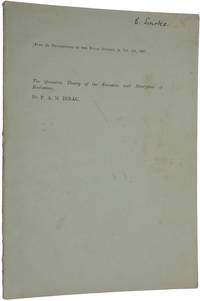
DIRAC, Paul Adrien Maurice
The Quantum Theory of the Emission and Absorption of Radiation. Offprint from Proceedings of the Royal Society A vol. 114 1927
London: Harrison & Sons for the Royal Society 1927. First edition. <p>First edition extremely rare offprint of Dirac's quantum theory of the electromagnetic field which for the first time reconciled the wave and particle nature of light. "This paper marks the birth of quantum electrodynamics" Schweber QED and the Men Who Made It. "Dirac's approach to the radiation problem . came as a revelation" Gregor Wentzel.</p>. THE BIRTH OF QUANTUM ELECTRODYNAMICS. <p>First edition extremely rare offprint of Dirac's quantum theory of the electromagnetic field which for the first time reconciled the wave and particle nature of light. "This paper marks the birth of quantum electrodynamics. In his 'Introduction and Summary' Dirac noted that the new quantum theory based on non-commuting dynamical variables was by then sufficiently developed to form a 'fairly complete theory of any 'dynamical system' composed of a number of particles with instantaneous forces acting between them provided it is describable by a Hamiltonian function.' But hardly anything had been done 'up to the present on quantum electrodynamics.' 'The questions of the correct treatment of a system in which the forces are propagated with the velocity of light instead of instantaneously of the production of an electromagnetic field by a moving electron and of the reaction of this field on the electron have not yet been touched. In addition there is a serious difficulty in making the theory satisfy all the requirements or the restricted principle of relativity' . Gregor Wentzel who contributed significantly to the development of quantum electrodynamics during the 1920s commented in 1959: 'Today the novelty and boldness of Dirac's approach to the radiation problem may be hard to appreciate . there had been no possibility within the correspondence principle framework to understand the process of spontaneous emission or the disappearance of a photon. Dirac's explanation . came as a revelation' . In his paper Dirac dealt with the problem of an atom interacting with the radiation field in two distinct ways that can be characterized as the 'corpuscular' and the 'wave' approaches. In the corpuscular approach the light quanta are described as an assembly of 'non-interactive particles moving with the speed of light and satisfying the Einstein-Bose statistics' . In the last brief section of his paper Dirac turned to the interaction of an atom with the electromagnetic field as described from the wave point of view . In a lecture on the origin of quantum field theory in 1982 Dirac characterized the two approaches as follows: 'Instead of working with a picture of the photons as particles one can use instead the components of the electromagnetic field. One thus gets a complete harmonizing of the wave and corpuscular theories of light. One can treat light as composed of electromagnetic waves each wave to be treated like an oscillator; alternatively one can treat light as composed of photons the photons being bosons and each photon state corresponding to one of the oscillators of the electromagnetic field. One then has the reconciliation of the wave and corpuscular theories of light. They are just two mathematical descriptions of the same physical reality" Schweber pp. 23-31. "Dirac's approach was instantly welcomed as the first consistent quantum theory of radiation and accepted as the paradigm in a whole series of subsequent studies" Kojevnikov p. 232. "Salam and Wigner in their preface to the Festschrift that honored Dirac on his seventieth birthday and commemorated his contributions to quantum mechanics succinctly assessed the man. 'Dirac is one of the chief creators of quantum mechanics . Posterity will rate Dirac as one of the greatest physicists of all time . He is a legend in his own lifetime and rightly so'" ibid. pp. 11-12. Not on OCLC no copies in auction records.</p> <br /> <p>Provenance: Bertha Swirles 1903-99 signature on front wrapper marginal pencil annotations including an equation in the lower margin of p. 261. As an undergraduate at Cambridge Swirles attended lectures by J. J. Thomson and Rutherford. She remained at Cambridge in 1925 to undertake research in mathematical astronomy under the supervision of Ralph Fowler; another of Fowler's research students a couple of years ahead of Swirles was Paul Dirac. After periods at Bristol Imperial College London and Manchester Swirles took up a lectureship in mathematics at Girton College Cambridge in 1938 where she remained for the rest of her career.</p> <br /> <p>Before Dirac's work the understanding of the emission and absorption of radiation was founded on that set out by Einstein in 1917. Einstein admitted the existence of three kinds of processes involving the interaction of radiation with matter: spontaneous emission absorption and stimulated emission. Einstein denoted the probability per unit time of these processes A ÏB and ÏB' where Ï is the intensity of the incident radiation in the cases of absorption and stimulated emission. Einstein showed that in order to satisfy Planck's radiation law one must have B = B' so that the processes were determined by two coefficients A and B. The new process of stimulated emission in which an atom is 'persuaded' to undergo a quantum jump between two quantum states when radiation of the correct frequency is incident upon it is the process involved in the operation of the laser.</p> <br /> <p>Dirac's first study of radiation theory was the subject of the last section of the important paper 'On the Theory of Quantum Mechanics'. The first part of this paper is best known for establishing the connection between Bose-Einstein statistics and symmetric wave functions on the one hand and what became known as Fermi-Dirac statistics and anti-symmetric wave functions on the other. In the second part of this paper "Dirac considered a system of atoms subjected to an external perturbation that could vary arbitrarily with the time. Of course the particular perturbation he had in mind was an incident electromagnetic field but characteristically he stated the problem in the most general way possible . Dirac obtained results 'in agreement with the ordinary Einstein theory' that is with the quantum mechanical derivation of the B coefficients that occurred in Einstein's theory of 1917. Since he made use of a classical description of the electromagnetic field Dirac was not at the time able to proceed further and he noted 'One cannot take spontaneous emission i.e. the A coefficients into account without a more elaborate theory.' This more elaborate theory was ready less than half a year later" Kragh pp. 120-121.</p> <br /> <p>"The introduction to the 'Quantum Theory of Radiation' appears to have been written after reflection on the already completed body of the paper. It presented the construction of a quantum theory 'of the emission of radiation and of the reaction of the radiation field on the emitting system' as the main object of the paper. This must be accomplished by taking the Hamiltonian for an atom interacting with an electromagnetic field and converting the classical field quantities into quantum-mechanical operators. If the Hamiltonians were then written in terms of a closed system that is with terms representing the energies of the atom the field and the interaction a calculation of the coefficient of spontaneous emission as well as of induced emission and absorption would be possible and thus the problem that had been left open would be solved. Dirac also reported that he had discovered a way to write the Hamiltonian for matter and radiation in terms of the interaction of the atom with an assembly of light quanta. This gave him two equivalent expressions whose starting points were respectively waves and quanta. This equivalence on the one hand and the translation of the classical field variables into quantum operators on the other provided the formal basis for an understanding of the constitution of light" Bromberg p. 151.</p> <br /> <p>"According to Dirac's recollections the fundamental idea of his 1927 radiation theory was obtained unsystematically and unexpectedly. It was 'one of those ideas out of the blue' from which so much of his science originated. The work was the result of 'playing about with the Schrodinger equation . . . and seeing what happens when you make the wave functions into a set of non-commuting variables.' This idea out of the blue led to what was later called 'second quantization.' Instead of treating the energies and phases of radiation as c-numbers i.e. commuting quantities as he had done in his 1926 paper Dirac treated them as q-numbers non-commuting quantities generalizing the matrices of Heisenberg's quantum mechanics. In general second quantization involves considering the wave function as an operator instead of just a number .</p> <br /> <p>"In order to calculate the probabilities of absorption and emission of a photon he constructed a Hamiltonian that described the interaction between a photon and an atom. The Hamiltonian had to incorporate the fact that photons are not conserved but may be spontaneously created or destroyed. Dirac included this feature in his Hamiltonian by introducing unobservable or spurious photons that is photons with zero energy and momentum:</p> <br /> <p>'When a light-quantum is absorbed it can be considered to jump into this zero state and when one is emitted it can be considered to jump from the zero state to one in which it is physically in evidence so that it appears to have been created. Since there is no limit to the number of light-quanta that may be created in this way we must suppose that there are an infinite number of light-quanta in the zero-state.'</p> <br /> <p>"Dirac introduced the idea of zero-state photons because he believed such entities were necessitated by formal reasons. From the point of view of methodology it should be noted that unobservable zero-state photons were dubious entities according to the positivist Heisenberg-inspired view of physical theory that Dirac by and large accepted. This only illustrates that Dirac's positivism was not strict. Also worth noticing is that in 1930 when introducing the hole theory of electrons Dirac proceeded in a way that was conceptually similar to the way he followed in formulating his radiation theory .</p> <br /> <p>"In the last section of his paper Dirac turned to consider the interaction between an atom and radiation from the wave point of view. He again calculated the Einstein coefficients getting the same result he had obtained when using the photon point of view. He concluded that</p> <br /> <p>'. the Hamiltonian which describes the interaction of the atom and the electromagnetic waves can be made identical with the Hamiltonian for the problem of the interaction of the atom with an assembly of particles moving with the velocity of light and satisfying the Einstein-Bose statistics by a suitable choice of the interaction energy for the particles . There is thus a complete harmony between the wave and light-quantum descriptions of the interaction'" Kragh pp. 121-124</p> <br /> <p>"The quantization of the electromagnetic field as carried out in the construction of the second Hamiltonian for atoms and waves by itself brought with it introduction of light quanta. 'The assumption that the variables are q-numbers satisfying the standard quantum conditions immediately gives light-quantum properties to the radiation'" Bromberg p. 153.</p> <br /> <p>"As an indirect consequence of his theory Dirac arrived at a completely new picture for the vacuum. After Einstein had abolished the concept of the ether the matter-free and field-free vacuum was considered as an entirely empty space. But in quantum mechanics because of Heisenberg's uncertainty principle the electromagnetic field oscillators cannot be strictly at rest. As a consequence even in the ground state with the lowest possible energy there still exist the so-called zero-point oscillations of quantum oscillators. Hence the oscillatory nature of the electromagnetic field of radiation leads to the zero-point oscillations of this field in the vacuum state the state of lowest possible energy. The physical vacuum is not an empty space but is 'populated' with zero point oscillations which are the cause of the spontaneous emission of radiation from atoms. Thus Dirac's theory provided the explanation for all results regarding the emission and absorption of radiation by atoms" Mehra & Milton p. 180.</p> <br /> <p>"Everybody was impressed by the new radiation theory. Heisenberg and Pauli soon decided to construct their own quantum electrodynamics on the same basis. Bohr liked it too because it fit well with his philosophy of complementarity. 'The renunciation of intuition in space and time that characterizes this treatment of the radiation problem gives and impressive indication of the essentially complementary nature of description in the theory of quanta'" Darrigol p. 226. "On the other hand since the early 1930s Dirac was an active critic of the theory and tried to develop alternative schemes. He did not become satisfied with the later method of renormalization and regarded it as a mathematical trick rather than a fundamental solution and died unreconciled with what to a large extent was his own brainchild" Kojevnikov p. 229.</p> <br /> <p>"Although not well known to the general public Paul Adrian Maurice Dirac hardly needs to be introduced to physicists and historians of science. Born in Bristol in 1902 as a Swiss citizen - his father was Swiss and Paul only acquired British nationality in 1919 - he became one of the most important theoretical physicists ever. His impact on modern physics may even have been greater than that of Einstein. Young Dirac made his first breakthrough in the fall of 1925 when he developed his own version of quantum mechanics known as q-number algebra and over the next few years he established himself as a leading expert in the new quantum physics. In 1927-28 he made pioneering contributions to quantum statistics Fermi-Dirac statistics quantum electrodynamics and relativistic quantum theory. The linear and relativistically-invariant wave equation for the electron that he published in early 1928 not only explained the electron's spin and magnetic moment but also three years later led to the prediction of antielectrons positrons and antiparticles more generally.</p> <br /> <p>"Dirac's genius was recognized early on. For example he was part of the exclusive company of physicists invited to the famous Solvay conference in 1927. In 1930 at the unusually young age of 27 he was elected a fellow of the prestigious Royal Society and the same year he published his monumental Principles of Quantum Mechanics. Two years later he was appointed Lucasian Professor of mathematics at Cambridge University the chair once held by Isaac Newton and later by Stephen Hawking. Another high point of Dirac's career came in 1933 when he was awarded the Nobel Prize in physics sharing it with Erwin Schrödinger. Although Dirac's scientific fame is closely linked to his fundamental contributions to quantum theory and especially to those of the period 1925-34 he also dealt with other subjects including cosmology classical electron theory and the general theory of relativity. Moreover the influence of his ideas extended beyond physics especially to mathematics e.g. the Dirac δ-function Dirac matrices and Dirac operators. Paul Dirac remained Lucasian Professor until his retirement in 1969 when he joined the physics department of Florida State University in Tallahassee. He died in 1984 and in 1995 a commemorative stone carrying his name and equation was unveiled at a ceremony in Westminster Abbey.</p> <br /> <p>Bromberg 'Dirac's Quantum Electrodynamics and the Wave-Particle Equivalence' pp. 147-157 in: History of Twentieth Century Physics. Proceedings of the International School of Physics 'Enrico Fermi' Course LVII Weiner ed. 1977. Darrigol 'The Origin of Quantized Matter Waves' pp. 197-253 in: Historical Studies in the Physical and Biological Sciences 16 1986. Kojevnikov 'Dirac's quantum electrodynamics' pp. 229-259 in: Einstein Studies in Russia. Einstein Studies Vol. 10 2002. Kragh Dirac. A Scientific Biography 1990. Mehra & Milton Climbing the Mountain. The Scientific Biography of Julian Schwinger 2003. Schweber QED and the Men Who Made It 1994.</p> <br/> <br/> 8vo 254 x 179 mm pp. 243 244-265 1 blank Original printed wrappers. Harrison & Sons for the Royal Society unknown
書籍販売業者の参照番号
: 5979
|
|
|
DIRAC, Paul Adrien Maurice
Les principes de la mécanique quantique
Paris, Les presses universitaires de France, 1931, , VIII-314 pp, demi-toile grise de l'éditeur, plats cartonnés imprimés en noir, Traduit par AL. Proca et J. Ullmo. Première édition française du fameux ouvrage de Paul Adrien Maurice Dirac (1902-1984), The Principles of Quantum Mechanics paru en 1930. Dans cet ouvrage, Dirac, qui est l'un des pères de la mécanique quantique, utilise l'algèbre des opérateurs linéaires comme une généralisation des théories d'Heisenberg et de Schrödinger. Cet ouvrage fait partie de la collection "Recueil des conférences-rapports de documentation sur la physique" (Vol.21). Il partage le prix Nobel de physique en 1933 avec Erwin Schrödinger pour « la découverte de formes nouvelles et productives de la théorie atomique » Couverture rigide
書籍販売業者の参照番号
: 77259
|
|
|
Direccion: Henri Decoin Con Sara Montiel, Maurice Ronet, Franco Fabrizi
Besame Noches de Casablanca. Movie poster. Cartel de la Película.
Mexico: Finanziaria Cinematografica Italiana FICIT 1963. Set of promotional photographs. 20 cm. x 25 cm. Mexico: Finanziaria Cinematografica Italiana (FICIT), 1963. unknown
書籍販売業者の参照番号
: 55-2816

|
|
|
Directed by Manuel Poirier; co-written by Jean-Francois Goyer; produced by Maurice Bernard and Michel Saint-Jean; edited by Yand
Nino no Sora
Cinema Wear Tokyu 1999. Soft Cover. Fine. Size: 12cm Number of books: 1 Cinema Wear Tokyu paperback
書籍販売業者の参照番号
: 2083002115701577
|
|
|
Directeur Guillaume Apollinaire et Jean Cérusse. Collectif : Roch Grey - Guillaume Apollinaire - Edgard Varèse - Horace Holley - Maurice Raynal.
Les Soirées de Paris 15 février 1914 - Numéro 21. Recueil mensuel. SOMMAIRE : Cinq reproductions d'après les récents tableaux d'ANDRE DERAIN. Chronique mensuelle : Roch Grey - Guillaume Apollinaire - Edgard Varèse - Horace Holley - Maurice Raynal. Lettres d'ALFRED JARRY avec un portrait d'après le croquis de PABLO PICASSO. Maurice Raynal L'Art d'être un imbécile. Poèmes : Guillaume Apollinaire - Fernand Divoire - Max Jacob. Roch Grey : Un fait divers. Trois romances. Elégie.
Paris Edité par Les Soirées de Paris, 15 février 1914, in-4, agrafé, pagination continue. Rousseurs.
書籍販売業者の参照番号
: 84555

|
|
|
Directeur Guillaume Apollinaire et Jean Cérusse. Collectif : Roch Grey - Guillaume Apollinaire - Max Jacob - Jean Cérusse - Maurice Raynal. Blaise Cendrars.
Les Soirées de Paris 15 juin 1914 - Numéro 25. SOMMAIRE : Quatre reproductions d'après les oeuvres récentes d'ALEXANDRE ARCHIPENKO. Chronique mensuelle : Guillaume Apollinaire - Jean Cérusse etc. Ambroise Vollard : Cézanne et M. Chocquet. Roch Grey : Capri. G. Apollinaire : Simultanisme -Librettisme. Max Jacob : Surprise et Charme. Poèmes : Soffici - Léonard Pieux - Blaise Cendrars - Guillaume Apollinaire. René Dalize : Chanson du voyageur - Offrande. Blaise Cendrars : Amours. Les réalisations picturales par FERNAND LEGER
Paris Edité par Les Soirées de Paris, 15 mai 1914, in-4, agrafé, pagination continue. Rousseurs.
書籍販売業者の参照番号
: 84557

|
|
|
Directeur Guillaume Apollinaire et Jean Cérusse. Collectif : Roch Grey - Guillaume Apollinaire - Albert Savinio - Jean Cérusse - Maurice Raynal
Les Soirées de Paris 15 mai 1914 - Numéro 24. SOMMAIRE : Sept reproductions d'après les récents tableaux d'HENRI MATISSE. Chronique mensuelle : Albert Savinio - Jean Cérusse - Maurice Raynal - Guillaume Apollinaire. Lettres d'ALFRED Docteur Albert Haas : Souvenirs de la vie littéraire à Paris. Lettres d'ALFRED JARRY avec la reproduction de la marionnette originale d'UBU ROI. Roch Grey : Prélude - Milan. Poèmes : Guillaume Apollinaire - Léonard Pieux - Henri Stretz. André Dupont : Portraits au fiel et au miel. G.P. Fauconnet : Conversation.
Paris Edité par Les Soirées de Paris, 15 mai 1914, in-4, agrafé, pagination continue. Rousseurs.
書籍販売業者の参照番号
: 84556

|
|
|
Dirlik, Arif (Editor)/ Meisner, Maurice (Editor)
Marxism & the Chinese Experience: Issues in Contemporary Chinese Socialism
M E Sharpe Inc 1989. Paperback. New. 384 pages. 9.25x6.00x1.00 inches. M E Sharpe Inc paperback
書籍販売業者の参照番号
: x-087332546X ISBN : 087332546X 9780873325462

|
|
|
Dirlik, Arif (Editor)/ Meisner, Maurice (Editor)
Marxism and the Chinese Experience: Issues in Contemporary Chinese Socialism
M E Sharpe Inc 1989. Hardcover. New. 396 pages. 9.50x6.50x1.25 inches. M E Sharpe Inc hardcover
書籍販売業者の参照番号
: x-087332515X ISBN : 087332515X 9780873325158
|
|
|
Dirlik, Arif; Meisner, Maurice
Marxism and the Chinese Experience: Issues in Contemporary Chinese Socialism Studies of the East Asian Institute M. E. Sharpe
Routledge 1989-01-31. Hardcover. New. 9x6x1. As new clean tight and bright Please email for photos. Routledge hardcover
書籍販売業者の参照番号
: 102670 ISBN : 087332515X 9780873325158
|
|
|
Dirlik, Arif; Meisner, Maurice
Marxism and the Chinese Experience: Issues in Contemporary Chinese Socialism Studies on Contemporary China M.E. Sharpe Paperback
Routledge 1989-01-31. Paperback. New. In shrink wrap. Looks like an interesting title! Routledge paperback
書籍販売業者の参照番号
: Q-087332546X ISBN : 087332546X 9780873325462
|
|
|
DISHER (Maurice Willson).
Melodrama : Plots that thrilled.
London Rockliff 1954 1 vol. relié in-8, cartonnage sous jaquette illustrée, 210 pp., nombreuses photos en noir hors-texte, index. Edition originale. Texte en anglais. Très bon état. Exemplaire provenant de la bibliothèque d'Alain Resnais.
書籍販売業者の参照番号
: 112074
|
|
|
DISHER (Maurice Willson).
Melodrama : Plots that thrilled.
London Rockliff 1954 1 vol. relié in-8, cartonnage sous jaquette illustrée, 210 pp., nombreuses photos en noir hors-texte, index. Edition originale. Texte en anglais. Très bon état. Exemplaire provenant de la bibliothèque d'Alain Resnais.
書籍販売業者の参照番号
: 112074
|
|
|
DISHER, (Maurice Willson).
FAIRS CIRCUSES AND MUSIC HALLS.
London Collins 1942. 8vo. 48pp. 8 colour plates and 27 text illustrations. PRESENTED BY THE AUTHOR TO JOHN ARLOTT SIGNED AND INSCRIBED on the front endpaper: 'To John Arlott wth admiration of his verses. M. Willson Disher.' WITH A ONE PAGE SIGNED AUTOGRAPH LETTER FROM THE AUTHOR TO JOHN ARLOTT dated 21st May 1946 loosely inserted. John Arlott 1914-1991 was a famous English journalist author poet and cricket commentator. Cavanagh British Theatre. A Bibliography 1901 to 1985 4695. unknown
書籍販売業者の参照番号
: 71412
|
|
|
Disher, Maurice Willson
ALS to Geoffrey Robinson.
London August 4 1953. 1 p. Maurice Willson Disher theatre historian author of Pleasures of London and The Last Romantic: The Authorised Biography of Sir John Martin-Harvey. Some small tears. From a collection of letters and papers amassed by illustrator and painter Geoffrey Robinson during his years as a publisher with Rockliff John Baker Maclaren et al. [London], August 4, 1953. unknown
書籍販売業者の参照番号
: 05-1846
|
|
|
Disher, Maurice Willson
ALS to Geoffrey Robinson.
London February 26 1953. 1 p. Maurice Willson Disher theatre historian author of Pleasures of London and The Last Romantic: The Authorised Biography of Sir John Martin-Harvey. With tape residue along left front margin. From a collection of letters and papers amassed by illustrator and painter Geoffrey Robinson during his years as a publisher with Rockliff John Baker Maclaren et al. London, February 26, 1953. unknown
書籍販売業者の参照番号
: 05-1658
|
|
|
Disher, Maurice Willson
Blood and thunder;: Mid-Victorian melodrama and its origins
hardcover. Good. Access codes and supplements are not guaranteed with used items. May be an ex-library book. hardcover
書籍販売業者の参照番号
: 0838317618.G ISBN : 0838317618 9780838317617

|
|
|
Disher, Maurice Willson
Blood and thunder;: Mid-Victorian melodrama and its origins
New. hardcover. New. Satisfaction Guaranteed or your money back. hardcover
書籍販売業者の参照番号
: 0838317618 ISBN : 0838317618 9780838317617
|
|
|
Disher, Maurice Willson
Blood and thunder;: Mid-Victorian melodrama and its origins
Haskell House Publishers. Used - Good. Ships from UK in 48 hours or less usually same day. Your purchase helps support Sri Lankan Children's Charity 'The Rainbow Centre'. Ex-library so some wear and internal barcode may have been clipped but in good overall condition. 100% money back guarantee. We are a world class secondhand bookstore based in Hertfordshire United Kingdom and specialize in high quality textbooks across an enormous variety of subjects. We aim to provide a vast range of textbooks rare and collectible books at a great price. Our donations to The Rainbow Centre have helped provide an education and a safe haven to hundreds of children who live in appalling conditions. We provide a 100% money back guarantee and are dedicated to providing our customers with the highest standards of service in the bookselling industry. Haskell House Publishers unknown
書籍販売業者の参照番号
: Z1-W-023-01517 ISBN : 0838317618 9780838317617
|
|
|
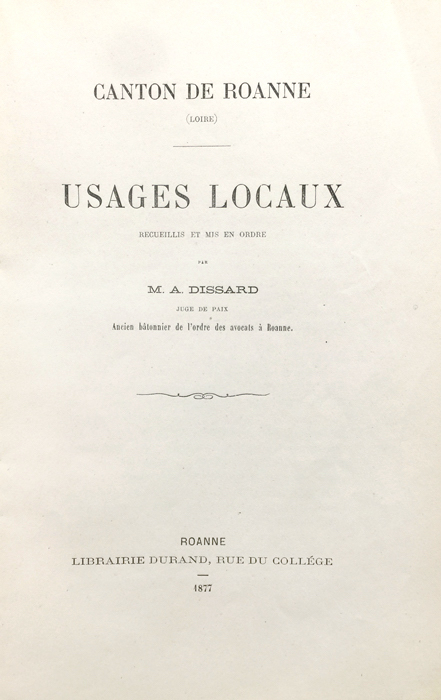
Dissard (A.) :
Canton de Roanne (Loire). Usages Locaux, recueillis et mis en ordre.
Roanne, Librairie Dardel (Imprimerie Chorgnon, Abel), 1877 ; in-8, broché ; (1) f. blanc, 77 pp., (3) pp. blanches, couverture gris-bleu imprimée.
書籍販売業者の参照番号
: 13339
|
|
|
Dissemond, Joachim/ Moelleken, Maurice
Blickdiagnosen Dermatologie: Die 135 wichtigsten dermatologischen Krankheitsbilder
Urban & Fischer/Elsevier 2023. Spiral-bound. New. German language. 9.49x6.93x0.87 inches. Urban & Fischer/Elsevier unknown
書籍販売業者の参照番号
: __3437210149 ISBN : 3437210149 9783437210143
|
|
|
Distel Sacha - Anka Paul - Tézé Maurice
Partition de la chanson : Guitare et copains
Spanka 1956 approx.
書籍販売業者の参照番号
: 2110

|
|
|
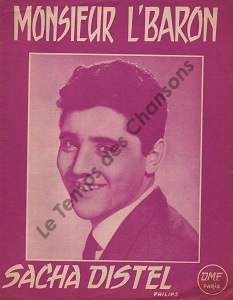
Distel Sacha - Bernard Raymond - Tézé Maurice
Partition de la chanson : Monsieur le Baron
D.M.F 1960
書籍販売業者の参照番号
: 26619
|
|
|
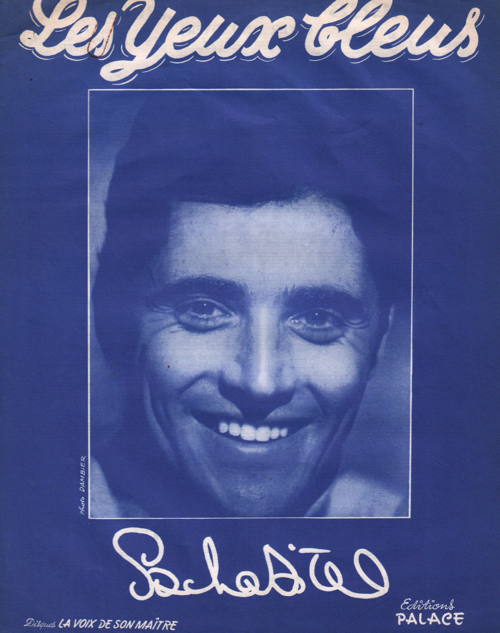
Distel Sacha - Byrd Robert - Tézé Maurice,Byrd Robert
Partition de la chanson : Yeux bleus (Les) Over and over
Palace 1958
書籍販売業者の参照番号
: 82156
|
|
|
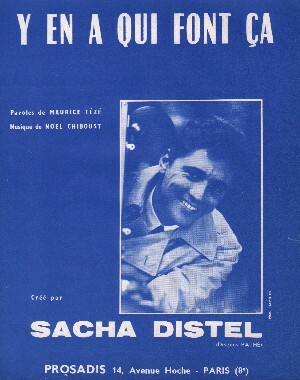
Distel Sacha - Chiboust Noël - Tézé Maurice
Partition de la chanson : Y en a qui font ça
Prosadis 1966
書籍販売業者の参照番号
: 32012
|
|
|
Distel Sacha - Dean Jimmy - Tézé Maurice
Partition de la chanson : Et nous aussi mon frère
Spanka 1962
書籍販売業者の参照番号
: 75524

|
|
|
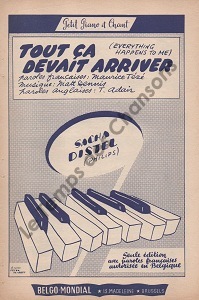
Distel Sacha - Dennis Matt - Tézé Maurice
Partition de la chanson : Tout ça devait arriver Everything happens to me
Belgo mondial 1960
書籍販売業者の参照番号
: 21728
|
|
|
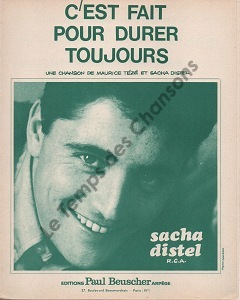
Distel Sacha - Distel Sacha - Tézé Maurice
Partition de la chanson : C'est fait pour durer toujours
Beuscher Paul 1964
書籍販売業者の参照番号
: 23822
|
|
|
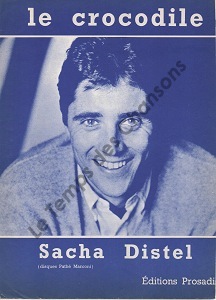
Distel Sacha - Distel Sacha - Tézé Maurice
Partition de la chanson : Crocodile (Le)
Prosadis 1966
書籍販売業者の参照番号
: 30218
|
|
|
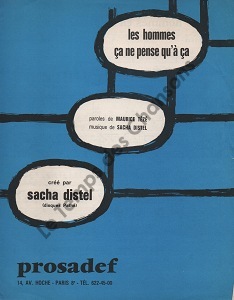
Distel Sacha - Distel Sacha - Tézé Maurice
Partition de la chanson : Hommes ça ne pense qu'à ça (Les)
Prosadis 1968
書籍販売業者の参照番号
: 23829
|
|
|
Distel Sacha - Distel Sacha - Tézé Maurice
Partition de la chanson : Il tient le monde D'après : He's got the whole world in his hands
Prosadis 1964
書籍販売業者の参照番号
: 82132

|
|
|
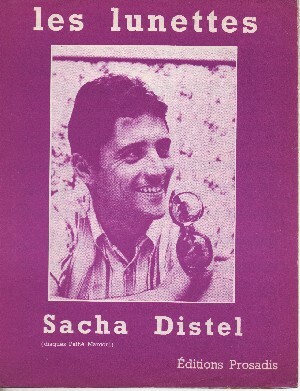
Distel Sacha - Distel Sacha - Tézé Maurice
Partition de la chanson : Lunettes (Les)
Prosadis 1966
書籍販売業者の参照番号
: 23831
|
|
|
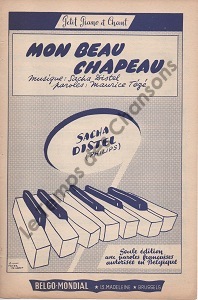
Distel Sacha - Distel Sacha - Tézé Maurice
Partition de la chanson : Mon beau chapeau
Partitions sur les Coiffes, coiffeurs et coiffures Belgo mondial 1960
書籍販売業者の参照番号
: 22080
|
|
|
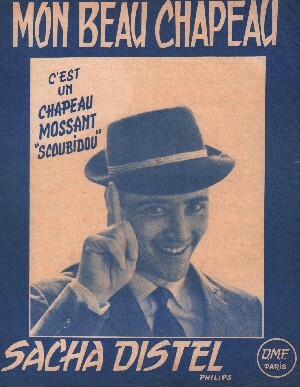
Distel Sacha - Distel Sacha - Tézé Maurice
Partition de la chanson : Mon beau chapeau
Partitions sur la Mode et accessoires D.M.F 1960
書籍販売業者の参照番号
: 32007
|
|
|
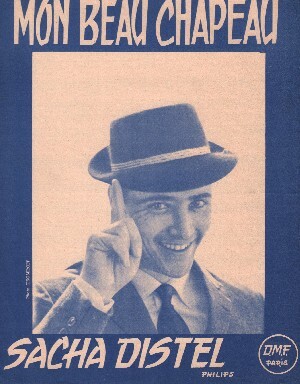
Distel Sacha - Distel Sacha - Tézé Maurice
Partition de la chanson : mon beau chapeau
Partitions sur la Mode et accessoires D.M.F 1960
書籍販売業者の参照番号
: 32008
|
|
|
Distel Sacha - Distel Sacha - Tézé Maurice
Partition de la chanson : Mon petit bout de chou
Prosadis 1966
書籍販売業者の参照番号
: 82134

|
|
|
Distel Sacha - Distel Sacha - Tézé Maurice
Partition de la chanson : Ouah, ouah Toutou
Belgo mondial 1959
書籍販売業者の参照番号
: 81287

|
|
|
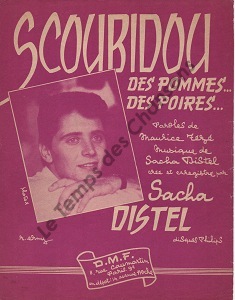
Distel Sacha - Distel Sacha - Tézé Maurice
Partition de la chanson : Scoubidou Des pommes ... Des poires ...
D.M.F 1959
書籍販売業者の参照番号
: 23838
|
|
|
Distel Sacha - Distel Sacha - Tézé Maurice
Partition de la chanson : Ting toung Viens danser la Bossa nova Annotation stylo sur la couverture
Prosadis 1962
書籍販売業者の参照番号
: 82154

|
|
|
Distel Sacha - Distel Sacha,Denjean Jacques - Delanoé Pierre,Tézé Maurice
Partition de la chanson : Tu danses dans mes bras
Prosadis 1965
書籍販売業者の参照番号
: 106968

|
|
|
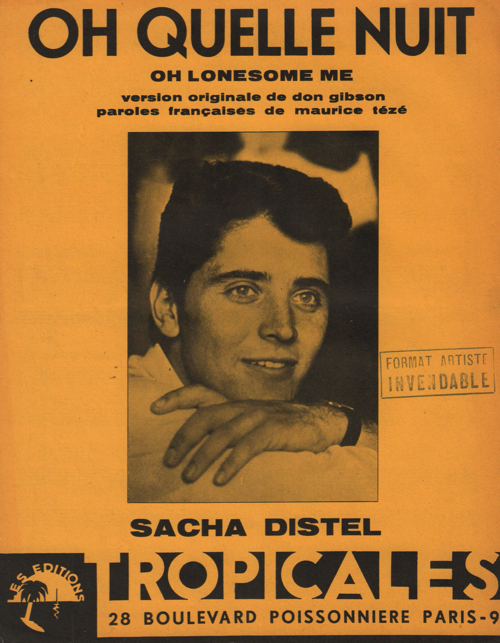
Distel Sacha - Gibson Don - Tézé Maurice
Partition de la chanson : Oh quelle nuit
Tropicales 1958
書籍販売業者の参照番号
: 82138
|
|
|
Distel Sacha - Goldstein Bob - Tézé Maurice
Partition de la chanson : Air de banjo (Un) Washington square
Ray Ventura 1963
書籍販売業者の参照番号
: 23818

|
|
|
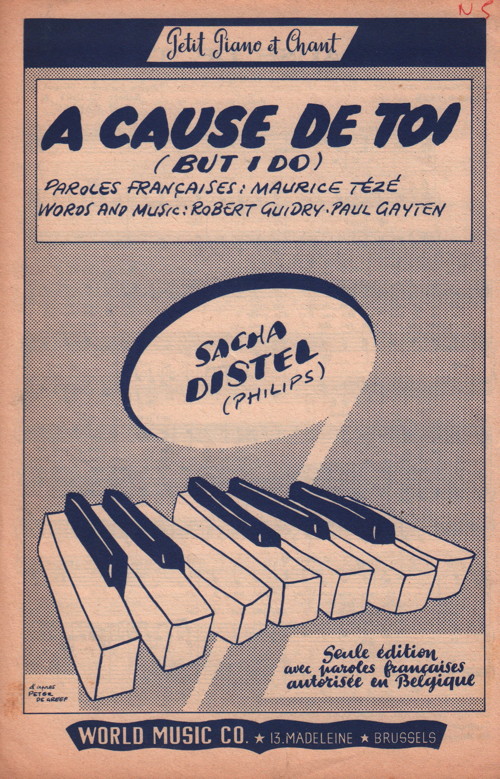
Distel Sacha - Guidry Robert,Gayten Paul - Tézé Maurice
Partition de la chanson : A cause de toi But i do Annotation stylo sur le haut de la couverture
World Music 1961
書籍販売業者の参照番号
: 83762
|
|
|
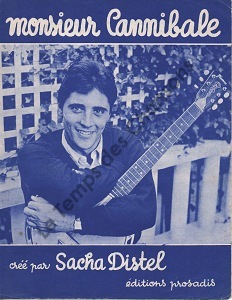
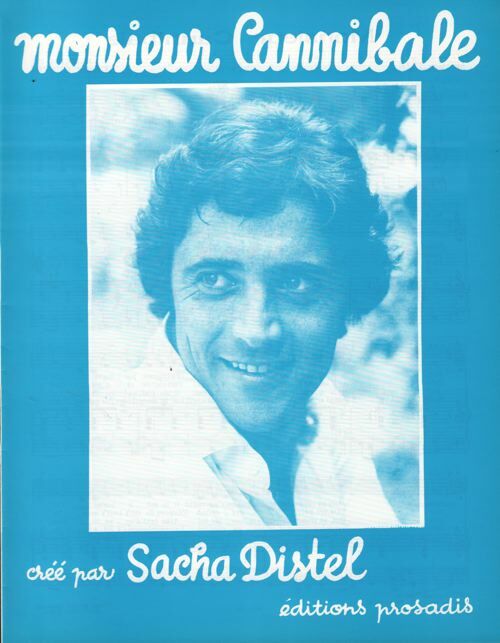
Distel Sacha - Gustin Gérard - Tézé Maurice
Partition de la chanson : Monsieur Cannibale
Prosadis 1966
書籍販売業者の参照番号
: 23833
|
|
|
Distel Sacha - Gustin Gérard - Tézé Maurice
Partition de la chanson : Monsieur Cannibale Retirage 1984
Prosadis 1966
書籍販売業者の参照番号
: 71119
|
|

 検索結果のメールを受信する
 PDFファイルの検索結果をダウンロード
 RSSフィード
 パーマネントリンク


