|
|
|
JAILLOT.
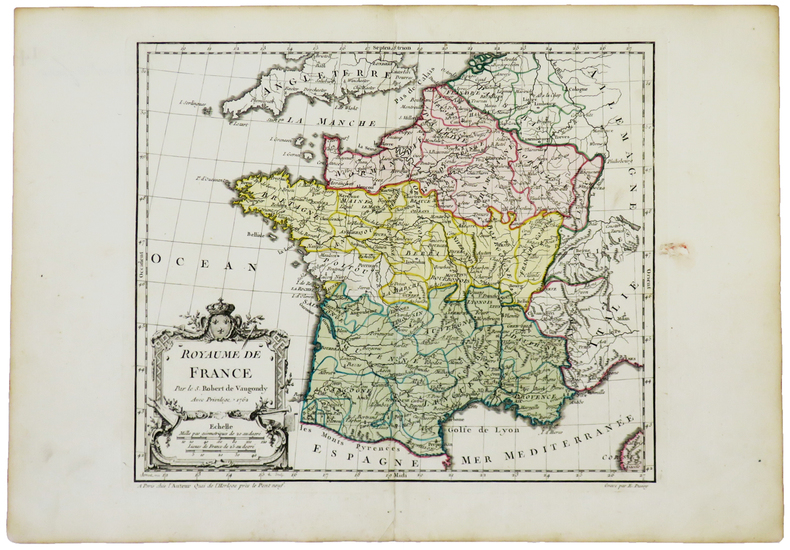
Postcharte von Frankreich auf das Jahr 1787 durch Jaillot.
(Paris ?), ca. 1800. 61,5x54 cm. Engraved postal-map, 2 cartouches and with German text. Place-names in French. Lightly browned. Traces of folding.
|
|
|
JAILLOT.
Postcharte von Frankreich auf das Jahr 1787 durch Jaillot.
(Paris ?), ca. 1800. 61,5x54 cm. Engraved postal-map, 2 cartouches and with German text. Place-names in French. Lightly browned. Traces of folding.
Referentie van de boekhandelaar : 25396
|
|
|
JAIS Pierre - LEBEL Michel
Tout le monde peut jouer au Bridge. Illustr?.
Broch?. 190 pages.
|
|
|
Jakubicska, Stephan.
Neuester Grundriss der Haupt und Residenzstadt Wien und der Umliegenden Gegenden [...]. Vienne et ses Environs. Wien, Artaria und Comp., 1803.
635 x 1302 mm. Mehrfarbige Kupferstichkarte, 44 Segmente auf Leinen aufgezogen mit Legende auf der linken Seite. Gefaltet in marmoriertem Umschlag und Schuber der Zeit mit goldgepr. Rückenschildchen "Grundriss von Wien". Der "inhaltlich vorzügliche" (Austria Picta) Grundrissplan von Wien, hier im seltenen Mehrfarben-Kupferstichdruck. Erstmals 1789 erschienen und noch mehrfach wiederaufgelegt. "Unter den Karten, die Artaria und Comp. [...] verlegte, bildet die von Stephan Jakubicska gezeichnete und Sebastian Mansfeld gestochene Umgebungskarte von Wien zweifelsohne den qualitativen Höhepunkt [...] Als Grundlage für die Arbeit dienten zweifelsohne die entsprechenden Sektionen der sog. Josephinischen Landesaufnahme [...] Es handelt sich hiermit um die einzige Karte, die auf Grund der streng geheimgehaltenen Josephinischen Landesaufnahme entworfen und im gleichen Maßstab (1:28.800) und in der gleichen Ausführung (Geländedarstellung) wie diese an die Öffentlichkeit gelangte [...] Jakubicskas Karte stellt jedoch keine bloße Kopie der Josephinischen Landesaufnahme dar: zum einen sind die [...] eingetretenen Veränderungen in der Topographie berücksichtigt [...], zum anderen hat Jakubicska die Karte nach Südosten orientiert, um im üblichen Quer-(Imperialfolio-)Format auch die kaiserliche Sommerresidenz Laxenburg unterzubringen" (Dörflinger, S. 285f.). - Mit den oft fehlenden ergänzenden Kartensegmenten von Baden und Trumau, die die Karte ab der dritten Ausgabe 1799 nach Südwesten erweiterten. Die vorliegende Neuausgabe von 1803 unterscheidet sich "von ihrer Vorgängerin durch einen geringfügig geänderten Titel [...], durch den zusätzlichen französischen Titel [...] und durch die Einzeichnung der 'Cavallerie Lager' und 'Infanterie Lager' bei Münchendorf", die in der Folgeausgabe von 1805 wieder entfernt wurden (Dörflinger, S. 371). - Alte hs. Bibliothekssignatur auf der Karte verso sowie auf dem Umschlag. Der Schuber unbedeutend berieben; die Karte ausgezeichnet erhalten. Dörflinger, Österr. Karten im frühen 19. Jh., S. 371. Vgl. Dörflinger, Österr. Karten des 18. Jhs., Art 11. Austria Picta, 108.
|
|
|
JALLIFFIER (R.), BUCHNER (A.)
Cartes et croquis des campagnes de 1789 à nos jours. Avec sommaires explicatifs. 5e édition refondue et complétée.
Paris, Garnier Frères, s.d.; petit in-4, 61 pp., 60 cartes en coul., percaline ocre (rel. de l'éditeur).
Referentie van de boekhandelaar : 96254
|
|
|
JALLIFFIER R & A BUCHNER
Cartes et croquis des campagnes de 1589 à 1789
Petit in 4 pleine toile rouge d’éditeur titre doré sur le premier plat faux-titre,titre illustré,30 cartes en couleurs,sommaires explicatifs en regard,texte sur 2 colonnes Garnier frères éditeur sans date, Bon exemplaire
Referentie van de boekhandelaar : 6199
|
|
|
JAMAS (Abel).
[MARNE] Champagne. Département de la Marne.
[vers 1896]. 395 x 260 mm.
Referentie van de boekhandelaar : LBW-8241
|
|
|
James E. (Maps & Skstches Compiled By Becke A. F.) Edmonds
Military Operations France And Belgium 1916
Battery Press 1993. Hardcover. Good. Missing dust jacket; Pages can have notes/highlighting. Spine may show signs of wear. ~ ThriftBooks: Read More Spend Less.Dust jacket quality is not guaranteed. Battery Press hardcover
Referentie van de boekhandelaar : G0898391857I3N01 ISBN : 0898391857 9780898391855
|
|
|
James E. (Maps & Sketches By A. F. Becke) Edmonds
Military Operations France and Belgium 1918: The German March Offensive and Its Preliminaries v. 1 Official History of the Great War
Imperial War Museum & Battery Press 1995. Hardcover. Good. Missing dust jacket; Pages can have notes/highlighting. Spine may show signs of wear. ~ ThriftBooks: Read More Spend Less.Dust jacket quality is not guaranteed. Imperial War Museum & Battery Press hardcover
Referentie van de boekhandelaar : G1870423933I3N01 ISBN : 1870423933 9781870423939
|
|
|
James P. Warburg; Illustrator-11 Maps
Western Intruders: America's Role in the Far East
Atheneum 1967. Hardcover. Like New. Well-preserved UNREAD 1967 hardcover with dust jacket. Bright unmarked crisp-edged well-bound pages. Jacket shows only very minor shelf-rubbing to its face; no rips creases or bumps. NOT an ex-library book. Very nice copy! Atheneum hardcover
Referentie van de boekhandelaar : 2615f
|
|
|
James, H. L. (Editor), Photographs/Pictures/Maps
Guidebook of the San Luis Basin Colorado: Twenty-Second Field Conference Sept. 30 - Oct. 1-2 1971
New Mexico Geological Society 1971. 325 pp. hardcover minor library markings else text clean & binding tight. INCLUDES maps in rear pocket. - If you are reading this this item is actually physically in our stock and ready for shipment once ordered. We are not bookjackers. Buyer is responsible for any additional duties taxes or fees required by recipient's country. New Mexico Geological Society hardcover
Referentie van de boekhandelaar : ZB1259760
|
|
|
James, Henry
A Little Tour in France
A clean, unmarked book with a tight binding. Bluecover with pasted-down illustration. 9"w x 7 3/4"h. 256 pages.
|
|
|
James, Louis
Budapest (with free CD packed with travel tips)
No marks or inscriptions. No creasing to covers or to spine. A lovely clean crisp tight copy with bright covers and no bumping to corners. 192pp. The book comes with a free CD in a wallet attached to the rear cover, which is packed with practical travel tips - from hotels and eating out to foreign exchange and booking information.
|
|
|
JANET (G.);
Chasse au lasso.
Paris circa 1860 124 x 165 mm.
Referentie van de boekhandelaar : LBW-1256
|
|
|
JANNIN (Nicolas Henri).
Steeple chasse autour et à travers le monde - Steeple chasse round the World.
Paris, A. Thomaron, [1860]. 40,5 x 80,7 cm, replié 40 x 48,8 cm, monté sur carton fort ; cabochons au dos du second plat.
Referentie van de boekhandelaar : LBW-8957
|
|
|
JANNOT (J.-B.).
[CHOCOLAT MENIER] Le Tour du Monde en 120 images. Grand concours du Chocolat Menier.
Paris, Agence Française de Propagande, [1956]. 712 x 720 mm.
Referentie van de boekhandelaar : LBW-7927
|
|
|
JANSSON (Joannes).
[ESTONIE/LETTONIE] Nova totius Livoniae accurata descriptio.
[Amsterdam, 1658]. 389 x 514 mm.
Referentie van de boekhandelaar : LBW-2759
|
|
|
JANSSON (Joannes).
[NIVERNAIS] Carte du païs et duché de Nivernois.
Amsterdam, [circa 1650]. 376 x 495 mm.
Referentie van de boekhandelaar : LBW-3815
|
|
|
JANSSON (Joannes).
[SCHLESWIG-HOLSTEIN] Ducatus Holsatiae nova tabula.
Amsterdam, [1658]. 380 x 512 mm.
Referentie van de boekhandelaar : LBW-2846
|
|
|
JANSSON (Joannes).
[TOURAINE] Touraine - Turonensis ducatus.
Amsterdam, [vers 1640]. 373 x 491 mm.
Referentie van de boekhandelaar : LBW-1480
|
|
|
JANSSON (Joannes).
Moscoviae pars australis.
[Amsterdam, 1658]. 382 x 501 mm.
Referentie van de boekhandelaar : LBW-2661
|
|
|
JANSSON (Joannes).
Novissima Poloniae regni descriptio.
[Amsterdam, 1658]. 432 x 539 mm.
Referentie van de boekhandelaar : LBW-2739
|
|
|
JANSSON (Joannes).
Russiae, vulgo Moscovia dictae, partes septentrionalis et orientalis.
[Amsterdam, 1658]. 438 x 540 mm.
Referentie van de boekhandelaar : LBW-2722
|
|
|
JANSSON (Joannes);
[LOMBARDIE] Alpinae seu foederatae Rhaetiae subditarumque ei terrarum nova descriptio.
Amsterdam vers 1640 397 x 488 mm.
Referentie van de boekhandelaar : LBW-1393
|
|
|
JANSSON (Joannes);
[MODENE] Ducato di Modena Regio et Carpi col dominio della Carfagnana.
Amsterdam 1638 397 x 488 mm.
Referentie van de boekhandelaar : LBW-1397
|
|
|
JANSSON (Johannes) & PEUTINGER (Konrad).
Tabula itineraria ex illustri Peutingerorum bibliotheca quæ Augustæ Vindelicorum beneficio Marci Velseri septem-viri Augustani in lucem edita.
[Amsterdam, 1657-1658]. En quatre feuilles, chacune d'environ 398 x 512 mm.
Referentie van de boekhandelaar : LBW-2625
|
|
|
JANSSON (Johannes).
[AUVERGNE] Le duché de Auvergne.
Amsterdam, [1652-1658]. 380 x 494 mm.
Referentie van de boekhandelaar : LBW-5000
|
|
|
JANSSON (Johannes).
[CHAMPAGNE] Champagne - Comitatus Campania.
Amsterdam, [1633-1636]. 375 x 496 mm.
Referentie van de boekhandelaar : LBW-6202
|
|
|
JANSSON (Johannes).
[CRETE] Creta iovis magni, medio jacet insula ponto.
[Amsterdam, 1657-1658]. 377 x 487 mm.
Referentie van de boekhandelaar : LBW-2753
|
|
|
JANSSON (Johannes).
[JAVA] Insulæ Javæ cum parte insularum Borneo Sumatræ, et circumjacentium insularum novissima delineatio.
[Amsterdam, 1657-1658]. 420 x 516 mm.
Referentie van de boekhandelaar : LBW-2961
|
|
|
JANSSON (Johannes).
[LAC LÉMAN] Lacus Lemanni vicinorumq. locorum nova et accurata descriptio.
[Amsterdam, 1631-1633]. 372 x 492 mm.
Referentie van de boekhandelaar : LBW-8673
|
|
|
JANSSON (Johannes).
[MANHATTAN] Nova Anglia Novum Belgium et Virginia.
Amsterdam, [1636]. 387 x 503 mm.
Referentie van de boekhandelaar : LBW-4982
|
|
|
JANSSON (Johannes).
[PERCHE] Perchensis comitatus - La Perche compté.
[Amsterdam, circa 1630]. 368 x 491 mm.
Referentie van de boekhandelaar : LBW-8705
|
|
|
JANSSON (Johannes).
[SUMATRA] Sumatræ et insularum locorumque nonnullorum circumiacentium tabula nova.
[Amsterdam, 1657-1658]. 416 x 516 mm.
Referentie van de boekhandelaar : LBW-2960
|
|
|
JANSSON (Johannes).
[TOSCANE] Nova & accurata Tusciæ antiquæ descriptio. Autore Ab. Ortelio.
[Amsterdam, 1657-1658]. 347 x 494 mm.
Referentie van de boekhandelaar : LBW-2962
|
|
|
JANSSON (Johannes).
Turcicum Imperium.
[Amsterdam, circa 1640]. 410 x 517 mm.
Referentie van de boekhandelaar : LBW-6792
|
|
|
Jansson, Jan
Nobilis Fluvius Albis maximâ curâ, ex variis famosisque Auctoribus collectus, et in lucem editus. Zweigeteilte in Kupfer gestochene Elbkarte auf 1 Blatt.
[Frankfurt am Main, Merian, 1637]. Je Darstellung 17,5 x 51,5 cm. Fachmännisch gerahmt 56,5 x 65,5 cm (Flachgoldleiste 3,5 cm breit).
Referentie van de boekhandelaar : 84923
|
|
|
JANSSONIUS Joannes (cartographe) - DUVAL Pierre, secrétaire de Monseigneur lévesque dAire
Carte de "LÉVESCHÉ D'AIRE" tracé par le Sieur Pierre du Val, secrétaire de Monseigneur lévesque dAire [circa 1680]
Amsterdam JANSSONIUS Joannes 1658 une carte ancienne gravée sur cuivre (Copper etching) en noir et couleurs d'Epoque. Format : 44,5 cm de haut x 55 cm de large, pli central vertical normal venant d'un atlas( horizontal centerfold), texte en latin au verso, carte ornée de 4 cartouches richement ornés de 20 angelots et dun paysan entrain de ramasser des pommes. carte double page gravée et colorée à la main d'époque, provenance : "Atlas novus, sive theatrum orbis terrarum : In quo Galliae, Helvetiae(Volume II)", 1658 Amsterdam JANSSONIUS Joannes Editeur,
Referentie van de boekhandelaar : 24912
|
|
|
JANSSONIUS Johannes (1588-1664)
Aegyptus Antiqua divisa in Nomos. Authore P. Duval Abbeviliense…
Orientata con il Nord a destra, la mappa raffigura nel dettaglio la regione compresa tra la valle del Nilo e il Mar Rosso. Dall'Atlas MajorDoppio cartiglio, uno per il titolo e uno per la dedica in francese a "A Monsieur Monsieur Doviat Sgr. de Montreuille, Con.er du Roy, et Maistre Ordinaire en sa Chambre des Comptes Par son Très humble et obéisant Serviteur P. Duval Géographe de sa Maiesté". Johannes Janssonius, figlio dell'editore di Arnhem Jan Janssen, sposò Elisabeth Hondius, figlia di Jodocus Hondius, ad Amsterdam nel 1612. Dopo il suo matrimonio, si stabilì in questa città come libraio ed editore di materiale cartografico. Nel 1618 si stabilì ad Amsterdam accanto alla libreria di Willem Jansz. Blaeu, entrando in una seria competizione. Le sue attività non riguardavano solo la pubblicazione di atlanti e libri, ma anche di mappe singole e un vasto commercio di libri con filiali a Francoforte, Danzica, Stoccolma, Copenaghen, Berlino, Koningsbergen, Ginevra e Lione. Nel 1631 iniziò a pubblicare atlanti insieme a Henricus Hondius. Nei primi anni 1640 Henricus Hondius lasciò l'attività di pubblicazione di atlanti completamente a Janssonius. La concorrenza con Joan Blaeu, figlio e successore di Willem, nella produzione di atlanti spinse Janssonius ad ampliare il suo Atlas Novus finalmente in un'opera di sei volumi, in cui furono inseriti un atlante marino e un atlante del Vecchio Mondo. Dopo la morte di Joannes Janssonius, il negozio e la casa editrice furono continuati dagli eredi sotto la direzione di Johannes van Waesbergen (c. 1616-1681), genero di Joannes Janssonius. Le matrici degli atlanti di Janssonius furono in seguito vendute a Schenk e Valck. Map oriented with north on the right. It presents a colorful and detailed picture of the region between the fertile Nile River valley and the Red Sea. The map is adorned with a strapwork title cartouche with a credit to Pierre du Val. Includes a note in a decorative cartouche: "A Monsieur Monsieur Doviat Sgr. de Montreuille, Con.er du Roy, et Maistre Ordinaire en sa Chambre des Comptes Par son Très humble et obéisant Serviteur P. Duval Géographe de sa Maiesté".Published in Janssonius' Atlas Major. Johannes Janssonius (Arnhem, 1588-1664), son of the Arnhem publisher Jan Janssen, married Elisabeth Hondius, daughter of Jodocus Hondius, in Amsterdam in 1612. After his marriage, he settled down in this town as a bookseller and publisher of cartographic material. In 1618 he established himself in Amsterdam next door to Blaeu’s book shop. He entered into serious competition with Willem Jansz. Blaeu.. His activities not only concerned the publication of atlases and books, but also of single maps and an extensive book trade with branches in Frankfurt, Danzig, Stockholm, Copenhagen, Berlin, Koningsbergen, Geneva, and Lyon. In 1631 he began publishing atlases together with Henricus Hondius. In the early 1640s Henricus Hondius left the atlas publishing business completely to Janssonius. Competition with Joan Blaeu, Willem’s son and successor, in atlas production prompted Janssonius to enlarge his Atlas Novus finally into a work of six volumes, into which a sea atlas and an atlas of the Old World were inserted. After the death of Joannes Janssonius, the shop and publishing firm were continued by the heirs under the direction of Johannes van Waesbergen (c. 1616-1681), son-in-law of Joannes Janssonius. The copperplates from Janssonius’s atlases were afterwards sold to Schenk and Valck. Van der Krogt 1
|
|
|
JANSSONIUS Johannes (1588-1664)
Antiqua Urbis Roma Imago Accuratissima…
Grande pianta della città stampata su due fogli, ispirata alla celebre carta del Pirro Ligorio del 1561.Questa straordinaria ricostruzione di Roma durante il regno di Augusto, arricchita da una cospicua legenda con 269 richiami, costituisce il lavorò più ambizioso contenuto nel Civitates Orbis Terrarum, del quale oltretutto è una delle sole tre mappe a doppio foglio. Incisione in rame, finemente colorata a mano, in eccellente stato di conservazione. Opera tratta dal "Theatrum praecipuarum urbium" celebre teatro delle città del Janssonius, sullo stile del "Civitates Orbis Terrarum" di Braun & Hogenberg. La raccolta, pubblicata ad Amsterdam tra il 1652 ed il 1657, contiene 500 tavole raffiguranti città di ogni parte del mondo. Contrariamente al lavoro degli acerrimi rivali Blaeu, Janssonius si servì per la realizzazione dell'opera delle lastre di precedenti cartografi ed editori. In particolare nel 1653 egli acquisto da Abraham Hogenberg le lastre del "Civitates orbis Terrarum" che incorporò nella sua opera, ristampandole, con alcune modifiche. Per le piante delle città olandesi, ordinò delle nuove lastre basate sull'atlante che Johannes Blaeu diede alla luce nel 1649. Per molte delle opere contenute nel 5° volume, quello dedicato all'Italia e denominato "Theatrum celebriorum urbium Italiae..", si servì delle lastre realizzate da Jodocus Hondius per l'opera "Italia Hodierna.." del 1627. Nella pianta di Roma antica cambia il decoro del cartiglio in alto, mentre in basso ai lati del cartiglio sono aggiunte dei personaggi. Incisione in rame, finemente colorata a mano, in ottimo stato di conservazione. Map of the city printed on two sheets, inspired by the famous work by Pirro Ligorio, printed by Michele Tramezzino in 1561. This extraordinary reconstruction of Rome during the reign of Augustus, enriched by a conspicuous legend with 269 references, constitutes the most ambitious work contained in the Civitates Orbis Terrarum, of which it is one of only three double-sheet maps. Work taken from the "Theatrum praecipuarum urbium" famous theatre of the cities of Janssonius, in the style of Braun & Hogenberg's "Civitates Orbis Terrarum". The collection, published in Amsterdam between 1652 and 1657, contains 500 plates depicting cities from all over the world. Janssonius used the plates of previous cartographers and publishers to create the work. In particular, in 1653 he bought the plates of the "Civitates orbis Terrarum" from Abraham Hogenberg, who incorporated them into his work and reprinted them with some modifications. For many of the works contained in the 5th volume, the one dedicated to Italy and called "Theatrum celebriorum urbium Italiae...", he used the plates made by Jodocus Hondius for the work "Italia Hodierna..." of 1627. In the map of ancient Rome the decoration of the cartouche at the top changes, while at the bottom at the sides of the cartouche are added characters. Copper engraving, finely coloured by hand, in excellent condition.
|
|
|
JANSSONIUS Johannes (1588-1664)
Argonautica
Carta storico/geografica tratta dall'atlante di Georgius HORNIUS "Accuratissima orbis antiqui delineatio sive Geographia vetus sacra & profana", per la prima volta edito nel 1653. Le carte derivano da quelle di Ortelius, pubblicata nel "Parergon". Mappa dei viaggi di Giasone e degli Argonauti, mostra il Mediterraneo e il Mar Nero con specifico riferimento al percorso dell'Argo, seguendo principalmente la linea temporale e la geografia delle Argonautiche di Apollonio di Rodi. Molti degli elementi più fantastici del mito sono anche tracciati, tra cui le Symplegades o 'Rocce Erranti' all'imboccatura del Bosforo del Mar Nero, i mostri Scilla e Cariddi su entrambi i lati dello Stretto di Messina, l'isola di Eea casa della strega Circe al largo della costa napoletana, l'isola della ninfa Calipso al largo della costa calabrese meridionale, il paradisiaco Giardino delle Esperidi sulla costa settentrionale dell'Africa, e le città della Colchide sul Mar Nero, casa della futura moglie di Giasone, Medea, e del famoso Vello d'oro. Johannes Janssonius, figlio dell'editore di Arnhem Jan Janssen, sposò Elisabeth Hondius, figlia di Jodocus Hondius, ad Amsterdam nel 1612. Dopo il suo matrimonio, si stabilì in questa città come libraio ed editore di materiale cartografico. Nel 1618 si stabilì ad Amsterdam accanto alla libreria di Willem Jansz. Blaeu, entrando in una seria competizione. Le sue attività non riguardavano solo la pubblicazione di atlanti e libri, ma anche di mappe singole e un vasto commercio di libri con filiali a Francoforte, Danzica, Stoccolma, Copenaghen, Berlino, Koningsbergen, Ginevra e Lione. Nel 1631 iniziò a pubblicare atlanti insieme a Henricus Hondius. Nei primi anni 1640 Henricus Hondius lasciò l'attività di pubblicazione di atlanti completamente a Janssonius. La concorrenza con Joan Blaeu, figlio e successore di Willem, nella produzione di atlanti spinse Janssonius ad ampliare il suo Atlas Novus finalmente in un'opera di sei volumi, in cui furono inseriti un atlante marino e un atlante del Vecchio Mondo. Dopo la morte di Joannes Janssonius, il negozio e la casa editrice furono continuati dagli eredi sotto la direzione di Johannes van Waesbergen (c. 1616-1681), genero di Joannes Janssonius. Le matrici degli atlanti di Janssonius furono in seguito vendute a Schenk e Valck. Incisione in rame, finemente colorata a mano, in buone condizioni. Map taken from the HORNIUS, Georgius"Accuratissima orbis antiqui delineatio sive Geographia vetus sacra & profana" first published in Amsterdam in 1653. After Ortelius' map published in the "Parergon". Map of the journeys of Jason and the Argonauts, shows the Mediterranean and Black Sea with specific reference to the path of the Argo, mainly following the timeline and geography of Apollonius of Rhodes' Argonautica. Many of the myth's more fantastical elements are also plotted, including the Symplegades or 'Wandering Rocks' at the Bosporus mouth of the Black Sea, the monsters Scylla and Charybdis on either side of the Straits of Messina, the island of Aeaea home of the witch Circe off the Neapolitan coast, the island of the nymph Calypso off the southern Calabrian coast, the paradisiacal Garden of the Hesperides on the northern coast of Africa, and the cities of Colchis on the Black Sea, home of Jason's future wife Medea and the famous Golden Fleece. Johannes Janssonius (Arnhem, 1588-1664), son of the Arnhem publisher Jan Janssen, married Elisabeth Hondius, daughter of Jodocus Hondius, in Amsterdam in 1612. After his marriage, he settled down in this town as a bookseller and publisher of cartographic material. In 1618 he established himself in Amsterdam next door to Blaeu’s book shop. He entered into serious competition with Willem Jansz. Blaeu.. His activities not only concerned the publication of atlases and books, but also of single maps and an extensive book trade with branches in Frankfurt, Danzig, Stockholm, Copenhagen, Berlin, Koningsbergen, Geneva, and Lyon. In 1631 he began publishing atlases together with Henricus Hondius. In the early 1640s Henricus Hondius left the atlas publishing business completely to Janssonius. Competition with Joan Blaeu, Willem’s son and successor, in atlas production prompted Janssonius to enlarge his Atlas Novus finally into a work of six volumes, into which a sea atlas and an atlas of the Old World were inserted. After the death of Joannes Janssonius, the shop and publishing firm were continued by the heirs under the direction of Johannes van Waesbergen (c. 1616-1681), son-in-law of Joannes Janssonius. The copperplates from Janssonius’s atlases were afterwards sold to Schenk and Valck. Copperplate with fine later hand colour, in good conditions.
|
|
|
JANSSONIUS Johannes (1588-1664)
Erythraei Sive Rubri Maris Periplus
Carta storico/geografica tratta dall'atlante di Georgius HORNIUS "Accuratissima orbis antiqui delineatio sive Geographia vetus sacra & profana", per la prima volta edito nel 1653. Le carte derivano da quelle di Ortelius, pubblicata nel "Parergon". Un'insolita e attraente mappa del 1658 dell'Oceano Indiano, o Mare Eritreo, come era nell'antichità. Composta da Jan Jansson ispirandosi alla carta molto simile del 1597 pubblicata da A. Ortelius nel suo Parergon. Copre dall'Egitto e la valle del Nilo verso est passando per l'Arabia e l'India, fino al sud-est asiatico e Java. Cartograficamente, India, Arabia e Africa corrispondono approssimativamente alle convenzioni del periodo. Il sud-est asiatico è meno riconoscibile, ma la penisola malese, Sumatra e Giava sono chiaramente indicate. La maggior parte dei nomi dei luoghi utilizzati sono derivati da Tolomeo, che ha basato la sua descrizione della regione sulle registrazioni delle conquiste di Alessandro Magno. Due mappe più piccole nei quadranti superiore sinistro e destro sono di eccezionale interesse. La carta in alto a sinistra mostra l'Africa nord-occidentale ed è intitolata "Annonis Periplus". Questo è un riferimento alle leggendarie spedizioni del re cartaginese Hanno, che si dice sia stato il primo ad accedere all'Oceano Indiano navigando intorno alla punta meridionale dell'Africa. Per inciso, durante il viaggio, si dice anche che sia stato il primo a domare un leone. La carta in alto a destra mostra le regioni polari settentrionali come erano percepite all'epoca. Una massa che copre la calotta polare è identificata come "Hyperborea". A sinistra di questa, più o meno dove si trova oggi il Nord America, appare l'isola di Atlantide; mentre la Scizia, l'Europa (Thule) e l'Asia sono sulla destra. La Groenlandia e forse l'Islanda appaiono in basso. Questa mappa ha lo scopo di indicare la possibilità di un passaggio a nord-est verso l'Asia, che all'epoca era attivamente ricercato dai navigatori olandesi, inglesi e russi. Johannes Janssonius, figlio dell'editore di Arnhem Jan Janssen, sposò Elisabeth Hondius, figlia di Jodocus Hondius, ad Amsterdam nel 1612. Dopo il suo matrimonio, si stabilì in questa città come libraio ed editore di materiale cartografico. Nel 1618 si stabilì ad Amsterdam accanto alla libreria di Willem Jansz. Blaeu, entrando in una seria competizione. Le sue attività non riguardavano solo la pubblicazione di atlanti e libri, ma anche di mappe singole e un vasto commercio di libri con filiali a Francoforte, Danzica, Stoccolma, Copenaghen, Berlino, Koningsbergen, Ginevra e Lione. Nel 1631 iniziò a pubblicare atlanti insieme a Henricus Hondius. Nei primi anni 1640 Henricus Hondius lasciò l'attività di pubblicazione di atlanti completamente a Janssonius. La concorrenza con Joan Blaeu, figlio e successore di Willem, nella produzione di atlanti spinse Janssonius ad ampliare il suo Atlas Novus finalmente in un'opera di sei volumi, in cui furono inseriti un atlante marino e un atlante del Vecchio Mondo. Dopo la morte di Joannes Janssonius, il negozio e la casa editrice furono continuati dagli eredi sotto la direzione di Johannes van Waesbergen (c. 1616-1681), genero di Joannes Janssonius. Le matrici degli atlanti di Janssonius furono in seguito vendute a Schenk e Valck. Incisione in rame, finemente colorata a mano, in buone condizioni. Map taken from the HORNIUS, Georgius"Accuratissima orbis antiqui delineatio sive Geographia vetus sacra & profana" first published in Amsterdam in 1653. After Ortelius' map published in the "Parergon". An unusual and attractive 1658 map of the Indian Ocean, or Erythraean Sea, as it was in antiquity. Composed by Jan Jansson after a similar 1597 map published by A. Ortelius in his Parergon. Covers from Egypt and the Nile valley eastward past Arabia and India, to Southeast Asia and Java. Cartographically, India, Arabia, and Africa roughly correspond to the conventions of the period. Southeast Asia is less recognizable, but the Malay Peninsula, Sumatra, and Java are clearly noted. Most of the place names used throughout are derived from Ptolemy, who himself based his description of the region heavily on records from Alexander the Great's conquests. Two smaller maps in the upper left and right quadrants are of exceptional interest. The upper left chart shows northwestern Africa and is titled 'Annonis Periplus.' This is a reference to the legendary expeditions of the Carthaginian King Hanno, said to have been the first to access the Indian Ocean by sailing around the southern tip of Africa. Incidentally, en route, he is also said to have been the first to tame a lion. The upper right chart shows the northern polar regions as they were perceived at the time. A landmass covering the polar ice cap is indentified as 'Hyperborea.' To the left of this, roughly where North America rests today, the island of Atlantis appears; while Scythia, Europe (Thule) and Asia are on the right. Greenland and possibly Iceland appear at the bottom. This map is intended to point out the possibility of a Northeast Passage to Asia, which was at the time being actively sought after by Dutch, English, and Russian navigators. Johannes Janssonius (Arnhem, 1588-1664), son of the Arnhem publisher Jan Janssen, married Elisabeth Hondius, daughter of Jodocus Hondius, in Amsterdam in 1612. After his marriage, he settled down in this town as a bookseller and publisher of cartographic material. In 1618 he established himself in Amsterdam next door to Blaeu’s book shop. He entered into serious competition with Willem Jansz. Blaeu.. His activities not only concerned the publication of atlases and books, but also of single maps and an extensive book trade with branches in Frankfurt, Danzig, Stockholm, Copenhagen, Berlin, Koningsbergen, Geneva, and Lyon. In 1631 he began publishing atlases together with Henricus Hondius. In the early 1640s Henricus Hondius left the atlas publishing business completely to Janssonius. Competition with Joan Blaeu, Willem’s son and successor, in atlas production prompted Janssonius to enlarge his Atlas Novus finally into a work of six volumes, into which a sea atlas and an atlas of the Old World were inserted. After the death of Joannes Janssonius, the shop and publishing firm were continued by the heirs under the direction of Johannes van Waesbergen (c. 1616-1681), son-in-law of Joannes Janssonius. The copperplates from Janssonius’s atlases were afterwards sold to Schenk and Valck. Copperplate with fine later hand colour, in good conditions.
|
|
|
JANSSONIUS Johannes (1588-1664)
Insularum Britannicarum acurata delineatio ex Geographicis Conatibus Abrahami Ortelii
Mappa realizzata da Jansson delle antiche Isole Britanniche, così come si presentavano durante il terzo e il quarto secolo, che include un cartiglio decorativo con il titolo, navi a vela e un mostro marino.Sono presenti nomi di storici siti d'epoca romana, tra cui il muro di Adriano e il muro di Pio. Incisione di Peter Van Den Keere, preparata da Ortelius. Ortelius divide l'intera isola in Britannia Maior (le attuali Inghilterra, Galles e Cornovaglia) e Britannia Minor (Scozia). Joannes Janssonius, figlio dell'editore di Arnhem Jan Janssen, sposò Elisabeth Hondius, figlia di Jodocus Hondius, ad Amsterdam nel 1612. Dopo il suo matrimonio, si stabilì in questa città come libraio ed editore di materiale cartografico. Nel 1618 si stabilì ad Amsterdam accanto alla libreria di Willem Jansz. Blaeu, entrando in una seria competizione. Le sue attività non riguardavano solo la pubblicazione di atlanti e libri, ma anche di mappe singole e un vasto commercio di libri con filiali a Francoforte, Danzica, Stoccolma, Copenaghen, Berlino, Koningsbergen, Ginevra e Lione. Nel 1631 iniziò a pubblicare atlanti insieme a Henricus Hondius. Nei primi anni 1640 Henricus Hondius lasciò l'attività di pubblicazione di atlanti completamente a Janssonius. La concorrenza con Joan Blaeu, figlio e successore di Willem, nella produzione di atlanti spinse Janssonius ad ampliare il suo Atlas Novus finalmente in un'opera di sei volumi, in cui furono inseriti un atlante marino e un atlante del Vecchio Mondo. Dopo la morte di Joannes Janssonius, il negozio e la casa editrice furono continuati dagli eredi sotto la direzione di Johannes van Waesbergen (c. 1616-1681), genero di Joannes Janssonius. Le matrici degli atlanti di Janssonius furono in seguito vendute a Schenk e Valck. Scarce first state of Jansson's map of the Ancient British Isles as seen during the third and fourth centuries.. Includes decorative cartouche, sea monstersa and 7 sailing vessels. Roman place names as well as Hadrian's Wall and the Wall of Pius appear on the map, identifying the era represented. Engraved by Peter Van Den Keere. Prepared by A.Ortelius. Ortelius divides the entire island into Britannia Maior (present day England, Wales and Cornwall) and Britannia Minor (present day Scotland). Joannes Janssonius (Arnhem, 1588-1664), son of the Arnhem publisher Jan Janssen, married Elisabeth Hondius, daughter of Jodocus Hondius, in Amsterdam in 1612. After his marriage, he settled down in this town as a bookseller and publisher of cartographic material. In 1618 he established himself in Amsterdam next door to Blaeu’s book shop. He entered into serious competition with Willem Jansz. Blaeu.. His activities not only concerned the publication of atlases and books, but also of single maps and an extensive book trade with branches in Frankfurt, Danzig, Stockholm, Copenhagen, Berlin, Koningsbergen, Geneva, and Lyon. In 1631 he began publishing atlases together with Henricus Hondius. In the early 1640s Henricus Hondius left the atlas publishing business completely to Janssonius. Competition with Joan Blaeu, Willem’s son and successor, in atlas production prompted Janssonius to enlarge his Atlas Novus finally into a work of six volumes, into which a sea atlas and an atlas of the Old World were inserted. After the death of Joannes Janssonius, the shop and publishing firm were continued by the heirs under the direction of Johannes van Waesbergen (c. 1616-1681), son-in-law of Joannes Janssonius. The copperplates from Janssonius’s atlases were afterwards sold to Schenk and Valck.
|
|
|
JANSSONIUS Johannes (1588-1664)
Latium
Carta storico/geografica realizzata per l'atlante storico di Georgius Hornius "Accuratissima orbis antiqui delineatio sive Geographia vetus sacra & profana", per la prima volta edito nel 1653. Le carte derivano da quelle di Ortelius, pubblicata nel "Parergon". Johannes Janssonius, figlio dell'editore di Arnhem Jan Janssen, sposò Elisabeth Hondius, figlia di Jodocus Hondius, ad Amsterdam nel 1612. Dopo il suo matrimonio, si stabilì in questa città come libraio ed editore di materiale cartografico. Nel 1618 si stabilì ad Amsterdam accanto alla libreria di Willem Jansz. Blaeu, entrando in una seria competizione. Le sue attività non riguardavano solo la pubblicazione di atlanti e libri, ma anche di mappe singole e un vasto commercio di libri con filiali a Francoforte, Danzica, Stoccolma, Copenaghen, Berlino, Koningsbergen, Ginevra e Lione. Nel 1631 iniziò a pubblicare atlanti insieme a Henricus Hondius. Nei primi anni 1640 Henricus Hondius lasciò l'attività di pubblicazione di atlanti completamente a Janssonius. La concorrenza con Joan Blaeu, figlio e successore di Willem, nella produzione di atlanti spinse Janssonius ad ampliare il suo Atlas Novus finalmente in un'opera di sei volumi, in cui furono inseriti un atlante marino e un atlante del Vecchio Mondo. Dopo la morte di Joannes Janssonius, il negozio e la casa editrice furono continuati dagli eredi sotto la direzione di Johannes van Waesbergen (c. 1616-1681), genero di Joannes Janssonius. Le matrici degli atlanti di Janssonius furono in seguito vendute a Schenk e Valck. Incisione in rame, finemente colorata a mano, in ottime condizioni. Map realized for the historical atlas of Georgius Hornius "Accuratissima orbis antiqui delineatio sive Geographia vetus sacra & profana", for the first time published in 1653. Johannes Janssonius (Arnhem, 1588-1664), son of the Arnhem publisher Jan Janssen, married Elisabeth Hondius, daughter of Jodocus Hondius, in Amsterdam in 1612. After his marriage, he settled down in this town as a bookseller and publisher of cartographic material. In 1618 he established himself in Amsterdam next door to Blaeu’s book shop. He entered into serious competition with Willem Jansz. Blaeu.. His activities not only concerned the publication of atlases and books, but also of single maps and an extensive book trade with branches in Frankfurt, Danzig, Stockholm, Copenhagen, Berlin, Koningsbergen, Geneva, and Lyon. In 1631 he began publishing atlases together with Henricus Hondius. In the early 1640s Henricus Hondius left the atlas publishing business completely to Janssonius. Competition with Joan Blaeu, Willem’s son and successor, in atlas production prompted Janssonius to enlarge his Atlas Novus finally into a work of six volumes, into which a sea atlas and an atlas of the Old World were inserted. After the death of Joannes Janssonius, the shop and publishing firm were continued by the heirs under the direction of Johannes van Waesbergen (c. 1616-1681), son-in-law of Joannes Janssonius. The copperplates from Janssonius’s atlases were afterwards sold to Schenk and Valck.
|
|
|
JANSSONIUS Johannes (1588-1664)
Nova & accurata Tusciae Antiquae Descriptio
Carta storico/geografica tratta dall'atlante di Georgius HORNIUS "Accuratissima orbis antiqui delineatio sive Geographia vetus sacra & profana", per la prima volta edito nel 1653. Le carte derivano da quelle di Ortelius, pubblicata nel "Parergon". Johannes Janssonius, figlio dell'editore di Arnhem Jan Janssen, sposò Elisabeth Hondius, figlia di Jodocus Hondius, ad Amsterdam nel 1612. Dopo il suo matrimonio, si stabilì in questa città come libraio ed editore di materiale cartografico. Nel 1618 si stabilì ad Amsterdam accanto alla libreria di Willem Jansz. Blaeu, entrando in una seria competizione. Le sue attività non riguardavano solo la pubblicazione di atlanti e libri, ma anche di mappe singole e un vasto commercio di libri con filiali a Francoforte, Danzica, Stoccolma, Copenaghen, Berlino, Koningsbergen, Ginevra e Lione. Nel 1631 iniziò a pubblicare atlanti insieme a Henricus Hondius. Nei primi anni 1640 Henricus Hondius lasciò l'attività di pubblicazione di atlanti completamente a Janssonius. La concorrenza con Joan Blaeu, figlio e successore di Willem, nella produzione di atlanti spinse Janssonius ad ampliare il suo Atlas Novus finalmente in un'opera di sei volumi, in cui furono inseriti un atlante marino e un atlante del Vecchio Mondo. Dopo la morte di Joannes Janssonius, il negozio e la casa editrice furono continuati dagli eredi sotto la direzione di Johannes van Waesbergen (c. 1616-1681), genero di Joannes Janssonius. Le matrici degli atlanti di Janssonius furono in seguito vendute a Schenk e Valck. Incisione in rame, finemente colorata a mano, in buone condizioni. Map taken from the HORNIUS, Georgius"Accuratissima orbis antiqui delineatio sive Geographia vetus sacra & profana" first published in Amsterdam in 1653. After Ortelius' map published in the "Parergon". Johannes Janssonius (Arnhem, 1588-1664), son of the Arnhem publisher Jan Janssen, married Elisabeth Hondius, daughter of Jodocus Hondius, in Amsterdam in 1612. After his marriage, he settled down in this town as a bookseller and publisher of cartographic material. In 1618 he established himself in Amsterdam next door to Blaeu’s book shop. He entered into serious competition with Willem Jansz. Blaeu.. His activities not only concerned the publication of atlases and books, but also of single maps and an extensive book trade with branches in Frankfurt, Danzig, Stockholm, Copenhagen, Berlin, Koningsbergen, Geneva, and Lyon. In 1631 he began publishing atlases together with Henricus Hondius. In the early 1640s Henricus Hondius left the atlas publishing business completely to Janssonius. Competition with Joan Blaeu, Willem’s son and successor, in atlas production prompted Janssonius to enlarge his Atlas Novus finally into a work of six volumes, into which a sea atlas and an atlas of the Old World were inserted. After the death of Joannes Janssonius, the shop and publishing firm were continued by the heirs under the direction of Johannes van Waesbergen (c. 1616-1681), son-in-law of Joannes Janssonius. The copperplates from Janssonius’s atlases were afterwards sold to Schenk and Valck. Copperplate with fine later hand colour, in good conditions.
|
|
|
JANSSONIUS Johannes (1588-1664)
Roma Hodierna
Magnifica veduta a volo d'uccello di Roma con cartiglio decorativo con titolo, che mostra la città com'era nel 1550. Sono incluse varie strutture superstiti dell'antica Roma: le mura circostanti, il Pantheon, il Colosseo, l'Arco di Costantino e il Foro Romano. Nell'angolo sinistro in primo piano si possono vedere il Palazzo Papale e l'Obelisco dal circo di Caligola e Nerone. “La stampa, sebbene incisa ed edita ad Amsterdam nel 1657, riproduce Roma verso il 150, essendo copia della pianta del Braun Hogenberg, dalla quale si differenzia unicamente per i personaggi in primo piano […] In basso, entro due cartigli, una legenda di 101 numeri” (cfr. Marigliani, Le Piante di Roma, p. 153). Il modello originale è da ricercare però nella pianta di Giovanni Francesco Camocio del 1569 (o della precedente di Leon Pitor del 1568, come sostiene Scaccia Scarafoni) nella quale la città è ritratta a volo d'uccello dal Gianicolo. La pianta è inclusa nel Theatrum Celebriorum Urbium Italiae, Aliarumque In Insulis Maris Mediterranei di Janssonius, stampato ad Amsterdam nel 1657. Acquaforte e bulino, finemente colorata a mano, ossidazioni nei margini, per il resto in buono stato di conservazione. Non comune. Bibliografia Marigliani n. 53; Scaccia Scarafoni n. 165; Van der Krogt 4, 42:15. Fine example of Jansson's rare modern view of Rome, from his Theatrum Celebriorum Urbium Italiae, Aliarumque In Insulis Maris Mediterranei. Striking bird's-eye plan of Rome with decorative title cartouche, showing the city as it was c. 1550. Included are various surviving features of ancient Rome: the surrounding walls, the Pantheon, the Coliseum, the Arch of Constantine, and the Forum Romanum. In the left corner in the foreground can be seen the Papal Palace and the Obelisk from the circus of Caligula and Nero. The print, although engraved and published in Amsterdam in 1657, reproduces Rome around 1550, being a copy of Braun Hogenberg's plan, from which it differs only by the figures in the foreground [...] At the bottom, within two cartouches, a legend of 101 numbers" (cf. Marigliani, Le Piante di Roma, p. 153). The original model, however, is to be found in Giovanni Francesco Camocio's plan from 1569 (or Leon Pitor's earlier one from 1568, as Scaccia Scarafoni claims) in which the city is portrayed from a bird's eye view from the Janiculum. Jan Janssonius (also known as Johann or Jan Jansson or Janszoon) (1588-1664) was a renowned geographer and publisher of the seventeenth century, when the Dutch dominated map publishing in Europe. Born in Arnhem, Jan was first exposed to the trade via his father, who was also a bookseller and publisher. In 1612, Jan married the daughter of Jodocus Hondius, who was also a prominent mapmaker and seller. Jonssonius’ first maps date from 1616. In the 1630s, Janssonius worked with his brother-in-law, Henricus Hondius. Their most successful venture was to reissue the Mercator-Hondius atlas. Jodocus Hondius had acquired the plates to the Mercator atlas, first published in 1595, and added 36 additional maps. After Hondius died in 1612, Henricus took over publication; Janssonius joined the venture in 1633. Eventually, the atlas was renamed the Atlas Novus and then the Atlas Major, by which time it had expanded to eleven volumes. Janssonius is also well known for his volume of English county maps, published in 1646. Etching, with fine later hand colour, some foxing on the margins, otherwise good condition. Bibliografia Marigliani n. 53; Scaccia Scarafoni n. 165; Van der Krogt 4, 42:15.
|
|
|
JANSSONIUS Johannes (1588-1664)
Tabula Itineris decies mille Graecorum sub Cyro contra fratem suum Artaxerxem Regem Persarum, …
Bella carta storico-geografica che riporta il percorso dei Diecimila secondo l’Anabasi di Senofonte, ovvero la marcia da Sardi a Cunassa, e il ritorno da Cunassa in Grecia, dei mercenari greci assoldati da Ciro il giovane per usurpare il trono di Persia al fratello Artaserse.Senofonte era uno dei Diecimila.La battaglia tra i due esericti fu combattuta a Cunassa, nel 401 a.C.Anche se l'armata dei mercenari fu vittoriosa nella battaglia sostenuta a Cunassa contro l'esercito dell'imperatore, Ciro non sopravvisse allo scontro, e la sua morte privò la spedizione di ogni senso: i Greci, penetrati troppo a fondo nel territorio nemico, dovettero così ritirarsi verso un porto sicuro, in un ripiegamento che si preannunciava lunghissimo e pieno di insidie.Esemplare tratto da Accuratissima Orbis antiqui delineatio ... L'atlante del Mondo Antico di J. Janssonius, che ebbe diverse edizioni dal 1652 al 1741. Joannes Janssonius, figlio dell'editore di Arnhem Jan Janssen, sposò Elisabeth Hondius, figlia di Jodocus Hondius, ad Amsterdam nel 1612. Dopo il suo matrimonio, si stabilì in questa città come libraio ed editore di materiale cartografico. Nel 1618 si stabilì ad Amsterdam accanto alla libreria di Willem Jansz. Blaeu, entrando in una seria competizione. Le sue attività non riguardavano solo la pubblicazione di atlanti e libri, ma anche di mappe singole e un vasto commercio di libri con filiali a Francoforte, Danzica, Stoccolma, Copenaghen, Berlino, Koningsbergen, Ginevra e Lione. Nel 1631 iniziò a pubblicare atlanti insieme a Henricus Hondius. Nei primi anni 1640 Henricus Hondius lasciò l'attività di pubblicazione di atlanti completamente a Janssonius. La concorrenza con Joan Blaeu, figlio e successore di Willem, nella produzione di atlanti spinse Janssonius ad ampliare il suo Atlas Novus finalmente in un'opera di sei volumi, in cui furono inseriti un atlante marino e un atlante del Vecchio Mondo. Dopo la morte di Joannes Janssonius, il negozio e la casa editrice furono continuati dagli eredi sotto la direzione di Johannes van Waesbergen (c. 1616-1681), genero di Joannes Janssonius. Le matrici degli atlanti di Janssonius furono in seguito vendute a Schenk e Valck. Acquaforte, impressa su carta vergata coeva, finemente acquarellata, in ottimo stato di conservazione. A map of Persia, indicating major settlements, regions, and mountain ranges, as well as the march of the Ten Thousand . The Ten Thousand were a group of mercenary units, mainly Greek, drawn up by Cyrus the Younger to attempt to wrest the throne of the Persian Empire from his brother, Artaxerxes II. Their march to the Battle of Cunaxa and back to Greece (401 BC-399 BC) was recorded by Xenophon (one of its leaders) in his work, The Anabasis. This map was compliled by the French cartographer Pierre du Val, and published in Jansson's Atlas of the Antique World , Accuratissima Orbis antiqui delineatio... which went through several editions 1652-1741. Joannes Janssonius (Arnhem, 1588-1664), son of the Arnhem publisher Jan Janssen, married Elisabeth Hondius, daughter of Jodocus Hondius, in Amsterdam in 1612. After his marriage, he settled down in this town as a bookseller and publisher of cartographic material. In 1618 he established himself in Amsterdam next door to Blaeu’s book shop. He entered into serious competition with Willem Jansz. Blaeu.. His activities not only concerned the publication of atlases and books, but also of single maps and an extensive book trade with branches in Frankfurt, Danzig, Stockholm, Copenhagen, Berlin, Koningsbergen, Geneva, and Lyon. In 1631 he began publishing atlases together with Henricus Hondius. In the early 1640s Henricus Hondius left the atlas publishing business completely to Janssonius. Competition with Joan Blaeu, Willem’s son and successor, in atlas production prompted Janssonius to enlarge his Atlas Novus finally into a work of six volumes, into which a sea atlas and an atlas of the Old World were inserted. After the death of Joannes Janssonius, the shop and publishing firm were continued by the heirs under the direction of Johannes van Waesbergen (c. 1616-1681), son-in-law of Joannes Janssonius. The copperplates from Janssonius’s atlases were afterwards sold to Schenk and Valck. Koeman, C. Atlantes Neerlandici, Ja 2.
|
|
|
Janssonius, Johann
Brandenburgum Marchionatus cum Ducatibus Pomeraniae et Meklenburgi (um 1633). [Altkolorierter Kupferstich, gerahmt / handcoloured copper engraving, framed].
o.J. (Johann Janssonius, geb. 1588 in Arnhem, gest. vor dem 11. Juli 1664 in Amsterdam, eigentlich Jan Janszoon, weitere Schr
Referentie van de boekhandelaar : 66675CB
|
|
|
JANTON Henri
Les emplois non postaux des timbres-poste des territoires français
Le Monde des Philathélistes 1956 1956, Le Monde des Philatélistes, in-12 agrafé de 8 pages, quelques figures noir et blanc exemplaire sur papier ordinaire n°232/500. | Etat : Bon état général (Ref.: J4097)
Referentie van de boekhandelaar : 6787
|
|
|
JANVIER GÉOGRAPHE
CARTE DU ROYAUME DE HONGRIE DIVISÉ EN HAUTE ET BASSE HONGRIE,TRANSILVANIE, ESCLAVONIE ET CROATIE, dressé par le Sieur JANVIER GÉOGRAPHE - 1771
Paris Lattré 1771 carte ancienne colorée d'époque en vert , rouge et jaune, cartouche non coloré, gravée par Arrivet. Format total : 50 centimètres de haut par 39 centimètres de large, 1771 Paris Lattré Editeur,
Referentie van de boekhandelaar : 27418
|
|
|