BRASSAIABAA

707 resultados
1935ref. 1952Paris: Paris-Publications 1935. FIRST EDITION THE PRESUMED FIRST ISSUE COMPLETE WITH THE EIGHT SUPPRESSED PLATES AND ORIGINAL SPIRAL BINDING. Original spiral binding. Very Good. FIRST EDITION THE PRESUMED FIRST ISSUE COMPLETE WITH THE EIGHT SUPPRESSED PLATES AND ORIGINAL SPIRAL BINDING. "Brassaï's early photographs concentrated on the nighttime world of Montparnasse a district of Paris then noted for its artists streetwalkers and petty criminals. His pictures were published in a successful book Paris de nuit 1933 which caused a stir because of its sometimes scandalous subject matter. His next book Voluptés de Paris made him internationally famous" Britannica. "Paris by Night was no sooner off the press than Brassaï sold the remaining photographs to the popular magazine Voilà and began another phase of his exploration of the city. In December 1933 he wrote his parents that he was taking the final photographs for his 'Paris intime' Pierre Mac Orlan had agreed to write the preface and publication was scheduled for March. "By October 1935 it was clear that the book had stalled at the publishers. Although Brassaï had received an advance the publisher claimed he was financially unable to bring the book out. When the book finally did emerge from the printer it was entitled Voluptés de Paris and there was no introduction by Mac Orlan. The unsigned preface mimicked a carnival barker's spiel touting the city to the potential reader like a lewd sideshow attraction: 'Paris the paradise of desire the capital of Adventure. Paris where you can find your every fantasy in reality.'. Available by mail order the book would be sent in a plain wrapper." Brassaï was not pleased with the production and distribution of the book and soon disowned it. "However Voluptés de Paris did not entirely escape critical notice. Peter Pollack. judged it among Brassaï's best work 'an invaluable collection of Brassaï's essential pictures'." Marja Warehime Brassai: Images of Culture and the Surrealist Observer. On the two issues: Anne Wilkes Tucker notes in her detailed book Brassaï: The Eye of Paris: "The book is very rare and for unknown reasons two versions exist. One has thirty-eight halftones and the other has forty-six. I have yet to see a copy of the larger edition with the binding intact so perhaps plates were removed to prevent the rings from breaking". This is the only copy we have seen complete with the forty-six photos and original spiral rings. Paris: Paris-Publications 1935. Quarto original orange wrappers original spiral binding; custom box. One leaf neatly detached; neat stars drawn on two leaves not affecting images. A spectacular copy. RARE. Paris-Publications unknown books
1966ref. 112218Cannes 1966. Unpublished and heavily corrected manuscript of Brassai's account of his visit to Picasso A superb unpublished and heavily corrected manuscript in French in which Brassaï recounts a visit to Picasso a long-standing friend at his home near Cannes. Brassaï who photographed much of Picasso's work in the 1940s published Conversations with Picasso in 1964 creating an intimate portrait of the artist through an account of their friendship and artistic collaboration and recording each of their meetings in minute detail. Picasso said of the volume "Read this book if you want to understand me." Written in a similar style this account records an afternoon during which Picasso speaks about his nostalgia for his former studios his health his enthusiasm for the recently invented felt-tip pen his opinion of his own writings his relationship with his wife Jacqueline and his views on feminism. Though unmarked as such the manuscript comes from the collection of Brassaï's close friend and colleague the photographer Stefan Lorant founder of Picture Post the pioneering pictorial magazine. Quarto 285 x 233. 20 typed sheets in French rectos only legibly hand-corrected throughout by Brassai in black ink. Housed in a black cloth album with each sheet in a separate clear plastic file. In excellent condition the final page a little creased and with minor loss to right-hand side affecting one letter. Overall fresh and clean. hardcover
1933ref. 48496Neuilly-sur-Seine. 1933. Original publisher's printed white glossy wrappers reproduction of a Man Ray photograph to front cover of each issue with titles and contributors in red against a white background taking the form of a lighthouse with revolving light later cream morocco-backed black card board chemise with title in red to spine and matching slipcase. 4 vols. in 3. Small 4to. 252 x 182 mm. 4to. 284 x 194 mm. Printed text in French with reproductions of monochrome photographs throughout nos. 1 & 2 with printed 'Bulletin d'Abonnement' sheets on orange paper tipped-in issue with advertisements on various coloured stock see below. An excellent complete set of Lise Deharme's very scarce 'Le Phare de Neuilly' with the final number in the even scarcer large paper édition de tête format.The third number i.e. 'Numéro 3 - 4' is a large paper copy one of 20 nominatif examples issued on papier couché mat spécial printed for 'Monsieur et Madame Raoul Fernandez'; only the third volume was issued in this format.Although each title page of 'Le Phare de Neuilly' suggests that ten issues were to be published 'Dix numéros par an' only these four were achieved. A mixture of the literary and artistic the illustration is of monochrome photographs throughout with Lee Miller contributing to each issue; Man Ray's work also features - the covers are his work - as well as Nadar Dora Maar Brassaï Pierre Keffer Eli Lotar Lloyd Sloane and others.The literary contributors - all listed on the covers of each issue - are extremely varied and include Georges Ribemont-Dessaignes who also wrote the record reviews in the first two numbers Robert Desnos two poems in no. 1 Céline Arnauld Jacques Baron Hans Arp as a poet translated from the German by Georges Hugnet Paul Dermée Lise Hertz i.e. Lise Deharme Nathalie Barney Stendhal the unpublished 'Le lac de Genève' writen under Stendhal's pseudonym 'Henri Martineau' James Joyce see below Thérèse Aubray Jacques Lacan the poem 'Hiatus Irrationalis' Marcel Jouhandeau Ilarie Voronca the poem 'Foules' translated from the Romanian by M. de Boully D. H. Lawrence a translation of 'The Man Who Died' Claire Goll Eugène Jolas 'Gyroscope' Raymond Queneau 'Fragments d'un Roman' and many others.Of particular note in terms of content not to mention innovation are the following: - Alejo Carpentier's 'Images et Prières Nègres' illustrated with a series of photographs - the negatives were burnt in the presence of the Cuban sorceror 'Taita José' - of ritualistic objects shrines and saints; - Le Phare de Neuilly's presumably Deharme herself writing under the eponymous psudonym 'Manifeste du Désarmement Psychique'; - James Joyce's poem 'Ecce Puer' written on the birth of his grandson Stephen in 1932 translated into French by Yvan Goll and printed on the right of a sheet of transparent crystal paper; beneath on a sheet of glossy paper is a photographic reproduction of Joyce's manuscript for the poem and at left is a portrait of both Joyce and his grandson by Robert H. Davis; - Lloyd Sloane's extraordinary 'Monsieur Sépulcre Agent d'Assurances Présente . ' a Surrealist photographic collage novella; - no. 1 with the advertisements at the front of the issue printed in black on monochrome sheets of burgundy blue and pink paper that on pink with text reproducing Deharme's manuscript those at rear on cream newsprint paper advertising Jose Corti''s publishing house 'Corti / 6 Rue de Clichy' and announcing Deharme's own 'Cahier de Curieuse Personne / Poèmes / par / Lise Hirtz' to be published by Corti as appearing 'dans trois mois' this advertisement also reproducing Deharme's manuscript and Roger Vitrac's 'Le Coup de Trafalgar'.Lise Deharme the editor of 'Le Phare de Neuilly' published in the Paris suburb of Neuilly was a salonnière a prolific poetess and a novelist. A muse and patron to the Surrealists - she encountered them as a group in the 1920s - her first published work was 'Images dans le Dos de Cocher' of 1922 although her collaboration with Miró 'Il était une petite pie' of 1928 is cited more usually as her first publication both were issued under her maiden name Ilse Hirtz. Deharme was immortalised by Breton in Nadja as 'la dame au gant' and she can be regarded in many ways as being 'Le Phare de Neuilly' herself.'Page de couverture identique pour les trois fascicules : photographie de Man Ray contient de nombreuses reproductions photographiques de Man Ray Lee Miller Nadar Brassaï Pierre Keffer Dora Maar'. Destribats. Le Fonds Paul Destribats 339; not in Ades. unknown
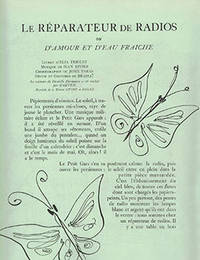
ref. 51-1017Paris: Théâtre des Champs-Elysées 1949. Seven original drawings by Brassaï who did the décor for the ballet together with the typescript with the author's manuscript annotations as well as the printed publication.Louis Aragon Elsa's husband described the performance in Les Lettres françaises n° 1096 915 septembre 1965.Ça me rappelle cette soirée aux Champs Elysées à la première d'un ballet d'Elsa musique de Jean Rivier chorégraphie de Boris Kochno décors de Brassaï le réparateur de radios avec le déchaînement de la salle les sifflets à roulettes parce que l'on voyait danser les gens du monde dans une boîte de nuit et qu'est-ce que vous voulez tout de suite tout Paris se sentait visé !Dessins originaux à l'encre de Chine sur 7 feuillets environ 246 x 159 mm représentant des bouquets de muguet 3 ou des papillons 4 destinés à illustrés le texte de présentation d'Elsa Triolet "Le Réparateur de radios" publié dans le programme du Théâtre des Champs-Elysées de 1949-1950.On joint :- Triolet Elsa. Le Réparateur de radios ou d'amour et d'eau fraîche. Tapuscrit corrigé 3 p. et épreuves corrigées 3 p. signées.Le livret du Réparateur de radios d'Elsa Triolet sera mis en musique par Jean Rivier avec une chorégraphie de John Taras au Théâtre des Champs-Elysées.- Programme du Théâtre des Champs-Elysées 1950 n° 10.In-4 324 x 346 mm en feuilles cordelette. Dirigé par Boris Kochno textes de Paul Eluard et Elsa Triolet dessins de Balthus Cecil Beaton Brassaï etc. Paris: Théâtre des Champs-Elysées, 1949. unknown
ref. 13232Used; Like New/Used; Like New. An important collection of early sketchbooks and original drawings from the influential Hungarian-born French photographer sculptor writer and filmmaker. The three sketchbooks one dated 1915 and one with drawings dated 1916 contain a total of 104 pages of pencil ink charcoal and watercolor drawings including portraits animal and figure studies architectural drawings and geometrical shapes. Some works are captioned in Hungarian. An interesting and important record of the artist's very early work accomplished as a young man during World War I in Transylvania. The first sketchbook of lined paper is inscribed with Brassaï's name Halász G. Y. and dated Brassó Brassaï's hometown in Transylvania 1915. 44 pp. drawings in total. Heavy wear and fraying to the boards; slight water stains; internally in very good condition. 6.5 x 8 inches 16.5 x 20.5 cm. Contents: 1 full-page ink drawing of a crowd of people dated Oct. 30; 4 pages of pencil studies of men in uniform seated and standing dated Nov. 3-5; ink drawing of a group of standing women dated Nov. 5; ink drawing and colored pencil drawing of standing figures dated Nov. 5; 2 pages of pencil drawings of standing figures dated Nov. 5; 5 pages of pencil and colored pencil drawings of a young boy dated Nov. 6-8; 1 page of pencil drawings of people with umbrellas dated Nov. 10; 2 pages of rough pencil sketches of a face dog and a female figure dated Nov. 10; 1 page drawings of a woman heavily shaded in pencil dated Nov 10; 2 pages rough pencil sketches of people backs and studies of arms dated Nov. 10; 2 pages pencil drawings of a young boy standing dated Nov 10; 1 page rough sketches of men undated; 2 pages rough pencil sketches of a dog dated Nov. 11; 1 page pencil sketch of a seated man and rough figures dated Nov. 11; 1 page very bold pencil studies of fighting figures dated Nov. 11; 1 page pencil studies of standing figures dated Nov. 10; 1 page rough pencil sketches of a young child dated Nov. 13; 1 page rough pencil sketches of standing figures dated Nov. 13; 1 page pencil sketch of a man with glasses and mustache dated Nov. 13; 2 pages pencil sketches of a young child dated Nov. 14; 1 page pencil sketches of standing figures undated; 1 page bold pencil sketches of standing figures dated Nov. 14; 1 page rough sketches of standing figures and shapes dated Nov. 15; 1 page bold pencil sketches of a dog and a child dated Nov. 16; 1 page pencil drawings of a young child dated Nov. 17; 5 pages pencil sketches of standing figures dated Nov. 19; 1 full-page pencil drawing of an outdoor scene at a fair dated Nov. 19. The second sketchbook of grid paper contains drawings dated 1916 many with captions in Hungarian. Scribbles mathematical calculations and geometric diagrams on the endpapers. Most of the drawings are identified as having been drawn in Szászsebes Sebeș Transylvania or Brassó. 42 pp. drawings in total. Heavy wear and fraying to the boards; several pages removed; otherwise in fine condition internally. 6 x 9 inches 14.5 x 22.5 cm. Contents: 1 loose full-page pencil drawing of men in uniform with a van outside a gate dated Sep. 11; 1 loose page drawings of a young child dated Jan. 1; 1 loose full-page drawing of a man with beard in profile; 1 loose page drawings of men and women part of the page cut away dated Sep. 17; 1 page pencil drawings of women at a fair dated Jul. 20; 1 page pencil drawing of a man in uniform dated Jul. 20; 1 full-page pencil drawing of women at a market stall dated Jul. 20; 1 page pencil drawings of standing and seated figures with headscarves dated Jul. 20; 1 full-page pencil drawing of people at a cheese chart dated Jul. 20; 1 page small pencil sketch of a standing woman dated Jul. 20; 1 page pencil sketch of a group of standing figures dated Jul. 22; 1 page pencil sketches of chickens; 1 page pencil drawings of pigs; 1 page very small pencil drawings of figures approaching a wall dated Jul. 22; 1 page pencil drawings of cows dated Jul. 22; 1 full-page pencil drawing of a boy playing a viola dated Jul. 30; 1 page pencil drawing of a pig dated Jul. 26; 1 full-page pencil drawing of a boy in a tree dated Jul. 26; 1 full-page pencil drawing of cows dated Jul. 27; 1 full-page pencil drawing of a family with a covered wagon dated Jul. 27; 1 page rough ink and pencil drawings of a boy; 1 full-page pencil drawing of a boy looking out a window dated Jul. 27; 1 full-page pencil drawing of two men playing flute and violin dated Jul. 30; 1 full-page ink drawing of people working with a large barrel in the center dated Jul. 27; 1 full-page pencil drawing of a doll dated Jul. 31; 1 full-page pencil drawing of a fence flowers and trees dated Jul. 31; 1 page pencil drawing of two men in uniform at a fence dated Aug. 5; 1 page pencil drawing of a pig dated Aug. 1; 1 page small pencil drawings of cats and birds dated Aug. 1; 1 page pencil drawing of people at a table; 1 page pencil drawing of a train traveling around a curve dated Aug. 5; 1 full-page pencil drawing of people waiting at a train station dated Aug. 5; 1 page small colored pencil drawings of ducks chickens and rabbits dated Aug. 8; 1 page colored pencil drawing of a figure on a park bench dated Aug. 8; 1 page colored pencil drawing of 3 figures at a table with a lantern dated Aug. 9; 1 page ink drawing of men in unfirom sitting under a tree dated Aug. 10; 1 full-page pencil drawing of a male semi-nude dated Aug. 11; 1 page small pencil drawings of squirrels in a tree dated Aug. 14; 1 full-page pencil drawing of the view over a fence; 1 page bold ink sketch of a half-length figure; 1 full-page ink drawing of a landscape with cows dated Aug. 23; 1 full-page pencil sketch of figures in a house. The third sketchbook of blank paper is labeled on the cover: "Halász Gyulas / Ábrázoló geometria" "Descriptive geometry." Undated. 18 pp. drawings in total. Some external wear internally in fine condition except for light toning. 7.5 x 9.75 inches 19.5 x 24.5 cm. Contents: 1 page pencil and ink architectural drawings; 1 page ink drawing of a fountain with another small ink sketch; 1 page architectural ink drawing with charcoal scribbles at the foot; 1 full-page charcoal drawing of a house; 1 page ink drawings of city buildings and trees; 1 full-page ink and watercolor drawing of concrete buildings; 7 pages geometrical pencil diagrams with captions in Hungarian; 2 pages blue and black ink and pencil lettering geometrical designs and architectural details; 1 page small architectural ink drawings; 1 page pencil and charcoal drawing with studies of a male head; 1 full-page ink and pencil drawing of concrete buildings. Together with two large original drawings one of a woman dated Berlin April 1921 approx. 48 x 42 cm and one of an old woman approx. 60 x 45.5 cm. Each signed "Halász" upper right. Known primarily for his dramatic photographs of Paris at night the artist's pseudonym Brassaï is derived from the name of his native city. He trained as an artist and settled in Paris in 1924 working there as a sculptor painter and journalist and associating with such artists as Pablo Picasso Joan Miró Salvador Dalí and the writer Henry Miller. Although he disliked photography at the time he found it necessary to use it in his journalistic assignments and soon came to appreciate the medium's unique aesthetic qualities. In his remarkable oeuvre of photographs Brassai imbues even the most inanimate images with a warm sense of human life. The present early collection of drawings shows the artist honing his eye through keen observation of detail and nuance precisely the qualities which would inform the work for which he is today best remembered. hardcover books
1937ref. 87781Gallimard | Paris 1937 | 14.50 x 19.50 cm | Relié
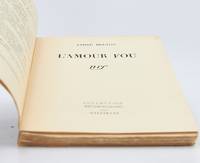
1937ref. 87781Paris: Gallimard 1937. Fine. ""Convulsive beauty will be veiled-erotic fixed-explosive magic-circumstantial or it will not be"" Gallimard Paris 1937 14.50 x 19.50 cm Relié First edition one of 9 numbered copies on japon only deluxe issue aside from 35 copies on pur fil and a few on coloured paper. Full black morocco binding flat spine authors name palladium-stamped title stamped lengthwise in palladium and blind grey long-grain shagreen inlays to boards with author and title stamped lengthwise in palladium and in blind turn-ins framed in morocco light plum suede pastedowns and flyleaves three palladium decorated deckled edges outstanding custom binding by Thomas Boichot. Illustrated with 20 photographs including 7 photographs by Man Ray 4 by Brassaï one each by Dora Maar Henri Cartier-Bresson and Rogi André as well as artworks by Max Ernst and the statue of a female character by Giacometti in which the writer saw the very emanation of the desire to love and to be loved in search of its real human object in its painful ignorance. André Breton offers a meditation on love at first sight and passion drawn from his fateful first encounter in 1934 with his future wife Jacqueline Lamba this woman was scandalously beautiful. Recalling the beginnings of their romantic relationship he reflects on chance and embarks on a rereading of their love story detecting all sorts of phantasmagoric signs analysing his experiences and feelings. He concludes with an open letter to their daughter Aube born in December 1935 which ends with these words: I want you to be madly loved. A masterpiece of Surrealist literature both an extension and opposite of Nadja which was published nine years earlier also considered an objectbook in the classic surrealist style interleaved with photographs by Cartier-Bresson Brassaï and Man Ray . It proves its own startling kind of existence in the real world being not just a book not just the record of an extraordinary love that between André Breton and the artist with whom he shared his life but an object inserted madly and really now in our world Mary Ann Caws Translators note Mad Love University of Nebraska Press 1987. Gallimard hardcover