868 resultados
1878ref. 82671Nadar | Paris 1878 | 6 x 10.50 cm | une photographie
1856ref. 84662Paris: Nadar 1856. Fine. Nadar Paris 1856 6.50 x 10.50 cm une feuille Original photographic portrait of Alfred de Vigny seated in profile in a velvet armchair mounted at an early date on stiff grey card. The poet sits with his arms folded his gaze directed beyond the frame holding a propelling pencil in his right hand. Early manuscript caption in ink along the lower margin of the mount Le C.te Alfred de Vigny with NADAR inscribed in capitals in the right margin. From a collector's album. Small area of superficial loss to the mount in the foreground beneath the sitter's hand. The composition belongs to Nadar's earliest sittings with Vigny. The Musée d'Orsay preserves among others a portrait dated circa 1854 showing the writer in a closely related pose seated in profile against a deliberately spare background; the same iconography was subsequently circulated in different formats. By the mid-1850s Alfred de Vigny had long been one of the major figures of French Romanticism while his presence in literary and social life had become increasingly discreet. He was still working on the philosophical poems that would be collected posthumously as Les Destinées. Nadar's portrait appears particularly consonant with the image the ageing writer fashioned of himself: no theatrical setting scarcely an accessory only the controlled rigidity of the pose the sharply defined profile and the gaze directed into the distance. The propelling pencil held in his right hand provides the composition's only explicit allusion to his vocation as a writer. Yet the attitude is less that of an author caught at work than of a man consciously constructing his own likeness: the folded arms close the silhouette while the profile removes his gaze from that of the viewer. In this economy of means the portrait closely accords with the reserve distance and self-command that had become central to Vigny's public persona. A small insignia appears at his collar probably the rosette of the Légion d'honneur. Vigny a Chevalier since 1833 was promoted to Officer in 1856; the detail is therefore consistent with a date in the middle of the decade. Nadar himself was then entering the most inventive period of his photographic career. Working from his rue Saint-Lazare studio he increasingly dispensed with the elaborate props and settings still common in commercial portraiture concentrating instead upon physiognomy posture and the presence of the sitter. Vigny thus belongs to the first generation of writers whose likenesses he fixed at the moment when photography was beginning permanently to shape the public image of literary figures. With its severe pose and extreme economy of setting this portrait closely accords with the late image Vigny sought to leave of himself; made during Nadar's formative years as a photographer it brings together the almost hieratic self-fashioning of the writer and one of the foundational moments of French literary portrait photography. Nadar unknown
1851ref. 9021Écrivain. Paris 1826-1869. Dessin au fusain et à l'estompe rehaussé de gouache sur papier brun, titré en bas au centre et signé de l'initiale sur la droite. Panthéon Nadar 215. Voir le n° 75 de la vente à Drouot du 3/12/2004 (5300 €). Un dessin proche se trouve à La B.N. dont on sait qu'elle avait acquis nombre de dessins définitifs ou préparatoires au Panthéon Nadar. Ces trois dessins sont tous signés de Nadar qui semble avoir accordé une grande importance à ce personnage. Sous chemise fermée. Cette chemise ancienne porte le n° 66 : probablement de la vente du banquier Millaud vers 1865. Très bon Paris 1851/57 23,3 x 15 cm
1864ref. 182678Various publishers in or near Brussels: c. 1864. The Brussels ballooning buzz Scarce material capturing the excitement generated by the launch of Le Géant 6000 cubic metres in size and equipped with a huge cabin to celebrate Belgian National Day. As much a publicist as an aviator Nadar turned the event into an epic spectacle the crowds teeming behind barriers. He shared a passion for the skies with Jules Verne who drew on Nadar's exploits for his writings. Born Gaspard-Félix Tournachon Nadar 1820-1910 was also a pioneering photographer taking some of the earliest aerial shots of Paris. Le Géant was commissioned from the balloonist Eugène Goddard in 1863 and was first launched in Paris in October of the same year in front of 80000 people. A second launch drew half a million people setting the stage for the scenes in Brussels. Among those struck by the sight was Jules Verne who had established Societe d'aviation with Nadar in 1862. Verne based Five Weeks in a Balloon 1863 on Le Géant and Nadar appeared as the character Michael Ardan in Verne's From the Earth to the Moon 1865. The publications give information on the balloonist's background and his visit their excitable tone sometimes crossing over into satire. a Le Ballon Le Géant et Nadar Pérégrinations Accidents Notices biographiques etc. etc. Brussels: P. J. Leemans 1864. 8 pp. original illustrated wrappers. b Nadar et le Ballon Le Géant. Saint Josse-ten-Noode: Renaut-Ledeganck c.1864. 8 pp. original yellow illustrated wrappers. c Nouvelle Ascensions du Géant. Relation du Voyage et la Chanson de Nadar. Brussels: Sorriaux c.1864. 8 pp. original self-wrappers unstitched. d Voyage Comique de M. Nadar. Circumnavigation Aérienne effectuée par M. Nadar en 4 Heures at 15 Minutes le 26 September 1864 à bord du ballon le Géant. Brussels: J. Sacré c.1864. 8 pp. original self-wrappers unstitched. 4 works octavo each 8 pp. Text in French. Each wrappers or self-wrappers stitched or unstitched see note. Housed in custom blue quarter cloth folder. One work with price on front cover changed in contemporary hand in pencil. Light creasing and toning: a near-fine collection of fragile material. hardcover
1888ref. 92029Paul Nadar | Paris s. d. [1888 - 1900] | 11 x 16.4 cm | une photographie
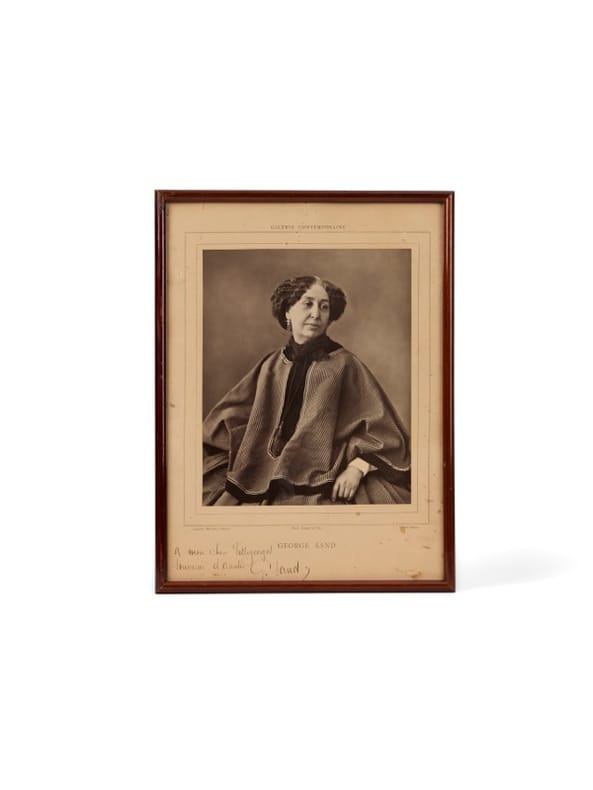
ref. 32237S.l.n.d. « Galerie contemporaine 126 boulevard de Magenta » et « Cliché Nadar rue d'Anjou-Saint-Honoré 51 ». 1 tirage sur papier albuminé 250 x 340 mm encadré. Célèbre portrait sur papier fin contrecollé sur carton de la Galerie Contemporaine littéraire 2e série n°37. Rarissime épreuve dédicacée : « à mon cher Villegeorges souvenir d'amitié George Sand ». Ce portrait fait partie de l'une des entreprises éditoriales les plus caractéristiques de la fin du XIXe siècle : La Galerie contemporaine publiée de 1876 à 1884 réunit 242 biographies illustrées de 410 photographies dont 241 reproduits en photoglyptie par la maison Goupil & Cie Ce procédé photomécanique nouveau connut pendant trente ans un énorme succès dans la presse et l'édition grâce à une impression stable diffusable en grand nombre et bien moins coûteux que les tirages argentiques. George Sand est la première figure féminine à être publiée dans la Galerie Contemporaine. Le portrait reprend l'un des fameux clichés exécutés par Nadar en mars 1864 : une série de huit clichés de la romancière au mois de mars 1864. La bonne dame de Nohant ne s'appréciait pas physiquement et ne fit confiance qu'à Nadar pour poser lequel consacra de longues heures à la photographier jusqu'à ce que l'image lui convienne : « Les épreuves de ma photographie n'ont pas encore très bien réussi chez Nadar j'y retourne demain." écrit-elle à Maurice son fils le 8 mars 1864 à Paris. Ces photographies restées célèbres inaugurèrent le début d'une longue série. Nadar qui avait toujours admiré la romancière l'avait placée en tête de son Panthéon Nadar 1854 et lui avait dédicacé un livre Quand j'étais étudiant 1856 : « À madame George Sand enthousiasme fervent et profond respect » ; la romancière deviendra par ailleurs la marraine de son fils Paul. Précieuse épreuve dédicacé par Georges Sand qui devait décéder l'année même de cette parution le 8 juin 1876 si bien que les portraits signés sont absolument rarissimes George Sand n'ayant que peu d'occasions de les avoir en mains. On ne connaît qu'un autre portrait dédicacé de la série Nadar au petit format carte de cabinet à Charles-Edouard de Vasson et quelques autres tirages dans ce même format carte simplement signés. S.l.n.d. [« Galerie contemporaine, 126 boulevard de Magenta » et « Cliché Nadar, rue d'Anjou-Saint-Honoré, 51 »]. 1 tirage unknown
1876ref. 32237Seul portrait dédicacé connu S.l.n.d. [« Galerie contemporaine, 126 boulevard de Magenta » et « Cliché Nadar, rue d'Anjou-Saint-Honoré, 51 »]. 1 tirage sur papier albuminé (250 x 340 mm), encadré. Célèbre portrait sur papier fin, contrecollé sur carton de la Galerie Contemporaine littéraire (2e série, n°37). Rarissime épreuve dédicacée : «à mon cher Villegeorges, souvenir d'amitié, George Sand»
1864ref. 555Paris : Nadar & Cie, 1864. UN RARE PORTRAIT PHOTOGRAPHIQUE SUR ÉMAIL INÉDIT DU GRAND NADAR
ref. 5007Nadar pens a brief letter with a drawing requesting his friend to give him "three places for the day." He signs "Nadar Tuesday Aug. 8 1892." He fills the bottom portion of the letter with a bust length sketch and descriptive note "made from memory of a young Nadar age 8." This is his second signature in the letter in French on an 8vo sheet n.p. Condition: Fine condition with several slight aging spots and light soiling at the corners. Letters with drawings by Nadar are rare. unknown
ref. 5007Nadar pens a brief letter with a drawing requesting his friend to give him "three places for the day." He signs "Nadar Tuesday Aug. 8 1892." He fills the bottom portion of the letter with a bust length sketch and descriptive note "made from memory of a young Nadar age 8." This is his second signature in the letter in French on an 8vo sheet n.p. Condition: Fine condition with several slight aging spots and light soiling at the corners. Letters with drawings by Nadar are rare. unknown books
1884ref. 353598Paris: Nadar 51 rue d'Anjou 1884. Half length portrait with hands at waist right hand on an ornamental belt. 1 vols. 13-1/2 x 7-1/2 inches. On black card mount lettered in gilt at foot and on verso. Old gilt frame by Walker Gallery Westport Conn. Half length portrait with hands at waist right hand on an ornamental belt. 1 vols. 13-1/2 x 7-1/2 inches. Attractive portrait of the young Sarah Bernhardt inscribed above her head. The most logical candidate for "Mademoiselle Moore" would seem Eva Moore 1870-1965 who had a long stage career and from 1920 made many films. She was quite well known married to actor-manager H. V. Edmond. Theater critic and translator Michael Feingold 1945-2022 knew Eva Le Gallienne 1899-1901 when he was a student a Yale. Provenance: Eva Le Gallienne; Michael Feingold Nadar, 51 rue d'Anjou unknown books
1888ref. 92029Paris: Paul Nadar 1888. Fine. Paul Nadar Paris s. d. 1888 - 1900 11 x 16.4 cm une photographie Paris Nadar studio negative circa 1888 print circa 1900-1924. Cabinet-card photograph. Albumen print mounted on the Nadar studio card. Maupassant is shown bust-length in left profile. The mount bears the printed name ""P. Nadar"" at the head and the studio signature printed in red in the lower margin. The verso gives the addresses 51 rue d'Anjou and 53 rue des Mathurins together with Paul Nadar's distinctions at the 1900 Exposition Universelle: hors concours member of the jury Class XII. These details make it possible to distinguish clearly between the date of the sitting and that of the present print. The negative is generally dated to 1888 although 1890 has also been proposed whereas the mount cannot predate the 1900 Exposition Universelle. The present photograph is therefore a later print made by the studio from an earlier negative probably between 1900 and the transfer of the rue d'Anjou premises in 1924. Paul Nadar who had worked full-time in the studio from 1876 had assumed its artistic direction by 1880 and thereafter signed most of its portraits. A label mounted on the verso reads: ""Gaston Bernard / 174 rue de Rivoli / Paris / Estampes"" recording the photograph's passage through this Paris establishment. At least two closely related poses of Maupassant from this sitting are known one showing his right profile and the other his left as here. In the latter the face turned almost entirely away from the viewer together with the moustache and sharply defined line of forehead and nose creates an immediately recognisable silhouette. The image was to become one of the writer's most familiar photographic portraits. The paradox is particularly striking since Maupassant consistently resisted the public dissemination of his likeness. He had little taste for the construction of a public image of the writer and explicitly protested against the reproduction of his portraits. Octave Uzanne who had known him personally reproduced in 1902 an autograph note in which Maupassant expressed his position unequivocally: ""I have made it an absolute rule never to allow my portrait to be published whenever I can prevent it. The exceptions have occurred only by surprise. Our works belong to the public but not our faces."" This reluctance partly accounts for the relative scarcity of his photographic iconography. Less than a decade after Maupassant's death Uzanne already observed that authentic likenesses of the writer consisted essentially of a small number of photographs taken full-face in profile or three-quarter view. He singled out the portrait of 1888 as the one in which he most readily recognised his lost friend: the Maupassant of Le Horla and Sur l'eau then at the height of his literary fame. The photograph belongs precisely to this period. Pierre et Jean and Sur l'eau appeared in 1888 while Bel-Ami published three years earlier had already established Maupassant before a wide readership. The Nadar profile thus fixes the writer at the moment when his face might naturally have become that of a literary celebrity precisely when he was attempting to prevent such a transformation. The present print is all the more revealing for having been produced after his death. The negative retained by the studio continued to be used after 1900 on a mount now advertising Paul Nadar's latest distinctions. The image Maupassant had wished to withhold from public curiosity survived him and entered the commercial repertoire of a photographic house celebrated for its portraits of prominent figures. A photographic sitting had gradually become an icon. A rare cabinet-card portrait of Maupassant printed after 1900 from a negative made circa 1888 by the Nadar studio. Of the writer who insisted that ""our works belong to the public but not our faces"" this photograph was destined to preserve one of the most recognisable faces of all. Â Paul Nadar unknown
1876ref. 46191876-1880. 175 numéros de 8 pages chacun, avec un portrait photographique monté sur la première page de chaque numéro, relié en demi maroquin vert, dos à nerfs, étiquettes de titre et tomaison en maroquin rouge, tête dorée.
ref. 17224Paris Paul De Lacroix 8 Volumes In-Folios Malgré 8 volumes, cet Exemplaire ne comprte qu'a peu près la moitié de ce qui est paru. Aucune Collation ne semble tout à fait identique, Notre exemplaire comporte les principales Photos de Beaudelaire par Carjat, Sand par Nadar, Loti, Zola, Etc. En dehors des Ecrivains, de nombreuses photos et articles sont consacrés aux artistes de la deuxième moitié du XiX ème siècle; Collation détaillée sur Demande ( Il es très important de savoir ce que comportent les différents exemplaires proposés). Quelques épidermures, sinon reliure en bon état, tête dorée
1884ref. 138930Paris, Ludovic Bascet 1884 12 volumes sur 14 grand in-4, demi-chagrin vert, dos à nerfs, flrurons et guirlandes dorées. 314 planches montées sur onglets. 1876, 2 volumes ; 1877, 2 volumes ; 1878, 2 manque 1878,1 ; 1879, 2 volumes ; 1880,1 manque 1880,2 ; 1881 à 1884 chiffrés 10 à 13. Menus frottements, un coin cassé 1877,2. Quelques rousseurs éparses n’affectant pas les portraits. Bon exemplaire.
1891ref. 92258Paul Nadar | Paris s. d. [1891] | 11 x 16.5 cm | format carte de cabinet
1895ref. 206631895 Photographies en noir et blanc signées pour la plupart, certaines sont montées sur carton, (1895-1937), formats allant de 14 x 10 à 32 x 40 cm.
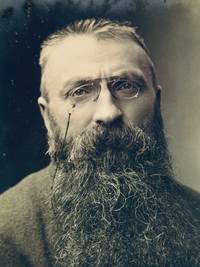
1891ref. 92258Paris: Paul Nadar 1891. Fine. Paul Nadar Paris s. d. 1891 11 x 16.5 cm format carte de cabinet Original albumen print photograph of Auguste Rodin cabinet card format mounted on stiff card. Nadar's signature in red in the lower margin. Advertisements in red on the verso. A small white area in the upper left margin with a few imperfections from the glass plate in the same area not affecting the portrait. Foxing to the margins. Iconic portrait of the sculptor with close-cropped hair and pince-nez staring fixedly into the lens. This snapshot gathers every hallmark of the celebrated ""style Nadar"" whose stark unadorned clarity establishes his gallery of portraits as one of the most compelling of the nineteenth century. The Nadar collection at the Bibliothèque nationale de France holds the few surviving trial prints of the Rodin portraits the present portrait appears under number 9115 B of volume 39. Rodin appears to have sat for the photographer only once on which occasion four exposures were taken in total. The sitting is usually dated to 1891 by which time Félix Nadar had retired from active business to devote himself to his aeronautical projects though he is known to have continued sporadically producing portraits of established artists and literary figures. This is far removed from the ""commercial"" style often attributed to his son Paul who took over the running of the studio in 1886. This ""spartiate"" approach to use Ulrich Keller's expression corresponds far more closely to Félix's own manner. The Musée Rodin which holds a print of this portrait attributes the negative to him: a letter from Rodin sent to the Ermitage de Sénart where Félix was then residing confirms this attribution: ""et puis des remerciements encore pour autres choses des portraits de votre serviteur"" lettre du 18 septembre 1892. The present print dates from the late 1920s as indicated by the studio stamp the studio then being located in the former Léon Bonnat atelier at 48 rue Bassano. In reference to Félix's earlier profession the stamp on the print reads ""Panthéon Nadar"" after the celebrated gallery of hundreds of celebrity caricatures assembled into a panoramic composition the first sheet of which Nadar published in 1854. He had planned to issue four lithographed sheets each presenting a serpentine procession of a thousand figures drawn from the ranks of noted ""gens de lettres auteurs dramatiques peintres et sculpteurs musiciens."" It was this aborted titanic undertaking that turned him toward photography in which he would become one of the most gifted practitioners of the nineteenth century. Sculptor and photographer also collaborated during this same period on a major undertaking: when Rodin received the commission for a monument to Balzac in 1891 Nadar placed his entire archive at his disposal: most notably the sole surviving daguerreotype portrait of Balzac taken by Bisson in 1842 which the sculptor regarded as the ""seule effigie fidèle et vraiment ressemblante de l'écrivain."" The letter quoted above bears witness to a further project as well for a Baudelaire portrait. A superb portrait of the master of sculpture by the master of nineteenth-century photography. Paul Nadar unknown