919 résultats
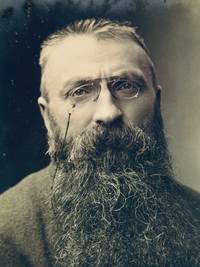
1891réf. 92258Paris: Paul Nadar 1891. Fine. Paul Nadar Paris s. d. 1891 11 x 16.5 cm format carte de cabinet Original albumen print photograph of Auguste Rodin cabinet card format mounted on stiff card. Nadar's signature in red in the lower margin. Advertisements in red on the verso. A small white area in the upper left margin with a few imperfections from the glass plate in the same area not affecting the portrait. Foxing to the margins. Iconic portrait of the sculptor with close-cropped hair and pince-nez staring fixedly into the lens. This snapshot gathers every hallmark of the celebrated ""style Nadar"" whose stark unadorned clarity establishes his gallery of portraits as one of the most compelling of the nineteenth century. The Nadar collection at the Bibliothèque nationale de France holds the few surviving trial prints of the Rodin portraits the present portrait appears under number 9115 B of volume 39. Rodin appears to have sat for the photographer only once on which occasion four exposures were taken in total. The sitting is usually dated to 1891 by which time Félix Nadar had retired from active business to devote himself to his aeronautical projects though he is known to have continued sporadically producing portraits of established artists and literary figures. This is far removed from the ""commercial"" style often attributed to his son Paul who took over the running of the studio in 1886. This ""spartiate"" approach to use Ulrich Keller's expression corresponds far more closely to Félix's own manner. The Musée Rodin which holds a print of this portrait attributes the negative to him: a letter from Rodin sent to the Ermitage de Sénart where Félix was then residing confirms this attribution: ""et puis des remerciements encore pour autres choses des portraits de votre serviteur"" lettre du 18 septembre 1892. The present print dates from the late 1920s as indicated by the studio stamp the studio then being located in the former Léon Bonnat atelier at 48 rue Bassano. In reference to Félix's earlier profession the stamp on the print reads ""Panthéon Nadar"" after the celebrated gallery of hundreds of celebrity caricatures assembled into a panoramic composition the first sheet of which Nadar published in 1854. He had planned to issue four lithographed sheets each presenting a serpentine procession of a thousand figures drawn from the ranks of noted ""gens de lettres auteurs dramatiques peintres et sculpteurs musiciens."" It was this aborted titanic undertaking that turned him toward photography in which he would become one of the most gifted practitioners of the nineteenth century. Sculptor and photographer also collaborated during this same period on a major undertaking: when Rodin received the commission for a monument to Balzac in 1891 Nadar placed his entire archive at his disposal: most notably the sole surviving daguerreotype portrait of Balzac taken by Bisson in 1842 which the sculptor regarded as the ""seule effigie fidèle et vraiment ressemblante de l'écrivain."" The letter quoted above bears witness to a further project as well for a Baudelaire portrait. A superb portrait of the master of sculpture by the master of nineteenth-century photography. Paul Nadar unknown
réf. 29520798-nnew. unknown
réf. 29711445-nnew. unknown
réf. 29711445like new. unknown
1888réf. 92029Paris: Paul Nadar 1888. Fine. Paul Nadar Paris s. d. 1888 - 1900 11 x 16.4 cm une photographie Paris Nadar studio negative circa 1888 print circa 1900-1924. Cabinet-card photograph. Albumen print mounted on the Nadar studio card. Maupassant is shown bust-length in left profile. The mount bears the printed name ""P. Nadar"" at the head and the studio signature printed in red in the lower margin. The verso gives the addresses 51 rue d'Anjou and 53 rue des Mathurins together with Paul Nadar's distinctions at the 1900 Exposition Universelle: hors concours member of the jury Class XII. These details make it possible to distinguish clearly between the date of the sitting and that of the present print. The negative is generally dated to 1888 although 1890 has also been proposed whereas the mount cannot predate the 1900 Exposition Universelle. The present photograph is therefore a later print made by the studio from an earlier negative probably between 1900 and the transfer of the rue d'Anjou premises in 1924. Paul Nadar who had worked full-time in the studio from 1876 had assumed its artistic direction by 1880 and thereafter signed most of its portraits. A label mounted on the verso reads: ""Gaston Bernard / 174 rue de Rivoli / Paris / Estampes"" recording the photograph's passage through this Paris establishment. At least two closely related poses of Maupassant from this sitting are known one showing his right profile and the other his left as here. In the latter the face turned almost entirely away from the viewer together with the moustache and sharply defined line of forehead and nose creates an immediately recognisable silhouette. The image was to become one of the writer's most familiar photographic portraits. The paradox is particularly striking since Maupassant consistently resisted the public dissemination of his likeness. He had little taste for the construction of a public image of the writer and explicitly protested against the reproduction of his portraits. Octave Uzanne who had known him personally reproduced in 1902 an autograph note in which Maupassant expressed his position unequivocally: ""I have made it an absolute rule never to allow my portrait to be published whenever I can prevent it. The exceptions have occurred only by surprise. Our works belong to the public but not our faces."" This reluctance partly accounts for the relative scarcity of his photographic iconography. Less than a decade after Maupassant's death Uzanne already observed that authentic likenesses of the writer consisted essentially of a small number of photographs taken full-face in profile or three-quarter view. He singled out the portrait of 1888 as the one in which he most readily recognised his lost friend: the Maupassant of Le Horla and Sur l'eau then at the height of his literary fame. The photograph belongs precisely to this period. Pierre et Jean and Sur l'eau appeared in 1888 while Bel-Ami published three years earlier had already established Maupassant before a wide readership. The Nadar profile thus fixes the writer at the moment when his face might naturally have become that of a literary celebrity precisely when he was attempting to prevent such a transformation. The present print is all the more revealing for having been produced after his death. The negative retained by the studio continued to be used after 1900 on a mount now advertising Paul Nadar's latest distinctions. The image Maupassant had wished to withhold from public curiosity survived him and entered the commercial repertoire of a photographic house celebrated for its portraits of prominent figures. A photographic sitting had gradually become an icon. A rare cabinet-card portrait of Maupassant printed after 1900 from a negative made circa 1888 by the Nadar studio. Of the writer who insisted that ""our works belong to the public but not our faces"" this photograph was destined to preserve one of the most recognisable faces of all. Â Paul Nadar unknown
2002réf. 1-0262025329Mit Pr 2002. Hardcover. New. illustrated edition. 160 pages. 9.25x7.00x0.75 inches. Mit Pr hardcover
réf. 44342438-nnew. unknown
réf. 44342438like new. unknown
réf. 44203334like new. unknown
1856réf. 84662Paris: Nadar 1856. Fine. Nadar Paris 1856 6.50 x 10.50 cm une feuille Original photographic portrait of Alfred de Vigny seated in profile in a velvet armchair mounted at an early date on stiff grey card. The poet sits with his arms folded his gaze directed beyond the frame holding a propelling pencil in his right hand. Early manuscript caption in ink along the lower margin of the mount Le C.te Alfred de Vigny with NADAR inscribed in capitals in the right margin. From a collector's album. Small area of superficial loss to the mount in the foreground beneath the sitter's hand. The composition belongs to Nadar's earliest sittings with Vigny. The Musée d'Orsay preserves among others a portrait dated circa 1854 showing the writer in a closely related pose seated in profile against a deliberately spare background; the same iconography was subsequently circulated in different formats. By the mid-1850s Alfred de Vigny had long been one of the major figures of French Romanticism while his presence in literary and social life had become increasingly discreet. He was still working on the philosophical poems that would be collected posthumously as Les Destinées. Nadar's portrait appears particularly consonant with the image the ageing writer fashioned of himself: no theatrical setting scarcely an accessory only the controlled rigidity of the pose the sharply defined profile and the gaze directed into the distance. The propelling pencil held in his right hand provides the composition's only explicit allusion to his vocation as a writer. Yet the attitude is less that of an author caught at work than of a man consciously constructing his own likeness: the folded arms close the silhouette while the profile removes his gaze from that of the viewer. In this economy of means the portrait closely accords with the reserve distance and self-command that had become central to Vigny's public persona. A small insignia appears at his collar probably the rosette of the Légion d'honneur. Vigny a Chevalier since 1833 was promoted to Officer in 1856; the detail is therefore consistent with a date in the middle of the decade. Nadar himself was then entering the most inventive period of his photographic career. Working from his rue Saint-Lazare studio he increasingly dispensed with the elaborate props and settings still common in commercial portraiture concentrating instead upon physiognomy posture and the presence of the sitter. Vigny thus belongs to the first generation of writers whose likenesses he fixed at the moment when photography was beginning permanently to shape the public image of literary figures. With its severe pose and extreme economy of setting this portrait closely accords with the late image Vigny sought to leave of himself; made during Nadar's formative years as a photographer it brings together the almost hieratic self-fashioning of the writer and one of the foundational moments of French literary portrait photography. Nadar unknown
1878réf. 82671Paris: Nadar 1878. Fine. Nadar Paris 1878 6 x 10.50 cm une photographie Original albumen photograph of Jules Verne in profile in carte-de-visite format mounted on the heavy card stock of the Nadar studio 51 rue d'Anjou-Saint-Honoré Paris. Early pen inscription on the verso identifying Jules Verne printed advertising matter for the studio including the statement Gold Medal Universal Exhibition 1878 and blue stamp J. Kuhn Paris. Card with rounded corners; very slight wear to one corner otherwise without significant defect. The Nadar mount whose advertising records the gold medal awarded at the 1878 Universal Exhibition establishes a date after 1878 for this print. The Bibliothèque nationale de France preserves several portraits of Jules Verne in the studio's reference albums catalogued under numbers 3436 and 3437 and broadly dated between 1875 and 1895. Jules Verne and Nadar had known one another since the early 1860s when the photographer embarked upon his celebrated campaign in support of heavier-than-air flight. When Nadar founded the Société d'encouragement de la navigation aérienne au moyen du plus lourd que l'air in 1863 Verne was among the dozen or so figures associated with it; a surviving sheet of the Society's letterhead in the Jules Verne collections at Nantes expressly lists him among its censors. In the same year Verne published Nadar the Aeronaut in the Musée des Familles while Nadar constructed the Géant the enormous balloon whose first ascent took place that October. Their association soon passed from aeronautics into fiction. In From the Earth to the Moon published in 1865 Verne gave the French adventurer Michel Ardan a surname formed as an anagram of Nadar; the character would return in Around the Moon. His physical description extends the tribute by borrowing several traits from the photographer's famously exuberant personality: He was a man of forty-two tall though already somewhat stooped like those caryatids that bear balconies upon their shoulders. His powerful head a veritable lion's mask would from time to time toss a mass of fiery hair that formed a true mane. By the rearrangement of a few letters Verne's aeronaut friend had entered the world of the Voyages extraordinaires. By the time this carte de visite was printed after 1878 Verne was already the author of Around the World in Eighty Days Michael Strogoff Hector Servadac and The Fifteen-Year-Old Captain; Nadar whose name had become that of a Verne hero thirteen years earlier now fixed the writer's own likeness. This portrait thus brings together within a single object the personal and intellectual relationship between two men brought close by the aeronautical experiments of the 1860s: the Nadar studio here photographs the writer who in the figure of Michel Ardan had already brought his friend into fiction. Nadar unknown
1877réf. 76745Paris: Georges Decaux 1877. Fine. Georges Decaux Paris s. d. 1877 11.50 x 18.50 cm relié First edition. Contemporary half bottle-green shagreen binding spine with five raised bands set with gilt fleurons some minor rubbing to spine without gravity marbled paper boards endpapers and pastedowns of pebbled paper contemporary binding. Some minor foxing without gravity a pencil library shelf mark on one endpaper. Autograph inscription dated and signed by Nadar: ""A M. Bertrand de main amie. Nadar. Nov"". Georges Decaux hardcover
1880réf. 73633Paris: Nadar 1880. Fine. Nadar Paris 1880 10.70 x 16.60 cm une photographie Original albumen photograph in cabinet card format mounted on cardboard. At the bottom of the photograph: Aimé dupont 574 fifth Avenue New-York. Portrait of the actress taken in New-York during the great American tour of 1880-1881 256 performances in 50 cities. Sarah Bernhardt poses in elegant Parisian attire her gaze turned skyward. Signed in the plate: Copyright by A. Dupont. Good overall condition one dark stain on the right of the photograph near the margin. Aimé Dupont was a Belgian photographer first active in Brussels then in Paris. He settled in New-York with his American wife Etta Greer herself a photographer. Already in Paris the photographer had specialized in photographs of actors and singers from the Opera and he renewed this specialty for the New-York opera and all the French artists who came to the USA. It is therefore not surprising that Sarah Bernhardt visited his studio to create a recent photograph dedicated to her American tour. Nadar unknown
1880réf. 71647Paris: Goupil & Cie 1880. Fine. Goupil & Cie Paris 1880 24 x 33 cm une feuille Photoglypty from the Galerie contemporaine. Portrait of Edmond Goncourt. Mounted sheet on which a photoglypty of 19x24cm has been laid down. Caption at the bottom of the mount: Galerie Contemporaine 126 boulevard de Magenta. Phot. Goupil et Cie. Cliché Nadar 51 rue d'Anjou-St-Honoré. Superb condition. Handsome portrait of the writer seated with a fixed and fierce gaze a cigarette in his right hand his elbow resting on attributes that represent him. Close to a carbon print by its warm and deep tones photoglypty is a complex photomechanical process of photographic reproduction which the publishing industry used for about 20 years from 1875 to 1895. Seeking an ideal and aesthetic image of famous men the plates were always retouched and repainted to erase an unsightly wrinkle or too troublesome defect to polish the hair etc. Thus photography and printmaking converge in a new representation. The Galerie Contemporaine became a publishing house that sold images of contemporary men these images were assembled into 8 folio volumes by Paul de Lacroix but continued to be sold separately at the headquarters of the Galerie Contemporaine. Goupil & Cie unknown
1856réf. 73025Paris: Nadar 1856. Fine. Nadar Paris s. d. 1856 6.50 x 10.20 cm une photographie Original albumen print photograph depicting Alphonse de Lamartine in carte-de-visite format mounted on studio card from Nadar ""35 boulevart des Capucines"". This photograph taken in 1856 was marketed between 1862 and 1871 as evidenced by the photographer's address on the back of the card. Pen annotation on the reverse of the photograph. Nadar unknown
1893réf. 70792Paris: Office général de Photographie 1893. Fine. Office général de Photographie Paris Janvier-Décembre 1893 18.50 x 27 cm 12 fascicules brochés First edition. Complete third year in 12 issues of this extremely rare scholarly review founded and directed by Paul Nadar. Each copy includes at least two plates outside the text including a plate of Nadar's photographic prints and a photograph often reproduced in heliogravure. Contributions by P. Nadar A. and L. Lumière A. Marey G. Geffroy J. Grand-Carteret J. Demarçay Davison S. Ferrand H. Fourtier C. Gravier A. Guerronnan Ponton d'Amécourt H. Reeb L. Vidal J. Waterhouse. Among the numerous subjects treated one will find chronophotography color reproduction skies in photography The pilgrimage to Mecca very beautiful heliogravure plate outside the text of the grand çalat ceremony. ""We believe we are advancing progress by interesting the public even more in this entirely French discovery of Photography."" ""Nous pensons faire oeuvre de progrès en intéressant encore davantage le public à cette découverte toute française de la Photographie."". Thus Paul Nadar concluded his introduction as presentation of this precious review containing a print by the celebrated photographer in each issue. At the origin of the creation of Paris-photographe P. Nadar explains the absence of a luxury photography review in France contrary to the magnificent foreign publications. Some rare and minimal marginal dampstains and small tears of no consequence otherwise very handsome uncut copies forming a set of remarkable rarity. Office général de Photographie unknown
1882réf. 49432Paris: chés l'auctheur 1882. Fine. chés l'auctheur Paris s. d. 1882 14 x 19 cm relié first edition of this Rabelaisian style pamphlet directed against Gambetta one of 300 numbered copies on Holland paper. Binding to open bradel ivory wove smooth back red mesh coaching boards and boards painted in watercolor compositions centers: a bookplate and a monogram on the first front cover and Léon Gambetta embodying Christ crucified fragile parchment wrappers preserved and bound in contemporary binding signed Dodé. Nadar handwritten signature under the justification of the draw. In addition this copy is enriched with a handwritten correction Nadar pencil in The Passion p. 45 to orveitan sic. Book adorned the author of illustrations. Provenance: Library of Frederick Lachèvre bibliographer specialist in French poetry with its large bookplate engraved and painted emblem repeated in the first boardes. A book illustration is reproduced on the lower flat of each volume. Some light and light bites to bookbinding. chés l'auctheur hardcover
1882réf. 49471Paris: chés l'auctheur 1882. Fine. chés l'auctheur Paris s. d. 1882 14 x 19 cm relié first edition of this Rabelaisian style pamphlet directed against Gambetta one of 300 numbered copies on paper of the Netherlands. Binding to open bradel ivory wove smooth back red mesh frame compositions painted boards and boards to centers: a bookplate and a monogram on the first front cover and Léon Gambetta dabbling in a bathtub on the second fragile parchment wrappers preserved and bound in contemporary binding signed Dodé. Nadar handwritten signature under the justification of the draw. Book adorned the author of illustrations. Provenance: Library of Frederick Lachèvre bibliographer specialist in French poetry with its large bookplate engraved and painted emblem repeated in the first boardes. A book illustration is reproduced on the lower flat of each volume. Some light and light bites to bookbinding. chés l'auctheur hardcover
1857réf. 40580Paris: Michel Lévy 1857. Fine. Michel Lévy Paris 1857 11.50 x 18 cm relié Second edition published one year after the first edition. Half fir green shagreen binding with corners spine with five raised bands set with black fillets decorated with double black compartments embellished with gilt fleurons slight scratches without any gravity on one joint marbled paper boards marbled endpapers and pastedowns all edges gilt. Autograph inscription signed by Nadar to Madame Dufay. Handsome copy. Michel Lévy hardcover
1910réf. 31230Paris: Le Livre et l'Image 1910. Fine. Le Livre et l'Image Paris 1910 18 x 27.50 cm broché First edition. Illustrated cover printed in red and black spine with tears but no loss corners showing traces of wear. Collaborations by L. Millanvoy: ""Nadar"" Henry Eon: ""Maxime Maufra"" Clément-Janin Dubray. A brown stain appears in the upper part of page 96 not touching the text. Copy lacking the original embossing by Alexandre Charpentier. Minimal foxing. Le Livre et l'Image unknown
1893réf. 27471Paris: Office général de la photographie 1893. Fine. Office général de la photographie Paris 28 Février 1893 18.50 x 27 cm broché First edition of this extremely rare scholarly journal founded and directed by Paul Nadar. Each copy contains at least two plates outside the text including a plate of photographic prints by Nadar and a photograph often reproduced in heliogravure. Contributions by P. Nadar A. and L. Lumière A. Marey G. Geffroy J. Grand-Carteret J. Demarçay Davison S. Ferrand H. Fourtier C. Gravier A. Guerronnan Ponton d'Amécourt H. Reeb L. Vidal J. Waterhouse. ""We believe we are advancing progress by further engaging the public's interest in this entirely French discovery of Photography."". Thus did Paul Nadar conclude his introduction as a presentation of this precious journal containing a photograph by the celebrated photographer in each issue. At the origin of the creation of Paris-photographe P. Nadar explains the absence of a luxurious photography journal in France contrary to the magnificent foreign publications. A handsome copy. Of exceptional rarity. Office général de la photographie unknown
1893réf. 27468Paris: Office général de la photographie 1893. Fine. Office général de la photographie Paris 30 Juillet 1893 18.50 x 27 cm broché First edition of this extremely rare scholarly journal founded and directed by Paul Nadar. Each copy contains at least two plates including a sheet of Nadar's photographic prints and a photograph often reproduced in heliogravure. Contributions by P. Nadar A. and L. Lumière A. Marey G. Geffroy J. Grand-Carteret J. Demarçay Davison S. Ferrand H. Fourtier C. Gravier A. Guerronnan Ponton d'Amécourt H. Reeb L. Vidal J. Waterhouse. ""We believe we are advancing progress by further engaging the public with this entirely French discovery of Photography."". Thus Paul Nadar concluded his introduction as a presentation of this precious journal containing a print by the celebrated photographer in each issue. At the origin of the creation of Paris-photographe P. Nadar explains the absence of a luxurious photography journal in France contrary to the magnificent foreign publications. Handsome copy. Of remarkable rarity. Office général de la photographie unknown
1893réf. 27467Paris: Office général de la photographie 1893. Fine. Office général de la photographie Paris 30 Avril 1893 18.50 x 27 cm broché First edition of this extremely rare scholarly journal founded and directed by Paul Nadar. Each copy contains at least two plates including a sheet of Nadar's photographic prints and a photograph often reproduced in heliogravure. Contributions by P. Nadar A. and L. Lumière A. Marey G. Geffroy J. Grand-Carteret J. Demarçay Davison S. Ferrand H. Fourtier C. Gravier A. Guerronnan Ponton d'Amécourt H. Reeb L. Vidal J. Waterhouse. ""We believe we are advancing progress by further engaging the public with this entirely French discovery of Photography."". Thus Paul Nadar concluded his introduction as a presentation of this precious journal containing a print by the celebrated photographer in each issue. At the origin of the creation of Paris-photographe P. Nadar explains the absence of a luxurious photography journal in France contrary to the magnificent foreign publications. Handsome copy. Of remarkable rarity. Office général de la photographie unknown
1893réf. 27472Paris: Office général de la photographie 1893. Fine. Office général de la photographie Paris 30 Octobre 1893 18.50 x 27 cm broché First edition of this extremely rare scholarly journal founded and directed by Paul Nadar. Each copy contains at least two plates outside the text including a plate of photographic prints by Nadar and a photograph often reproduced in heliogravure. Contributions by P. Nadar A. and L. Lumière A. Marey G. Geffroy J. Grand-Carteret J. Demarçay Davison S. Ferrand H. Fourtier C. Gravier A. Guerronnan Ponton d'Amécourt H. Reeb L. Vidal J. Waterhouse. ""We believe we are advancing progress by further engaging the public's interest in this entirely French discovery of Photography."". Thus did Paul Nadar conclude his introduction as a presentation of this precious journal containing a photograph by the celebrated photographer in each issue. At the origin of the creation of Paris-photographe P. Nadar explains the absence of a luxurious photography journal in France contrary to the magnificent foreign publications. Small marginal tears at foot of first cover otherwise a handsome copy. Of exceptional rarity. Office général de la photographie unknown
1891réf. 27452Paris: Office général de la photographie 1891. Fine. Office général de la photographie Paris Octobre 1891 18.50 x 27 cm broché First edition of this extremely rare scholarly journal founded and directed by Paul Nadar. Each issue contains at least two plates including a sheet of photographic prints by Nadar and a photograph often reproduced in photogravure. Contributions by P. Nadar A. and L. Lumière A. Marey G. Geffroy J. Grand-Carteret J. Demarçay Davison S. Ferrand H. Fourtier C. Gravier A. Guerronnan Ponton d'Amécourt H. Reeb L. Vidal J. Waterhouse. « Nous pensons faire oeuvre de progrès en intéressant encore davantage le public à cette découverte toute française de la Photographie. ». ""We believe we are advancing progress by further engaging the public with this entirely French discovery of Photography."". Thus Paul Nadar concluded his introduction as a presentation of this precious journal containing a photograph by the celebrated photographer in each issue. Explaining the creation of Paris-photographe P. Nadar notes the absence of a luxurious photography journal in France unlike the magnificent foreign publications. Small marginal tears with minor lacks to covers angular traces of kraft paper that protected the journal on the covers handsome interior condition. Of exceptional rarity. Office général de la photographie unknown