919 résultats
1885réf. GF59081885 Paris - Galerie Contemporaine des Illustrations Françaises - (vers 1885) - Photographie tirée en photoglyptie de 11,5 x 8 cms environ, contrecollée sur papier -
1885réf. GF58921885 Paris - Galerie Contemporaine des Illustrations Françaises - (vers 1885) - Photographie tirée en photoglyptie de 11,5 x 8 cms environ, contrecollée sur papier -
1885réf. GF57871885 Paris - Galerie Contemporaine des Illustrations Françaises - (vers 1885) - Photographie tirée en photoglyptie de 23 x 18,5 cms environ, contrecollée sur carton fort -
1885réf. GF57841885 Paris - Galerie Contemporaine des Illustrations Françaises - (vers 1885) - Photographie tirée en photoglyptie de 23 x 18,5 cms environ, contrecollée sur carton fort -
1885réf. GF59011885 Paris - Galerie Contemporaine des Illustrations Françaises - (vers 1885) - Photographie tirée en photoglyptie de 11,5 x 8 cms environ, contrecollée sur papier -
1885réf. GF59071885 Paris - Galerie Contemporaine des Illustrations Françaises - (vers 1885) - Photographie tirée en photoglyptie de 11,5 x 8 cms environ, contrecollée sur papier -
1885réf. GF57961885 Paris - Galerie Contemporaine des Illustrations Françaises - (vers 1885) - Photographie originale d'époque tirée en photoglyptie de 23 x 18,5 cms environ, contrecollée sur carton fort -
1885réf. GF57821885 Paris - Galerie Contemporaine des Illustrations Françaises - (vers 1885) - Photographie tirée en photoglyptie de 23 x 18,5 cms environ, contrecollée sur carton fort -
1885réf. GF57941885 Paris - Galerie Contemporaine des Illustrations Françaises - (vers 1885) - Photographie originale d'époque tirée en photoglyptie de 23 x 18,5 cms environ, contrecollée sur carton fort -
1885réf. GF57801885 Paris - Galerie Contemporaine des Illustrations Françaises - (vers 1885) - Photographie tirée en photoglyptie de 23 x 18,5 cms environ, contrecollée sur carton fort -
1885réf. GF58031885 Paris - Galerie Contemporaine des Illustrations Françaises - (vers 1885) - Photographie originale d'époque tirée en photoglyptie de 23 x 18,5 cms environ, contrecollée sur carton fort -
1885réf. GF57891885 Paris - Galerie Contemporaine des Illustrations Françaises - (vers 1885) - Photographie tirée en photoglyptie de 23 x 18,5 cms environ, contrecollée sur carton fort -
réf. 13779Photographie originale d'un format exceptionnellement grand (44 x 35 cm), sur papier albuminé avec importants rehauts de gouache marron dans les cheveux, la robe, les chaussures et dans le décor, contrecollée sur carton, papier bleu collé au verso.Tirage viré au sépia, taches de gouache sur le visage de l'enfant, traces de montage ancien au verso
1862réf. 552621862 Paris, E.Jung - Treuttel, sd, In douze, 296 pp, broché,dos très légèrement fendu mais en bon état,papier non piqué,
1878réf. 82671Paris: Nadar 1878. Fine. Nadar Paris 1878 6 x 10.50 cm une photographie Original albumen photograph of Jules Verne in profile in carte-de-visite format mounted on the heavy card stock of the Nadar studio 51 rue d'Anjou-Saint-Honoré Paris. Early pen inscription on the verso identifying Jules Verne printed advertising matter for the studio including the statement Gold Medal Universal Exhibition 1878 and blue stamp J. Kuhn Paris. Card with rounded corners; very slight wear to one corner otherwise without significant defect. The Nadar mount whose advertising records the gold medal awarded at the 1878 Universal Exhibition establishes a date after 1878 for this print. The Bibliothèque nationale de France preserves several portraits of Jules Verne in the studio's reference albums catalogued under numbers 3436 and 3437 and broadly dated between 1875 and 1895. Jules Verne and Nadar had known one another since the early 1860s when the photographer embarked upon his celebrated campaign in support of heavier-than-air flight. When Nadar founded the Société d'encouragement de la navigation aérienne au moyen du plus lourd que l'air in 1863 Verne was among the dozen or so figures associated with it; a surviving sheet of the Society's letterhead in the Jules Verne collections at Nantes expressly lists him among its censors. In the same year Verne published Nadar the Aeronaut in the Musée des Familles while Nadar constructed the Géant the enormous balloon whose first ascent took place that October. Their association soon passed from aeronautics into fiction. In From the Earth to the Moon published in 1865 Verne gave the French adventurer Michel Ardan a surname formed as an anagram of Nadar; the character would return in Around the Moon. His physical description extends the tribute by borrowing several traits from the photographer's famously exuberant personality: He was a man of forty-two tall though already somewhat stooped like those caryatids that bear balconies upon their shoulders. His powerful head a veritable lion's mask would from time to time toss a mass of fiery hair that formed a true mane. By the rearrangement of a few letters Verne's aeronaut friend had entered the world of the Voyages extraordinaires. By the time this carte de visite was printed after 1878 Verne was already the author of Around the World in Eighty Days Michael Strogoff Hector Servadac and The Fifteen-Year-Old Captain; Nadar whose name had become that of a Verne hero thirteen years earlier now fixed the writer's own likeness. This portrait thus brings together within a single object the personal and intellectual relationship between two men brought close by the aeronautical experiments of the 1860s: the Nadar studio here photographs the writer who in the figure of Michel Ardan had already brought his friend into fiction. Nadar unknown
1888réf. 92029Paris: Paul Nadar 1888. Fine. Paul Nadar Paris s. d. 1888 - 1900 11 x 16.4 cm une photographie Paris Nadar studio negative circa 1888 print circa 1900-1924. Cabinet-card photograph. Albumen print mounted on the Nadar studio card. Maupassant is shown bust-length in left profile. The mount bears the printed name ""P. Nadar"" at the head and the studio signature printed in red in the lower margin. The verso gives the addresses 51 rue d'Anjou and 53 rue des Mathurins together with Paul Nadar's distinctions at the 1900 Exposition Universelle: hors concours member of the jury Class XII. These details make it possible to distinguish clearly between the date of the sitting and that of the present print. The negative is generally dated to 1888 although 1890 has also been proposed whereas the mount cannot predate the 1900 Exposition Universelle. The present photograph is therefore a later print made by the studio from an earlier negative probably between 1900 and the transfer of the rue d'Anjou premises in 1924. Paul Nadar who had worked full-time in the studio from 1876 had assumed its artistic direction by 1880 and thereafter signed most of its portraits. A label mounted on the verso reads: ""Gaston Bernard / 174 rue de Rivoli / Paris / Estampes"" recording the photograph's passage through this Paris establishment. At least two closely related poses of Maupassant from this sitting are known one showing his right profile and the other his left as here. In the latter the face turned almost entirely away from the viewer together with the moustache and sharply defined line of forehead and nose creates an immediately recognisable silhouette. The image was to become one of the writer's most familiar photographic portraits. The paradox is particularly striking since Maupassant consistently resisted the public dissemination of his likeness. He had little taste for the construction of a public image of the writer and explicitly protested against the reproduction of his portraits. Octave Uzanne who had known him personally reproduced in 1902 an autograph note in which Maupassant expressed his position unequivocally: ""I have made it an absolute rule never to allow my portrait to be published whenever I can prevent it. The exceptions have occurred only by surprise. Our works belong to the public but not our faces."" This reluctance partly accounts for the relative scarcity of his photographic iconography. Less than a decade after Maupassant's death Uzanne already observed that authentic likenesses of the writer consisted essentially of a small number of photographs taken full-face in profile or three-quarter view. He singled out the portrait of 1888 as the one in which he most readily recognised his lost friend: the Maupassant of Le Horla and Sur l'eau then at the height of his literary fame. The photograph belongs precisely to this period. Pierre et Jean and Sur l'eau appeared in 1888 while Bel-Ami published three years earlier had already established Maupassant before a wide readership. The Nadar profile thus fixes the writer at the moment when his face might naturally have become that of a literary celebrity precisely when he was attempting to prevent such a transformation. The present print is all the more revealing for having been produced after his death. The negative retained by the studio continued to be used after 1900 on a mount now advertising Paul Nadar's latest distinctions. The image Maupassant had wished to withhold from public curiosity survived him and entered the commercial repertoire of a photographic house celebrated for its portraits of prominent figures. A photographic sitting had gradually become an icon. A rare cabinet-card portrait of Maupassant printed after 1900 from a negative made circa 1888 by the Nadar studio. Of the writer who insisted that ""our works belong to the public but not our faces"" this photograph was destined to preserve one of the most recognisable faces of all. Â Paul Nadar unknown
1867réf. 71239Paris: Nadar 1867. Fine. Nadar Paris s. d. 1867 6.60 x 10.40 cm une photographie Nadar Paris N.D. but 1867 66x10.4 cm photograph Original photograph on albumin paper in a visiting card format laid down on card by Nadar initialed and with a red border. Doré poses with his arm on a fringed chair the same as in the portraits of Théophile Gautier Edouard Manet and Alexandre Dumas. Manuscript annotation to verso. We have not been able to find any copies of this photograph in any of the international public collections. Nadar unknown
1866réf. 113791866 Paris, Aux buraux du Journal Amusant, des Modes parisiennes…( Typographie Henri Plon), 1866 - 1867; 1 volume in-4°, demi-basane rouge époque, dos à faux-netrfs plats, filets dorés et à froid titre doré “Album comique" et date dorée . Chaque numéro de 8 pages, comporte un dessins de Grévin mis en couleurs à la 1ère page et de nombreux dessins à plaine page ou dans le texte en noir.Ensemble de 70 numéros regroupant les numéros 463 à 472 ( 10), 504 à 512 ( 9), 514 (1) 518 à 535 ( 18),537-538 (2), 540 à 543 (4), 546 à 552 (7), 568 à 569 ( 2), 562 à 564 (3),566 à 567 (2), 570 à 571 (2), 573 à 579 (7), 545 (1), 580 à 581 (2) et reliés dans cet ordre. Plusieurs numéros consacrés à la photographie ( pour et contre).
réf. 10585Paris, Phototypie Patin, Cliché Nadar. Maison Vieilliot et Labbé, Leray imp. Partition grand in-8°, photo contrecollée sur la couverture , 17 X 12,5 cm. (le papier a un peu gondolé sous la colle).
1884réf. 353598Paris: Nadar 51 rue d'Anjou 1884. Half length portrait with hands at waist right hand on an ornamental belt. 1 vols. 13-1/2 x 7-1/2 inches. On black card mount lettered in gilt at foot and on verso. Old gilt frame by Walker Gallery Westport Conn. Half length portrait with hands at waist right hand on an ornamental belt. 1 vols. 13-1/2 x 7-1/2 inches. Attractive portrait of the young Sarah Bernhardt inscribed above her head. The most logical candidate for "Mademoiselle Moore" would seem Eva Moore 1870-1965 who had a long stage career and from 1920 made many films. She was quite well known married to actor-manager H. V. Edmond. Theater critic and translator Michael Feingold 1945-2022 knew Eva Le Gallienne 1899-1901 when he was a student a Yale. Provenance: Eva Le Gallienne; Michael Feingold Nadar, 51 rue d'Anjou unknown books
1884réf. 353598Paris: Nadar 51 rue d'Anjou 1884. Half length portrait with hands at waist right hand on an ornamental belt. 1 vols. 13-1/2 x 7-1/2 inches. On black card mount lettered in gilt at foot and on verso. Old gilt frame by Walker Gallery Westport Conn. Half length portrait with hands at waist right hand on an ornamental belt. 1 vols. 13-1/2 x 7-1/2 inches. Attractive portrait of the young Sarah Bernhardt inscribed above her head. The most logical candidate for "Mademoiselle Moore" would seem Eva Moore 1870-1965 who had a long stage career and from 1920 made many films. She was quite well known married to actor-manager H. V. Edmond. Theater critic and translator Michael Feingold 1945-2022 knew Eva Le Gallienne 1899-1901 when he was a student a Yale. Provenance: Eva Le Gallienne; Michael Feingold Nadar, 51 rue d'Anjou unknown
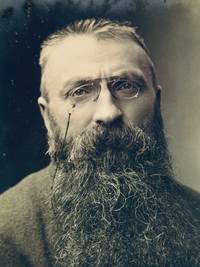
1891réf. 92258Paris: Paul Nadar 1891. Fine. Paul Nadar Paris s. d. 1891 11 x 16.5 cm format carte de cabinet Original albumen print photograph of Auguste Rodin cabinet card format mounted on stiff card. Nadar's signature in red in the lower margin. Advertisements in red on the verso. A small white area in the upper left margin with a few imperfections from the glass plate in the same area not affecting the portrait. Foxing to the margins. Iconic portrait of the sculptor with close-cropped hair and pince-nez staring fixedly into the lens. This snapshot gathers every hallmark of the celebrated ""style Nadar"" whose stark unadorned clarity establishes his gallery of portraits as one of the most compelling of the nineteenth century. The Nadar collection at the Bibliothèque nationale de France holds the few surviving trial prints of the Rodin portraits the present portrait appears under number 9115 B of volume 39. Rodin appears to have sat for the photographer only once on which occasion four exposures were taken in total. The sitting is usually dated to 1891 by which time Félix Nadar had retired from active business to devote himself to his aeronautical projects though he is known to have continued sporadically producing portraits of established artists and literary figures. This is far removed from the ""commercial"" style often attributed to his son Paul who took over the running of the studio in 1886. This ""spartiate"" approach to use Ulrich Keller's expression corresponds far more closely to Félix's own manner. The Musée Rodin which holds a print of this portrait attributes the negative to him: a letter from Rodin sent to the Ermitage de Sénart where Félix was then residing confirms this attribution: ""et puis des remerciements encore pour autres choses des portraits de votre serviteur"" lettre du 18 septembre 1892. The present print dates from the late 1920s as indicated by the studio stamp the studio then being located in the former Léon Bonnat atelier at 48 rue Bassano. In reference to Félix's earlier profession the stamp on the print reads ""Panthéon Nadar"" after the celebrated gallery of hundreds of celebrity caricatures assembled into a panoramic composition the first sheet of which Nadar published in 1854. He had planned to issue four lithographed sheets each presenting a serpentine procession of a thousand figures drawn from the ranks of noted ""gens de lettres auteurs dramatiques peintres et sculpteurs musiciens."" It was this aborted titanic undertaking that turned him toward photography in which he would become one of the most gifted practitioners of the nineteenth century. Sculptor and photographer also collaborated during this same period on a major undertaking: when Rodin received the commission for a monument to Balzac in 1891 Nadar placed his entire archive at his disposal: most notably the sole surviving daguerreotype portrait of Balzac taken by Bisson in 1842 which the sculptor regarded as the ""seule effigie fidèle et vraiment ressemblante de l'écrivain."" The letter quoted above bears witness to a further project as well for a Baudelaire portrait. A superb portrait of the master of sculpture by the master of nineteenth-century photography. Paul Nadar unknown
1856réf. 84662Paris: Nadar 1856. Fine. Nadar Paris 1856 6.50 x 10.50 cm une feuille Original photographic portrait of Alfred de Vigny seated in profile in a velvet armchair mounted at an early date on stiff grey card. The poet sits with his arms folded his gaze directed beyond the frame holding a propelling pencil in his right hand. Early manuscript caption in ink along the lower margin of the mount Le C.te Alfred de Vigny with NADAR inscribed in capitals in the right margin. From a collector's album. Small area of superficial loss to the mount in the foreground beneath the sitter's hand. The composition belongs to Nadar's earliest sittings with Vigny. The Musée d'Orsay preserves among others a portrait dated circa 1854 showing the writer in a closely related pose seated in profile against a deliberately spare background; the same iconography was subsequently circulated in different formats. By the mid-1850s Alfred de Vigny had long been one of the major figures of French Romanticism while his presence in literary and social life had become increasingly discreet. He was still working on the philosophical poems that would be collected posthumously as Les Destinées. Nadar's portrait appears particularly consonant with the image the ageing writer fashioned of himself: no theatrical setting scarcely an accessory only the controlled rigidity of the pose the sharply defined profile and the gaze directed into the distance. The propelling pencil held in his right hand provides the composition's only explicit allusion to his vocation as a writer. Yet the attitude is less that of an author caught at work than of a man consciously constructing his own likeness: the folded arms close the silhouette while the profile removes his gaze from that of the viewer. In this economy of means the portrait closely accords with the reserve distance and self-command that had become central to Vigny's public persona. A small insignia appears at his collar probably the rosette of the Légion d'honneur. Vigny a Chevalier since 1833 was promoted to Officer in 1856; the detail is therefore consistent with a date in the middle of the decade. Nadar himself was then entering the most inventive period of his photographic career. Working from his rue Saint-Lazare studio he increasingly dispensed with the elaborate props and settings still common in commercial portraiture concentrating instead upon physiognomy posture and the presence of the sitter. Vigny thus belongs to the first generation of writers whose likenesses he fixed at the moment when photography was beginning permanently to shape the public image of literary figures. With its severe pose and extreme economy of setting this portrait closely accords with the late image Vigny sought to leave of himself; made during Nadar's formative years as a photographer it brings together the almost hieratic self-fashioning of the writer and one of the foundational moments of French literary portrait photography. Nadar unknown
1979réf. 3558Editions Arthur Hubschmid 1979. Deux forts volumes in-8 reliure toile éditeur de 1300 pages au total ( pagination en continu ), au format 14 x 12 x 22 cm. Couvertures et dos rond avec titre. Complet des jaquettes illustrées ( photo et dessin ). Livres glissés sous carton gris de protection, abimé. Plats et intérieur frais, malgré une légère trace de mouillure en haut de la jaquette du tome 2. Le premier volume, préfacé par Jean-François Bory, recense plus de 600 photographies de Nadar choisies et commentées par Philippe Néagu et Jean-Jacques Poulet-Allamagny. le second volume recueille des centaines de dessins et textes de Nadar : Revue Comique à l'usage des gens sérieux - Môssieu Réac - Petits albums pour rire - Dessins - Panthéon Nadar - Ecrits - Droit au vol - Quand j'étais photographe. Choix, notes de préface de Jean-François Bory pour le second volume, qui forme le catalogue raisonné de l'ensemble de la production écrite et dessinée de Nadar. Edition originale. Rare ensemble des deux tomes en superbe état général.
1989réf. 5836Jean de Bonnot 1989. In-8 reliure éditeur cuir véritable de mouton de 355 pages au format 14 x 21 cm. 1er plat orné d'un appareil photographique doré. Dos décoré & doré à l'or fin. Tête dorée. Portrait de l'auteur en frontispice. Préface de Léon Daudet. Suite d'illustrations photographiques de l'auteur en fin de volume, en sus des hors texte. Tirage sur vergé avec fac-similé de la signature autographe de l'éditeur. Belle réalisation. Etat proche du neuf. Edition originale.