2 301 résultats
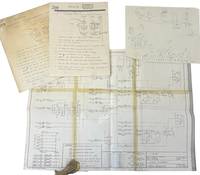
1974réf. 236291974. JRW Electronics' board level modification of Atari Pong to create Handicap Pong arcade conversion engineering archive 1974 documenting JRW Electronics' board level modification of Atari Pong during the first years of the commercial video game industry. The name "Handicap pong" originated with the intention to allow for gameplay to be adjusted so players of different skill levels preferences or abilities could compete on the same machine without replacing the original cabinet. The archive records the conversion of an existing Pong cabinet into Handicap Pong through revised controls altered circuitry and adjustable game parameters. The annotated sheets suggest professional technical use by a JRW technician installer or arcade service operator Archive of four technical documents Mountain View and Sunnyvale California 1974. 1 Logic Diagram. Pong Handicap. JRW Electronics Inc. drawing no. JRW 005 dated 8-6-74. Large engineering schematic titled Logic Diagram Pong Handicap identifying integrated circuit IC locations electrical signal paths wiring harness connections and required circuit board modifications. 2 Handicap Pong. JRW Electronics Inc. Sunnyvale California. Stapled three-page instruction packet titled in manuscript "Handicap Pong" with component-side diagrams showing the populated face of the printed circuit board and numbered steps for lifting IC pins from the board cutting printed copper traces replacing electronic components and adding jumper wires. 3 Handicap Pong. JRW Electronics Inc. Mountain View California. Stapled four-page instruction packet with manuscript check marks wire color assignments IC pin modifications underside wiring connections and a printed adjustment sheet for paddle position paddle centering and ball speed. 4 Single lined notebook sheet with hand-drawn wiring diagrams connector layouts and pin assignments. The documents record the engineering practice of the discrete logic era before microprocessor-based arcade games made software the primary means of altering game behavior. The conversion required physical intervention in the circuit: lifted IC pins cut printed traces substituted resistors and capacitors rerouted harnesses and recalibrated analog controls. JRW's kit belongs to the first commercial aftermarket for coin operated video games in which operators modified existing cabinets rather than purchasing complete replacements. Folding moderate toning edge wear old tape to the large schematic and manuscript annotations throughout. Overall good condition. A compact technical archive of early arcade hardware modification and pre microprocessor video game engineering. unknown books
réf. 171865Los Angeles: Antler Productions 1987. Shooting Script for the 1987 hybrid VHS board game copy belonging to screenwriter Stephen Sustarsic with manuscript pencil and ink annotations of his name and an address on the title page. An internally duplicated copy with the majority of pages with copied punch holes with occasional manuscript pencil annotations checking characters or scenes. A unique and important example of video game construction from the heart of its era one that pulled Sherlockiana into its concept. Deluxe 304-page script housed in a large generic pink three-ring binder with ten-page dividers nine labeled for each of the game's ten mysteries. Each mystery includes a title page noting screenwriters and draft date a one or two page Short Rundown and a cast page followed by the segment's script. Three "Promo" segments are interspersed throughout the script to assist and instruct players through gameplay. Bound in following the script is a six-page Staff List two copies of a 15-page Shooting Schedule dated 8/3/87 and a 15-page Shooting Schedule dated 8/7/87. Laid in the binder's pockets are two copies of a four-page Shooting Schedule dated 8/9/87 and a copy of directions to "The Complex" in West Los Angeles. "221B Baker Street" was a popular board game developed by Jay Moriarty and produced by Antler Productions in 1975 in which players solve up to 75 mysteries with Sherlock Holmes and his associate Dr. Watson by using clues provided by visiting locations on the game board and using Scotland Yard Badges and Skeleton Keys cards to control opponents' access to locations. In 1987 on the centennial anniversary of Arthur Conan Doyle's first published Sherlock story Moriarty and Antler released two new adaptations of the board game: a video game produced by Datasoft and a VCR board game the latter featuring ten new mysteries and a videocassette of dramatized briefings and reenactments-represented by the script on offer here. VCR board games were a short-lived fad in the mid-to-late-1980s in which board games would include a VHS tape to be played at certain points in the game to act as a timer reveal clues or advance a plot. The concept was an attempt by the game developers to remain relevant by incorporating the latest technological innovations prior to the ascension of modern video game consoles. Screenwriter and producer Sustarsic is best known as an Emmy Award winning screenwriter for the 1988-1991 animated Disney series "The New Adventures of Winnie the Pooh" the 2004 Independent Comedy Horror film "Lucky" and the 2017 animated Disney XD series "Xiaolin Chronicles - Special Edition." Other screenwriting credits from Sustarsic's 35 year career in television and film include episodes for "The Jeffersons" 1981 "One Day at a Time" 1982 "Alice" 1985 "Newhart" 1989 "Alf" 1990 and "Dilbert" 2000 among many others. Front wrapper integral with first uncredited title page dated 1987 noted as SHOOTING SCRIPT. Second title page dated 1987 with credits for screenwriters Mark Chambers Jay Moriarty and Stephen Sustarsic. 304 leaves with last page of text numbered 13. Xerographic duplication rectos only. Pages Near Fine overall with first title page separated housed in a Near Fine generic pink three-ring binder. Staff List and Shooting Schedules saddle-stapled with a single staple to the top left corner. Near Fine. Antler Productions unknown books
1975réf. 82543Bagnols-sur-Ceze: Guy Chambelland 1975. First Edition. No. 23 of 150 copies on pur fil de Lana signed by Simon and Rougemont of a total edition of 163 copies. Quarto; paper-covered boards with unbound text laid-in as issued; slipcase; 328pp; illus. A fine copy in the original board slipcase gently sunned at extremities else fine. Artist's book comprised of Simon's text set within color-printed abstract designs by Rougemont; serigraphically printed by Michel Caza. Text entirely in French. Guy Chambelland unknown books
1874réf. 774621874. Convicted for Poaching Trout Game Law. Great Britain. Notice of Conviction for Poaching Leek Staffordshire England June 8 1874. 13-1/4" x 8-3/4" 33.65 x 22.22 cm single sheet part-printed document on blue paper completed in manuscript wax seals at foot next to signatures. Horizontal fold line to center two minor creases to lower right corner. $150. Benjamin Alcock was convicted for poaching trout in a private stream owned by Richard Roscoe. The court at Leek gave him a fine of five shillings plus costs of one pound and sixpence. Alcock was further charged that he would be "imprisoned in the House of Correction at Stafford and . kept to hard labour for the space of seven days" if he failed to pay his fine. unknown books
réf. 231114Paris: Collection J. Hertzel & Cie. 1 vols. 8vo. Faux Red publisher's cloth binding marbled edges opening to marbled interior. About fine. 1 vols. 8vo. Collection J. Hertzel & Cie unknown books
1929réf. 302295Los Angeles 1929. 100 pp of typed documents and an additional 50 album leaves mounted with approximately 50 photographs various sizes and processes and various documents. Folio. Limp leatherette with title and recipient name stamped in gilt to upper cover. Large black quarter morocco clamshell box gilt. 100 pp of typed documents and an additional 50 album leaves mounted with approximately 50 photographs various sizes and processes and various documents. Folio. "It is proposed that a COMPLETE ZOOLOGICAL GARDENS be opened to the public on a fifty cent admission basis which is to be properly laid out as an attractive Zoological and Botanical Garden with the finest and largest private collection of animals birds and reptiles to be seen anywhere on the continent." The advent of the motion picture industry in California had many wide-ranging ramifications on the business world and one was that it created a new market for firms who traditionally supplied animals to circuses and zoos both public and private owned by the likes of William Randolph Hearst. This archive is a report by the Investment Auditors of California for the Horne Corporation that was looking to expand by establishing a zoological garden in the environs of Los Angeles. The Horne Corporation was the largest and most successful of its type at the time apparently the only company in the US that could completely outfit a circus with both animals and show equipment. They were to purchase the Los Angeles Zoological Garden and Jungle Studio for $250000 and thereby sought to provide a similarly complete service to the film studios with both animals and suitable locations for film sets. The head of the company I.S. Horne for whom this report was compiled commenced trading in animals from Kansas City MO around 1914. The range of animals at the their disposal included big game birds reptiles and many of the documents concern the prospect of importing reindeer from Alaska. The material is held in a presentation album and includes the certificate of incorporation in Wilmington Delaware May 13 1929 as well as the by-laws of the corporation minutes of the first meeting the proposal for Los Angeles Zoological Garden and Jungle Studio and a balance sheet. At this stage the company had total assets of $57700 & liabilities of $625388.46; an enumeration of the various animals in inventory including wildebeest sables leopard lynx Rhodesian baboons bushbaby and a large aardvark. Of real interest are the plans for the park including artist's impressions which would be furnished with circus attractions "Monkey Island" jungle setting for motion pictures and an acknowledgment that "before the introduction of the motion picture industry the art of showmanship was not quite so highly developed as it is today." In fact one of the first pictures they supplied animals for was - appropriately enough - Trader Horn which was nominated for the 1931 Academy Award for Best Picture. On a more practical level there is a "Descriptive Classification of Principal Commercial Wild Animals" which lists 340 different animals in some details. There is also an account of hunting wild animals in East Africa as well as a section on animals that have been trained to hunt by man. Furthermore there is also much correspondence which provides much insight into the game industry its clients and the prospects for its future. Horne's venture subsequently became known as the World Jungle Compound in Thousand Oaks California eventually being acquired by 20th Century Fox studios. This archive is a record of a new phase of the entertainment industry. unknown books
1874réf. 246686London: Chapman and Hall 1874. First edition secondary binding. vi 337. 1 vols. 8vo. Green cloth spine titled in gilt. Very good minor rubbing. First edition secondary binding. vi 337. 1 vols. 8vo. Tiger hunting in Central India with notes on leopard. The author "also relates numerous stories from other sportsmen focusing on hunting bear rogue elephant and the like" Czech. Czech Asia p. 2 Chapman and Hall unknown books
1772réf. 28703Paris: Chez Debure l'aîne 1772. 1 vols. 8vo. Contemporary stained calf citron morocco label spine gilt. Some rubbing surface worming on lower cover else very good. 1 vols. 8vo. Commentary on the environmental and game laws. Chez Debure l'aîne unknown books
1875réf. 37921Paris: M.J. & Cie 1875. 10 1/4 x 10 1/4 x 5 inches. Some minor wear. 10 1/4 x 10 1/4 x 5 inches. M.J. & Cie unknown books
1955réf. acs242Tampa Florida: Florida Grower Press Inc. 1955. Octavo navy blue cloth hardcover gilt lettering 208 pp. Very Good with light foxing age darkened spotting to endpapers. This volume of “Birds in Florida” has been especially prepared for Miss Lindy Fernandez and is given to her as a momento of Business Education Day. Illustrated in full color. Florida Grower Press, Inc., 1955. hardcover books
1905réf. 67842NP: T. W. Ingersoll 1905. Color stereoview 7 x 3 ½ inches two photographic images mounted side by side on card stock picturing a well-dressed hunter shotguns at his side sitting at the wheel of his period automobile; long caption verso describing the advantages of hunting from an automobile rather than a horse. Pencil markings at bottom of left image the mount rubbed. Still a good copy. T. W. Ingersoll unknown books
1925réf. 24468Montgomery AL: Dept. of Game & Fisheries Birmingham Printing Co. 1925. First edition. 8vo. 152 pp. Illustrated from wood engravings and photographs and paintings map. Good copy only. Original illustrated tan wrappers soiled edges somewhat chipped. 10717. Dept. of Game & Fisheries (Birmingham Printing Co.) unknown books
2013réf. UWYOWIL00acmfWyoming Game and Fish Department 2013. Very Good. Wyoming Game and Fish Department. Wildlife Crime: Stories from Wyoming's Wildlife Officers. Cheyenne Wyoming: Wyoming Game and Fish Department 2013. 208pp. Illustrated. 12mo. Paperback. Book condition: Very good with gentle rubbing. Wyoming Game and Fish Department paperback books
réf. 05401France: 1900. Les Trois Chats" A Delightfully Grotesque French Belle Époque Passé-Boules Carnival Game PASSÉ-BOULES GAME. Les Trois Chats. French hand-painted polychrome papier-mâché ball-toss carnival game. France ca. 1900. A remarkable surviving French passé-boules fairground game modeled as three wonderfully expressive cats arranged side by side each with a wide-open mouth forming the target through which the player was required to throw a ball. Hand-modelled and painted in polychrome papier-mâché over a wooden-supported structure measuring approximately 24 1/2 inches high × 23 5/8 inches wide × 5 7/8 inches deep 630 × 600 × 150 mm. The three feline heads are individually characterized with wonderfully exaggerated green eyes whiskers and large open mouths each approximately 2 1/2 inches 63 mm. across. The particularly splendid central gray cat wears a jaunty orange-and-blue striped hat prominently lettered "TOTO." The cats rest above three projecting differently colored receptacles - blue orange and yellow - with the respective scores "30" "50" and "20" painted beneath them. The higher-scoring central target is therefore appropriately occupied by the magnificently hatted Toto. The whole is reinforced by a simple wooden structure including boards at the base and upper portion while the projecting lower section forms the ball-catching receptacle. The reverse revealing the utilitarian construction of what was intended as a working fairground amusement survives substantially intact. The photographs also reveal the wonderfully irregular hand-modeled surfaces and surviving original polychrome decoration that give the three cats their extraordinary personalities. A remarkable survival of a French passé-boules carnival game from the Belle Époque. Passé-boules - literally games in which a ball was passed or thrown through an opening - were a familiar feature of French fêtes foraines and popular entertainments during the nineteenth and early twentieth centuries. Targets frequently took the form of grotesque or comic human and animal heads their exaggerated open mouths providing the aperture through which the player attempted to propel a small ball. Points were awarded according to the successful target as demonstrated here by the painted scores beneath the three cats. The present example is particularly appealing for its three anthropomorphic feline characters. Their exaggerated expressions brilliant green eyes and distinctly individual personalities inevitably recall the celebrated comic cats of Louis Wain 1860-1939. No attribution to Wain is intended but the comparison places the game delightfully within the wider late-Victorian and Edwardian fascination with humorous humanized cats. Unlike printed or manufactured toys intended for domestic use fairground games were working objects subjected to repeated handling impact transportation and exposure. Consequently early papier-mâché examples surviving substantially complete are inherently scarce. The survival here of the three original sculptural targets their painted decoration numbered scoring system and integral ball receptacle makes Les Trois Chats an unusually evocative piece of French popular entertainment. Its appeal lies equally as a folk-art sculpture fairground artifact and piece of feline whimsy: three gloriously eccentric cats who have apparently spent more than a century waiting for someone to throw a ball into their mouths. Provenance: Acquired in Paris directly from the family of the former owner by whom it was said to have descended from a grandparent who acquired the game around the turn of the twentieth century. France: , 1900 unknown books
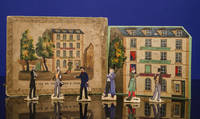
réf. 04338Paris: H. Duru 1840. A Remarkable Survival H. Duru's Apparently Unrecorded Le Jeu du Portier Complete with All Six Hand-Colored Standing Figures and the Original Pictorial Box FRENCH GAME. DURU H. publisher. Le Jeu du Portier. The Doorman's Game. Paris: H. Duru ca. 1840. An exceptionally rare early French hand-colored lithographed game complete with the original architectural playing board all six numbered standing figures and the original pictorial card box. Original hand-colored lithographed board depicting the façade of a Parisian multi-story house 8 3/4 x 6 3/4 inches; 222 x 172 mm. the upper right corner beveled as issued. Six original hand-colored lithographed cut-out figures each mounted on its original base average size 3 1/8 x 1 1/4 inches; 80 x 32 mm. Complete in the original card box the lid bearing a hand-colored lithograph depicting the same multi-story house and titled beneath "LE JEU DU PORTIER PAR H. DURU." The board and figures in near fine condition; the box somewhat soiled with the corners strengthened with cloth tape. A remarkable survival in substantially complete original condition. The architectural board represents a vertically organized Parisian apartment house its occupants and businesses identified floor by floor. It is lettered from top to bottom: "No. 6"; "No. 5 / Locart Fnt Lunetier au 3me"; "No. 4 / F. Sonnet M.de Dentelles"; "No. 3 / Clagmann et Cie. Banquiers"; "No. 2"; and "No. 1 / Loge du Portier." The six accompanying figures correspond to the numbered hierarchy of the building and are identified as: 1. Le Portier the doorman or concierge; 2. Propriétaire proprietor or landlord; 3. Banquier banker; 4. Marchand merchant; 5. Fabricant manufacturer; and 6. Ouvrier worker. The original printed numbers and occupational designations remain visible on the bases of the figures. The figures form a delightful miniature gallery of French social types: the prosperous Propriétaire in his vividly patterned blue coat; the top-hatted Banquier; the fashionably dressed Marchand carrying his hat; the Fabricant; the plainly dressed Ouvrier; and the Portier the indispensable guardian of the building. Their original hand-coloring remains remarkably fresh. More than simply a children's amusement Le Jeu du Portier presents in miniature a fascinating picture of nineteenth-century Parisian urban life and social hierarchy. Proprietor banker merchant manufacturer workman and concierge are transformed into movable characters associated with a single apartment house. The game belongs to the particularly appealing nineteenth-century tradition in which children's toys simultaneously entertained and introduced their young players to occupations social distinctions and the organization of contemporary life. The choice of the portier as the central character is especially evocative. Occupying the loge at street level the Parisian concierge stood literally at the entrance to the social world represented by the building controlling access and observing the comings and goings of its occupants. The numbered inhabitants ascending through the building consequently provide an engaging physical representation of the social structure of nineteenth-century Paris. H. Duru was a Parisian publisher active in the production of illustrated educational works children's books puzzles and games during the middle decades of the nineteenth century. Among Duru's publications were Nouvelle méthode de lecture progressive ou Lecture apprise en quarante jours Syllabaire universel en action Les homonymes illustrés Grammaire illustrée and Alphabet chantant. Duru's activity as a publisher of games is independently confirmed by another lithographed production Le Jeu du Touriste preserved in the collection of the Musée des Civilisations de l'Europe et de la Méditerranée Mucem. The survival of the six separate standing figures together with their architectural board and original pictorial box is exceptional. The standing figures are of particularly delicate construction consisting of thin lithographed card cut-outs mounted upright on their original bases - ephemeral playthings never intended to survive nearly two centuries of use. We have been unable to locate another example of Le Jeu du Portier in OCLC or in the institutional collections and published references consulted. Apparently unrecorded and possibly unique in this complete state. A remarkable and highly evocative survival of an early French children's game combining hand-colored lithography three-dimensional play and a wonderfully detailed representation of nineteenth-century Parisian social life. Paris: H. Duru, 1840 unknown books
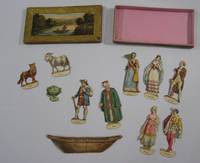
1825réf. 18320French: n.p. 1825. Very good. 11 engraved cut-out figures or objects including ferryman three couples wolf goat cabbage and boat to be slotted into boat original box with engraved pictorial label colored by hand A rare children's game possibly printed by the Parisian publisher Nepveau. Contained in the box measuring 14cm x 7cm x 1cm is a complete set of figures for the two river crossing puzzles known as the 'Jealous Husbands Problem' and 'Goat Wolf and Cabbage'. The earliest account of these puzzles is in the 9th century manuscript "Propositionnes ad Acuendos Juvenes" Problems to Sharpen the Young attributed to Alcuin. In both puzzles there are only two places in the boat. In the Jealous Husbands Problem no woman can be with another man unless also accompanied by her husband. In Goat Wolf and Cabbage the wolf will eat the goat and the goat will eat the cabbage unless they are guarded by the boatman. Originally accompanied by counters and an instruction sheet now lost. The box is lightly worn else in very good condition; the figures are in fine condition except the boat which has been repaired and the cabbage which lacks the lower part of its insertion tab and one female figure lacks a hand. Rare. n.p. unknown books
1990réf. 149761990. Higinbotham William A. Signed typescript of Frederic D. Schwartz's 1990 article on the origins of early video games documents the role of a nuclear physicist in the development of interactive electronic entertainment later associated with Pong. Higinbotham a scientist at Brookhaven National Laboratory created an oscilloscope-based tennis simulation in 1958 as part of public demonstrations designed to make atomic research accessible and non-threatening during the Cold War. The document situates the origins of video gaming within a government laboratory environment connected to earlier wartime research including instrumentation work linked to the Manhattan Project. The text provides primary evidence of how scientific expertise developed for military and nuclear purposes contributed to the emergence of recreational digital technologies. Higinbotham William A. Signed typescript of "Remember Pong" by Frederic D. Schwartz. New York: Invention and Technology Magazine 1990. Three pages signed on page three "Best Wishes William A. Higinbotham Feb. 8 1991." The article opens: "Remember Pong In 1972 it became the first successful video-arcade game. In reality though it was invented in 1958. by a man named William Higinbotham." The text describes Higinbotham's position overseeing instrumentation design at Brookhaven and explains the development of a "tennis game with the court displayed on an oscilloscope's screen." It further notes the institutional context of government employment stating that patent rights would have belonged to the federal government preventing personal ownership of the invention. Produced at the end of Higinbotham's life the signed typescript frames early video game history through the perspective of a scientist who had witnessed the first atomic test and later advocated for nonviolence and nuclear restraint. The article connects Cold War scientific culture with the emergence of interactive media emphasizing how technologies designed for warfare and research environments were adapted for public engagement and entertainment. Higinbotham's stated intention to create a nonviolent diversion underscores a countercurrent within late twentieth-century debates over digital media and violence positioning the document within broader discussions of ethics in technology development. Light wear from handling; stapled at upper left; text and signature clear; overall in very good condition. unknown books
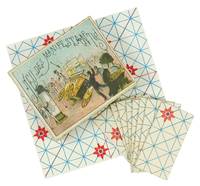
1895réf. 1270431895. Paris: n.d. ca 1895. Original box 85 x 73 x 20 mm covered in gilt-patterned paper with mounted color illustrated title on outside lid and printed instructions slip on inside lid. With 8 printed rectangular card game pieces plus the rare color printed solution sheet 120 x 120 mm folded twice. Minor split to one edge of the lid a few small tears to the sheet otherwise a very good and complete example of this rare and fragile game. § A very early apparently the first issue of this French "game of protesters" in which the player takes on the part of a police officer attempting to prevent people from assembling at a demonstration. Not located in OCLC although other searches reveal copies in the Indiana Lilly Library in the Jerry Slocum Mechanical Puzzle Collection one within a "coffret de jeu" a boxed group of puzzles and games at the Musée du Jouet de Poissy and another a variant in which the game pieces are triangular at the Marseille Musée des Civilisations de l'Europe et de la Méditerranée MUCEM. Later issues with varying artwork can also sometimes appear. The Marseille museum's copy featured in a forum held on February 5 2024: "Faut-il parler des violences policières" "Should we talk about police brutality". The curator Mireille Jacotin explained: "Jeu des manifestants is a game in which you are the hero that is to say the police officer and as the accompanying instructions explicitly state you are firmly positioned on the side of the public authority responsible for maintaining order. In reality the game consists of arranging a set of cardboard pieces-printed on a right-angled triangle-shaped board-in such a way as to ensure that no two red dots end up on the same line. The underlying concept is to simplify the police's task by ensuring that they do not face a mere undifferentiated crowd-and certainly not any organized lines requiring a tactical breach such as a battlefront during wartime. The game board features no specific characters; instead it presents a simple grid-comprising lines and sectors-that serves as a framework for devising and visualizing a strategic plan atop a generic cartographic representation of public space. The red dots in this scenario represent the demonstrators. On the lid of the box however is an urban scene: an overturned double-decker bus a urinal figures stirring in the distance and a policeman in the foreground." For the original French see https://www.davduf.net/le-jeu-des-manifestants-1895. It seems likely this game was inspired by the many protests that took place in Paris throughout the 1890s including the birth of the international May Day demonstrations. unknown books
1883réf. 4269Vienna: Militär - Wissenschaftlichen Vereines 1883. First Edition. 19th century marbled boards and linen backstrip. Good; two institutional stamps of the Officiers Bibliothek of the Bosn.- Herceg. Infant. Bat. #4 on the title page and a text page; some age toning; wear to the linen backstrip. 8vo 4 130 pp 11 charts some with outline color and maps with a printed pocket holder at the rear. The author was a colonel on the Austro Hungarian general staff and an authority on military science. The text is a very detailed and critical assessment of the usefulness and limitations of military war games e.g. the limitations of the use of dice in games of this kind based on the mathematical outcomes allowed. A rigorous critique. There are also lengthy descriptions of the combinations of troops terrain and actions based on chance. No American locations in OCLC and the five locations in Europe show at least two defective copies; absent from von Hilgers War Games - A History of War on Paper. Militär - Wissenschaftlichen Vereines hardcover books
1915réf. 6646New York: Garden City 1915. First Edition. orig. publisher's dec. cloth. A very good copy; some light wear to the top of the spine. 8vo. There are several inserted plates. An excellent compilation of golf stories. This copy is an association and was offered as a prize to William Gettinger of the Tampa Golf Club; it is also signed on the endpaper in 1916 by ten members of the club. The book has an illus. presentation leaf inserted before the text. Garden City hardcover books
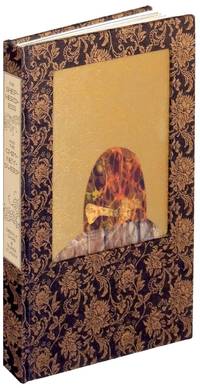
2012réf. 32906San Francisco: Deeply Game Publications 2012. Hardcover. Fine. Hardcover. Number 45 of 55 copies. Signed by the author and book artists. Book artist Sara Press collaborated with Andrew Rottner to create this exquisite tribute to printing's golden age. "The story by Christina Lauritsen mis-remembers H.C. Andersen's classic tale of the same name transforming it into a story of revelation and madness. The visual progression of the book mirrors the plot pitting the beauty of the decorative arts against the intense and unpredictable messiness of human experience. This book confronts the inevitability of loss and bows to intellectual freedom and its attendant risks." artists' statement. The book is printed in Garamond and Bembo types on Moab Entrada paper. It features two 26 inch wide foldouts with illustrations by Rottner. The striking cover is done from a cut-marbled-paper and brocade. The book measures 7 x 9 inches. It is unpaginated. Deeply Game Productions creates and distributes the art works of Sara Press and her collaborators. Sara L. Press is a photographer printmaker and book artist based in the San Francisco Bay Area. Many of her projects examine peculiar areas of overlap between nature and culture for example: dog fighting feral children and our co-evolution with snakes. Sara has also wrestled with the relationship between creativity and the scientific method. Recently Sara has turned to constructions of masculinity and femininity in our culture such as human bloodsports and altered fairy-tales. Her work can be seen in public collections around the country and are also in many library and private collections. A lovely book in fine condition. PRI/021919. Deeply Game Publications hardcover books
1946réf. 03869MR. REE Selchow & Righter ca. 1946 a very nice issue of this game with all pieces cards and board in fresh condition. The original box accompanies the game and exhibits some wear to the pictorial top section. The forerunner to CLUE. Selchow & Righter unknown books
1898réf. NF0052WHERE TO HUNT AMERICAN GAME United States Cartridge Co.1898 first edition a bright vg copy in gold-gilt stamped pictorial with over 125 illustrations. United States Cartridge Co. 1898 unknown books
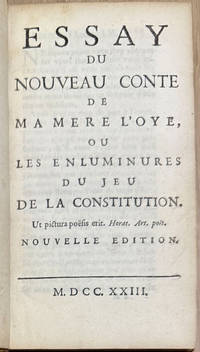
1723réf. Debonnaire1723GAME OF THE GOOSE Essay du nouveau conte de ma Mère l'Oye ou les enluminures du jeu de la Constitution by Louis Debonnaire. No imprint 1723. 8vo xiii xviii 176pp; early leather boards with original spine laid down. Despite the claim that this is a new edition it is nonetheless an UNCOMMON IMITATION of the traditional "Game of the Goose" a rhymed pastiche as if spoken by Mother Goose written by a Jansenist priest Abbot wherein one must win the formation of a new Council here referred to as a Constitution. It introduced what became a familiar catchphrase "LIBERTY EQUALITY FRATERNITY" condemned in 1725 as anti-Rome. Barber III 880 No imprint hardcover books
1899réf. 41810Wynkoop Hallenback Crawford Co. State Printers 1899. First edition. Cloth with gilt titles stamped in blind string tied. Maps very good with small splits at corner folds colors bright in very good portfolio with small soiled spot on front and some sunning to spine. 1 colored map on 2 joined sheets 102 x 121 cm. Each map is 32 3/4 x 25 1/2 inches. Issued in portfolio 9 1/4 x 5 3/4 inches with cover title: Map of the Catskill Preserve. Engraved by J.Y. McClintock and W.L. Lawton. Over four feet if joined scale is 1 inch to 2 miles. Shows patents lots names of landowners and town boundaries subdivided into tracts. Shows street names and railroads. Compiled from "Official Maps and Field Notes on file in the State Departments at Albany N.Y. by Authority of the Fisheries Game and Forest Commission." The first meeting of the Forest Preserve Commission was held on September 23 1885 and a tabulation of the state ownership did not exist yet; in 1892 the State provided $250 the Forest Commission "for completing the public path leading to the summit of Slide mountain Ulster County included within the preserve." and in a 1893 budget bill Chapter 726 the State provided $1000 "For the expenses of examination of title and survey of lands owned by the state on Slide Mountain in Ulster County and other parts of the Catskills." which lead to the creation of this first map of the Catskill Forest Preserve. Quite detailed and in remarkably good condition. Wynkoop Hallenback Crawford Co. State Printers hardcover books