[CARTES À JOUER ]Livre Rare Book

2 969 résultats
réf. 20410Asie, moitié du XIXe siècle. In-12 oblong, [48] ff., demi-percaline à coins chagrinée noire, plats de papier chagriné, étiquette "Carnet C2" au premier plat (reliure défraîchie mais solide, quelques taches, des cartes et/ou des ff. manquants).
1794réf. 114610London: John Wallis 1794. First Edition. Hardcover. Very Good. London John Wallis 24 December 1794. Overall dimensions 520 × 663 mm dissected into 16 panels and mounted on linen comprising a hand-coloured map engraved by McIntyre printed surface 380 × 530 mm with extensive letterpress text on either side. Paper slightly tanned with a few small marks including some inkspots creases tiny chips and scattered light foxing; top right-hand corner trimmed close with the text lightly shaved; cloth a little foxed and discoloured on the verso; overall in very good condition. An attractive Georgian board game with the winner being the first player to reach London. The letterpress gives rules for playing the game and details of the history and manufactures of the 117 towns mentioned. It is not necessarily accurate; for instance Henry VI not Henry IV was captured at Northampton by the Yorkists. We have traced several reissues of the game using the same plate but with some variation to the letterpress and this error appears in several of them. A spinner 'Totum' and counters were available for separate purchase and are not present in this instance. John Wallis hardcover
réf. 85059Paris, Opta (Collection "Aventures Fantastiques", AF N°8), 1972, petit in 8° reliure pleine toile rouge décorée de l'éditeur, jaquette rhodoïd, 380 page ; infime tache brune dans la gouttière.
réf. 46719Birmingham, Eley Game Advisory Station, Imperial Metal Industries (Paris, Cartoucherie Française), Automne 1965, in 8° broché, 60 pages ; illustrations.
1979réf. 786901979 Paris, Ministère de l'Environnement, 1979, in 8° broché, 276 pages ; nombreuses cartes.
1914réf. 801301914 Paris, Larousse, 1914, in 8° broché, 284 pages ; couverture très légèrement fanée.
1953réf. 97666Librairie Plon, coll. « Durel » 1953 In-8 24,5 x 18,5 cm. Reliure demi-chagrin havane à coins, dos à nerfs orné d’un motif doré, couvertures et dos conservés, tête dorée, 313 pp., illustré de croquis de Charles-Jean Hallo et de 8 photographies hors-texte, table des matières, table des photographies. Reliure légèrement frottée.
1861réf. 105281Paris, Aug. Aubry, Libraire, Aug. Durand, Libraire 1861 In-8 22 x 14 cm. Broché, couverture beige, titre en noir sur le dos et le premier plat, 159 pp., table. Exemplaire en bon état.
1952réf. 63021Paris: Imprimeurs L.I.E.S.A. 174 Quae de Jemmapes 1952. Oblong 4to. 9.25 x 7.75 in. 2 24 pp. colour-lithograph illustrations throughout 10 leaves unnumbered. consisting of 4 colour lithograph boards to cut out alphabet letters for playing 2 black & white lithograph letter pages for colouring cutting out themselves and playing word games 1 thick instruction leaf 3 printed leaves on blue- salmon- and green-tinted thin paper instruction sheets. Flexible boards colour-lithographed front cover rear board with model figures on verso to be cut out to create paper-engineered toys spiral metal comb binding as issued minor edgewear age toning still a VG and complete copy. First edition of this wonderfully illustrated and charming alphabet game/book featuring anthropomorphic letters in the “Kingdom of the Alphabet” set against the adventures of a Medieval/Renaissance Country of Vowels and the Isle of Consonants uniting over a banquet ball to form an alphabet. Marquet 1892-1984 and Desnoyer 1901-1988 were illustrators and miniaturists noted for their inventive games and illustrations who had originally designed this game/book in 1939. They were married to the well known painters Albert Marquet and Francois Denoyer respectively. Desnoyer a Russian-Ukrainian emigre from Kiev had originally landed in Bohemia by 1906 where she learned the Western alphabet and later settled in France. This particular copy not only features the four colour lithograph boards for children to cut out and play the suggested alphabet game but also the 2 additional boards for an adult word game and back board to create toys which are typically missing as are often the colour-tinted instruction sheets. Worldcat locates 4 copies U of WA & Princeton Incomplete Bibliotheque Nationale FR & Bibliotheque des Chiroux BE -- complete; See: Robert Bolick Books on Books Collection -- Souza Desnoyer and Marcelle Marquet Il etait une fois un alphabet 1951-2009 Dec. 22 2022. Imprimeurs L.I.E.S.A., 174, Quae de Jemmapes, hardcover
1870réf. 27855France 1870. Board game. Fine. A French childrens' board game complete with the folding board 10 number disks 6 wooden pieces the instruction sheet and box. The box is papered in apricot & gold spotted paper with an image on the cover of clowns ascending a pyramide and one tumbling down. The box measures 11 x 8". All in very good condition. unknown
1915réf. 20568New York: Kangaroo Corporation; Gray Lith. Co. 1915. A large laughing female kangaroo with a joey in her pouch who says "Be Happy at Home!" to another young kangaroo asking "Why such joy" decorates the triangular box lid of this amusing bright orange and purple 1915 peg board game. The playing board itself is framed with the text "You can't be blue if you KANGAROO. No trouble troubles you." The unusual triangular box features three kangaroos on the top lid with edges decorated with horse shoes and shamrocks on a purple ground. The instructions are printed on the under side of the top lid including the offer of a $500 reward. The Kangaroo Corporation offered the prize for any correct solution to the game which involves landing the King in Goal No. 14. "The above prize to be awarded January 15 1916." 25 numbered holes on the board with 12 small wooden pegs. The object of the game was to jump holes so that only the King remained in hole number 14 in the manner of Chinese checkers. Each side of the triangular box measures 9 1/4". The box printed by Gray Lith. Co. N.Y.;1915 copyright by the Kangaroo Corporation. The top lid with little scratch in the lower edge corners repaired with sticky tape. Previous owner signature verso of lower box. The board interior with color more vivid just a bit of wear around numbered peg holes. Not found on Trove. Kangaroo Corporation; Gray Lith. Co. unknown
réf. 5334Paris, Librairie Larousse, sans date. In-8, reliure de l'éditeur.
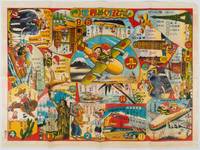
1960réf. 215411Japan.: No publication details. Circa1960. Very colourful folding sugoroku game sheet 45 x 61.4cm a little very light browning at margins very good copy. This vibrant sugoroku game sheet showcases playful illustrations of landscapes and cultures from around the world. The game begins in Japan where a boy and girl embark on an adventurous journey. Their first stop is the United States followed by rafting along the Amazon River. Along the way they explore Africa Europe India Australia and Sumatra. The journey concludes with their return to Japan by small plane. Through the game players experience a sense of global travel and gain insight into world geography. . No publication details. unknown
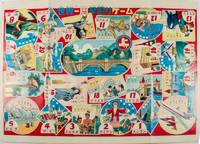
1960réf. 171593No publication details. Circa1960. Colourful folding sugoroku game sheet 55 x 79cm a fukuwarai game on reverse does not include face pieces. This is brightly coloured post-war sugoroku is a "round the world" game and this together with the fukuwarai game printed on the reverse would have been enjoyed by Japanese families during the new year celebrations. The game which is colourfully illustrated covers East Asia Southeast Asia New Guinea Africa Europe and North and South Americas with the final goal being returning to Japan and visiting the Royal Palace in Tokyo. The game was probably printed in the 1960s when overseas travel by jet plane was regarded as a possible dream for many Japanese people. On the reverse is a fukuwarai happy-laughter game where a blind-folded player places eyes nose mouth and other pieces on the faces outlined. . No publication details. unknown
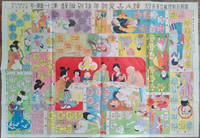
1419réf. 223794東京. Tokyo.: 実業之日本社. Jitsugyo no Nihonsha. Taisho 14 1925. Colour folding sugoroku game sheet 55 x 75.5 cm occasional browning visible on the reverse and a little on the margins but otherwise a very clean and good copy. The game follows a woman's life stages from her wedding to child birth as players progress each month from January to December. In addition daily and seasonal menus are included for each month. The breakfast and lunch menus given are in the main for Japanese dishes but occasionally western dishes such as croquettes and beef steaks appear for dinner. The beginning of the game is the woman's wedding in January. In March she is learning to cook. In April her husband helps cooking as she is suffering from morning sickness. The pregnancy progresses well and in December a baby boy arrives. The goal is a family tea party held in western style to welcome the baby. Both the husband and the wife are featured in illustrations and the companionship of marriage is emphasised as a source of family happiness. This colourful sugoroku game sheet was issued as a supplement to the January 1924 issue of Fujin Sekai Women's World. The magazine was founded in 1906 and was a very popular monthly magazine for women. . 実業之日本社. [Jitsugyo no Nihonsha]. unknown
2012réf. 26660Pasadena CA: Deeply Game Productions 2012. Hardcover. Near Fine. Hardcover. Number 1 of 7 copies. Signed and numbered by the book artist. Sara Press is a photographer printer and book artist whose work addresses science nature and the intricacies of our culture. This is a suite of four etchings by Ms. Press that depict contemporary mixed-martial-arts fighters. The accompanying text has been appropriated from a panther / bear fight advertising poster from the 1850s. The text describing animal fights is juxtaposed with the prints of human fighters to make an important statement on violence. The typeface is designed by Dan Mayer. Letterpress printed on a Vandercook No. 3 Proof Press. The loose prints and text pages are housed in a solid maple box with title burnt into the lid. Unpaginated. ARTISTSBOOKS/030613. Deeply Game Productions hardcover
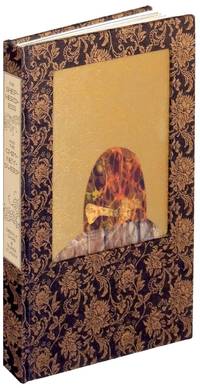
2012réf. 32906San Francisco: Deeply Game Publications 2012. Hardcover. Fine. Hardcover. Number 45 of 55 copies. Signed by the author and book artists. Book artist Sara Press collaborated with Andrew Rottner to create this exquisite tribute to printing's golden age. "The story by Christina Lauritsen mis-remembers H.C. Andersen's classic tale of the same name transforming it into a story of revelation and madness. The visual progression of the book mirrors the plot pitting the beauty of the decorative arts against the intense and unpredictable messiness of human experience. This book confronts the inevitability of loss and bows to intellectual freedom and its attendant risks." artists' statement. The book is printed in Garamond and Bembo types on Moab Entrada paper. It features two 26 inch wide foldouts with illustrations by Rottner. The striking cover is done from a cut-marbled-paper and brocade. The book measures 7 x 9 inches. It is unpaginated. Deeply Game Productions creates and distributes the art works of Sara Press and her collaborators. Sara L. Press is a photographer printmaker and book artist based in the San Francisco Bay Area. Many of her projects examine peculiar areas of overlap between nature and culture for example: dog fighting feral children and our co-evolution with snakes. Sara has also wrestled with the relationship between creativity and the scientific method. Recently Sara has turned to constructions of masculinity and femininity in our culture such as human bloodsports and altered fairy-tales. Her work can be seen in public collections around the country and are also in many library and private collections. A lovely book in fine condition. PRI/021919. Deeply Game Publications hardcover
2012réf. 26660Pasadena CA: Deeply Game Productions 2012. Hardcover. Near Fine. Hardcover. Number 1 of 7 copies. Signed and numbered by the book artist. Sara Press is a photographer printer and book artist whose work addresses science nature and the intricacies of our culture. This is a suite of four etchings by Ms. Press that depict contemporary mixed-martial-arts fighters. The accompanying text has been appropriated from a panther / bear fight advertising poster from the 1850s. The text describing animal fights is juxtaposed with the prints of human fighters to make an important statement on violence. The typeface is designed by Dan Mayer. Letterpress printed on a Vandercook No. 3 Proof Press. The loose prints and text pages are housed in a solid maple box with title burnt into the lid. Unpaginated. ARTISTSBOOKS/030613. Deeply Game Productions hardcover books
2012réf. 32906San Francisco: Deeply Game Publications 2012. Hardcover. Fine. Hardcover. Number 45 of 55 copies. Signed by the author and book artists. Book artist Sara Press collaborated with Andrew Rottner to create this exquisite tribute to printing's golden age. "The story by Christina Lauritsen mis-remembers H.C. Andersen's classic tale of the same name transforming it into a story of revelation and madness. The visual progression of the book mirrors the plot pitting the beauty of the decorative arts against the intense and unpredictable messiness of human experience. This book confronts the inevitability of loss and bows to intellectual freedom and its attendant risks." artists' statement. The book is printed in Garamond and Bembo types on Moab Entrada paper. It features two 26 inch wide foldouts with illustrations by Rottner. The striking cover is done from a cut-marbled-paper and brocade. The book measures 7 x 9 inches. It is unpaginated. Deeply Game Productions creates and distributes the art works of Sara Press and her collaborators. Sara L. Press is a photographer printmaker and book artist based in the San Francisco Bay Area. Many of her projects examine peculiar areas of overlap between nature and culture for example: dog fighting feral children and our co-evolution with snakes. Sara has also wrestled with the relationship between creativity and the scientific method. Recently Sara has turned to constructions of masculinity and femininity in our culture such as human bloodsports and altered fairy-tales. Her work can be seen in public collections around the country and are also in many library and private collections. A lovely book in fine condition. PRI/021919. Deeply Game Publications hardcover books
réf. 22540Paris, La Compagnie des libraires, 1764-1765. 2 vol. in-12, XXIV-590-XXXIX-[3] pp. + [4]-690 pp., basane marbrée havane, dos à nerfs orné de caissons dorés, pièce de titre rouge, pièce de tomaison verte, tranches rouges pour le 1er volume, tranches marbrées pour le second (exemplaire composite comprenant deux volumes à dates différentes, restaurations de la reliure du premier vol., quelques petits manques et épidermures, remboîtage du second vol., pièces de titre et tomaison manquantes au second vol.).
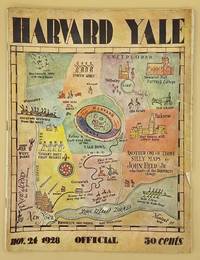
réf. 66643Yale University Athletic Association. Good. 160pp. Thin quarto 31 cm The front wrap is detached but present. The rear wrap is absent. Two small closed tears to the fore-edge of the front wrap. Scarce. Cover art by Utah artist John Held Jr. Utah Artist John Held Jr. 1889-1958 was a prominent illustrator of the 1920s and 1930s. He began by drawing sports and political drawings for The Salt Lake Tribune when he was just 16 years old. Held moved to New York City in 1910 where he went on to gain notoriety for his drawings in the popular magazines "Life" "The New Yorker" "Vanity Fair" "Judge" and "College Humor." His work epitomized the Jazz Age. He is most recognized for creating the short-haired "flapper." The cover of this publication features one of Held's maps. Held's maps illustrate the diversity of his art while at the same time serving to demonstrate Held's interpretation of various notable places and things. Kori Alexander writes in his article entitled Relevant Magic in the Art of John Held Jr. "While it was Held's caricatures of the young college chaps and flapper girls that earned him public notoriety it was his linoleum cuts and pen and ink maps that fortified his legitimacy as a social commentator." Virginia Commonwealth University website. Yale University Athletic Association unknown
réf. 66643Yale University Athletic Association. Good. 160pp. Thin quarto 31 cm The front wrap is detached but present. The rear wrap is absent. Two small closed tears to the fore-edge of the front wrap. Scarce. Cover art by Utah artist John Held Jr. Utah Artist John Held Jr. 1889-1958 was a prominent illustrator of the 1920s and 1930s. He began by drawing sports and political drawings for The Salt Lake Tribune when he was just 16 years old. Held moved to New York City in 1910 where he went on to gain notoriety for his drawings in the popular magazines "Life" "The New Yorker" "Vanity Fair" "Judge" and "College Humor." His work epitomized the Jazz Age. He is most recognized for creating the short-haired "flapper." The cover of this publication features one of Held's maps. Held's maps illustrate the diversity of his art while at the same time serving to demonstrate Held's interpretation of various notable places and things. Kori Alexander writes in his article entitled Relevant Magic in the Art of John Held Jr. "While it was Held's caricatures of the young college chaps and flapper girls that earned him public notoriety it was his linoleum cuts and pen and ink maps that fortified his legitimacy as a social commentator." Virginia Commonwealth University website. Yale University Athletic Association unknown books
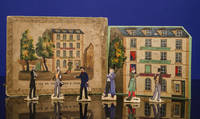
réf. 04338Paris: H. Duru 1840. A Remarkable Survival H. Duru's Apparently Unrecorded Le Jeu du Portier Complete with All Six Hand-Colored Standing Figures and the Original Pictorial Box FRENCH GAME. DURU H. publisher. Le Jeu du Portier. The Doorman's Game. Paris: H. Duru ca. 1840. An exceptionally rare early French hand-colored lithographed game complete with the original architectural playing board all six numbered standing figures and the original pictorial card box. Original hand-colored lithographed board depicting the façade of a Parisian multi-story house 8 3/4 x 6 3/4 inches; 222 x 172 mm. the upper right corner beveled as issued. Six original hand-colored lithographed cut-out figures each mounted on its original base average size 3 1/8 x 1 1/4 inches; 80 x 32 mm. Complete in the original card box the lid bearing a hand-colored lithograph depicting the same multi-story house and titled beneath "LE JEU DU PORTIER PAR H. DURU." The board and figures in near fine condition; the box somewhat soiled with the corners strengthened with cloth tape. A remarkable survival in substantially complete original condition. The architectural board represents a vertically organized Parisian apartment house its occupants and businesses identified floor by floor. It is lettered from top to bottom: "No. 6"; "No. 5 / Locart Fnt Lunetier au 3me"; "No. 4 / F. Sonnet M.de Dentelles"; "No. 3 / Clagmann et Cie. Banquiers"; "No. 2"; and "No. 1 / Loge du Portier." The six accompanying figures correspond to the numbered hierarchy of the building and are identified as: 1. Le Portier the doorman or concierge; 2. Propriétaire proprietor or landlord; 3. Banquier banker; 4. Marchand merchant; 5. Fabricant manufacturer; and 6. Ouvrier worker. The original printed numbers and occupational designations remain visible on the bases of the figures. The figures form a delightful miniature gallery of French social types: the prosperous Propriétaire in his vividly patterned blue coat; the top-hatted Banquier; the fashionably dressed Marchand carrying his hat; the Fabricant; the plainly dressed Ouvrier; and the Portier the indispensable guardian of the building. Their original hand-coloring remains remarkably fresh. More than simply a children's amusement Le Jeu du Portier presents in miniature a fascinating picture of nineteenth-century Parisian urban life and social hierarchy. Proprietor banker merchant manufacturer workman and concierge are transformed into movable characters associated with a single apartment house. The game belongs to the particularly appealing nineteenth-century tradition in which children's toys simultaneously entertained and introduced their young players to occupations social distinctions and the organization of contemporary life. The choice of the portier as the central character is especially evocative. Occupying the loge at street level the Parisian concierge stood literally at the entrance to the social world represented by the building controlling access and observing the comings and goings of its occupants. The numbered inhabitants ascending through the building consequently provide an engaging physical representation of the social structure of nineteenth-century Paris. H. Duru was a Parisian publisher active in the production of illustrated educational works children's books puzzles and games during the middle decades of the nineteenth century. Among Duru's publications were Nouvelle méthode de lecture progressive ou Lecture apprise en quarante jours Syllabaire universel en action Les homonymes illustrés Grammaire illustrée and Alphabet chantant. Duru's activity as a publisher of games is independently confirmed by another lithographed production Le Jeu du Touriste preserved in the collection of the Musée des Civilisations de l'Europe et de la Méditerranée Mucem. The survival of the six separate standing figures together with their architectural board and original pictorial box is exceptional. The standing figures are of particularly delicate construction consisting of thin lithographed card cut-outs mounted upright on their original bases - ephemeral playthings never intended to survive nearly two centuries of use. We have been unable to locate another example of Le Jeu du Portier in OCLC or in the institutional collections and published references consulted. Apparently unrecorded and possibly unique in this complete state. A remarkable and highly evocative survival of an early French children's game combining hand-colored lithography three-dimensional play and a wonderfully detailed representation of nineteenth-century Parisian social life. Paris: H. Duru, 1840 unknown
réf. 04338Paris: H. Duru 1840. A Remarkable Survival H. Duru's Apparently Unrecorded Le Jeu du Portier Complete with All Six Hand-Colored Standing Figures and the Original Pictorial Box FRENCH GAME. DURU H. publisher. Le Jeu du Portier. The Doorman's Game. Paris: H. Duru ca. 1840. An exceptionally rare early French hand-colored lithographed game complete with the original architectural playing board all six numbered standing figures and the original pictorial card box. Original hand-colored lithographed board depicting the façade of a Parisian multi-story house 8 3/4 x 6 3/4 inches; 222 x 172 mm. the upper right corner beveled as issued. Six original hand-colored lithographed cut-out figures each mounted on its original base average size 3 1/8 x 1 1/4 inches; 80 x 32 mm. Complete in the original card box the lid bearing a hand-colored lithograph depicting the same multi-story house and titled beneath "LE JEU DU PORTIER PAR H. DURU." The board and figures in near fine condition; the box somewhat soiled with the corners strengthened with cloth tape. A remarkable survival in substantially complete original condition. The architectural board represents a vertically organized Parisian apartment house its occupants and businesses identified floor by floor. It is lettered from top to bottom: "No. 6"; "No. 5 / Locart Fnt Lunetier au 3me"; "No. 4 / F. Sonnet M.de Dentelles"; "No. 3 / Clagmann et Cie. Banquiers"; "No. 2"; and "No. 1 / Loge du Portier." The six accompanying figures correspond to the numbered hierarchy of the building and are identified as: 1. Le Portier the doorman or concierge; 2. Propriétaire proprietor or landlord; 3. Banquier banker; 4. Marchand merchant; 5. Fabricant manufacturer; and 6. Ouvrier worker. The original printed numbers and occupational designations remain visible on the bases of the figures. The figures form a delightful miniature gallery of French social types: the prosperous Propriétaire in his vividly patterned blue coat; the top-hatted Banquier; the fashionably dressed Marchand carrying his hat; the Fabricant; the plainly dressed Ouvrier; and the Portier the indispensable guardian of the building. Their original hand-coloring remains remarkably fresh. More than simply a children's amusement Le Jeu du Portier presents in miniature a fascinating picture of nineteenth-century Parisian urban life and social hierarchy. Proprietor banker merchant manufacturer workman and concierge are transformed into movable characters associated with a single apartment house. The game belongs to the particularly appealing nineteenth-century tradition in which children's toys simultaneously entertained and introduced their young players to occupations social distinctions and the organization of contemporary life. The choice of the portier as the central character is especially evocative. Occupying the loge at street level the Parisian concierge stood literally at the entrance to the social world represented by the building controlling access and observing the comings and goings of its occupants. The numbered inhabitants ascending through the building consequently provide an engaging physical representation of the social structure of nineteenth-century Paris. H. Duru was a Parisian publisher active in the production of illustrated educational works children's books puzzles and games during the middle decades of the nineteenth century. Among Duru's publications were Nouvelle méthode de lecture progressive ou Lecture apprise en quarante jours Syllabaire universel en action Les homonymes illustrés Grammaire illustrée and Alphabet chantant. Duru's activity as a publisher of games is independently confirmed by another lithographed production Le Jeu du Touriste preserved in the collection of the Musée des Civilisations de l'Europe et de la Méditerranée Mucem. The survival of the six separate standing figures together with their architectural board and original pictorial box is exceptional. The standing figures are of particularly delicate construction consisting of thin lithographed card cut-outs mounted upright on their original bases - ephemeral playthings never intended to survive nearly two centuries of use. We have been unable to locate another example of Le Jeu du Portier in OCLC or in the institutional collections and published references consulted. Apparently unrecorded and possibly unique in this complete state. A remarkable and highly evocative survival of an early French children's game combining hand-colored lithography three-dimensional play and a wonderfully detailed representation of nineteenth-century Parisian social life. Paris: H. Duru, 1840 unknown books
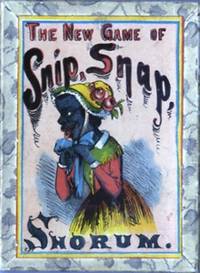
1890réf. 510171890. Deck of 20 illustrated playing cards 3 5/8 x 2 9/16 inches hand-colored with 2 card with printed game instructions. All housed in the original box with color printed label on the lid. A few cards have light soiling or foxing as does the blank paper of the box. Near fine. The game or Snip Snap Snorum has its roots in the late 18th century and was popular throughout the 19th century. It is basically a stops game in which cards are played in ascending sequence in suit. This version has five suits each containing four cards. Of these two suits depict stereotyped images of blacks with ridiculous racist names. unknown