2 574 résultats
1930réf. 617261930 P., Durville, sans date (vers 1930), in 12 broché, 344 pages.
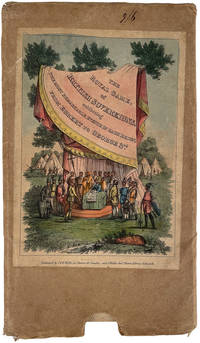
1820réf. 21196041820. Published by J. & E. Wallis 42 Skinner Street London and J. Wallis Junr. Marine Library Sidmouth. 1820. Original engraved sheet game circa 61 x 46cm mounted in sections on original linen folded and housed in the original buff card slipcase with publisher's onlaid engraved and handcoloured pictorial label to one side; a striking and decorative Georgian table or chase game which is composed of 53 pictorial compartments surrounding the elaborately engraved title and printed rules of the game; both game and slipcase in uncommonly fresh condition with some slight toning dusting and a few marks and some light staining to the reverse side the slipcase in unusually fresh condition; scarce in this condition; without the additional explanatory rules booklet which is frequently the case.Third edition with No 53 described in the rules as ""1820. Buonaparte on board the Bellerophon"". Later editions of the book of rules have 3 spaces added: 54. George IV. Plans of London Improvements submitted to the King; 55 William IV. Negro Slavery abolished throughout the British Dominions; 56 Victoria l. May her reign be long and happy. The game would have required a teetotum and counters but these were not supplied by the publisher Whitehouse 25. unknown
réf. 49543P., Nouvelles Editions de la Toison d'Or, 1950, grand in 4° broché, 179 pages ; couverture illustrée.
réf. 12891Christian Prigent, Jean-Luc Steinmetz (sur Artaud), Jean-Pierre Verheggen, William Burroughs, Michel Thévoz (« Les écrits de Jules Doudin »), Philippe Muray, Valère Novarina, Denis Roche, Claude Viallat. Très bon état.
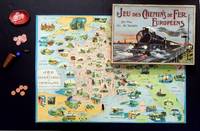
1920réf. 3220195Two-fold chromolithograph playing board measuring approximately 85.5 × 61.5cm 6 metal Locomotive playing pieces 30 counters two shakers a dish and two dice one a later replacement; all contained within the original box 45 x 33cm lid with pictorial scene of a locomotive outside Paris the Eiffel tower visible in the distance with the printed rules pasted to underside of lid some rubbing to extremities but overall in very good original condition. A wonderful railway game beautifully illustrated taking players from Paris space 1 on route's through France her neighbours and beyond. The mechanic is roll and move as in the Goose-type games. If you land on a red space you are penalised but landing on green you get some assistance. The publisher reports the game will be most instructive not only for learning about French towns but also about the towns in neighbouring countries. The toy and games maker Saussine were established in 1860 by Léon Saussine after he had acquired the prolific children's bookseller and publishers Hugues-Marie Duru at the rue du Cloitre Saint-Jacques in Paris. Saussine developed the business making board games card games and puzzles but also began producing shadow theatres under the mark 'LS edit Paris'. Like most such enterprises Saussine thought up ideas for his wares and employed various specialist manufacturers in France Belgium and Germany to construct them. After Léon's death in 1896 his widow continued to run the business until her sons George and Maurice were able in their turn to take over the reigns in 1916. They were then succeeded by a grandson of the founder in 1944 the company continued to supply the marketplace until around 1964. Saussine Ed.
1950réf. 18318Monsterbeskyttet: Kaj Kjeldsen No date circa 1950. The game board with an impressive pop-up circus tent featuring Dumbo in the center preparing for his famed “burning building leap” and decorated with colorful characters from the movie. Included game pieces featuring colourful characters and an instruction sheet in Danish. 19 by 19 inches fold-up cardboard game board and a colorful pictorially decorated paper-board box containing the Dumbo playing pieces a die and an instruction sheet. One sheet of playing instructions in Danish. The pop up board is in lovely condition some wear to the small box of playing pieces. A WELL-PRESERVED DISNEY GAME and one featuring one of the studio’s most beloved animal characters. Dumbo is of course the baby elephant who could fly. Although the rules are in Danish the game is fairly simple to figure out and appears to be essentially complete. The main attraction here however is the fabulous pop-up circus scene which serves as a centerpiece to the playing-board. Kaj Kjeldsen] unknown
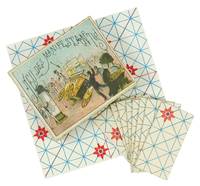
1895réf. 1270431895. Paris: n.d. ca 1895. Original box 85 x 73 x 20 mm covered in gilt-patterned paper with mounted color illustrated title on outside lid and printed instructions slip on inside lid. With 8 printed rectangular card game pieces plus the rare color printed solution sheet 120 x 120 mm folded twice. Minor split to one edge of the lid a few small tears to the sheet otherwise a very good and complete example of this rare and fragile game. § A very early apparently the first issue of this French "game of protesters" in which the player takes on the part of a police officer attempting to prevent people from assembling at a demonstration. Not located in OCLC although other searches reveal copies in the Indiana Lilly Library in the Jerry Slocum Mechanical Puzzle Collection one within a "coffret de jeu" a boxed group of puzzles and games at the Musée du Jouet de Poissy and another a variant in which the game pieces are triangular at the Marseille Musée des Civilisations de l'Europe et de la Méditerranée MUCEM. Later issues with varying artwork can also sometimes appear. The Marseille museum's copy featured in a forum held on February 5 2024: "Faut-il parler des violences policières" "Should we talk about police brutality". The curator Mireille Jacotin explained: "Jeu des manifestants is a game in which you are the hero that is to say the police officer and as the accompanying instructions explicitly state you are firmly positioned on the side of the public authority responsible for maintaining order. In reality the game consists of arranging a set of cardboard pieces-printed on a right-angled triangle-shaped board-in such a way as to ensure that no two red dots end up on the same line. The underlying concept is to simplify the police's task by ensuring that they do not face a mere undifferentiated crowd-and certainly not any organized lines requiring a tactical breach such as a battlefront during wartime. The game board features no specific characters; instead it presents a simple grid-comprising lines and sectors-that serves as a framework for devising and visualizing a strategic plan atop a generic cartographic representation of public space. The red dots in this scenario represent the demonstrators. On the lid of the box however is an urban scene: an overturned double-decker bus a urinal figures stirring in the distance and a policeman in the foreground." For the original French see https://www.davduf.net/le-jeu-des-manifestants-1895. It seems likely this game was inspired by the many protests that took place in Paris throughout the 1890s including the birth of the international May Day demonstrations. unknown books
1895réf. 1270431895. Paris: n.d. ca 1895. Original box 85 x 73 x 20 mm covered in gilt-patterned paper with mounted color illustrated title on outside lid and printed instructions slip on inside lid. With 8 printed rectangular card game pieces plus the rare color printed solution sheet 120 x 120 mm folded twice. Minor split to one edge of the lid a few small tears to the sheet otherwise a very good and complete example of this rare and fragile game. § A very early apparently the first issue of this French "game of protesters" in which the player takes on the part of a police officer attempting to prevent people from assembling at a demonstration. Not located in OCLC although other searches reveal copies in the Indiana Lilly Library in the Jerry Slocum Mechanical Puzzle Collection one within a "coffret de jeu" a boxed group of puzzles and games at the Musée du Jouet de Poissy and another a variant in which the game pieces are triangular at the Marseille Musée des Civilisations de l'Europe et de la Méditerranée MUCEM. Later issues with varying artwork can also sometimes appear. The Marseille museum's copy featured in a forum held on February 5 2024: "Faut-il parler des violences policières" "Should we talk about police brutality". The curator Mireille Jacotin explained: "Jeu des manifestants is a game in which you are the hero that is to say the police officer and as the accompanying instructions explicitly state you are firmly positioned on the side of the public authority responsible for maintaining order. In reality the game consists of arranging a set of cardboard pieces-printed on a right-angled triangle-shaped board-in such a way as to ensure that no two red dots end up on the same line. The underlying concept is to simplify the police's task by ensuring that they do not face a mere undifferentiated crowd-and certainly not any organized lines requiring a tactical breach such as a battlefront during wartime. The game board features no specific characters; instead it presents a simple grid-comprising lines and sectors-that serves as a framework for devising and visualizing a strategic plan atop a generic cartographic representation of public space. The red dots in this scenario represent the demonstrators. On the lid of the box however is an urban scene: an overturned double-decker bus a urinal figures stirring in the distance and a policeman in the foreground." For the original French see https://www.davduf.net/le-jeu-des-manifestants-1895. It seems likely this game was inspired by the many protests that took place in Paris throughout the 1890s including the birth of the international May Day demonstrations. unknown
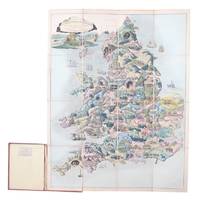
réf. AQ30350London: Published by Edward Wallis 42 Skinner Street s.d. c. 1840 Elaborately lithographed aquatint folding sheet dissected into 16 and mounted on linen bound within original publisher's gilt-lettered blind-tooled cloth folding case. The case a trifle marked lacking ties with some cracking to hinges internally; very occasional marking to map-sheet itself. Without the rare instruction book or draw cards. A well-preserved example of an obscure early nineteenth-century educational map game - issued by Edward Wallis 42 Skinner Street - wherein the player is instructed through play and vignette illustrations in the notable towns and principal economic outputs of the different English and Welsh counties. Dorset for example features images of coopers i.e. making barrels and dairy maids; whilst the topography of Cornwall is dominated by an illustration of copper mining. Other counties feature cathedrals Such as Winchester and factories. The aim of the race was to progress through the counties which are numbered with Essex as 1 and Kent as 150 the moves determined by drawing cards; the answering of questions related to the county of landing would also allow players to progress more rapidly. Edward Wallis was one of two of the sons of John Wallis d. 1818 the prolific London board game book map and print seller to follow him into the publishing business. He operated on his own account from 42 Skinner Street between 1818 and 1847. . Dimensions 520 x 660mm unfolded 140x180mm folded. Published by Edward Wallis, 42 Skinner Street, [s.d., c. 1840] hardcover
réf. 200507968Bruxelles, DARGAUD, 1977 ; in-4, 46 pp., br. RÉEDITION.
1889réf. 59410Paris: n.p. 1889. 4to. 10.5 x 10.75 in. Six individual puzzles individually postcard sized approx. 3.5 x 4.75 in. w/ colour chromolithograph image dissected onto nine wooden pieces each 1 small piece has been supplied in facsimile for upper corner of the Cairo street puzzle. All contained w/in the original deep red paper-covered wooden box raised bed w/in the box to hold the puzzles lid w/ decorative gilt title lettering minor shelfwear very minor rubbing still a VG nearly complete artifact. Very scarce original souvenir puzzle game issued for the fourth great Paris World’s Fair celebrating through pomp and events the Centennial of the French Revolution and the storming of the Bastille. The Exposition was intended to pull France out of a ruinous recession and attracted over 61000 exhibitors as well as 32 million visitors many of whom came to view the iconic Eiffel Tower. This puzzle celebrates several of the pavilions at the Exposition including Palais des Beaux-Arts designed by Joseph Brouvard filled with painting and flanking the Eiffel Tower providing visitors; the Palais de Trocadero held over from the famed 1878 Exposition celebrating the renewal of Paris following the Franco-Prussian War; as well as the Ministere de la Guerre which featured an Arms & Armour exhibition as well as displays of knightly tournaments assorted uniforms and cannon. The Maison Egyptienne and Rue au Caire would fuel the Orientalist movement and fascination with the Middle East among artists writers and the industrial arts well into the 20th Century. These boxed puzzle games were quite popular souvenirs as well as educational tools in the Belle Epoque and have become remarkably scarce. No copies in Worldcat. n.p., unknown
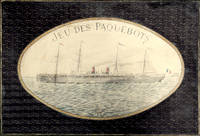
1897réf. 2210164Comprising two coloured map board 66 x 99 cm folding down to 32.5 x 49.5 cm one cloth hinge broken; 14 route cards; a barometer dial 19 x 19 cm with gilt metal spinning arrow some abrading from use; eight painted white metal playing pieces in the form of ships contained in the original small box one piece not original; 16pp booklet of instructions bound in original light green printed wrappers; all contained in the original box 35 x 52 x 5 cm; the hinged lid with a large coloured lithograph title label showing the 'Normandie' leaving port at full steam some minor abrasions but overall in good condition. Jue des Paquebots was something new to games when it was published in 1897 as each player moves their boats on large maps exactly replicating the routes taken by two major French shipping lines. The game includes two large folding boards designated 'Carte A' which illustrates the Atlantic shipping lines the other 'Carte B' with the shipping lines leaving Marseilles in the direction of the Black Sea the Indian Ocean and the Pacific. Rather pointedly the instructions state that the two maps include only the French shipping lines of the Messageries Maritimes and the Cie Générale Transatlantique the United Kingdom then the leading maritime nation is neither shown on the maps nor mentioned. The players first decide which map they are going use and then select or bid one of the Itinerary cards 8 for map A and 6 for map B. The aim of each player is to complete the journey indicated by their itinerary and then make the return voyage; the first player to complete this double crossing wins. However the number of stopovers is not equal for each different itinerary in play. In order to equalise the chances of winning the players with the fewer ports of call have to repeat their journey a second or even a third time if necessary until the number of ports visited or passed by them in these different routes equates to the number of ports of the busiest route. The routes all follow those which the two major French shipping companies plied. These include final destinations at Yokohama Australia New Zealand Zanzibar Odessa Buenos Ayres New York and the Antilles. Each player places a ship playing piece at port at the beginning of their route. The first player now spins the Barometer Dial which has outer and inner instructions that allows them to advance out of port when their turn come around again the arrow is again spun and the player can read the inner line of instructions and so advance 1 2 or 3 ports along their route. However there are also stops on the Barometer Dial that include Damage - where you go back to the previous port and pay a token to the bank; Heavy Fog - where you are left stranded until the next round; Collision - this allows another turn of the dial but it the result is 50/50 chance of being sunk and thrown out of the game - you can pay for another ships so all is not lost; Call for Distress - also misses a turn; Shipwreck - something like collision although you can start out again with a new ship and no fine; Rescue - also causes the player to miss a turn; lastly and somewhat topical there is Quarantine - here the player misses a turn and also has a second spin of the arrow to determine if you can go into port or not. The lid of the box illustrates the Cie Général Transatlantique liner La Normandie that plied the North Atlantic to New York in the summer and the south Atlantic in the winter - the ship sports a US flag on the foremast and the makers initials on the aft mast. Built in 1886 it was the largest and fastest liner of the company and was originally named 'Ville de New York.' It was also lit by electricity and could carry 1000 passengers and became the model for several sister ships built to the same plan. The maker Charles Watilliaux succeeded the games manufacturer Coqueret in 1874 and for the next 35 years became a major publisher and manufacturer of board games and toys until their acquisition by Revenaz & Tabernat. His registered initials were 'W.X.' which is slightly modified for the flag on the box lid as C.W.X. Watilliaux, éditeur.
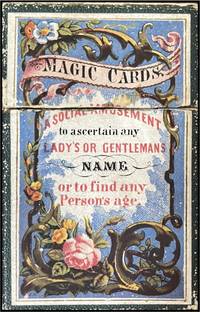
1850réf. 19999England 1850. 18 cards 89 x 54 mm 9 printed on pink cardstock and 9 on yellow. Housed in original slipcover made of pebbled green paper over boards with chromolithographed label affixed to the front open at top and bottom. Light wear to edges of slipcover otherwise in excellent condition. A charming and unusual magic card game based on mathematical principles that purports to reveal anyone’s name and age. Using the pink cards for women and yellow for men the questioner holds onto the instruction and key cards and gives the player the rest of them which have lists of names and numbers and the letters A E I O U W and Y at the top. The player tells the questioner the letters corresponding to which cards have their name on them and using the key the questioner adds their corresponding numbers to get the player’s name provided it is one of the 127 names listed. The game is played the same way to determine players’ ages. The game actually works! unknown books
1850réf. 19999England 1850. 18 cards 89 x 54 mm 9 printed on pink cardstock and 9 on yellow. Housed in original slipcover made of pebbled green paper over boards with chromolithographed label affixed to the front open at top and bottom. Light wear to edges of slipcover otherwise in excellent condition. A charming and unusual magic card game based on mathematical principles that purports to reveal anyone’s name and age. Using the pink cards for women and yellow for men the questioner holds onto the instruction and key cards and gives the player the rest of them which have lists of names and numbers and the letters A E I O U W and Y at the top. The player tells the questioner the letters corresponding to which cards have their name on them and using the key the questioner adds their corresponding numbers to get the player’s name provided it is one of the 127 names listed. The game is played the same way to determine players’ ages. The game actually works! unknown
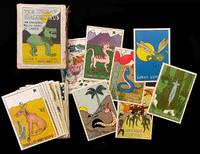
1923réf. 3210241Complete set of 48 cards 93 x 62 mm including 4 'Privilege Cards' marked with a star; folded sheet of rules; contained in the original purple card slipcase 98 x 76 x 25mm illustrated title label. A round game based on nonsense names of creatures probably the name The Great Galumphus derived from invention of the word 'galumph' by Lewis Carroll for Through the Looking Glass of 1872. Certainly all the other named creatures whose images decorate the cards are each in the same nonsense fashion and include the Crowned Cornubian Tasselled Snort Hound Bubbling Water-Hog Pushfoot Polliwog Climbing Chumtrunk Painted Pooh-Pooh Cissling Sand-Snapper Hairless Hunkum Flying Umbratunk Long Eared Scootler Scru-Wuzzium Lunar Lumpkin Putty Faced Popcat and Spotted Sniffle-Grub. This is a memory game where the players have to claim cards from their opponents after they have been turned over with a set of cards needed to become the winner. Jaques as a games maker had been established in 1795 however it was John Jaques II in the mid Victorian era who is credited with inventing such perennials as Happy Families Tiddledywinks Ludo and Snakes and Ladders where the company's fame was most in the ascendent. We have not been able to trace Miss Jessie Veal but wonder if she actually lived in some part of the far flung British Empire the animals and exotic scenery tend strongly to support this idea. Published by J. Jaques & Son Ltd.,
1915réf. 57029Helena MT: Independent Publishing Co. 1915. 8vo. 88 pp. Photo illustrations tables historiated vignettes at upper fore-edges of text pages throughout. Beige-printed softcovers salmon-coloured outline map of Montana on front cover border in burgandy minor chipping head & foot of spine & to couple corners minor dustsoiling still VG- copy. First edition of this exceedingly scarce original and well illustrated report. The Montana Legislature in 1913-1914 codified a number of fish and game laws and established the Game and Fish Commission in order to adjust hunting seasons bag limits license hunters and fishermen who were rapidly decreasing the numbers of game animals and fish as well as try and legislate against water pollution through cyanide and other pollutants introduced by mining interests in the State. Montana had established a number of fish hatcheries to feed many of the small landlocked lakes & ponds which were rapidly being depleted by intrepid sportsmen dynamiting the habitats and harvesting the fish. There are descriptions of hunting bear in Flathead County with a photo of the “Famous Lady Hunter” standing over her trophy; descriptions of deer hunting and remonstrations against poachers especially with those continuing to kill the “Bull Moose” which had been barred by State law. Of additional interest are the photos and detailed description of the Montana State “Fish Car ‘Thymallus’” featuring banks of specially fitted aerated aquariums for transporting hatchery fish for license paying sportsmen followed by tables of the 10s of 1000s of fish released. Also included are statistics on poaching arrests jail sentences and fines. Worldcat locates copies UCLA NOAA Woods Hole Yale holds an edition issued in 1914 for the Northern Pacific Railway with 75 pp.; See: Diann Ericson The Legislative and Political Development of the Montana Department of Fish Wildlife and Parks 1895-1921: A Case of Cultural Heritage 1994. Independent Publishing Co., paperback
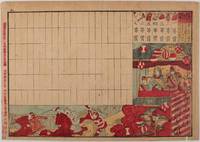
1892réf. 215726大野栄吉. Ōno Eikichi. Meiji 25 1892. Colour woodblock print 22.8 x 32.5cm evenly browned few chips in margins but overall very good. This colourful woodblock print serves as a point sheet for a horse racing board game. While the game rules are unclear the print vividly captures an exciting race scene featuring three horses and their jockeys. The race unfolds in a festive atmosphere complete with blossoms and lanterns while the spectators appear to include the Meiji Emperor and Empress along with their entourage. The Emperor is depicted in full military uniform and the Empress is shown in a traditional kimono. The print also displays the prizes for first through seventh place which include a silver cup a trophy a riding cap a scarf a shoe and a whip. Western-style horse racing began in Japan in the mid-19th century following the arrival of Westerners and became a high-class social event during the Meiji period. . 大野栄吉. [Ōno Eikichi]. unknown
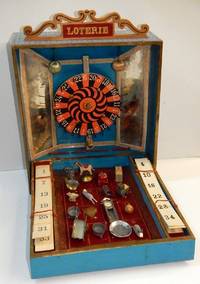
1900réf. 2210013Wooden box 32 x 26 x 8 cm with light blue patterned paper covering; the lid with a label lettered 'Loterie' and a hinged pierced wooden sign with the words 'Loterie' lettered in gilt paper on red; the lined paper interior with a central mounted wheel between mirrored sides and two hanging silk balls; the fall front where the prizes are held with two spaces left and right containing six lottery cards one from another set together with 16 toy prizes as listed below. Lottery or carnival wheels games became popular at the end of the nineteenth century. Their construction was more complicated than heretofore with the addition of a rotating wheel with pins with a 'clack' mechanism sounding as the wheel is spun. The numbers on the wheel are randomly arranged from 0 through to 25 in white on alternating in black and red ground - clearly based on the 'single zero' form of roulette wheel that became the norm in Europe from the middle of the nineteenth century. The design has a second purpose as the box is hinged so that open it is given the form of a fairground entertainment with an assortment of prizes laid out in a display on squares below the wheel that each have a number too. The idea of the game is twofold firstly as the wheel is spun and numbers called out the player who first completes a card of numbers is the winner. In the second game when the numbers 1 to 16 are called out and a player has the number on one of the cards they can then claim one of the small toy prizes. The sixteen twenty assorted of toy prizes include: a handcart wall clock bracelet scales pram wooden top bracelet fairground horse two rabbits a chicken a dish a parcel a metal top metal puzzle pair antimony jardinieres and a heart broach. There is no makers name and the design although of a solid construction is nevertheless probably a bespoke production possibly made in order to be sold through fairgrounds and market stalls rather than the more salubrious emporia for children. The interior is lined in turquoise paper with bevelled mirrored silvered card sides and although simple the idea was glittery enough to catch any passing child's attention.
2007réf. LFA-126742136Revue de 32 pages, format 210 x 270 mm, illustrée, brochée, bon état
réf. 201807038Geneve, Collection eldorado - Les humanides associes, 1989 ; in-4, 48 pp., cartonnage de l'éditeur. En bon état - E.O.
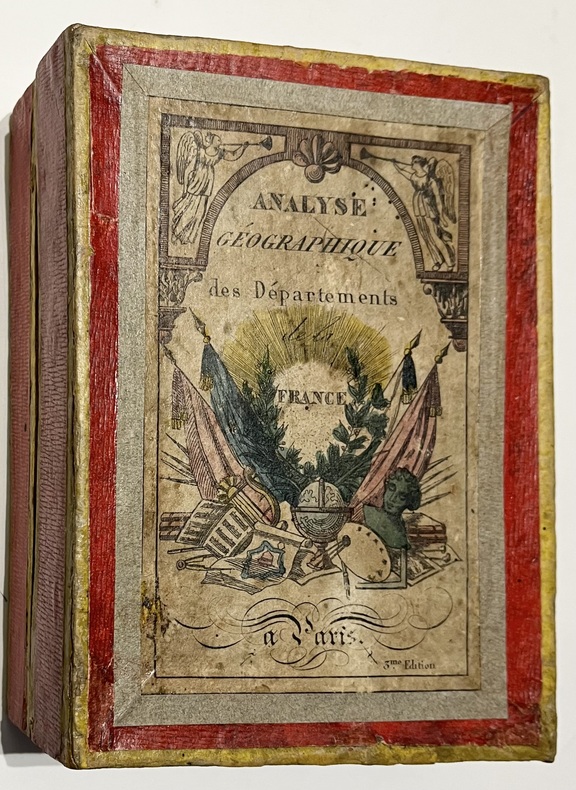
1836réf. 5579Paris, Bourrut Lemerie, [circa 1836]. 1836 Jeu de 90 cartes (132 x 82 mm). (quelques rousseurs) 1 boite d'origine (160 x 120 mm) en carton recouverte de papier rouge, titre imprimé en couleur sur le couvercle. (défauts d'usage)
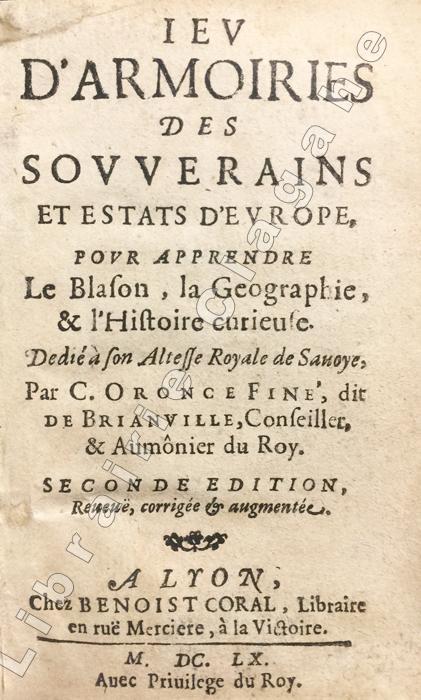
1660réf. 9246Lyon, Benoist Coral, 1660 ; in-24 ; pleine percaline bleue à décor floral, filets et titre dorés au dos (reliure du XIXe) ; (16) ff. dont titre et 2 planches gravées, 209 pp.
1884réf. 6396Cambrai: Renaut, 1884. 1884 1 vol in-8° (210 x 140 mm) de : 139 pp. (dont faux titre, titre) ; nombreux schémas et tableaux dans le texte ; cachet de libraire et signature manuscrite de l'auteur et concepteur du jeu au dos de la page de titre. Demi-basane verte d'époque, dos lisse orné et titré, plats recouverts de papier marbré, tranches marbrées. (Reliure frottée).
1940réf. 216804Japan. Circa 1940. Colour folding game sheet 36.5 x 26cm 10 wooden playing pieces each with embossed images in beige and blue complete original box 15.5 x 7.6 x 2.3cm considerably worn and soiled and corners reinforced the game itself is in very good bright condition. This is a two-player board game where air planes and war ships fight against each other. Fascinatingly the game sheet illustration shows the battle ground is in the Pacific where islands with palm tree are dotted. Consequently the game might be produced at the early stage of the Pacific War. The players attack each other after starting from a naval base and an air base. There are two islands each where they are safely protected from their enemies. The playing pieces are made out of paper with embossed images of war ships and air planes in beige air power and blue sea power colours. . unknown
1927réf. 53798New York: Frederick A. Stokes Co. 1927. 8vo. xi 3 239 1 pp. Colour-tinted frontisp. 7 colour-tinted plates. Orange cloth silver lettering front cover & spine very minor shelfwear very slight bumping to corners w/ d.j. vivid Art Deco cover art of stalking Tiger silhouette on front cover by Reynolds in black silver and orange slight chipping head of spine minor creasing edgewear still NF/VG- copy. First edition of this anthology of big game stories of the Indian jungle set on the North Eastern frontier near Bhutan. Casserly 1869-1947 joined the 22nd Bombay Infantry in 1892 served in China during the Boxer Rebellion and later with the 120th Rajputana Infantry with about 200 sepoys in a small fort in Cooch Behar. Frederick A. Stokes Co., hardcover