3.280 Ergebnisse
1976Best.-Nr. 1233081976 Editions du Club du Livre, Philippe Lebaud éditeur - 1976 - Deux volumes, in-folio, une reliure pleine peau de daim, dos à cinq nerfs, avec étiquette de titre "manuscrite" + une reliure demi peau de daim, plats cartonnés, dos à cinq nerfs, avec étiquette de titre "manuscrite", emboitage cartonné avec ourlet de cuir aux ouvertures - Premier tome sans pagination (fac-similé de l'édition originale, texte en ancien français) + 58 pages (textes sur deux colonnes en français moderne) - Très belles reproductions d'illustrations, miniatures, enluminures et lettrines
Best.-Nr. 62461Coll. "Cuisine et Saveurs", Paris, 2007, Montbel, in-8, br., couv. ill. coul. éd., texte et dessins en orange et noir, belle iconographie ancienne, très bon état
1978Best.-Nr. CHA2014MRelié, non paginé ( environ 150 pages ), paru en 1978 chez Gerfaut, très bon état général.
Best.-Nr. 62457Coll. "Cuisine et Saveurs", Paris, 2008, Montbel, in-8, br., couv. ill. coul. éd., 96 pp., texte et dessins en brun et noir, belle iconographie ancienne, très bon état
1989Best.-Nr. 93581989 cartonné noir éditeur (hard-back percale editor) grand in-octavo, premier plat illustré en couleurs (front cover illustrated in colours), illustrations : bien documenté (well-documented), 277 pages, 1989 à Paris France Loisirs,
1972Best.-Nr. 103121972 broché in-octavo (paperback), dos blanc (white spine), première de couverture illustrée et quatrième de couverture imprimée (front cover illustrated and back cover printed), illustrations : figures in texte (pictures in text), 320 pages, 1972 à Verviers Les Nouvelles Editions Marabout, 19 à Verviers
Best.-Nr. 12596histoire naturelle et chasse. Traduction de H. MANHES d’ANGENY In 8 demi chagrin marron, (dos insolé) titre, filets dorés. Faux-titre, titre, 262 pages illustrations dans le texte en noir et hors texte en couleurs, plus couverture illustrée en couleurs, conservées, de Charles HALLO. La Toison d’Or paris 10 mai 1954. Très bon état, belle édition sur beau papier. Ouvrage le plus complet sur ce sujet.
1954Best.-Nr. 49420La Toison d'Or, 1954. Format 20x27 cm, broché, 259 pages. Un morceau de scotch rouge protège la coiffe. Bon état.
1962Best.-Nr. wc1320Del Duca Cartonné avec jaquette 1962 In-4 (20,7 x 26,3 cm), cartonné avec jaquette, 134 pages, illustrations en couleurs de E. Demartini ; quelques petites marques d'usage sur la jaquette, par ailleurs bon état. Livraison a domicile (La Poste) ou en Mondial Relay sur simple demande.
1971Best.-Nr. 1100251971 Editions Crepin-Leblond - 1971 - 4ème édition - In-4, cartonnage illustré - 280 pages - Illustrations en N&B in et hors-texte
1968Best.-Nr. 44591968 broché in-octavo tellière (paperback), dos blanc (white spine), couverture verte (green cover), illustrations : figures et tableaux (pictures and tables), 128 pages, 1968 Paris Presse Universitaires de France,
Best.-Nr. 107428Paris, Gustave Barba, Libraire Editeur, 34 rue Mazarine, 1846, 1 volume in-8 de 225x140x40 mm environ, 1f.blanc, 4ff. (faux-titre, titre, avis de l'éditeur, préface), 60-616 pages, 1f.blanc, reliure muette en parchemin crème, un ex-libris collé sur le premier contreplat et traces de papier arraché sur le dernier contraplat. Rousseurs et brunissures (fortes par endroits), manque de papier dans un coin (p.279), déchirure p. 589 (sans manque), 2 coins tassés, légers manques de cuir sur les coins et sur une coiffe. Complet des 13 planches annoncées
1895Best.-Nr. 132391895 bradel demi-percale marron clair in-octavo (half hard-back brown percale in-octavo), dos long (spine without raised bands) - pièce de titre sur fond bleu-marine avec double filet or (label of title with gilt lines) - 1 fleuron au fer plein évidé (1 hollowed out blocking stamp) - double filet or au bas du dos (double gilt line in the bottom of the spine), papier peigné aux plats (cover with painting paper), tranches rognées (edges smooth), pages de garde blanches (white endpaper), illustrations : 1 portrait de l'auteur en frontispice (author's frontispiece portrait) et 32 figures explicatives in-texte (explanatory pictures in text), 414 pages, sans date (no date) (les années environ) - 1895 - à Paris H. Delarue et Compagnie Libraires-Editeurs,
1998Best.-Nr. 500103360Editions SAEP 1998 1x26x20cm. 1998. Album.
in-8°, 207 pp., illustrations en noir, broche, couverture illustree. Bel exemplaire. [LA-2]
Paris, Edit. Plon, 1977. 470p. 8º mayor. Rústica editorial ilustrada. Livre en français. Muy buen ejemplar.
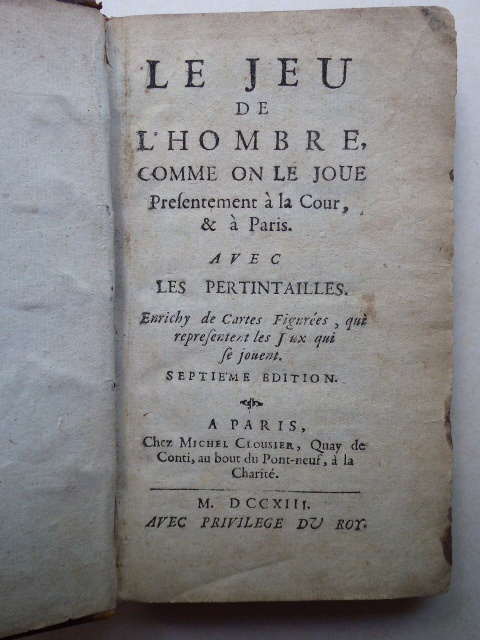
1713Best.-Nr. 134794A Paris, Chez Michel Clousier, M. DCCXIII. Avec privilege du Roy et Chez Hilaire Foucault M. DCCXII. (1713). Two parts in one volume. (12), 167 pages and (12), 33 pages. With a lot of illustrations (cards). Leather binding. (Spine not complete. Papier partially spotted. In the second part some pages on the wrong place, but complete). 16x10 cm
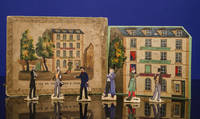
Best.-Nr. 04338Paris: H. Duru 1840. A Remarkable Survival H. Duru's Apparently Unrecorded Le Jeu du Portier Complete with All Six Hand-Colored Standing Figures and the Original Pictorial Box FRENCH GAME. DURU H. publisher. Le Jeu du Portier. The Doorman's Game. Paris: H. Duru ca. 1840. An exceptionally rare early French hand-colored lithographed game complete with the original architectural playing board all six numbered standing figures and the original pictorial card box. Original hand-colored lithographed board depicting the façade of a Parisian multi-story house 8 3/4 x 6 3/4 inches; 222 x 172 mm. the upper right corner beveled as issued. Six original hand-colored lithographed cut-out figures each mounted on its original base average size 3 1/8 x 1 1/4 inches; 80 x 32 mm. Complete in the original card box the lid bearing a hand-colored lithograph depicting the same multi-story house and titled beneath "LE JEU DU PORTIER PAR H. DURU." The board and figures in near fine condition; the box somewhat soiled with the corners strengthened with cloth tape. A remarkable survival in substantially complete original condition. The architectural board represents a vertically organized Parisian apartment house its occupants and businesses identified floor by floor. It is lettered from top to bottom: "No. 6"; "No. 5 / Locart Fnt Lunetier au 3me"; "No. 4 / F. Sonnet M.de Dentelles"; "No. 3 / Clagmann et Cie. Banquiers"; "No. 2"; and "No. 1 / Loge du Portier." The six accompanying figures correspond to the numbered hierarchy of the building and are identified as: 1. Le Portier the doorman or concierge; 2. Propriétaire proprietor or landlord; 3. Banquier banker; 4. Marchand merchant; 5. Fabricant manufacturer; and 6. Ouvrier worker. The original printed numbers and occupational designations remain visible on the bases of the figures. The figures form a delightful miniature gallery of French social types: the prosperous Propriétaire in his vividly patterned blue coat; the top-hatted Banquier; the fashionably dressed Marchand carrying his hat; the Fabricant; the plainly dressed Ouvrier; and the Portier the indispensable guardian of the building. Their original hand-coloring remains remarkably fresh. More than simply a children's amusement Le Jeu du Portier presents in miniature a fascinating picture of nineteenth-century Parisian urban life and social hierarchy. Proprietor banker merchant manufacturer workman and concierge are transformed into movable characters associated with a single apartment house. The game belongs to the particularly appealing nineteenth-century tradition in which children's toys simultaneously entertained and introduced their young players to occupations social distinctions and the organization of contemporary life. The choice of the portier as the central character is especially evocative. Occupying the loge at street level the Parisian concierge stood literally at the entrance to the social world represented by the building controlling access and observing the comings and goings of its occupants. The numbered inhabitants ascending through the building consequently provide an engaging physical representation of the social structure of nineteenth-century Paris. H. Duru was a Parisian publisher active in the production of illustrated educational works children's books puzzles and games during the middle decades of the nineteenth century. Among Duru's publications were Nouvelle méthode de lecture progressive ou Lecture apprise en quarante jours Syllabaire universel en action Les homonymes illustrés Grammaire illustrée and Alphabet chantant. Duru's activity as a publisher of games is independently confirmed by another lithographed production Le Jeu du Touriste preserved in the collection of the Musée des Civilisations de l'Europe et de la Méditerranée Mucem. The survival of the six separate standing figures together with their architectural board and original pictorial box is exceptional. The standing figures are of particularly delicate construction consisting of thin lithographed card cut-outs mounted upright on their original bases - ephemeral playthings never intended to survive nearly two centuries of use. We have been unable to locate another example of Le Jeu du Portier in OCLC or in the institutional collections and published references consulted. Apparently unrecorded and possibly unique in this complete state. A remarkable and highly evocative survival of an early French children's game combining hand-colored lithography three-dimensional play and a wonderfully detailed representation of nineteenth-century Parisian social life. Paris: H. Duru, 1840 unknown
Best.-Nr. 04338Paris: H. Duru 1840. A Remarkable Survival H. Duru's Apparently Unrecorded Le Jeu du Portier Complete with All Six Hand-Colored Standing Figures and the Original Pictorial Box FRENCH GAME. DURU H. publisher. Le Jeu du Portier. The Doorman's Game. Paris: H. Duru ca. 1840. An exceptionally rare early French hand-colored lithographed game complete with the original architectural playing board all six numbered standing figures and the original pictorial card box. Original hand-colored lithographed board depicting the façade of a Parisian multi-story house 8 3/4 x 6 3/4 inches; 222 x 172 mm. the upper right corner beveled as issued. Six original hand-colored lithographed cut-out figures each mounted on its original base average size 3 1/8 x 1 1/4 inches; 80 x 32 mm. Complete in the original card box the lid bearing a hand-colored lithograph depicting the same multi-story house and titled beneath "LE JEU DU PORTIER PAR H. DURU." The board and figures in near fine condition; the box somewhat soiled with the corners strengthened with cloth tape. A remarkable survival in substantially complete original condition. The architectural board represents a vertically organized Parisian apartment house its occupants and businesses identified floor by floor. It is lettered from top to bottom: "No. 6"; "No. 5 / Locart Fnt Lunetier au 3me"; "No. 4 / F. Sonnet M.de Dentelles"; "No. 3 / Clagmann et Cie. Banquiers"; "No. 2"; and "No. 1 / Loge du Portier." The six accompanying figures correspond to the numbered hierarchy of the building and are identified as: 1. Le Portier the doorman or concierge; 2. Propriétaire proprietor or landlord; 3. Banquier banker; 4. Marchand merchant; 5. Fabricant manufacturer; and 6. Ouvrier worker. The original printed numbers and occupational designations remain visible on the bases of the figures. The figures form a delightful miniature gallery of French social types: the prosperous Propriétaire in his vividly patterned blue coat; the top-hatted Banquier; the fashionably dressed Marchand carrying his hat; the Fabricant; the plainly dressed Ouvrier; and the Portier the indispensable guardian of the building. Their original hand-coloring remains remarkably fresh. More than simply a children's amusement Le Jeu du Portier presents in miniature a fascinating picture of nineteenth-century Parisian urban life and social hierarchy. Proprietor banker merchant manufacturer workman and concierge are transformed into movable characters associated with a single apartment house. The game belongs to the particularly appealing nineteenth-century tradition in which children's toys simultaneously entertained and introduced their young players to occupations social distinctions and the organization of contemporary life. The choice of the portier as the central character is especially evocative. Occupying the loge at street level the Parisian concierge stood literally at the entrance to the social world represented by the building controlling access and observing the comings and goings of its occupants. The numbered inhabitants ascending through the building consequently provide an engaging physical representation of the social structure of nineteenth-century Paris. H. Duru was a Parisian publisher active in the production of illustrated educational works children's books puzzles and games during the middle decades of the nineteenth century. Among Duru's publications were Nouvelle méthode de lecture progressive ou Lecture apprise en quarante jours Syllabaire universel en action Les homonymes illustrés Grammaire illustrée and Alphabet chantant. Duru's activity as a publisher of games is independently confirmed by another lithographed production Le Jeu du Touriste preserved in the collection of the Musée des Civilisations de l'Europe et de la Méditerranée Mucem. The survival of the six separate standing figures together with their architectural board and original pictorial box is exceptional. The standing figures are of particularly delicate construction consisting of thin lithographed card cut-outs mounted upright on their original bases - ephemeral playthings never intended to survive nearly two centuries of use. We have been unable to locate another example of Le Jeu du Portier in OCLC or in the institutional collections and published references consulted. Apparently unrecorded and possibly unique in this complete state. A remarkable and highly evocative survival of an early French children's game combining hand-colored lithography three-dimensional play and a wonderfully detailed representation of nineteenth-century Parisian social life. Paris: H. Duru, 1840 unknown books
Best.-Nr. BN316563Delcourt. Le monde d'Arkadi Tome 7 : Le château d'Antarc Le monde d'Arkadi Tome 7 : Le château d'Antarc Caza Delcourt unknown
2008Best.-Nr. BN503168Delcourt 2008. 2008. Le monde d'Arkadi Tome 9 : Le jour de l'arche Le monde d'Arkadi Tome 9 : Le jour de l'arche Caza Delcourt unknown
2007Best.-Nr. BN506165Delcourt 2007. 2007. Le monde d'Arkadi Tome 8 : Pierres de lune Le monde d'Arkadi Tome 8 : Pierres de lune Caza Delcourt unknown
2008Best.-Nr. I-618-477Delcourt 2008. Good. Former library book. Volume 9. Ammareal gives back up to 15% of this item's net price to charity organizations. Delcourt unknown
2004Best.-Nr. I-478-535Productions Guy Delcourt 2004. Hardcover. Very Good. Volume 1. Ammareal gives back up to 15% of this item's net price to charity organizations. Productions Guy Delcourt hardcover
2004Best.-Nr. I-478-537Productions Guy Delcourt 2004. Very Good. Volume 3. Ammareal gives back up to 15% of this item's net price to charity organizations. Productions Guy Delcourt unknown