3 280 résultats
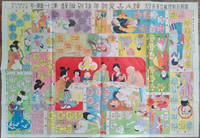
1419réf. 223794東京. Tokyo.: 実業之日本社. Jitsugyo no Nihonsha. Taisho 14 1925. Colour folding sugoroku game sheet 55 x 75.5 cm occasional browning visible on the reverse and a little on the margins but otherwise a very clean and good copy. The game follows a woman's life stages from her wedding to child birth as players progress each month from January to December. In addition daily and seasonal menus are included for each month. The breakfast and lunch menus given are in the main for Japanese dishes but occasionally western dishes such as croquettes and beef steaks appear for dinner. The beginning of the game is the woman's wedding in January. In March she is learning to cook. In April her husband helps cooking as she is suffering from morning sickness. The pregnancy progresses well and in December a baby boy arrives. The goal is a family tea party held in western style to welcome the baby. Both the husband and the wife are featured in illustrations and the companionship of marriage is emphasised as a source of family happiness. This colourful sugoroku game sheet was issued as a supplement to the January 1924 issue of Fujin Sekai Women's World. The magazine was founded in 1906 and was a very popular monthly magazine for women. . 実業之日本社. [Jitsugyo no Nihonsha]. unknown
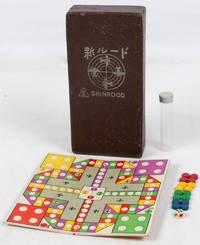
1930réf. 216904Japan. Circa 1930. Folding coloured board game 12.6 x 12.9cm small tube with a metal lid containing a dice and 4 playing pieces each in 4 colours original box 15 x 7.5 x 2.6cm rules of the game in Japanese text laid down inside lid. Signs of light use but overall very good. A compact miniature Ludo game set neatly packed in a small box. The game rules are printed inside the lid. It is described as a "new" version of Ludo likely due to the inclusion of aeroplanes in the illustrations. The board features English captions. . unknown
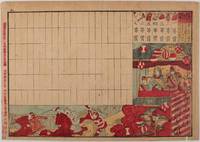
1892réf. 215726大野栄吉. Ōno Eikichi. Meiji 25 1892. Colour woodblock print 22.8 x 32.5cm evenly browned few chips in margins but overall very good. This colourful woodblock print serves as a point sheet for a horse racing board game. While the game rules are unclear the print vividly captures an exciting race scene featuring three horses and their jockeys. The race unfolds in a festive atmosphere complete with blossoms and lanterns while the spectators appear to include the Meiji Emperor and Empress along with their entourage. The Emperor is depicted in full military uniform and the Empress is shown in a traditional kimono. The print also displays the prizes for first through seventh place which include a silver cup a trophy a riding cap a scarf a shoe and a whip. Western-style horse racing began in Japan in the mid-19th century following the arrival of Westerners and became a high-class social event during the Meiji period. . 大野栄吉. [Ōno Eikichi]. unknown
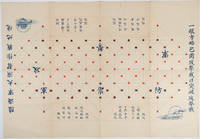
réf. 214048Early 20th Century. Colour folding game sheet some light browning and a few small holes at folds but overall a good and attractive game. 54 x 80cm. The title of this board game sheet indicates that the game is designed for two opposing sides with one side acting as the attackers and the other as the defenders. The defending side possesses more naval power compared to the attacking side. Although specific playing instructions are not provided information on the right-hand side suggests that offensive tactics should involve either seizing or charging. At the top and bottom there are lists of rear force units for both sides including docks for housing captured enemy boats and sunken boats Red Cross field hospitals and facilities for casualties. Additionally in the corners two small illustrations of warships are printed in blue ink. . unknown
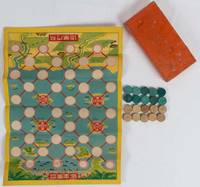
1940réf. 216804Japan. Circa 1940. Colour folding game sheet 36.5 x 26cm 10 wooden playing pieces each with embossed images in beige and blue complete original box 15.5 x 7.6 x 2.3cm considerably worn and soiled and corners reinforced the game itself is in very good bright condition. This is a two-player board game where air planes and war ships fight against each other. Fascinatingly the game sheet illustration shows the battle ground is in the Pacific where islands with palm tree are dotted. Consequently the game might be produced at the early stage of the Pacific War. The players attack each other after starting from a naval base and an air base. There are two islands each where they are safely protected from their enemies. The playing pieces are made out of paper with embossed images of war ships and air planes in beige air power and blue sea power colours. . unknown