Raunkiaer, Barclay.MareMagnum
Upton, Peter.MareMagnum
Portraits of three Arab mares Gold Roseifa, Russallka and Roxira. No place, 1987.
1987Watercolour over pencil. 780 x 525 mm. Signed and dated by the artist. Matted.
4080 resultados
8vo. (4), 304 pp. With a frontispiece showing the author in Arab garb, 88 illustrations in text, most of them reproductions of drawings and photographs by the author, and a folding map loosely inserted in a pocket at the end. Publisher's green cloth. First and only edition, in the original Danish, of an account of a journey through the Arabian Peninsula. Sponsored by the Royal Danish Geographical Society, Barclay Raunkiaer (1889-1915) set out to penetrate the hitherto unexplored deserts of south-east Arabia. Although the traveler came equipped with a modest amount of scientific instruments and a camera, the use of these became almost impossible. The foreigner was looked on with suspicion by the Arabs and Raunkiaer could only use his camera, with great risk, at certain unwatched moments (p. 12). At the beginning of 1912, the traveler reached Kuwait, where he stayed at the palace of Sheikh Mubarak. Since it was Mubarak's policy to keep Kuwait free of foreign interference, it took some active lobbying of the British envoy to convince the Kuwaitis that Runkiaer was a harmless traveller. After that, it seems that the Dane enjoyed a certain amount of freedom, as numerous photographs, including one of pearl-fishers and a portrait of Sheikh Mohammed, testify. Raunkiaer was very impressed by the volume of trade in Kuwait, which he considered to be the most important trading town on the east coast of Arabia. - In Kuwait, Raunkiaer became seriously ill, but his tuberculosis was undiagnosed. After a period of rest, he travelled further to Riyadh. As the first western traveller in the city in half a century, Raunkiaer was graciously received by Ibn Saud. After a short stay in Riyadh, Raunkiaer followed a caravan which mostly consisted of 150 pearl-fishers bound for Bahrain. During a stay in Hofuf, where the book ends, Raunkiaer's health became worse and he sailed to Bahrain to recuperate. From there he travelled back to Copenhagen via Bombay. After a few years working for the East Asiatic Company, Raunkiaer died from tuberculosis. - Shortly after the appearance of the Danish edition, the book was translated into German. T. E. Lawrence, who considered it to be one of the "readable Arabian books", helped facilitate an English translation in 1916, which was privately printed by the Arab bureau in Cairo. - Inscribed by the author to the Danish historian of religion Ditlef Nielsen (1874-1949), with and a few annotations in pencil in the final chapter. Binding slightly worn along the edges, with a small stain on the title. Endpapers foxed with the text browned; some small random pen marks at the lower margin of p. 47. The map with a few tears along the folds, most of them expertly repaired; a very good copy. Facey, Kuwait by the first photographers, pp. 50-51; "Mr. Raunkiaer's expedition in east-central Arabia", The geographical journal XL (1912), pp. 331-332; "Danish expedition to Arabia", The geographical journal XLIV (1914), pp. 85-86; not in Howgego.
Folio (218 x 282 mm). (12), 382, (2) pp. With separate engraved title-page, 21 engravings in the text, 3 engraved headpieces and 3 engraved initials. Contemporary full calf with giltstamped spine (rebacked preserving the original spine). The rare first French edition (first issue, in-folio) of Sir Paul Rycaut‘s famous Turkish chronicle, drawn from various authentic sources and from the author‘s own observations. "His most important work [...] presents an animated and, on the whole, faithful picture of Turkish manners" (DNB). "This work is regarded as one of the best of its kind with respect to the religious and military state of Turkey" (Cox). "Provides an account of the society and political system of the Ottoman Empire with unprecedented thoroughness" (cf. Osterhammel, Die Entzauberung Asiens, 32). "An extremely important and influential work, which provides the fullest account of Ottoman affairs during the 17th century" (Blackmer). The attractive engravings depict dignitaries and persons of various ranks in their costumes, also including the illustration of a turban. "Rycaut was appointed consul in Smyrna, where he resided for eleven years. His information on the Ottoman Empire was taken from several sources: original records, and from a Polish resident of some nineteen years at the Ottoman court" (Aboussouan). - 18th century ink ownership of Paul Lignon de Brassac on title page; additional ownership ("Dr. Lignon") and notes on flyleaf. Some browning fingerstaining, mainly confined to margins; slight worming affecting upper edge of first two leaves. Binding rubbed; corners bumped. A wide-margined copy. Weber II, 330. Goldsmith R 1262. Aboussouan 806 (lacking a leaf). Graesse VI/1, 108. Cf. Atabey 1069. Blackmer 1464. Lipperheide Lb 19 (all 2nd ed.). Hiler 770 (1686 English ed.). Howgego R 92 (Rouen 1677 ed.). Cox I, 210. Not in Colas.
1987Watercolour over pencil. 780 x 525 mm. Signed and dated by the artist. Matted.
Large 4to. 2 vols. XII, 227, (1), 87, (3) pp. XII, (229)-559, (1), 83, (1). With engraved frontispiece in vol. 1, 8 engr. maps (6 folding), and 1 folding table. - (Bound with): The Voyage of Nearchus, and the Periplus of the Erythrean Sea. Oxford, Cadell & Davies, 1809. XV, (1), 119, (1) pp. With 1 plate. Contemporary giltstamped English full calf; spines rebacked with original gilt labels. First edition of this rare Middle Eastern geography, published in two parts: 1. From the Sea of Suez to the Coast of Zanguebar; 2. From the Gulph of Elana, in the Red Sea, to the Island of Ceylon. Includes an extensive discussion of the Arabian Peninsula, including sections on Myos Hormus, the Wealth of Arabia, the Coast of Yemen, Aden, Mokha and Oman, Oriental Commerce by the Gulph, etc. Among the plates are a map of the western Arabian coastline, a chart of the Red Sea, and al-Idrisi's famous world map, "a pinnacle of mediaeval cartography as well as of the history of geographical research" (cf. Lex. z. Gesch. d. Kartographie, p. 325; Tooley II, 405). William Vincent (1739-1815) served as headmaster and later Dean of Westminster, and "ancient geography was the subject which Vincent made his chief study" (DNB). Also includes Vincent's edition of the Greek text of the voyage of Nearchus. - Covers rubbed; corners bumped. Traces of old stamps, removed from title pages and half titles. Somewhat browned and brownstained. From the library of the antiquary and bookseller Francis Drake (1828-85), a descendant of the like-named English navigator and privateer, with his engr. bookplate to pastedowns. A good, wide-margined copy. Ibrahim-Hilmy II, 311. DNB LVIII, 364. Graesse VI/2, 325. OCLC 6388867. Not in Atabey, Blackmer, Aboussouan, Weber, Henze, etc.
4to. (16), 170, (4) pp., final blank f. With 2 large folding maps. Contemporary vellum. First edition. - Early study on the sources of the Nile by the Dutch classicist and librarian Isaac Voss (1618-89). The maps show north-eastern Africa from Zanzibar to the Nile Delta (with large parts of the Arabian Peninsula) and a detail thereof, focusing on the tributary region of Lake Tana in Dembiya, Ethiopia. Also includes an "Appendix ad scriptum de natura et proprietate Lucis. Accedit epistola ad amicum, de potentiis quibusdam mechanicis" (p. 77-170), an early and little-received discussion of the nature of light, refraction, colours, optics, mechanics, and even comets (for a note on Voss's work on Snel's law of refraction of light rays, cf. DSB XII, 501). - Slight browning, spine defective. Early 19th c. title inked to corner of upper cover. Provenance: 1) in the collection of the cleric and abolitionist Francis Wrangham (1769-1842), later Archdeacon of the East Riding, with his 1804 ownership to t. p.; 2) in 1810/11 the book was in the collection of Percy B. Shelley's friend Thomas Jefferson Hogg (1792-1862), famously expelled from Oxford together with the young poet for having published the treatise, "The Necessity of Atheism" (his ownership "T. Jeff.n Hogg, Univ. Coll., Oxon." on pastedown); 3) in 1898 the volume passed into the library of the Swiss-born U.S. officer Edward Louis Berthoud (1828-1910), best known for his role as chief engineer and secretary of the Colorado Central Railroad during its expansion throughout Colorado in the 1870s (his stamp and ms. ownership to t. p. and the reverse of the plates); 4) acquired on 12 Feb. 1903 by the Colorado chemist Charles Skeele Palmer (1858-1939) (his ownership on t. p.); 5) Ida May Lewis (ownership, dated 1945, on pastedown). With irreverent ms. notes at the end of the dedication (to King Louis XIV) by either Berthoud or Palmer: "Vossius give us a rest"; under the author's signature: "A Brick". Ibrahim-Hilmy II, 312. OCLC 8556942. Cf. Gay 2317 (Paris ed.).
Small folio (206 x 324 mm). (8), 162, (6) [instead of 8] pp. Title-page printed in red and black. With double-page-sized frontispiece, 39 (instead of 41) engr. plates and 2 engr. maps; numerous woodcuts in the text. Contemp. blindstamped leather over wooden boards with 2 clasps. First edition of this highly interesting, appealing work, a topical publication produced but a year after the 1683 Siege of Vienna. Four additional volumes would be prepared by 1689. The plates show views of Hungary, the Ottoman Empire, and the Near and Middle East (Jerusalem, Egypt, Babylon, etc.), as well as Sultan Mehmet IV and the relief of Vienna. - Binding rubbed. Some brownstaining throughout with occasional waterstains. Several leaves rebacked or reinforced in the margins (occasional loss to text or image); wants the view of Ofen (Buda) and the "Crowning of the Empress" as well as one leaf of the index. VD 17, 23:300271C. Lipperheide LB 22. Nebehay/W. 794. Not in Apponyi.
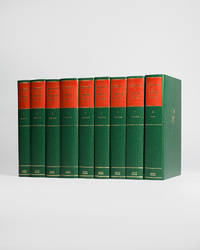
ref. 121954London Archive Editions 1991. . 8 vols 8vo 25.5 x 16.5 cm; 7 vols text & map portfolio containing 12 large folding maps; publisher's original green cloth gilt arms of Qatar to upper boards gilt lettering to spines with red lettering pieces top edges gilt a fine set. An unrivalled collection of material revealing the history of Qatar from 1820 to 1960 focussing on primary documents charting the history of the peninsular from Qatar's first maritime treaty with Britain in 1820 up to the abdication of Ali bin Abdullah in 1960. Many of the documents within are published for the first time. London, Archive Editions, 1991. hardcover
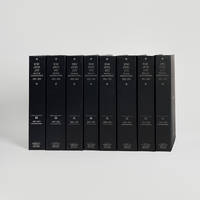
ref. 121947Cambridge Cambridge Archive Editions 2020. . 2 works in 8 vols 25.5 x 16.5 cm; publisher's original black cloth silver gilt lettering a fine set. An extensive collection of documents and letters covering the reign of King Abdulaziz also known as Ibn Saud and the first king of a unified Saudi Arabia from the reconquest of Riyadh in 1902 until his death in 1953. Many of the documents and letters here are published for the first time and many of the letters are reproduced in facsimile in King Abdulaziz's own hand. Cambridge, Cambridge Archive Editions, 2020. hardcover
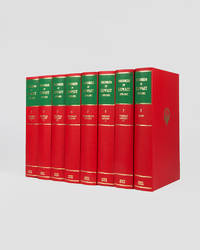
ref. 121949London Archive Editions 1989. . 8 vols 8vo 25.5 x 16.5 cm; 7 vols text & map portfolio containing 9 large folding maps and 2 tables; publisher's original red cloth gilt royal arms of Kuwait to upper boards spines in gilt with green labels top edges gilt a fine set. An impressive set of records documenting the history of Kuwait from 1899 to 1961 covering the period from the first treaty signed between Britain and Mubarak Al-Sabah to the establshiment of Kuwait as an independent state in 1961. London, Archive Editions, 1989. hardcover
4to. (10), 648 [but: 598], (4) pp. Contemporary half calf with giltstamped spine. Rare first edition of "the oldest complete translation of the Qur'an into a European vernacular" (Encylopedia of the Qur'an). Du Ryer's work served as the basis for further translations of the Qur'an into English, German, Dutch, and Russian, and was instrumental in introducing Europeans to the tenets of the Muslim faith. Du Ryer was a celebrated linguist and had lived in Egypt and Turkey, where he studied classical Arabic. His introduction briefly summarizes the Muslim religion for Christian readers, noting customs such as Ramadan, circumcision, the practice of having as many as four wives, the significance of Mecca and Medina, Sufi brotherhoods and wandering ascetics, and finally the Islamic recognition of Jesus as a prophet but not the son of God. A prayer printed in Arabic is included on the verso of leaf e2. - "Du Ryer's translation of the Qur'an [...] became an unparalleled literary success [...] The easy availability of the Qur'an accompanied a newfound interest in the Orient; additionally, du Ryer's translation lacked the polemical tone of previous editions, an orientation which arose mainly in ecclesiastical contexts. Du Ryer used Islamic commentaries such as al-Bayawi's Anwar al-tanzil, the Tafsir al-Jalalayan by al-Mahalli (d. 864/1459) and al-Suyu i (d. 911/1505), or an excerpt from al-Razi's (d. 606/1210) great commentary made by al-Raghi al-Tunisi (d. 715/1315) entitled al-Tanwir fi l-tafsir, quite casually in his translation, merely noting them in the margins. The deprecatory tone present in the introductory chapter, 'Sommaire de la religion des Turcs,' can be understood as an attempt at camouflage (cf. Hamilton and Richard, André du Ryer, 94f)" (Encyclopedia of the Qur'an). - Some waterstaining throughout; occasional worming; more pronounced edge damage near end. Provenance: 1714 ms. ownership (partly stricken out) of the Castelnaudary Capuchins, dissolved in 1789; acquired by the notary J. L. E. Bauzit of Castelnaudary (his ownership on title and flyleaf). Chauvin X, p. 126. Schnurrer 427. Fück 74. Brunet III, 1309. Encyclopedia of the Qur'an V, 347.
Large 4to. 2 vols. (7), 208 ff. (5), 238 ff. Title vignettes (royal arms of Portugal). Uniform mottled calf with giltstamped red and green spine labels. All edges yellow. Second edition of the first two of the three "Decades" on Portugal's Middle Eastern enterprises (a fourth volume was produced posthumously in 1615, and the set was continued by other hands). "This is considered by Du Fresnoy as being a good edition" (Clarke, The Progress of Maritime Discovery, p. 132). The writer de Barros (1496-1570), head agent for the Portuguese overseas trade authority "Casa da Índia", managed to persuade King João III to commission from him a history of the Portuguese in India (including Asia and southeast Africa). The result, published between 1552 and 1563, earned him renown as one of the first great Portuguese historians, and the the title of a "Portuguese Livy". The 'Decades' contain "the early history of the Portuguese in India and Asia and reveal careful study of Eastern historians and geographers, as well as of the records of his own country. They are distinguished by clearness of exposition and orderly arrangement. They are also lively accounts" (Enc. Britannica). Books 2 and 3 of the "Decada Segunda" (fols. 21 ff.) offer a detailed narrative of Afonso de Albuquerque's expedition to the Arabian Gulf and his conquest of Ormuz in 1507; the island remained under Portuese occupation from 1515 to 1622. As vassals of the Portuguese state, the Kingdom of Ormuz jointly participated in the 1521 invasion of Bahrain that ended Jabrid rule of the Arabian archipelago. - Slight waterstaining throughout first volume; old handwritten ownership "Jose Joares E Britto" to title pages, with earlier ink ownerships obliterated (ink corrosion to title of vol. 2 and final leaf of vol. 1). A good set. Palau I.181b. Howgego I, B34, p. 91. Arouca B 56f. Löwendahl, Sino-Western Cultural Relations I, p. 42, no. 75. OCLC 4507939. Cf. Macro 474.
12mo. With a woodcut of the main character on the title-page. Contemporary plain wrappers. Very rare first edition of a Croatian translation of the popular comic novel "Le sottilissime astuzie di Bertoldo" by Giulio Cesare Croce, first published in 1606. Based on oral traditions, this highly popular novel told the story of the farmer Bertoldo, who is sometimes cunning and at other times stupid. In this Croatian version the translator "localized" the name of the main character to Nasreddin, thereby establishing a link with the famous 13th-century Turkish satirist Nasreddin Hodja, whose stories were well known in the Balkan region. The translator, Nikola Palikuca from Prokljan (near Šibenik) was probably the pseudonym of a friar or nun. A second edition of the book was published in 1799 in Venice. - With owner's inscriptions on the final blank and interior of the wrapper and some pencil crossing on the back of the title-page. Browned and with waterstains throughout, nevertheless a structurally good edition of a very rare book. Deželjin, "Bertoldi di Giulio Cesare Croce e il riflesso di quest'opera nell'altra sponda dell'Adriatico" in: Capasso, L'Italia altrove, atti del III convegno internazionale di studi dell'AIBA, pp. 135-144. Not in WorldCat; ICCU.
4to. (2), XXXVIII, 184 pp. Title-page printed in red and black. With a woodcut in the text. - (Bound with) II: Hottinger, Johann Heinrich. Exercitationes Anti-Morinianae: De pentateucho Samaritano. Zurich, Bodmer, 1644. (20), 116 pp. Contemporary vellum. The first book in Arabic ever printed in England, some parts set in Arabic and Latin parallel text. "Partial edition of the Annals of the Melkite patriarch Said ibn Batriq as a polemic on the origin of the Alexandrian Church and the distinction between priests and bishops, to which Ecchellensis was to reply in extenso" (Smitskamp). - II: First edition of Hottinger's study on the Samaritan pentateuch, directed against the findings of the Oratorian Jean Morin. - Insignificant browning due to paper; altogether a fine copy. I: Ibrahim-Hilmy I, 225. Graf II, 34. Schnurrer 171. Fück 86. Smitskamp 370 (with different imprint). - II: BM-STC H 1722. Fürst I, 414.
4to. 2 vols. (4), XXIV, 453, (19) pp. (2), VIII, 537, (2) pp. With 2 engr. title vignettes, 10 engr. initials, 20 engr. text vignettes, 2 engr. frontispieces, and 28 engr. plates. Contemp. calf gilt with giltstamped spine labels. Second issue in the year of first publication. "This work is especially valued for its engravings of Turkish costume figures and genre scences by Duflos after Boucher and Hallé" (Navari Greek), as well as for "its fine folding panorama of Constantinople" (Atabey). "The French writer and jurist Guer (1713-64) had not travelled. His work is based on a wide knowledge of historiography and travel literature. It is singled out by the high quality of its wealth of illustrations" (Chatzipanagioti-Sangmeister). The first edition was published by Coustelier in Paris, 1746-47; the same year saw the second edition (Merigot and Piget in Paris) as well as the third (Mortier in Amsterdam). - Inconspicuous repairs to folds of Constantinople view; occasional slight browning. Formerly in the Ottoman collection of the Swiss industrialist Herry W. Schaefer. Atabey 534. Auboyneau 301. Blackmer 762. Weber II, 761. Chatzipanagioti-S. 382. Cohen/R. 465. Colas 1348. Hage Chahine 2000. Navari (Greek) 308. Sander 872. Cf. Aboussoan 308. Lipperheide Lb 31 (Mortier). Brunet II, 1783 (1746).
Small folio (215 x 308 mm). Broadsheet, 2 pp. Printed in French and Arabic in two columns. A rare broadsheet from the first printing press in the Arab world, announcing the peace concluded between Napoleon and the rulers of Algiers and Tunis: "Je vous annonce qu'il nous est parvenu récemment des lettres de la part du Gouvernement de la République Française, et de son premier Consul, l'illustre guerrier Bonaparte. Elles nous donnent avis que la paix a été conclue définitivement entre la République Française et les royaumes d'Alger et de Tunis. Que Dieu en soit loué! [...] Habitans de l'Égypte! Dieu favorise toutes les entreprises des Français et du premier consul Bonaparte, qui ne veulent que justice: la tranquillité, la sécurité et le bonheur des peuples [...]". Napoleon's peace treaty was intended to send a strong signal to the Muslim world and pave the way for more ready acceptance of French power in Egypt. - "The expedition of Napoleon Bonaparte to Egypt from 1798 until 1801 was a prelude to modernity. It was to change permanently the traditional Arab world [...] The French brought Arabic typography to Egypt, where it was practised under the supervision [...] of Jean Joseph Marcel [...]. Only a few days after the French troops landed [...] they set up the Imprimerie Orientale et Française there. It was an extraordinarily important turning point. For, leaving aside the Hebrew printing presses in Egypt of the 16th to the 18th centuries, until this date announcements and news adressed to Arabs there, as well as in other parts of the Arab-Islamic world, had been spread only in hand-writing or orally, by criers, preachers or storytellers" (Glass/Roper). - The productions of the Imprimerie included rare scientific and practical brochures, periodicals, but above all broadsheets and notices in French, Arabic and Turkish, intended for authorities, soldiers and the literate general population. The Imprimerie employed more than 30 men, including several Egyptians hired and trained on the spot, among them Yousef Msabky, later head of the royal printing press in Egypt. For the printing of Arabic and Turkish texts the Imprimerie had extensive typographical material at its disposal, including the entire set of oriental types that Monge had seized in Rome from the Congregatio Fide press. Jean-Joseph Marcel, himself a very competent Arabist, enlisted the services of the Turkish interpreter Elia Fatalla and of two scholars from Acre, Yakoub and Mikhaïl, who had fled the persecutions of Jazzar Pasha. - Folded horizontally. Untrimmed an in excellent state of preservation. Cf. D. Glass/G. Roper, The Printing of Arabic Books in the Arab World, in: Middle Eastern Languages and the Print Revolution (Gutenberg Museum Mainz 2002), p. 177-225, at 182.
4to. 2 vols. XVI, (6), 505, (1) pp. With 72 plates and folding map. (16), 479, (1) pp. With 52 plates and maps. Contemporary vellum with title to spine. First edition. - Niebuhr's "work on Arabia was the first European attempt at a complete account of Arabia, its people and their way of life. He amassed a vast quantity of factual information which he relates in a simple unrhetorical fashion, distinguishing clearly between things observed personally and things learned from others. The expedition, which lasted six years, was sponsored by the Danish king, and included the brilliant Swedish scientist, Peter Forsskal, who died while in Yemen" (Cat. Sotheby‘s, 13 Oct 98, lot 1010). Of the five scientists, Carsten Niebuhr (1733-1815) was the sole survivor, and his work represents an important contribution to the study of the Middle East. His map of the Yemen, the first exact map of the area ever, remained the standard for the next 200 years. - An unsophisticated, exceptionally fine copy. Macro 1700. Gay 3589. Howgego I, N24 (p. 752).
4to. 2 vols. bound in one. 14 pp. (index), 210 pp., (1 blank), 7 pp. (index), 190 pp. Original full calf with later paper label; later marbled paper on the spine. An important first-hand account of relations between the Porte and central Europe as well as the wider political events during the second half of the 18th century. Written by the Baghdad-born diplomat Ahmed Vasif Effendi and also known as "Vasif Tarihi" ("Vasif's History"), it forms one of the most important works of Ottoman political history for the period between 1754 and 1774, when the author actively participated in the world of diplomacy in the Ottoman Empire, on the Balkans, in Russia and in Vienna. Vasif was known for his quick temper and was later described by the German orientalist Franz Babinger as "vain, stingy, jealous, and excessively vicious" (cf. p. 336). His text was left unfinished after a dispute with the Istanbul-based press of Rasid Efendi, which Vasif himself had helped establish, and it was completed by Sadullah Enveri (d. 1794), who himself had participated in the military events described. - At the time one of the few available printed historico-political accounts of contemporary Middle Eastern relations with the West during the age of Enlightenment, the book proved extremely popular throughout Europe and is today found in many European libraries. This is the third and last edition, the second printed at Bulaq, by the first official and governmental printing press in Egypt, after first being published in Istanbul in 1219 (1803/04). - Bulaqor Al-Amiriya Press, the first official and governmental printing press established in Egypt, was founded in 1820 by the viceroy of Egypt, Muhammad Ali. As early as in 1815 the first delegation was sent from Egypt to Milan to learn printing. After the building for the press was finished in the autumn of 1820, it took another two years to transport the machines and train the employees, and the first book, an Arabic-Italian dictionary, was published in 1822. Viceroy Muhammad Ali started several reform programmes with a view to create a modern Egyptian society after the European model, and the press was part of this modernisation. He is remembered for establishing modern Egypt as an independent country. - Printed on thick paper. Interior clean with sporadic old staining; old pencil and ink annotations to endpapers. Binding shows larger scratches and loss of material, but still in the original Bulaq covers. Provenance: 19th century bookseller's label of Benjamin Duprat, Paris, on front pastedown; later owned by the Iraqi architect Mohamed Makiya (2015). Özege V, 22519. OCLC 949617481, 777193206, 320228577, 780208235, 165361809, 26779362 and 600848792 (some examples on microfilm). Ethan L. Menchinger, The First of the Modern Ottomans: The Intellectual History of Ahmed Vasif (2017). Franz Babinger, Die Geschichtsschreiber der Osmanen und ihre Werke (1927), pp. 335-337.
4to (170 x 227 mm). Arabic manuscript on polished paper. 42 written pp., 19-24 lines, per extensum, black and occasional red ink with red underlinings. With several astronomical diagrams in the text. Modern brown cloth binding with the original 18th century blindstamped leather covers pasted on the boards. An Arabic astronomical manuscript on quadrants in three parts, comprising: 1. Muhammad ibn al-Sheikh al-Hamid, Risalat al-kura (dhat al-kursi). - 2. Sabat Al-Mardini, Risalat mukhtasirat fi aleamal bialrabe alshamalii almaqtue (A brief treatise on the work in the northern quadrant). - 3. Sabat Al-Mardini, Risalat fi aleamal bialrabe almajib al-risalat al-fathiat fi al'aemal al-jibia (A treatise on work in the responding quadrant). All parts include detailed astronomical tables and diagrams in ink. - Well preserved manuscript in a professionally restored modern binding.
Folio (220 x 332 mm). (8), 556, (12) pp. With engraved frontispiece, 3 double-page-sized engraved maps, 20 engraved plates (13 double-page-sized, 1 folding), and 8 engravings in the text. Contemp. calf with gilt spine. First German edition of Dapper's description of the Middle East, including Mesopotamia or Algizira, Assyria, and Anatolia; the second part is entirely devoted to Arabia. Dapper's work is of special importance for its original and new information on Islam, Arab science, astronomy, philosophy, and historiography, as well as for its illustrations. "Dr. Olfert Dapper (1636-1689), physician, geographical and historical scholar, was the author of a series of works dealing with Africa, America and Asia. The fine plates [...] are after a number of mapmakers and artists, including Christiaan van Adrichom, Juan Bautista Villalpando and Wenzel Hollar among others" (Blackmer). Includes accounts of Mecca (with a description of the Hajj), Jeddah, Medina, Sana'a, etc. The engravings show costumes, religious rites, specimens of local flora, views, etc., including Aden, Mocha, Maskat, Babylon, Baghdad, Ninive, Ephesus, and Smyrna (re-engraved from the Dutch original edition). - Old repair to view of the Tower of Babylon (slight loss to image). Engraved armorial bookplate "ex Bibliotheca Blomiana" to pastedown. Formerly in the Ottoman collection of the Swiss industrialist Herry W. Schaefer. VD 17, 39:133144U. STC D 200. Blackmer 450. Tiele 300 (note).
8vo (129 x 195 mm). 146 pp., 1 blank leaf. Arabic manuscript on European laid paper (f. 6 coloured light green). South Arabian Naskh script with Ta'liq features, 19 lines, black ink with rubrication. Colophon on f. 73v with copyist verse. Entire text set within a single red frame, simple illumination over the beginning (f. 1v). Full leather binding with remnants of blind-tooled and coloured ornamentation. A commentary (or supercommentary) on the "dibacha", the introduction of the "Kitab al-Misbah fil-Nahw" on Arabic syntax by Nasir b. 'Abd al-Sayyid al-Mutarrizi (d. 610/1213). This appears to be a commentary which is closely related to - but not identical with - MS Berlin SBPK, Lbg. 841 (= Ahlwardt 6547) and MS Berlin, SBPK, Springer 1015 (= Ahlwardt 6545). The latter commentary is by Sa'd al-Din Mas'ud bin 'Umar al-Taftazani (d. 791/1389). - The Sharh is distinguished from the Matn by overlining (black and sometimes also red). The calligraphy is marked by nervous, short and quick strokes as well as some uncommon ligatures. A note on the final page below the colophon reads: "Kafa' al-katib mahrum fi'l-turab, tarikh itna-wa khamsin wa tisa-mi'a", i.e.: "The deprived scribe did enough of the required on the earth (literally, "dust"), [in the] year two and fifty and nine hundred" (= 952 H). The paleographical and ornamental evidence fully agrees with such a date. - Provenance: Christie's South Kensington, London, 11 October 2013, lot 765. Cf. GAL I, 293.
2 topographic maps, colour-printed. Lambert conformal conic projection, scale 1:1,000,000. In Russian (Cyrillic). Ca. 86 x 107 cm each. Extremely rare: the two massively-sized synoptic 1:1,000,000 maps covering the Arabian Gulf in its entirety, as published by the Soviet Union's General Staff of the army. Not to be confused with the Soviet Union's vastly smaller General Staff map quadrangles of the same scale which are aligned along the graticules, spanning 4° latitude by 6° longitude and covering only roughly half the area shown by each of the present sheets. - Edited from information sourced during the years 1972-1983 by D. D. Trushin and I. A. Medvedev. Although not specifically marked as classified, all General Staff maps de facto constituted closely guarded military material, none of which became available in the West before the end of the Cold War in the early 1990s. - A few insignificant edge flaws, but generally in perfect condition.
Landscape folio (30 x 42 cm). 16 hand-coloured lithographed plates, all with captions and decorative borders (lacks title-page). A fine example of Adam's expertise in lithography. The plates depict a variety of unusual equestrian racing scenes including female chariot racing and monkeys riding horseback. Victor Adam (1801-67) was originally employed as painter for the Museum at Versailles. However, in the 1840s he decided to concentrate on the art of lithography, and this scarce album is typical of his work. - 10 plates show some spotting, mainly marginal; one plate with tear in margin (ca. 1 cm, not affecting the plate). Paper on front pastedown wrinkled, bookseller's label, bound in original blue gilt decorated cloth. Overall an attractive copy. Not in Schwerdt, Lipperheide or Colas.
8vo. (4), VI, 71 pp., final blank page. With folding map in colour and 10 black-and-white photo illustrations and maps on plates. Original illustrated wrappers printed in red and black. Only edition, rare. - Report on the Islamic pilgrimage to Mecca, with spectacular views of the holy city and the Kaaba, as well as the Beirut quarantine hospital. The French-trained Lebanese physican and medical historian Ahmed Chérif discusses not only the history and rituals of the Hajj, but also focuses on aspects of health and hygiene during the week-long mass gathering. - Occasional foxing to margins. Two temporary block-stitches to gutter; a few pages and plates loose. Untrimmed copy much in the original condition as issued, awaiting its first proper binding. Macro 16. OCLC 936820237.
Small folio (ca. 230 x 304 mm). (2), 62 pp. Original printed boards. Blue and white illustrated flyleaves. Signed, illustrated (with a portrait of Tintin and Milou/Snowy) and inscribed by the artist on the verso of the front flyleaf to Denis Jamin for his birthday, dated 3 September 1971. The recipient was the grandson of the Belgian caricaturist Paul Jamin (1911-95), an old friend of Hergé's. - An early Tintin adventure, set in the Middle East, where the young reporter attempts to uncover a militant group responsible for sabotaging oil supplies. First published in album form in 1950. The story was originally set in Palestine under the British Mandate, but Hergé's publisher requested several alterations, and the setting was transferred to the fictional state of Khemed. - Extremeties a little bumped and chipped, internally an excellent copy.
4to (285 x 233 mm). 2 vols. VIII, (6), 484, (2) pp. (16), 455, (1) pp. With engraved vignette by N. van der Meer to each title-page, 94 plates (30 folding, 64 full-page), and 31 maps and plans (7 folding, 24 full-page, of which the folding map of Yemen handcoloured in outline), engraved by C. Philips, Th. and C. H. de Koning, C. J. de Huyser, C. F. Fritsch, O. de Vries and others. 19th-century half calf. Untrimmed. First Dutch translation of this important and famous account of the Royal Danish Expedition (1761-67) to the Middle East, Egypt, Persia and India, the first scientific expedition to this area. The original German edition was published in Copenhagen in 1744-1778 under the title "Reisebeschreibung nach Arabien und anderen umliegenden Ländern". - ''In volume II, p. 317 he [Niebuhr] begins his description of the journey from Beit el Fakih in the coffee mountains. This is accompanied by three engravings'' (Hünersdorff). There are some 40 other references to coffee in this work, including the journey from Sana'a to Mocha. The plates, the same as used for the first German language edition, include many views of cities, antiquities and statues, natives in traditional dress, hieroglyphs, Arabic script, musical instruments, a reception with the Iman of Sana'a (Yemen), and views of the mosque in Meshed Ali. The 31 maps and plans are of Constantinople, the Nile, Jeddah in the province of Mecca, Bombay, the palace of Persepolis, Muscat, the Arabian ("Persian") Gulf, Baghdad, Mosul, etc. Niebuhr's map of Yemen, the first exact map of the area ever, remained the standard for the next 200 years. - "The expedition had been proposed by the Hebrew scholar Johann David Michäelis of Göttingen for the purpose of illustrating certain passages of the Old Testament, and initially envisaged only a single traveller, possible an Arabic scholar. However, the idea rapidly blossomed into a fully-fledged scientific expedition. The team eventually assembled, for which there was no appointed leader, included Niebuhr as surveyor, along with Friedrich Christian von Haven, Peter Forskall, Christian Carl Kramer, Georg Baurenfeind, and a Swedish ex-soldier named Berggren" (Howgego). Carsten Niebuhr (1733-1815) was the sole survivor, and his work represents an important contribution to the study of the Middle East. - Bindings used. Large-margined copy of this famous account of the Middle East, Egypt, Persia, and India in fine condition. Howgego I, N24. Hünersdorff, Coffee, p. 1081. Van Hulthem 15024. Nyon 21018. Tiele, Bibl. 796. Cf. Atabey 873-874. Cox I, pp. 237-238. Gay, Bibl. de l'Afrique et Arabe 3589. Macro, Bibliography of the Arabian Peninsula, 1700. Carter, Robert A. Sea of Pearls, p. 116. Not in Atabey or Blackmer.