3979 resultados
Large 8vo. 2 vols. XV, (1), 334 pp. XIII, (3), 434 pp. With 2 (instead of 3) folding maps in rear-cover pockets and numerous illustrations in the text and on photo plates. Original illustrated green cloth. First edition of this rare travel account by the diplomat, archaeologist and orientalist Max Oppenheim (1860-1946), a work that made his name as an expert on the orient. With numerous, mainly photographic illustrations. - Bindings professionally restored; wants the large general map. Some slight browning; one map in vol. 2 loose with frayed edges. Henze III, 650ff. OCLC 13166400.
Folio (305 x 455 mm). 7 vols. All title pages printed in red and black. With engr. frontispiece, 7 engr. title vignettes, numerous engr. head- and tailpieces and initials, and 243 plates. Contemporary half calf; spine elaborated gilt with double giltstamped red labels. A perfectly preserved tall paper copy of this beautifully illustrated ethnographic work on the world's religions. Despite condemnation by the Catholic church, the publication was a resounding success. "'Ceremonies and customs' prepared the ground for religious toleration amid seemingly unending religious conflict, and demonstrated the impact of the global on Western consciousness [...] as it shaped the development of a modern, secular understanding of religion" (Hunt). - Based on the author's "Cérémonies et coutumes religieuses de tous les peuples du monde" (Amsterdam, 1723-1743), the text is corrected (and sometimes entirely revised) from the original edition. The plates are mostly repeated from the Dutch publication, but the vignettes are engraved in Paris (by Duflos and others). Also contains descriptions of irreligious customs, such as the Adamites, Flagellants, etc. - Bindings a little rubbed, a bit browned in places, otherwise an excellent and unusually wide-margined complete copy in uniform bindings with elaborately gilt spines. Brunet I, 1743. Graesse II, 104. Cf. L. Hunt, The Book That Changed Europe: Picart & Bernard's Religious Ceremonies Of The World (Harvard UP, 2010). Lipperheide Oc 24. Hiler 708. Cohen/R. 134. Sander 1548. Lewine 414.
4to. 3 parts in 1 vol. Title-page printed in red and black. With 3 woodcut title vignettes (including one showing a camel). (8) ff. (incl. final blank), 123, (1) pp. (2), 161, (1) pp., 1 bl. f. 176, (6) pp. Contemporary blindstamped brown calf with 2 clasps. Rare second edition, printed in the year of the first edition: a German description of a three-year journey to Palestine and the Near East by the botanist Rauwolf (1535-96), with many authentic and reliable observations, also about the people and customs and of the difficulties of travel. His description of the preparation of coffee in Aleppo was the first such report by a European. "Highly influential travel account by the learned Augsburg physician and botanist who journeyed to Jerusalem in the years 1573 to 1576. The 8th chapter of part I contains the celebrated descriptions of the coffee drink and of the coffee berry [...] Rauwolf's account of coffee as a social drink of the East is thought to be the earliest in a printed book" (Hünersdorff/H. II, 1221). "Rauwolf [...] made a hazardous journey in many parts of the East to collect foreign plants; his herbarium is now carefully preserved at the Rijksherbarium in Leiden" (Hunt 146). "He was the first modern botanist to collect and describe the flora of the regions east of the Levantine coast" (Norman). An illustrated edition expanded by a fourth part was published at Lauingen the following year. - Binding professionally repaired at extremeties. Title page remargined, showing some fingerstaining; occasional slight brown- and waterstaining; a few contemporary marginalia near the end. VD 16, ZV 12969. Adams R 188. Pritzel 7430. Cf. Norman 1782. Not in BM-STC German.
Small 8vo (143 x 110 mm). 32 ff. of sketches in coloured chalk pastels and charcoal on bluish-grey laid paper. Contemp. half cloth. Contains 19 pp. of sketches showing the Keferloh horse market (some dated September 14), the others mostly showing landscape views from the environs of Munich (captioned Herrsching, Großhesselohe, Grünwald, Solln, Karlsfeld, Allach etc.). Inside front cover has Röhm's autograph name and address in pencil. - The painter, etcher, and lithographer Röhm studied at Nuremberg and the Munich Academy (1898-1902) with Wilhelm von Diez war. In 1927 he became professor in Munich (cf. Thieme/Becker and Nürnberger Künstlerlexikon). - The Keferloh horse market (known as "Keferloher Montag") was the largest of its kind in the German Reich until the Second World War. - Binding somewhat stained and rubbed; interior very well preserved.
Imperial folio (600 x 450 mm). 2 vols. 21, 43 pp. With 120 plates (67 of which in full colour). Original half calf with marbled boards and gilt title to spine. First edition. "A milestone publication based on the earlier pioneer works published by the Museum [...] Documentation and technical notes on each carpet. Magnificent illustrations" (Arntzen/Rainwater). Includes a bibliography on oriental carpets and additional examples of oriental rugmaking previously unknown and not published in Martin's 1908 monograph. - A nicely bound copy, interior clean and spotless throughout. Arntzen/Rainwater P629. Enay/Azadi 517.
Folio (365 x 245 mm). Title printed in red and black with engraved vignette by D. Coster. Engraved frontispiece portrait of Gaspard de Saunier by and after Coster and 61 plates by and after François Morellon La Cave, François van Bleyswyck, and Ernst Ludwig. Early 20th century brown morocco, spine with raised bands gilt in compartments, gilt centrepieces, red edges, marbled endpapers. First edition. A superb example of this richly illustrated work of equine anatomy and hippiatrics, written by the inspector of the King of France's High Stable and edited by his son, who was riding-master at the Academy of the University of Leiden. It was a popular work which was later translated into German (Glogau, 1767) and into English as "Guide to the Perfect Knowledge of Horses" (London, 1769). - First leaves a little browned due to to paper, otherwise an excellent copy. Huth 66. Mennessier de la Lance 490. Cohen/R. 940. Nissen, ZBI 3592. Brunet V, 149. Graesse VI, 276.
Folio (306 x 430 mm). (2), lithogr. title page, 40 pp. With 13 colour lithogr. plates and 12 text vignettes (1 in colour). Original blinstamped calf with 8 brass bosses and a central portrait medallion showing Wilhelm of Württemberg. All edges gilt. With fine illustrations of the King's famous studs as well as of the "Arabian stallion Bairakhtar" (p. 9) etc. W. R. Brown states that the Württemberg Royal stud was run from 1852 to 1871 by Baron Julius von Hügel, who purchased valuable stock from the Egyptian stud of Abbas Pasha, "thus raising it to the highest standard of excellence" (The Horse of the Desert, p. 161/166). - Some foxing throughout. Heyd 2773.
Oblong 8vo (330 x 265 mm). 16 original albumen prints, c. 205 x 150 mm. Mounted on original boards. Original richly decorated cloth, on front cover: "Album des Trabrenn-Sport. H. Schnaebeli & Co. Hof-Photographen u. Kunstverlag. Berlin Unter den Linden 30". Fine album of original albumen prints depicting trotting. All horses and jockeys are identified in handwriting on the opposite page. 1 Cremien. 2. Lump. schw. H. v. Lump a. d. Nelly Parker. Züchter u. Bes. Gestüt Mariahall. 3. Mazeppa. Fahrer J. W. Raymer. 4. anon. 5. France's Alexander. Schwarzer Hengst v. Ben Patschen a. d. Jenny Martin. Besitzer Gestüt Mariahall. 6. Lynwood. Schimmel-Hengst v. Clinker a. d. Belton Maid. Besitzer. Berliner Trabrenn-Verein. 7. Sunol. Braune Stute v. Electioneer a. d. Wazana. Besitzer Rob. Bronner. 8. Djelowaja. Schimmel-Stute v. Atlasnuyi a. d. Delni. Besitzer und Fahrer Herr G. Barthels. 9. Blue belle. Fuchs-Stute v. Blue Bull. Besitzer: Gestüt Mariahall. Trainer u. Fahrer L. Raymer. 10. Polly. Braune Stute v. Hamdallah a. d. Belle. Besitzer: Herr Ehrich. Trainer u. Fahrer Joe Raymer. 11. Tiger. F. H. gez. in Russland 1873 v. Stroining a. d. Saszita. Besitzer: Albas Singer in Wien. 12. Lumpazius. br. H. v. Lump a. d. Addre E. C. Züchter u. Bes. Gestüt Mariahall. 13. Sametz. 14. Maud. S. Fuchs-Stute v. Harlod a. d. Miss Russell. 15. Ledenaja. Fahrer J. W. Raymer. 16. Jersey Thorne brauner Hengst v. Thorndale a. d. Martha, Besitzer Mr. Wilson. - Most photographs signed in the plate: H. Schnaebeli; one dated 1879. Very early example of an album illustrating horses, horsemanship and trotting. Extremely scarce: we were unable to trace another copy in any public library according to OCLC-Worldcat and KVK; not in JAP or ABPC. - Binding a bit discoloured, otherwise very well preserved. Boards show some browning and foxing; albumen prints in very good condition.
4to (178 x 240 mm). Arabic manuscript on paper. (136) pp. Calligraphic text with cursive writing in red ink, black and gold in a frame of double red rules, 15-23 lines, frontispiece on double page, 4 banners. Contemporary blindstamped red morocco binding with fore-edge flap. Arabic manuscript on the virtue of prayer upon the Prophet Muhammad. The very neat cursive calligraphy is finely executed in three inks: black, red and gold (the latter having taken on an olive green hue). The manuscript begins with the last three suras of the Qur'an, followed by the Asma ul-Husna, an introduction, and a prayer. A superb frontispiece on a double page (pp. 5-6) is executed in black ink on a red background within polychrome frames. The one on the right-hand side, decorated with five outward-facing arches in the margins, gives the names of Allah, of the Prophet, and of his four caliphs; the panel on the left indicates the name of the manuscript and its author, "Abi Abdallah Hashim ibn Abdulaziz al-Mohammadi al-Shafei". The titles of each of the six chapters are written in red ink or gold, followed by the "Bismillah" in larger calligraphy. The first colophon, at the end of the first chapter, is calligraphed in red ink in a banner; the other three colophons, arranged within triangular tiers, announce the end of each chapter and repeat the name of the author. The text ends with the "Qasida" to the glory of the Prophet. The analysis of the document and the use of the term "Shafei" suggest that its author was an imam trained in the Shafiist school of jurisprudence, one of four schools (madhhab) of jurisprudence within Sunni Islam, based on the teaching of Imam Al-Shafi'i (767-820) and his followers. This "madhhab" is widespread in Yemen and around the Horn of Africa (Djibouti, Eritrea, Ethiopia, and Somalia), as well as in Kurdistan and Egypt. Binding and paper suggest a date in the second half of the 18th century.
4to (164 x 244 mm). Persian manuscript on polished but unsophisticated laid paper. 352 leaves (misnumbered 347, numerous errors in pagination, but complete). 21 lines of black and occasional red Nast'aliq within blue and double red rules; a pretty gilt, red and lapislazuli 'unwan headpiece on the first page. Some marginal glosses throughout, likewise in black and red ink. 19th century Western-style codex binding with leather spine and cloth edges, using the original red morocco covers. An amplified Persian adaptation of the Arabic medical treatise "Sharh al-asbab" (completed in 1424) by the Persian physician Burhan addin Nafis ibn 'Iwaz al-Kirmani (d. ca. 1449), itself a commentary on Najib addin al-Samarqandi's (d. 619/1222) "Kitab al-asbab wa'l-'alamat". This medical compendium, later translated into Urdu and Sindhi, covers the symptoms and treatment of diseases specific to particular parts as well as general diseases. - The Indian medical writer Mohammad Akbar Arzani composed several works in Persian which circulated also through various Urdu translations and thus gained considerable diffusion among later physicians. "According to his own statement in the 'Tibb-i akbari', he had been a recluse in a convent (zawia), later on he studied the religious doctrines and finally dedicated himself to the study of medicine. He probably took part in the Mughal military campaign in the Deccan under Awrangzeb" (Encyclopedia Iranica, online). - Inherently brittle and fragile throughout with numerous edge tears, chips, marginal worming and other minor flaws, several paper breaks due to ink corrosion along the rules. One quire loosened, two leaves have old repairs with adhesive tape. Foliation erratic; leaf 196 (recte: 206) transposed before 194, but complete. Cf. GAL I, 491 & S I, 895 (for Nafis ibn 'Iwaz al-Kirmani's commentary).
Folio. 2 parts in one volume. (12), 843, (112) pp. (4), 282, (8) pp. Title printed in red and black with engraved vignette showing arms of Louis XIII. Double-column text in Greek and Latin. Finely engraved head- and tail-pieces and large inhabited initials throughout. Contemporary English vellum gilt, panelled sides with two double-rule borders enclosing a four-part fan motif centrepiece and surrounded by fan motif cornerpieces, flat spine gilt with foliate motifs and small tools. Enlarged and corrected second edition ("much more accurate and splendid than the first", says Dibdin) of Strabo’s "Geography", one of the earliest and most important scientific treatises of historical geography. Contains the Greek text beside Xylander's Latin translation, with commentaries by Frédéric Morel and Isaac Casaubon. Together with the works of Ptolemy and Solinus, Strabo's "Geography" constitutes the first attempt at a unified treatise of geographical knowledge. Strabo had visited Egypt and sailed up the Nile in 25 BC. Even in the introductory chapters, the author provides important details on the Arabian Peninsula: "Adjoining the Ethiopians, a needy and nomad race, is Arabia: one part of which is distinguished above all other lands by the title of Felix [i.e., Hedjaz and Nejd-ed-Ared], and the other, though not dignified by that name, is both generally believed and also said to be pre-eminently blessed. Though Homer knew of Arabia Felix, at that time it was by no means wealthy, but a wild country, the inhabitants of which dwelt for the most part in tents. It is only a small district which produces the aromatics from which the whole territory afterwards received its name, owing to the rarity of the commodity amongst us, and the value set upon it. That the Arabians are now flourishing and wealthy is due to their vast and extended trade" (bk. 1, p. 39); "Arabia Felix is bounded by the entire Arabian and Persian Gulfs, together with all the country of the tent-dwellers and the Sheikh-governed tribes. [...] Beside the ocean the country is tolerably fitted for habitation of man, but not so the centre of the country: this for the most part is barren, rugged sand desert. The same applies to the country of the Troglodytic Arabians and the part occupied by the fish-eating tribes" (bk. 2, p. 130f.) Furthermore, books 15 and 16 are devoted entirely to the Orient (bk. 16 is on Arabia in particular), while the final book 17 discusses Egypt and Libya. - With 19th c. bookplate of Richard Newcome, and later label of Viscount Mersey, Bignor Park, on the front free endpaper. Short marginal tear and a crease to the titlepage, single minute wormhole in the inner margin through the first half of the text block; a very good copy. Brunet V, 554. Graesse VII, 604. Schweiger I, 303. Hoffmann III, 454. Dibdin II, 433. Moss II, 620f. Ebert 21809.
8vo. 29, (1) pp. With one lithographed folding map. Contemporary giltstamped full calf bearing the tughra of Sultan Abdul Hamid II. Leading edges gilt. Endpapers with golden floral pattern. All edges gilt. First and sole edition of this historical study of the "March of the Ten Thousand", the retreat of Greek mercenaries immortalized in Xenophon's "Anabasis". The author retraces the soldiers' marching route, drawing on his own experience after having spent several years in Armenia. The map shows a portion of Higher Armenia with the author's own route, as well as that given by Xenophon. Strecker, a former Prussian artillery lieutenant, entered Ottoman service in 1854 and was appointed governor of Bulgaria's Vidin region from 1864 to 1865, when he was known as "Reshid Pascha". In later sources he also appears as a leader of the Ottoman militia, going by the name of "Strecker Pascha". - Spine slightly rubbed, title-page slightly foxed, with traces of a paper label to verso. Inscribed to Sultan Abdul Hamid II and signed in Ottoman Turkish by Strecker (as "Reshid Pasha") on verso of flyleaf, opposite the title. - From the library of Sultan Abdul Hamid II (1842-1918), the last Sultan of the Ottoman Empire to exert effective contol over the fracturing state and also remembered as a poet, translator and one of the dynasty's greatest bibliophiles. While his passion for books is memorialized by the many precious donations he gave to libraries all over the world and which mostly have remained intact to this day (including the 400-volume "Abdul-Hamid II Collection of Books and Serials" gifted to the Library of Congress), his own library was dispersed in the years following his deposition in 1909: books were removed to other palaces and even sold to Western collectors, the greatest part of his collection is today preserved in the Chester Beatty Library in Dublin. H. Rohrbacher, Georgien. Bibliographie des deutschsprachigen Schrifttums (Wiesbaden 2008), 902.
Folio. (10), 148, 116, (48) pp. (pages 109, 100, 111, and 112 bound out of order). With plates, tables and 3 volvelles. 18th century panelled calf with the binding dated "1734" and with a newer, and heavily buttressed, spine added. A very good copy of this important, influential and rare-to-the-market nautical classic, being the fourth edition with "Useful Additions". - Samuel Sturmy states that he was apprenticed to a Bristol sailmaker and thereafter commanded ships sailing out of Bristol, primarily to Virginia and to the West Indies. His experiences formed the core of the work herein described, a work produced by him to provide his three brothers, his sons, and other young seamen with all of the information they would need - even if their own mathematical abilities were restricted to ordinary arithmetic. Sturmy wrote in a lively fashion, and in the sections pertaining to seamanship the usual commands and responses were set forth as a dialogue between the ship's captain and the crew, parts of which were used verbatim by Jonathan Swift in "Gulliver's Travels". It is from Sturmy's book that Dampier remembered the recipe ("receipt") for gunpowder. Sturmy's work also contains what may be one of the earliest complete explanations of the construction of a polar gnomonic chart, presenting a detailed example of a great circle route from the Lizard to the Bermudas. The Oxford Reference states: "The gnomonic chart became popular with the publication by Hugh Godfray in 1858 of two polar gnomonic charts covering the greater part of the world, one for the northern and the other for the southern hemisphere. Although it was generally believed that Godfray was the original inventor of this method of great circle sailing, it is interesting to note that a complete explanation of the construction of a polar gnomonic chart, with a detailed example of a great circle route from the Lizard to the Bermudas, appeared in Samuel Sturmey's 'Mariners' Mirror', of 1669." - A superior copy of a rare and highly notable book: an early classic of navigation, of which few copies in any edition have come to auction over the last several decades and which constitutes a critical component of any any nautical library.
Folio (200 x 305 mm). 6 parts in one vol. (18), 264 pp. (2), 214 pp. (8), 154, (2) pp. (6), 113, (1) pp. (14), 87, (1), 66, (2) pp. Modern half calf over marbled boards using remains of 18th-c. calf spine with modern gilt red morocco label. The first collected edition in English, translated by John Phillips and Henry Oldenburg: an account of Tavernier's travels to Turkey, Persia, India, and Japan (with large map of Japan), containing reports about the Japanese persecution of the Christians and the Dutch settlements in the Far East. Book Two, chapter Nine of the Persian Travels is of particular interest, as it contains an account of Tavernier's voyage through the Arabian Gulf, mentioning Bahrain, Bandar Abbas, Qeshm, and Hormuz and making observations on the people and navigation of the Gulf. There is also a bird's-eye map of the Strait of Hormuz showing the Musandam Peninsula (peppered with palm trees and captioned "A promontorie of Arabia the happey"), Hormuz, Larak, and Qeshm island, as well as Bandar Abbas and Bandar Kong on the Persian side. Intriguingly, this engraved map also includes depth soundings throughout the Gulf, making it useful as an early "Persian Gulf Pilot". A separate, illustrated chapter discusses extensively the invaluable pearl in the collection of the Imam of Muscat. Another illustrated chapter discusses "The Money of Arabia". In general, the plates depict festivals, processions, costumes, views, and images of the Eastern flora and fauna as well as coins and gems. - Occasional browning, but well-preserved on the whole. Blackmer 1632. Wing T251A, T252, T253. Campbell (Japan) 28. OCLC 6071990. Not in Atabey or Weber.
Folio (225 x 340 mm). 5 pts. in 1 vol. (24), 296, (4) pp. (8), 232, (4) pp. (8), 200, (4) pp. (8), 122 pp. (2), 120, (4) pp. With 2 engr. title pages, 2 engr. maps (1 double-page), 63 engravings on 30 plates (1 folding) and numerous engravings in the text. Contemp. calf with giltstamped (oxydized) cover monogram "B.P.B.F.", dated "1681". Independently published in Geneva and Nuremberg, this is one of the four slightly different Nuremberg issues of the same year. The first three parts treat Tavernier's travels to Turkey, Persia, India, and Japan (with large map of Japan), containing reports about the Japanese persecution of the Christians and the Dutch settlements in the Far East. Book Two, chapter Nine of the Persian Travels is of particular interest, as it contains an account of Tavernier's voyage through the Arabian Gulf, mentioning Bahrain, Bandar Abbas, Qeshm, and Hormuz and making observations on the people and navigation of the Gulf. Parts 4 and 5 of the present Nuremberg edition contain as a supplement the first German edition of Spon's and Wheeler's archaeological description of their journey to the Levant. The plates depict festivals, processions, costumes, views, and images of the Eastern flora and fauna as well as coins and gems. - Binding slightly chafed in places; lower corners bumped. Interior somewhat browned and brownstained; bookplate of Thomas Christian Wöhler to front pastedown. Seldom found complete; the copies last auctioned all lacked plates or the last 2 parts. The copy described by Laures is likewise incomplete, containing a mere 23 plates. Not in the Atabey collection. VD 17, 12:635124A. Lipperheide 1456 = La 6. Alt-Japan-Kat. 1472. Mendelssohn IV, 462. Laures 530. Graesse VI/2, 43. Cf. Blackmer 1631 (note); Weber II, 279 (the Geneva edition only).
Oblong 8vo (250 x 150 mm). Ornate lithograph title page and 38 plates in original hand colour, some parts varnished with albumin. Original full brown morocco stamped in gilt and blind. All edges gilt. 38 stunningly hand-coloured plates of coaches in various styles, ranging from the plainest to the most elaborate and luxurious. The first two plates depict horses, a pair and a single horse, harnessed respectively to pull the coaches. The imagery is rich and vibrant; the binding is tight. - William Thomas Thorn (1819-81) and his brother Frederick (1822-82?) continued the prestigious family coachbuilding concern founded by their father Willliam in 1824. Upper board with gilt royal coat of arms and title "W. & F. Thorn Coach Builders & Harness Makers, by Special Appointment to Her Majesty the Queen" within a gilt geometric and floral border with embossed corner pieces. Lower board with same border design but all embossed. Expertly rebacked retaining the original spine; endpapers renewed. Rubbing and slight chipping along edges; occasional foxing, mostly affecting tissue guards. A scarce item, with no copies located on OCLC or COPAC.
4to (174 x 260 mm). 16 pp. Includes 34 (of 70) loose albumen photographs, images approximately 130 x 100 mm each, mounted separately and numbered, housed in a modern album. Text volume in original paper wrappers. Rare anthropological publication, with original photographic documentation, of the inhabitants of the Fergana region in the extreme east of Uzbekistan, near Kyrgyzstan and Tajikistan. - Born in Transylvania, Károly Jenö (Charles Eugene) Ujfalvy de Mezokövesd (1842-1904) was a noted Austro-Hungarian ethographic researcher and linguist of Central Asia and the Himalayas. He settled in France, where he was trained by the noted anthropologist Paul Broca, and taught Asian history and geography at the School of Oriental Languages. The Ministry of Education sent him on a mission to Russia, Siberia, Turkestan and Uzbekistan in 1876, on which journeys he recorded these images of locals in the region. (Ujfalvy would also travel to Samarkand and Bokhara and lead an expedition to the Kashmir in 1880.) This is the fourth of a total of six volumes concerning the French expedition to Central Asia. In his preface, Ujfalvy develops the aims of his enterprise and outlines the principles by which one may obtain anthropologically useful portraits: subjects are to be photographed in the nude, from the front and in profile, against a white background and using a light metre. The individuals, whose portraits measure exactly one-eighth of their natural size, are identified by name, race, sex, height, and age, as well as by the colour of the skin, the hair, and the eyes. The photographs were realised with the aid of one photographer "Kazlowski, le plus habile de Tachkend"; the present album likely constitutes his only published work. - Text volume chipped at edges with some repairs, otherwise good; photos well preserved. OCLC 698467635.
8vo. VII, (1), 126 pp., final blank f. With lithographed map at the end of the volume; printed notes of a Bedouin melody within the text. Green half calf with contemporary marbled boards and giltstamped title to rebacked spine. First edition, published posthumously. - Extremely rare account of Wallin's principal journey through Arabia, unknown to most bibliographers: "It was not until two years after his death", writes Henze, "that the report of his first (and most important) journey (performed in 1845, a year before the appearance of the first volume of Carl Ritter's 'Arabia') was published". This refers to the English "Narrative of a Journey from Cairo to Medina and Mecca", which was printed in the Journal of the Royal Geographical Society in 1854. In fact, an extensive account of the first leg of this highly significant journey was first given to the world in December 1853, but little more than a year after the author's passing. Of this Swedish-language book, edited by Berndt Otto Schauman, fewer than two dozen copies are known worldwide, 12 of which are in Finnish libraries (the remainder distributed throughout Sweden [4 copies], Germany [2 copies], Denmark, France, and the U.S.A. [a single copy each]). In contrast with the later JRGS publication, the present work includes an appendix rendering Arabic terms and phrases that occur throughout the text in the original language and script. - Like his more famous contemporary J. L. Burckhardt, Wallin was fluent in Arabic and, in local costume, was capable of passing for a scholarly sheikh. Indeed, the two explorers are often compared: "I see many points of resemblance between them, the same iron constitution, the same versatility, the same indomitable energy, the same imperturbable temper" (H. C. Rawlinson, quoted in Henze). Financially backed by his alma mater, the University of Helsinki, Wallin departed for the Middle East in 1843 and set out on his expeditions from Cairo under the name of Abd al-Wali. "In 1845, proceeding southeast across the wastelands of the Nafud Desert, he reached Ha'il then continued by force of circumstances southward to Medina and Mecca. From there he returned to Egypt" (Howgego). More precisely, he "moved eastwards from Wadi al-Araba, first touching upon the upper regions of Wadi Sirhan, then on to the oasis of Djuf ('Algawf') and crossed the central regions of Shammar, via Djobbah ('Gubbi'), the Great Nefud ('Nufood'), and Hail [...] Of Shammar and its inhabitants he provided the fullest account, unsurpassed by later travellers in its scholarly precision" (Henze). After his return to Europe in 1850, Wallin was made Professor of oriental languages at Helsingfors. His notes provide a detailed overview of the political and religious movements and the role of the different tribes in Palestine and especially in Saudi Arabia. - Stamped ownership "L. L. Cygnaeus, Helsingfors" to flyleaf. A fine, largely unbrowned copy. K.-E. Henriksson (A Wallin Bibliography), in: Studia orientalia 17 (1952), p. 13-16, at p. 13. OCLC 551923531. Cf. Macro 2262. Howgego II (1800-50), W12, p. 627. Henze V, 452 (all citing only the 1854 JRGS publication). Cf. Fück 198 (mentioning the journey). Not in Gay or Ibrahim-Hilmy.
Folio (230 x 338 mm). 2 parts in 1 volume. (8), 272 ff. (6), 277, (1 blank), (12) ff. With 39 woodcut illustrations in text. Near-contemporary full vellum on four raised bands with giltstamped red spine label. Second illustrated edition, the first with the commentary of Costaeus, of the collected works of the Arabic physician Mesue the Younger (also known as Masawaih al-Mardini) in Latin, with commentaries by Mondino de Liuzzi, Christoph de Honestis, Jacobus Sylvius, Giovanni mardi and Johannes Costaeus. - The work includes the "Canones universalis", dealing with treatment regimens; the second part, "De simplicibus", about the properties of various pharmaceutical drugs; and the Grabadin, "the most popular compendium of drugs in medieval Europe, and [...] used everywhere in their preparation" (Garrison). "The esteem in which these works were held is shown by the fact that a Latin translation of both was one of the first medical works to be printed (Venice, 1471)" (ibid.). - Binding stained; rubbed and chipped at extremeties. Interior shows occasional brownstaining. Modern flyleaves browned and brittle. Provenance: bookplates of the American botanist Edward Sandford Burgess (1855-1928) and of the Horticultural Society of New York, identifiying this volume as part of the bequest of the American attorney and plant collector Kenneth Kent MacKenzie (1877-1934). Durling 3131. Adams Y 10. BM-STC Italian 739. Edit 16, CNCE 27626.
ref. 121946London Archive Editions 1994. . 14 vols 8vo 25.5 x 16.5 cm; includes maps charts & diagrams; publisher's original orange-brown cloth gilt lettering to spines top edges gilt a fine set. The complete development plans of Saudi Arabia from 1970 to 1995 with supplementary documents and reports including the master plans for Jeddah. London, Archive Editions, 1994. hardcover
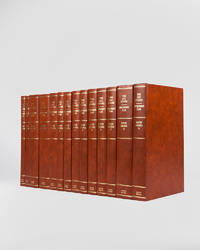
7 vols. Original illustrated cloth/gilt embossed percaline. First editions, very rare. - Complete set of this famous reference work. No more than 380 copies were printed (and many destroyed by a flood); vols. III and V were limited to a press run of 250 and 284 copies, respectively. Raswan became an expert on the Arabian breed through his lengthy trips to the desert, where he lived with the Bedouins and learned their language and customs. - Some hinges split. All volumes save for VI and the posthumous VII numbered and signed by Raswan, mostly in the year of publication. In very good condition.
12mo. XXX, 161, 113 pp. Modern brown calf preserving original marbled covers. First edition of "Sind-Bâd" and the first independent printing of any part of the Arabian Nights in Arabic. Although traditionally included in the corpus of the Thousand and One Nights (Alf layla wa-layla) as told by Scheherazade, it is thought that the series of stories that make up the voyages of Sindbad have older and separate origins, incorporating elements of Homer, Panchatantra, other Persian, Arab and Indian literary material as well as historical material relating to trade and navigation. Set traditionally during the reign of Haroun al-Rashid, Sindbad undertakes seven voyages from Basra, each leading one to the other, encounters fabulous creatures, faces exhaustive ordeals and amasses fabulous wealth. The publisher of the present edition, Louis-Mathieu Langlès (1763-1824), an important figure in the study of Middle-Eastern and Oriental languages and literature, was a correspondent of William Jones in Calcutta, co-founder of the École des Langues Orientales Vivantes in Paris, and the keeper of the Indian manuscript department in the Bibliothèque Nationale in Paris. "Un ouvrage classique, et d'une certaine importance sous le point de vue scientifique, historique ou littéraire" (preface). - Some browning and waterstaining throughout; occasional paper defects to edges (no loss to text); an Arabic stamp to p. 90 of the French text. Chauvin VII, p. 2. Brunet III, 820. OCLC 4433261.
11 vintage photo prints (ca. 90 x 120 mm, but one 105 x 170 mm) on backing cardboard (20 x 25 cm). Highly uncommon photographs of Arabian horses (all individually captioned) at the famous Bábolna stud in Hungary, the principal stud for producing the best horses for the Austro-Hungarian military in the 19th century. The "Bábolna Nemzeti Ménesbirtok" (Bábolna National Stud) was founded by Emperor Joseph II in 1789. In 1816 it was decreed that henceforth only Arabian stallions should be used for stud service - a policy that raised the quality of the Austrian cavalry's horses to a famous level and necessitated the frequent introduction of new pure-bred Arabian stallions from the Middle East. One of the greatest commanders and stud-masters of Bábolna, Mihály Fadlallah el Hedad, hailed from Syria. - The photos show portraits of the horses Sechun, Nadir, Tahita, Nasira, Celeby, Dzerid, El Hafi, El Denedzi, Hiläl, Riat, as well as a larger group portrait showing several of the horses with their Arabian and Austro-Hungarian trainers. Some slight staining to backboards, but altogether well-preserved. Extremely rare.
A total of 267 photographs of construction work on the Aswan Dam. Comprises 190 large photographs (ca 25 x 30 cm), frequently with captions in the negative, mainly by D. S. George but also including A. Gianny and G. Kemble Bolam of Cairo (56 tipped in to an album and captioned, 21 loosely inserted within another album, 108 stored loosely within a portfolio, and 5 separately matted). Also, 77 smaller photographs (gelatin prints) of the dam and its environs, ca 15 x 18 cm (including a few duplicates), in an envelope. An impressive collection of photographs detailing the construction and opening of the Aswan Low Dam between 1899 and 1902 and of the work to raise it in 1907-1912. The images (frequently captioned in English on reverse) include views of the navigation channel in various stages of completion, the countless hundreds of local workers toiling in the unfinished West Channel and on the masonry of Bab el Maroum, the locks, trenches, Asyut Barrage, the accumulator house, the inauguration ceremony, but also a friendly football match between the "10th Soudanese Regiment (Blacks)" and the "Whites" (final score: Blacks 0, Whites 5). A stark panoramic shot shows the solar eclipse of 28 May 1900 above the Mohammed Ali Channel, seen from Awad. - Owing to its rainless climate Egypt has always depended on the annual flooding of the Nile for irrigation. The Aswan dam was designed by eminent British engineers to provide storage of annual floodwater and to augment dry season flows; construction about 1000 kilometres up the river from Cairo was begun in February 1899 by the London-based contractor John Aird & Co. Nothing of its scale had ever been attempted; on completion, it was the largest masonry dam in the world. It created an artificial lake extending 200 miles up the valley, partly submerging Ptolemy's temple on the island of Philae. The 1.25 mile-long dam with 180 sluice gates cost 3 million pounds sterling. It was opened by the Khedive on 10 December 1902. Originally limited in height by conservation concerns, the dam worked as designed but provided inadequate storage capacity for planned development and was raised between 1907 and 1912. The heightening still did not meet irrigation demands, and in the 1960s the Aswan High Dam was built 6 kilometres upstream. - A few nicks along the edges, some gelatin prints somewhat faded and with occasional creases. Mats generally foxed, with some foxing to the matted images, but on the whole an outstandingly preserved ensemble printed in rich, crisp detail.
8vo. (10), 736 pp. Printed in red and black throughout. Contemporary blindstamped black calf binding. The Arabic Horologion (following the Byzantine rite), containing the breviary, canonical prayers and hymns for the feast days of the Saints throughout the year. From the printing office of the Melkite monastery of St. John the Baptist at al-Shuwayr in the Lebanese Kisrawan mountains, operative between 1734 and 1899, during which time it produced in all 69 Arabic books, including re-editions (cf. Silvestre de Sacy I, pp. 412-414; Middle Eastern Languages and the Print Revolution. A Cross-Cultural Encounter, Westhofen 2002, pp. 179-181). Occasional insignificant brownstaining; slight chipping to extremeties of the appealing original binding. Rare: OCLC lists two copies only (at the University of Leiden and the Veech Library, Catholic Institute of Sydney, Australia). OCLC 68525490, 224329156.