4 085 résultats
21 album leaves with 1 drawing mounted on each recto. Album: full-sheet leaves (oblong folio, 395 x 525 mm); drawings: oblong folio and oblong 4to. An album with 21 watercolour drawings on paper with views of sea coasts from the shore (240 x 310 mm to 295 x 465 mm), one with a 22nd watercolour drawing on the back with a similar view, and one with about 15 human figure drawings in graphite pencil on the back. All bear the artist's stamp on the front (Lugt 3703) and 4 are signed or initialled by the artist. Richly gold- and blind-tooled green goatskin morocco, sewn on 3 recessed cords (not aligned with the six flat raised bands on the spine), each board with a blind-tooled inner oval frame of interlaced abstracted leaves and vines, surrounded by a gold-tooled frame of similar decoration (oval inside and rectangular outside), surrounded by 2 frames of thick-thin fillets, the front board with the owner's initials in textura capitals in the centre: "A.L.", signed at the foot of the spine, "A. Giroux & C:" (last recorded in 1856), white watered silk endleaves (the paste-down in the form of a doublure). The whole in a protective folder lined with thick leather, with green goatskin morocco where it wraps around the 2 short ends, and chemical-marbled paper sides (black papier croise d'Annonay: cf. Wolfe XXI, 1-3: France, 1830s-50s), with remains of a green cloth tie on the flap. A richly gold- and blind-tooled album (ca. 1850/56) containing 22 excellent and detailed watercolour views of rocky sea coasts, all or nearly all in New Caledonia and Peru (plus 1 graphite pencil drawing of about 15 human figures), the coastal views made from the shore. All were executed by Osmond Romieux (1826-1908), a leading amateur artist who made them during his tours of duty as a French naval officer. At least 18 have a pencil note on the back identifying the location: 15 "Nouvelle Caledonie", 2 "Pérou" (drawings 18, 20) and 2 "Callao" in Peru (drawings 17, 18). We have found no location indicated on drawings 3 (with views on both sides), 8 and 19 (with figure drawings on the back). Most of the drawings were made from the sea shore, looking out over both the sea and the nearby coasts, nearly all with rocky cliffs or outcroppings and some with trees or other plants. Many were made along bays or inlets where one can see the coast on both sides and the water in one view. Some show fortifications or other buildings, a few show boats in the water or on the shore and several show people on the shore, all or nearly all in European dress. Drawings 2, 8, 15 and 17 are signed or initialled by the artist. - No drawing in the album bears a date, but the album shows no signs of other items having been removed, so the drawings probably date from before or soon after the album was manufactured. The album leaves are made of wove paper with no watermark, but A. Giroux & Cie is not recorded after 1856 and the binding style suggests the album is not much older. Most of the drawings are made on thick wove paper with no visible watermarks and with a rough surface texture much like many of today's watercolour papers. Drawing 4 is on thinner and smoother wove paper with no watermark visible and drawings 9 and 11 are on laid paper watermarked (in the centre of a half-sheet): grapes on a crowned shield (20 grapes plus stem, rendered naturalistically, with grapes arranged in an irregular pattern rather than a honeycomb and sometimes overlapping), about 118 x 70 mm (chainlines 26 mm apart). Unfortunately, the watermark literature does not cover this period well, but the crown is in the general style of those used much earlier for a fleur-de-lis on a crowned shield, such as Heawood 1822. Drawings 20 and 21 may be on the same stock as 9 and 11 but show no watermark, though 20 was made in Peru and the others in New Caledonia. Drawings 9, 20, 21 and probably 3 and 19 are executed on oblong 4to leaves; at least most of the others are on oblong folio leaves. Drawing 13 may be backed with smoother wove paper. - Prosper Halvor Henri Oscar Romieux, who used the first name Osmond, joined the French navy at Rochefort (less the 30 km from his native La Rochelle) in 1841 and passed his exams at the École Navale in 1843. He made his first tour of duty in Polynesia during the Franco-Tahitian War (1844-47), at least from 1845 aboard the ship "La Virginie". We find no record of Romieux or the ship visiting New Caledonia during this period, although it is "only" 4500 km from Tahiti. Romieux must have shown artistic skill from early childhood, for already on this first tour he made excellent watercolour drawings, and he continued to make watercolour views around the world until he retired from duty in 1891. He was made a chevalier of the Légion d'Honneur in 1863 and later an officier. Other undated drawings also record him in New Caledonia and Peru (including Lima and Callao). He is documented in New Caledonia in 1880 and 1882, but the present drawings are unlikely to be that late, and we have found no date for his visit(s) to Peru. We have little record of Romieux's movements from 1848 to 1850, but if he left the South Pacific he soon returned, for he is recorded in Hong Kong in 1851 and the Philippines in 1852 (in 1851 he was an Enseigne on the ship "l'Algérie"). He must have left in 1852, however, for he is recorded in the Seychelles (in the Indian Ocean) in 1852 and Italy in 1853 and 1854. In this last year he was promoted to Lieutenant, but we have another gap in the records of his movements from that time to 1860. He may have made the present drawings during this period, for he set off for the Levant on the ship "Redoutable", apparently in or shortly before 1860, since he is regularly recorded in Syria, Lebanon, Greece, Algeria and Jerusalem from 1860 to 1864. He was promoted to Capitaine in 1867 and continued his travels, but since the present album was probably bound in or before 1856 we think it unlikely that he made the drawings after 1864. - Although the binding is signed by Giroux, the firm operated primarily as suppliers of artists' materials and Ramsden plausibly suggests that they "commissioned bindings by the best executants of the day". Alphonse Giroux established the firm by 1799, but his son Alphonse Gustave Giroux (1809-86) managed it from at least 1838 and the father died in 1848. - We have not identified the "A.L." who apparently acquired these watercolours and had the album made in the 1850s: Lugt lists several French collectors with those initials active at the time. One watercolour has a small corner torn off at the lower right, another is slightly frayed along the right edge and the one on thin wove paper is very slightly browned, but the watercolours are otherwise in very good condition. The binding may have been expertly rebacked, preserving the original backstrip, but so unobtrusively that one must wonder if the binding was originally made that way. It is further in very good condition and even the folder is olny slightly rubbed.A lovely and finely executed series of large watercolour drawings of the coasts of New Caledonia and Peru, probably made in the 1850s and mounted in a stunning gold- and blind-tooled contemporary album. For Romieux: Lugt 3703. For Giroux: Flety, Dictionnaire des relieurs francais p. 82; Ramsden, p. 94.
4to (225 x 264 mm). X, 42 pp. With 4 lithogr. folding plates. (And:) Beitraege [...] Zweites, Drittes, Viertes, Fünftes Heft. Systema Astronomiae Aegyptiacae Quadripartitum. Ibid., 1833. XXX, 445, (10) pp. (series titles and separate half-title for no. 2). With hand-coloured frontispiece and 10 large folding plates, lithographed throughout. Contemporary polished red morocco, spine, leading edges, inner dentelle and covers richly gilt and blind-tooled in the Romantic style. Glazed green endpapers; all edges goffered and gilt. Bound by the Leipzig master Anton Stumme with his label on the first flyleaf. A fine morocco volume comprising the first five of Seyffarth’s monographic "Contributions" to Egyptology (apparently all published at the time of binding; two more were to follow by 1840). While the first fascicle contains the earliest catalogue raisonnée of the substantial Berlin collection of papyri, fascicles 2-5 (published with continuous pagination) constitute a bold investigation into early Egyptian astronomy and its all-pervading cosmological cult. This section includes a hand-coloured frontispiece of astronomical animal forms and ten large folding plates, all lithographed, showing important pieces of archeological evidence: the Navicula astronomica (Paris), Zodiacus Tentyriticus (Paris), Zodiacus Taurinensis (Turin), Sarcophagus Sethi (London), Sarcophagus Ramsis (Paris), Monolithus Amosis (Paris), Mensa Isiaca (Rome), and a Papyrus funeralis formerly in the d'Hermand collection. The final part is an astronomical lexicon, a typographical masterpiece that fits more than 1300 lithographed hieroglyphs precisely into their letterpress explanations. - Seyffarth, an opponent of Champollion's, emigrated to the U.S. in 1855. His thousands of transcriptions and sketches are preserved in the Brooklyn Museum as the "Bibliotheca Aegyptiaca Manuscripta". - A luxury copy printed entirely on wove paper and bound in elaborate morocco with finely goffered edges (unusual for a secular binding of the time) by the Leipzig master Anton Wilhelm August Stumme (1804-67), who also worked for Robert Schumann. Minor wear to binding, occasional foxing as typical for wove paper. Coloured frontispiece browned evenly; largely insignificant gutter tears to four folding plates. A crisp, unused copy in a magnificent binding. Ibrahim-Hilmy II, 229f.
Large 4to (195 x 268 mm). Title and 30 captioned plates, engraved throughout (image size ca 110 x 170 mm). Late 19th century half calf with gilt spine rules and 18th or early 19th c. giltstamped lozenge label on upper cover. Charming, rare suite of engravings showing the costumes of the Turks, including the Sultan and various courtiers of the Porte, Ottoman soldiers and janissaries, an Arabian preacher, a falconer, street salesmen, a porter smoking a long meerschaum pipe, and several Turkish ladies (one in surprisingly revealing attire). - Charles-Francois Silvestre (1667-1738) held the title of "Maître à dessiner du Roi" (Drawing Master to the King) and was in 1695 appointed art instructor to the young Dukes of Burgundy, Anjou and Berry, the grandsons of Louis XIV. The present suite, dedicated to Louis, Duke of Burgundy, reflects the orientalist fashion of its time but is also a highly original work of art demonstrating a vivid, flamboyant style and not apparently based on earlier illustrations. The title and 21 of the plates are signed in full with the Royal privilege: "F. Silvestre inv. et ex. C.P.R.", while eight are simply signed "S." and one ("Janissaire de la garde, Solac ou Pzyc") is not signed, though it is clearly executed in the same style as the others. Uncommon thus with 31 plates including the title: the copies listed by both Hiler and Colas, as well as that in the Gennadius Library at the American School of Classical Studies at Athens, are oblong volumes containing only 30 plates including the title, on a total of 15 leaves (Colas: "titre compris [...] Ces planches sont tirées à deux sur la même feuille"), while the Lipperheide copy comprised a mere 22 plates including the title, making this the most complete set known. - Insignificant browning and fingerstaining, more pronounced in title but on the whole confied to the wide margins. Hiler 799; Colas 2744 (both listing 30 plates including title). Lipperheide Lb 25 (listing title and 21 plates).
Watercolour on a large sheet of paper (image size: 74.5 × 52 cm), signed at the foot right: "E. Tarenghi". Contemporary (?) gilt wooden frame (89.5 × 66 cm), behind plastic. Attractive watercolour painting by the Italian orientalist painter Enrico Tarenghi (1848-1938), it shows three bearded men with carpets and two poufs. One of them is clearly the seller, another is inspecting the wares and the third is sitting on the ground rolling up one of the carpets. In the background a wide river (generally assumed to be the Nile), a dromedary and dozens of palm trees. Tarenghi made extensive use of photography in his work and often used photographs as a template for the background. The present setting is found more often in his work, not only showing carpet sellers, but also merchants selling fruit. The carpet trade, however, seems to be one of his favourite subjects regardless of the background. The carpets allowed Tarenghi to show off his skills, with their intricate motives, textures, creases and folds. - Small waterstain and minor defects at the foot and a few other negligible blemishes, but otherwise in very good condition. For the artist: Thieme & Becker XXXII, p. 445.
Folio (212 x 324 mm). Persian manuscript on faintly ruled paper. 1 blank leaf, 336 pp. (168 ff.), 1 blank leaf. Text is complete, but last leaf is missing. 1 illuminated headpiece and 49 illustrations in ink and bright watercolour wash. Text in black, ruled in black, with important words and phrases picked out in purple. 19th century leather ruled and stamped in blind. Lavishly illuminated Persian manuscript depicting the romance which came to define the love story in Western literature. Composed by Abu al-Qasim Hasan Unsuri (ca. 961-1039), the original Persian was in fact lost, and preserved in a Turkish translation. Unsuri's version was itself based on what was already an ancient love story in his own time, the Ancient Greek novel "Metiochus and Parthenope", which also survives only in fragments. Though certainly derived from the Greek, like many Persian romances with Greek origins, "the nature of the relationship is not [...] the simple one of the earlier (Greek) material influencing the later (Persian) material, as the Greek novels contain a number of motifs and topoi which are identified within the narratives themselves as Persian in origin. The relationship between the love narratives of the two cultures appear, therefore, to have been one of mutual reciprocity over a considerable stretch of time" (Davis). - Some fragments of the original Persian do survive: Sa'id Nafisi collected 141 verses of "Wameq o 'Adra" that were used as evidence in Persian dictionaries, and 372 more verses were discovered by Mohammad Šafi' in the binding of an old manuscript in 1950 (Blois, 201). Unsuri's version was translated in the 16th century into Turkish by Shaikh Mahmud Lame'i, though in comparison with the earlier fragments, this is considered a loose translation of the original. However, it provides the source of most subsequent translations and most of what we know of "Vamiq va 'Azra", as a romance which underpins the genre. In literature both medieval and modern, the narratives of the original persist: lovers separated by a kidnapping, a virgin who must use a range of tricks to elude unworthy attempts on her chastity, an interrupted wedding, and a seemingly final separation with the (supposed) death of one of the lovers. In this way, "Vamiq va 'Azra" echoes down the literary ages. - Covers somewhat worn but professionally repaired; still tightly bound. Light soiling, otherwise a beautifully illustrated and uncommon manuscript. Richard Davis, "Greece IX. Greek and Persian Romances", in: Encyclopaedia Iranica XI, 339-342. Francois de Blois, Persian Literature: A Bio-Bibliographical Survey. Vol. V: Poetry of the Pre-Mongol Period (London: Royal Asiatic Society, 2004), pp. 201-204.
2 text vols. (8vo) and 2 plate vols. (large folio). (2), 491, (1), (4) pp. 788, (6) pp. text. With engraved portrait of Segato as frontispiece in the first text volume and the plate volumes with 160 engraved and aquatint plates (7 double-page), including 51 tinted and/or coloured by a contemporary hand; many plates contain multiple illustrations, making 309 illustrations in total. Contemporary green (text vols.) and brown (plates vols.) half morocco, sewn on 3 recessed cords (text vols.) and 4 tapes (plates vols.), "agate" chemical marbled sides. First edition of a beautiful series of illustrations of Egypt and classical Egyptian monuments, with the accompanying text volumes giving detailed information on each illustration. The illustrations show maps, costumes and views of both ancient and modern Egypt. The scientist and Egyptologist Girolamo Segato (1792-1836) began working on a new description and depiction of Egypt, selecting illustrations from the works of Denon, Grau and Rosellini, and also including his own original drawings. After his premature death his collaborator Domenico Valeriani finished the work and provided the accompanying texts. - Segato is best known for his technique similar to mummification, this technique of petrification remains mysterious, despite numerous studies and attempts to imitate, as he destroyed all his documentation before his death. - The text and plates volumes with marginal foxing throughout, minor except in the preliminary leaves. Otherwise in good condition. The binding slightly rubbed along the extremities, damage to the upper right corner of the first plates volume, resulting in a stain on the front endpapers, and the upper half of the sides on the second plate volume faded, otherwise good and structurally sound. Blackmer 1521 (plate volumes only, erroneously noting 159 plates). Blackmer sales cat. 984 (160 plates). Ibrahim-Hilmy II, 301. ICCU 0154707. For Segato: Almagia, "Segato, Girolamo" in: Treccani Enciclopedia Italiana (online ed.).
Small 8vo (94 x 143 mm). 100, (4) ff. With woodcut title illustration and woodcut printer's device to final leaf. Near-contemporary limp vellum with traces of a handwritten spine title. Still early original Italian edition of Ludovico di Varthema's famous travels to Arabia, Persia, and India: the highly important and adventurous narrative containing the first printed eyewitness account of any place in today's United Arab Emirates. On his return journey from Mecca (which he was the first Westerner to describe), Varthema visited Ras al-Khaimah ("Giulfar") and portrayed the city as "most excellent and abounding in everything", with "a good seaport", and whose inhabitants are "all Muslims". While Montalboddo's famous anthology of discoveries, printed in 1507, contained the first printed reference to the Arabian Gulf region, it was Varthema's work, published only three years later, that offered the first actual report from the region by a Western traveller who had visited the coast. All early editions of Varthema’s “Itinerario” are exceedingly rare (even the 2013 Hajj exhibition at the MIA, Doha, only featured the 1654 reprint; cf. below). - Varthema, a gentleman adventurer and soldier from Bologna, left Venice at the end of 1502. In 1503 he reached Alexandria and ascended the Nile to Cairo, continuing to Beirut, Tripoli, Aleppo and Damascus, where, adopting Islam and taking the name of Yunas, he joined a Mameluke escort of a Hajj caravan and began the pilgrimage to Mecca. Varthema was amazed by what he observed: "Truly I never saw so many people collected in one spot as during the twenty days I remained there", he begins, and arriving at the Great Mosque, continues, "it would not be possible to describe the sweetness and the fragrances which are smelt within this temple." Thanks to his knowledge of Arabic and Islam, Varthema was able to appreciate the local culture of the places he visited. Impressed and fascinated, he describes not only rites and rituals, but also social, geographical, and day-to-day details. "I determined, personally, and with my own eyes", he declares in the prefatory dedication, "to ascertain the situation of places, the qualities of peoples [...] of Egypt, Syria, Arabia Deserta and Felix, Persia, India, and Ethiopia, remembering well that the testimony of one eye-witness is worth more than ten hear-says." His good fortune did not continue unabated, however: after embarking at Jeddah and sailing to Aden, he was denounced as a Christian spy and imprisoned. He secured his release and proceeded on an extensive tour of southwest Arabia. Stopping in Sanaa and Zebid as well as a number of smaller cities, he describes the people, the markets and trade, the kind of fruits and animals that are plentiful in the vicinity, and any historical or cultural information he deems noteworthy. Returning to Aden, and after a brief stop in Ethiopia, he set sail for India. In addition to visiting Persia, Varthema explored the coasts of Malabar and Coromandel, including a stay at Calicut at the beginning of 1505. He also purports to have made extensive travels around the Malay peninsula and the Moluccas. Returning to Calicut in August 1505, he took employment with the Portuguese at Cochin and, in 1508, made his way back to Europe via the Cape of Good Hope. - First published in 1510, Varthema's account became an immediate bestseller. In addition to his fascinating account of Egypt, Syria, the Arabian Peninsula, and the holy Muslim cities, "Varthema brought into European literature an appreciation of the areas east of India [...] which it had previously not received from the sea-travelers and which confirmed by firsthand observations many of the statements made earlier by Marco Polo and the writers of antiquity" (Lach, I. i. 166). "Varthema was a real traveller. His reports on the social and political conditions of the various lands he visited are reliable as being gathered from personal contact with places and peoples. His account of the overland trade is of great value in that we are made to see it before it had begun to give way to the all-seas route. He even heard of a southern continent and of a region of intense cold and very short days, being the first European probably after Marco Polo to bring back the rumor of Terra Australis" (Cox I, 260). - This edition includes the itinerary of the island of Yucatan (fols. 89ff.), repeated from the 1526 edition of Varthema: Juan Díaz's account of Juan de Grijalva's 1518 expedition to Middle America, first published in Venice in 1520. - Trimmed closely with occasional slight loss to the outermost letters of the page. Some browning and waterstains. The fine title woodcut, copied from Scinzenzeler's 1523 edition, shows Varthema seated on a bench in front of a building, writing on a globe, behind him a set of dividers; in the background is a landscape with a ship at sea and a castle. 17th century ink annotation to verso of last leaf. Rare; a single complete copy in international auction records since 1936. OCLC lists six copies only. Edit 16, CNCE 48228. BM-STC Italian 73. Macro 2239. Gay 140. Röhricht 574, p. 163. Cordier Indosinica I, 98f. Fumagalli 77. Harrisse 205. Sabin 98646. Alden, European Americana, 535/20. OCLC 56581916. Cf. Blackmer 1719. (1523 edition). Boies Penrose, pp. 28-32. Exhibition cat. "Hajj - The Journey Through Art" (Doha, 2013), p. 90 (1655 Dutch ed. only). Carter, Robert A. Sea of Pearls, p. 68 (1520 edition). Not in the Atabey collection. Not in Adams.
Folio (205 x 290 mm). (24), 491, (1) pp. 17th century black-tinted vellum binding using an earlier liturgic musical manuscript. Important Latin edition of this Arabic medical compendium (first printed, also in Latin, in 1479), with additions by Gerard de Cremona. It provides a collection of opinions voiced by Greek and Arabic physicians on pathology and therapeutics. "No Arabic printed edition exists so far" (cf. Choulant). The third-century doctor Yahya bin Sarabiyun, son of a Bagarma physician, wrote his great medical work "Al-Kunnas" in Syriac, but it was soon translated into Arabic by scholars such as Musa Ibrahim al-Haditi and ibn Bahlul. There exist manuscripts in twelve and in seven books. "The seven-book edition was frequently printed in Latin translations as 'Breviarium' and 'Practica therapeuticae methodus'. Albanus Torinus, the editor of the Basel 1543 edition, called him Janus Damascenus, for which reason he has been confused with the well-known theologian of that name. He is also often mistaken for his younger namesake, Serapio junior" (cf. GAL I, 233). Some catalogues even ascribe this work to the Baghdad physician Abu-Zakariya Yuanna Ibn-Masawaih. - Slight waterstaining; some unobtrusive worming to upper cover and flyleaves. Binding rubbed; extremeties bumped with chipping to spine-ends. A wide-margined copy. Provenance: 1677 ownership of the pharmacist and medical student Joseph Franz König on front pastedown; later in the library of Bonifacius Brix von Wahlberg, court physician to the Princes of Fürstenberg, in the later 18th century (his ownership on the title page). VD 16, Y 11. Adams I 14. BM-STC German 932. GAL I, 233 & S 417. Durling 4778. Choulant, Handb. p. 347. Not in Waller.
Folio (210 x 319 mm). (4), 126, (4) pp.; 22 ff. Title within engraved figurative border. With an engraved vignette, 22 engraved plates (2 of which are double-page-sized). Contemporary brown calf with gilt borders and decoration on middle of covers; blindtooled spine rebacked. Traces of ties. Book seven of Théodore de Bry's "Petits Voyages", the greatest single collection of material on early voyages to the East Indies, which is considered unique in its extraordinary wealth of cartographical and visual material. Crucially, this much-sought volume includes Gasparo Balbi's groundbreaking account of the Middle East, first published in 1590 as "Viaggio dell' Indie Orientali" - a mere 16 years before this present issue, making this the second appearance in print altogether and the first Latin translation. Balbi, a Venetian jewel merchant, travelled extensively in the Arabian Peninsula in search of precious stones. From Venice he sailed for Aleppo, proceeding to Bir and from there overland to Baghdad, descending the Tigris to Basra, where he embarked for India. While in the Gulf, he studied the pearl industry, noting that the best pearls were to be found at Bahrain and Julfar. He refers to islands in the Emirate of Abu Dhabi (including Sir Bani Yas and Das) and to several coastal settlements that were to become permanently established, such as Dubai and Ras al Khaima. Balbi was the first to record the place names along the coast of modern Qatar, the United Arab Emirates and Oman. Practically "none of the names of places on the coast between Qatar and Ras al Khaima occur in other sources before the end of the eighteenth century" (Slot). The volume also comprises the account of Joris von Spilbergen's voyage to Ceylon in 1601-04 (with excellent plates). - Calf slightly worn, some browning due to paper. Title browned in the margins; some foxing to plates. Contemporary ownership inscription of Thomas Knyvett in upper margin of title (partly obliterated by a later owner), dated 27 June 1608; also inscribed "perlegi (I finished reading) 20 Octob. 1608 Tho. Kny." near lower edge of the title. Armorial bookplate and later ownership of "T. Norcliffe" on inside of upper cover. Thomas Knyvet, 1st Baron Knyvet (also Knevytt, Knyvett, Knevett, Knevitt; 1545-1622) was an English courtier and Member of Parliament who played a part in foiling the Gunpowder Plot. Latterly the library of Swedish antiquarian bookdealer Björn Löwendahl (1941-2013). Brunet I, 1334. Church 206, 207, 208, 211, 212, 214, 217, 219, 221-225. Cf. Howgego I, B7. Ibrahim Al Abed, Peter Hellyer. United Arab Emirates: A New Perspective. London 2001. Slot, B. J. The Arabs of the Gulf, 1602-1784. Leidschendam, published with the support of the Cultural Foundation Abu Dhabi, 1993. Geoffrey King. Delmephialmas and Sircorcor: Gasparo Balbi, Dalmâ, Julfâr and a problem of transliteration. In: Arabian archeology and epigraphy 17 (2006) 248-252. United Arab Emirates yearbook 2005 by Ibrahim Al-Abed, Paula Vine, Peter Hellyer. London 2005. The Heritage Library, Qatar, p. 17. Carter, Robert A. Sea of Pearls, p. 79.
Elephant folio (685 x 510 mm). 2 plate volumes. [Antiquities volume]: Half-title, title for Histoire Naturelle [!], list of artists (mounted). 92 large engraved plates, maps, and plans, including 2 colour, 9 double page, and a few folding, numbered 1-97 (lacking plates 15, 18, 49, 79, 87). - [Etat Moderne]: Half-title, title, list of artists (all trimmed and mounted). 57 engraved plates and maps, including 2 double page. 19th century green half morocco, spines gilt. All edges gilt. From the first comprehensive description of ancient and modern Egypt. Two plate volumes from the 23-volume series produced by the commission of scholars and artists that accompanied Napoleon's expedition to Egypt in 1798-1801. The complete set comprises 10 text and 13 plate volumes, divided into "Antiquités", "Mémoires", "Histoire naturelle", "Etat moderne", and "Carte topographique", published between 1809 and 1828. The present volumes are something of an amalgam: the spine and title page of one indicate the first volume of plates for "Histoire Naturelle", but the 92 large plates within are from the first volume of "Antiquités", depicting architecture and ruins, monuments, tombs, artifacts, views, elevations, and maps from Philae, Eswan, Edfou, Esne, Koum Omobu, and elsewhere. The volume labeled "Etat Moderne" (with a corresponding title page) features a selection of plates from volumes 1 and 2 of "Etat Moderne", in addition to 21 plates from the first volume of "Histoire Naturelle", including 17 ichthyological plates as well as plates mineralogical and botanical. - Condition report for "Antiquités": all plates backed with new sheets, scattered foxing (significant to 2 or 3 plates) and a few pale dampstains, a few repaired tears and marginal restorations, lower third of plate 10 lacking, some restoration to spine. - "Etat Moderne": Plates trimmed at plate marks and mounted to elephant folio sheets, dampstaining throughout at upper right quarter, restoration to margins outside image of several plates, title page trimmed close at upper margin and worn at lower margin, plate 14 scuffed with loss of text, foxing throughout, staining to natural history plates, repairs to margins mostly outside of image of several plates. Blackmer 476. Ibrahim-Hilmy I, 239. Gay 1999. Cf. Tobler p. 236 (citing the Carte Topographique only). Heritage Library, Islamic Treasures, s. v. "Art" (illlustration). Graesse II, 365.
8vo mimeographed typescript. Approx. 122 pp. Original black wrappers. Together with: 3 colour stills on board (364 x 281 mm), 12 colour stills (241 x 185 mm) issued for the press, 10 silver gelatin print stills (278 x 210 mm), colour poster, and 14 behind the scenes and costume test silver gelatin prints (ranging from 158 x 105 mm to 290 x 290 mm), with further costume test photographs tucked into the script. Fascinating and significant collection of material relating to one of the most famous British films of all time, Sir David Lean's "Lawrence of Arabia" (1962). The collection includes a unique production-used script, the title-page annotated "2nd Unit, Abbey", with various test photographs inserted into the script at different points and annotations and added tabs towards the end of the script. Includes four large black and white behind-the-scenes photos of the film's then-unknown star, Peter O'Toole (1932-2013), on camelback taken by famous stills photographer Ken Danvers (1911-80). Various additional costume reference photographs are present, including three for 'Lawrence', one featuring Peter O'Toole, in costume, smoking next to a set trailer. Also present are a set of twelve front of house stills for the film, an American one-sheet poster from the 1971 re-release, and other photographic stills relating to the production including three large colour film stills on board, which round out an impressive collection. Also included are 11 photographic references of T. E. Lawrence used by the costume design team to style Peter O'Toole. - "Lawrence of Arabia" (1962) was O'Toole's film debut, for which he received international acclaim. The film itself was selected in 1999 as the third best British film of the 20th century, and won seven of an impressive ten Oscar nominations. It is generally considered one of the most important films to come out of the 1960s, and has been selected for preservation in America's National Film Registry in acknowledgment of its cultural significance. - Occasional light wear to photographs, generally in the form of subtle pinpricks to corners. In general, exceptionally well preserved. - Provenance: Acquired by an employee of the film's producer, Sam Spiegel (1901-85). Spiegel was financially responsible for some of the most critically acclaimed motion pictures of the 20th century, and was the first independent Hollywood producer to work on films that won the Academy Award for "Best Picture" three times. One of those films was, of course, "Lawrence of Arabia".
Album of 18 well-preserved algal specimens carefully mounted on individual sheets of white wove paper, each approximately 330 x 155 mm. Loosely laid in to folding portfolio, housed in a marble clamshell box. A rare and early ensemble of algae specimens collected from the Red Sea, from different areas between Suez and Yemen, including one specimen from Alexandria. All items identified with the Latin name and details of the location around the Red Sea and date of collection written in French on the mounts, e.g., "Caulerpa prolifera: très commune dans toute la mèr rouge á la prodondeur de 1½ mètre à 2 [...] Avril 1844", or "Mer rouge dans le Golfe de l'Acaba, Juillet 1844". - The French botanist A. H. Husson, a native of Nancy, was also a pioneer of early photography. He lived in Egypt, where he worked as the director of the botanical garden and conservator for the Museum of Natural History for the Qasr Al-Ainy, the Cairo University's Faculty of Medicine. - "The Red sea has been a region of natural history exploration by European scientists from about 240 years. The first record of marine algae in the Red Sea was by Strand (a pupil of Linnaeus's), who in his thesis on the flora of Palestine listed three species. The first person to collect marine algae from the Saudi Arabian Red Sea Coast was the Danish botanist and explorer Forsskal in the 18th century who, in the month of November 1762, made a collection of seaweeds from the Sea of Jeddah [...] In the early years of the 19th century a British admiral Viscount Valentia made collections of algae from the Red Sea [...] Several other workers, including medical doctors and amateurs, collected marine algae from the Red Sea during the rest of the 19th century" (Beni-Suef Univ. Journal of Basic and Applied Sciences, Vol. 3/4 [Dec. 2014], pp. 278-285). - Includes the offprint of a short biography of Husson: Christian Debize, "L'album photographique d'Anne-Henry Husson. Regards d'un colon nancéien dur l'Egypte moderne", Annales de l'Est (1985), no. 4, pp. 261-299. Stab-sewn in wrappers. - A most exceptional and scarce collection of preserved algal specimens from the Red Sea. Provenance: from the property of the botanist Dr. Eugene L. Vigil (b. 1941), of Lynden, Washington, USA.
229 original photographs, 1 portrait reproduced from a painting, and 2 portraits printed on thin cardboard (one round-shaped). Various sizes (ca. 74 x 110 to 201 x 282 mm), printed both in colour and black-and-white. Some photographs with handwritten Arabic captions in pen on verso; a few with pasted mimeograph typescript captions in English. Stored in 5 display books. A large private photo archive, apparently assembled by a professional Middle Eastern journalist or press photographer, illustrating the reign of HRH Sheikh Zayed bin Sultan Al Nahyan (1918-2004), Father of the Nation and the ruler of Abu Dhabi for more than 30 years. Some pictures show HRH Sheikh Zayed welcoming foreign dignitaries such as the Syrian president Hafez Al Assad, Egyptian president Hosni Mubarak and French president Valery Giscard d'Estaing; others display industrial and cultural aspects of the Emirates, ranging from oil production in the desert to camel races and falconry. Another part of the set shows off prominent landmarks, including the Al Badiyah mosque, the oldest mosque of the Emirates, the forts of Al Hayl, Al Bithnah, and Al Jahili, the Blue Souq market hall in Sharjah, as well as Earth Park and the Zayed Sports City Stadium in Abu Dhabi. In addition, several images record National Day celebrations at the foot of Volcano Fountain in Abu Dhabi, demolished in 2004, but also show the Dubai skyline, military parades, and sailing vessels. A picture of an Iranian Phantom fighter-bomber flying over the Tunb islands shortly before Iranian forces occupied them in 1971 is a rare asset to this archive. - Mostly stamped and/or annotated in Arabic (and some in English) on versos for possibly use by the press, but not traced in the UAEhistory, Keystone or Hulton/Getty press photo archives. A few images have marginal tears or creases; one with a portion whited out for reproduction. Impressive in its extent and its wide variety of motifs, this uncommon set of not widely circulated photographs documents Abu Dhabi's transformation into a modern metropolis since the early 1970s.
Folio. 3 pp. With integral address leaf. Appointed by King Henri III, Jacques de Germigny served as French Ambassador to the Ottoman Empire from 1579 to 1585. - Writing to Lieutenant General M. de Montholon, recounting the torment of two Jewish women and their Jewish and Christian lovers: "[…] nous attendons encor de ce coste là le boyteaux avecq les gallères du cappitaine Bassa lequel est Osman Bassa [Assan Bassa, roi d’Alger] sont ycy attenduz en bonne dévotion. Nottamment led. Osman que ce seigneur veult faire triompher à son entrée audid Constantinople pour sa valeur et ses conquestes qu’il a faites […]. Et le mesme mofti a envoyé un fetfa ou advis à cedit seigneur portant que si son Altesse lui alloit en personne au devant qu’elle ne feroit chose qui fust contre leurs lois. Et ia esté deffendu par cry publicq à touttes femmes de ne se trouver le jour de lad. entrée par les rues, sous grand peine, ainsi demeurer aux maisons et à venir par les fenestres pour plusieurs respects. Et sur ce propos je vous diray qu’il se faict teftis ou informations aud. Constantinople en tous les quartiers ou parroisses des mosquées de la prud’hommie et chasteté de toutes lesdictes femmes turques à l’instance des spahis et aïas bassi, pour avoir esté trouvées et prinses en adultère ces jours derniers. Deux femmes de semblables hommes leurs compaignons qui se retrouvent à la guerre, l’une avec un Juif qui en fut samedy dernier empallé vif, devant la porte de la grande sinagogue, qui soit audit, et icelle ayant esté noyée. Et aultres pour avoir esté aussi prinse avec un chrétien arménien, que l’on tient, seront ensemblement et aujourd’huy traynez à la queue d’un cheval les visaiges contre terre par tout ladit. ville. Et après s’ils auront encore vie mis aux Ganches sur le port […]". - Early diplomatic correspondence relating to the Ottoman Empire, especially on such a delicate matter, is of the utmost rarity.
Folio (390 x 518 mm). VII, (1), 81, (4), 82-86, (2) pp.; 58 pp. With 190 lithographed plates (14 in colour). Modern full black morocco gilt, spine in six compartments gilt, remains of original wrapper cover title inset within lower cover. First and only edition of "the earliest comprehensive study on the history and theory of Ottoman architecture" (Ersoy, p. 117). Only a few copies of this rare work, produced to the most exacting standards of the day, appear to have been printed. It was produced under the patronage of Edhem Pasha, president of the Imperial Ottoman Commission for the Vienna Exhibition of 1873. The text (in German and French, followed by Turkish) consists of a series of monographs. The entire work was "prepared [...] by a diverse group of artists, architects, and bureaucrats who had close professional ties with the palace. The text begins with a lengthy historical overview that embodies a pioneering attempt to define and represent the entire Ottoman architectural past according to the norms of modern historiography [...] The editor of the whole volume, and the author of a substantial portion of the original text, was the amateur historian and artist Victor Marie de Launay, a 'naturalized' Frenchman who held a secretarial position in the Ministry of Trade and Public Works [...] With a keen scholarly interest in architecture, art, and traditional crafts, Marie de Launay, throughout his lengthy bureaucratic career in the imperial capital, was deeply involved in the representation of the Ottoman state in the world expositions [...] The expertly crafted plates that supplement the text of the 'Usul' include plans, elevations, and section of various Ottoman buildings as well as a rich panoply of decorative details and ornamental patterns, all meticulously depicted in accordance with the academic standards of the Beaux-Arts model [...] Accompanying the monochrome illustrations are fourteen chromolithographic plates (printed in the Sébah studios in Istanbul), skillfully drafted with vibrant and sharply delineated colors. In the superior technical quality and graphic precision of its illustrations, the 'Usul' is duly comparable to its highly acclaimed European counterparts, such as Owen Jones's 'The Grammar of Ornament' (London, 1956), Auguste Racinet's 'L'ornement polychrome' (Paris, 1869), or Jules Bourgoin's 'Les arts arabes' (Paris, 1873). Thus, leaving aside the intellectual scope of its text, the 'Usul' must be considered an artistic specimen in and of itself, conceived as a unique showcase of Ottoman technical competence in the art of publishing" (ibid., p. 117-120). The set is not infrequently encountered incomplete: even the Blackmer copy lacked a plate, and that of William Morris (now in the Calouste Gulbenkian Library) lacked three. - Occasional slight brownstaining (not concerning plates), but entirely complete and finely bound to style. Blackmer 956. OCLC 5465203. A. Ersoy, "Architecture and the Search for Ottoman Origins in the Tanzimat Period", in: J. Bailey et al. (ed.), History and Ideology [Leiden 2007], p. 117ff. Not in Atabey.
Folio (32 x 20 cm). 2 vols. in one. (58), 614, (42) pp. (12), 632, (86) pp. Elaborate woodcut device on title-page; woodcut initials, head and tailpieces. 19th century half morocco & marbled boards, spine tooled in blind, lettered in gilt, raised bands. Pliny the Elder's renowned Natural History in its first publication in English, translated by Philemon Holland, the greatest translator of the Elizabethan age. The "Naturalis Historia" is one of the largest single works to have survived from the Roman empire to the modern day and purports to cover the entire field of ancient knowledge, based on the best authorities available to Pliny. He claims to be the only Roman ever to have undertaken such a work. It comprised 37 books in 10 volumes and covered over 20.000 facts on topics including the fields of botany, zoology, astronomy, geology and mineralogy as well as the exploitation of those resources. It remains a standard work for the Roman period and the advances in technology and understanding of natural phenomena at the time. Some technical advances he discusses are the only sources for those inventions, such as hushing in mining technology or the use of water mills for crushing or grinding corn. Much of what he wrote about has been confirmed by archaeology. "We know from Pliny that there were important pearl fisheries in the Gulf [...] Pliny identifies Tylos (Bahrain) as a place famous for its pearls [... He] attests that pearls were the most highly rated valuable in Roman society, and that those from the Gulf were specially praised [...] The pearl related finds at the site of El-Dur indicate the site was integrated into the maritime trade routes linking the Roman Empire, the Persian Empire, India and South Arabia" (Carter). Book 6 holds a chapter that gives the first detailed account of the regions around the Gulf, including what are now Qatar, the Emirates and Oman. - Includes the final printed leaf in vol. 2, containing the errata and printer's colophon. In this copy, the title-page was evidently cut horizontally, above the device, then pieced back together, backed with early laid paper, with the lower half slightly darkened. STC 20029. Pforzheimer 496.
Small folio (224 x 284 mm). 15 vols. (final vol. in 2 parts), uniformly bound in half tan sheep over decorated boards, spines gilt with raised bands in five compartments, decorated endleaves. Some original printed wrappers bound within. All edges sprinkled. First editions; all that was published of this massive project. The "Corpo diplomatico" deals with the relations between Portugal and the Roman Curia, presenting a chronologically arranged sequence of documents from the 16th and 17th centuries. The Portuguese Empire was the first global empire in history, and the sources here edited - frequently citing the significant Portuguese royal title of "King of Portugal and the Algarves, on this side of the sea, and on the other side in Africa, lord of Guinea and of the naval and commercial conquest of Ethiopia, Arabia, Persia, and India" - provide substantial information on the principal world issues and conflicts during that vast Empire's first era. Much of the diplomatic correspondence concerns conflicts between the worlds of Christianity and Islam: in one letter, King Manuel describes his attacks on and victories over the local Muslim rulers ("the Saracens are thrown into confusion"; "our men attacked and burned maritime towns belonging to the Saracens, situated on the mainland"; cf. vol. I, p. 116f.), and in a Papal Breve, Pius V praises the strengthening of the Maltese fortifications after the Great Siege of Malta ("erit opportunissimum adversus Turcas, et praedones Afros totius christiani populi propugnaculum", vol. X, p. 226). Many volumes, but VII through XI in particular, contain material on the Arabian Gulf (Basra, Bahrain, Muscat, and Ormuz): "Ormuz, que he cabeça de todo o Reino de Ormuz [...] e na dita Cidade de Ormuz fortaleza minha com muita gente de christâos portuguezes" (vol. II, p. 374); "o vejo, que se se faz guerra ao Turco e Vossa Alteza quer, sem despesa de quasi nada, o Egipto e Suria e Arabia seraom vossos" (vol. III, p. 243); "e asy mandou que se reteuessem todas as naos, que viessem da India a Judá e a Meca" (p. 397); "se entende hum muito boom socedimento pella armada de Vossa Alteza na ilha de Banrrehem [= Bahrain] de que se deve ter muito contentamento assi pella reputaçâo" (vol. VIII, p. 372); "e depois em Ormuz poderia saber o acontesimento de Baharem" (p. 468); "toda a costa de Melinde ate Moçambique e assi da outra de Adem ate Ormuz quererâo por alguma d aquellas tentar ardis [...] A Baçora vai tambem muita somma de especiaria" (vol. IX, p. 110f.); "O negocio he grave e de muita consideraçâo e em ser muita a somma da speciaria que vem pello mar Roxo ao Cayro e pello de Ormuz a Bacora" (p. 135); "Andre Ribeiro que com Joâo de Lisboa foi cativo em Mazcate" (p. 175); "creo tambem que elles lá ou nos quá nâo sabemps o que passa em Bacora porque se n aquella ilha creserem galees sem hirem do mar Roxo, como as que ali vierâo quando de caminho tomarâo Mascate nâo sey por onde viessem as outras" (p. 305); "pera o resgate dos portugueses que estam cativos no Cayro, e forom presos em Mazcate" (p. 382; cf. p. 485); etc. - Furthermore, there are reports on the Portuguese in Suez, Africa (including Angola, Mozambique, Guiné, Sofala, Morocco, Arguin, Cabo Verde, Congo, São Thomé, Ethiopia), Brazil (Bahia, Maranhão, Rio de Janeiro, Pernambuco), the Azores, India (in nearly every volume, including Goa, Cochin, Damão, Malabar), and the Far East (Malacca and the Moluccas, with a few sections on Macau, China, and Japan scattered in vols. X-XIV). The work also provides a wealth of detail about the Inquisition and "cristãos novos" (both discussed in almost every volume), the Jesuits (vols. V-XV), the Council of Trent (vols. VI-X), Protestant activity (particularly in England), the Restauração, the Dutch in Brazil, the wars with the Turks on land and sea, and the activities of D. Sebastião and St. Charles Borromeu, the Order of Malta, and Cardinal Mazarin. Among the most notable texts are Ambassador Martinho's 1533 letter describing the forces defending Christianity in India and Africa, Bishop Lourenço Pires de Tavora's account of monasteries in India in 1561, and 25 letters written by P. Antonio Vieira from 1671 to 1675 (vol. XIV). - Marginal spotting in vol. XV, part 1; last 5 leaves remargined. Very discreet library markings on rear pastedown of each volume. Overall a very good set. Innocêncio IX, 95. OCLC 55783574.
4to. 75, (1) ff. - (Bound with) II: Fabri, Felix. Eigentliche beschreibung der hin unnd wider farth zu dem Heyligen Landt gen Jerusalem, und furter durch die grosse Wüsteney zu dem Heiligen Berge Horeb Sinay, darauß zuvernemen was wunders die Pilgrin hin und wider auff Land und wasser zu erfahren und zu besehen haben. [Frankfurt, David Zöpfel], 1556. 219, (1) ff. With a title woodcut depicting a pilgrim with two camels. Contemporary blindstamped leather over wooden boards. I: A fine Renaissance edition of Tucher's pilgrimage to the Holy Land, undertaken in 1479-80 and first published by Schönsberger in Augsburg in 1482. Tucher (1428-91) was a wealthy Nuremberg merchant who moved in humanistic circles; "his travel report is remarkable in several respects: geographically, because it provides a different, non-traditional route from Jerusalem to Mt. Sinai. Tucher departed from Gaza like Breydenbach, Count Solms, and Felix Fabri in 1483, and seems to have crossed the Tih by the pass el-Mureikhy (which he calls 'Roackie'). But Tucher's stations in the desert denote a different route and are even more difficult to reconcile with the known localities. In historical respect, Tucher's account is remarkable for abstaining largely from the fabulous and for revealing a sense of factual reporting, even though much space is given to miraculous episodes, as might be expected from a text of this genre and age. Finally, it is of linguistic interest" (ADB). - II: Editio princeps of Fabri's pilgrimage account. Felix Fabri, a native of Zurich and a Dominican preacher at Ulm, describes his two pilgrimages made to the Holy Land, the first in 1480, as chaplain to Georg von Stein, and the second in 1483-84 as chaplain to Johannes Truchsess von Waldburg, as part of the same party as Breydenbach. - Title-page of Tucher frayed. Some light staining throughout. Worldcat lists 3 copies of Tucher in the US, and 5 copies of Fabri. Not a single copy of Tucher in auction records; a copy of Fabri in a modern binding commanded £4140 at Sotheby's in 1998. I: VD 16, T 2164. Röhricht 390. ADB XXXVIII, 766. - II: VD 16, F 136. Röhricht 395 ("Ulm").
12mo. 4 vols. (40), 670 pp. (2) ff. (1 blank), 734, (34) pp., (2) ff. (1 blank), 792, (18) pp. 756, (24) pp. With a woodcut in the text of vol. 3, p. 193, and a full-page engraving on p. 361 of vol. 4 (both diagrammatic). Contemporary limp vellum with ms. spine titles; all edges of vol. 2 sprinkled in red. Early duodecimo edition of Della Valle's complete "Viaggi", published while the first complete edition was still under the press. Della Valle's account is highly sought after as one of the earliest printed sources for the early history of Dibba, the coastal region at the northeastern tip of the United Arab Emirates, today ruled by the Emirates of Fujairah and of Sharjah. - Pietro della Valle (1586-1652) left Venice in 1614 on a pilgrimage to Palestine, proceeding to Baghdad and then into Persia, where he married and sojourned in the court of Shah Abbas. While staying with the Sultan of Bandar Abbas, he "met the son of the ruler of Dibba who was visiting. From this he learned that Dibba had formerly been subject to the kingdom of Hormuz, but was at that time loyal to the Safavids who in 1623 sent troops to Dibba, Khor Fakkan and other ports on the southeast coast of Arabia in order to prepare for a Portuguese counter-attack following their expulsion from Hormuz (Jarun). In fact, the Portuguese under Ruy Freire were so successful that the people of Dibba turned on their Safavid overlords, putting them all to death, whereupon a Portuguese garrison of 50 men was installed at Dibba. More Portuguese forces, however, had to be sent to Dibba in 1627 as a result of an Arab revolt. Curiously, two years later the Portuguese proposed moving part of the Mandaean population of southern Iraq, under pressure from neighbouring Arab tribes, to Dibba" (UAE History: 2000 to 200 years ago - UAEinteract, online). "Della Valle displayed excellent narrative and descriptive skills, powers of acute observation, and a genuinely scholarly breadth of learning. He refused to comment on what he had not witnessed himself or checked against the best authorities" (Gurney). He continued his travels east to the coast of India, Goa and Muscat, and thence back to Aleppo by way of Basra. He reached Rome in 1626, where the original Italian text of his letters written to the Neapolitan physician Mario Schipano was published. Only the first volume, dealing with Turkey, saw print during his lifetime. The two-part volume II on Persia was released in 1658, four years after his death; in 1662 the Turkey volume saw a second edition, and the set was concluded in 1663 with the volume on India. A single-volume English translation of the Indian travels appeared in 1665. - Occasional slight brownstaining, otherwise fine. Röhricht 947, p. 238. Tobler 95. Weber II, 251. British Library STC II, 931. Cf. Graesse VII, 251. Atabey 1271 (1667 Baglioni ed., 3 vols. only). Blackmer 1712 (mixed French ed.). Macro 2233. Gurney, "Della Valle, Pietro", in: Encyclopaedia Iranica (online ed.).
Folio (45 x 29 cm). (2) (half title and title), (4) (description of plates), 28 pp. With 20 plates (including a map of Northern Africa and the region around Siwa). Very nice contemporary half calf, spine richly gilt. Map slightly cropped in right-hand margin, but only touching frame, no loss of picture. A fine, very attractive copy of a particularly scarce work. - (Bound after:) Cailliaud, Frédéric. Voyage a l'Oasis de Thèbes et dans les Déserts situés a l'orient et a l'occident de la Thébaide, fait pendant les années 1815, 1816, 1817 et 1818. Contenant: 1. Le Voyage à l'Oasis de Dakel, par M. le Chevalier Drovetti. 2. Le Journal du premier Voyage de M. Cailliaud en Nubie. 3. Des recherches sur les Oasis, sur les Mines d'émeraude, et sur l'ancienne Route du commerce entre le Nil et la mer Rouge. Paris, l'Imprimerie Royale, 1821. XVII, 120 pp. With 24 (1 colour) plates (including 2 maps). I) Voyage y l'oasis de Syouah: An important work on Siwa and at the same time the only source on Drovetti's research in the oasis - a particularly rare book! - In September 1819, Cailliaud travelled from Fayun westward to Siwa, where he carried out important research which was the foundation of the scientific discovery and exploration of Siwa oasis. In 1820 Bernardino Drovetti arrrived in Siwa together with Mehmed Ali's expedition. Accompanied by 2 draughtsmen and protected by the Egyptian troops, Drovetti was able to explore the oasis and to have plans and views drawn. Thus, he managed to supplement the picture Cailliaud had given of Siwa. He was also the first European to visit the village of Agharmi. Drovetti's and Cailliaud's reports were sent to Jomard who edited and published them. - II) Voyage à l'oasis de Thèbes: In 1815, Cailliaud travelled to Nubia together with B. Drovetti. When he had returned, Mehmed Ali advised him to explore the adjacent desert regions near Egypt. First he went east through the Arabian desert to the Red Sea. After seven days he reached the diamond mines at Djebel Subara. From Djebel Kebrit, his easternmost point, he went back to the Nile. In June 1818 he went east of Esna to the Great Oasis (Kharga), which, although Poncet und Browne had already seen it, had still remained unexplored. - The plates show Sekket, Douch El Qualah, Chargeh, El Gabouet, the ruins of Chargeh, etc. Also contains the only publication of Bernardino Drovetti's 'Le Voyage à l'Oasis du Dakel'. Drovetti was, after Edmonstone, the second explorer to reach Dakel. - A separate second volume of the Voyage a l'oasis de Thèbes was issued in 1824. I: Henze I, 474/475 (Cailliaud) and II, 97/98 (Drovetti). Ibrahim Hilmy I, 113. Not in Blackmer. - II: Cf. Henze I, 474 ff. Blackmer 268. Gay 1967. Ibrahim-Hilmy I, 113. Embacher 66.
Folio. 4 volumes (1 text volume, 2 plates volumes and the supplement volume with plates and interleaved text). (406); (96) ff. plus plates. With lithographed title-pages in plates and supplement volumes; in total 552 plates (the plates volumes with in total 432 lithographed plates (425 hand-coloured, 7 black and white); supplement volume with 120 hand-coloured lithographed plates. Contemporary red half sheepskin. Rare complete set with the supplement (often lacking) of a sumptuous botanical work with 552 striking lithographic plates by Aimée Henry. Among the plants and trees depicted are the date palm, the Commiphora gileadensis, and the Acacia Arabica. The work was begun by M. F. Weyhe, J. W. Wolter and P. W. Funke, and finished by the important German botanist and pharmacologist Theodor Friedrich Ludwig Nees von Esenbeck (1787-1837), best remembered for his systematic research on the medical properties of plants, which helped to establish pharmacology as a serious academic discipline. The plates appeared in instalments between 1822 and 1828, followed by several instalments of text, and finally a supplement volume in 1833. Some confusion exists as to the general title of the work, since the volumes of plates are titled "Plantae medicinales", whereas the text volume was published as "Plantae officinales". - Bookplate and library stamps in each volume. Some browning and foxing as usual; bindings worn. A good set, rare in its present complete form. GFB, p. 69. Johnston 945. Nissen, BBI 1442. Plesch p. 347. Pritzel 6662. Stafleu/C. 17391. Cf. Graesse IV, 655.
Folio (ca. 280 x 365 mm). 3 vols. XVII, (3), 482 pp. (2), 483-1041, (2) pp. With 2 folding maps and illlustrations in the text. Vol. III (atlas): half-title and 100 engraved plates, 84 of which in original hand colour, with descriptions. Original printed wrappers; vol. III in contemporary half cloth. Stored in decorative full cloth slipcases. First edition. Signed presentation copy, inscribed by the author to the entomologist and carcinologist Eugène Louis Bouvier (1856-1944), who wrote the introduction to this elaborate entomological work: "A Monsieur le Professeur Bouvier, à qui je dois toute ma reconnaissance pour avoir mené à bonne fin cet important ouvrage faisant le plus grand honneur à sa haut compétence et à son grand dévouement à la sciene [...]". - Between the years of 1904 and 1905 Maurice de Rothschild (1881-1957) led and financed a collecting expedition in East Africa, travelling from Djibouti, across Eritrea to Ethiopia and Kenya. The collected specimens were presented to the Paris Natural History Museum. A large number of entomologists, including Charles Rothschild (1877-1923), worked on the specimens, their descriptions - some in Latin - being published in the first two volumes. A total of 68 specimens were named 'rothschildi', although not all of them are today known by this name. The third volume, containing exquisite colour illustrations of the insects, occupied a similarly large number of artists. - Uncut. Bindings somewhat worn; interior crisp and clean. A very well preserved copy of this elaborate work. Rare: a single copy in auction records. BM (NH) VIII, 1096. Not in Nissen or Pankhurst.
Folio (210 x 345 mm). 22 issues. Together (58), 388 pp. With 2 photographs, 1 plate of graphs showing incidents in Egypt, June-July 1946, 1 folding plan of Persian Azerbaijan, 1 folding plan of Greece and Western Turkey, and 1 folding map of Middle East Intelligence. Original printed stapled wrappers. An intriguing specimen of British post-war intelligence documentation rarely seen in the trade, focussing on but not limited to the Middle East. Based on the Middle Eastern Intelligence services' zones of major responsibility and their spheres of interest (see the map in vol. 100), their reviews cover a vast range of topics. They not only outline the Anglo-Egyptian treaty negotiations and the political situation in Libya, Palestine, and Syria, but also discuss the Arab League (photograph of a meeting of the League in vol. 90), terrorist attacks carried out by Jewish illegal forces in Palestine, the struggle with illegal immigration (a photograph showing a boat of immigrants in vol. 74), and political Zionism. However, the reviews also cover the political and economic situation in Germany, the problem of former Nazi sympathisers regaining positions of power and security (sketched out in the case of "Dr. Drecksacker"), and include an eye-witness report by an SS man employed at the Auschwitz concentration camp, translated into English. British views on Russia make up another significant part, including the reprint of an article by the American journalist Brooks Atkinson, published in the U.S. magazine "Life", accusing Soviet leaders of "group paranoia", as well as analyses of Russian broadcasts with respect to Middle Eastern countries. Moreover, the reviews outline British relations with Greece and the Balkans, France, Yugoslavia, Bulgaria, Italy, Turkey and Kurdistan, Romania, and India, while also discussing the organisation and functions of the U.N. - Despite the imprint indicating a print run of 400 copies, none can be traced on WorldCat. A 12-volume set was sold at Christie's in 2018. - Wrappers have stamps of the "Assistant Director of Medical Service 3rd Divisions". Traces of rust near the staples. The first two pages of vol. 100 loose; a small tear on pp. 9f. of vol. 90, as well as a small flaw to the title-page of vol. 98, neither touching the text. - A rare window into the issues that concerned the British military intelligence following WWII.
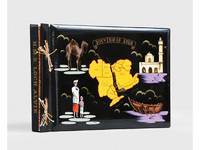
1955réf. 188201On board HMS Loch Alvie: South Asia and Arabian Gulf 1955-56. Striking visual record of the Gulf at the dawn of the oil boom An attractive photograph album compiled by a Royal Navy rating during service in the Gulf in 1955-56 notable for its early views of Abu Dhabi and other sites in the present-day UAE on the eve of the oil transformation. Drawn to the stark coastline and improvised shore installations he recorded places that within a decade would be reshaped by petroleum infrastructure and urban expansion. Several images relate to Abu Dhabi. A view of Das Island dated 11 April 1956 shows a bare shoreline with oil drums and rudimentary structures in the first phase of development linked to the Umm Shaif field. At Khawr al Bazm 19 April 1956 he photographed the coast from the ship and the firing of a 21-gun salute for the Queen's birthday juxtaposing imperial ceremony with an undeveloped littoral. Four deckle-edged photographs depict Dalma Island - then a remote outpost - including a grave the remains of a wrecked dhow and the stretch of coast where the vessel was driven ashore in bad weather. Today Dalma is recognised as a major archaeological site within Abu Dhabi emirate. Dubai appears in a 22 April 1956 view of water taxis and the souq along Dubai Creek still a modest mercantile settlement. The following day Lord and Lady Mountbatten paused there during their return from Asia and Australasia an event marked by guards of honour and captured in the album. A coastal view of Dibba on the Musandam Peninsula - now divided between Oman and the UAE - records the rugged shoreline before modern development. Although centred on the Gulf the album also includes related regional material - Bahrain including Juffair naval base Qatar's early oil installations at Umm Said and Halul Island and shipboard scenes - placing the UAE images within the wider strategic network of Britain's post-war naval presence east of Suez. The volume concludes with an official photograph of HMS Loch Alvie and a track chart of her cruise under Captain C. J. Matthews sailing from Chatham in July 1955 and returning in July 1956. Landscape folio 270 × 390 mm. 88 mounted silver gelatine photographs the majority personal rather than purchase and 24 of which relate to the Gulf various formats mostly 105 x 80 mm the great majority captioned in white ink leaves additionally decorated with small sketches and various ephemera. Asian black lacquer album silk ties at the spine typical of those available at the Liberty Stores Aden lettered "Souvenir of Aden" on the front cover with a hand-painted map of the Arabian Peninsula and Red Sea surrounded by images of a mosque camel dhow and local inhabitants HMS Loch Alvie cap tally pasted to spine edges gilt decorative gold and silver leaf spackled endpapers; black card mounting leaves. Corners a little bumped and worn a couple of cracks to the lacquer to the back cover; some tissue guards a little creased contents otherwise clean sound and complete; very good. unknown
Large 12mo. 24 vols. With engraved portraits of Barros, Couto, Henry the Navigator, and Afonso de Albuquerque and 3 (instead of 5) folding maps. Uniformly bound in contemporary half calf over marbled boards, spines with giltstamped titles and volume numbers. Edges lightly sprinkled red. A fundamental travel work: the best and most complete edition of what is considered the most comprehensive publication on Portuguese exploration and colonial history by João de Barros (decades I-IV) and Diego de Couto; the first edition to include decades X and XI. Books 2 and 3 of the "Decada Segunda" offer a detailed narrative of Afonso de Albuquerque's expedition to the Arabian Gulf and his conquest of Ormuz in 1507; the island remained under Portuguese occupation from 1515 to 1622. As vassals of the Portuguese state, the Kingdom of Ormuz jointly participated in the 1521 invasion of Bahrain that ended Jabrid rule of the Arabian archipelago. - This is "the best edition of this famous work on Portuguese colonial history. The first edition appeared at Lisbon, Madrid and Paris from 1552 to 1645. It consists of 12 "Decadas" (decades), comprising the history of the years 1420-1600. Only Decadas I, II, III and a part of IV are by J. de Barros, the rest is by D. de Couto, who begins his part also with Decada IV, so that there are two Decadas IV" (Laures). De Barros (1496-1570), head agent for the Portuguese overseas trade authority "Casa da Índia", managed to persuade King João III to commission from him a history of the Portuguese in India (including Asia and southeast Africa). The result earned him renown as one of the first great Portuguese historians, and the the title of a "Portuguese Livy". The 'Decades' contain "the early history of the Portuguese in India and Asia and reveal careful study of Eastern historians and geographers, as well as of the records of his own country. They are distinguished by clearness of exposition and orderly arrangement. They are also lively accounts" (Enc. Britannica). Cordier, BJ, 34 and BS, 2309. Innocencio III, 322. Laures 642. Streit IV, 667 (with extensive list of contents) & VI, 630. This edition not in Borba de Moraes. For the maps cf. Gole, India, 8.