réf. 86624aafFribourg, Office du Livre & München, Mosaik Verlag, 1987, in-4to, 224 S., illustr. mit zahlreichen farbigen Fotogr., Original-Pappband mit orig. illustr. Umschlag und orig. illustr. Schuber.
réf. 87300aafMünchen, Mosaik Verlag, 1987, in-4to, 224 S., illustr. mit zahlreichen farbigen Fotogr., Verlags-Archiv Exemplar mit Stempel ‘Exemplaire d’Archive’, Original-Leinenband, OU, ill. Schuber. Neues Exemplar.
réf. 86021aafOffice du Livre & Buchheim Editions S.A., 1987, in-4to, 224 p., plus de 250 illustrations en couleurs, exemplaire des archives de l’éditeur, tamponné ‘Exemplaire d’Archive’, cartonnage original. Jaquette couleur. Bel exemplaire.
réf. 86301aafParis, Nathan, 1988, in-4to, 224 p., plus de 250 illustrations en couleurs, exemplaire des archives de l’éditeur, tamponné ‘Exemplaire d’Archive’, cartonnage original. Jaquette couleur. Bel exemplaire.
réf. 86912aafMilano, Rizzoli, 1988, in-4to, 224 p., numerose fotografie a colori, esemplare degli archivi dell’editore timbrato ‘exemplaire d’archive’, rilegatura originale in tela, con sovraccoperta. In ottimo stato.
1990réf. 5374Nathan 1990 165 pages IN4. 1990. cartonnage editeur avec jaquette. 165 pages. Ce livre de Denis Machenaud initialement publié en 1987 et réédité numériquement présente une sélection des plus beaux parcours de golf du monde. Il explore l'évolution de l'architecture des parcours incluant des terrains récents et est abondamment illustré de photographies en couleurs
Folio. (4), 232 pp. With a woodcut Portuguese coat of arms with owl and Hermes staff on the title-page, decorated "Tuscan" titling caps for the title and script type for the author's name. Set in roman and italic, with transcriptions of and quotations from documents in Greek and Arabic.Modern brown paper wrapper, side stitched through 3 holes. A detailed scholarly study of ancient sources for the history and geography of the Canary Islands, attempting to prove that the Portuguese discovered them before Islamic explorers, and that Islamic geographers knew them only through classical Greek and Roman sources. The main text (pp. 1-105) is followed by extensive notes from a wide variety of sources (pp. 107-168) and transcriptions of numerous primary sources, some in Greek or Arabic (pp. 199-232). In passing it also provides a wealth of information about navigation in the Mediterranean and Atlantic by classical Greek and Roman and by Islamic explorers. - Macedo (1777-1867), son of a Lisbon professor and librarian, was an historian, archivist, councillor to the Kingdom of Portugal and a member of many academic societies at home and abroad. His work on Portuguese explorers in general and the Canary Islands in particular began with a brief 1816 essay read to the Academia Real. He returned to the subject after almost thirty years, publishing the present account in both the present separate publication and as vol. VI of the proceedings of the Academia Real das Sciencias. While Macedo's claim for Malocello's discovery of the Canaries in 1336 is no longer accepted, the Islamic geographer Idrisi noted a Portuguese voyage to the Canaries already before 1154. - In fine condition and wholly untrimmed, with all deckles intact, giving very large margins. The modern wrapper is slightly tattered. A detailed study of early voyages to the Canary Islands, with the texts of primary sources in Greek, Arabic and other languages. Porbase (1 copy). Cf. Innocêncio IV, 96 and XII, 80 (issue in proceedings). For the author: Protásio, "MACEDO, JOAQUIM JOSÉ DA COSTA DE (1777-1867)" in: Dicionário de Historiadores Portugueses.
4to. 459, (1) pp. Ottoman Turkish in Arabic type. With 1 folding map and 32 woodcut plates. Contemporary half calf with giltstamped spine and spine title (partly oxydized). First edition. - Exceedingly rare Turkish translation (by Ahmed Sükrü) of the popular account of the 1873 Russo-Khivan war and the fall of the Khivan Khanate by the American war correspondent MacGahan (1844-78), first published in New York in 1874 as "Campaigning on the Oxus and the fall of Khiva". After a daring journey through the Kyzil Kum desert, MacGahan joined the Russian commander Konstantin von Kaufmann’s army on the banks of the Amu Darya. In his report he vividly describes the fall of the Khanate to three Russian columns reaching it from North and East. The book discusses the situation of Kazakh (misleadingly called "Kirghiz") and Yomuk Turkmen nomads, Uzbek and Sart settlers, as well as of Persian slaves, and includes a report on earlier failed Russian attempts to conquer Khiva. While MacGahan is impressed by the beautiful gardens and orchards of the Khanate, he is disappointed by the city of Khiva, the capital and main residence of its ruler. Even the Khan's palace, in which he is allowed by the Russian authorities to spend a few days, including a visit to the treasury room, strikes him as unspectacular. The illustrations, based on designs and paintings by artists and Russian officers, including Vereschagin and Feodoroff, show portraits, scenes of rural and nomad life, somewhat stereotypical depictions of locals, as well as buildings, army generals, and battle scenes. - While the original English edition occasionally appears at auction, the Turkish edition has never been seen on the market. - A few crayon annotations and underlinings in a contemporary hand. Binding slightly bumped at extremeties. Paper evenly browned and brownstained throughout; a few pages somewhat waterstained in the second half of the volume. OCLC 1014870496. Özege 7682. Cf. Atabey 744 (English ed.).
1990Reli?. 167 pages. Jaquette. 24,5 x 28,5 cm.
1990Milano, Sonzogno, 1990, 8vo (cm. 24 x 16,5) cartonato con copertina illustrata a colori, pp. 192 riccamente illustrato da fotografie e disegni in nero e a colori.
1996réf. 105070München : Orbis-Verlag, 1996. 220 S., Ill. OPp., gebundene Ausgabe.
1979160 pages including footnotes, bibliography and index. Numerous black and white reproductions of fascinating archival photos. "Tells the story of Anticosti and its people from the discovery by Jacques Cartier to the present day." - dust jacket. Book unmarked with average wear. Above-average wear to dust jacket which is now preserved in archival-grade Brodart. A sound copy. Book
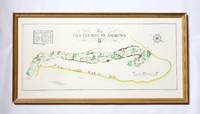
réf. 258j2741Glasgow Scotland: McCorquodale Ltd. Fine. Reprint. Framed Print. Beautiful framed colour print illustrating the famed St. Andrews golf course. Includes the name and length of each hole. Recent reprint of the original created by Golf Course Architect A. Mackenzie in 1924. 27" x 14". The beige wooden frame is attractively colour-co-ordinated with gilt and green trim. In excellent condition. 2kg.; Artist; Folio . McCorquodale Ltd. unknown
1927Generously illustrated with black and white photos and illustrations. Features: Ning Wo Pays His Debt - The Chinese servant of a Chief of Police in a Malay state settles a score with an enemy who killed his brother; My Sea-Trip - Peter Carden's amusing experience as a 'horseman' aboard a cargo-steamer; Photo of a Mariamma goddess in India, used to ward off epidemics; Photo and brief write-up of a marine fruit market in Bangkok, the "Venice of the East"; Passages With Pachyderms - exciting encounters with these great beasts, as told by Captain C. Lestock Reid; Dead Man's Treasure - A consulting engineer for the Cyclops M. and M. Company of Montida USA makes strange discoveries on a prospecting trip; Through Spain in Disguise - Part III - A continuation of the adventures and misadventures of Count and Countess Malmignati who travelled through Spain disguised as wandering Arab beggars, singing and dancing for a living; Zaki and Zomo - The Dog and Pony who both lost their lives while serving Captain J.F.J. Fitzpatrick in battle against the Germans; On Foot Through South America - G.C. Thompson and his two young sons travlled all over South America in search of work for four years; The Tale of the Toheroa - The curious shellfish found only in New Zealand - with photos; On the Trail of the "Thirstland Trekkers" - Part I - Colonel Deneys Reitz describes his exploration of mysterious terra incognita in what was formerly known as German South-West Africa - with many interesting photos; Timothy Murphy's "Donkey" - Great story about a logging donkey-engine at Calfton's logging outfit on Myrtle Island on the British Columbia Coast; The Mine Under the Creek - A brush with death when a mine floods in the Gulf country of Australia; The Chrissie C. Thomey's" Last Voyage - A gallant old Arctic schooner is lost through a most unlikely mischance - with photo; The Big Voyage of the Little "Shanghai" - Part V - The amazing voyage of several young men from Shanghai to Copenhagen - article with nice photos. 84 pages plus 16 pages of nostalgic ads. Clean and unmarked with moderate wear. A quality copy of this fascinating vintage issue. Book
1988188 pages including black and white illustrations. Highlights of the 30 stories include: Devon III in Rose Bay, Trawler Gulf Gull, Chignecto Ship Railway, Iona Gypson Company, Bryden's Mill, Harvest Excursion, The Highlands, and Buck & Jim Murder. Moderate wear. Unmarked. Decent copy. Book
1982réf. 17512Herford, Busse Verlag, 1982.
1991réf. 47731ABKöln, vgs, 1991. 26 cm. 185 S. : zahlr. Ill. Pp., OU. Sauber u. gut erhalten. Exlibr. a. Tit.-Bl.
1994réf. 13561München Heyne, 1994. 190 S. 18 cm, Taschenbuch,Softcover
1983Vg/vg not price-clipped. no inscriptions. The Hauraki Gulf, the gateway to Auckland is a yachtsman's paradise and a fishermans dream. The Gulf and its islands have known bloody wars, brutal crimes ,sagas of pioneering daring. This is a well illustrated history of the many islands of the Gulf
8vo. (8), 272 pp. With half-title and errata leaf. Contemporary half morocco, gilt, with original printed wrappers bound in at end. Signed presentation copy from the author to Florian Pharaon (1827-87). A good association copy of a "work which no student of the history of Falconry should neglect" (Harting). Florian Pharaon was the first Arab editor at Le Figaro, and the translator of an Arabic hunting work into French. - Some spotting, binding rubbed. Harting 211. Schwerdt II, pp. 2-3. Thiébaud 621.
2000réf. DADAX1579651623Artisan 2000-10-02. hardcover. New. 11.50x1.50x11.50. Buy with confidence. Excellent Customer Service & Return policy. Artisan hardcover
Folio (225 x 332 mm). 2 parts in one vol. (12), 143, (1) pp. (6) pp., 1 blank f., 96 pp. With printer's woodcut device to both title-pages. Contemporary half vellum over papered boards with faded handwritten spine title. Second edition of this "at least linguistically rather unusual combination of a Georgian and a Turkish grammar, using the Georgian types first displayed in 1629" (Smitskamp). This is "an almost line for line reprint of the 1643 edition, only distinguishable by the 'Iterum imprimatur' [...] The work is set in mkhedruli type that has no upper case, but upper and lower case khutsuri type (the sacred script) is also displayed, absent in the 1629 'Alphabetum'. In the second part, containing a Turkish grammar (the third of its kind, after those by Megiser [1612] and du Ryer [1630]), the Hebrew and Syriac scripts [...] are also discussed as vehicles of the Arabic or Turkish language. Maggio mentions della Valle as his instructor in Turkish [...] At the end of the second part a Turkish translation is printed of the 'Corolla B.M. Virginis', a widely used devotional prayer" (ibid.). - Binding lightly rubbed. Some browning throughout; occasional worming in the margins. A few contemporary ink corrections in Georgian script. Removed from the library of the Capuchin mission to Trabzon, Turkey (Missione dei Cappuccini di Trebisonda) with their stamp to the title-page. Smitskamp, PO 227. Lang 167. Vater/Jülg 140.
4to. (40), 24, (4), 25-234 pp., final blank leaf. With 3 engraved plates. Contemporary vellum with ms. title to spine. Very scarce first and only edition of the life and death of San Alipio, who was captured by Ottoman pirates on 1 July 1643 and brought to Tripoli. He converted to Islam, but repented and was martyred on 17 February 1645 when he told to the Pasha that he wished to return to his Christian faith. The plates show the martyrdom (a supersized image after the prelims, folded in at the bottom) and the holy relics of the Saint. - Some defects to spine, otherwise fine. Old ownership of the "Convento dell' Angelo Custode" on the flyleaf. Streit XVI, p. 525, no. 4001. ICCU UM1E\007052.
Folio (533 x 364 mm). (3), 79 pp., engraved, illustrated title-page and 25 engraved maps after William Faden, in contemporary hand colour. Contemporary black morocco, richly stamped in silver and blind. Bright yellow pastedowns. In custom-made half morocco solander box. The first European-style atlas printed in the Islamic world: an exceedingly rare, handsome, and entirely complete example in its original first binding. "[T]he first world atlas printed by Muslims [...], of which only fifty copies were printed" (Library of Congress, Near East Collections: an illustrated guide, online). Several copies were reserved for high-ranking officials and important institutions; most of the remainder were destroyed in a warehouse fire during the Janissary Revolt of 1808. "Based on several estimates and accounting for the single maps (torn-out from bound volumes of the atlas) sold or being offered worldwide, it is believed that a maximum of 20 complete examples could be present in libraries or in private collections, whereas some sources suggest that there exist only 10 complete and intact copies in the world. As such, it is one of the rarest printed atlases of historical value" (Wikipedia). - A prestigious project for the Ottoman Palace with the seal of approval of the Sultan Selim III, this work was one of the avantgardistic enterprises promoted by Mahmoud Ra'if to introduce Western technical and scientific knowledge to the Ottoman state. Composed of 25 maps based on William Faden's "General Atlas", it is the first Muslim-published world atlas to make use of European geographic knowledge. On each of the maps the place-names are transliterated in Arabic. The Atlas includes Raif's 79-page geographical treatise "Ucalet ül-Cografiye" and the frequently missing folding celestial map on blue paper. - Maps very clean, showing only a few minor stains and repaired tears to folds; a creasemark to the map of Africa; an internal tear to pre-Revolutionary map of France. Binding professionally repaired at extremeties and upper hinge with a few scuffmarks and insignificant traces of worming. An excellent copy, one of the very few surviving specimens in the beautiful original oriental leather binding (the only other known example was sold through us in 2019). A severely defective copy recently commanded an auction price of USD 118,750 (Swann Galleries NY, 26 May 2016, lot 199). OCLC 54966656. Not in Philipps/Le Gear. Not in Atabey or Blackmer collections.
Folio (210 x 308 mm). 60 pp. With 27 engraved and etched plates (some double-page). Contemporary speckled sheep. Marbled pastedowns. First and only edition, printed at the second printing press established in Istanbul. "A rare and very interesting work outlining the military reforms and the regulations for the New Troops established by Selim III in 1796/97" (Blackmer). The author, Mahmoud Ra'if, was a member of the reform movement instigated in Turkey by Sultan Selim III, who tried to change the traditional political structures of the Ottoman Empire and replace them with a political state that owed much to his youthful contact with Europe, and more particularly, the influence of the French Revolution. After his succession in 1789, Selim took steps to establish a new state under the Nizam-Jedid ("new order") regulations - from which the present work derives - underpinning his state with the formation of a new army and military infrastructure. Among the moves towards "Europeanisation" were the installation of printing presses at the military engineering school (where the present work, the first from the press in roman types, was printed), and the establishment of Ottoman embassies in the capitals of Europe, including London, where Mahmoud Ra'if served as secretary to the Ottoman Ambassador in the mid 1790s. As outsiders feared, the very reforms which are the subject of his work led to Selim's murder in 1808, while the author himself was "cut to pieces" by the enraged Janissaries whose elite position had been threatened. "The establishment of these troops - the Nizam-Jedid - and the jealousy which this aroused was one of the main factors leading to the revolt of the Janissaries in 1808 which cost Selim, and later the author of this work, their lives" (Blackmer). - Binding very slightly worn, interior clean and flawless throughout. Provenance: armorial bookplate of the Swedish diplomat Johan Henrik Tawast (1763-1841), who was seconded to Constantinople in 1812-13 to help negotiate the Russian-Turkish peace treaty of Bucharest; his autograph note "Scutari, 9 janvier 1813. 16 piastres, 20 pares" inscribed to front pastedown. Latterly in the collection of Thomas Fremantle, 3rd Baron Cottesloe (1862-1956), commander of the Territorial Army and president of the Society for Army History Research. Atabey 752. Blackmer 1060.