4 085 résultats
1977In-4, tela editoriale, sovracoperta, pp. 280,con numerose illustrazioni a colori e in bianco e nero nel testo. In ottimo stato (fine copy).
19818vo., First Edition, with numerous plates; green cloth, gilt back, a near fine copy in price-clipped dustwrapper.
1979réf. V26515London (Mitchell Beazley Publishers) 1979 (= Reprinted). 4°, illustrierte Originalbroschur ( Paperback) 280 S., durchgehend farbig illustriert, ISBN 0 85533 184 4
1981Good pbk reprint. Covers worn. ISBN 0855331844. 16372. eng
1998réf. 11963Königswinter: HEEL Verlag. 1998. 271 S. 4to. Durchgehend farbig Illustriert. Illustrierter Original-Pappband mit Schutzumschlag.
1976280pp. Hardcover Very good condition good
1807Folio. XIII, (3), 329, (1) pp. With engraved frontispiece (Fat'h-Ali Shah Qajar, King of Persia) and engr. portrait plate (Shaknubat, mistress of Kurim Khan), both after Persian originals. Later blue cloth with giltstamped spine title. First European-printed edition, following an error-ridden edition published at Bombay in 1804. Includes a chapter on Arabian horses, an early account of Muhammad ibn 'Abd al-Wahhab and Wahhabi Islam, and passages on hawk-hunting and pearl fishing in the Arabian Gulf "from the 56th to the 48th degree east longitude", i. e., essentially the Gulf coast from Ras al-Khaimah to Qatar and Bahrain and on to Kuwait. Early attempt at an encompassing description of Persia, by the Bengal civil servant Edward W. H. Scott-Waring (1783-1821). "Very rare" (Allibone). - Bound without the half-title; bookplate and blindstamps of the City of Leeds Public Library. Diba Collection p. 139. Wilson p. 240. Henze IV, 461. Cf. Weber I, 3. Brunet V, 1416. Graesse VI/2, 420 (1st ed. Bombay, 1804).
8vo. 264 pp. With 3 folding engr. plates. Contemp. calf with giltstamped red label to gilt spine. Marbled endpapers. All edges red. Second, enlarged edition, published a year after the first and now including "diverses observations sur les grandes actions qui se sont passées dans la dernière guerre d’Hongrie, et dans la présente en Moldavie". This is the first work of the Swiss-born De Warnery (1720-86), published in a German translation as early as 1766 (purportedly against his own wishes): according to the author, never one to eschew self-aggrandizement, he was the first to "unmask the Turks" and show that they did not warrant the fear with which they were usually viewed (cf. ADB XLI, 176). The plates show suggestions for battle arrays. - Unobtrusive repairs to lower cover of the appealing binding. Variously browned and brownstained due to paper. Rare. Formerly in the Ottoman collection of the Swiss industrialist Herry W. Schaefer. Barbier IV, 257. Cf. Atabey 1321 (first ed. 1770). Not in Blackmer.
1990No marks or inscriptions. No creasing to covers or to spine. A lovely clean crisp very tight copy with bright unmarked boards and no bumping to corners. Dust jacket not price clipped or creased with light rubbing a a few tiny nicks to upper and lower edges. 317pp. This is the honest, anecdotal behind-the-scenes look at America's richest road show - the PGA Tour.
VI, (8), 369, (3) pp. With numerous folding plates. Contemporary green half calf with giltstamped spine and marbled boards. 8vo. First edition. - Indispensable French studbook of pure-bred Anglo-Arabian horses, indicating their percentage of Arabian blood. - Slight browning, but well preserved. Rare. Mennessier de la Lance 642. OCLC 843391487.
1985réf. 143414Couverture souple. Broché. 179 pages. Couverture légèrement défraîchie.
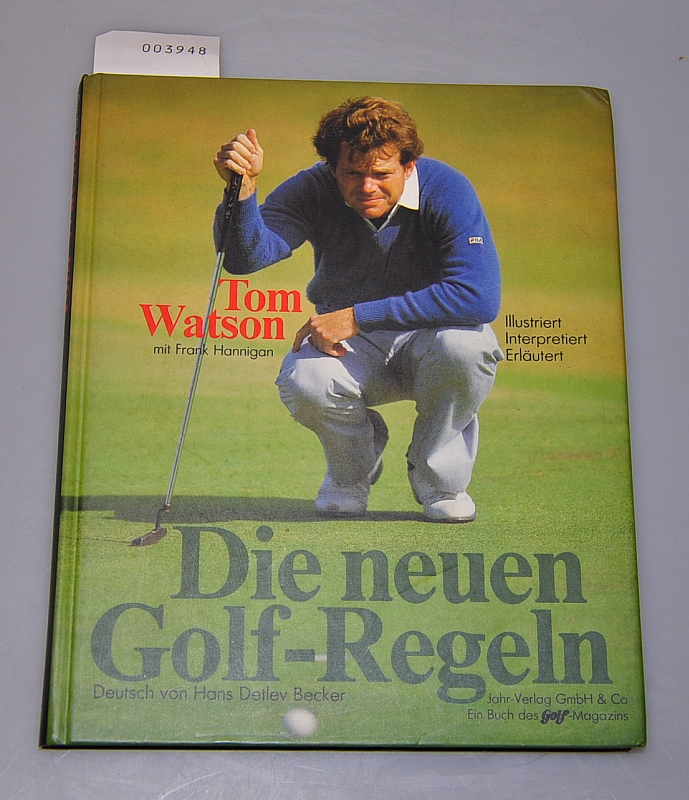
1985réf. 03948Hamburg, Jahr, 1985. PP, 185S, gutes Exemplar
1985réf. 08253Hamburg, Jahr, 1985. PP, 185S, gutes Exemplar
1989réf. 07609Hamburg, Jahr, 1989. PP, 191S, gutes Exemplar
1983réf. 03445New York, Random House, 1983. Hln, OU, 192S, gut
199624769 WATT ALICK A. 1) IL GOLF tecniche e consigli 2) IL GOLF le origini - 2 VOLL. MILANO, TECNICHE NUOVE 1996 , Cofanetto a libro ill. a col. con chiusura a fettuccia contenente 2 volumi - In-8 quadro - leg. in cartonato pesante ill. - pp. 96 / 96 - allo stato di nuovo
2007Pr?face - Introduction 2 21x21 cm., legatura editoriale cartonata lucida, 2 volumi in una custodia aperta e chiusa con nastri, pp.96; 96, prima edizione francese, numerose illustrazioni, come nuovo
1996Mm 220x220 Due volumi in copertina rigida nella loro custodia editoriale, 95 + 96 pagine profusamente illustrate a colori. Eccellenti le condizioni; spedizione in 24 ore dalla conferma dell'ordine.
Small 4to. (8), 253, (1) pp., final blank leaf. Contemporary full cloth with giltstamped spine title. Top edge red. First edition. - In his fourth travel book the British writer Waugh (1903-66), who was commissioned by the Daily Mail to cover events in Ethiopia in August 1935, makes a case for the Italian intervention in the country, presenting "a lucid and interesting narrative of personal experience, and useful as a minority defense of Italian occupation and attack on British policy" (Morris/Dooley). Interestingly enough, a printed sheet of paper denying the oil magnate Francis William Rickett access to travel facilities to Persia and the states on the Persian Gulf is loosely enclosed. On the journey from Port Said, Waugh met Rickett, who was dispatched by the African Exploration & Development Company to conduct secret negotiations with the Ethiopian emperor Haile Selassie in pursuit of a concession. While Waugh was up country, sidetracked by another story, Rickett was conferring with government officials in Addis Ababa at the dead of night. After a week of to-ing and fro-ing, papers were signed by which about half the nation's subsoil rights - an area of nearly 400,000 square km - was made over to Rickett for a period of 75 years. By the time he sailed into Suez, the story had made world headlines. Waugh, for his part, missed the scoop and was sacked. - A few marginal notes in pencil, some of them highlighting passages that also appear in Waugh's 1938 novel "Scoop", a satire of sensationalist journalism and foreign correspondents. Newspaper clipping with excerpts of a review of "Waugh in Abyssinia" from the Times Literary Supplement of 7 November 1936 is loosely enclosed. - Spine and lower inner hinges slightly worn. Still a good copy. Morris/Dooley, Evelyn Waugh: a reference guide 15. OCLC 807259442.
8vo. IX, (1 blank), 349, (1) pp. With a photo of the author as a frontispiece, 6 plates and 1 folding map of the Arabian Peninsula. Blue cloth with gold lettering on front cover and spine, and blind-tooling on front cover. An account of the travels of an Englishman through Arabia, including an eye-witness account of the 1911 siege of Sana'a, the capital of Yemen. This siege was one of the last big events in the Yemeni-Ottoman conflicts, which started with the first Ottoman attempt to conquer Yemen in 1538. In 1911 a treaty was signed, with which Yemen became a vassal state of the Ottoman Empire until the country could take advantage of the Empire's collapse during and after WWI to reclaim its independence. - Wavell did not intend to include a description of his journey to the holy city of Mecca, but apart from his accounts of Yemen he admits in the preface that the present work breaks no new ground. The places he visited had already been described, possibly more extensively, by other explorers and travellers, but a journey to Mecca and Medina was still quite out of the ordinary for Europeans, and thus a description of his experiences was added to the work. It was first published in 1912 and the present copy was a part of the second impression of that edition, which appeared in 1913. An edited, smaller and thus cheaper second edition appeared posthumously in 1918. The chapters on Wavell's travels in Yemen had been removed and an introduction by Major Leonard Darwin, son of the naturalist Charles Darwin, had been added. - Arthur John Byng Wavell (1882-1916) was an English army officer and traveller who was educated and trained at the Royal Military college Sandhurst. He was a cousin of the decorated field marshal Archibald Percival Wavell, 1st Earl Wavell, who served in the Second Boer War, in other parts of Africa, and in India where he also served as the Viceroy. The author of the present work resigned his army commission in 1906 and went to Mombasa in British East Africa - modern Kenya - where he learnt Arabic and Swahili and where his desire to explore Arabia and even visit Mecca grew. After his travels in Arabia, described in "A Modern Pilgrim in Mecca", he returned to Africa. During the First World War he remained in Africa, where he founded a coastal defence force called the "Arab Rifles", active around Mombasa. Later he was sent to serve near the border of Kenya with Tanzania (then British East Africa and German East Africa), where he was killed in 1916 as a result of a German ambush. - Binding slightly rubbed, very slight foxing on the edges, some foxing on the first and last flyleaves. Small tear in the in the inner margin of the map, without affecting the map itself. Sharp folding lines in the plate of The Haram in Mecca (between pp. 152-152). With an ownership inscription: "R. S. Breene, 1 June, 1928" over the remnants of an erased inscription on the first flyleaf. Howgego IV, W13. Smith, The Yemens, 103. Cf. Macro 2266. Canton, From Cairo to Baghdad: British Travellers in Arabia, pp. 161-165. Sotheby's, The library of Robert Michael Burrell, 858 (other ed.).
1985réf. 114014Texas A & M University Press 1985 In-8 reliure éd. sous jaquette. 457 pages. Traces de ruban adhésif sur les pages de garde, jaquette effrangée. Jaquette en état moyen. Bon état d’occasion.
Hand-coloured engraved map (380 x 320 mm). Striking map of the Arabian Peninusla featuring the geographical features known to the ancients. Decorated with a vignette and 9 medallions depicting camels in the upper right corner. An interesting and highly decorative map. Al Ankary 293. Al-Qasimi 129. Not in Tibbetts.
Six engraved maps, all in four segments on orange cloth with title labels. All ca. 68 x 54 cm. Stored in a contemporary marbled slipcase. A fine set of six maps, comprising all the Near East and Middle East maps from Weiland's great "Allgemeiner Hand-Atlas" (general hand atlas) published by the Geographical Institute in Weimar. - Includes: Turkey and Levant ("Das osmanische Asien", 1829); the Arabian Peninsula ("Arabien", 1834); Persia ("Iran, Afghanistan und Beludschistan", 1828); Africa (1831); Northern Africa ("Das nordwestliche Africa oder die Staaten Fez und Marokko, Algier, Tunis und Tripoli, nebst der Wüste Sahara", 1827); and the Nile Valley with the south-western coast of Arabia ("Das nordöstliche Africa oder Aegypten, Nubien, Habesch, Kordofan und Darfur", 1829). - All with engraved labels of the Paris map dealer and publisher Charles Simonneau with titles inscribed in French. Some mild foxing throughout, but altogether fine. Slipcase worn but professionally repaired. Cf. Espenhorst p. 24; Le Gear 6107 (1848 ed.); Al-Qasimi (2nd ed.), p. 281 (Weiland's map of Arabia, 1839 edition).
1) 260:340 mm. 2) 260:350 mm. 3) 260:360 mm. James Weir (d. 1820) was Captain of Marines on HMS Audacious from 1795 to 1800, and was also an accomplished watercolourist. His drawings show 1) "The Seraglio from the Marmora March 1806", 2) "The Seraglio at Constantinople from the harbour", and "7 towers Constantinople 19 March 1806".
Watercolour on paper, some on 2 sheets, mounted (sizes approximately from 155 x 230 to 300 x 480 mm), some with inscription or sketches on verso, most with captions either mounted, laid down or written directly on image. James Weir (d. 1820) was Captain of Marines on HMS Audacious from 1795 to 1800, and was also an accomplished watercolourist. Some of the earliest watercolours in this group were produced when the Audacious was on patrol off the Portuguese coast in 1796. Others were painted in the months leading up to the Battle of the Nile, when the Audacious was part of Nelson's squadron searching for the French fleet off the Italian coast after it had escaped from Toulon. Others were painted in the months leading up to the Battle of the Nile, when the Audacious was part of Nelson's squadron searching for the French fleet off the Italian coast after it had escaped from Toulon. He also depicted Nelson's flagship, HMS Vanguard, anchored at Naples Bay for repairs in October 1798, when he first met Emma Hamilton. Also shown are views of Syracuse and surrounding area, the Valley of Temples at Agrigento, Catania and Mount Etna, the Temple of Venus at Baia, the ruins of the Temple of Jupiter Olympus, the interior of the Temple of Concord, Mount Nuovo and Pozzuoli near Naples, the Temple of Ceres at Segesta, Convent of St. Nicolo Argentum, the Iron Mine of Elba. The fleet at Palermo is also depicted, where Nelson had accompanied the royal court of the Two Sicilies after they fled Naples. - Very minor scattered tears or repairs, a few restored or trimmed, light staining or spotting.