Various ContributorsMareMagnum

3 989 résultats
1964Features/Photos: Historic remains at Aveley; Flash-Point in the Cyprus Crisis - The Turkish Air Attack on August 8; the Gulf of Tonkin Incident and Johnson's response; Mine rescue at Champagnole; The 'Holy War' of Alice Lenshina - violent disturbances in Northern Rhodesia and savage fighting with the fanatic Lumpa sectarians - Numerous Pictures; The Murungs of the Bandarban Rain Forest; and more. Moderate wear. Unmarked. Quality copy. Magazine
1961Features/Photos: Royal visit to Pakistan; Warsak Dam; the Khyber Pass; Swiss disasters - fire and avalanche; New York paralysed by two severe blizzards in 2 weeks - 5 photos; Exclusive photos from on board the Santa Maria, one of the most exciting episodes ever to take place on the high seas; Submarine Oberon commissioned at Chatham; colour portrait depicting golf in the 18th century; Soviet colonialism; Back cover is an excellent colour advert. for Senior Service cigarettes showing the H.M.S. Tiger. Moderate wear. Clean and unmrked. Quality copy. Magazine
1961Features/Photos: Demonstrating against austerity measures in Belgium; violence in the streets of Brussels; the insidious campaign in Laos; Blazing timber whark in Barking, Essex; Unrolling the copper scroll - the process illustrated; Qumran treasure; Revolutionary vertical take-off and landing engints; 1916 Photo of the edge of the Gulf Stream; The Wolseley 6/99; and more. Moderate wear. Unmarked. Sound copy. Magazine
1960136 pages. Features: Nice color photo Lord & Taylor ad; Cuba - Profile of a Revolution - the old order has been swept away forever - many photos; Lament for the Rocking Chair; The Bantu Listens to a Louder Drum - the South African Negro call to freedom frightens the ruling whites; America's 500,000 Migrant Farm Workers; 'Marxist Mandarin' on Another Sales Trip - China's Premier Chou En-lai Revisits his South Asian Neighbors; Long-Run Plays - The Top Ten; photos of ice-breaking in the Great Lakes; Photos of interesting Senatorial Doors; Nice color photo ad for B. Altman & Co.; Photos of excavation in New York City; Peter M. Dawkins compares the attitudes toward collegiate sports in the United States and Great Britain - he was captain of the West Point Football Team and a unanimous All-America choice at halfback; 'April in Paris' for New York - Joseph Wechsberg is excited at the prospect of bringing Gallic imports to NYC; First Night Party for "Bye Bye Birdie" sponsored by L. Slade Brown; Let the Native Indian Be the Hero, by Stanley Walker; Rudolph Valentino was born 65 years ago - 5 nice photos; Restless Ports for the City's Food - Washington and Fulton Markets are colorful, obsolete, and about to be moved - article with photos; Golf Fever in Japan; Cut Out for Leisure - sexy photos by Gleb Derujinsky; Color photo ad for Knickerbocker Beer; Nice color Pepsi ad "The Sociables Prefer Pepsi"; About Polygamy - a fading practice in Africa; and more. Clean and unmarked with moderate wear. Some yellowing with age. A sound vintage copy. Book
Large hand-coloured four-sheet plan. Pen and ink, graphite and watercolour on paper laid on canvas. Framed and glazed. Dimensions: app. 90 x 170 cm (sheet); 105 x 205 cm (frame). Large manuscript plan in beautiful colour; a unique witness to Vanderbilt's passion and ambitions. A member of the prominent American Vanderbilt family, William Kissam (1849-1920) managed railroads and was also a horse breeder. He was one of the founders of The Jockey Club and the owner of a successful racing stable. In 1896, Vanderbilt built the American Horse Exchange at 50th Street (Manhattan). In World War II, the United States liberty ship SS William K. Vanderbilt was named in his honour. - This impressive plan represents the horse-racing stable and track at the chateau, which Vanderbilt built in 1906, with the help of Henri Guillaume and Pierre Sardou, architects. He purchased in 1903 the land in an area of Poissy called Les Gresillons, 20 miles outside Paris. At the time, he ran a breeding operation in Deauville, making the location, also called "Carrieres-sous-Poissy", particularly convenient since it is on the way from Paris to Deauville. The hippodrome comprised three oval tracks, the outer of which measured 2400 metres, as well as a straight track. A long wall separated the racing areas from the Chateau St-Louis where the Vanderbilts lived, called the Chemin Plat, now known as Avenue Vanderbilt. With the beginning of World War I, the racing stables were shut down and eventually sold. The Chateau St. Louis is now the corporate headquarters for a local quarry, which spreads over the land previously occupied by the hippodrome. As of today, only the residential building known as "Chateau Grésillons" still stands and is currently being restored. - Provenance: Ralph Esmerian (New York jeweler).
20001 vol., pagine non numerate, illustrate, con suddivisione a rubrica. 21 cm. Legatura a spirale metallica e cofanetto. Ottimo, come nuovo
Folio. Tinted lithographic additional title by Charles Parsons, printed by Endicott & Co., 20 chromolithographic plates by Parsons after van Lennep, all printed by Endicott & Co. of New York. Expertly bound to style in half dark green morocco over period patterned cloth covered boards, spine lettered and decorated in gilt. A rare and important colour-plate book: one of the relatively few American costume books, and certainly the best such created in 19th-century America. This is a notable and unusual instance of the taste for the Ottoman or "Turkish" which manifested itself in the furniture of the period but seldom in books. In terms of American color-plate books, this is one of the only large projects from the 1860s, when the Civil War seems to have curtailed production of such lavish enterprises. "The one really big chromolithographic book of this decade [...] the art is simple, but [Charles] Parson's hand is obvious in the good lithography, and Endicott's printing is well done for its time" (McGrath). "Endicott achieved a rich variety of color which demonstrated the increased technical ability of American printers in the medium" (Reese). Henry Van Lennep was born in Smyrna, the son of European merchants. Educated, on the advice of American missionaries, in the United States, he returned to Turkey as a missionary in 1840, and spent most of the next twenty years in various parts of the Ottoman Empire. Returning to the United States in 1861, he turned his superb original drawings of Middle Eastern life into the Oriental Album. The plates include two scenes of Jewish life in the Ottoman Empire. Included are plates of "A Turkish Effendi", "Armenian Lady (at home)", "Turkish and Armenian Ladies (abroad)", "Turkish Scribe", "Turkish Lady of Rank (at home)", "Turkish Cavass (police officer)", "Turkish Lady (unveiled)", "Armenian Piper", "Armenian Ladies (at home)", "Armenian Marriage Procession", "Armenian Bride", "Albanian Guard", "Armenian Peasant Woman", "Bagdad Merchant (travelling)", "Jewish Marriage", "Jewish Merchant", "Gypsy Fortune Telling", "Bandit Chief", "Circassian Warrior", "Druse Girl". Bennett, p. 108. Blackmer Catalogue 1715. Blackmer Sale 1500. DAB XIX, 200. McGrath, pp. 38, 115, 162. Reese, Stamped with a National Character 97. Atabey 1274.
Folio. 4 vols. bound as 1. [20], 218, [12], [2 blank]; [4], 236, [12]; [4], 244, [13], [1 blank]; [6], 231, [17] pp. First title-page printed in red and black, each title-page with Widerholds's woodcut device (motto: "Gradatim ad sidera tollor"). With 31 engraved plates (1 folding), including frontispiece and portraits of the author and his wife, by Jean Jacques Thourneyser. Further with woodcut initials, head- and tailpieces, factotums and several small woodcuts in the text. Contemporary vellum, manuscript spine-title, blue sprinkled edges. First edition in German of Pietro della Valle's deservedly famous narrative of his travels in the Middle East, with an excellent account of Muscat and the Arabian Gulf and references to Dibba. Della Valle, an Italian nobleman, sailed from Venice in 1614 to Istanbul, where he arrived in August 1614, spending a year to explore the city. He continued to Rhodes, Alexandria, Rosetta, Cairo, crossing the Sinai desert to Jerusalem, Damascus and Aleppo. From there Della Valle proceeded to Isfahan (Iran) to meet the Safavid ruler Shah Abbas I. He sojourned in Persia until early 1623, witnessing and commenting on the escalating conflict between Shah Abbas and the Portuguese empire. In 1621 he decided to return to Europe and set off for the Persian Gulf, but the Persian and English blockade prevented his sailing. By way of India he finally sailed for Muscat in January 1623, from which he crossed the Arabian Gulf to Basra, continuing overland to Aleppo, arriving in Europe in 1626. During his travels he wrote regularly to his learned friend in Naples, Mario Schipano. These 54 letters formed the basis of an account of his travels that was first published in Rome as Viaggi di Pietro della Valle from 1650 to 1658. "Della Valle displayed excellent narrative and descriptive skills, powers of acute observation, and a genuinely scholarly breadth of learning. He refused to comment on what he had not witnessed himself or checked against the best authorities [...] Della Valle's eighteen letters from Persia provide one of the most detailed sources of information for most aspects of Persian life in the second half of Shah Abbas' reign" (Gurney). - Engraved armorial bookplate on paste-down. Evenly browned throughout, some spotting, few quires in volume 3 with wormholes in gutter margin, not affecting the text, otherwise in very good condition. VD 17, 39:135561Q. Tobler, p. 95. Cf. Atabey 1269-1271 (other eds.); Blackmer 1712 (French ed.); Gurney, "Della Valle, Pietro", in: Encyclopaedia Iranica (online ed.).
4to. 3 parts in 4 vols.: 780, (34) pp. (12), 492, (24) pp. (2), 546, (24) pp. (20), 508, (18) pp. With engraved portrait of Pietro della Valle, 2 engraved title-vignettes, 3 woodcut title-vignettes, and several woodcut illustrations in the text. Contemporary full vellum with handwritten spine title and shelfmarks. All edges sprinkled red. A complete set of the first edition of Della Valle's "Viaggi", highly sought after as one of the earliest printed sources for the early history of Dibba, the coastal region at the northeastern tip of the United Arab Emirates, today ruled by the Emirates of Fujairah and of Sharjah. - Pietro della Valle (1586-1652) left Venice in 1614 on a pilgrimage to Palestine, proceeding to Baghdad and then into Persia, where he married and sojourned at the court of Shah Abbas. While staying with the Sultan of Bandar Abbas, he "met the son of the ruler of Dibba who was visiting. From this he learned that Dibba had formerly been subject to the kingdom of Hormuz, but was at that time loyal to the Safavids who in 1623 sent troops to Dibba, Khor Fakkan and other ports on the southeast coast of Arabia in order to prepare for a Portuguese counter-attack following their expulsion from Hormuz (Jarun). In fact, the Portuguese under Ruy Freire were so successful that the people of Dibba turned on their Safavid overlords, putting them all to death, whereupon a Portuguese garrison of 50 men was installed at Dibba. More Portuguese forces, however, had to be sent to Dibba in 1627 as a result of an Arab revolt. Curiously, two years later the Portuguese proposed moving part of the Mandaean population of southern Iraq, under pressure from neighbouring Arab tribes, to Dibba" (UAE History: 2000 to 200 years ago - UAEinteract, online). "Della Valle displayed excellent narrative and descriptive skills, powers of acute observation, and a genuinely scholarly breadth of learning. He refused to comment on what he had not witnessed himself or checked against the best authorities" (Gurney). He continued his travels east to the coast of India, Goa and Muscat, and thence back to Aleppo by way of Basra. He reached Rome in 1626, where the original Italian text of his letters written to the Neapolitan physician Mario Schipano was published. Only the first volume, dealing with Turkey, saw print during his lifetime. The two-part volume II on Persia was released in 1658, four years after his death, and the set was concluded in 1663 with the volume on India. Complete sets are usually encountered only with the first volume in its second edition, published in 1662. - Binding somewhat spotted. Some brownstaining throughout with occasional waterstains. Several repairs to p. 344 of vol. II; occasional insignificant marginal tears and small holes. Title page of vol. 2 (La Persia, parte prima) has the title of "parte seconda" with the word "seconda" overpasted with "prima" by the publisher. In all an attractive copy including the frequently missing portrait. Röhricht 946. Henze II, 42. Tobler 95. Gurney, "Della Valle, Pietro", in: Encyclopaedia Iranica (online ed.). Macro 1633. Cox I, 273. Wilson 234.
12mo. 4 vols. (40), 670 pp. (2) ff. (1 blank), 734, (34) pp., (2) ff. (1 blank), 792, (18) pp. 756, (24) pp. With a woodcut in the text of vol. 3, p. 193, and a full-page engraving on p. 361 of vol. 4 (both diagrammatic). Contemporary limp vellum with ms. spine titles; all edges of vol. 2 sprinkled in red. Early duodecimo edition of Della Valle's complete "Viaggi", published while the first complete edition was still under the press. Della Valle's account is highly sought after as one of the earliest printed sources for the early history of Dibba, the coastal region at the northeastern tip of the United Arab Emirates, today ruled by the Emirates of Fujairah and of Sharjah. - Pietro della Valle (1586-1652) left Venice in 1614 on a pilgrimage to Palestine, proceeding to Baghdad and then into Persia, where he married and sojourned in the court of Shah Abbas. While staying with the Sultan of Bandar Abbas, he "met the son of the ruler of Dibba who was visiting. From this he learned that Dibba had formerly been subject to the kingdom of Hormuz, but was at that time loyal to the Safavids who in 1623 sent troops to Dibba, Khor Fakkan and other ports on the southeast coast of Arabia in order to prepare for a Portuguese counter-attack following their expulsion from Hormuz (Jarun). In fact, the Portuguese under Ruy Freire were so successful that the people of Dibba turned on their Safavid overlords, putting them all to death, whereupon a Portuguese garrison of 50 men was installed at Dibba. More Portuguese forces, however, had to be sent to Dibba in 1627 as a result of an Arab revolt. Curiously, two years later the Portuguese proposed moving part of the Mandaean population of southern Iraq, under pressure from neighbouring Arab tribes, to Dibba" (UAE History: 2000 to 200 years ago - UAEinteract, online). "Della Valle displayed excellent narrative and descriptive skills, powers of acute observation, and a genuinely scholarly breadth of learning. He refused to comment on what he had not witnessed himself or checked against the best authorities" (Gurney). He continued his travels east to the coast of India, Goa and Muscat, and thence back to Aleppo by way of Basra. He reached Rome in 1626, where the original Italian text of his letters written to the Neapolitan physician Mario Schipano was published. Only the first volume, dealing with Turkey, saw print during his lifetime. The two-part volume II on Persia was released in 1658, four years after his death; in 1662 the Turkey volume saw a second edition, and the set was concluded in 1663 with the volume on India. A single-volume English translation of the Indian travels appeared in 1665. - Occasional slight brownstaining, otherwise fine. Röhricht 947, p. 238. Tobler 95. Weber II, 251. British Library STC II, 931. Cf. Graesse VII, 251. Atabey 1271 (1667 Baglioni ed., 3 vols. only). Blackmer 1712 (mixed French ed.). Macro 2233. Gurney, "Della Valle, Pietro", in: Encyclopaedia Iranica (online ed.).
1562230:325 mm. Engraved map. "A blown-up copy of the map designed by Gastaldi in 1548" (Al Ankary). The Gastaldi map "was the first modern map of the Arabian peninsula"; for the first time it "clearly shows the island of Bahrain and Qatar" (ibid.). Al Ankary 136.Tibbetts 27. Cf. Sultan Bin Muhammad Al-Qasimi 19 (the small version only).
1562230:325 mm. Engraved map. An early Ptolemaic map, showing "the mountains as lightly shaded slopes. The map includes details on towns and watercourses. The Arabian Gulf is distorted and the size of the watercourses is exaggerated" (Al Ankary). Al Ankary 147.Tibbetts 30. Not in the Al-Quasimi collection.
2 text vols. (8vo) and 2 plate vols. (large folio). (2), 491, (1), (4) pp. 788, (6) pp. text. With engraved portrait of Segato as frontispiece in the first text volume and the plate volumes with 160 engraved and aquatint plates (7 double-page), including 51 tinted and/or coloured by a contemporary hand; many plates contain multiple illustrations, making 309 illustrations in total. Contemporary green (text vols.) and brown (plates vols.) half morocco, sewn on 3 recessed cords (text vols.) and 4 tapes (plates vols.), "agate" chemical marbled sides. First edition of a beautiful series of illustrations of Egypt and classical Egyptian monuments, with the accompanying text volumes giving detailed information on each illustration. The illustrations show maps, costumes and views of both ancient and modern Egypt. The scientist and Egyptologist Girolamo Segato (1792-1836) began working on a new description and depiction of Egypt, selecting illustrations from the works of Denon, Grau and Rosellini, and also including his own original drawings. After his premature death his collaborator Domenico Valeriani finished the work and provided the accompanying texts. - Segato is best known for his technique similar to mummification, this technique of petrification remains mysterious, despite numerous studies and attempts to imitate, as he destroyed all his documentation before his death. - The text and plates volumes with marginal foxing throughout, minor except in the preliminary leaves. Otherwise in good condition. The binding slightly rubbed along the extremities, damage to the upper right corner of the first plates volume, resulting in a stain on the front endpapers, and the upper half of the sides on the second plate volume faded, otherwise good and structurally sound. Blackmer 1521 (plate volumes only, erroneously noting 159 plates). Blackmer sales cat. 984 (160 plates). Ibrahim-Hilmy II, 301. ICCU 0154707. For Segato: Almagia, "Segato, Girolamo" in: Treccani Enciclopedia Italiana (online ed.).
2007Valentini Giovanni Valentini Giovanni, La magia del golf, Sperling and Kupfer, 2007 - I. Milano, Sperling and Kupfer 2007 - I italiano, in sedicesimo pp.150 38421 Valentini Giovanni, La magia del golf, Sperling and Kupfer, 2007 - I ed, in 16, Cartonato con sovraccoperta, pp. 150, Molto buono.
8vo. 12 vols. With 72 engr. maps. Contemp. French full calf with giltstamped labels and gilt spines. All edges red; marbled endpapers. A fine copy of the twelve-volume octavo edition of the most detailed and accurate geography of its day (published simultaneously in four quarto volumes). All the maps are taken from the "Atlas Portatif" (1748-49) of Robert de Vaugondy. The fine map of the Arabian Peninsula is derived, via Vaugondy, from Delisle; "it includes the three classic divisions of the Arabian Peninsula and the following regional subdivisions: Tahama in the south west, Bahrain, which extends along the east coast and includes the town of Cathema, Yemen in the south which includes Oman, the States of the Cherif of Mecca which includes Hagiaz and parts of the centre of the Arabian Peninsula. Although the width of the Red Sea is exaggerated, the Sinai peninsula's shape is very close to reality. The topographical features and watercourses are not very different to how they are shown on other maps of the same period. A town named Naged is shown to the north west of the town of Janama" (Al Ankary). - Some bindings slightly bumped at extremeties. Contemporary ms. ownership "Leon. van Berg" to pastedowns; titles bear stamp of the La Valsainte Charterhouse, Switzerland (dissolved in 1825). Slightly browned. Formerly in the collection of the Swiss industrialist Herry W. Schaefer. Streit 17, p. 252, n. 6198. Brunet VI, 19613. OCLC 34221488. For the map of Arabia cf. Tibbetts 278. Sultan Bin Muhammad Al-Qasimi, The Gulf in Historic Maps, S. 162. Al Ankary Collection 338 (all referencing Vaugondy's map).
4to. (6), 112 pp. (but: 108 pp.; pp. 61-64 skipped in pagination). With large engraved map of Vienna and its environs; wants an additional plan. Contemporary calf; spine repaired; leading edges gilt. All edges sprinkled in red. First English translation. The Imperial Councillor of War J. P. a Vaelckeren was sick in Vienna in 1683 when the Turks enclosed the capital. His report of the siege and liberation of the city quickly spread throughout Europe in numerous editions and translations. - Wants the map of Vienna; the corresponding "explanation of figures" is present in the preliminaries. Early 19th c. ownership "H. E. Somerville" to pastedown. A good copy of this rare English imprint. Sturminger 2953. Apponyi II, 1132. ESTC R28429. Gugitz I, 485. Cf. Kábdebo, p. 43f. Cf. Mayer 576ff. Cf. Jöcher IV, 1381.
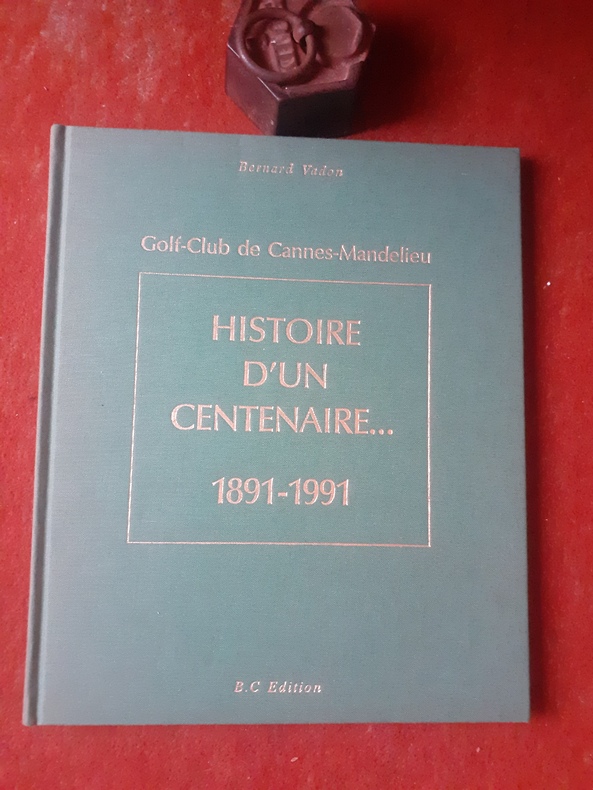
réf. QWA-19822Golf Magazine BC Editions, 1991, in-4 rel. toile verte (24,5 x 29,5), 95 p., nombreuses illustrations en n. et en coul., bon état.
VI, 238 pp. 8vo. Modern boards using the original printed upper cover. First edition. - The autobiography of Usamah ibn Murshid ibn Munqidh (1095-1188), who introduced this genre of writing to Arabic literature (cf. GAL I, 319). Born in Shaizar in northern Syria, where his family ruled a small Emirate, he was banished by his uncle and for a time entered the services of Atabeg Sihabaddin ibn Buri, where he got to know members of the Knights Templar. After spending several years in seclusion as a hunter in Egypt, he returned to Damaskus in 1154, joining the campaign against the European crusaders. The editor H. Derenbourg was the first to discover the sole surviving manuscript of the "Kitab al-I'tibar" (in the Escorial in Madrid) and produced this first translation, afterwards the first Arabic edition (1886) and a biography of Usamah (1889). - A few repaired paper defects; well-preserved altogether. OCLC 7045652.
Small 4to (21 x 15 cm). (16), 410, (6) pp. With woodcut arms of the Dominican order (with the IHS and cross covering the centre) on title-page, and a variant version on the last page, and 3 woodcuts in text (2 saints and the Cross). Further with 24 decorated woodcut initials in two series, including 11 repeats. Contemporary gold-tooled mottled calf, each board with the coat of arms of the French Seguier family and with the monogram PSMF (Pierre Seguier and his wife Madeleine Fabry) repeated 6 times on the spine, rebacked (on recessed cords) with original gold-tooled backstrip laid-down, a later spine label (between the 1st and 2nd monogram), the year of publication 1611 at the foot of the spine, later endpapers. First and only edition, in Spanish, of an early work on Ethiopia by the Spanish Dominican monk Luis de Urreta (ca. 1570-1636), who wrote two volumes glorifying his own order's accomplishments in Ethiopia while diminishing those of the Jesuits (his Dominican coat of arms incorporates the IHS with cross, often used by the Jesuits). In the present work, the second of the two, he deals specifically with the Dominican presence in Ethiopia and the history of the Ethiopian saints. Like the first work, the "Historia ecclesiastica" published in 1610, it is a late example of a stream of geographical fantasies where Ethiopia was presented as the wondrous utopian kingdom of Prester John, and Urreta makes the case for an ancient Dominican presence in the country, arguing that they should thus be given precedence over the Jesuits as Catholic missionaries in that country. On pp. 88-90 it gives the information from a report to Pope Gregory XIII (1502-85) on two Dominican monks (Blackfriars) from the Alleluya monastery, who entered Mecca around 1580 and had contact with a Faqih and a Marabout. Everyone who travelled from Africa to Mecca supposedly had to travel by way of the Alleluya monastery as the rest of the region was considered uninhabitable (p. 61). - From the library of Pierre Seguier, Lord Chancellor of France from 1635 to 1672, best known for his appearance in The three musketeers, with his arms and monogram stamped in gold on the binding. And with an owner's inscription of the 17th-century French scholar Etienne Baluze ("Stephanus Baluzius Tutelensis") on title-page. With a faint water stain in the lower margin of four leaves in the introduction, a tiny corner torn from the title-page and two tiny tears in the margins of the main text, otherwise in very good condition. Binding heavily restored, but with the gold-tooled coat of arms still very clear. Olivier, 271(4). Finger & Piccolino, The shocking history of electric fishes, p. 117; Palau 345993; Salva 3417; cf. Gay, Bibl. de l'Afrique et l'Arabe 2690.
8vo. XI, (1), 211, (1) pp. With a hand-coloured wood-engraved frontispiece and 4 large folding lithographed pedigree tables. Original burnt red cloth binding with giltstamped title to spine and upper cover. First edition. - Upton was one of the early experts on the bloodlines of British thoroughbreds. His book describes both the influence of the Arabian horse on the development of the English thoroughbred as well as many interesting aspects of the Arabian horse. Shortly after the publication of this work - intended to "point out errors that have been committed in the breeding of our horse" (p. iii) - he travelled in Arabia to obtain purebred horses and so improve the quality of British cavalry remounts. Upton served with the 9th Lancers. - Binding somewhat bumped and rubbed with traces of moisture to covers. Lightly browned throughout, paper brittle with occasional edge or corner flaws, frontispiece and title-page rather foxed. Rare. Boyd/P. 130. Huth 273. OCLC 12795478.
Watercolour over traces of pencil. 708 x 490 mm. Signed and dated by the artist. Matted.
1974Watercolour heightened with white. 681 x 520 mm. Signed and dated by the artist. Matted.
Watercolour over pencil, matted. Signed and dated by the artist lower left. 460 x 363 mm. An impressive watercolour of the famous Arabian mare, dedicated by the artist "to Rachel".
1987Ballpoint, heightened with white. 378 x 278 mm. A sheet of annotated preliminary sketches for Upton's watercolour portrait of the three Arab mares Gold Roseifa, Russallka, and Roxiralot. - Matted.
1987Watercolour over pencil. 780 x 525 mm. Signed and dated by the artist. Matted.