957 risultati
1952rif. 106513Magazine glossy covers 4to illustrated 74 pp. Corner folds top of one page missing normal aging; otherwise very good. Includes articles about Gil Turner Max Schmeling Jack Johnson Paddy DeMarco and Lord Carlton. Joseph Weider books
1952rif. 1064884to magazine formate illustrated 74 pp. Some spine wear but in pretty good shape 4 pages loose normal aging; otherwise very good. This is Vol. 1 No. 12 March-April 1952. Cover features world champion Joe Walcott and his main challengers. Boxing & Wrestling, Inc. books
1935rif. 106810Collection of ten first generation wire photos of boxing stills and action shots. Some have stamped notation on rear others have taped notes by wire service to describe photo. All black and white and most are about 8" x 10" or around 6" x 9". Normal aging and a few corner chips; otherwise very good. The collection includes a stills of Floyd Paterson and Johnny Dundee. Action shots of the light heavyweight championship fight between Joey Maxim and Archie Moore Barney Ross vs. Jimmy McLarnin and the light-heavyweight championship fight between Archie Moore and Harold Johnson. Other photos include Harry Kid Matthews Dave Charnley a family photo with Jersey Joe Walcott and a shot of Archie Moore with Brian Keith preparing for a TV show. Family Affair. books
1953rif. 106519Magazine 4to illustrated 80 pp. Slight edge wear normal aging; otherwise very good plus. Nice condition. Colorful Kid Gavilan cover. Articles on Henry Armstrong Kid Gavilan Floyd Paterson and TV fights. True, The Man's Magazine, books
1946rif. 106524Magazine 4to illustrated. 64 pp. Some crud tape repairs to spine back cover a couple of minor edge chips a little staining pages aged and browned. Maybe missing table of contents but not certain since otherwise complete. Overall in fair condition. Picture of Gus Lesnevich on the cover. Some wonderful material on some of the greatest fights ever including Willie Pep Ray Robinson Jake LaMotta and Charlie Wright. The Ring, Inc. books
1956rif. 106525Magazine 4to illustrated 66 pp. Tape repairs to spine some soiling corner and edge chips normal aging; otherwise fair or better. Issue XXXV No. 11 with cover that claims to feature Carmen Basilio but does not appear to show his likeness. Articles on Archie Moor and Floyd Paterson Carmen Basilio Ray Robinson and Tommy Jackson. The Ring, Inc. books
1947rif. 106518Magazine 4to illustrated 64 pp. Crude tape repairs to spine ink mark on cover a couple of edge chips normal aging; otherwise about good. This is the June 1947 issue with Charlie Fusari on the cover.Articles on Joe Louis Charlie Fusari and Freddie Welsh. The Ring, Inc. books
1952rif. 106516Magazine 4to illustrated 64 pp. Spine split but partially repaired with archival tape chips and tears to edges normal aging; otherwise good. Early Robinson cover with stories on Rocky Marciano television and boxing and Joey Maxim. The Ring, Inc. books
1955rif. 106520Magazine 4to illustrated.64 pp. Cover damaged corner and edge pieces missing archival tap repair to cover tear corner piece missing from first leaf but no loss normal aging; otherwise fair. Marciano's last fight featured on cover. Articles on Ray Robinson Carmen Basilio and Marciano's last fight. True, The Man's Magazine, books
1955rif. 53801New York: Simon and Schuster 1955. 8vo. 8 375 1 pp. Double-page title numerous photo illustrations. Quarter-beige cloth over gray boards blue & red lettering front cover & spine minor edgewear rubbing slight bumping to couple corners w/ d.j. minor chipping head of spine couple minor tears couple closed tears minor creasing still VG/VG- copy inscribed by Rocky Graziano on ffep. First edition inscribed of this memoir detailing the violent life of the famed World Middleweight boxer which served as the basis for the 1956 Oscar-winning MGM film starring Paul Newman Pier Angeli Everett Sloane and directed by Robert Wise. An interesting side-note is that this was also one of the first screen appearances of a young Steve McQueen. Simon and Schuster, hardcover
1961rif. 1040884to boxing program glossy covers and paper illustrated 32 pp. Spine and edges in good shape one small slight corner fold some normal aging to contents; very good plus or better. This attractive program sets the stage for the third and final fight between Paterson and Johansson. After winning the first fight and losing the second Johansson would lose the third and final fight to Patterson by a knockout in the sixth round. All three fights were exciting and won inside the distance and Floyd Paterson would become the first man to regain the heavyweight championship with a win in the second fight with Johansson. The program gives some background and photos on the first two fights and provides information on both fighters. The program contains a couple of interesting ad pages including one for the Fontainebleau Hotel that featured Frank Sinatra Dean Martin Joey Bishop and Sammy Davis jr.in what appears are shows at the hotel. Feature Sports Inc.,
1961rif. 1040884to boxing program glossy covers and paper illustrated 32 pp. Spine and edges in good shape one small slight corner fold some normal aging to contents; very good plus or better. This attractive program sets the stage for the third and final fight between Paterson and Johansson. After winning the first fight and losing the second Johansson would lose the third and final fight to Patterson by a knockout in the sixth round. All three fights were exciting and won inside the distance and Floyd Paterson would become the first man to regain the heavyweight championship with a win in the second fight with Johansson. The program gives some background and photos on the first two fights and provides information on both fighters. The program contains a couple of interesting ad pages including one for the Fontainebleau Hotel that featured Frank Sinatra Dean Martin Joey Bishop and Sammy Davis jr.in what appears are shows at the hotel. Feature Sports Inc., books
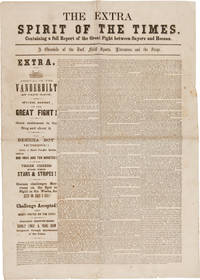
1860rif. 66827New York. 1860. Two Contemporary Accounts of the First "World Title" Match in Boxing A pair of special issue American newspapers offering "first-hand" reports on the famous Sayers-Heenan bareknuckle boxing match generally considered the sport's first international title match. As evidenced by these two papers contemporary reports of the fight vary wildly on the details but the outline appears to be as follows. John C. Heenan of California nicknamed the "Benicia Boy" travelled to England in early 1860 in order to enter the ring with the reigning champion of English pugilism Tom Sayers. The international nature of the contest attracted intense interest from both sides of the Atlantic despite the illegal nature of prize fighting. The fight took place on the morning of April 17 in front of a crowd of thousands at an "undisclosed location" in Farnborough Hampshire. The match was protracted and violent lasting over two hours and with both fighters sustaining serious injuries. The ultimate result is a point of debate but the most accepted version is that local police eventually managed to force their way into the ring and break up the unsanctioned event resulting in a draw. Together here are extra issues of two of the most prominent sports periodicals of the day the Spirit of the Times and the New York Clipper. Between them they present three different accounts of the day one in the Spirit and two different accounts in the Clipper. All three give a similar outline of the lead-up to the bout though differing in certain details. In effusive fashion they describe the machinations that went into organizing the illegal fight determining its location getting thousands of spectators "tickets to 'nowhere'" the forming of the ring the esteemed personages present and of course the betting odds. The round-by-round descriptions of the fight however differ in nearly every detail and betray a certain degree of wholesale fabrication. The Spirit of the Times is the most unapologetically pro-American claiming a complete victory for Heenan after a mere twenty-seven rounds. Their portrayal of the third round provides a succinct example of the colorful language used in these papers clearly meant to entertain the reader as much or more than to share truthful events: "3. Tom came up rather flushed and the gravy distilling from his damaged brow he dodged and tried his double but did not get home he tried a second time but was stopped cleverly and Heenan returned on the right ogle. This led to very heavy counters each on the larboard goggle Tom feinted and popped his left on the smeller. They got hold swung round broke away and Heenan then popped his left again on the right eye severe exchanges followed at close quarters and both were in the end down." The special issue of the Clipper tells a different story giving play-by-play details of forty-three rounds of bareknuckle boxing with round three ending in a knockdown by Heenan. At the end of the fight they claim that Sayer surrendered and was escorted out of the ring and declare "British 'Fair Play and May the Best Man Win' a Grand Humbug." The following page prints an account from The Bell which puts the fight at thirty-seven rounds ending with the police entering the ring. The rest of the issue is occupied by numerous other articles about the history and practice of boxing including the most recent "Rules of the Prize Ring" the history of "The Championship of England" from 1719 the "Duties of Seconds and Bottle Holders" and a full-page timeline of "Remarkable Occurrences in the Prize Ring" including a brief section on "Female Pugilists." A pair of rare antebellum sports reporting newspapers recording a legendary moment in the history of boxing. Old folds light foxing and staining minor edge wear. Some splitting to gutter of the Clipper which is uncut along the top edge. Both very good overall. For a detailed discussion of the Sayers-Heenan fight and its place in American culture see Elliott J. Gorn The Manly Art Ithaca NY 1986 pp.148-59. unknown
1860rif. 66827New York. 1860. Two Contemporary Accounts of the First "World Title" Match in Boxing A pair of special issue American newspapers offering "first-hand" reports on the famous Sayers-Heenan bareknuckle boxing match generally considered the sport's first international title match. As evidenced by these two papers contemporary reports of the fight vary wildly on the details but the outline appears to be as follows. John C. Heenan of California nicknamed the "Benicia Boy" travelled to England in early 1860 in order to enter the ring with the reigning champion of English pugilism Tom Sayers. The international nature of the contest attracted intense interest from both sides of the Atlantic despite the illegal nature of prize fighting. The fight took place on the morning of April 17 in front of a crowd of thousands at an "undisclosed location" in Farnborough Hampshire. The match was protracted and violent lasting over two hours and with both fighters sustaining serious injuries. The ultimate result is a point of debate but the most accepted version is that local police eventually managed to force their way into the ring and break up the unsanctioned event resulting in a draw. Together here are extra issues of two of the most prominent sports periodicals of the day the Spirit of the Times and the New York Clipper. Between them they present three different accounts of the day one in the Spirit and two different accounts in the Clipper. All three give a similar outline of the lead-up to the bout though differing in certain details. In effusive fashion they describe the machinations that went into organizing the illegal fight determining its location getting thousands of spectators "tickets to 'nowhere'" the forming of the ring the esteemed personages present and of course the betting odds. The round-by-round descriptions of the fight however differ in nearly every detail and betray a certain degree of wholesale fabrication. The Spirit of the Times is the most unapologetically pro-American claiming a complete victory for Heenan after a mere twenty-seven rounds. Their portrayal of the third round provides a succinct example of the colorful language used in these papers clearly meant to entertain the reader as much or more than to share truthful events: "3. Tom came up rather flushed and the gravy distilling from his damaged brow he dodged and tried his double but did not get home he tried a second time but was stopped cleverly and Heenan returned on the right ogle. This led to very heavy counters each on the larboard goggle Tom feinted and popped his left on the smeller. They got hold swung round broke away and Heenan then popped his left again on the right eye severe exchanges followed at close quarters and both were in the end down." The special issue of the Clipper tells a different story giving play-by-play details of forty-three rounds of bareknuckle boxing with round three ending in a knockdown by Heenan. At the end of the fight they claim that Sayer surrendered and was escorted out of the ring and declare "British 'Fair Play and May the Best Man Win' a Grand Humbug." The following page prints an account from The Bell which puts the fight at thirty-seven rounds ending with the police entering the ring. The rest of the issue is occupied by numerous other articles about the history and practice of boxing including the most recent "Rules of the Prize Ring" the history of "The Championship of England" from 1719 the "Duties of Seconds and Bottle Holders" and a full-page timeline of "Remarkable Occurrences in the Prize Ring" including a brief section on "Female Pugilists." A pair of rare antebellum sports reporting newspapers recording a legendary moment in the history of boxing. Old folds light foxing and staining minor edge wear. Some splitting to gutter of the Clipper which is uncut along the top edge. Both very good overall. For a detailed discussion of the Sayers-Heenan fight and its place in American culture see Elliott J. Gorn The Manly Art Ithaca NY 1986 pp.148-59. unknown books
1867rif. 47391Dublin: P. Brereton Printer 1867. Very Good. Dublin: P. Peter Brereton Printer ca. 1867. First Edition. Pictorial broadside 28.25x11cm; woodcut illustration followed by a ballad. Mild rubbing and toning to edges; Very Good and sound. John Morrissey 1831-1878 known as Old Smoke was an Irish-American politician bare-knuckle boxing champion and criminal. While this fight at Tierra del Fuego is not historically verified clearly Morrissey was the model for the hero. Born in County Tipperary Ireland his family emigrated to the U.S. when Morrissey was still a child. Among the exploits that would make him a folk hero in Ireland were his winning of the heavyweight boxing championship fighting and possibly murdering Bill the Butcher and testifying against Boss Tweed and winning a State Senate seat on an anti-Tammany platform. A version of this ballad is included in Sandburg's The American Songbag. Brereton printed a number of these Irish Street Ballads which were cheaply and carelessly printed as they are riddled with errors. "A closer investigation reveals the blemishes of composition—inverted letters multiple type-faces broken sorts uneven leading etc. Clearly neither the printer nor reader cared much for these minor details. The broadsheets were printed quickly and inexpensively" Kuhn. A lovely survival of Irish street literature highlighting the connection between the country's print trade and its robust oral tradition. Andrew Kuhn "Reading Room Log: Brereton Broadsides." From the John J. Burns Library Blog accessed online. P. Brereton Printer unknown
1867rif. 47391Dublin: P. Brereton Printer 1867. Very Good. Dublin: P. Peter Brereton Printer ca. 1867. First Edition. Pictorial broadside 28.25x11cm; woodcut illustration followed by a ballad. Mild rubbing and toning to edges; Very Good and sound. John Morrissey 1831-1878 known as Old Smoke was an Irish-American politician bare-knuckle boxing champion and criminal. While this fight at Tierra del Fuego is not historically verified clearly Morrissey was the model for the hero. Born in County Tipperary Ireland his family emigrated to the U.S. when Morrissey was still a child. Among the exploits that would make him a folk hero in Ireland were his winning of the heavyweight boxing championship fighting and possibly murdering Bill the Butcher and testifying against Boss Tweed and winning a State Senate seat on an anti-Tammany platform. A version of this ballad is included in Sandburg's The American Songbag. Brereton printed a number of these Irish Street Ballads which were cheaply and carelessly printed as they are riddled with errors. "A closer investigation reveals the blemishes of composition—inverted letters multiple type-faces broken sorts uneven leading etc. Clearly neither the printer nor reader cared much for these minor details. The broadsheets were printed quickly and inexpensively" Kuhn. A lovely survival of Irish street literature highlighting the connection between the country's print trade and its robust oral tradition. Andrew Kuhn "Reading Room Log: Brereton Broadsides." From the John J. Burns Library Blog accessed online. P. Brereton Printer unknown books
1918rif. List3130Muskogee Oklahoma 1918. Real photo postcard measuring 3 ¼ x 5 ½ inches. A real photo postcard depicting Japanese-American boxer Young Togo inscribed verso: “To K. Iwana Muskogee Oklahoma / From Young Togo fighter and jiu jitsu wrestler Muskogee Okla”. Young Togo was a lightweight and sometimes featherweight or bantamweight boxer from Fort Smith Arkansas who debuted around 1907. He seemed to have been a popular fighter based on contemporaneous newspaper articles. Following a draw with Togo “Battling” Nelson described him as “the toughest piece of Japanese flesh that ever stepped into a prize ring” and stated that “he was game to the core. He fought clean and took his beating like a gamester” then noting that Young Togo had been “full of malaria” at the time.1 In the same article sports journalist Otto Floto described Togo as “one of the very toughest boys of his weight” who “seems to be invincible.” Togo may be Koriyama Kokichi the head coach of YūjirÅ Watanabe’s Nippon KentÅ Club founded in 1921 in Tokyo; Boxing: A Quick Guide 1923 a book written by the pair in Japanese identifies Kokichi as “Young Togo”. 1 “What Nelson Thinks Of Fort Smith Fans By Battling Nelson” Southwest American March 1 1912 5. unknown
1918rif. List3130Muskogee Oklahoma 1918. Real photo postcard measuring 3 ¼ x 5 ½ inches. A real photo postcard depicting Japanese-American boxer Young Togo inscribed verso: “To K. Iwana Muskogee Oklahoma / From Young Togo fighter and jiu jitsu wrestler Muskogee Okla”. Young Togo was a lightweight and sometimes featherweight or bantamweight boxer from Fort Smith Arkansas who debuted around 1907. He seemed to have been a popular fighter based on contemporaneous newspaper articles. Following a draw with Togo “Battling” Nelson described him as “the toughest piece of Japanese flesh that ever stepped into a prize ring” and stated that “he was game to the core. He fought clean and took his beating like a gamester” then noting that Young Togo had been “full of malaria” at the time.1 In the same article sports journalist Otto Floto described Togo as “one of the very toughest boys of his weight” who “seems to be invincible.” Togo may be Koriyama Kokichi the head coach of YūjirÅ Watanabe’s Nippon KentÅ Club founded in 1921 in Tokyo; Boxing: A Quick Guide 1923 a book written by the pair in Japanese identifies Kokichi as “Young Togo”. 1 “What Nelson Thinks Of Fort Smith Fans By Battling Nelson” Southwest American March 1 1912 5. unknown books
2008rif. LFA-126746766N° 99 (Décembre 2008-Janvier 2009) : revue de 66 pages, format 215 x 285 mm, illustrée, brochée couverture couleurs, bon état
1956rif. 1050604to magazine glossy covers illustrated 66 pp. Some tape repairs to spine covers slightly soiled or darkened a few edge chips archiva; tape repair at edge normal aging to contents. Still a decent copy and an important issue. Feature article on Rocky Marciano who won fighter of the year honors. Some pictures of Rocky’s last fight which was against Archie Moore. Another feature article names the Basilio-DeMarco bout as fight of the year. A rare and interesting article on how Dr. Joyce Brothers who won the $64000 question on TV by answering some incredible difficult questions on boxing. The Ring Inc. books
1950rif. 1050134to magazine glossy covers illustrated 64 pp. Covers generally bright some dull soiling or darkening minor edgewear small nick on one edge usual aging and browning; very good plus. British heavyweight champ Bruce Woodcock featured on the cover. Woodcock is covered among upcoming heavyweight fights. An article naming Sugar Ray Robinson the best fighter in all divisions is included. This is probably the start of the love affair boxing historians have had with Robinson often naming him the best pound for pound fighter in history. The Ring Inc., books
1941rif. 1050094to magazine glossy covers illustrated 64 pp. Covers bright and in really nice condition normal aging and browning; very good plus or better. This issue is probably one of the most important issues of the 1940s. The historic first fight between heavyweight champ Joe Louis and challenger Billy Conn is nicely covered with words and pictures. Conn ahead on points thanks to some great boxing skills blows his chance by trying to knock out Louis late in the fight. Despite the victory Louis lost the PR battle as Conn the smaller man was seen as a hero by almost defeating the champ. Boxer Sammy Angott is featured on the cover. The Ring Inc., books
1952rif. 1041564to magazine glossy covers illustrated 64 pp. Some edge and spine wear normal aging and browing; very good overall. This issue provides annual rankings and features an article on Sugar Ray Robinson as the fighter of the year. Robinson regained his middleweight crown by beating Randy Turpin in their second bout. Ring names the Walcott-Charles bout as the fight of the year. Walcott's knockout of Charles earned him the heavyweight title. books
1952rif. 1050124to magazine glossy covers illustrated 64 pp. Covers bright and clean with just a slight bit of edgewear slight aging and browning; very good plus. Unusual Ring issue that features coverage of fighters outside the United States. The cover story features South African Bantamweight Champion Vic Toweel who is shown on the cover. Other articles include coverage of Marciano’s fight with Lee Savold Kid Gavilan's victory over Bobby Dykes and Japanese fighters invade the world of boxing. The Ring Inc., books
1951rif. 1050114to magazine glossy covers illustrated 64 pp. Covers bright and clean slight aging and browning; very good plus. A feature article discusses Joe Louis probable return match with heavyweight champ Ezzard Charles. Louis got back in contention with a knockout of Lou Savold. There is another feature article by Nat Fleischer about Sugar Ray Robinson. Also coverage of a rising star Walter Cartier who had a nice start but didn't have a great record with top contenders. He would eventually become an actor. The Ring Inc., books