957 resultados
Broadside (360 x 240 mm), printed on one side only, paper browned, cut down centre fold and repaired with archival paper, previous sellotape browning visible. Harry Paulson (1819-1890), prize-fighter, born in Newark, Nottinghamshire. He was most famous for his three momentous bouts against Tom Paddock of Redditch which took place between 1851 and 1854, and the fight of over 100 rounds with Tom Sayers, a younger man and the champion of England at the time. After a brief biography we are informed of his fighting career "He next beat Tom Paddock (born 1824, died 1864) for ?25 a-side, at Sedgebrook near Grantham, Sept 23, 1851, in 71 rounds, lasting 95 minutes. They met again, Dec. 16, 1851, at the "Cross of Hands" Belper, Derbyshire, when Paddock won in 86 rounds, 95 minutes... They fought for a third time, for ?100 a-side... when Paddock was again conqueror, in 102 rounds, time, 2 hours 32 minutes. He next entered the lists with that Prince of English boxers, Tom Sayers, for ?50 a-side. This great battle took place at Appledore, in Kent, on Jan. 29 1856, and Sayers was victorious after 3 hours 8 minutes had elapsed, during which time 109 rounds were got through..." We are then given a brief description of Paulson's social life and an account of his death and funeral. It appears that Wilson, an old-established firm of Nottingham printers, also issued similar broadsides for the careers of other boxes: Bendigo, Sayers, Mace, Fryer, Click Soles and others. Apparently unrecorded.
1910ref. 201861910. Women's participation in boxing long preceded formal recognition of the sport for female athletes developing through informal exhibitions training clubs and novelty bouts that challenged prevailing gender norms. Although women were largely excluded from organized boxing competitions during the nineteenth and early twentieth centuries scattered photographic evidence demonstrates that women continued to box recreationally and publicly despite social restrictions. This archive of photographs dating from the early twentieth century through the mid twentieth century documents women participating in boxing across a range of informal settings illustrating the gradual emergence of female athletic culture in a sport historically defined as masculine. Archive of sixteen black and white photographs including six silver gelatin prints and one real photo postcard measuring approximately 2.5 x 3.5 inches to 3.5 x 5.25 inches dating from the 1910s through the 1950s. The earliest image a real photo postcard dated August 1914 depicts two women wearing corsets and long dresses while sparring with boxing gloves before a mixed group of spectators. The postcard bears a pencil inscription on the verso reading "August 1914 For fun women boxers Francis Edith." Another early photograph shows two women posing with gloved fists raised before a snowy background with the inscription "Grace Miss Vandehei boxing This is Grace's roommate. A fine girl she's here now." Later photographs from the 1920s depict staged boxing encounters between a man and a woman with the female boxer dressed in athletic trousers and high heeled shoes reflecting the novelty and spectacle often associated with early female boxing exhibitions. One image shows the pair squared off with raised fists while another captures the moment of a punch landing against the man's chest. Another photograph shows two women sparring on a ship deck while surrounded by onlookers one boxer wearing a dress and curlers beneath her head covering while raising her gloved fists before a mixed audience of men and women. Boxing has historically generated controversy due to its physical intensity and female participation in the sport remained marginal for decades. Women occasionally boxed publicly as early as the eighteenth century yet organized opportunities remained rare. Women's boxing appeared briefly as a demonstration sport at the 1904 Olympic Games in St. Louis and training clubs such as Andrew Newton's Women's Boxing Club in London emerged during the 1920s. Nevertheless women's boxing did not become an official Olympic sport until the 2012 Olympic Games. The photographs in this archive illustrate the persistence of women athletes who trained and competed informally despite these restrictions offering visual evidence of women's athletic experimentation and resilience during a period of shifting gender expectations in sport. Sixteen photographs including silver gelatin prints and a real photo postcard measuring approximately 2.5 x 3.5 inches to 3.5 x 5.25 inches. Photographs clear and well preserved with light handling wear. Overall condition very good. unknown
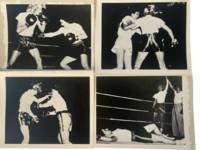
1910ref. 201861910. Women's participation in boxing long preceded formal recognition of the sport for female athletes developing through informal exhibitions training clubs and novelty bouts that challenged prevailing gender norms. Although women were largely excluded from organized boxing competitions during the nineteenth and early twentieth centuries scattered photographic evidence demonstrates that women continued to box recreationally and publicly despite social restrictions. This archive of photographs dating from the early twentieth century through the mid twentieth century documents women participating in boxing across a range of informal settings illustrating the gradual emergence of female athletic culture in a sport historically defined as masculine. Archive of sixteen black and white photographs including six silver gelatin prints and one real photo postcard measuring approximately 2.5 x 3.5 inches to 3.5 x 5.25 inches dating from the 1910s through the 1950s. The earliest image a real photo postcard dated August 1914 depicts two women wearing corsets and long dresses while sparring with boxing gloves before a mixed group of spectators. The postcard bears a pencil inscription on the verso reading "August 1914 For fun women boxers Francis Edith." Another early photograph shows two women posing with gloved fists raised before a snowy background with the inscription "Grace Miss Vandehei boxing This is Grace's roommate. A fine girl she's here now." Later photographs from the 1920s depict staged boxing encounters between a man and a woman with the female boxer dressed in athletic trousers and high heeled shoes reflecting the novelty and spectacle often associated with early female boxing exhibitions. One image shows the pair squared off with raised fists while another captures the moment of a punch landing against the man's chest. Another photograph shows two women sparring on a ship deck while surrounded by onlookers one boxer wearing a dress and curlers beneath her head covering while raising her gloved fists before a mixed audience of men and women. Boxing has historically generated controversy due to its physical intensity and female participation in the sport remained marginal for decades. Women occasionally boxed publicly as early as the eighteenth century yet organized opportunities remained rare. Women's boxing appeared briefly as a demonstration sport at the 1904 Olympic Games in St. Louis and training clubs such as Andrew Newton's Women's Boxing Club in London emerged during the 1920s. Nevertheless women's boxing did not become an official Olympic sport until the 2012 Olympic Games. The photographs in this archive illustrate the persistence of women athletes who trained and competed informally despite these restrictions offering visual evidence of women's athletic experimentation and resilience during a period of shifting gender expectations in sport. Sixteen photographs including silver gelatin prints and a real photo postcard measuring approximately 2.5 x 3.5 inches to 3.5 x 5.25 inches. Photographs clear and well preserved with light handling wear. Overall condition very good. unknown books
197366 pages. Features: At Ringside; California Grapevine; Sound Off; Joe Bugner to fight Muhammad Ali; New Bantamweight Champ Romeo Anaya defeats Enrique Pinder; Worldwide Ratings; Carmen Basilio; Where Does New Heavyweight Champ George Foreman Go From Here? (six-page article with great photos); Q & A with Angelo Dundee; Ali's Evaluation of Joe Frazier's Performance vs. Foreman; Dick Sadler is George Foreman's Manager; Foreman's Secret Weapon - Archie Moore (The 'Ol Mongoose); Jack Kent Cooke takes financial bath after Frazier is destroyed; Where Does Joe Frazier Go From Here?; George Foreman's Career in Words and Pictures (9 grea pages); George Foreman vs. Jimmy Ellis; George Foreman vs. Jerry Quarry; George Foreman vs. Muhammad Ali; George Foreman vs. Ron Lyle; International Wrapup; Hilarious one-page photo ad for inflatable Love Doll from Londons Sales - "for conversation, for companionship, for fun, for excitement!"; and more. Unmarked with somewhat above-average wear. A sound vintage copy. Book
1943ref. boz_003832Émile Di Cristo. Carte postale photographique signée et dédicacée, 1943 Champion de france de Boxe en 1943 Carte postale photographique signée et dédicacée, datée du 30/09/1943. "Bien amicalement A mon petit supporter Michel Blanchard" Ensemble de photos provenant d'une collection privée d'un certain Michel Blanchard. Dimensions : 13,8 x 8,9 cm État : Voir photos pour plus de détails. Nombre de pages : 1 page
1929Torino, 1929, 26 maggio, copertina illustrata a colori in fascicolo originale completo di pp. 16 de “Illustrazione del popolo" - Supplemento della ”Gazzetta del Popolo" .
1954Roma, 1954, 5 dicembre, copertina illustrata a colori in fascicolo originale completo di pp. 24 de “La Tribuna Illustrata".