Phoenix Boxing ClubBiblio.com

987 results
1954ref. 4197Kilmainham Ireland: Phoenix Boxing Club 1954. Poster. Near Fine. The Phoenix Boxing Club is an historic Dublin club that was established in the 1920s and still remains active today. A promotional poster printed in black ink onto robust paper measuring 30 x 20 inch wide. The poster advertises an impressive line up of bouts to be held in the National Stadium featuring Irish Northern County and Irish International champions on the fight card. Poster w. fold marks some soil and creases minor edge wear w. pin holes at upper right corner and two stray ink marks. An amazing survivor considering the posters intended use. A nice piece of scarce and ephemeral Irish Boxing memorabilia. Printed by "Ardiff" in Kilmainham Dublin Ireland. Phoenix Boxing Club unknown
1971263p. Hardcover Very good condition good Signed by Archie Moore for Bob Dion & resigned for a New England Patriots fan by B. H. (Brian Holloway?)
In-folio, VII-107p. Edition de luxe numérotée 1/111 exemplaires sur papier vélin de Rives [tirage total: 242 exemplaires]. Illustré de 60 lithographies en noir de Luc-Albert Moreau. Avant-propos de Henry de Montherlant. Le très bel étui est malheureusement fendu (mais sans manque). Intérieur de première fraicheur.
1920ref. 106644Two BroadsidesThe New Colored Menace: World's Greatest Heavyweight Al Walker. 44x31 cm 17¼x12". c.1929. Ripple & Curran Manage the Greatest Boxing Stable in the West - Directing Fighters with a Future Who Fight. With a list of 7 boxers each with a short biography. c.1920s. General light wear with some old folds pinholes normal aging minor closed tears at edges etc. the Walker broadside may have some manuscript additions; both pieces very good. The Walker broadside is significant in that Black heavyweights were essentially eliminated from fighting for the heavyweight championship. After Jack Johnson white America wanted no part of a black heavyweight until Joe Louis came on the scene in the 1930s. It is doubtful Walker's record would have made a top ten fighter but he did fight George Godfrey. The second broadside features a list of western prizefighters including Cowboy Billy Owens a Native American heavyweight. books
1920ref. 106644Two BroadsidesThe New Colored Menace: World's Greatest Heavyweight Al Walker. 44x31 cm 17¼x12". c.1929. Ripple & Curran Manage the Greatest Boxing Stable in the West - Directing Fighters with a Future Who Fight. With a list of 7 boxers each with a short biography. c.1920s. General light wear with some old folds pinholes normal aging minor closed tears at edges etc. the Walker broadside may have some manuscript additions; both pieces very good. The Walker broadside is significant in that Black heavyweights were essentially eliminated from fighting for the heavyweight championship. After Jack Johnson white America wanted no part of a black heavyweight until Joe Louis came on the scene in the 1930s. It is doubtful Walker's record would have made a top ten fighter but he did fight George Godfrey. The second broadside features a list of western prizefighters including Cowboy Billy Owens a Native American heavyweight.
Broadside (360 x 240 mm), printed on one side only, paper browned, cut down centre fold and repaired with archival paper, previous sellotape browning visible. Harry Paulson (1819-1890), prize-fighter, born in Newark, Nottinghamshire. He was most famous for his three momentous bouts against Tom Paddock of Redditch which took place between 1851 and 1854, and the fight of over 100 rounds with Tom Sayers, a younger man and the champion of England at the time. After a brief biography we are informed of his fighting career "He next beat Tom Paddock (born 1824, died 1864) for ?25 a-side, at Sedgebrook near Grantham, Sept 23, 1851, in 71 rounds, lasting 95 minutes. They met again, Dec. 16, 1851, at the "Cross of Hands" Belper, Derbyshire, when Paddock won in 86 rounds, 95 minutes... They fought for a third time, for ?100 a-side... when Paddock was again conqueror, in 102 rounds, time, 2 hours 32 minutes. He next entered the lists with that Prince of English boxers, Tom Sayers, for ?50 a-side. This great battle took place at Appledore, in Kent, on Jan. 29 1856, and Sayers was victorious after 3 hours 8 minutes had elapsed, during which time 109 rounds were got through..." We are then given a brief description of Paulson's social life and an account of his death and funeral. It appears that Wilson, an old-established firm of Nottingham printers, also issued similar broadsides for the careers of other boxes: Bendigo, Sayers, Mace, Fryer, Click Soles and others. Apparently unrecorded.
1916Abundant black and white illustrations and reproductions of photos. Features: The Knife-Haft Clue - a tale of murder at Cavadiera Camp in Brazil; The War in the Dolomites - article and photos of extremely challenging terrain in Italy; Stalked! - L. Rogers was stalked on a lonely trail by a big mountain lion; The Return Match - follow-up to October 1915 article "A Prize-Fight in Mexico" by N.E. Guthrie, one of the principals in the fight; Two Girls in Camp in British Columbia - Miss H.W. Paul and her friend Fatima, two English nurses, describe their month-long holiday in the wilds of the B.C. coast; In the Grip of the "Hip Sings" - part III - an American businessman was also a member of a Chinese tong; The Mutiny of the Z.___ - part I of a tragic story related by the first mate; On the Trail in Wonderland - Part II - exploring America's newest national reserve, Glacier Park in North-Western Montana; The Disappearance of Charlie Westcott - WWI story of a lucky escape; From Job to Job Around the World - Part IX - Alfred C.B. Fletcher recounts his voyage to Spitzbergen, his coal-mining experiences in the Arctic, and his final return to the U.S., with fascinating photos; "Mike" - The Story of a Mounted Police Sled Dog that rescued a man who had fallen unconscious in a blizzard; and more. pp. 5 [ads], [2], 96, 6-24 [ads]. Unmarked with moderate wear. A quality vintage copy. Book
193966 pages. Features: Charming cover art by Elise Parks depicts mother holding infant; Is The President [FDR] A Well Man? - A look at some fantastic world-wide rumors - and an intimate, authoritative revelation of plain facts; Mothers Can't Help It - fiction by E.G. Morris; The Railroads Tell What is Wrong with Senator Burton K. Wheeler; Forgotten Lullaby - fiction by Rita Weiman; Filthy Rich - fiction by Cornelius Vanderbilt, Jr.; Five Hollywood Daughters and a Prayer - Article on the singing Lane Sisters [Leota, Lola, Rosemary, Priscilla, Martha] with photo of the girls with their mom at home in Indianola, Iowa; Twilight Cheats - fiction by Grace Perkins; Nice one-page color Gillette Blue [Shaving] Blade ad; Illustrated centerfold two-color Schlitz beer ad explains how a derby winning horse's pedigree goes a long way back; The Bright Eyes of Dangers - short story by Donald Barr Chidsey; Crossword; Half-page black and white photo ad for Old Gold cigarettes features Hollywood's Jean Parker; World's Fair Girl - fiction by Oscar Schisgall; A Fool and His Money - by the famous bridge maestro Sidney S. Lenz; The Ghost of Wall Street - an eye-opening tale of new cures for old crimes, by Frederick L. Collins; Black and white 2/3-page Sinclair motor oils features photos of Andrea Leeds, Gary Cooper's leading lady in upcoming film "The Real Glory"; Half-page black and white photo ad for Bromo-Seltzer ad features world speed record holder Captain George E.T. Eyston and his 357.5 mph car; Small Crosley Shalvador fridge ad features photo of Mrs. Philip Friedman of Kalamazoo; We Need Red-Blooded Men - former boxer Tom Sharkey looks at the past - and challenges the present; The Wilkes-Barre Way - Dr. Louis M. Levitsky's story of a little rabbi and a mighty blow against bigotry; Article for ladies by Princess Alexandra Kropotkin; Movie Reviews; Union Pacific ad features photo of Evelyn Keyes; Nice color ad for Listerine Tooth Paste inside back cover; Lovely color ad for Chesterfield cigarettes on back cover features illustration of well-dressed young lady in green hat, gloves and scarf. Clean and unmarked with moderate wear. A well-preserved copy of this wonderful vintage issue. Book
ref. 190454Editions De La Nouvelle Revue Française Paris 1922 In-4 carré ( 245 X 200 mm ) de 212 pages, demi maroquin cassis, dos à nerfs orné de filets dorés, tête dorée, couvertures et dos conservés. Beau livre illustré de 29 gravures à l'eau-forte originales d'André DUNOYER DE SEGONZAC dont 9 hors texte. EDITION ORIGINALE, 1 des 318 exemplaires numérotés imprimés sur vélin pur fil Lafuma-Navarre ( N°193 ). Dos légèrement éclairci, très bel exemplaire.
ref. 20381Madrid et Paris, Le Chat et le Gant, 1991. In-folio, 20 pp., cartonnage éditeur de toile moirée verte, étiquette au premier plat (quelques petits frottements).
1920ref. 604042"Jack Dempsey" in dark blue fountain pen ink on full length pose dressed in boxing outfit in a fighting stance wearing boxing gloves. Note his muscular arms. Photograph is by Woodbury L.A. with their rubberstamp on the back and is on heavy stock; 7 1/2" x 9 1/2"; very good fresh tack holes in corners; ca. 1920. Signed and inscribed: "To My Friend Frank with best wishes Jack Dempsey". unknown books
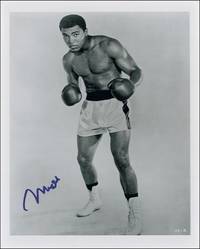
1978ref. 131531978. Ali Muhammad signed photograph documents the public image of the African American heavyweight champion whose athletic career intersected with civil rights politics antiwar dissent religious identity and twentieth-century mass media. Ali became the first fighter to win the world heavyweight championship on three separate occasions a boxing milestone confirmed by his 1978 victory over Leon Spinks and his career remains central to research on Black celebrity sports activism masculinity and political speech in the Vietnam era. Glossy photographic print undated signed in blue felt tip by Muhammad Ali. The photograph measures 8 x 10 inches and shows Ali in a pugilistic pose during his prime presenting the composed combative ring persona that shaped his public recognition beyond boxing. The quickly executed blue felt-tip signature adds autograph value while leaving the image's central focus on Ali's physical bearing as heavyweight champion and public figure. Glossy surface with no stated defects signature visible in blue felt tip near fine. Signed images of Ali in a boxing stance offer compact documentary value for collections focused on African American sports history twentieth-century protest culture celebrity and the visual construction of athletic authority. unknown books
1920ref. 604042"Jack Dempsey" in dark blue fountain pen ink on full length pose dressed in boxing outfit in a fighting stance wearing boxing gloves. Note his muscular arms. Photograph is by Woodbury L.A. with their rubberstamp on the back and is on heavy stock; 7 1/2" x 9 1/2"; very good fresh tack holes in corners; ca. 1920. Signed and inscribed: "To My Friend Frank with best wishes Jack Dempsey". unknown
1978ref. 131531978. Ali Muhammad signed photograph documents the public image of the African American heavyweight champion whose athletic career intersected with civil rights politics antiwar dissent religious identity and twentieth-century mass media. Ali became the first fighter to win the world heavyweight championship on three separate occasions a boxing milestone confirmed by his 1978 victory over Leon Spinks and his career remains central to research on Black celebrity sports activism masculinity and political speech in the Vietnam era. Glossy photographic print undated signed in blue felt tip by Muhammad Ali. The photograph measures 8 x 10 inches and shows Ali in a pugilistic pose during his prime presenting the composed combative ring persona that shaped his public recognition beyond boxing. The quickly executed blue felt-tip signature adds autograph value while leaving the image's central focus on Ali's physical bearing as heavyweight champion and public figure. Glossy surface with no stated defects signature visible in blue felt tip near fine. Signed images of Ali in a boxing stance offer compact documentary value for collections focused on African American sports history twentieth-century protest culture celebrity and the visual construction of athletic authority. unknown
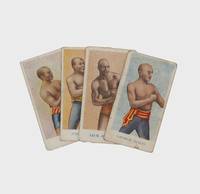
1909ref. 3787731909. Together 4 cards: Jack Johnson Joe Walcott Joe Gans and George Dixon. Approx. 1-1/2x2-3/4 inches each. Corners rounded two printed slightly offcenter other wear. Together 4 cards: Jack Johnson Joe Walcott Joe Gans and George Dixon. Approx. 1-1/2x2-3/4 inches each. unknown books
1909ref. 3787731909. Together 4 cards: Jack Johnson Joe Walcott Joe Gans and George Dixon. Approx. 1-1/2x2-3/4 inches each. Corners rounded two printed slightly offcenter other wear. Together 4 cards: Jack Johnson Joe Walcott Joe Gans and George Dixon. Approx. 1-1/2x2-3/4 inches each. unknown
ref. 1711Bruxelles, J. Degrève et Cie, s.d. [1926].Un volume In-folio (30 x 40 cm) de [1 f.], 8 pl. montées sur ff. de support. Chemise illustrée d'éditeur légèrement défraîchie sinon bon exemplaire. Planches en belle condition. Complet du feuillet d'introduction dédié à Monsieur Horta par Robert de Bendère et des 8 pl. en fac-similé offset, figurant des sportifs (coureur, escrimeur, tennisman, footballeur, boxeur, etc.).Tirage à 500 ex. num. Un des 489 exemplaires numérotés sur carton ivoire.Notre exemplaire contient en plus 7 planches en double. Ensemble de 15 planches.
ref. 1711Bruxelles, J. Degrève et Cie, s.d. [1926].Un volume In-folio (30 x 40 cm) de [1 f.], 8 pl. montées sur ff. de support. Chemise illustrée d'éditeur légèrement défraîchie sinon bon exemplaire. Planches en belle condition. Complet du feuillet d'introduction dédié à Monsieur Horta par Robert de Bendère et des 8 pl. en fac-similé offset, figurant des sportifs (coureur, escrimeur, tennisman, footballeur, boxeur, etc.).Tirage à 500 ex. num. Un des 489 exemplaires numérotés sur carton ivoire.Notre exemplaire contient en plus 7 planches en double. Ensemble de 15 planches.
1915Abundant black and white illustrations and reproductions of photos. Features: Barton's Grizzly - Well-known Western hunter and guide J. Barton sets out to single-handedly capture a live California grizzly bear (includes cover illustration); In Search of Adventure - Part IV - the story of a chequered cruise; Kidnapped - A Tale of the Burmese Border in which Sir Robert Carson retrieves his kidnapped daughter; An Interrupted Holiday - John Hawkins was tramping through Idaho in 1886; Down the Amazon From Source to Mouth - Part II - J. Campbell Besley and his party continue their journey from the source of the Amazon to the Atlantic, fighting for their lives along the way; Three Years off the Beaten Track - H.E. Weller spent three years in Northern Canada running a small steamer for the Hudson's Bay Company among fur traders and Indians - article with many interesting photos; A Prize-Fight in Mexico - amusing story of what happened when a Spaniard fought an American; Life Among the Eskimos - Clint Wiseman describes a visit he paid to these hardy little hunters of north, complete with photos; The Story of the Missing Fingers - the awful experience of Melvin Parker who fell overboard and clung to a bell-buoy for many hours in the depth of winter; Fallen Among the Theives - exciting adventures of two novice rubber-collectors in Central America, by Rowland W. Cater; Hotel-Keeping in the Wilds - two ex-members of the Cape Mounted Rifles and their hotel-keeping adventures out on the veldt; and more. pp. 9 [ads], 94, 10-32 [ads]. Clean and unmarked with moderate wear. A sound vintage copy. Book
1918ref. List3130Muskogee Oklahoma 1918. Real photo postcard measuring 3 ¼ x 5 ½ inches. A real photo postcard depicting Japanese-American boxer Young Togo inscribed verso: “To K. Iwana Muskogee Oklahoma / From Young Togo fighter and jiu jitsu wrestler Muskogee Okla”. Young Togo was a lightweight and sometimes featherweight or bantamweight boxer from Fort Smith Arkansas who debuted around 1907. He seemed to have been a popular fighter based on contemporaneous newspaper articles. Following a draw with Togo “Battling” Nelson described him as “the toughest piece of Japanese flesh that ever stepped into a prize ring” and stated that “he was game to the core. He fought clean and took his beating like a gamester” then noting that Young Togo had been “full of malaria” at the time.1 In the same article sports journalist Otto Floto described Togo as “one of the very toughest boys of his weight” who “seems to be invincible.” Togo may be Koriyama Kokichi the head coach of YūjirÅ Watanabe’s Nippon KentÅ Club founded in 1921 in Tokyo; Boxing: A Quick Guide 1923 a book written by the pair in Japanese identifies Kokichi as “Young Togo”. 1 “What Nelson Thinks Of Fort Smith Fans By Battling Nelson” Southwest American March 1 1912 5. unknown books
1918ref. List3130Muskogee Oklahoma 1918. Real photo postcard measuring 3 ¼ x 5 ½ inches. A real photo postcard depicting Japanese-American boxer Young Togo inscribed verso: “To K. Iwana Muskogee Oklahoma / From Young Togo fighter and jiu jitsu wrestler Muskogee Okla”. Young Togo was a lightweight and sometimes featherweight or bantamweight boxer from Fort Smith Arkansas who debuted around 1907. He seemed to have been a popular fighter based on contemporaneous newspaper articles. Following a draw with Togo “Battling” Nelson described him as “the toughest piece of Japanese flesh that ever stepped into a prize ring” and stated that “he was game to the core. He fought clean and took his beating like a gamester” then noting that Young Togo had been “full of malaria” at the time.1 In the same article sports journalist Otto Floto described Togo as “one of the very toughest boys of his weight” who “seems to be invincible.” Togo may be Koriyama Kokichi the head coach of YūjirÅ Watanabe’s Nippon KentÅ Club founded in 1921 in Tokyo; Boxing: A Quick Guide 1923 a book written by the pair in Japanese identifies Kokichi as “Young Togo”. 1 “What Nelson Thinks Of Fort Smith Fans By Battling Nelson” Southwest American March 1 1912 5. unknown
ref. DADAX0980139422New unknown
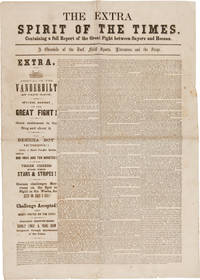
1860ref. 66827New York. 1860. Two Contemporary Accounts of the First "World Title" Match in Boxing A pair of special issue American newspapers offering "first-hand" reports on the famous Sayers-Heenan bareknuckle boxing match generally considered the sport's first international title match. As evidenced by these two papers contemporary reports of the fight vary wildly on the details but the outline appears to be as follows. John C. Heenan of California nicknamed the "Benicia Boy" travelled to England in early 1860 in order to enter the ring with the reigning champion of English pugilism Tom Sayers. The international nature of the contest attracted intense interest from both sides of the Atlantic despite the illegal nature of prize fighting. The fight took place on the morning of April 17 in front of a crowd of thousands at an "undisclosed location" in Farnborough Hampshire. The match was protracted and violent lasting over two hours and with both fighters sustaining serious injuries. The ultimate result is a point of debate but the most accepted version is that local police eventually managed to force their way into the ring and break up the unsanctioned event resulting in a draw. Together here are extra issues of two of the most prominent sports periodicals of the day the Spirit of the Times and the New York Clipper. Between them they present three different accounts of the day one in the Spirit and two different accounts in the Clipper. All three give a similar outline of the lead-up to the bout though differing in certain details. In effusive fashion they describe the machinations that went into organizing the illegal fight determining its location getting thousands of spectators "tickets to 'nowhere'" the forming of the ring the esteemed personages present and of course the betting odds. The round-by-round descriptions of the fight however differ in nearly every detail and betray a certain degree of wholesale fabrication. The Spirit of the Times is the most unapologetically pro-American claiming a complete victory for Heenan after a mere twenty-seven rounds. Their portrayal of the third round provides a succinct example of the colorful language used in these papers clearly meant to entertain the reader as much or more than to share truthful events: "3. Tom came up rather flushed and the gravy distilling from his damaged brow he dodged and tried his double but did not get home he tried a second time but was stopped cleverly and Heenan returned on the right ogle. This led to very heavy counters each on the larboard goggle Tom feinted and popped his left on the smeller. They got hold swung round broke away and Heenan then popped his left again on the right eye severe exchanges followed at close quarters and both were in the end down." The special issue of the Clipper tells a different story giving play-by-play details of forty-three rounds of bareknuckle boxing with round three ending in a knockdown by Heenan. At the end of the fight they claim that Sayer surrendered and was escorted out of the ring and declare "British 'Fair Play and May the Best Man Win' a Grand Humbug." The following page prints an account from The Bell which puts the fight at thirty-seven rounds ending with the police entering the ring. The rest of the issue is occupied by numerous other articles about the history and practice of boxing including the most recent "Rules of the Prize Ring" the history of "The Championship of England" from 1719 the "Duties of Seconds and Bottle Holders" and a full-page timeline of "Remarkable Occurrences in the Prize Ring" including a brief section on "Female Pugilists." A pair of rare antebellum sports reporting newspapers recording a legendary moment in the history of boxing. Old folds light foxing and staining minor edge wear. Some splitting to gutter of the Clipper which is uncut along the top edge. Both very good overall. For a detailed discussion of the Sayers-Heenan fight and its place in American culture see Elliott J. Gorn The Manly Art Ithaca NY 1986 pp.148-59. unknown books
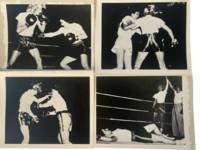
1910ref. 201861910. Women's participation in boxing long preceded formal recognition of the sport for female athletes developing through informal exhibitions training clubs and novelty bouts that challenged prevailing gender norms. Although women were largely excluded from organized boxing competitions during the nineteenth and early twentieth centuries scattered photographic evidence demonstrates that women continued to box recreationally and publicly despite social restrictions. This archive of photographs dating from the early twentieth century through the mid twentieth century documents women participating in boxing across a range of informal settings illustrating the gradual emergence of female athletic culture in a sport historically defined as masculine. Archive of sixteen black and white photographs including six silver gelatin prints and one real photo postcard measuring approximately 2.5 x 3.5 inches to 3.5 x 5.25 inches dating from the 1910s through the 1950s. The earliest image a real photo postcard dated August 1914 depicts two women wearing corsets and long dresses while sparring with boxing gloves before a mixed group of spectators. The postcard bears a pencil inscription on the verso reading "August 1914 For fun women boxers Francis Edith." Another early photograph shows two women posing with gloved fists raised before a snowy background with the inscription "Grace Miss Vandehei boxing This is Grace's roommate. A fine girl she's here now." Later photographs from the 1920s depict staged boxing encounters between a man and a woman with the female boxer dressed in athletic trousers and high heeled shoes reflecting the novelty and spectacle often associated with early female boxing exhibitions. One image shows the pair squared off with raised fists while another captures the moment of a punch landing against the man's chest. Another photograph shows two women sparring on a ship deck while surrounded by onlookers one boxer wearing a dress and curlers beneath her head covering while raising her gloved fists before a mixed audience of men and women. Boxing has historically generated controversy due to its physical intensity and female participation in the sport remained marginal for decades. Women occasionally boxed publicly as early as the eighteenth century yet organized opportunities remained rare. Women's boxing appeared briefly as a demonstration sport at the 1904 Olympic Games in St. Louis and training clubs such as Andrew Newton's Women's Boxing Club in London emerged during the 1920s. Nevertheless women's boxing did not become an official Olympic sport until the 2012 Olympic Games. The photographs in this archive illustrate the persistence of women athletes who trained and competed informally despite these restrictions offering visual evidence of women's athletic experimentation and resilience during a period of shifting gender expectations in sport. Sixteen photographs including silver gelatin prints and a real photo postcard measuring approximately 2.5 x 3.5 inches to 3.5 x 5.25 inches. Photographs clear and well preserved with light handling wear. Overall condition very good. unknown books
1860ref. 66827New York. 1860. Two Contemporary Accounts of the First "World Title" Match in Boxing A pair of special issue American newspapers offering "first-hand" reports on the famous Sayers-Heenan bareknuckle boxing match generally considered the sport's first international title match. As evidenced by these two papers contemporary reports of the fight vary wildly on the details but the outline appears to be as follows. John C. Heenan of California nicknamed the "Benicia Boy" travelled to England in early 1860 in order to enter the ring with the reigning champion of English pugilism Tom Sayers. The international nature of the contest attracted intense interest from both sides of the Atlantic despite the illegal nature of prize fighting. The fight took place on the morning of April 17 in front of a crowd of thousands at an "undisclosed location" in Farnborough Hampshire. The match was protracted and violent lasting over two hours and with both fighters sustaining serious injuries. The ultimate result is a point of debate but the most accepted version is that local police eventually managed to force their way into the ring and break up the unsanctioned event resulting in a draw. Together here are extra issues of two of the most prominent sports periodicals of the day the Spirit of the Times and the New York Clipper. Between them they present three different accounts of the day one in the Spirit and two different accounts in the Clipper. All three give a similar outline of the lead-up to the bout though differing in certain details. In effusive fashion they describe the machinations that went into organizing the illegal fight determining its location getting thousands of spectators "tickets to 'nowhere'" the forming of the ring the esteemed personages present and of course the betting odds. The round-by-round descriptions of the fight however differ in nearly every detail and betray a certain degree of wholesale fabrication. The Spirit of the Times is the most unapologetically pro-American claiming a complete victory for Heenan after a mere twenty-seven rounds. Their portrayal of the third round provides a succinct example of the colorful language used in these papers clearly meant to entertain the reader as much or more than to share truthful events: "3. Tom came up rather flushed and the gravy distilling from his damaged brow he dodged and tried his double but did not get home he tried a second time but was stopped cleverly and Heenan returned on the right ogle. This led to very heavy counters each on the larboard goggle Tom feinted and popped his left on the smeller. They got hold swung round broke away and Heenan then popped his left again on the right eye severe exchanges followed at close quarters and both were in the end down." The special issue of the Clipper tells a different story giving play-by-play details of forty-three rounds of bareknuckle boxing with round three ending in a knockdown by Heenan. At the end of the fight they claim that Sayer surrendered and was escorted out of the ring and declare "British 'Fair Play and May the Best Man Win' a Grand Humbug." The following page prints an account from The Bell which puts the fight at thirty-seven rounds ending with the police entering the ring. The rest of the issue is occupied by numerous other articles about the history and practice of boxing including the most recent "Rules of the Prize Ring" the history of "The Championship of England" from 1719 the "Duties of Seconds and Bottle Holders" and a full-page timeline of "Remarkable Occurrences in the Prize Ring" including a brief section on "Female Pugilists." A pair of rare antebellum sports reporting newspapers recording a legendary moment in the history of boxing. Old folds light foxing and staining minor edge wear. Some splitting to gutter of the Clipper which is uncut along the top edge. Both very good overall. For a detailed discussion of the Sayers-Heenan fight and its place in American culture see Elliott J. Gorn The Manly Art Ithaca NY 1986 pp.148-59. unknown