(Stamp Act) Dickinson, JohnBiblio.com
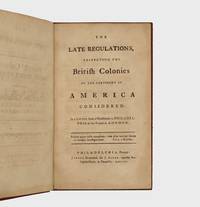
Late Regulations Respecting the British Colonies on the Continent of America Considered: In a Letter from a Gentleman in Philadelphia to his Friend in London
1766Best.-Nr. 376944London: J. Almon 1766. First English edition. 62pp. Without the terminal ad leaf. 8vo. Modern full speckled calf spine gilt red morocco label. First English edition. 62pp. Without the terminal ad leaf. 8vo. The scarce first British edition after the first edition printed in Philadelphia in December 1765 of Dickinson's first work an important tract against the Stamp Act. Here Dickinson argued against stricter trade regulations that drained the colonies of currency and warned that taxing the colonies without their consent was a step toward slavery. "Considered only as an essay in economic theory the pamphlet is notable for its discussion of paper money of flows of trade and of the mechanisms and effects of taxation are sophisticated for the time.But the essay is more than a technical treatise. Stylistically it has the vivid phraseology the dramatic exclamatory italicization and paragraphing and the aptness of illustration that would soon make Dickinson the most widely read pamphleteer in the colonies" Bailyn. This can be exemplified by the culminating section of this work in which Dickinson writes: "Late measures have indeed excited an universal and unexampled grief and indignation throughout the colonies. What man who wishes the welfare of America can view without pity without passion her restricted and almost stagnated trade with its numerous train of evils-taxes torn from her without her consent-Her legislative assemblies the principal pillars of her liberty crushed into insignificance-A formidable force established in the midst of peace to bleed her into obedience-The sacred right of trial by jury violated by the erection of arbitrary and unconstitutional jurisdictions-and general poverty discontent and despondence stretching themselves over his unoffending country" Indeed it was in the wake of the dissent following the Stamp Act that Dickinson emerged as arguably the first hero of the Revolution an important spokeman against British tyranny. His Letters from a Farmer in Pennsylvania published in 1768 would put him at the forefront of the Patriot movement and the philosophical underpinnings of that work can be found in his Late Regulations. It is widely believed that Benjamin Franklin then in London as the colonial agent for Pennsylvania arranged for the work's publication there timed with his famous testimony before the House of Commons protesting the Stamp Act. Both the Philadelphia and London first editions of Dickinson's Late Regulations are considerably more scarce than his Letters from a Farmer with only a single example of either edition appearing in the auction records in the last quarter century. American Controversy 65-5b; Howes D238; Sabin 20043; Bailyn Pamphlets of the Revolution 14 J. Almon unknown
James Cummins Bookseller · Vereinigte Staaten8.500,00 $≈ 7.579,14 €