"ARIOSTO, LODOVICO.Livre Rare Book
1 338 résultats
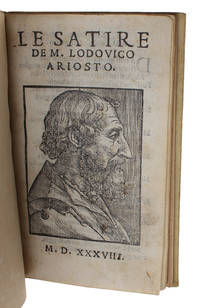
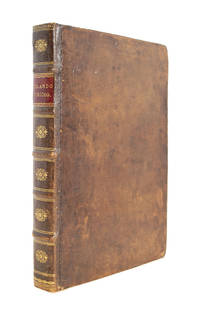
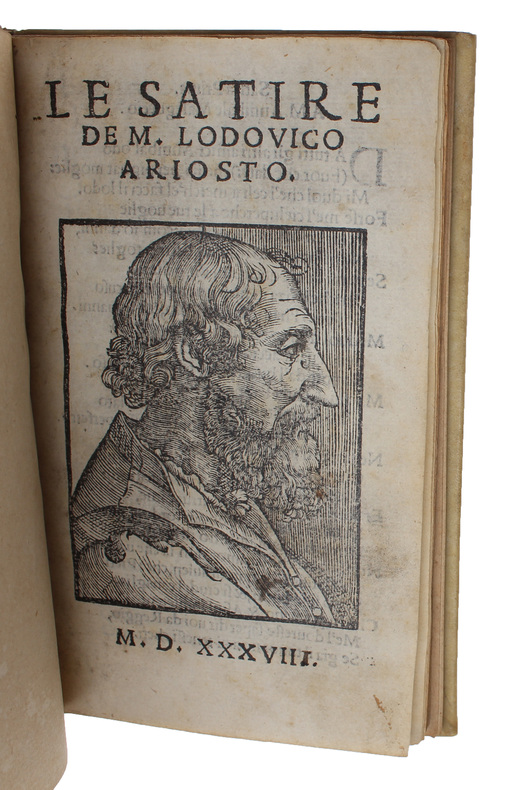
1538réf. 33452(Vinegia), 1538. Colophon: In Vinegia Nicolo d'Aristotile detto Zoppino M.D.XXXVIII. Small8vo. Fine full vellum with handwritten title on back (ca. 1850). Woodcut portrait of Ariosto on title copied after the woodcut to the edition of ""Orlando Furioso"" from 1532, which was done after Tizian by F. de Nanto. Ff. 32 (=64 pp.). Good margins, fine and clean.
1538réf. 33452Vinegia 1538. Colophon: In Vinegia Nicolo d'Aristotile detto Zoppino M.D.XXXVIII. Small8vo. Fine full vellum with handwritten title on back ca. 1850. Woodcut portrait of Ariosto on title copied after the woodcut to the edition of "Orlando Furioso" from 1532 which was done after Tizian by F. de Nanto. Ff. 32 =64 pp. Good margins fine and clean. Extremely scarce early edition first published 1532 of the Seven Satires modeled after the Sermons satires of Horats by the "Divino Lodovico". - Not in Adams the earliest edition here is from 1545 . hardcover
réf. alb81ff12cbc8715628Ariosto Ludovico. Furious Roland (in 3 books). In Russian (ask us if in doubt)/Ariosto Ludoviko. Neistovyy Roland (v 3-kh knigakh). Short description: In Russian (ask us if in doubt).Series: Family Library. Front Hall. St. Petersburg Vita Nova 2009. 624s. We have thousands of titles and often several copies of each title may be available. Please feel free to contact us for a detailed description of the copies available. SKUalb81ff12cbc8715628
1574"In-4°, (12pp), 330, (29cc), legatura in piena pergamena coeva con titolo manoscritto al dorso. Ariosto usava l'allegoria con l'esplicito scopo di dare varietà alla sua opera, così come usava i miti classici, le narrazioni medievali, le storie pie o piccanti, e molto altro ancora. La prova di questa predilezione si trova nelle Bellezze del Furioso di Orazio Toscanella, pubblicate nel 1574. In questo commento canto per canto ai punti salienti stilistici del poema, Toscanella propone che uno dei notevoli attributi artistici di Ariosto fosse quello di ""molto variare"". La capacità del poeta di variare lo stesso argomento o situazione è ben illustrata nelle descrizioni dei duelli e, in diverse occasioni, analizza le tecniche di variazione che Ariosto usa nel raccontare questi incontri. La dilatazione e l'abbreviazione, vengono esaminati per primi. Ma ancor più impressionante, secondo Toscanella, è la capacità del poeta di variare gli elementi che costituiscono la descrizione di un combattimento cavalleresco per evitare la noia che potrebbe produrre la ripetizione di tali combattimenti. L'analisi di Toscanella è piuttosto specifica. Ad esempio, mentre commenta i colpi che Marfisa, Bradamante e Ruggiero infliggono agli uomini di Marganorre nel canto 37, Toscanella classifica i mezzi per realizzare tale diversificazione: distinguendo le cavalcature, le armature, le armi o gli usi delle armi; differenziando i tipi di colpi, ferite, cadute o morti subite; concentrandosi sui diversi arti colpiti dai colpi. E Toscanella illustra come l'Ariosto modifichi questi particolari. La sua attenta analisi rende consapevoli di quanto i lettori moderni siano diventati disattenti a queste sottili alterazioni. I loro occhi tendono ad appannarsi quando incontrano questo tipo di ripetizione, nonostante le notevoli variazioni individuate da Toscanella. Eppure la capacità illimitata di Ariosto di scoprire mezzi per alterare le componenti di azioni o eventi ricorrenti potrebbe essere stata il segno distintivo della sua arte per i suoi primi lettori. A parte i duelli, tali azioni ed eventi includevano giostre formali, combattimenti su larga scala, assedi, morti, funerali e gli altri avvenimenti che segnarono la vita dei cavalieri erranti: prove di abilità, salvataggi di sfortunate vittime, viaggi, prigioni. Si ripetono, inoltre, situazioni e motivi relativi alle 'donne e amori': descrizioni di bellezze femminili, di corteggiamenti, di amanti traditi; i lamenti degli innamorati abbandonati; e così via. Daniel Javitch, The poetics of Variatio in Orlando Furioso; Francesco Sberlati, Il genere e la disputa. La poetica tra Ariosto e Tasso. In-4°, (12pp), 330, (29cc), contemporary vellum binding, with manuscript title at the spine. Ariosto used allegory with the explicit aim of giving variety to his work, much in the same way as he used classical myths, medieval narrations, pious or spicy stories, and so much more. Evidence of this predilection is found in Orazio Toscanella’s Bellezze del Furioso, published in 1574. In this canto-by-canto commentary on the poem’s stylistic highlights, Toscanella proposes that one of Ariosto’s notable artistic attributes were to ‘far variare’. He finds that the poet’s capacity to vary the same subject or situation is well illustrated in the descriptions of duels, and on several occasion, he analyzes the techniques of variation that Ariosto uses when recounting these encounters. Dilation and abbreviation, other standard school exercises, are brought up first. But even more impressive, according to Toscanella, is the poet’s ability to vary the elements that constitute the description of a knightly combat so as to avoid the boredom that the repetition of such combats could produce. Toscanella’s analysis is quite specific. For example, while commenting on the blows that Marfisa, Bradamante, and Ruggiero inflict on Marganorre’s men in canto 37, Toscanella categorizes the means to achieve such diversification: by distinguishing the mounts, armors, weapons, or uses of the weapons; by differentiating the types of blows, wounds, falls, or deaths suffered; by focusing on the different limbs struck with blows. And Toscanella illustrates how Ariosto alters these particulars. His close analysis makes one aware how inattentive modern reader have become to these subtle alterations. Their eyes tend to glaze over when they encounter this kind of repetition, despite the remarkable variations Toscanella singles out. Yet Ariosto’s limitless ability to discover means of altering the components of recurring actions or events may well have been the hallmark of his artistry for his early readers. Aside from duels, such actions and events included formal jousts, large-scale combats, sieges, deaths, funerals, and the other happenings that marked the lives of knights errant: tests of prowess, rescues of hapless victims, voyages, imprisonments. Moreover, there were repeated situations and motifs relating to ‘donne e amori’: descriptions of feminine beauty, of courtships, of lovers betrayed; the laments of abandoned lovers; and so on. Daniel Javitch, The poetics of Variatio in Orlando Furioso; Francesco Sberlati, Il genere e la disputa. La poetica tra Ariosto e Tasso. "
1532In-8°; cc. (40) grande ritratto dell’autore inciso su legno al frontespizio. Legatura in cartonato moderno. Agnelli 2, pp. 119-120
1532In-8°; cc. (32), grande ritratto dell’autore inciso su legno al frontespizio. Legatura in cartonato moderno. Edizione originale. Agnelli 2, pp. 109-110.
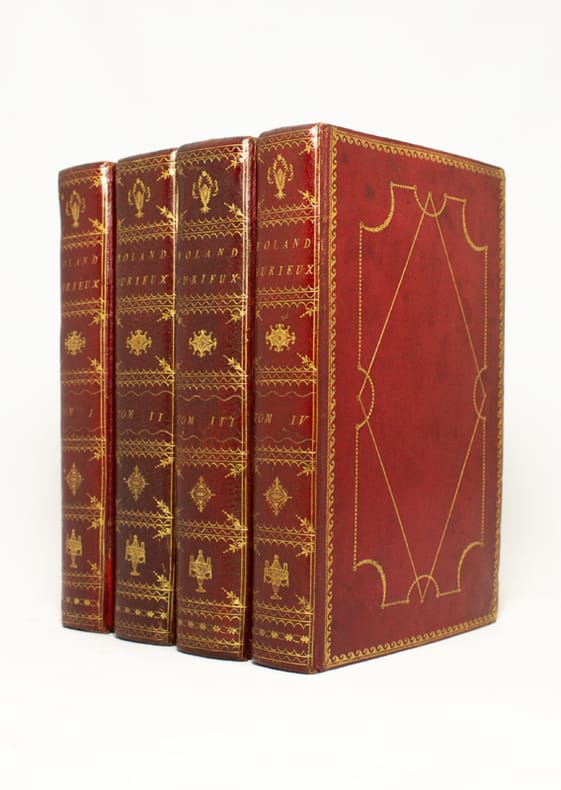
réf. 16605Paris, chez Brunet, 1775 - 1783. 4 volumes in-8 de [6]-321; [2]-391; [2]-407; 410 pages, plein maroquin rouge grenat, dos lisse orné de fleurons et dentelle dorée, plats au triple encadrement stylisé de roulettes dorées, roulettes dorées aux coupes et aux chasses, tranches dorées.
1772réf. b9006Venice: Antonio Zatta 1772 vols. 1-3 1773 vol. 4 1772. First printing of this edition . Hardcover. Near Fine. Zuliani Daniotto Baratta Leonardis Novelli engravings. Four volumes. Large 4to. Volume one: a-b xxiv LX 324; volume two: 456; volume three: 446; volume four: 520. Four engraved title-pages 58 full-page engravings within decorative ornate borders 36 smaller engravings and 51 engraved "argomenti" . Uniformly bound in sheepskin with gilt devices on the boards dark red leather spine labels and marbled endpapers. Four ribbon markers in place. All edges are stained in a coated red. Boards are somewhat soiled two small nicks on the volume-four foredge and one small nick on the volume-three foredge. Edges are somewhat mottled. Small nineteenth-century bookplates. Interiors are generally fine with occasional widely scattered foxing. Among the full-page engravings are a portrait of Ariosto the floorplan of his house and a facsimile of a holograph passage. A handsome and desirable set. Uncommon. Antonio Zatta, 1772 (vols. 1-3), 1773 (vol. 4) hardcover
1787réf. CLL-197Paris, Plassan, 1787 10 volumes petit in-12 de XII, 52pp., (2) ff., 401pp. - (4) ff., 475pp., (10)ff. - (4) ff., 503pp. - (4)ff., 527pp. - (4) ff., 452pp. - (2) ff., 34 pp., (1) f., 493 pp. - (4)ff., 493pp. - (4)ff., 507pp. - (4)ff., 465pp. - (4)ff., 595pp., maroquin vert, triple filet doré et dentelle dorée d'encadrement sur les plats, dos à nerfs ornés de caissons de fleurons dorés, coupes et bordures décorées, tranches dorées (Petit succ-r de Simier).
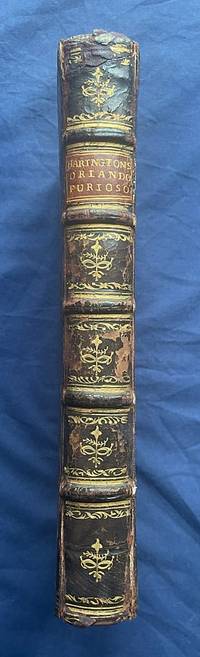
1634réf. V64647London: Miller for Parker 1634. Very Good/None. copperplates 46 full-page said to be engraved under direction of Harrington & exalting legendary Roger d'Este. Sm.4to 278x185mm contemporary ruled calf with contrasting gilt lettered label and 5 raised bands compartment nicely gilt. Blindstamp initials H.H.to covers tips worn/ some splitting to foot of spine/some scuffed and scored and some leather surface laminating. All edges speckled red. 9423pgs9 Titlepage for Epigrams dated 1633 43pp SIGNATURES of Robert Kirk 1705 to margin of Titlepage & another very fancy but faint to foot of Titlepage in the margin. Third edition of Harington's 1591 translation. The engraved title with architectural border includes portraits of Ariosto and Harrington as well as a portrait of Harington's dog Bungy in the lower left corner. Strange EPS made of sheets from a bible with bookplate of James Marquis of Carnarvon and another coat of arms bookplate to rear EP. A fine wide margined copy with well printed well inked plates and unusually thick strong paper. Crisp and clean. Referenced by: STC 2nd ed. 748 and ESTC S106834. Miller for Parker hardcover
1617réf. 1807030002In Genoua : Appresso Giuseppe Pauoni 1617. Hardcover. Good. 3 parts in one volume. Folio 31 cm. Bound in 18th century mottled calf. Gilt ruled gilt fleurons spines engraved in gilt. Front hinge cracked with chipping to joint. Internally clean and unmarked. 20 full-page engraved plates by Camillo Cungio after Bernardo Castello. Text printed in double columns. Woodcut head- and tail-pieces initials. Two portraits of Tasso and Carlo Emanuele I Duke of Savoy. Historiated initials. 16 255 1 71 1 36 4 p. The "third and grandest Tasso series". See Unglaub Poussin and the Poetics of Painting: Pictorial Narrative and the Legacy of Tasso p. 235. The illustrations differ significantly from Castello's in the Pavoni editions of 1590 and 1604. Brunet V.666; ABPC 1977; Cicognara 1:1113 In Genoua : Appresso Giuseppe Pauoni hardcover
réf. 16-6460Venetia: Appresso gli Heredi di Vincenzo Valgrisi 1580. Quarto 17.5 x 25.5 cm; bound in blond calfskin with a gilt-decorated ribbed spine 18th century; rubbed and worn. An edition of Ariosto’s epic poem printed in italics in a two-column layout. It is illustrated with 51 full-page woodcuts—each set within a handsome decorative border—and a frontispiece plate featuring a portrait of Ariosto. At the head of each canto the verse summary is enclosed within a wood-engraved frame. Foxing staining.OCLC Number / Unique Identifier:896165021: 16 654 34 pages : illustrations woodcuts ; 25 cm 4to.Con privilegio."Title within elaborate ornamental border with printer's device; printer's device also appears as title vignette on page 533 special title page to "I cinque canti""I cinque canti" has separate title page; pagination and register are continuousThe designs for the illustrations have been attributed probably falsely to Dosso DossiEach canto is preceded by a full-page woodcutSignatures: ⸠A-2V⸠2R4 signed '2S4'; 2V8 blank.Provenance: The Marquis de Saporta was an 18th-century French noble known for his personal bookplate which frequently appears as a mark of provenance in rare antiquarian and classical texts.Second provenance:.Fitzroy Fitzcharles and Fitzjames were the names bestowed by the two sons of King Charles I of England upon their illegitimate offspring. This tradition of using the prefix Fitz—which translates as "son of"—for English royal bastards continued under the Hanoverian dynasty: William IV uncle to Queen Victoria was himself the progenitor of numerous Fitzclarences.James Fitzjames 1670–1734 the fruit of the union between James II Stuart and Arabella Churchill was created Duke of Berwick by his father in 1687. Appointed a Marshal of France in 1706 he was also granted the title of Duke of Fitz-James within the French peerage by Louis XIV in 1710. His eldest son founded the Spanish branch of the Dukes of Berwick—a line that under the name Fitz-James Stuart today holds several Grandeeships of Spain including that of Duke of Alba. His younger son founded the French branch of the Dukes of Fitz-James a line that distinguished itself over seven generations until its extinction in the mid-20th century.Fitzroy Fitzcharles et Fitzjames furent les noms donnés par les deux fils du roi Charles Ier d’Angleterre à leur descendance illégitime. Cette tradition du préfixe Fitz pour les bâtards royaux anglais qui se traduit par « fils de» se poursuivra sous la dynastie des Hanovre : Guillaume IV oncle de la reine Victoria fut en son temps l’auteur de nombreux Fitzclarence …James Fitzjames 1670-1734 fruit des amours de Jacques II Stuart et d’Arabella Churchill fut titré par son père duc de Berwick en 1687. Maréchal de France en 1706 il reçut également de Louis XIV le titre de duc de Fitz-James dans la pairie française en 1710. Son fils ainé est l’auteur de la branche espagnole des ducs de Berwick qui sous le nom de Fitz-James Stuart cumule aujourd’hui plusieurs grandesses d’Espagne dont celle de duc d’Albe. Son fils cadet est l’auteur de la branche française des ducs de Fitz-James qui s’illustra pendant sept générations jusqu’à son extinction au milieu du XXe siècle. Venetia: Appresso gli Heredi di Vincenzo Valgrisi, 1580 unknown
1556réf. 19212In Lione, Apresso Bastiano di Bartholomeo Honorati, 1556. Grand in-8 de 508-[42] pages, plein veau brun, dos à nerfs orné de filets et fleurons dorés.
1634réf. 69070London: Printed by G. Miller for J. Parker 1634. HARRINGTON John. . Orlando Furioso. in English Heroical Verse by Sir John Harrington of Bath Knight. Now thirdly revised and amended with the Addition of the Author's Epigrams. London: Printed by G. Miller for J. Parker 1634. Full Description: ARIOSTO Lodovico. HARRINGTON John translator. Orlando Furioso in English Heroical Verse by Sir John Harrington of Bath Knight. Now thirdly revised and amended with the Addition of the Author's Epigrams. London: Printed by G. Miller for J. Parker 1634. Third edition of Harrington's 1591 translation which was the first English edition and remained the only English translation of many years. This third edition is further expanded by the addition of the "Author's Epigrams." Two works in one small folio in sixes 10 5/8 x 7 1/4 inches; 270 x 185 mm. 16 1 Ads 1 plate 423 9 table 1 Title 1 blank 43 1 blank pp. With engraved title-page for the first work and 46 full-page engravings included in the pagination accompanying each Canto. Separate title-page for "Epigrams" with an engraved vignette. Epigrams have a separate title but continuous register. Elaborate engraved head and tail pieces and initials. Contemporary full calf rebacked to style. Spine with red morocco spine label lettered in gilt. Spine stamped in gilt. All edges speckled red. Newer endpapers Fore-edge margins are trimmed close a few times just touching printed marginal notes. Closed tear to bottom margin of S1 barley touching a few letters. T6 with a tear to fore-edge margin with a bit of loss to marginal note. Some various dampstains and other soiling throughout. Some minor occasional offsetting from plates. Overall a very good copy. "Lodovico Ariosto represented the sentiments the passions and the vices and virtues of 16th-century Italians in his epic poem L'Orlando Furioso The Crazy Orlando. This Renaissance classic based on romances popular at the time furnished the framework for the chivalric narrative in Edmund Spenser's The Faerie Queene. Orlando Furioso is a tale of knights dames and courtesies when the Moors invaded France to avenge the death of their king's father. In the story Orlando Roland Charlemagne's nephew and most famous knight falls madly in love with Angelica who is also pursued by many other Christian and Moorish knights. She flees these attentions only to bestow her love in the end on a poor man without rank. Ariosto's view of life reflected throughout the poem is one of ironic disillusionment-love is madness. John Harington 1561-1612 was a witty courtier and godson of Queen Elizabeth. He is also the acknowledged inventor of the flush toilet. According to lore Harington first translated the racy tale of Jocundo from Canto XXVIII and circulated it among the ladies of the Court. The Queen feigned to be shocked by some passages and reprimanded her godson for endangering the morals of her maids of honor. Elizabeth sentenced Harington to stay away from the Court until he had translated the whole of Ariosto's poem. Harington completed the translation by 1591. Harington's Orlando Furioso is one of the major translations of the age freely executed but faithful to the spirit and style of the original. At 33000 lines in length and nearly 6000 lines shorter than the original the translation is seldom exactly what Ariosto wrote shorter in places and expanded elsewhere-with moral truisms added. Each of the forty-six cantos of the poem is preceded by a full-page illustration including the especially risqué one for Canto XXVIII. All are copied strictly or with slight variation from the plates used by Girolamo Porro in a Venice edition printed in 1584. The engravings are unsigned purportedly the work of several engravers including possibly Jodocus Hondius. Clark Library UCLA Chrzanowski 1607a : Regarding the 1607 Second edition. STC 748. Pforzheimer 447. HBS 69070. $3000. Printed by G. Miller for J. Parker unknown
1634réf. 69070London: Printed by G. Miller for J. Parker 1634. HARRINGTON John. . Orlando Furioso. in English Heroical Verse by Sir John Harrington of Bath Knight. Now thirdly revised and amended with the Addition of the Author's Epigrams. London: Printed by G. Miller for J. Parker 1634. Full Description: ARIOSTO Lodovico. HARRINGTON John translator. Orlando Furioso in English Heroical Verse by Sir John Harrington of Bath Knight. Now thirdly revised and amended with the Addition of the Author's Epigrams. London: Printed by G. Miller for J. Parker 1634. Third edition of Harrington's 1591 translation which was the first English edition and remained the only English translation of many years. This third edition is further expanded by the addition of the "Author's Epigrams." Two works in one small folio in sixes 10 5/8 x 7 1/4 inches; 270 x 185 mm. 16 1 Ads 1 plate 423 9 table 1 Title 1 blank 43 1 blank pp. With engraved title-page for the first work and 46 full-page engravings included in the pagination accompanying each Canto. Separate title-page for "Epigrams" with an engraved vignette. Epigrams have a separate title but continuous register. Elaborate engraved head and tail pieces and initials. Contemporary full calf rebacked to style. Spine with red morocco spine label lettered in gilt. Spine stamped in gilt. All edges speckled red. Newer endpapers Fore-edge margins are trimmed close a few times just touching printed marginal notes. Closed tear to bottom margin of S1 barley touching a few letters. T6 with a tear to fore-edge margin with a bit of loss to marginal note. Some various dampstains and other soiling throughout. Some minor occasional offsetting from plates. Overall a very good copy. "Lodovico Ariosto represented the sentiments the passions and the vices and virtues of 16th-century Italians in his epic poem L'Orlando Furioso The Crazy Orlando. This Renaissance classic based on romances popular at the time furnished the framework for the chivalric narrative in Edmund Spenser's The Faerie Queene. Orlando Furioso is a tale of knights dames and courtesies when the Moors invaded France to avenge the death of their king's father. In the story Orlando Roland Charlemagne's nephew and most famous knight falls madly in love with Angelica who is also pursued by many other Christian and Moorish knights. She flees these attentions only to bestow her love in the end on a poor man without rank. Ariosto's view of life reflected throughout the poem is one of ironic disillusionment-love is madness. John Harington 1561-1612 was a witty courtier and godson of Queen Elizabeth. He is also the acknowledged inventor of the flush toilet. According to lore Harington first translated the racy tale of Jocundo from Canto XXVIII and circulated it among the ladies of the Court. The Queen feigned to be shocked by some passages and reprimanded her godson for endangering the morals of her maids of honor. Elizabeth sentenced Harington to stay away from the Court until he had translated the whole of Ariosto's poem. Harington completed the translation by 1591. Harington's Orlando Furioso is one of the major translations of the age freely executed but faithful to the spirit and style of the original. At 33000 lines in length and nearly 6000 lines shorter than the original the translation is seldom exactly what Ariosto wrote shorter in places and expanded elsewhere-with moral truisms added. Each of the forty-six cantos of the poem is preceded by a full-page illustration including the especially risqué one for Canto XXVIII. All are copied strictly or with slight variation from the plates used by Girolamo Porro in a Venice edition printed in 1584. The engravings are unsigned purportedly the work of several engravers including possibly Jodocus Hondius. Clark Library UCLA Chrzanowski 1607a : Regarding the 1607 Second edition. STC 748. Pforzheimer 447. HBS 69070. $3000. Printed by G. Miller for J. Parker unknown books
réf. 3603Bellezze del Furioso di M. Lodouico Ariosto; scielte da Oratio Toscanella: con gli argomenti, et allegorie de i canti: con l'allegorie de i nomi proprii principali dell'opera: et co i luochi communi dell'autore, per ordine di alfabeto; del medesimo Pubblicazione In Venetia : appresso Pietro de i Franceschi, & nepoti, 1574 (In Venetia : appresso Pietro de i Franceschi, & nepoti, 1574)
17734 volumi in-4, bella legatura coeva in piena pelle, riquadro di filetti in oro ai piatti, titolo e fregi in oro ai dorsi. Illustrati da 1 ritratto dell'A. di Eisen inc. da Fiquet e 46 figure in stupende tavole fuori testo, di Cipriani, Cochin, Eisen, Greuze, Monnet, Moreau incise da Bartolozzi, Choffard, Duclos, ed altri. Celebre edizione dell'Orlando Furioso. Ottimo esemplare.. .
1775réf. 87791775 A Paris, chez Brunet, Libraire [Laporte pour le volume IV], 1775-1783, deux tomes en quatre volumes, in-4°, 21 x 26,5 cm. I tome: [4] + 222 pp. + 1 portrait + 23 figures / II tome: [2] + 223-388 + 23 figures / [2] + 283 + [1 bl] pp.+ 24 figures / tome IV: [4] + 287-567 + [1 bl] pp. + 22 figures; toutes les gravures sont protégées par des serpentes. Reliure en basane finement marbrée, triple filet doré sur le plat, dos orné à 5 nerfs, pièce de titre et de tomaison en maroquin vert, tranches dorées. Bas des charnières du tome I endommagées, petits accrocs à la coiffe du tome II, exemplaire autrement en très bon état; intérieur parfaitement propre.
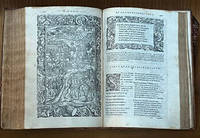
1580réf. 75291580 In Venetia: Appresso gli Heredi di Vincenzo Valgrisi, 1580. Deux parties en un vol. in-4: 18,5 x 26 cm. 8 ff. n. chiff. de pièce lim., 654 pp. de texte du Orlando et des Cinque Canti, 16 ff. n. chiff. de table. Nouvelle impression de la célèbre édition du Roland Furieux de l'Arioste imprimée pour la première fois chez Valgrisi en 1556 et illustrée des figures communément attribées à Dosso Dossi. (Brunet, I, 434). Édition établie par Girolamo Ruscelli. Volume illustré de 51 figures hors-texte finement gravés sur bois (46 pour l'Orlando et 5 supplémentaires pour les Cinque Canti). Parmis les nombreuses éditions illustrée de l'arioste, l'édition Valgrisi est la première à confier à l'illustration une place si importante, en effet, chaque chant est précédé d'une grande figure qui résume en image la narration. Reliure légèrement postérieure en veau brun. Dos à cin nerfs avec titre en capitales dorées et caissons aux petits fers. Tranches mouchetées. Reliure uniformément frottée. Mors de pied légèrement fendu, cependant ouvrage solide. Petit travail de vers discret dans la marge inférieure des derniers feuillets et dans la marge latérale des pages 525 à 542. Pale rousseurs aux premiers ff., sinon papier extrêmement frais. Un bijou d'impression.
1603réf. 18663Venetia: Vencenzo Valgrifi 1603. A very early printing of the complete and corrected ORLANDO FURIOSO also with the Life of Ariosto by Battista Pigna. Letters tables and scholarly critical works by Ruscelli and others. Magnificently illustrated with 51 full-page woodcut engravings within ornate borders using the blocks from the first Valgrisi quarto edition of 1556 46 in the ORLANDO 5 additional in the appended “Cinque Canti” also with engraved architectural titlepage imprint set in type in a cartouche in the lower part of the border type ornament with the title medallion portrait of Ariosto from the Giolito portrait of 1542 from the profile by Titian devices of Ariosto and Valgrisi’s serpent device half titles and beautifully engraved decorated large head and tail pieces and large historiated and arabesqe capital initials printed in double column Italic. 4to full antique Italian vellum over stiff boards spine with terra-cotta morocco label lettered and decorated in gilt. 8 A - Z8; Aa - Vv8; ie xvi 654 32. A very handsome copy in proper period binding. The paper just likely mellowed and toned by time very occasionally headlines slightly shaved first gathering cropped a bit the vellum very well preserved sturdy and handsome. RARE AND EARLY ILLUSTRATED PRINTING OF ONE OF THE FOUR CORNERSTONES OF ITALIAN LITERATURE. Ariosto’s great cantos inspired by the crusades are considered his crowning achievement. Though first published in 1516 Ariosto considered this edition incomplete and imperfect. He continued to work on correcting and enlarging it throughout the remainder of his life thus the first “complete” ORLANDO FURIOSO was not produced till 1532 the year prior to the author’s death by consumption. The extraordinary merits of this work cast into oblivion the numberless romantic poetry which inundated Italy during this period. This flawless work powerful elegant and cultivated. In description and narrative he excites the reader’s deepest feelings and displays a vivacity of fancy with which no other poet can vie. ‘The ORLANDO blocks were cut for Valgrisi’s first quarto edition of 1556 and follow Niccolo Zoppino’s idea of providing one illustration to each canto but going far beyond the Zoppino blocks in skill of design and cutting. They are the first full-page illustrations for Ariosto. They were placed in the instructive tradition of the Marcolini Dante the illustration is mentioned on the title-page and at the beginning of Ruscelli’s 1556 dedication to Alfonso d’Este Duke of Ferrara. Ruscelli explains to the reader the application of the rules of perspective to the multiple scenes in these cuts. The upper part of the block often becomes a map offering as Philip Hofer notes a tour of the canto by hippogryph. Valgrisi’s artist often varied from Giolito’s in his choice of the principal scene for illustration and relegated the Giolito subjects to his background. Valgrisi’s blocks are printed within borders with figures and grotesques. He was able to use the same blocks without borders in an octavo of 1556 for the popular market. There are two different border designs for the illustrations and two smaller cherub borders for the “argomento” to each canto.’ Vencenzo Valgrifi hardcover
1772réf. 018555Venezia: Zatta 1772-73. Quattro volumi in 4to 20x29 cm rilegati in piena pelle coeva dorso a nervi ornato e dorato con tassello di titolo vede; risguardie con carta marmorizzata blu notte; tagli azzurri. Spellature alla superficie dei piatti; difetto al piede del primo volume con mancanza di pelle ma nel complesso bella legatura settecentesca di pregevole fattura. Vol 1: 18-LX-300pp21 tavole compresa antiporta e ritratto dell'Ariosto inciso da Giuseppe Daniotto. Vol 2: di 214pp13 tavole. Vol 3: di 206pp 14 tavole. Vol 4: di 280pp 12 tavole. Ampi margini e stampa di notevole nitidezza. Nel totale 4 pagine di frontespizi calcografici 58 incisioni a pagina intera 36 incisioni di dimensioni minori 51 argomenti riquadrati con testo inciso agli inizi dei canti 46 canti 5 canti rivisti 20 tra testatine e finalini incisi. Incisioni di Giuliano Zuliani Tommaso Baratti Ferdinando Fambrini Giacomo Malosso e altri su soggetti di Pietro Antonio Novelli ecc. In fine al vol. 4: La presente opera fu corretta dall'illustr. sig. ab. D. Leonardo Marcellotto e ricorretta dal sig. Antonio Cilis. Contiene anche al vol 1: "Vita di msr. Lodovico Ariosto riveduta e accresciuta per la terza volta e di annotazioni non poco aumentata ." di Giovanni Andrea Barotti. Uno dei più famosi e raffinati libri illustrati del 700 opera dello Zatta in ottime condizioni. Zatta unknown
1542réf. 173105Venetia: Appresso Gabriel Iolito di Ferrari 1542. Leather bound. Good front hinge weaker than rear hinge wear to extremities text block and pages clean and tight. Full red leather with elaborate gilt embossed design front and back reeded gilt edges to covers five raised bands with gilt devices in compartments and applied leather label. All edges gilt with impressed cross design on all three text block edges. Ancient marbled endpapers with bookplate of Olin Lane Merriam on inside front pastedown. 260 xx leaves collated complete title page within engraved architectural border text with 46 woodcut engravings and engraved initial at beginning of each canto in text wood-engraved oval bust portrait of Ariosto on verso of leaf 260; unpaginated 20-leaf commentary by Lodovico Dolce has its own title page with wood-engraved vignette of phoenix rising at center of title page and verso of last leaf. This is the first complete printing with the "Espositione di tutti i vocaboli et luoghi difficili . con vna brieue dimostratione di molte comparationi & sentenze dall' Ariosto in diuersi autori imitate / raccolte da M. Lodovico Dolce" 20 leaves at end has special t.p." at rear after portrait. A lovely example in an exceptional binding. Similar copy sold for 5000 Euro in 2016. Appresso Gabriel Iolito di Ferrari hardcover
1542réf. 173105Venetia: Appresso Gabriel Iolito di Ferrari 1542. Leather bound. Good front hinge weaker than rear hinge wear to extremities text block and pages clean and tight. Full red leather with elaborate gilt embossed design front and back reeded gilt edges to covers five raised bands with gilt devices in compartments and applied leather label. All edges gilt with impressed cross design on all three text block edges. Ancient marbled endpapers with bookplate of Olin Lane Merriam on inside front pastedown. 260 xx leaves collated complete title page within engraved architectural border text with 46 woodcut engravings and engraved initial at beginning of each canto in text wood-engraved oval bust portrait of Ariosto on verso of leaf 260; unpaginated 20-leaf commentary by Lodovico Dolce has its own title page with wood-engraved vignette of phoenix rising at center of title page and verso of last leaf. This is the first complete printing with the "Espositione di tutti i vocaboli et luoghi difficili . con vna brieue dimostratione di molte comparationi & sentenze dall' Ariosto in diuersi autori imitate / raccolte da M. Lodovico Dolce" 20 leaves at end has special t.p." at rear after portrait. A lovely example in an exceptional binding. Similar copy sold for 5000 Euro in 2016. Appresso Gabriel Iolito di Ferrari hardcover books
1795réf. (LCPCLIT-0012)(Le "Orlando Furioso" de l'Arioste, avec une double suite de gravures, conservé dans une élégante reliure en maroquin du temps) ARIOSTO Ludovico. (Reggio Emilia, 1474 - Ferrara, 1533) "ORLANDO FURIOSO". 1795, Parigi, P. Plessan. 4 volumes in-fol. (323x245 mm) (dimensions pages 313x237 mm) I: (1) f. (portrait de l'Arioste), LXXIX, (1), 360 pp.; II: 452 pp.; III: 448 pp.; IV: 452 pp. 92 planches h.t., y compris le portrait de l'Arioste au frontispice, gravé sur cuivre par Fiquet d'après Eisen. Elégante reliure de l'époque en maroquin vert. Encadrement de triple filet doré sur les plats. Dos à cinq nerfs avec fleurons, décorations et titres dorés. Filet doré sur les coupes et dentelle intérieure dorée. Tranches dorées. Gardes de papier décoré. "L'Orlando furioso è un poema cavalleresco in ottave, a schema ABABABCC, strutturato su 46 canti, per un totale di 38.736 versi nell'edizione definitiva del 1532. Vi sono infatti due edizioni precedenti, scritte con una lingua più popolare e rozza. In particolare, una prima redazione dell'Orlando furioso, in 40 canti, era stata redatta nel 1515 e venne pubblicata nel 1516. La seconda edizione uscì nel 1521, caratterizzata da una lieve revisione linguistica. L'opera ha una trama molto stratificata che si sviluppa sostanzialmente su tre narrazioni principali: quella militare, costituita dalla guerra tra paladini, difensori della religione cristiana, e i saraceni infedeli; quella amorosa, incentrata sula fuga di Angelica e sulla pazzia di Orlando, e infine quella encomiastica, con cui si lodava la grandezza dei duchi d'Este, dedicata invece alle vicende amorose tra la cristiana Bradamante e il saraceno Ruggiero. L'Orlando furioso si propone come il naturale prosieguo dell'Orlando innamorato di Matteo Maria Boiaro; Ariosto continuò la narrazione proprio dove Boiardo la interruppe, facendo evolvere la vicenda amorosa tra Angelica e Orlando che, a causa del rifiuto dell'amata, diviene furioso, pazzo per amore". (Wikipedia) Très jolie édition. Exemplaire enrichi d'une double suite de gravures: celle de Cochin, en premier tirage, et celle de Moreau le jeune, Eisen et Monnet, réalisée pour l'édition de Birmingham de 1773. Exemplaire imprimé sur papier de Hollande, à marges immenses, quelques fois non rognées. Petits frottements à la coiffe inférieure et petit coup sur le second plat du premier tome. Quelques rousseurs, surtout aux marges des planches et plus fortes sur quelques cartes. Deux gravures du t. III avec des rousseurs plus fortes. Provenance: Ex Libris Fumach (XXe siècle). (Cohen, p. 98) (LCPCLIT-0012) (4.800,00 €) (Tous les livres provenant d'Italie possèdent la licence d'exportation