ARIOSTO, LodovicoBiblio.com
Orlando furioso.
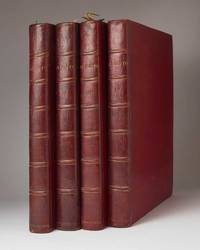
1773Best.-Nr. 21246051773. Birmingham: John Baskerville for Pietro and Giovanni Claudio Molini. 1773. Four vols 4to. Contemporary red straight-grained morocco boards filleted in gilt spine gilt-ruled in compartments and lettered directly in gilt raised bands edges gilt board-edges with a single gilt fillet turn-ins roll-tooled in gilt marbled endpapers green silk place-markers; I: pp. vi lviii 362 with copper-engraved portrait frontispiece by Etienne Fiquet after Charles Eisen and a further 12 copper-engraved plates; II: pp. ii 450 with 11 copper-engraved plates; III: pp. ii 446 with 12 copper-engraved plates; IV: pp. ii 446 26 list of subscribers with 11 copper-engraved plates issued without errata leaf 52 as usual; light variable foxing and browning slight offset from plates vol. II with marginal paperflaw to H2; generally a very good crisp set in a well-preserved and unrestored binding with all the cancels called for by Gaskell; nineteenth-century ink inscriptions to vol. I frontispiece verso in two hands 'coll: perf: H. Drury. Harrow.' and 'LARGE PAPER. C. 153.3. from Queen Charlotte's Collection where it was bought 1819. bound by Roger Payne' see below; recent bookseller's tickets to front pastedowns.The dedication copy of John Baskerville's Orlando furioso a handsomely bound large-paper copy from the library of Queen Charlotte later in the possession of Lord Byron's tutor and friend Henry Drury with an uncensored plate defaced by the disgruntled engraver.Among the most accomplished productions of the Baskerville Press this edition of Ariosto's epic poem was commissioned by the brothers Giovanni Claudio c. 1724-c. 1812 and Pietro Molini c. 1730-1806 members of a prominent Florentine family of publishers and booksellers active in Italy France and England. Pietro who styled himself 'Librajo dell'Accademia Reale' at Haymarket is documented in London from at least 1769 - when he acted as the London representative for the Livorno edition of the Encyclopedie 1770-79 - to 1795. In his preface Pietro Molini emphasises the correctness of the text partly based on Francesco de Franceschi's 1584 Venetian edition the diligence of its printer the 'notissimo Giovanni Baskerville' and the collaboration of 'the most celebrated artists of London and Paris' trans. This is followed by a detailed life of Ariosto by Giovanni Andrea Barotti 1701-1772 a scholar from Ferrara whose edition of the complete works of the poet first published in 1741 was among the first to draw on the poet's autograph manuscript rather than relying solely on printed sources. Baskerville appears to have printed the letterpress in 1770 while the copperplates were completed by 1774. Each of the forty-six cantos opens with a facing engraving the illustrations signed by twenty-one artists and engravers active in London and Paris. The designers include Giovanni Battista Cipriani Jean-Michel Moreau le Jeune Charles-Nicolas Cochin Charles Monnet and Jean-Baptiste Greuze. The result was widely admired. Dibdin described it as the finest edition of Ariosto known to him: 'Paper printing drawing plates - all delight the eye and gratify the heart of the thorough-bred bibliomaniacal virtuoso. This edition has hardly its equal and certainly not its superior in any publication with which I am acquainted' pp. 758-59. This copy features an early uncensored state of the plate to Canto XLIII engraved by Francesco Bartolozzi 1727-1815 after Giovanni Battista Cipriani. Apparently exasperated by delays and insults from Molini - who 'one day in a passion called him an ass a poltroon an animal' Benton p. 42. Bartolozzi defaced his own work incising on the tomb of the Saracen knight Brandimarte the words 'd'asino de poltrone d'animale' removed in subsequent states cf. the Princeton copy.Ariosto dedicated his Orlando furioso to Cardinal Ippolito d'Este 1479-1520 son of Ercole I d'Este Duke of Ferrara. While centred on the paladin Orlando and his unrequited love for the pagan princess Angelica - which drives him mad - the poem interweaves multiple narrative strands within a famously complex episodic structure. Among these are the trials leading to the union of Ruggiero - a pagan knight descended from Hector - and the Christian knight heroine Bradamante culminating in Ruggiero's conversion and their marriage. From this union Ariosto mythically derives the House of Este. In his dedication to Queen Charlotte Molini explicitly draws on this genealogy invoking the 'heroes of the most glorious House of Este from which the august progenitors of your royal consort trace their origin who did not have to envy Achilles Homer nor Augustus Virgil' trans. This alludes to the eleventh-century union of Alberto Azzo II founder of the House of Este and Kunigunde of Altdorf whose son Welf I founded the younger House of Welf ancestors of the dukes of Brunswick and the Hanoverian monarchs of Britain. This dynastic connection had long played a role in the political and genealogical self-fashioning of the House of Hanover. In 1676 Sophia of Hanover mother of George I commissioned genealogical research to substantiate the traditional claim that her house descended from the Este through the Welf line. These investigations established that the House of Hanover could also claim English royal descent through Mathilda of England daughter of Henry II. Molini thus constructs a deliberate bridge between Ariosto's original Este dedication and the British royal family linking the poem's chivalric mythology to the lineage of George III and his consort.An avid reader from an early age Queen Charlotte began to form a substantial personal library after her marriage to George III in 1761. Initially housed in London her collection was later moved to Windsor Castle increasingly used as a royal residence from the mid-1770s and partly to Frogmore House which was expanded to accommodate the growing collection. In 1803 the Queen appointed Edward Harding 1755-1840 as her personal librarian at Frogmore a position he held until her death. The 1819 Christie's sale catalogue records over 4500 titles in German French Italian and English mostly recent publications.The King and Queen head the long list of subscribers to the Baskerville Orlando George III's copy is now in the King's Library at the British Library; see Bibliothecae regiae catalogus vol. I p. 123. This list forms a veritable 'who's who' of eighteenth-century Britain including aristocrats artists writers and booksellers. Among the most notable subscribers are Johann Christian Bach 1735-1782 Edmund Burke 1729-1797 David Garrick 1716-1779 and Joshua Reynolds 1723-1792. Several women are also included among them Society hostess Margaret Clive Baroness Clive nee Maskelyne 1735-1817 sculptor Anne Seymour Damer nee Conway 1748-1828 and Susanna Leveson-Gower Marchioness of Stafford nee Stewart 1742-1805 one of the most influential women in eighteenth-century British politics. The list extends internationally including subscribers from France Spain the Netherlands Russia Germany and Italy. In Naples appear Sir William Hamilton 1730-1803 British envoy and antiquarian and the architect Luigi Vanvitelli 1700-1773. The subscription price was four guineas or louis d'or with the plates.Following Queen Charlotte's death her Baskerville Orlando furioso was sold at auction with the rest of her books and personal effects an event that gave rise to a national scandal; after passing through the London trade this copy was acquired by Henry Drury classical scholar and assistant master at Harrow School from 1801 until his death serving as master of the lower school from 1833 to 1841. He was also a member of the Roxburghe Club and Fellow of the Royal Society. Among his many friends were Dibdin Drury appears in his Bibliographical Decameron and Lord Byron who stayed in his house at Harrow and later corresponded with him 'in affectionate terms and without much regard to the propriety later thought usual to preserve in a correspondence with a clergyman' ODNB. Drury's vast library including numerous Greek and Latin classics was dispersed in 4729 lots by Robert Harding Evans in a sale lasting twenty-three days in 1827 and a second by Christie & Manson in 1841 after his death. Although the binding has been attributed to Roger Payne he is not known to have bound for the Royal family; however 'he strongly influenced many who did more particularly Christian Samuel Kalthoeber who bound many of the books in the King's Library at the British Museum' Davenport p. 91. Provenance:1. Charlotte of Mecklenburg-Strelitz Queen Consort of Great Britain and Ireland r. 1761-1818; her sale Christie's 9 June-16 July 1819 lot 1766 '4 vol. 4to. Cuojo turch. Birm. 1773'. 2. Evidently bought at Queen Charlotte's sale by the bookseller and publisher Robert Triphook 1781/2-1868 active on St James's Street c. 1809 and on Old Bond Street from 1815 to 1825 no. 2648 'Ariosto . large paper fine impressions of plates red morocco gilt leaves . The Queen's Copy' listed for PS12 in the supplement to his Catalogue for 1819 of Rare Books in Various Languages.3. Henry Joseph Thomas 'Harry' Drury 1778-1841 bibliophile Harrow master and friend and correspondent of Lord Byron; his sale R. H. Evans 19 February-23 March 1827 lot 339 'Ariosto L. Orlando Furioso 4 vol. LARGE PAPER. Plates by Bartolozzi &c. red morocco gilt leaves Queen Charlotte's copy Birmingham Baskerville 1773' sold for PS10 10s see The Classical Journal vol. xxxvi Sept.-Dec. 1827 p. 145.4. The booksellers Dulau and Co. at 37 Soho Square 'Valuable and Choice Works' in Bent's Literary Adviser September 1842 'ARIOSTO . large paper . red morocco by Roger Payne . From the Collection of Queen Charlotte' listed for PS11 11s.Brunet I col. 438 'belle edition' Cohen-de Ricci 95 'Tres belle edition' Gaskell 48b; Graesse I p. 199 this copy 'Drury' mentioned in note; ESTC T133620; Lowndes I p. 61 this copy 'Drury' mentioned in note; Ray French 64. See Benton John Baskerville 1914; Davenport Royal English Bookbindings 1896; Dibdin The Library Companion 1824; Schellenberg Book Illustration in the Long Eighteenth Century 2015. hardcover
Henry Sotheran Ltd. · Vereinigtes Königreich20.000,00 £≈ 23.886,88 €