BOCCACCIO, GiovanniBiblio.com
3.120 resultados
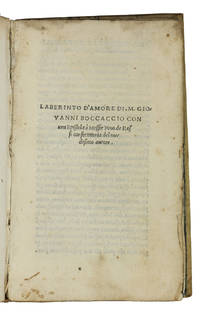
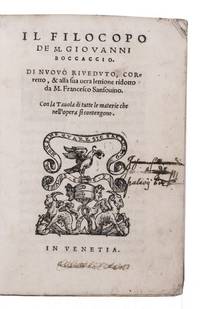
1554ref. L1NFVE7U6EX8Venice: device of Domenico Giglio colophon: Francesco Rampazetto 1554. Contemporary limp vellum sewn on 3 alum-tawed supports laced through the joints with manuscript title down the spine in rotunda gothic lettering 6 mm x-height with decorated capitals: Filocopo del Boccaccio. Small 8vo 15 x 11 cm. With Giglios woodcut device a bird with a scorpion in its beak above a pot with DG above 2 winged sea-goats with motto non sine quare sic facio and N.S.C.C.F. on the title-page 6 woodcut decorated initials 3 series plus 2 repeats. Set in Aldine-style italic types with upright capitals with incidental roman. Second Sansovino edition of Boccaccio's first important work Il Filocolo here Filocopo a prose romance written ca. 1334-1336 about twenty years before the Decameron. Boccaccio reworked the 12th-century French love story of Floire Florio muslim Prince of Andalusia and Blancheflor Biancifiore the orphaned daughter of his mother's Roman Christian lady-in-waiting. They grow up together in the royal household but when they fall in love his parents try to break up the romance by selling her to merchants who will take her to Alexandria to join a harem. Florio under the pseudonym Filocopo rescues and marries her. He converts to Christianity and they return home where he ascends the throne and his people embrace Christianity. Boccaccio introduced many new elements into the story and told it with his usual flare for often risqué humour. It served as inspiration for writers around the world from Chaucer to Keats and Boccaccio himself further developed several episodes for stories in his Decameron.Francesco Sansovino 1521-1583 had produced the first variorum edition of the Decameron in 1546 and then turned his editorial scholarship to Il Filocolo beginning with Gaetano's text editions in 1527 and 1538. With 2 early owners' inscriptions on the title-page both struck through and part of one abraded. With a small hole in the title-page and the corners of a few leaves dog-eared but otherwise internally in very good condition. The binding is worn but the lovely manuscript title on the spine remains clear. Second edition of the best Renaissance redaction of Boccaccio's important influential and entertaining first major work.l EDIT 16 6334; Gay & Lemonnyer col. 726; USTC 814845; cf. Gamba Italiana letteratura 198 cr. other eds.; for the text: Kirkham et al. eds. Boccaccio: a critical guide pp. 87-93; Marrone Encyclopedia of Italian literary studies pp. 252-253. [device of Domenico Giglio] (colophon: Francesco Rampazetto, hardcover
1777ref. 57147A Londres ma Parigi: s.n. 1777-79. Dieci volumi di cm. 185 pp. 2.500 ca. complessive. Con frontespizio illustrato al primo volume dieci antiporta e 100 tavole f.t. incise da Vidal su invenzione di Boucher. Solida ed affascinante legatura coeva in pieno marocchino rosso con fleuron in oro al centro dei piatti entro elaborata bordura perimetrale in oro a motivi floreali a fitomorfi. Dorsi lisci con fitti fregi e titoli. Tagli dorati. Esemplare genuino e marginoso con solo qualche limitato segno d'uso. Celebre edizione della traduzione francese del "Decamerone" impreziosita dalle belle tavole di Boucher. Cfr. Cohen De Ricci 161 e Bacchi della Lega p. 68. s.n. unknown
1777Dieci volumi di cm. 18,5, pp. 2.500 ca. complessive. Con frontespizio illustrato al primo volume, dieci antiporta e 100 tavole f.t. incise da Vidal su invenzione di Boucher. Solida ed affascinante legatura coeva in pieno marocchino rosso con fleuron in oro al centro dei piatti entro elaborata bordura perimetrale in oro a motivi floreali a fitomorfi. Dorsi lisci con fitti fregi e titoli. Tagli dorati. Esemplare genuino e marginoso con solo qualche limitato segno d'uso. Celebre edizione della traduzione francese del "Decamerone" impreziosita dalle belle tavole di Boucher.. Cfr. Cohen De Ricci, 161 e Bacchi della Lega p. 68.
1768ref. (LCPCLIT-0028)(Le Boccace du Comte d'Eu, conservé dans une reliure en maroquin de l'époque à ses armoiries dorées) BOCCACE Jean. (Certaldo, 1313-1375) "IL DECAMERONE". 1768, Paris, Prault. 3 volumes in-12° (144x88 mm) (dimensions pages 139x81 mm) I : (2) ff., (1 portrait de Boccace en frontispice par Demoutart et 1 titre gravé par Aveline, d'après Moreau), XXIV pp. (vie de Boccace, introduction et table), 490 pp., (1) f. b. ; II : (1) f. (titre), 471, (1) pp. ; III : (1) f. (titre), 443, (1) pp. (I : (2) ff., a8, b4, A-V12, X6 ; II : (1) f., A-T12, V8 ; III : (1) f., A-S12, T6) Reliure armoriée de l'époque en maroquin rouge. Triple filet doré d'encadrement sur les plats et armoiries dorées au centre. Dos lisses avec fleurons et décorations dorés et pièce de titre en maroquin vert. Filet doré sur les coupes. Roulette intérieure dorée. Tranches dorées. Gardes de papier décoré. Jolie édition. Petites et habiles réféctions des coiffes supérieures et des coins. Quelques légères brunissures éparses, mais bel exemplaire. Provenance : Très rare exemplaire aux armoiries dorées de Louis-Charles de Bourbon (1701-1775), Prince de Dombes, Duc d'Aumale et de Gisors, Comte d'Eu et de Dreux, Prince d'Anet et Baron de Sceaux. Cinquième des sept enfants du Duc du Maine (Louis-Auguste de Bourbon, bâtard de Louis XIV et de Mme de Montespan) et de Louise-Bénédicte de Bourbon-Condé. Chevalier des Ordres du Roi (1728), Duc d'Aumale et Comte d'Eu (1736), il succéda à son frère aîné Louis-Auguste II de Bourbon et devint Grand Maître de l'artillerie de France. Célibataire et sans enfants, son cousin le Duc de Penthièvre hérita de toute sa fortune. Ex libris manuscrit sur chaque titre "S. Smith". (O.H.R., planche 2606, fer n° 12) (LCPCLIT-0028) (2.500,00 €)
ref. 8794Londres, 1779. 10 volumes in-8 (200 x 122 mm). Veau raciné, dentelle d'encadrement doré sur les plats, dos lisse orné, pièce de titre et de tomaison en maroquin rouge, roulettes dorées sur les coupes et les chasses, tranches dorées, des petites restaurations (reliure de l'époque).
ref. 15619Paris, Librairie des bibliophiles, 1873. 5 tomes en 4 volumes in-12, plein maroquin brun, dos à nerfs janséniste, décor aux coupes, tranches dorées sur jaspe, encadrement de maroquin de même couleur sur les gardes, orné d'un large dentelle dorée, ex-libris d'André Villet (reliure signée Marius Michel).
1885Two volumes, complete. A WONDERFUL SET OF THE RARE PRIVATELY-PRINTED CATALOGUE OF ONE OF THE GREAT PRIVATE COLLECTIONS OF BOOKS AND MANUSCRIPTS. 590; 8, 616 pp. Extensively indexed. Beautifully printed on fine wove paper, with ample margins. Horace de Landau (1824-1903) was the extremely successful representative of the House of Rothschild in Constantinople, Turin, and Florence, and amassed a library of about 90,000 volumes. This catalogue describes, thoroughly and with great precision, thousands of the most important. 4to. Beautifully bound in contemporary half morocco and marbled boards (volume I) and recent quarter vellum and marbled boards (volume II). ENTIRELY UNCUT. Light wear to extremities of volume I, else FINE AND BRIGHT. A rare and beautiful catalogue.
1551ref. 0006English description below. Venise, imprimé par Rapirio et Cesano, 1551. Rarissime première édition d'Il Filocopo de Boccace édité par Francesco Sansovino. En italien. Un épais in-12 de 160 x 110 mm pour 50 mm d'épaisseur et 390 pp. Relié plein vélin d'époque. Plats muets à l'exception d'une mention à la plume quasi effacée sur le plat avant. Dos à trois coutures plus tranchefiles, mention "Gio Boccaccio il Filicopo" (sic) ancienne, étiquette papier ancienne en coiffe avec inscriptions à la plume. Ex-libris au premier contreplat, extrémités des cordelettes de couture apparentes aux contreplats, mentions à la plume sur deux gardes blanches, page de titre, dédicace de F. Sansovino à Vitellozo Vitelli. Lettrines, indication du livre en haut de page. Table des matières en fin d'ouvrage. "Boccace a revisité l'histoire d'amour française du XIIe siècle de Floire (Florio), prince musulman d'Andalousie, et Blancheflor (Biancifiore), la fille orpheline de la dame d'honneur romaine chrétienne de sa mère. Ils grandissent ensemble dans la maison royale, mais lorsqu'ils tombent amoureux, les parents de la jeune femme tentent de mettre fin à leur romance en la vendant à des marchands qui l'emmèneront à Alexandrie pour la faire entrer dans un harem. Florio, sous le pseudonyme de Filocopo, la sauve et l'épouse. Il se convertit au christianisme et ils rentrent en Andalousie, où il monte sur le trône et convertit son peuple au christianisme. Boccace a introduit de nombreux éléments nouveaux dans l'histoire et l'a racontée avec son sens habituel de l'humour (souvent osé). Il a servi d'inspiration à des écrivains du monde entier, de Chaucer à Keats, et Boccace lui-même a développé plusieurs épisodes pour des histoires dans son Décaméron. Francesco Sansovino (1521-1583) avait produit la première édition variorum du Décaméron en 1546, puis avait tourné son érudition éditoriale vers Il Filocopo, en commençant par le texte de Gaetano (éditions en 1527 et 1538)." Provenance : bibliothèque de Caio de Mello Franco, ambassadeur du Brésil en France, dont l'ex-libris figure au contreplat. ********************** Venice, printed by Rapirio and Cesano, 1551. Extremely rare first edition of Boccaccio's Il Filocopo by Francesco Sansovino. In Italian. A thick duodecimo, 160 x 110 mm, 50 mm thick, and 390 pp. Bound in original full vellum. Blank covers except for a nearly erased pen-and-ink inscription on the front cover. Spine with three seams plus headbands, old inscription "Gio Boccaccio il Filicopo" (sic), old paper label at the end with pen-and-ink inscriptions. Bookplate on the front cover, ends of the stitching cords visible on the inside covers, pen-and-ink inscriptions on two blank endpapers, title page, dedication from F. Sansovino to Vitellozo Vitelli. Initials, book name at the top of the page. Table of contents at the end of the book. "Boccaccio revisited the 12th-century French love story of Floire (Florio), a Muslim prince of Andalusia, and Blancheflor (Biancifiore), the orphaned daughter of his mother's Christian Roman lady-in-waiting. They grow up together in the royal household, but when they fall in love, the young woman's parents try to end their romance by selling her to merchants who will take her to Alexandria to enter a harem. Florio, under the pseudonym Filocopo, rescues and marries her. He converts to Christianity, and they return to Andalusia, where he ascends the throne and converts its people to Christianity. He himself developed several episodes for stories in his Decameron. Francesco Sansovino (1521–1583) had produced the first variorum edition of the Decameron in 1546 and then turned his editorial scholarship to Il Filocopo, beginning with the text of Gaetano (editions in 1527 and 1538)." Provenance: personal library of Caio de Mello Franco, Brazilian ambassador to France, whose bookplate appears on the inside cover.
1550ref. CLL-600Venise, Giolito de' Ferrari, 1550 In-4 de (6)ff., 502pp., 1 f. bl., (30)ff., 1 f. bl., sign.: *6, A-HH8, II4, a4, b-d8, e4, veau raciné havane, filet à froid d'encadrement sur les plats, dos à nerfs orné de caissons de fleurons dorés, pièce de titre de maroquin rouge, roulette dorée sur les coupes, tranches rouges (reliure du XVIIIesiècle).
1520ref. 11557J. Gourmont & J. Petit Paris 1520 1520. Opb 4° 109s. Fraktur. fachmännisch restauriert am Ende des Buches restaurierte Fehlstellen mit geringem Textverlust. sonst in gutem Zustand AZA8 SL2. HC J. Gourmont & J. Petit, Paris 1520 (?), unknown
ref. 34084Florence. Philippo di Giunta. 1517& 1521. Hardcover. Fine. 12mo. 15cm 1st issue of the 5th edition foliated pagination110/94pp. head & tail decoration in volume two in lather full brown calf real raised bands faded gilt spine decorations in the panelshinges expertly restored without title page as issued with imprints on the final leaf a fine copy. cgc Adams B-2125. Gamba 100. Each volume is complete including the two original uncorrected leaves in "Ameto". The first issue has Boccacio for Boccaccio on title of volume two and the variant reading on f.2 line 21. The gilt decorations date the bindings to 18th or 19th centuries. Florence. Philippo di Giunta. 1517& 1521 hardcover
1525ref. L7UBM2B5YKM6Florence 1525. 8vo. heirs of Filippo Giunta the elder Contemporary sheepskin parchment with remains of a gold-tooled spine label dark blue edges. 72 ll. Second Giunta edition of the "Corbaccio" which first appeared in 1487 and was first and similarly anonymously printed by Filippo Giunta in 1516: "una materiale ristampa di questa edizione fatta pagina a pagina e riga a riga" Gamba; "ces deux editions sont assez rares" Brunet. This bawdy satire supposedly based on a Florentine widow who turned down Boccaccio was as popular as it remains controversial for its scurrilous and misogynistic elements. The text is prefixed by a letter from Filippo Giuntas son Bernardo "agli amatori della lingua Toscana"; leaves 57ff. contain Boccaccios letter to Pino di Rossi.With the engraved bookplate of Lord Robert Spencer 1747-1831 British Whig politician on the front paste-down. The youngest son of Charles Spencer 3rd Duke of Marlborough the hero of the Seven Years War Lord Robert was the nephew of the politician John Spencer 5th paternal great grandfather of Diana Princess of Wales and brother of George Spencer the great-great-great grandfather of Sir Winston Churchill. Occasional light brown stains and slight traces of worming to the foot margins of the first two leaves but altogether in very good condition. A charming example of a rare and desirable edition.l Adams B2182; Bandini Juntarum typographiae annales II 199; Brunet I 1016; Edit 16 CNCE 6267; Gamba 203 note; Panzer VII 40f 219; Renouard Supplément p. XLIX no. 79; WorldCat 612050557; cf. Hayn/Gotendorf I 398 citing later Italian eds.; not in BMC STC Italian. unknown
1757ref. 114589Londres Paris: Prault 1757-61. One of the masterpieces of the illustrated book A fine edition illustrated in large part by Gravelot: "one of the most accomplished illustrated books of the 18th century" Cohen-de Ricci 158-61; "one of the masterpieces of the illustrated book" Ray 15. The imprint is false; the book was published in Paris by Prault. The French translation is by Antoine Jean Le Maçon. Prault published an Italian version the same year with the same illustrations which is dated 1757 throughout and is usually regarded as taking precedence. 5 vols octavo 197 x 125 mm. Engraved portrait frontispiece title pages 110 plates engraved en-têtes engraved cartouches and 97 culs-de-lampe by Lemire Legrand and others after Gravelot Boucher Eisen and Cochin. Text in French. Contemporary French mottled calf smooth spines gilt in compartments green morocco double labels sides with triple gilt rule boards turn-ins decoratively gilt comb-marbled endpapers gilt edges. Contemporary ownership inscriptions to binder's blanks; wood-engraved bookplates of Bibl. Hammer Stockholm. A little wear to headcaps corners worn internally clean and fresh a very good set. hardcover
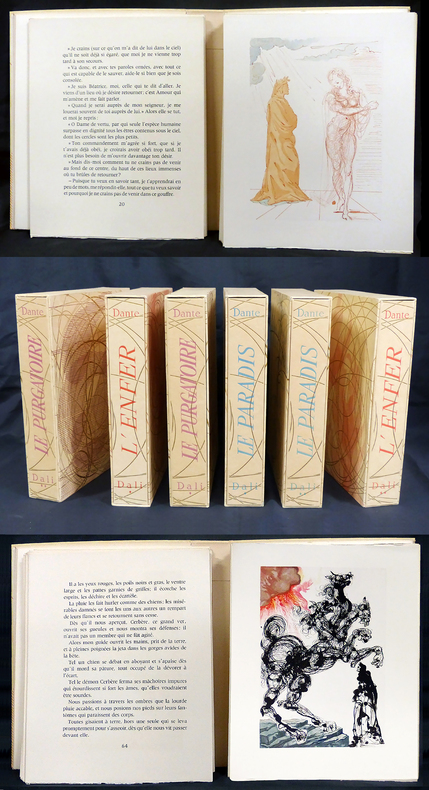
1963ref. 1371Les Heures Claires, Paris 1959-1963. 6 volumes in-folio (34 x 26 cm) en feuilles sous couvertures imprimées rempliées, chemises et étuis décorés de l'éditeur. 100 AQUARELLES ORIGINALES HORS-TEXTE DE SALVADOR DALI GRAVÉES SUR BOIS EN COULEURS par Raymond Jacquet. - Exemplaire : 1 des 3900 ex. numérotés sur pur chiffon de Rives filigrané. Les 6 ouvrages sont en excellent état et bien complets des 100 gravures et des 3 doubles-feuillets de justification numérotés. Les planches belles aux couleurs lumineuses. Les emboîtages sont en excellent état de conservation.
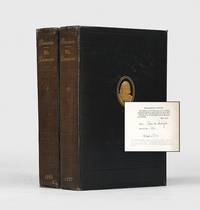
1925ref. 164153New York: Boni & Liveright 1925. With Tice's original etchings First Tice edition signed limited issue this copy uniquely if erratically illustrated with the issued halftone plates replaced with Tice's original hand-captioned etchings and three of Tice's expurgated illustrations in two states one of which not called for in the list of illustrations. This is number 334 of 2000 copies signed by the publisher this copy is unusual in being also signed by Tice. Several of the explicit erotic illustrations Tice produced for this work were deemed too risqué for general publication and Tice was asked to redraw them for the final edition; some of them were never issued. This set includes three of these ribald plates alongside their censored replacements. We were able to trace only one other set with a number of these illustrations included though in that copy they were halftone reproductions rather than original etchings as here. A deluxe issue of 12 sets with etchings was also produced and we have traced only one copy of it in auction records. The etchings in this set are hand-captioned by Tice with page numbers that differ from both their location and the printed illustration list suggesting that they may have been produced for Tice's own reference when working on the book's production. The set is accompanied by a suite of the removed halftone illustrations and a second set of 22 of the 48 illustrations as etchings these uncaptioned excepting one captioned p. 36. One of the etchings is in two states: one with Tice's pencil signature the other with the signature engraved. Clara Tice 1888-1973 was a notorious New York bohemian artist known as "the Queen of Greenwich Village". She was according to the New York Times the first woman in New York to bob her hair and she began exhibiting her work there from 1910 rising to prominence in 1915 when the Society for the Prevention of Vice attempted to confiscate her works which were on show at the bohemian restaurant Polly's. "Tice was apparently so highly regarded and so instantly recognizable as one of those 'queer artists' that her role in the first Greenwich Village Follies was simply to play herself. As 'Clara' she stepped out onto the stage at the appointed time outfitted in one of her typically bizarre bohemian ensembles and conducted a 'quick chalk talk of nudes bees and butterflies'" Keller p. 429. Throughout the 1920s she contributed to Vanity Fair and other magazines and illustrated several books such as this with her softly erotic illustrations. 2 vols quarto. halftone frontispieces 2 halftone plates 48 etched plates the majority hand-captioned by Tice of which 3 are in two states. Folding box with 22 additional etchings and 44 halftone illustrations. Original black cloth spines lettered in gilt covers blocked in blind front covers with gilt oval portrait of Boccaccio as centrepiece yapp edges largely uncut. Additional etchings and halftone illustrations in a repurposed green leather folding box labelled "Balzac's Droll Stories". Spines uniformly faded cloth lightly rubbed couple of corners worn splits to inner hinges remaining firm occasional browning or faint marks to margins generally clean with the plates in strong impression. A very good copy. Marie T. Keller "Clara Tice 'Queen of Greenwich Village'" Women in Dada ed. by Naomi Sawelson-Gorse 2001. hardcover
1538ref. 16624Paris, [Pierre Sergent], 1538. In-8 gothique (15 x 9 cm) de (8)-196 ff. (sign. Ø8, A-X8, AA-CC8, DD4), veau tabac, dos orné à nerfs, triple filet doré d’encadrement sur les plats, tranches dorées (Koehler).
1539ref. 65731Bern, Matthias Apiarius, 1539. Fol. Mit 2 versch. Holzschn.-Druckermarken (am Titel u. dem letzten Blatt, eine von Hans Holbein) u. 15 (dav. 2 wiederh.) fast halbseitigen Textholzschnitten (davon 9 monogrammiert J[akob] K[allenberg]). 6 nn., LXXXI num., 1 nn. Bll., Blauer Kleisterpapier-Bd. d. 18. Jhds. m. Farbschnitt in mod. blauer Maroquin-Kassette m. goldgepr. Rückentitel.
1497ref. 2109090007Venetiis: Venice: Manfredus de Bonellis de Monteferrato 1497. Hardcover. Good. Incunable Folio 33 cm. Bound in handsome modern 1/4 oasis goatskin over wooden boards. Linen-silk end joints. Front board is older wood and has the remnants of the metal claps. 152 leaves of 161 called for. Lacking gathering g and h1 9 leaves. 62 63 lines to a page. Engraved letters. 12 engraved genealogical plates. Title page washed and with minor professional restoration work. Some minor staining primarily to colophon page. Early marginalia. Includes a related letter with an old invoice and details of the restoration work from M.A. Thornton of Traditional Bookcrafts Wigtown Scotland. Refs: Hain/Copinger 3324. Pell-Pol 2470. Pol 713. IGI 1801. BMC V 504 IB. 23825. Goff B 754. IBP 1090. CIH 700. Sander 1078. Essling 800. Second illustrated edition a reprint of the ed. by Octavianus Scotus in 1494. Venice: Manfredus de Bonellis, de Monteferrato hardcover
1614ref. 35097Venetia: Appresso Alessandro Vecchi 1614. An excellent and early Venetian edition of Boccaccio's masterpiece. Illustrated with an engraved title-page engraved head- and tailpieces an engraved portrait of Boccaccio and 109 engraved illustrations throughout historiated multi-line capital letters throughout. Quarto 20.5 x 15 cm. handsomely bound in contemporary Italian vellum the spine with gilt titling to the tan coloured lettering label. 28 603 pp. A beautiful copy without any repairs or sophistication at all. The text-block is clean and crisp the illustrations are all in good order the binding is tight and strong and shows only very minimal evidence of use or wear. An occasional flaw to the paper originating with the printer and a very few marks from damp typical and not affecting the quality of the copy. AN IMPORTANT PRINTING OF BOCCACCIO'S MASTERPIECE. The 1614 edition of Giovanni Boccaccio’s Il Decameron published by Alessandro Vecchi in Venice is a notable printing of the famous 14th-century text highly valued today by rare book collectors and literary historians. This printing utilizes the famous linguistic revision edited by Lionardo Salviati which was originally published in 1582. Following the Catholic Church's censorship and banning of the Decameron in the mid-16th century Salviati provided the avenue to preserving Boccaccio’s celebrated Tuscan prose style. The edition features 109 woodcut illustrations embedded directly within the text. Rather than cutting entirely new blocks Vecchi reused the highly regarded Renaissance woodcuts originally crafted for Gabriel Giolito’s 1546 edition which was famous for its visual storytelling. To introduce the readers to each section each individual novella begins with an engraved vignette with an additional prominent illustration highlighting the beginning of the tenth day. The title page features the distinct printer's device belonging to Alessandro Vecchi's Venetian workshop. During this era Venice was the printing capital of Europe and printers like Vecchi found great commercial success by combining popular texts with woodblocks from previous decades. Vecchi actually published a few iterations of this specific setup over the years—including printings in 1597 and 1602—making the 1614 edition part of a successful multi-decade run of Boccaccio's masterpieces The result found in Vecchi's 1614 printing is a fascinating historical artifact: a Decameron that remains delightfully scandalous and linguistically beautiful but one where the Catholic Church’s authority has been thoroughly protected from Boccaccio's sharpest wit. See UArizona S.Illinois et al. Appresso Alessandro Vecchi hardcover
1614ref. 78341614 In Venetia : Alessandro Vecchi, 1614. In-8 : 15 x 21 cm, 12 ff. n. chiff. de pièces lim. y c, titre, 603 pp. de texte. Très belle édition vénitienne du Décaméron de Boccace illustrée dun portrait de lauteur et de 109 figures gravées sur bois dans le texte, certaines rehaussées dépoque en couleurs.Les bois sont ceux utilisés pour lédition de Giolito en 1546. Le texte, quant à lui, est celui établi par Leonardo Salviati parut 1582. Reliure en vélin doré de lépoque. Titre et date (erronée) manuscrits postérieurement au dos. Dos habilement restauré. Rares rousseurs.
ref. 6497Londres [Paris], 1757. 5 volumes in-12 (114 x 181 mm). Maroquin rouge, triple filet doré encadrant les plats, dos à nerfs orné, filet doré sur les coupes, roulette dorée sur les chasses, tranches dorées, quelques cahiers roussis, trait à l'encre très fin touchant la planche en regard de la page 203 du tome 2 (reliure de de l'époque).
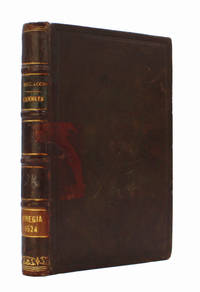
1524ref. 8801Venetia: Bernardino di Vitale 1524. First Edition Primera edición. Hardcover Tapa dura. 156x104mm. 6¼x4". Venetia Bernardino di Vitale 1524. En 8º 156 x 104mm. 116 hojas sin foliar la última blanca. Signaturas 4 B-O8 P-Q4. Marca del impresor en la última hoja de texto. Encuadernación del siglo diecinueve en piel tejuelo en marroquén cortes dorados de antiguo. Atractivo ejemplar de esta rarísima edición de La Fiammetta de Boccaccio desconocida a todos los repertorios bibliográficos consultados. Esta elegía de Madonna Fiammetta narra en primera persona sus desventuras y está considerada como la primera novela "psicológica". Escrita entre 1343 y 1344 la obra se presenta como una larga carta escrita en la que la protagonista Fiammetta relata su amor juvenil por Pánfilo en la ciudad de Nápoles. La relación entre ambos termina cuando Pánfilo debe partir a Florencia. Fiammetta sintiéndose abandonada por su amante intenta suicidarse. Al final de la obra la protagonista se siente de nuevo esperanzada cuando oye que Pánfilo ha regresado a la ciudad pero descubre con amargura que se trata de otra persona con el mismo nombre. La obra es dedicada por el autor «a las mujeres enamoradas». Obra con un importante componente autobiográfico. Giovanni Boccaccio 1313-1375 es uno de los padres de la literatura en italiano junto a Dante y Petrarca. Es recordado sobre todo como autor del Decamerón libro esencial para introducir en la literatura europea el género de la novela corta. Se trata de una edición desconocida a todos los repertorios consultados: no en Brunet ni Graesse ni Adams. OCLC no registra esta edición tampoco CCPB STL Italian Books ni BnF. Sólo lo registra el Catálogo del Servizio Bibliotecario Nazionale de Italia SBN código identificativo ITICCUCNCE006262. Aparece citada en Mostra di manoscritti documenti e edizioni Certaldo 1975 v. 2 n. 60. Contiene al fin la bella marca tipográfica de veneciano Bernardino di Vitale activo impresor italiano del que se conocen más de 150 impresiones entre los años 1493 a 1539. Triángulo con las iniciales TDG y seis estrellas en su interior. Buen jemplar generalmente limpio y de buenos márgenes muy ligera mancha en el margen exterior de los últimos folios por lo demás perfecto. Procedencia: Filiciano Ramírez de Arellano Marqués de Fuensanta del Valle. Su ex-libris. Uno de los más importantes bibliófilos españoles del siglo diecinueve Bernardino di Vitale hardcover
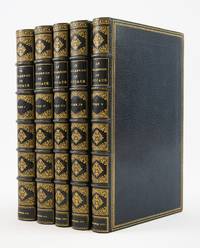
1757ref. ST20210Londres i.e. Paris: Prault 1757-61. 205 x 132 mm. 8 x 5 1/4". Five volumes. Translated by Antoine Jean Le Maçon. LOVELY INDIGO CRUSHED MOROCCO GILT BY DAVID stamp-signed on front turn-in covers with French fillet border raised bands spine compartments with intricate central fleuron and scrolling cornerpieces gilt lettering turn-ins with multiple decorative rolls marbled endpapers all edges gilt. Housed in a maroon buckram chemise in a matching morocco-backed slipcase. Engraved illustrated title page in each volume 110 engraved chapter headings and 205 ENGRAVED ILLUSTRATIONS BY GRAVELOT AND OTHERS 110 of these plates and 95 tailpiece vignettes. A Large Paper Copy. Cohen-de Ricci 160-61; Ray 15; Furstenberg 26. A couple of boards with trivial chafing isolated faint foxing occasional minor marginal smudges touching text on a couple of pages but A VERY FINE SET clean and fresh internally with spacious margins and in sparkling bindings with virtually no signs of wear. This is an elegantly bound and unusually well-preserved copy of one of the most famous and charming illustrated books of the 18th century a work frequently regarded as the supreme example of refined libertine illustration of the period. Owen Holloway calls it one of the four masterpieces of book illustration at the end of the Rococo period. Ray too is expansive in his praise calling the work simply "one of the masterpieces of the illustrated book." The publisher first released this work in Italian in 1757 with the present edition following later the same year. Although he had as collaborators on this work some of the outstanding French artists of the 18th century Gravelot born Hubert-François-Bourguignon 1699-1773 was chiefly responsible for its production designing 89 of its 111 plates and all 97 of its immensely delightful tailpieces. In this the most ambitious undertaking of his career Gravelot gave Boccaccio's narrative the settings and costumes of 18th century France and this transposition Ray tells us "made it possible for him to exercise his special talent for depicting the social world around him. For the most part his figures are young the women graceful and pretty the men lithe and handsome." But "all levels of life are presented from the peasant in his hovel to the king in his palace. Every variety of interior is there from boudoirs and bedrooms to dining rooms and salons. Animated street scenes alternate with glimpses of gardens and farms forests and river banks. The human condition has rarely been so attractively displayed." Our copy is particularly pleasing: it is in fine condition with wide generous margins and was bound in rich indigo morocco by David. Parisian binder Bernard David 1824-95 worked under Pfister Dompierre Lortic and Gruel before striking out on his own to establish a very high reputation in the trade. His bindery was taken over by his son Salvador in 1890. Prault] unknown
1757ref. ST20210Londres i.e. Paris: Prault 1757-61. 205 x 132 mm. 8 x 5 1/4". Five volumes. Translated by Antoine Jean Le Maçon. LOVELY INDIGO CRUSHED MOROCCO GILT BY DAVID stamp-signed on front turn-in covers with French fillet border raised bands spine compartments with intricate central fleuron and scrolling cornerpieces gilt lettering turn-ins with multiple decorative rolls marbled endpapers all edges gilt. Housed in a maroon buckram chemise in a matching morocco-backed slipcase. Engraved illustrated title page in each volume 110 engraved chapter headings and 205 ENGRAVED ILLUSTRATIONS BY GRAVELOT AND OTHERS 110 of these plates and 95 tailpiece vignettes. A Large Paper Copy. Cohen-de Ricci 160-61; Ray 15; Furstenberg 26. A couple of boards with trivial chafing isolated faint foxing occasional minor marginal smudges touching text on a couple of pages but A VERY FINE SET clean and fresh internally with spacious margins and in sparkling bindings with virtually no signs of wear. This is an elegantly bound and unusually well-preserved copy of one of the most famous and charming illustrated books of the 18th century a work frequently regarded as the supreme example of refined libertine illustration of the period. Owen Holloway calls it one of the four masterpieces of book illustration at the end of the Rococo period. Ray too is expansive in his praise calling the work simply "one of the masterpieces of the illustrated book." The publisher first released this work in Italian in 1757 with the present edition following later the same year. Although he had as collaborators on this work some of the outstanding French artists of the 18th century Gravelot born Hubert-François-Bourguignon 1699-1773 was chiefly responsible for its production designing 89 of its 111 plates and all 97 of its immensely delightful tailpieces. In this the most ambitious undertaking of his career Gravelot gave Boccaccio's narrative the settings and costumes of 18th century France and this transposition Ray tells us "made it possible for him to exercise his special talent for depicting the social world around him. For the most part his figures are young the women graceful and pretty the men lithe and handsome." But "all levels of life are presented from the peasant in his hovel to the king in his palace. Every variety of interior is there from boudoirs and bedrooms to dining rooms and salons. Animated street scenes alternate with glimpses of gardens and farms forests and river banks. The human condition has rarely been so attractively displayed." Our copy is particularly pleasing: it is in fine condition with wide generous margins and was bound in rich indigo morocco by David. Parisian binder Bernard David 1824-95 worked under Pfister Dompierre Lortic and Gruel before striking out on his own to establish a very high reputation in the trade. His bindery was taken over by his son Salvador in 1890. Prault] unknown books
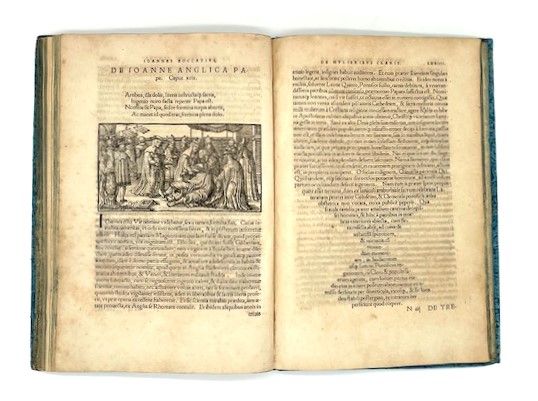
1539ref. 33106-1153Bern Mathias Apiarius 1539. With 15 near half-page woodcuts including 2 repeats of which 9 are signed Jakob Kallenberg 2 different printer's woodcut device on title and last leaf honey-licking bears one by H. Holbein. 6 LXXXI 1 ff. Small folio. 18th-century calf worn. From the library of G. Wüthrich with his engr. supralibros. Bern Mathias Apiarius 1539. Bound with: MAZZOCCHI Giacomo ed. Epigrammata antiquae urbis. With 21 woodcut illustrations of classical architecture and inscriptions including large depiction of the Pantheon on B2v more than 100 woodcut borders in text. Roman type. 10 CLXXXI leaves further 8 ff. with index and errate lacking at the end. Folio. Rome Jacobus Mazzocchi April 1521. Ad I: First edition of the earliest books from the press of the first printer of Bern and a beautifully illustrated edition of Boccaccio's encomium of famous women. It is notable as the first collection devoted exclusively to biographies of women in Western literature. The artist has been identified as Jakob Kallenberg a Bavarian painter and craftsman from Bern who worked there from 1535 until about 1565 and became a member of the city council. His style is reminiscent of Holbein whose pupil he probably was. Several of these cuts are also extant on broadside publications or loose sheets. The satirical cut of Pope Joan f. LXXIIIv giving birth during a procession surrounded by cardinals is here in perfect state whereas it is often either missing or mutilated.- 18th cent. ms. owner's entry on title-page otherwise a nice copy. Ad II: First edition of the first printed collection of classical inscriptions an anthology of ancient Roman epigraphs and the most beautiful book from the press of the famous Roman printer Mazzocchi active 1505- 1527. His work is import as one of the earliest humanist studies on epigraphy and valuable for its profuse woodcut illustrations. There are woodcuts of art and architecture of ancient Rome including the Pantheon triumphal arches the "Three Graces" and other reliefers and steles; about 80 cartouches of varying design frame the inscriptions and 7 full-page woodcut borders are on black ground. The work has been attributed to one of Mazzocchi's humanist friends Francesco Albertini the great scholar of Roman antiquities. This publication was a determining factor in the development of Roman studies in the 16th century and is the first collection of classical inscriptions from the city of Rome. - Last 8 ff. index and errata lacking 18th cent. ms. owner's entry on title-page otherwise fine. - Ad I: Fairfax Murray 78; VD 16 B 5814; Adams B 2141; Hollstein XVB p. 206 nos.1-15; ad II: Cicognara 3789; Sander 2554; Fumagalli p. 339-342 fig. 142; Coszena III 2251; Mortimer Italian 297; EDIT16 CNCE 18162; Adams E 236. GRAPHIC ARTS:ILLUSTRATED BOOKS ; SWITZERLAND ; ITALY ; Bern, Mathias Apiarius unknown