Blake, TomBiblio.com
12 380 résultats
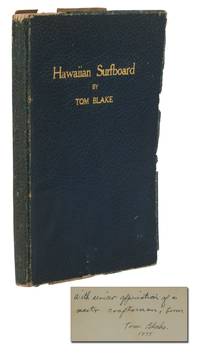
1935réf. 140945466Honolulu: Paradise of the Pacific Press 1935. First Edition. Very Good. First edition first printing. Signed by Tom Blake and inscribed in the year of publication "with sincere appreciation of a master craftsman from Tom Blake 1935". In 200 Years of Surfing Literature an Annotated Bibliography by Timothy DeLaVega the author states "There is one known soft bound cover blue with text only." It is not certain that this is the specific copy known to DeLaVega but it would appear that this binding is in the very least identical to the one he described and nonetheless a true rarity. Very Good with wear to yapped edges light lean to binding. Toning and light soiling to pages with several light marginal tidemarks several hinges slightly exposed and the page Blake has signed on is partially detached at the top inch; but on the whole very well preserved given the production and materials used for the binding. Tom Blake is often considered to be one of the most influential surfers in the history of the sport. He is largely credited with transforming surfing from a regional Hawaiian sport to one with national popularity as well as establishing California surf culture. Paradise of the Pacific Press unknown
réf. 20930BLAKE EUBIE. 1883-1983. American ragtime pianist and composer of "I'm Just Wild about Harry" "Love Will Find a Way" "Charleston Rag" "Memories of You" and other hits. AMusMsS. "Eubie Blake". 8pp. Small folio roughly 9½" x 12½". N.p.; after 1959. An autograph piano vocal score in pencil of his most famous song "I'm Just Wild about Harry" with notable differences from the original 1921 sheet music version. Seven pages of music and lyrics on four sheets of "King Brand" lined music paper totaling 90 triple measures in E-flat Major set to ¾ time; each page bearing Blake's 1959 Local 802 union stamp. Blake has written on the cover in blue ink "I think Harry would be better for Waltz if Key of C. Sorry about this number in Lead Penclesic." He has added his initials "E.B." in red ink to each of these two lines. The first page of music is headed "'I'm Just Wild about Harry' The New Arrangement for Miss Swann Words by Noble Sissle Music by Eubie Blake." Blake the son of former slaves who nurtured their child's musical talent began composing while playing in clubs bordellos medicine shows and on the vaudeville circuit where he met composer Noble Sissle and formed the Dixie Duo. Together they composed the groundbreaking musical revue Shuffle Along with playwrights Flournoy Miller and Aubrey Lyles whom they had met at an NAACP benefit. After touring New Jersey and Pennsylvania Shuffle Along premiered on Broadway in 1921 and was an instant hit running for an unprecedented 504 performances and defying conventional wisdom that a show written by and starring African-Americans could be commercially successful. Shuffle Alonglaunched the careers of Josephine Baker and Paul Robeson and was the first Broadway show to feature an all-black cast. Additionally its hit song "I'm Just Wild about Harry" broke the taboo against onstage romantic love between African-American characters. One of only three songs written specifically for the show "I'm Just Wild about Harry" was originally composed by Blake as a Viennese waltz but "Lottie Gee the veteran performer who introduced it said for her to make it work it would have to be an up-temp one step. 'That cut me to the quick' Blake remembered. 'She was going to destroy my beautiful melody. I loved that waltz. Then Sissle went along with her… 'All right' I said 'we'll make it a one step'" America's Songs: The Stories Behind the Songs of Broadway Hollywood and Tin Pan Alley Furia and Lasser. Blake's handwritten notes on our manuscript's cover indicates that he still preferred a waltz tempo for his most famous song nearly 40 years after its debut. The popularity of "I'm Just Wild about Harry" was revived in 1948 when President Harry S Truman used it during his reelection campaign. Detractors joked "I'm just mild about Harry." In recognition of its use Blake sent a manuscript excerpt of the song to Truman in 1967 erroneously reported on the internet as the original manuscript with a letter that stated "The interesting thing about 'Harry' was that it actually was written as an election song in the show whose plot was almost a parallel occurrence to the 1948 Presidential Campaign. The story was about the race for Mayor in a small Southern town. Our hero Harry Walton was the underdog in his race just as you were in the Election of 1948. Although we did not have a Chicago Tribunetelling the people that his rival had been elected it first appeared that one of the candidates opposing Harry in our Race had won." Among Blake's papers at the Maryland Historical Society are manuscripts of the song including one from 1959. However ours differs in both scoring and lyrics. Although Blake agreed to write out quotations from his best-known work this is the only full manuscript version of the song ever to be offered for sale. It belonged to Jazz musician Jim Hession Blake's friend and protégé. Some scattered staining and wear with reinforced file holes in the left margin. In very good condition. One of America's most popular and enduring melodies with a long and fascinating history. books
1797réf. 123299Large 4to. London: R. Noble 1797. Large 4to viii 1 95 2 pages; with 43 full-page engravings by Blake after his own designs surrounding the letterpress text. “Explanation” leaf bound in at the back. Half brown morocco backstrip gilt gilt top by Riviere; a very large copy measuring 16 1/2 x 13 inches thus preserving almost all the imprints. § First edition with Blake’s illustrations complete with the leaf of “Explanations”. Essick and LaBelle explain in their commentary how Blake virtually in a frenzy completed 537 watercolor designs when he was commissioned by the publisher Edwards to illustrate Young’s masterpiece. Edwards issued only the first four “Nights” or sections and had Blake etch and engrave 43 plates to test the market. The response must have been poor since no further engravings were requested of Blake and Edwards ceased business shortly thereafter. Ironically today the poet Young once compared with Shakespeare and Milton is largely forgotten save for this edition. Colored copies are known in two palettes the earlier of which may have been colored under Blake’s direction. Bentley Blake Books 515. Easson and Essick William Blake Book Illustrator vol. 1 IV. Essick and LaBelle Night Thoughts Dover 1975. Bindman Complete Graphic Works of Blake 357-379. Ray The Illustrator and the Book in England 3. R. Noble unknown books
1797réf. 37372London: R. Noble for Richard Edwards 1797. Large quarto. 16 5/8 x 12 3/4 inches. 4 engraved section titles and 39 pages with engraved border illustrations by William Blake with the letterpress Explanation of the Engravings leaf. Uncut on the fore-edge and lower edge. Minor offsetting as usual. Later half dark green morocco and green moire cloth boards by Riviere & Son spine with raised bands in seven compartments lettered in the second and fourth the others with a repeat decoration in gilt burgundy glazed endpapers top edge gilt. A spectacular work illustrated by Blake. "Of the merit of Mr. Blake . the editor conceives it to be unnecessary to speak. To the eyes of the discerning it need not be pointed out; and while the taste for the arts of design shall continue to exist the original conception and the bold and masterly execution of this artist cannot be unnoticed or unadmired" advertisement p.viii. Blake originally intended the present work to be the first installment of a much larger illustrated edition of Young's best selling poem. He chose 43 images to engrave from the 537 drawings in watercolour he had made around pages of the first edition of Young's poem inlaid in album sheets. Perhaps baffled by the novelty of Blake's interpretations the public remained unreceptive and the book remains what is essentially a remarkable fragment: a tantalising hint of what might have been. A large copy. Bentley notes that "the paper was only marginally larger than the copperplate and even in untrimmed copies . parts of the platemark may not appear." With the explanation leaf often wanting. Bentley Blake Books 515; Bindman Complete Graphic Works of Blake 337-379; Dover 1975; Easson and Essick William Blake Illustrator Vol. I IV; Essick and LaBelle Night Thoughts; Ray The Illustrator and the Book in England 3. R. Noble for Richard Edwards unknown books
1885réf. 1228882 vols. Edmonton: William Muir 1885. 2 vols. 4to 34; 30 leaves hand-colored with the original blue-gray wrappers as issued enclosed in a modern quarter-blue morocco folding box lettered in gilt. § Limited to around 50 copies of each "Innocence" inscribed "No. 0 Pearson's copy" and "Experience" inscribed "for The Times". These are amongst the most alluring and successful of Muir’s facsimiles. Songs of Innocence was taken from the Pearson copy and he is recorded at the end as the Publisher in London in 1884 but his death caused Muir to take the project to Quaritch who distributed the whole series. Songs of Experience is taken from the Beckford copy. The general title to both works is found at the end of Experience. Bentley BB 249 a and 249 d. Loosely inserted in the box is a prospectus from John Pearson for a series of facsimiles after Blake and a 4-pp ALS from Muir to the editor of The Times. Last sold by Heritage Bookshop in 1998. William Muir unknown books
1885réf. 1223852 vols. Edmonton: William Muir 1885. 2 vols. in one. 4to 34; 30 leaves hand-colored with the original blue-gray wrappers as issued; copies No. 24 Innocence and 11 Experience. Full dark red morocco gilt top gilt-lettered backstrip with gilt device at foot bookplates of Thomas William Waller and Willis Vickery. Very good with tissue guards as issued. § Limited to around 50 copies of each. These are amongst the most alluring and successful of Muir’s facsimiles. Songs of Innocence was taken from the Pearson copy and he is recorded at the end as the publisher in London in 1884 but his death caused Muir to take the project to Quaritch who distributed the whole series. Songs of Experience is taken from the Beckford copy. The general title to both works is found at the end of Experience. Bentley BB 249 a and 249 d. William Muir unknown books
1884réf. 303028Edmonton: John Pearson for Bernard Quaritch 1884. Each title one of 50 copies. With 8 26 11 and 21 plates in the four works 66 total. 1 vols. 4to. Contemporary full white vellum gilt spine and upper cover titled in gilt t.e.g. others untrimmed. Fine copy. Cloth slipcase. Each title one of 50 copies. With 8 26 11 and 21 plates in the four works 66 total. 1 vols. 4to. The Muir facsimiles were produced in editions of 50 copies; a few copies would have been bound up by Quaritch the distributor in white vellum as here. The wrappers are not preserved but the books are complete. Bentley 249 bce & g John Pearson for Bernard Quaritch unknown
1959réf. 219868Spartan Productions 1959 1959. First Edition. Hardback. A large format publication in fair to good condition. It is spiral-bound in elaborately blind-tooled full leather. There is some wear to the top of the spiral spine. In a portfolio leather folder with imitation cowhide on the front cover. The portfolio folder is somewhat edge-worn. The pages are impressively produced on colour-illustrated stiff card with slight dulling around the edges. Some of the introductory and credit pages have separated from the binding and have become brittle and edge-worn. Remains particularly well-preserved overall. Futher images and additional bibliographic information available on request. ; 8vo 8"" - 9"" tall; 0 pages; Pre-production or proposal portfolio for a western TV series entitled 'Rango' featuring the script for a presumed pilot episode 'Posse from Hell' with a selection of proposed storylines for future episodes. Three pages of production credits indicate that this item was published in 1959 by Spartan Productions with Blake Edwards credited as director. Gordon Oliver is credited in the leading role of Rango. Clair Huffaker is credited as writer indicating that the script is based on his 1958 novel 'Posse from Hell'. This novel was eventually adapted into a Universal film in 1961 starring Audie Murphy and directed by Herbert Coleman. Also included is the album cover for the original theme music written by Hank Mancini. Unfortunately the LP is lacking. Hank Henry Mancini was involved in a dispute regarding the 1961 film with Universal's music director Joseph Gershenson who reused the music scores from This Island Earth 1955 and It Came from Outer Space 1953 rather that the original music. Therefore it appears that Rango: Posse from Hell was the pilot for a proposed TV series that was eventually adapted into a film produced by Gordon Kay and Edward Muhl for Universal. In the film version Rango's name is changed to Banner Cole. There was also a 1967 Western/Comedy TV series called Rango. Other than the title of the main character there does not appear to be any link to between these productions although is is possible some elements may have been adapted. Subjects: Film -- Westerns -- TV series -- Scripts -- 1950s -- 1960s -- Television -- History -- United States. Physical description: Unpaginated. Impressively colour illustrated throughout. 38 x 54cm. [Spartan Productions, 1959] hardcover
1884réf. 303028Edmonton: John Pearson for Bernard Quaritch 1884. Each title one of 50 copies. With 8 26 11 and 21 plates in the four works 66 total. 1 vols. 4to. Contemporary full white vellum gilt spine and upper cover titled in gilt t.e.g. others untrimmed. Fine copy. Cloth slipcase. Each title one of 50 copies. With 8 26 11 and 21 plates in the four works 66 total. 1 vols. 4to. Four Muir Facsimiles in Special Binding. The Muir facsimiles were produced in editions of 50 copies; a few copies would have been bound up by Quaritch the distributor in white vellum as here. The wrappers are not preserved but the books are complete. Bentley 249 bce & g John Pearson for Bernard Quaritch unknown books
réf. 108280Sheet 10.2 x 12.8 cm. image and plate mark as per Essick 3.1 x 7.8 cm. and 3.3 x 8.1 cm. respectively. Printed in pale brown on a small 8vo sheet. Delicately printed with three tiny ink spots within the margins in very fine condition. § Blake’s last engraving executed for one of his closest friends. The images invoke one of Blake’s greatest themes—the relationships between time and eternity. Opinions vary on the purpose of this plate but it should be noted that at the time 1827 it was not uncommon to paste a calling card into a book as proof of ownership. However no book once owned by Cumberland has been located with his card pasted in. It has also been suggested that the name of Cumberland in the center was executed by a writing engraver and Blake added his borders later. 39 examples of this print are known to Essick not including examples now untraced all but three on laid paper printed later and three on card but it is quite rare in commerce. Essick The Separate Plates of William Blake XXI. Bindman Complete Graphic Works of Blake 654. unknown books
1977réf. 1105008vo. London: BM Publications Ltd. 1977. 8vo introductory pamphlet and 17 woodcuts on special paper each in an individual folder all contained in a brown cloth folding box with black leather gilt-lettered labels on upper cover and backstrip. As issued in the original BM-issued numbered cardboard box; a few prints and mounts are slightly foxed a little musty from storage a couple of spots on the cloth box. § Limited to 150 sets this superb reprinting of Blake’s only woodcuts from the original blocks was executed by Iain Bain the Bewick authority and sold out immediately. Very few sets have since come to market as most were purchased by institutions. The accompanying commentary volume includes an introduction by Lord Clark a technical account of the printing of the blocks by Bain and David Chambers an essay on the engravings by Andrew Wilton and the text of Ambrose Phillip's "Imitation of Virgil's First Eclogue" which the illustrations were made to accompany. Bentley BBS p.262. BM Publications Ltd hardcover books
1887réf. 109160Folio. Edmonton: William Muir 1887. Folio 17 plates richly hand colored. Original printed wrappers dated September 1887 backstrip renewed gilt top fine. § Limited to fewer than 50 copies this copy numbered #11 signed priced and numbered by Muir. Based on three different copies see below. With the frontispiece “The Ancient of Days” which is perhaps Blake’s most famous image. Bentley BB 249k1: "plates 1 and 4 are from originals in Mr. Muir's possession copy c plates 2 5-6 and 8 are from copy D and plate 7 9-18 from copy A." See also Bentley Blake Books Supplement pp.66-69. William Muir unknown books
réf. 1859472016. The excited retelling of great stories An alternative version of the illustration published within Morpurgo's picture book on page 8 showing an excited group of children talking with animation in a classroom. The story concerns a class of children from an inner-city school who spend a week living as farmers at Nethercott Farm in Devon. Morpurgo's text reads "Every year after our week in Devon we come back to school and the whole place is buzzing with excitement. Everyone wants to hear about it. In the playground and in the staff room all the stories of our time down on the farm. are told again and again. Some are true some are not so true maybe a bit exaggerated but they all make great stories". For many decades Quentin Blake has created different versions of the same illustration prior to publication. The one finally reproduced in a book is retained in the artist's archive and the alternative versions have generally been sold. These alternatives offer an insight into Blake's process of changing small details in his work. The present illustration for example includes a bright sunlit window and more wall decoration than in the published version. Ink and watercolour drawing 84 x 160 mm on single sheet of wove paper 198 x 280 mm signed "Quentin Blake" lower left. Mounted framed and glazed framed size 250 x 330 mm. Light rippling to paper some finger marks: fine and unfaded. unknown
1887réf. 109161Folio. Edmonton: William Muir 1887. Folio 18 plates printed in blue. Original wrappers rebacbacked top edge gilt fine. § Uncolored Muir facsimile limited to around 50 copies of which according to Keynes in 1921 only 6 were hand-colored. This is copy #3 signed priced and numbered by Muir. "In the first of his "Continental Prophecies" see also Europe and The Song of Los Blake explores the radical paradigms of political repression and revolt through a highly imaginative treatment of the American Revolution. While historical figures such as Washington and Paine appear much of the symbolic and thematic weight is placed on Blake's own invented mythological figures including "Albions Angel" and "Londons Guardian" forces of the British government Urizen the god of restrictive reason and the origin of political repression and fiery Orc the spirit of revolt. The American Revolution is viewed as a harbinger of universal revolution epistemological as much as political." The Blake Archive. Eighteen copies of the original are known to exist. William Muir's facsimiles of Blake's works were the most ambitious and in many cases the first of their kind until the Trianon Press began work for the Blake Trust in 1951. Upon establishing the Blake Press at Edmonton his goals were clear: "My desire and intention is to reproduce ALL the important works by Wm Blake that exist in book form and also some of his finest designs and this by methods of working as nearly the same as Blake himself used as the need of maintaining fidelity to his results will allow. I will not use either photography or chromolithography. All outlines are drawn and all the colouring is by hand. I produce fifty copies only of each book and each of them is numbered".Keri Davies writes "‘Muir’s facsimiles not only made Blake’s works in “Illuminated Printing” accessible for the first time in reliable copies and helped establish Blake’s reputation as visual artist alongside his reputation as poet but I feel must also have contributed to the most advanced ideas in English art of the 1880s." Bentley Blake Books 249j. William Muir unknown books
réf. 109358London: Jonathan Cape 1982. First edition of this Dahl classic which has sold over 20 million copies. Octavo original cloth illustrated by Quentin Blake. Presentation copy inscribed by the author on the front pastedown "Nicola Love Roald Dahl." Additionally inscribed by the illustrator Quentin Blake opposite Dahl's inscription. Fine in a near fine dust jacket. Uncommon signed by both Dahl and Blake. Roald Dahl is now considered one of the most beloved storytellers of the twentieth century. Dahl's ability to twist words into a clever and creative new language is fascinating to children and is evident in BFG. The gruesome descriptions of the horrid giants and the subtle allusions to other stories will entertain children young and old. An animated adaptation was released in theatres in 1987 with David Jason providing the voice of the BFG and Amanda Root as the voice of Sophie. It was also the basis for the 2016 film directed and co-produced by Steven Spielberg written by Melissa Mathison and starring Mark Rylance Ruby Barnhill Penelope Wilton Jemaine Clement Rebecca Hall Rafe Spall and Bill Hader. Jonathan Cape hardcover
1797réf. 6888London: R. Noble for R. Edwards 1797. First Edition. First Edition. Folio 16 1/4 x 13 inches. Bound in contemporary burgundy straight-grain morocco with triple gilt fillet and wide Greek key border in blind spine in compartments tooled in blind with five raised bands in gilt. Blake's inimitable illustrative interpretations of Edward Youngís philosophical and poetic meditation on death immortality and the soulís journey. In his preliminary work for "Night Thoughts" William Blake created 537 large watercolors and 43 of these were engraved and included in the published work. Blake brought a visionary symbolic dimension to the work infusing the illustrations with dramatic often apocalyptic imagery that expanded rather than merely echoed the text. His art introduced themes of cosmic struggle and spiritual awakening aligning Youngís moral reflections with Blakeís own mythic universe. Four engraved part-titles and 39 full-page illustrations by William Blake after his own designs around letterpress text. This copy without letterpress 'Explanation' leaf as often is the case. Some very light offsetting from plates as usual some plates slightly shaved at edges covers slightly rubbed and scuffed particularly spine ends and corners a couple of small gouges to lower cover endpapers with prior fold marks. Internally near fine. R. Noble for R. Edwards unknown
1888réf. 1223864to. Edmonton: William Muir 1888. 4to intaglio title page iv text prologue 18 leaves with Muir's black and white intaglio engraved plates sewed. with 25 leaves including the preliminary and final blank. Original wrappers upper cover lettered in manuscript and signed and numbered by Muir. with 1 leaf signed and numbered by Muir. Dark green straight grain morocco panelled in gilt gilt top backstrip lettered in gilt slightly worn but internally perfect. § The "Gates" is copy #17 signed by Muir. The facsimile is convincing enough that plates from it have been offered as originals on occasion. Bentley BB 249m. "There is No Natural Religion" is copy #4 and includes “ All Religions are One” and Muir's own version of the missing plate b5. Essick notes: There is No Natural Religion. The "Preface" dated 1886 indicates that the facsimile is based on plates "in the British Museum copy A and from some papers in my own possession copy L." Upper wrapper present. "On Homer's Poetry" is a single leaf #4 signed by Muir. Bentley BB 249 h. William Muir unknown books
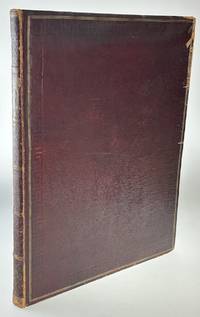
1808réf. 1078254to. London: Bensley for Cromek 1808. 4to xiv 36 4 pp. With a portrait frontispiece after Phillips etched title page and 11 plates engraved by Luigi Schiavonetti after Blake’s designs. Original drab gray boards printed paper label on upper cover preserved in a red cloth box worn. The finest copy we have ever seen. § First quarto edition of exceptional rarity in boards as issued. A completely untrimmed copy thus with the title-page uncropped. Bentley Blake Books 435B. Bindman Complete Graphic Works of Blake 465-476."In October 1805 Blake was commissioned by the engraver and would-be publisher Robert H. Cromek to prepare forty drawings illustrating Robert Blair's The Grave a popular "Graveyard" school poem first published in 1743. Cromek planned to select twenty of these designs for a deluxe edition of the poem. In Cromek's first prospectus of November 1805 Blake is named as both the designer and engraver of fifteen designs. Blake etched one image Deaths Door in white-line but Cromek rejected it. The dark power of the white-line print appeals to modern tastes but was far from fashionable in the early nineteenth century. In a second prospectus also of November 1805 Cromek announced that Luigi or Louis Schiavonetti would engrave twelve designs for the new edition. Blake had lost the potentially lucrative commission to engrave his own designs; his relationship with Cromek descended into anger and argument. In spite of their disagreement Cromek included a portrait of Blake as a frontispiece to the volume published in 1808. Cromek promoted the book aggressively and the illustrations to The Grave became Blake's best known work through much of the nineteenth century." The William Blake Archive Bensley for Cromek hardcover books
1886réf. 1088064to. Edmonton: William Muir 1886. 4to 4 45 hand-colored plates 2 leaves. Contemporary half navy calf gilt with navy morocco and gilt label on cover and navy cloth boards original wrappers bound in. A fine copy with the bookplate of H.C. Plimmer. § Limited to about 50 copies by Muir and his team based on copy A. Muir’s preface is five pages and at the end is a three-page facsimile of Blake’s letter of March 16 1804. The first facsimile of the second-longest and penultimate of Blake’s illuminated books which is known in only four copies. The poem follows the poet John Milton returned from heaven to the mortal world on a journey of self-discovery and renewal The William Blake Archive. Blake himself is present as the personification of Imagination and the poem contains many biographical allusions. It is exceptionally rich with numerous full-page plates. Blake’s famous poem “Jerusalem” appears in the preface to Milton only in copies A and B. Bentley BB 249f. William Muir hardcover books
1801réf. 1227331801. London : Dalla Stamperia di Gul. Bulmer 1801. Thick 4to 2 1 1-721 pp. Printed in English and Italian. Contemporary red straight-grained goatskin flat spine banded with double gilt rules single gilt rule to the margins of the boards all edges gilt some foxing to the preliminaries binding repaired and refurbished still showing some scratches and stains but still an attractive copy. § Only edition of absolute rarity three copies recorded none at auctionone in the marketplace bought by Yale. Maggs wrote of this copy: "Written by an associate of William Blake this is a profoundly eccentric production full of the revolutionary spirit of the times combining mysticism philosophy electricity and magnetism. One of an unknown number of copies privately printed for the author without a title page by George Bulmer all of them intended for presentation to the author's friends this copy bearing the 19th Century ownership inscription 'Girdlestone' for whose identity there are several candidates none completely convincing. It is in two parts the first "An Investigation into Principles" written in English is a series of reflections on the nature of elements gravitation "the pressure of the general ethereal fluid against our orb" time "Look for time in the vast expanse Eternity will start to view and time revolve no more" tides earthquakes and the lack of salt in rain when raised into the sky by waterspouts it is sweetened by the action of electricity. His logic is baffling at times demonstrating the wisdom of a forward five year old or of an experienced haschischan : for instance he observes that gravity isn't all that Newton cracked it up to be since water "from a known principle in hydraulics" rises to the top of mountains which truth he derives from the fact that rivers never run dry. "On the Barleycorn" is a dialogue between Mata and Ata based on a conversation with George Finch Earl of Winchilsea concerning wisdom folly genius reason the individuality and the faculty of the soul. The second part is titled "On the Soul. On Magnetism. Magnetic Productions." and comprises the transcripts of Avena's automatic writings see below in Italian many with English introductions and some untranscribed writings dismissed as "too confused to merit attention". There are a total 51 sessions in the first year dated to "Alessandria 1796" 52 in the second year and 27 in the third and last year. The last two years have almost no English narrative. In researching this book we Maggs rely heavily on the intoxicating and brilliant essay by Marsha Schuchard "Blake's Healing Trio: Magnetism Medicine and Mania" published in Blake an Illustrated Quarterly Vol 23 Issue 1 which explores Blake's relationship with the "eclectic network of illuminés which included Swedenborgians Freemasons and Cabalists who shared his interest in animal magnetism spirit-communication and erotic trances". George Baldwin was one of these and is included as "Baldwin of Egypt's Lake" in a vicious later 1808 - 1811 poem attacking their lack of commitment to his studies. Baldwin born in 1744 was an author and diplomat who became very wealthy in the later years of the 18th century establishing trade links for the East India Company with Egypt owning a monopoly of the British trade route through Suez demonstrating remarkable prescience about the importance to British trade of this route to the east. He was British Consul-General in Egypt from 1786 to 1796 in which position he warned the British Government of French plans to take over Egypt a warning which was largely ignored. When the French invaded Egypt in 1798 he left the country for Italy leaving behind substantial property in Alexandria which was seized by the French. He was of considerable help in the planning of the British counter invasion returning to Egypt in 1801 with the British forces and claimed the credit for the decision to breach the canal in Alexandria and flood Lake Mareotis to hinder French navigation which played a significant role in the recapture of Egypt - this is what Blake refers to when he mentions "Baldwin of Egypt's Lake." It is attractive to think of a time in which a man could be a senior servant of the state as well as indulging in such arcane personal tastes. Baldwin's wife Jane Malpass a famous Greek beauty sat for her portrait to Sir Joshua Reynolds and to Richard Cosway who introduced Baldwin to English devotees who believed in healing by magnetism which although he was a popular figure in English society made him the subject of some ridicule. Some Blake scholars believe that Jane Malpass is one of the figures in Blake's 'Vala' manuscript. Baldwin had come across what he claimed were many cures in Egypt using magnetism and experimented on himself with he said considerable success. His Magus so to speak was an itinerant poet one Cesare Avena di Valdieri who passed on his gifts to Baldwin during magnetic sleep. The 'Principles' begins in English with a history of the development of Animal Magnetism then turns to Italian and intertwines the further exploration of the theme with the story of Baldwin's 'contact' with the spirit of his lost first love through the mediumship of Valdieri in a magnetised trance. Both Blake and Baldwin believed that the same Muse that dictated spirit writings to them also inspired Milton in the writing of 'Paradise Lost'. Baldwin was in London from 1781-6 where he must have first encountered the English school of Animal Magnetism a fashionable science begun largely by Franz Anton Mesmer who was for a while very successful as a practitioner in London society. It is highly likely that Baldwin made the acquaintance of Blake during these years. Mesmer was soon eclipsed by his disciple Dr. John Bonniot de Mainaduc who became a very rich man treating the great and the good of British society from Royalty downwards. Mainaduc published in 1798 a series of lectures with a frontispiece by Cosway where much of the phraseology bears a striking resemblance to the writings of Blake. Baldwin was back in Egypt in 1786 from where he ordered many publications on Animal Magnetism and on his interest in 'native' medicines with their use of magic and trance states. He set himself up as a practitioner and claimed much success as a healer - it is thought that a drawing from Blake's notebooks showing a cloaked man wearing a turban treating a young crippled girl represents Baldwin. Baldwin even claimed to be able to heal the plague rife in Egypt at the time mainly by the use of massage with olive oil. This publication originated with Baldwin's meeting with Valdieri and his consequent magnetisation of the poet who poured forth the verse printed here dictated to him by spirits. In 1797 Baldwin was visited in Egypt by the art connoisseur Thomas Hope a devotee of Animal Magnetism. The copy of this book in Emory University Library is inscribed to Hope's brother Henry a wealthy banker and disciple of Mainaduc. The inscription reads 'To Henry Hope Esq from his humble servant George Baldwin author of the English part of this work and editor only of the Italian'. Baldwin himself categorises the principles of the title as 'the discovery of a spiritual influence on the physical temperature of man'. Worldcat reports only two copies in institutions worldwide Emory University and the University of Chicago but a deeper poke reveals a mis-catalogued copy in the British Library. Not in Crabtree Animal Magnetism early hypnotism and psychical research an annotated bibliography. 1766-1925." DNB notes: "Baldwin was welcomed into London society as an exotic newcomer. He was described by Wright as 'lolling on oriental cushions amid strange hangings' T. Wright Life of William Blake 1929 2.31 and had some interesting pictures to share. Baldwin became intrigued by Cosway's keen interest in the therapeutic powers of magnetism as expounded by John de Mainauduc. Baldwin's presence was noted in William Blake's lines: Cosway Frazer and Baldwin of Egypt's lake Fear to associate with Blake This life is a warfare against evils They heal the sick he Blake casts out devils." Bentley BBS 495 p. 404. unknown
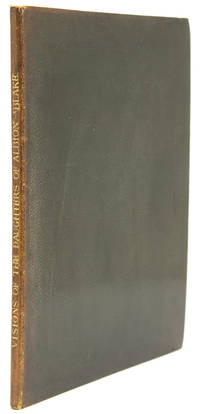
1885réf. 1088074to. Edmonton: William Muir 1885. 4to 1 preface by Muir 8 hand- colored leaves; 1preface by Muir 11 hand-colored leaves bound with tissue guards in original gray wrappers as issued by Muir: copies 24 and 30. Bound in contemporary half navy calf gilt with navy morocco and gilt label on cover and navy cloth boards with H.C. Plimmer's bookplate. Very good. § The Thel facsimile is based on copy D colored by hand and limited to about 50 copies. Essick notes three versions of the ca. 1885 edition one entirely executed by hand this version with the correction of ’sprin’ to ’springs’ on leaf 5 line 7 and with the two final plates numbered 7 and 8 and a third version with the final two leaves correctly numbered 5 and 6 as in Blake’s original. The Visions facsimile also limited to around 50 copies is on Hodgkinson wove paper some copies were printed on a thinner “Antique Note” laid paper. Based on copy A in the British Museum. Bentley Blake Books 249 b and c William Muir hardcover books
1791réf. 11069912mo. London: printed for J. Johnson 1791. 12mo xii 177 3 advertisements pages with 6 plates by William Blake after his own designs and an extra plate bound in at the front not by Blake. Modern polished tree calf gilt backstrip red label in very good condition. Some plates have offset onto the facing page as usual. § First edition to contain William Blake’s characteristic illustrations reminiscent in iconography to his designs for his own Songs of Innocence 1789. This copy has all the plates in the second and much improved state and an extra plate at the front thought to be by Blake but not. This collection of didactic tales for youth in part reinforcing the lessons of Wollstonecraft’s first book Thoughts on the Education of Daughters proved her most popular book going through five editions by 1800. Windle Bibliography of Mary Wollstonecraft A3b. Bentley Blake Books 514A. Easson and Essick vol. I no. III. printed for J. Johnson unknown books
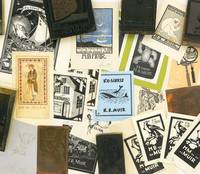
réf. 132768The archive comprises: 1. Sara Eugenia Blake: an etched bookplate Peake 3869: 'Juvenilia H.B. Muir'. One signed copy with the original zinc plate. 2. Sara Eugenia Blake: an etched bookplate depicting a Persian or Mughal figure Peake 3870: 'Indian Man'. Six signed proof copies printed in different coloured inks one extensively hand-coloured with the original zinc plate. 3. Tom R. Bond: a process bookplate Peake 3871: 'Mask' incorrectly dated 1937. One proof copy signed and dated 1933 by the artist and numbered 10/10 plus ten further proof prints on different paper stocks some untrimmed. With the original India ink drawing and process block. 4. Adrian Feint: a process bookplate Peake 3872: 'Desk open window river' 1936. One copy signed by the artist and another on Japanese paper likely a proof. With the original ink drawing and process block. 5. John Barclay Godson: an etched bookplate depicting the devil Peake 3873: 'Devil's face' 1934. One signed remarque proof with a preliminary pencil drawing and the original copper plate. With a list in Harry Muir's hand regarding distribution of copies of the bookplate. 6. John Goodchild: a process bookplate depicting a ship at sea Peake 3874: 'Galleon and seagull' 1932. Four copies two identified as proofs by Harry Muir on the reverse 'Delmonts proof of bookplate. 1st Sept 1932' and 'Hassells proof of bookplate from Delmonts zinc block'. With a preliminary pencil drawing signed by Harry Muir identifying the artist the final large ink drawing 146 × 102 mm with a pencil note to 'Reduce ¼ size' and the original process block. 7. John Goodchild: a process bookplate depicting a one-legged pedlar selling prints Peake 3875: 'Autolycus selling from tray' 1932. With the original process block. 8. John Goodchild: a three-colour linocut and process bookplate Peake 3877: 'Glass enlarging galleon plate' 1943. One copy with the three original blocks two linoleum and one process block. 9. Peter Hosokawa: a bookplate featuring two whales Peake 3878: 'Two whales' 1980. Number 31 of 100 signed copies; printed on blue paper. 10. Jane Hylton: a process bookplate depicting poppy kernels Peake 3879: 'Poppy kernels'. With the original process block heavily tarnished. 11. George David Perrottet: a three-colour linocut bookplate depicting a ship under a crescent moon Peake 3882: 'Sailing ship against crescent moon' 1933. Two copies one untrimmed and signed by the artist. With all three original linoleum blocks plus three process blocks heavily oxidised possibly prepared for Muir's 1942 publication on Perrottet's bookplates. 12. George David Perrottet: a hand-coloured two-colour linocut bookplate for Muir's books by and on John Galsworthy Peake 3880: 'Monkey with orange' 1936. With both original linoleum blocks. 13. George David Perrottet: a two-colour linocut bookplate featuring the exterior of Muir's bookshop Peake 3881: 'H B Muir bookshop' 1939. One signed proof copy on fine paper plus a copy of the standard version. 14. Derek Riley: a woodcut bookplate featuring bookstalls Peake 3883: 'Bookstalls with church tower behind'. One signed proof copy inscribed by the artist 'Opus 22' dated 1980. With the original woodblock. 15. Derek Riley: a woodcut bookplate featuring a tiki Peake 3884: 'New Zealand tiki'. Signed proof copy inscribed by the artist 'Opus 35' dated 1981; mounted in a card bifolium also signed and dated and a copy of the standard version. With the original woodblock. 16. Leslie Victor Smith: an etched bookplate showing maps of Canada and Australia Peake 3885: 'Tree embracing maps of Canada & Australia' 1943. One copy signed by the artist. With the original copper plate and an autograph letter 1943 with the original envelope to Muir from this Canadian artist primarily regarding the bookplate it appears he produced it as a gift without Muir's knowledge and sent him twelve signed proof copies. 17. Eric Thake: a process bookplate for Muir's collection of books on Bligh and the 'Bounty' Peake 3886: 'Three figures from "Bounty" mutiny' giving the date 1947. With two ink drawings a preliminary version and the final version dated '1945-1948' and the original process block. 18. Eric Thake: a process bookplate featuring a chained Pegasus Peake 3887: 'Pegasus' 1933. Number 9 of 15 proof copies signed by the artist plus two further copies one signed. With the original ink drawing and two lists in Muir's hand regarding distribution of the proof copies. 19. Noel Wood: a linocut bookplate Peake 3888: 'Eagle on rock' 1932. One untrimmed remarque proof number 5 of six copies almost certainly printed by the artist two copies of a more crisply-printed version possibly process; one with Muir's annotation on the verso stating that it is a 'Hassell's print'. With a preliminary ink drawing mistakenly giving Muir's middle initial as M not B. 20. John Goodchild: an offset-printed bookplate for Muir's holiday house Petrel Cottage at Encounter Bay Victor Harbor Peake 3876: 'Seagulls' 1938. 21. George David Perrottet possibly: two linoleum blocks for a second bookplate for Petrel Cottage a two-colour linocut very much in the style of Perrottet. This bookplate was apparently never published. Provenance: H.B. Harry Muir 1909-1992 bookseller publisher and bookplate collector; by descent. A quantity. unknown
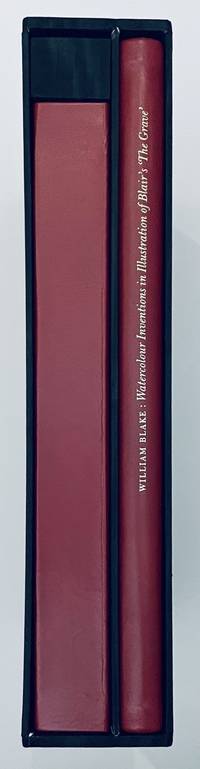
réf. 6633London: William Blake Trust 2009. Limited Edition. Hardcover. Fine in Fine Slipcase and Fine Portfolio. Limited Edition. Hardcover. "Bound in gilt-lettered quarter deep scarlet calf over black moiré silk covered boards deep scarlet leather label blocked in gilt to the centre of the upper board; 96pp. illustrated throughout with colour and b/w reproductions of Blake's drawings and watercolours. Contents: Morton D. Paley William Blake and Robert Blair's 'The Grave'. Martin Butlin The History of Blake's Illustrations to 'The Grave' and The Newly Discovered Water-colours. Blake's twenty watercolour designs with a Catalogue and illustrated Commentaries by Martin Butlin. Robert Blair's The Grave from Cromek's edition 1808. Schiavonetti's engravings of twelve of Blake's designs from the 1808 edition. Blake's rejected engraving of 'Death's Door'. Printed throughout in black and white and colour on 200 gsm archival acid-free paper. With A portfolio 35x28x2.8 cm bound in maroon calf with tongue-and-strap closure blocked in gold flap blind-embossed with double rule border lined in red; all in close replication of the portfolio made sometime after 1822 to contain: 19 of 20 watercolour inventions by Blake in illustration of Blair's The Grave mounted on thick beige paper within ruled and tinted borders and trimmed to 33.3x26.7 cm; here reproduced in facsimile. One of 36 copies of the Portfolio Plates and Book in cloth-covered double slipcase numbered I-XXXVI." Tight bright and unmarred. Black cloth red leather matching slipcase gilt lettering. Small fo. Illus. color plates. William Blake Trust hardcover
1885réf. 303029Edmonton 1885. No. 39 of 50 copies on Hodgkinson wove paper. William Muir facsimile. Preface and 11 hand-colored plates. 1 vols. 4to. Full dark green levant preserving wrappers with an unrecorded folding announcement from Muir bound in at front. No. 39 of 50 copies on Hodgkinson wove paper. William Muir facsimile. Preface and 11 hand-colored plates. 1 vols. 4to. Bentley 249c unknown