622 résultats
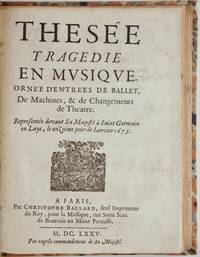
1675réf. 39689Paris: Christophe Ballard seul Imprimeur du Roy pour la Musique ruë Saint Jean de Beauvais au Mont Parnasse . Par exprés commandement de Sa Majesté 1675. Small quarto. Modern marbled boards with paper title label to upper and spine. 1f. recto title verso blank 1f. "Acteurs du Prologue" 4ff. "Prologue" 1f. "Acteurs de la Tragedie" 76 pp. With woodcut device to title including Apollo with lyre figures in Greco-Roman dress with harp and lute and a pegasus; exceptionally fine woodcut headpiece to Prologue and additional headpieces to each act; decorative woodcut initials and tailpieces throughout. Full named cast lists for the "Acteurs du Prologue" and the "Acteurs de la Tragedie." Small holes to blank inner margins from previous sewing; slightly worn; very occasional minor foxing soiling and stains; minor loss to blank upper outer corner of pp. 31/32. First Edition fourth issue. Sonneck Librettos p. 1069. Schmidt LLC3-2.3. Thesée a tragédie en musique in a prologue and five acts to a libretto by Quinault after Ovid's Metamorphoses was first performed at St Germain-en-Laye on 11 January 1675. "The orchestra and chorus are used with brilliant effect in several divertissements but especially in the evocation of battle throughout Act 1. Medea's role like that of Lully's final lovesick sorceress Armide is replete with expressive monologue airs: 'Doux repos' 'Dépit mortel' 'Sortez Ombres' and 'Ah! faut-il me venger'. Thésée was part of the standard repertory at the Paris Opéra from 1675 until 1767; in addition it was selected to represent Lully when in 1779 the Opéra presented an historical survey of French operatic styles. Lully's score was substantially modernized by editors for productions from 1754 onwards." Lois Rosow in Grove Music Online. Christophe Ballard, seul Imprimeur du Roy, pour la Musique, ruë Saint Jean de Beauvais au Mont Parnasse ... Par exprés command unknown books
1685réf. 262811Lyons: Girin 1685. hardcover. very good. 3 full page copperplate engravings and 4 engraved chapter headings. Thick 12mo 22 445 5 pages rubricated title and edges full calf gilt spine chipped and worn. Lyons: Jean Girin & B. Riviere 1685. Scarce. Very good . Sabin 21146; Wellcome II p. 494; Bitting 134. Girin unknown books
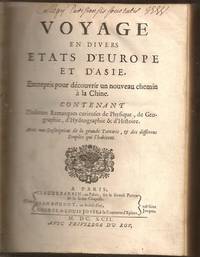
1692réf. LV1992Paris:: Chez Claude Barbin Jean Boudot George & Louis Josse avec privilege du Roy 1692. 1692. Sm. 4to. xx 406 xxiv pp. 6 chapter vignettes engraved by Vallet pp. aii 1 71 165 231 323 large engraved portrait of General Stanislas Jablonowski by Picart large folding map of Siberia 3 engraved plates: engr. pl. of transport sled of Moscow facing p.150 engr. pl. of a Calmouc Tartar facing p. 195 "Esquiss des Cosaques" facing p. 356. Nineteenth century quarter maroon morocco maroon paper over boards; rubbed. Rubber-stamp of Abbe E. Emile Longin Beaujeu fl.1904; receipt of sale of this copy to Armand Pushman 1932 NYC. First edition. This work was first translated into English in 1693. "At this time a major preoccupation of the Catholic Church and its China mission was to discover a safe land route from Europe to Peking through central Asia. This was due to the large numbers of out-going clergy who perished tragically every year at sea." Ames & Love p. 202. "The last decade of the century saw the publication of the accounts of several overland travelers to China and their destinations of China's inner-Asian neighbors. The story of the Jesuit Philippe Avril's attempt to establish a route across Russia for the safe passage of missionaries to China appeared in 1692 and includes descriptions of both the routes from Moscow to China and the peoples on China's frontiers. Avril himself however did not travel beyond Moscow and his descriptions therefore are not the result of his own observations." Lach & Kley pp. 1685-1686. The same for Nicolaas Witsen. Avril Philippe a Jesuit born in France explored extensively throughout Asia and the Far East. He was a professor of mathematics and philosophy in Paris before he began his overland journey. He traveled for six years through Kurdistan Armenia Astrakhan Persia and other parts of the southeast. At one point he came to Moscow and was refused entry to Tatary. He was sent by the government to Poland via Istanbul and back to France. Apparently affected by exhaustion and disease he still undertook another voyage his last for the ship was lost at sea circa 1698. – Love Ronald S. "A Passage to China: A French Jesuit's Perceptions of Siberia in the 1680s." French Colonial History 3: p. 94 2003. Ames & Love offer: "Though obliged to leave Moscow Avril did not return to France with Louis Barnabe . . . Remaining instead at Warsaw the two Jesuits had entered in early March 1688 Avril attempted twice more to achieve his objective or reaching China by land – if not through Siberia then via Persia and Central Asia. Aided in part by the Polish monarch John Sobieski r.1674-1696 and his ambassador to Russia the French priest once again traveled to Moscow in late spring. Just two days after his arrival in the Muscovite capital however Avril was ordered summarily out of the country. Once again he appealed the command in vain. 'Russia intended to keep her trade with China a secret.' Nor did he have better luck later the same year 1688 when he and a fellow Jesuit Pere de Beauvillier tried going south to Constantinople instead and thence through Persia to Bokhara Samarkland and the Chinese frontier. Crossing secretly into Ottoman territory the two men were arrested as spies. After several weeks they secured their release and resumed their trek. But Avril whose health had been waning as a result of relentless exertions suddenly developed a hemorrhage. Ordered to abandon the search and return home by his superiors he reached France in autumn 1689." Ames & Love p. 219. For Abbe Emile Longin provenance: see Bulletin de la Societe des sciences et arts du Beaujolais 1904 p.92. There is a Maggs Bros. London booksellers receipt of sale of this copy to Armand Pushman 10 Nov. 1932. Armand was one of two sons of Hovsep Pushman 1877-1966 an American artist of Armenian descent. He had studied art at the Imperial School of Fine Arts Istanbul. For a time Pushman lived at the famous Mission Inn Riverside California. He was also involved in the founding of the Laguna Beach Art Association. Armand Pushman d.1999 lived to 98 years and had been throughout his career a partner with his brother in their carpet business Pushman & Company. See: NYT Obituary January 11 1999. See: Henri Cordier Bibliotheca Sinica Dictionnaire Bibliographique des ouvrages relatifs a l'Empire chinois t. III 2088; De Backer Augustin & Carlos S.J. Sommervogel Bibliotheque de la Compagnie de Jesus. Bibliographie tome I p.706; Donald F. Lach Edwin J. Van Kley Asia in the Making of Europe Volume III: A Century of Advance book 4: East Asia. University of Chicago Press 1998; Glenn Joseph Ames Ronald S. Love Distant Lands and Diverse Cultures: The French Experience in Asia 1600-1700. Praeger 2003 – pp. 202 219; Howgego A142; Salmaslian Armenag Bibliographie de l'Armenie 1946 p. 238; Walravens Hartmut China illustrata. Das europaische Chinaverstandnis im Spiegel des 16. bis 18. Jahrhunderts. Mit einem Beitrag von David E. Mungello. Ausstellung im Zeughaus der Herzog August Bibliothek Wolfenbuttel vom 21. Marz bis 23. August 1987. Ausstellungskataloge der Herzog-August-Bibliothek Nr. 55 Wolfenbuttel: Herzog August Bibliothek 1987 55. 1691. Chez, Claude Barbin, Jean Boudot, George & Louis Josse, avec privilege du Roy, 1692. hardcover books
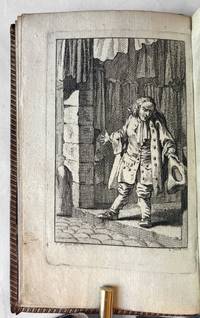
1746réf. 4391The Hague i.e. Paris: s.n. 1746. 8vo 168 x 101 mm. 2 parts separately titled and paginated: 3-vi-xxiv 182 pages 1 blank leaf; 2 leaves 128 pages. Engraved frontispiece by Fessard after Cochin fils apparently included in the pagination typographic title ornaments head- and tailpieces. An attractive copy stain to fols. A2-3 in second part 2 or 3 minor marginal tears some spotting. Contemporary red morocco triple gilt fillet on sides smooth spine sparingly gold-tooled and lettered board edges gilt gilt edges scuffing to lower board edges and extremities of spine corners a bit bumped. Provenance: early purchase note on lower flyleaf; John Wodehouse 3rd Earl of Kimberley 1883-1941 bookplate; Leonard Forrer 1869-1953 his bookshop ticket of L. S. Forrer Ltd. Numismatic Booksellers London; Charles Van der Elst 1904-1982 bookplate. Only Edition of an extended literary joke by the brilliant antiquarian engraver art patron and connoisseur the Comte de Caylus. He exercised his stylistic muscles in this peculiar collection of two dozen literary pieces revolving around the word manteau: in part 1 racy anecdotes short stories fairy tales and a chivalric tale written in pseudo-archaic French; and in part 2 tongue-in-cheek erudite essays in several styles — the religious history the antiquarian disquisition the etymological or bibliographical analysis — all laced with fictional and a few real references including imaginary medieval manuscripts. A glance at the entry for manteau in the online Trésor de la Langue Française gives an idea of the semantic opportunities offered by this word whose appearances in many idiomatic expressions are exhaustively exploited by Caylus. In part 1 appear the manteau de fourrure fur coat the manteau de lit a short bed-jacket into which a jealous husband is metamorphosed by his fairy mother-in-law to teach him a lesson the long and short coat the chimney mantel same word in French and a portrait of a remarkable old man presented as the fictional originator of the term “sous le manteau” clandestine or clandestinely. In part 2 which its title notes with a wink “one doesn’t need to read” the author delves into the Roman pallium a cloak the coats of saints and clerics those both heraldic and actual of Dukes and Peers and the order of the Blancs-Manteaux. Completing the picture are a florilegium of dictionary extracts and a satirical etymological comparison of the French manteau with other languages containing sentences like: “As for the letter L which is found at the end of words like Mantel and Mantello one can very well understand it to be a diminutive of the Arabic word Allah meaning God” p. 103. The self-imposition of arbitrary constraints onto one’s writing while an ancient practice viz. poetic meter have been associated more recently with a French literary movement from the 1960s known as Oulipo short for Ouvroir de littérature potentielle ”workship of potential literature” which included the great French authors Raymond Queneau and Georges Perec whose wry humor and doggedness in pursuing the conceit to the end Caylus foreshadowed. Cochin’s frontispiece shows a rather shifty-looking merchant in the doorway of his shop filled with coats. OCLC locates 4 copies in North American libraries. Cohen-De Ricci 210; Gay-Lemonnyer 3:23; Barbier III: 34 a 1775 edition not seen elsewhere. s.n. unknown books
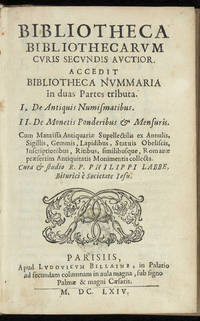
réf. 164616 p.l. 398 pp.; 27 pp. Two parts in one vol. 8vo cont. calf extremities a little rubbed contrasting leather lettering piece on spine. Rouen: A. Maurry for L. Billaine 1678. Third edition 1st ed.: 1664 “of the earliest extant bibliography of bibliographies. It is basically an alphabetical list arranged by authors’ first names followed by eight intricate subject indices among them one of publishers’ and booksellers’ catalogues. Appended is a very useful numismatic bibliography. The work enjoyed three later editions during the seventeenth century and provided the basis for Teissier. Labbé 1607-67 one of the most learned polymaths of his time was a Jesuit professor of philosophy in Paris.”–Grolier Club Bibliography 62–1st ed. The work attributed to John Selden on the title-page is actually by Alessandro Sardi 1520-88 and first appeared in 1579. There is also included a substantial bibliography on weights and measures. Haebler in his Handbuch states that this is the second book on incunabula and the first in which the word is used in connection with printing. A fine copy with some minor foxing. ⧠Taylor Book Catalogues pp. 176 208 & 219-20. unknown books
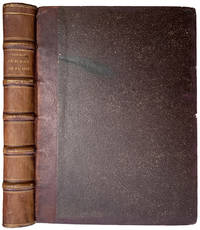
1692réf. E0527titlepictorial platexviifolding map406xxiv pages with engraved initials and vignettes and three additional plates and index. Royal octavo 9 3/4" x 7 1/2" bound in full leather with five raised bands and lettering in gilt and decorative vignettes. First edition. Philippe Avril was a Jesuit explorer of the Far East and professor of philosophy and mathematics at Paris when he was dispatched to the Jesuit missions of China. He was summoned by the Jesuit missions and sent as a Jesuit to the missions in China. Following the instructions of Ferdinand Verbiest another Jesuit then at Peking suggested that he attempted an overland journey which he ended up traveling for six years through Kurdistan Armenia Astrakhan Persia and other countries of eastern Asia arriving at Moscow. He now traveled to Grodno in Poland where he renewed an acquaintance with Count de Syri who had formerly befriended him at Astrakham. The count at the suggestion of Avril applied ot the French government for the appointment of ambassador from the King of France to the Emperor of China. He succeed in obtaining the appointment and it was arranged that Avril should accompany him. They set out to Moscow together. An accident detained Avril and the count arrived at Moscow days before his companion. On the arrival of Avril he received the intelligence that the Russian authorities and compelled the count to proceed and was refused permission to over take him. Avril proceeded to Warsaw and through the assistance of Prince Jablonowksi to reach Constantinople by way of Moldavia. Here he was seized with spitting of blood and he found himself compelled to relinquish his mission and returned to France. He landed at Toulon in 1690 and published an account of his travels. Avril's journal and writings provide a significant amount of useful material for modern historians and demographers. Condition: Corners bumped and rubbed lacking 3E4 blank leaf between the end of the main text and start of the Table de Metiers occasional toning ink inscription to title spine ends and raised spine rubbed some spotting to leather else a good to very good copy. Claude Barbin, Jean Boudot, George & Louis Josse hardcover books
réf. 37323Very Good. Two striking original photographs taken during the filming of Hans Richter's "8 x 8". One of the two photographs is signed in red ink by Philippe Halsman the photographer of both. A note on the back of the signed photo notes that Halsman signed this picture and that the film's cinematographer Arnold Eagle is visible in the background. The photos are mounted on discolored pieces of cardboard. In his original script for the film's prologue Richter wrote: ".my film 8 x 8 is a bizarre comedy-drama signs and sounds not only out of this world probably not even in the next. 8 x 8 mixes equal parts of Freud and Lewis Carroll with Venice Venus and Old Vienna Cocteau and Bullfights surrealism magic dreams girls and practically anything else that may currently be in your minds." Hans Richter undertook 8 x 8 at the suggestion of Marcel Duchamp a chess enthusiast after The Minotaur a planned sequel to the 'Narcissus' episode of Dreams That Money Can Buy failed to secure funding although 8 x 8 engaged similar concerns. 'Chess is so universal' wrote Richter to Jean Cocteau about this new project 'that practically every human situation has its corresponding move among the countless possibilities of chess.' The filmmaker further recognized a kinship between the work which took its title from the layout of a chessboard and Lewis Carroll's Through the Looking Glass. Some of the artists who appeared in this film included Max Ernst Fernand Léger Marcel Duchamp Man Ray and Alexander Calder. The photographs are accompanied by a reprint of an article that was written by Lewis Carroll collectors August and Clare Imholtz for the Fall 2019 issue of "Knight Letter" about the film and its participants along with a discussion of each of the photos. The photos are in very good condition. They measure 10.5 x 13.5 inches. PHOTO/062424. unknown books
1809réf. 100473Paris: J. Ant. Brosson 1809. Second edition. 8vo. 2 engraved plates 2 folding tables. 4 xxxii 496 pp. half-title. Near contemporary half calf and marbled boards; rubbed pp. 71-72 torn at bottom with loss of several words Inscribed on the half-title to dermatology pioneer Jean Louis Marc Alibert "de la part de l'Auteur" the inscription is slightly shaved. "In this entirely recast and greatly enlarged second edition Pinel adds much new material and discusses the results of new and more humane methods of treatment for the insane" Heirs of Hippocrates."Pinel founded the French School of Psychiatry. He was among the first to treat the insane humanely; he dispensed with chains and placed his patients under the care of specially selected physicians. Garrison considered the above book one of the foremost medical classics giving as it did a great impetus to humanitarian treatment of the insane. The second French edition Paris Brosson 1809 was very substantially enlarged by Pinel" Garrison-Morton.PROVENANCE: Haskell F. Norman bookplate his sale Christie's NY 1998 lot 722REFERENCE: Garrison-Morton 4922; Heirs of Hippocrates 1071; Norman 1703; Norman/Grolier 100 no. 54 1st ed. J. Ant. Brosson hardcover books
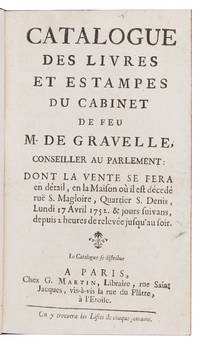
réf. 69441 p.l. 120 pp.; 21 p. & 19 leaves of author index in a contemporary hand. Two parts in one vol. 8vo attractive antique calf-backed paste-paper boards spine gilt red morocco lettering piece on spine. Paris: G. Martin 1752. One in a series of the very rare later auction catalogues issued by Gabriel Martin the Paris de Meyzieu of 1761 being his last. This library was formed by Gravelle 1699-1752 a magistrate in the court of inquiry of the Paris Parliament who is today best remembered for his Recueil de pierres gravées antiques published between 1732 and 1739 and for his parody L’Amant déguisé which was performed after his death. He was an expert engraver who prepared the etchings for his book on engraved gems. This was a fine and scholarly library of 1723 lots rich in literature and books on antiquities and art. There are many 16th-century works. The final 21 pages describe his large collection of prints and drawings 113 lots including works by Watteau van Dyck Boucher Guercino Le Brun Rembrandt Teniers An. Carracci etc. Fine copy. The first part has been priced throughout in a contemporary hand. There is also a most unusual manuscript index at the end. ⧠Lugt 785. Benezit Dictionary of Artists. Esprit des Livres website. Not in Grolier Club Printed Catalogues of French Book Auctions.1643-1830. unknown books
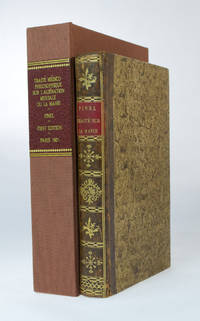
1801réf. 66795Paris: Chez Richard Caille et Ravier 1801. The Textual Foundation of Psychiatry PINEL Philippe. Traité médico-philosophique sur l'aliénation mentale ou la Manie.Avec figures représentant des formes de crâne ou des portraits d'aliénés. Paris: Chez Richard Caille et Ravier An IX 1800/1801. First edition. Octavo. lvi 318 pp. Folding letterpress table between pp. 250 and 251 and two engraved plates. Contemporary French quarter mottled sheep over paste paper boards. Smooth spine ruled in gilt with gilt red morocco lettering label. Occasional very light spotting. Housed in a custom brown cloth clamshell. Overall a superb copy. "Philippe Pinel's Traité médico-philosophique sur l'aliénation mentale ou la manie which presented the textual foundation of psychiatry stands as the first great publication of the nineteenth century in clinical medicine" Grolier Medicine. "In October 1793 while serving as médecin des infirmeries at Bicêtre Hospital Pinel 1745-1826 had the chains struck off from forty-nine male psychiatric patients in order to substitute for this cruel oppression his 'traitement morale' a humane form of psychiatric therapy that identified insanity with illness rather than moral perversity or demonic possession. This dramatic act performed in the liberating spirit of the American and French Revolutions found immediate and enduring favor in the popular imagination as a symbol of a new attitude toward the insane and ignited a general desire for more humane treatment of the mentally ill that culminated in the English non-restraint movement of the mid-nineteenth century. Yet humanitarian treatment of the insane although crucial to Pinel's psychiatric work was not that work's sole focus for Pinel also devoted himself to establishing psychiatry as a scientifically based branch of medicine. His Traité replaced the speculation and theorizing characteristic of earlier discussions of insanity with his own practical observations of the lunatics of the Bicêtre whose illnesses could now be observed undistorted by cruel treatment. He retained the old classifications of mental illness stating that contemporary medicine was as yet too primitive for more precise categories but did introduce some subdivisions isolating mania from delirium and recognizing the relationships between periodic mania melancholy and hypochondria. He recognized emotional disorders to be the main cause of intellectual dysfunction but also took into account heredity predisposition and hypersensitivity and attempted to find relationships between insanity and cranial deformity" Norman Library. Cushing P286. Garrison and Morton 4922. Grolier Medicine 54. Heirs of Hippocrates 668. Hunter & Macalpine pp. 602-610. Norman Library 1701. Waller 7456. Wellcome IV p. 388. HBS 66795. $3250. Chez Richard, Caille et Ravier unknown books
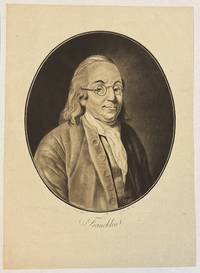
1795réf. 41061Paris 1795. Uncolored oval bust portrait of a bespectacled Benjamin Franklin. 8-1/4" x 9-3/4" on a 10-1/2" x 13-3/4" sheet. Portrait surrounded by a black oval border. The portrait is captioned "Francklin." Directly beneath the oval border in small type is printed "Vanloo Pinxt" to the left and "P.M. Alex Sculpt" to the right. Very Good. According to Sellers's BENJAMIN FRANKLIN IN PORTRAITURE the engraving was done after an original portrait by the famed French painter Charles Philippe Vanloo in which Franklin was wearing fur-trimmed costume. The original portrait was painted while Franklin resided in Paris a "life portrait" dated between 1777 and 1785 and is now in the collection of the American Philosophical Society which was founded by Franklin. Sellers discusses our print: "the substitution a simple gray coat for the fur-trimmed costume of the original was undoubtedly in deference to the revolutionary feeling." It is one of a series of portraits begun in July 1790 and finished in September 1797. The 'Francklin' was exhibited in 1795 so the estimated date of the portrait is between July 1790 and 1795. This print was engraved after Vanloo's portrait by the noted French engraver Pierre-Michel Alix who was known for his portraits of leading French citizens and prominent personalities. Sellers Charles Coleman: BENJAMIN FRANKLIN IN PORTRAITURE Yale University Press: 1962 pp. 393-394. Charles Philippe Amedee Vanloo 1715 -1795 was the member of a Flemish family of painters that settled in France. He was known for painting landscapes and portraits and he had an affinity for scientific subjects. Pierre-Michel Alix 1762-1817 was a French engraver and printmaker specializing in multiple-platecolor printing. He studied under Jacques-Philippe Le Bas and was best known for his portraits of notable figures during the French Revolution and First French Empire. unknown books
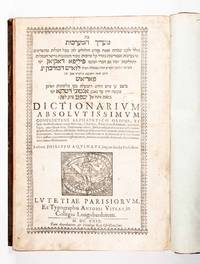
1629réf. 48838Paris: Antoine Vitré 1629. First edition. Hardcover. Good. Folio. Signed: a4 e2 A-3B6 3C4 = 298 leaves. 12 584pp. Paginated from right to left. Full title and imprint in both Hebrew and Latin with woodcut printer's device; title within decorative letterpress border; woodcut lettrines and head-pieces; printed marginalia. Text in two columns. Eighteenth-century calf scuffed especially at front cover; spine with raised bands and gilt morocco morocco labels; edges stained red; green silk ribbon marker. Title leaf skilfully mounted on eighteenth-century paper. Text crisp and clean with ample borders. Only edition of this rare and highly unusual Hebrew and Aramaic dictionary composed by the formerly Jewish convert to Catholicism Mordechai Cresque of Carpentras who derived his new name Philippus d'Aquin or Aquinas; 1578-1650 from the place of his baptism in Aquino Italy. Printed almost entirely in the fine bold rashi characters "grosse glose hebraicque" cut by Guillaume I Le Bé in 1592 only the vocalised quotations and the lemmata are in Le Bé's square Hebrew script. Apart from the Latin title dedication approbations a poetic encomium and the alpha-numeric leaf signatures the work is printed entirely in Hebrew characters. It ends with a short notice in Latin and Hebrew on the printing errors which are corrected on the last three pages. The author announces at the title that all Hebrew biblical and rabbinic-talmudic and Aramaic terms are to be found in Ma'arikh ha-Ma'arakhot including many that do not appear in any existing lexicons among Jews or Christians. D'Aquin notes in particular that rare and difficult terms in rabbinic and cabalistic literature along with obscure abbreviations are all clearly explained. "The work is called in Hebrew Maarik ha-maarikot i. e. "Survey of the orders" a term which in the plural is also applied to "battle-lines" Wolf 140 translates Disponens ordines sive acies. One cannot help wonder if there is not a connection with the political situation at the time when the Huguenot town of La Rochelle had to submit to the French Crown in 1628. The privilege for our book has "Données au Camp devant la Rochelle le 19. Septembre 1628" and the work is dedicated to Cardinal Richelieu whose conquest of La Rochelle is also extolled in a Hebrew poem by the author. But the types are also reminiscent of war: did not Le Bé cut them "après le siège de Paris pour passer l'ennui" see Carter & Vervliet p. 15. They were prominently displayed afterwards in Vitray's type-specimen of 1636" Smitskamp. Among the eleven scholars whose approbations grace the present volume are Gabriel Sionita 1577-1645; professor of Arabic and Syriac at the College de France; Gilbert Gaulmin 1585-1665; Orientalist; Denis Petau 1583-1652; Jesuit theologian; and Jean Morin 1591-1659; theologian and Orientalist. Morin offers quite extravagent praise: "nihil hactenus in eo studii genere comparandum vidit Europa." Provenance: A morocco label on the spine reads Me-izabin. Hirsch. Wolf Kola i. e. From the legacy of Hirsch. References: Baillet Jugement de Scavans 3 1685: 729. Fürst 1:47-48. Gesenius Geschichte 113: "umfasst auch das Chadaïsche und Rabbinische" Hebrew title incorrectly transcribed without the definite article and indication of plural. Smitskamp Cat. no. 611 but notably not in Philologia Orientalis. Steinschneider Handbuch 129: "Früher sehr gesucht und selten. Heidenheim wollte se zuerst wieder ediren s. Catal. p. 739." Wolf Historia lexicorum 140. For the interest of Richelieu in typographical matters and his foundation of the Imprimerie Royale in 1640 see Updike 1:238-40. Not in Goldsmith Hebrew title: מעריך המערכות. Antoine Vitré hardcover books
1801réf. 19588Paris: Richard Caille & Ravier 1801. FIRST EDITION. With 2 engraved plates and 1 folding table. Contemporary calf-backed marbled boards; spine gilt; a fine copy with an ownership signature on the half-title. First edition of what Garrison considered one of the foremost medical classics. Pinel 1745-1826 a Paris physician and founder of the French School of Psychiatry devoted his life to treatment of the insane. Shocked by inhumane conditions in mental institutions he dispensed with use of chains and placed his patients under the care of specially selected physicians. This classic work "located the origin of mental disease in pathological changes in the brain and gave great impetus to the humanitarian treatment of the insane" Heirs. G&M 4922. Richard, Caille & Ravier unknown books
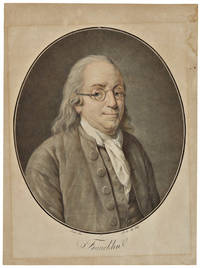
1790réf. 45754Paris: Marie Francois Drouhin ca. 1790. An Unusual Portrait Print of Franklin An attractive mezzotint portrait of Benjamin Franklin with delicate contemporary coloring. The engraving was done after an original portrait by the famed French painter Charles Philippe Vanloo sometimes spelled Van Loo. The original portrait was done while Franklin resided in Paris in the years during and after the American Revolution and is now in the collection of the American Philosophical Society which was founded by Franklin. Sellers asserts that it is "beyond question a life portrait" done between 1777 and 1785. In Vanloo's original portrait Franklin wears a fur coat. In this print of the painting the fur coat has been replaced by a simpler cloth coat. Franklin wears glasses his hair is long and gray and he has a slight smile on his face. In the caption below the image his name is spelled "Francklin." "The substitution of a simple gray coat for the fur-trimmed costume of the original was undoubtedly in deference to revolutionary feeling" - Sellers. This print was engraved after Vanloo's portrait by the noted French engraver Pierre-Michel Alix who was known for his portraits of leading French citizens and prominent personalities. A handsome contemporary portrait of the American who dazzled France as a diplomat scientist philosopher and gentleman of society. Sheet lightly browned more so around the edges. Overall very good. Matted. SELLERS BENJAMIN FRANKLIN IN PORTRAITURE p.394. hardcover books
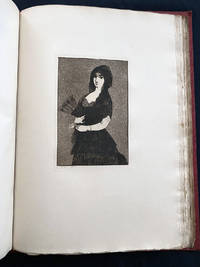
1869réf. B-21-070026Sonnets et Eaux-Fortes. A collection of 42 poems illustrated by 42 etchings published under the direction of Philippe Burty. Edition Alphonse Lemerre Paris 1869. Limited edition of 350 copies after the publication the plates for the etchings have been destroyed. Rare edition with poems by Renaud Claudel Lemoyne Vacquerie and others and etchings by Manet Gustav Dore Corot Braquemond Hugo after and others the book is bounded in ornate red cover with gilded title at the center and spine. Etchings printed by Salmon. Very Good condition. Contact us for complete condition report. Edition Alphonse Lemerre hardcover books
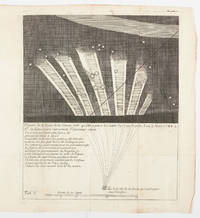
réf. 6925Six folding engraved plates. Title in red & black. 1 p.l. 308 pp. 8vo cont. mottled sheep flat spine nicely gilt contrasting leather lettering piece on spine. Lausanne & Geneva: M.M. Bousquet 1744. First edition of this important book in which Cheseaux 1718-51 grandson of Crouzas and a fellow the Royal Society of London first stated what was to become known as “the paradox of Cheseaux”: “With an infinite and uniform distribution of stars throughout space the night sky should shine with a brightness corresponding to their average surface brightness.” A number of notable astronomers have struggled with this problem including Halley Olbers Struve and Herschel. “The magnificent comet of 1744 was both bright and unusual in that it was reliably reported that it had multiple tails spread out like a fan. The Swiss astronomer Jean Philippe Loys de Cheseaux after whom the comet is often named began his observations on December 13 1743 and computed a parabolic orbit based on his own observations through March 1 1744…Before morning twilight on March 7 and 8 1744 Cheseaux reported seeing a multiple-tail system with 6 distinct rays extending above the horizon.”–Yeoman Comets pp. 161-62. This work also contains the observations of Cassini and Jean Louis Calandrini. Nice copy. ⧠Lalande p. 425. unknown books
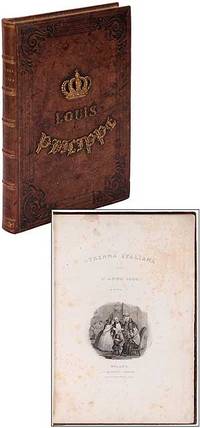
1838réf. 339910Milano: P. Ripamonti Carpano 1838. Hardcover. Very Good. First edition. Text in Italian. Quarto. pp. iv 280 4. With 7 engraved plates frontispiece title page and five plates in text. Bound in contemporary mottled calf gilt spine and turn-ins white silk moiré endpapers all edges gilt. An impressive armorial binding of King Louis Philippe I of France with his crown and name in an ornate metal relief design affixed to the front board. Professionally re-jointed with the original binding fully preserved modest chipping to the edges of the front free endpaper and fly leaf scattered foxing very good. The Strenna Italiana was a popular literary gift annual of Italian poetry and prose: this copy was likely given by Louis Philippe as a gift to an important political ally personal friend or dignitary. A scarce unique copy intended to display Louis Philippe's armorial binding conspicuously on a tabletop. P. Ripamonti Carpano hardcover books
réf. 294916 p.l. 394 i.e. 392 pp. 8vo cont. vellum over boards minor browning. Paris: L. Billaine 1664. “This is the first edition of the earliest extant bibliography of bibliographies despite the ‘curis secundis auctior’ on the title. It is basically an alphabetical list arranged by authors’ first names followed by eight intricate subject indices among them one of publishers’ and booksellers’ catalogues. Appended is a very useful numismatic bibliography. The work enjoyed three later editions during the seventeenth century and provided the basis for Teissier…Labbé 1607-67 one of the most learned polymaths of his time was a Jesuit professor of philosophy in Paris.”–Grolier Club Bibliography 62. Haebler in his Handbuch states that this is the second book on incunabula and the first in which the word is used in connection with printing. A fine copy and rare. Old stamp on verso of title and another on following leaf. ⧠Besterman The Beginnings of Systematic Bibliography pp. 50 & 54. Taylor Book Catalogues pp. 176 208 & 219-20. unknown books
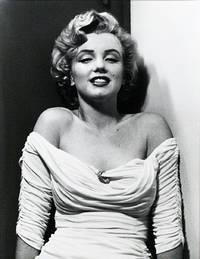
réf. 3092New York: The Neikrug Press 1981. First edition. Original linen clamshell box. Very Good. THE RARE STUNNING COMPLETE PORTFOLIO OF 10 LARGE ICONIC SILVER GELATIN PRINTS OF MARILYN MONROE BY PHILIPPE HALSMAN. EXTREMELY RARE ARTIST PROOF: From the collection of John Springer one of Monroe's press representatives. This portfolio was given to Springer by Yvonne Halsman at the time of publication. Nine of the prints are from Halsman's famous 1952 shoot at Monroe's apartment for LIFE Magazine including the cover shot for the April 7 1952 issue; one "Marilyn Jumping" from his 1959 "Jumpology" series. Halsman explained the circumstances of the 1952 shoot: "I drove to the outskirts of Los Angeles where she lived in a two-room apartment. What impressed me in the living room was the obvious striving for self-improvement. I saw a photograph of Eleanora Duse and a multitude of books that I did not expect to find there like the works of Dostoevsky Freud the history of Fabian socialism etc. On the floor were two barbells." Philippe Halsman website. In addition to the LIFE cover photograph and "Marilyn Jumping" the portfolio includes: "Portrait of Marilyn 1952"; "Marilyn with Barbells 1952"; "Marilyn Entering the Closet 1952"; "Marilyn Flirting 1952"; "Marilyn at the Drive-In 1952"; "Marilyn Listening to Music 1952"; "The True Marilyn 1952"; "Marilyn-Mao 1952". Limitation signed by Yvonne Halsman Philippe Halsman died two years before the portfolio was issued and with artist's proof designation "a/p". Each photograph with hand-stamped copyright on the reverse and the limitation number left blank indicating the artist's proof. Size: 11x14 inch prints; archivally fastened and matted onto 16x20 inch Museum Rag Board. Note: Two of the original mattes have recently been replaced with nearly indistinguishable archival matte boards. New York: The Neikrug Press 1981. Large portfolio. Prints loose as issued in linen clamshell box with title label. Some soiling to box as often; photographs fine. Over the years many sets have been broken up and the prints sold individually; complete sets are now very rare. The Neikrug Press unknown books
1772réf. 30530Paris: Edme 1772. Folio. 19 3/4 x 13 1/8 inches. Engraved frontispiece by B.L. Prevost after Sullier engraved portrait frontispiece by J. Baptiste Michel after Harguinier engraved title vignette by and after Prevost engraved arms of Charles-Eugene de Lorraine on dedication 56 hand-coloured engraved plates by B. Michel Adam femme Fessard F.A. Aveline C. Baquoy Benard Ch. Beulier L. Bosse Prevost and others after Harguinier Lafosse Saullier 19 folding and 7 engraved headpieces by Delaunay Hubert Levilain Lucas Mlle Massard Mesnil Michel after Le Carpentier type-ornament headpieces woodcut head- and tailpieces and initials. Contemporary calf covers bordered with gilt double fillet expertly rebacked to style spine gilt retaining the original red morocco lettering piece period marbled endpapers Deluxe hand-coloured first edition of the best 18th century French work on equine medicine and the anatomy of the horse. Cours d'hippiatrique is distinguished not only by Lafosse's anatomical skill and knowledge of equitation gained through both study and practice of the subject but also by the excellence of its execution: "Ce livre est un veritable monument eleve a l'Hippologie. Papier impression dessin gravure sont egalement signes" Mennessier de la Lance. The vivid colouring of the anatomical plates elevates this hand coloured issue far beyond the regular black and white edition. "Ouvrage fort bien execute et qui a ete longtemps le meilleur que l'on eut sur cette science" Brunet. Brunet III 765; Cohen-de Ricci col.587; Huth p.46; Mellon Books on Horses and Horsemanship 61; Mennessier de la Lance II pp.20-21; Nissen ZBI 2360. Edme unknown books
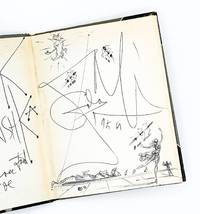
1954réf. 55808New York: Simon and Schuster 1954. First edition. Very good. Lavishly inscribed association copy with multiple drawings from the surrealist master - signed to movie studio mogul Jack Warner and his wife. Jack Warner 1892-1978 was the legendary co-founder and CEO of Warner Bros. Studios which produced such classic films as THE JAZZ SINGER 1927 the first feature-length "talkie" LITTLE CAESAR and PUBLIC ENEMY 1931 THE MALTESE FALCON 1941 CASABLANCA 1943 A STREETCAR NAMED DESIRE 1951 THE SEARCHERS 1956 MY FAIR LADY 1964 and WHO'S AFRAID OF VIRGINIA WOOLF 1966 as well as innumerable other iconic films. By the time Dalí inscribed this copy in 1954 the two had already known each other for at least a decade. In 1944 Dalí had come to Hollywood to work on the Hitchcock film SPELLBOUND for which the artist contributed a pioneering dream sequence. By 1945 Warner had commissioned Dalí to paint portraits of both Warner and his wife Ann with Dalí actually living with the couple while he completed the works Sperling and Millner 269. This unconventional arrangement in fact led to a now-famous meeting between Dalí and Walt Disney an encounter that resulted in "a lifelong friendship between the man behind the mouse and the painter of melted clocks" Jukareddy. At a dinner party hosted by Warner Dalí and Disney were introduced and hit it off so well they began a collaboration that would eventually result in the production of "Destino" a six-and-a-half-minute surrealist animated film: "Dalí and Disney immediately connected and an overjoyed Dalí accepted Disney's proposal to collaborate on a surrealist animated short. Over the next eight months they created more than 200 storyboard sketches" ibid. A work of myth-making and fame-enhancement as much as anything Dalí's whimsical MUSTACHE finds him and his mustache answering questions "Your mustache looks so rigid - how does it react to the winds of public opinion" with playful responses "She bends" all accompanied by surrealist photographs and photo collages. A close and important association between these two titans with among the most elaborate and exuberant Dalí inscriptions we've seen. Original black-and-white pictorial boards. No jacket as issued. 126 pages. Illustrated throughout with photos of Dalí by Philippe Halsman. Preface by Dalí with a "Postface" by Halsman plus publisher's notes "on how some of the photographs were made." Inscribed in year of publication by Dalí to Jack Warner and his wife Ann across the front pastedown and endpaper: "Pur sic a pun / Prince des Gouts Felines / Jack / ei / Anunshka / L'amour de sur tout / Dalí / Gala / 1954. Roughly: "Purr for the Prince of Feline Tastes Jack and Ann Love above all." Dali has added numerous figures including a crown a shooting star a drawing of two figures dancing in a desert plus three scurrying ants and a moon playing a trumpet overhead. Chipping to head of spine with top centimeter or so of spine beginning to separate but holding. Some toning to endpapers and some starting at gutter before title-page. Housed in a custom clamshell box. Simon and Schuster unknown books
réf. BOH 217FASCINATING MEDIEVAL BOOK OF HOURS WITH EXTENSIVE ILLUMINATIONS BY THREE DIFFERENT ARTISTS. In Latin and some French illuminated manuscript on parchment Southern Netherlands Mons c. 1460 original portion c. 1480-1490 updated. Dimensions 167 x 116 mm. 199 folios lacking one text leaf written by two different scribes in gothic textualis bookhand in single column on 17 lines; BINDING: seventeenth century brown calf over wooden boards spine with four raised bands gold-tooled gilt title "OFFICIU / BEATEM / VIRGIN" partly worn out gilt edges. ILLUSTRATION: 22 full-page miniatures within full rinceaux borders by the Mildmay Master 13 the Master of Philippe de Croÿ 7 and a third Mons illuminator follower of Simon Marmion 2 and 4 small miniatures by the Mildmay Master additional sixteen full rinceaux borders and 5-line initials in pink or blue on burnished gold grounds. The Mildmay Master was responsible for the core of the original manuscript; the artist paints elongated figures with small heads and slender bodies mostly situated on pale yellow tiled grounds. His outdoor landscapes are cursory. Unusual here are his delicate acanthus and floral borders sprinkled with fanciful grotesques. The artist responsible for updating the manuscript is the Philippe de Croÿ Master. He favors tiled floors in brown or gray and white with a generally somber almost grisaille palette with blue and white grey and a burnt brownish orange. A third painter a follower of Simon Marmion intervened during this second campaign. The most skilled of the three illuminators his delicate figures are well-modeled with tiny hands and individualized faces. PROVENANCE: The manuscript was made in Southern Netherlands probably in two different stages. The core of the Hours and the calendar were written in Mons for an unknown patron c. 1460. Then around 1480 the manuscript was updated also in Mons for a couple represented in prayer in the manuscript: Jean Antoine de Mahieu Lord of Bosqueau and his wife Jacqueline de Sivry Lady of Buath; belonged to Jean-Baptiste-Florentin Gabriel de Meyran marquis de Lagoy 1764-1829; inside front cover: "Jean Fransois de Lescluse demeurant a Frasne." CONDITION: ink stain in the margin of f. 1 water stains in lower margins of first 32 leaves colors slightly faded on marginal decoration f. 120v stain in the marginal decoration f. 77v other minor signs of use otherwise in very good condition. Binding condition: leather very rubbed gold tooling worn front cover almost detached hinges of the back cover fragile. Full description and images available. BOH 217 Southern Netherlands, Mons, c. 1460 (original portion), updated c. 1480-1490 books