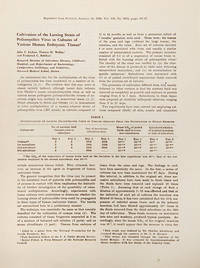
Best.-Nr. 115175Washington D.C. American Association for the Advancement of Science January 28 1949. . Offprint single leaf folded once; a fine copy. The rare offprint of the paper announcing the first cultivation of polio virus in cell cultures the breakthrough that made modern vaccines possible. After studying pathogenic bacteria for a decade Harvard Medical School microbiologist John Enders 1897-1985 turned his attention to viruses refining his culture techniques with the mumps before applying them to polio. 'Before this discovery scientists had been able to grow polio virus only in the nervous tissue of susceptible laboratory animals commonly monkeys in a painstaking process that yielded minute quantities of the virus. The work of Enders Weller and Robbins had the tremendous practical effect of enabling scientists to prepare large amounts of polio virus making possible the mass production of the Salk killed-virus vaccine and later the Sabin live-virus vaccine. The impact of their work however was not limited to the study of polio. Their culture technique gave researchers an invaluable tool for the study of other viruses; made viral research much less laborious time-consuming and costly; and sparked revolutionary progress in the field; America Association of Immunologists biography. Enders was responsible for 'one of the most gracious acts in the history of the Nobel Prize' refusing to accept the award when it was offered to him alone and insisting that his co-authors 'those who did the work' be recognised equally Rosen 'Isolation of Poliovirus - John Enders and the Nobel Prize' New England Journal of Medicine vol. 351 no. 1 October 2004. Garrison-Morton Medical Bibliography 4671.1. [Washington D.C., American Association for the Advancement of Science], January 28, 1949. unknown