4.581 Ergebnisse
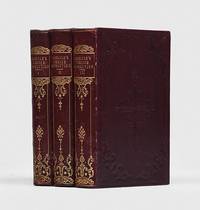
1907Best.-Nr. ST20299London: The Doves Press 1907. ONE OF 300 COPIES printed on paper and 15 on vellum. 235 x 165 mm. 9 1/4 x 6 1/2". 341 1 pp. VERY ATTRACTIVE DARK BLUE CRUSHED MOROCCO IN THE STYLE OF THE DOVES BINDERY counterfeit signature stamped and dated 1907 to the rear turn-in covers simply framed by two plain gilt rules raised bands spine compartments with rose window designs formed by six open ovals accented with dots encircled by two gilt rules with low platforms and dots above and below gilt titling turn-ins gilt-ruled and with cornerpieces of open ovals dots and gouge work all edges gilt and gauffered with two rows of tiny dots. Initials designed by Edward Johnston. Printed in red and black. Pastedown with the bookplate of Helen and Michael Oppenheimer. Tidcombe DP-13. For the binding: Tidcombe p. 464. Spine a little sunned just a trace of soiling to leather the usual offsetting from the facing turn-ins on the front and rear free endpaper a hint of yellowing to quire b but still fine the text otherwise pristine and the binding unworn and lustrous. This is one of the 26 intriguing and obviously uncommon examples Tidcombe has identified as forged or imitation Doves bindings a group of handsomely executed volumes that continue to be mysterious. Tidcombe differentiates between forgeries those books that are stamp-signed with "C - S" and a date as here on the one hand and unsigned "copies of Doves bindings or bindings in the Doves style" on the other. But she treats them as one group "because they have several features in common." For example signed or unsigned all of the suspect bindings cover Doves Press books all are bound in dark blue morocco and all have a signature pallet with the letters "E" and "S" close together. Although Tidcombe suggests that the person responsible for the forged Doves bindings could possibly have been the former Doves Bindery finisher Charles McLeish she does not settle on him or any other likely candidate. Whoever was behind them the volumes in this puzzling group of bindings--like other forgeries and imitations of historically important cultural artifacts--are actively collected for their value as counterfeits. And as with other counterfeits the present binding is a kind of implicit homage in this case to the outstanding work done by Cobden-Sanderson at the Doves Bindery--our spurious binding would not have been worth undertaking were the objects it mirrored not so universally recognized as worthy of imitation. The text here is an uncategorizable work reminiscent of satires by Swift and Sterne in its fictitious biography of Teufelsdroeckh i.e. "devil's dung" Professor of Things in General at the University of Weissnichtwo "Know-not-where". Day calls it "an intellectual and spiritual autobiography and a diatribe against current conditions in England" that advocates a reorganization of society and its institutions so that "Brotherhood and the duty to work usefully will grip mankind's true leaders and assure a theocracy a reborn humanity ruled by the divine spirit within." Our volume was formerly in the collection of fine private press books owned by the distinguished scholars Sir Michael Oppenheimer 1924-2020 and his wife Lady Helen Oppenheimer 1926-2022; he was an Oxford lecturer in politics and history she an Anglican theologian whose groundbreaking work on ethics helped reform the church's position on remarriage of divorced persons. The Doves Press unknown
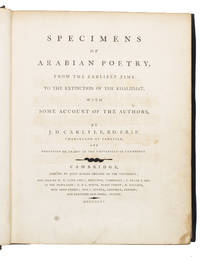
1796Best.-Nr. ABC_48589Cambridge: Printed by John Burges printer to the university 1796. Contemporary brown calf with a later spine a dark red morocco title-label on the spine with the title and author lettered in gold marbled endpapers. 4to. With an engraved sheet with musical notation. 2 parts in 1 volume. First edition of this beautiful example of Orientalist scholarship presenting sixty early Arabic poems in their original language with English translations. This work by Orientalist Joseph Dacre Carlyle 1758-1804 enabled the English to discover the beauty of Arabic literature. The poems which cover a wide range of topics offer a glimpse into the rich cultural heritage of the Arab world. Carlyle was the first to translate these poems into English. His translations became quite well-known and continued to be used in other works until at least the late 19th century.The work is a collection of poems from the Arabian peninsula between the 6th and 13th century. It includes a poem written on the tomb of Sayid by Abd Almalec Alharithy dates unknown a poem on avarice by Hatim al-Tai -578 and a poem about a thunder storm by Ibrahim Ben Khiret Abou Isaac dates unknown. In addition to the poems themselves the work also provides some biographical information about the poets offering readers a deeper understanding of the historical and cultural context in which the poems were written. The work consists of two parts the first contains the poems in English and the second in Arabic.Carlyle was professor of Arabic at the University of Cambridge. He was appointed chaplain by Thomas Bruce Lord Elgin 1766-1841 to the embassy at Constantinople in 1799 and pursued his researches in Eastern literature in a tour through Asia Minor Palestine Greece and Italy. During his travels he collected several valuable Greek and Syriac manuscripts.The work has been rebacked the leather on the boards is dried and cracked the flyleaf in the back has been replaced by a different marbled paper. The work is somewhat browned throughout with mild foxing on the first few leaves annotations in pencil on page 12 and 80. Otherwise in good condition.l BMC 4 1258.1197; Graesse II p. 49. Printed by John Burges printer to the university, unknown
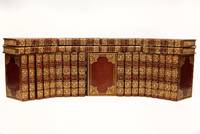
1896Best.-Nr. 3445London: Chapman and Hall Limited 1896. The Centenary Edition Large Paper Edition Limited Edition. Leather Bound. Very Good. The Centenary Edition Large Paper Edition Limited Edition. Leather Bound. 30 vol. Thomas Carlyle The Works of Thomas Carlyle. The Centenary Edition Large Paper Edition Limited Edition limited to 300 sets of which this is no. 274. Illustrated frontispiece of Louis XVI of France. Illustrated throughout. Top edges gilt raised bands on spine. Bound in full brown Morocco leather with elaborate gilt floral embellishments on front and back covers and beautiful gilt floral embellishments on spine panels. Beautiful leather and silk doublures on inner covers. Published London: Chapman and Hall Limited 1896. H: 8 7/8" W: 6 1/4" D: 1 1/2 Chapman and Hall Limited unknown
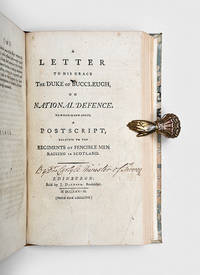
1778Best.-Nr. 152780Edinburgh: J. Dickson 1778. First edition second issue "a re-issue of the London edition of the same year with a cancel title page and the addition of a postscript dated: Lincoln's Inn July 20th 1778" ESTC this copy also retaining the London title page. "This discussion of the bill for extending the militia law of Scotland introduced in 1776 contains a number of passing references to the war in America" Adams. The postscript comments on Burgoyne's defeat. Carlyle is identified as author in a contemporary hand on the Edinburgh title. After studies at Edinburgh Glasgow and Leiden where his classmates included William Robertson Adam Ferguson and John Home Carlyle was licensed to preach in 1746 and was introduced to the parish of Inveresk some five miles south-east of Edinburgh by the duke of Buccleuch the following year receiving his ordination in 1748. A moderate in his support for ecclesiastical patronage and politically conservative issues as well as in his endorsement of Enlightenment cultural principles including liberal education polite learning and religious toleration Carlyle was a familiar figure in the cultural life of what has come to be known as the Scottish Enlightenment. Strong and outspoken in his support for the Scots militia cause having written in 1760 The Question relating to a Scots Militia Considered the present pamphlet attacks Smith's apparent opposition to militias in the Wealth of Nations citing passages from Smith's book and also referring to the opinions of the Encyclopedistes. The other pamphlets included in this volume are: DOUGLAS John William Pulteney and Junius attributed authors. A Letter addressed to two Great Men on the prospect of peace; and on the terms necessary to be insisted upon in the negotiation. London: Millar and A. Kincaid & J. Bell Edinburgh 1760. Howes 6095. DALRYMPLE Sir John. The Rights of Great Britain asserted against the Claims of America: being an answer to the declaration of the General Congress. The third edition with additions. London: T. Cadell 1776. Howes 2564. LIND John. An Answer to the Declaration of the American Congress. The fourth edition. London: T. Cadell J. Walter and T. Sewell 1776. Howes 6167. TOWNSHEND Charles. Remarks on the Letter addressed to two Great Men. I a Letter to the author of that piece. London: printed in the year 1760. Howes 10372. Manuscript attribution to Henry Lord Holland on title. Octavo 209 x 122 mm. Bound fourth with four other pamphlets related to American affairs in contemporary quarter sheep and marbled boards vellum tips spine ruled gilt in compartments red morocco label lettered "Pamphlets" and numbered 2 direct sprinkled edges. Ownership inscription "Binning" to front pastedown dated 1779 with a manuscript list of the volume's contents to front free endpaper. Short tear to head of front joint; a very good copy. Adams The American Controversy 78-56b variant; ESTC T179898 locating copies at the National Library of Scotland and Harvard Business School only. The London imprint ESTC T107064 is slightly more common with copies located at British Library Columbia Harvard JCB and the New York Historical Society only; Vanderblue p. 50. hardcover
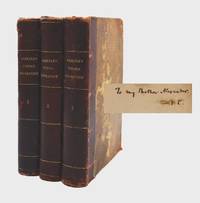
1837Best.-Nr. 372411London: James Fraser 1837. First Edition with half-titles. vii 1 404; vii 1 422 2; vii 1 448pp. 3 vols. 8vo. Contemporay three-quarters morocco with gilt bands and title to spine and marbled paper boards. General edgewear and rubbing to boards spine and corners generally sound; tear to half-title and bump to contents pages in vol. 3 overall occasional spotting and foxing to endpapers. Letters with old folds staining some loss both silked. In matching custom clamshell box and folder. First Edition with half-titles. vii 1 404; vii 1 422 2; vii 1 448pp. 3 vols. 8vo. Inscribed in the first volume: "To my brother Alexander. T.C." With 2 ALS laid in from Thomas to his brother Alex as well as a note laid-in in pencil: "Published 1837 / autographed to Grandfather / HCJ 1950." Carlyle and his brother Alexander were the eldest of nine children and their correspondence goes from when Carlyle was in Edinburgh trying to get his footing as a writer until Alexander died on his farm in Canada in 1876. They were "remarkably close" and Thomas wrote to Alexander with "an open and copious expression of feeling and in this regard are distinguished from the letters Carlyle wrote to Goethe Emerson Mill Sterling and Browing.He showed his love for Alexander in many of the letters he wrote either to or about him by the frequency with which he wrote and the moral and financial support he gave to him by accepting support from him in return and by graphically bringing to him the sophisticated worlds from which Alexander was isolated" Marrs p. viii. One of Carlyle's dreams was to live on a self-sustaining farm where he could work in peace. He moved to such a farm in Hoddam Hill in May 1825 which his father leased for him and Alexander moved away from the family farm to work the land with a helper. The plans for the farm are discussed in the second letter sent February 1825. Disagreements with the landlord caused them to give up the plot but Carlyle would remember it fondly the rest of his life. Alexander eventually moved to Canada to live on his own farm. The first letter of 24th of May 1823 tells an animated and detail rich story about traveling to Kinnaird the Buller house near Dunkeld where he was to work as tutor to the two adolescent sons. He talks sitting next to a Dr. Fyfe one of Jane Welsh's "more ardent and enterprising suitors" Marrs p. 146 as well as his impressions of first arriving in Dunkeld "among people of such a fashionable turn" and the house where he was to stay. At the time he was deeply involved in his Life of Schiller articles for Taylor's London Magazine completing the first of three articles in April and had begun translating Goethe's Apprenticeship of Wilhelm Meister for Edinburgh publisher Boyd: "The family received me hospitly and shewed me into my quarters where I spent two hours in unpacking and arranging my goods. I have not dined and having all put to rights I am scribbling to Alick.I shall be quite comfortable here.I shall be as quiet as in the middle of Sahara; shall bolt my door and study and read and smoke according to my own pleasure." The second letter dated February 14 1824 sic. but postmarked February 17 1825 discusses his plans: "I must settle some place of abode for myself some scheme of existing in conformity to my medical prescriptions and also of proceeding with my literary employments. The farm is still my favourite or rather only steady project. A reasonable house is all that I want; with land that would pay you for working it." He talks also of learning Spanish and describes his dreams of accomplishment and reputation: "Literary fame is a thing which I covet little; but I desire to be working honestly in my day and generation in this business which has now become my trade. I make no grain of doubt that in time I shall penetrate the fence that keeps me back and find the place which is due to me among my fellow men. Some hundreds of stupider people are at this very time doing duty with acceptance in the literature of the time. We shall see; I am not at all in a hurry; the time will come." It was this book written a decade later that established Carlyle's reputation as an important intellectual: "a prose epic teeming with colourful scenes of dramatic events and imaginative portraits of the leading revolutionaries. The book at once captured the English-speaking world and has outside France moulded popular conception of the French Revolution down to the present day" PMM In his letter to Alexander in Canada written 23 April 1837 he references the completion of "The Book" "it is all in type my share of it finished.I suppose it will be out as a Book in not many days. You shall have a Copy of it by the earliest chance after that; and good appetite I shall wish you with it. It is I think the most radical Book that has been written in these late centuries.and will give pleasure and displeasure one may expect to almost all classes of persons. Let it take its fate: the great indisputable blessin is that I have done with it forever and a day" Marrs p. 421. PMM 304; Marrs ed. The Letters of Thomas Carlyle to his Brother Alexander p. 142-147 p. 191-195 James Fraser unknown
1837Best.-Nr. 174294London: James Fraser 1837. Moulding "popular conceptions of the French Revolution down to the present day" First edition bound for presentation and inscribed by the author to his mother-in-law on the title page of the first volume: "To Mrs. John Welsh. Liverpool. T.C. London June 1837". A leaf of the original manuscript closely written across two sides is bound in facing the title. Presentation copies of Carlyle's magnum opus are extremely scarce. The History was published in May 1837. Grace Welsh 1782-1842 the mother of Jane Welsh Carlyle 1801-1866 is recorded as visiting the couple in London at the end of May whereupon Thomas removed himself to rural Scotland. Grace had not approved of her daughter's choice to marry Carlyle in October 1826. In Jane's own words writing to him without her mother's knowledge made her "as nervous as if I were committing a murder" ODNB. Grace leased the pair a modest home in Edinburgh shortly after their marriage but relations between mother and daughter remained fraught throughout their lives. While writing the History Carlyle observed of one maternal visit that "Jane and her mother cannot live together" quoted in Ireland p. 151. The manuscript leaf preserves the text for pages 58-62 of Volume III discussing the aftermath of the September Massacres of 1792. It runs to 45 lines and contains several corrections and crossed-through sections including some two and a half lines not printed on page 59. The final manuscript of the History was largely destroyed after publication only fragments remaining. This copy remained in the Welsh family until 1938 when it was sold at Sotheby's after the death of Mary Chrystal the granddaughter of Jane Welsh's uncle. Carlyle's History remains one of the most authoritative accounts of the early Revolution. The work established his reputation as an intellectual and influenced many of his contemporaries - including Dickens whose Tale of Two Cities drew heavily from it. "The book at once captured the English-speaking world and has outside France moulded popular conceptions of the French Revolution down to the present day" PMM. 3 vols octavo 182 x 115 mm. All vols bound without half-titles vol. II bound without leaf of publisher's advertisements at rear. Bound for presentation in contemporary full purple morocco spines lettered and decorated in gilt covers with decorative border and central ornament in blind turn-ins in gilt light yellow coated endpapers edges gilt. Housed in custom red morocco book-form case. Neat contemporary note to p. 318 of vol. III "see 328". Margins of manuscript leaf slightly trimmed vol. III sig. P4 bound after P8. Aside from light rubbing to extremities and very minor sunning to spines bindings bright and fresh slight superficial split to front inner hinge of vol. I and in a few places to the text block but all holding firm scattered light foxing. A highly attractive copy. Dyer p. 85; Printing and the Mind of Man 304; Tarr A8.1. Annie Elizabeth Ireland Life of Jane Welsh Carlyle 1891. unknown