4447 risultati
1910rif. R160152599MERCURE DE FRANCE. 1910. In-8. Broché. Etat d'usage, Couv. convenable, Dos satisfaisant, Intérieur frais. 443 Pages. . . . Classification Dewey : 820-Littératures anglaise et anglo-saxonne
rif. R160152600MERCURE DE FRANCE. NON DATE. In-8. Broché. Etat d'usage, Plats abîmés, Dos abîmé, Intérieur frais. 352 Pages - Manque coiffe en pied. . . . Classification Dewey : 820-Littératures anglaise et anglo-saxonne
1997rif. R240115474MAISONNEUVE ET LAROSE / EDITIONS DES DEUX MONDES. 1997. In-8. Broché. Bon état, Couv. convenable, Dos plié, Intérieur frais. 317 pages - annotation et soulignements au crayon dans le texte, sans conséquences sur la lecture - + 1 feuillet éditeur + 1 carte de visite signé de Bruno De Cessole. . . . Classification Dewey : 929.2-Histoire des familles célèbres
1949rif. R320089173DENT J.M. & SONS, LTD. VERS 1949. In-12. Relié. Bon état, Couv. convenable, Dos satisfaisant, Intérieur frais. XV + 304 pages - Jaquette satisfaisante.. Avec Jaquette. . . Classification Dewey : 420-Langue anglaise. Anglo-saxon
1905rif. RO60054144Armand Colin. 1905. In-12. Broché. Etat d'usage, Couv. convenable, Dos abîmé, Quelques rousseurs. 360 pages. Dos fendu, avec d'importants manques.. . . . Classification Dewey : 820-Littératures anglaise et anglo-saxonne
rif. RO60122702J. M. Dent & Sons Ltd - E. P. Dutton & Co.. Non daté. In-12. Relié. Etat d'usage, Couv. défraîchie, Dos satisfaisant, Intérieur acceptable. 339 pages. Motifs ornementaux noirs en frontispice et page de titre. Tranche en tête grise. Annotations en page de garde (ex-libris).. . . . Classification Dewey : 420-Langue anglaise. Anglo-saxon
1907rif. RO60122234Chapman & Hall. 1907. In-12. Relié. Etat d'usage, Couv. légèrement passée, Dos abîmé, Intérieur acceptable. 235 pages. Nombreuses annotations au crayon dans l'ouvrage (ouvrage de travail).. . . . Classification Dewey : 420-Langue anglaise. Anglo-saxon
rif. RO60122448J. M. Dent & Sons Ltd - E. P. Dutton & Co.. Non daté. In-12. Broché. Etat d'usage, Couv. légèrement passée, Coiffe en pied abîmée, Intérieur acceptable. 341 pages. Motifs ornementaux noirs en frontispice et page de titre. Titre et motifs dorés sur le dos. Tranche en tête grise. Annotations en page de garde.. . . . Classification Dewey : 420-Langue anglaise. Anglo-saxon
rif. R200079495HENRI GAUTIER. NON DATE. In-12. En feuillets. Etat d'usage, Couv. convenable, Dos satisfaisant, Papier jauni. 32 pages. Quelques rousseurs.. . . . Classification Dewey : 944.04-Révolution de 1789
rif. R240135726HENRI GAUTIER. NON DATE. In-12. Broché. Etat d'usage, Couv. légèrement passée, Dos satisfaisant, Intérieur acceptable. 32 pages.. . . . Classification Dewey : 944.04-Révolution de 1789
rif. R200100035Reclam-Verlag Stuttgart, Cassel and Company. Non daté. In-12. Relié toilé. Etat d'usage, Couv. convenable, Dos satisfaisant, Papier jauni. 192 pages. Quelques annotations à l'encre dans le texte. 1er Texte en allemand. 2ème texte en anglais.. . . . Classification Dewey : 430-Langues germaniques. Allemand
1888rif. R200104078Henry-Gautier / Librairie Bleriot. 1888. In-8. Broché. Etat d'usage, Tâchée, Dos satisfaisant, Papier jauni. 32 pages. Quelques rousseurs et pliures.. . . . Classification Dewey : 70.49-Presse illustrée, magazines, revues
rif. R240162672Chapman and Hall. Non daté. In-12. Relié toilé. Etat d'usage, Coins frottés, Dos frotté, Intérieur acceptable. 324 pages. Non daté. Nombreuses annotations au crayon de papier dans le texte. Coiffes abîmées.. . . . Classification Dewey : 420-Langue anglaise. Anglo-saxon
1908rif. R320126452Cassell and Company Ltd. 1908. In-12. Cartonné. Etat d'usage, Couv. convenable, Coiffe en tête abîmée, Papier jauni. 340 pages - ouvrage en anglais.. . . . Classification Dewey : 420-Langue anglaise. Anglo-saxon
rif. R300165507Mercure de France. Non daté. In-12. Broché. Etat d'usage, Couv. légèrement passée, Dos abîmé, Quelques rousseurs. 364 pages. Mors fendus, 1er plat et cahiers quasiment désolidarisés. Dos plié. Non daté.. . . . Classification Dewey : 97.2-Dédicace, envoi
rif. 4941The minerva library of famous books, 3 t. en 1 vol. – Londres, New-York et Melbourne, 1891 – illustrations n et b, in-8, 632 pp – rel. éditeur percaline verte d'ep.
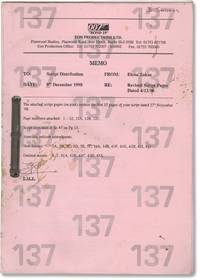
rif. 166272Iver Heath Buckinghamshire: Pinewood Studios 1998. Revised Draft script for the 1999 film seen here under the working title "Bond 19." Copy belonging to visual effects technician Brian Smithies with his name in manuscript ink on the first page of the script and his annotations on several script pages denoting scenes utilizing visual effects. Numeric watermark on each script page. During an assignment to protect a late billionaire's daughter from her father's killers James Bond uncovers an international scheme to increase petroleum prices by way of a nuclear disaster. The nineteenth film in the James Bond series and the third to star Pierce Brosnan as the titular MI6 agent. Shot on location throughout Spain France Azerbaijan Turkey and the UK. Self wrappers. Title page replaced with a memo revision page dated December 4 1998. 119 leaves with last page of text numbered 115. Xerographic duplication rectos only with 16 pink revision pages bound in at the beginning of the script dated December 4 1998. Pages Very Good plus bound with a silver prong with light rust near the binding and moderate dampstaining on the first page of the script. Pinewood Studios unknown books
1965rif. 147218Los Angeles: Twentieth Century-Fox Television 1965. First Draft script for the 14th and final episode of the first and only season of "Blue Light" originally aired on ABC on May 18 1966. With manuscript ink annotations to the cast list noting the names of prospective actors for each role. An American spy living in Germany during World War II receives orders to kill a scientist who appears to be completing an atomic bomb for the SS but soon realizes the man may be working against the Nazis after all. Set in Germany. Red titled wrappers noted as FIRST DRAFT on the front wrapper dated DECEMBER 22 1965. Title page present dated December 22 1965 noted as FIRST DRAFT with credits for screenwriter Harold Livingstone. 36 leaves with last page of text numbered 33. Mimeograph duplication on eye-rest green stock rectos only. Pages Near Fine wrapper Very Good plus bound with two gold brads. Twentieth Century-Fox Television unknown books
1988rif. 217862Austin TX: Dorsoduro Press 1988. First edition and first printing. Oblong hardcover. Includes numerous black and white images as well as text by Darling. A clean and tight very near fine copy with publisher sticker to the front free endpaper and in a near fine dust jacket. Signed and very warmly inscribed by Darling on the front free endpaper to fellow photographer Barbara Crane. A nice association copy. Dorsoduro Press unknown books
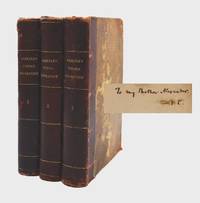
1837rif. 372411London: James Fraser 1837. First Edition with half-titles. vii 1 404; vii 1 422 2; vii 1 448pp. 3 vols. 8vo. Contemporay three-quarters morocco with gilt bands and title to spine and marbled paper boards. General edgewear and rubbing to boards spine and corners generally sound; tear to half-title and bump to contents pages in vol. 3 overall occasional spotting and foxing to endpapers. Letters with old folds staining some loss both silked. In matching custom clamshell box and folder. First Edition with half-titles. vii 1 404; vii 1 422 2; vii 1 448pp. 3 vols. 8vo. Inscribed in the first volume: "To my brother Alexander. T.C." With 2 ALS laid in from Thomas to his brother Alex as well as a note laid-in in pencil: "Published 1837 / autographed to Grandfather / HCJ 1950." Carlyle and his brother Alexander were the eldest of nine children and their correspondence goes from when Carlyle was in Edinburgh trying to get his footing as a writer until Alexander died on his farm in Canada in 1876. They were "remarkably close" and Thomas wrote to Alexander with "an open and copious expression of feeling and in this regard are distinguished from the letters Carlyle wrote to Goethe Emerson Mill Sterling and Browing.He showed his love for Alexander in many of the letters he wrote either to or about him by the frequency with which he wrote and the moral and financial support he gave to him by accepting support from him in return and by graphically bringing to him the sophisticated worlds from which Alexander was isolated" Marrs p. viii. One of Carlyle's dreams was to live on a self-sustaining farm where he could work in peace. He moved to such a farm in Hoddam Hill in May 1825 which his father leased for him and Alexander moved away from the family farm to work the land with a helper. The plans for the farm are discussed in the second letter sent February 1825. Disagreements with the landlord caused them to give up the plot but Carlyle would remember it fondly the rest of his life. Alexander eventually moved to Canada to live on his own farm. The first letter of 24th of May 1823 tells an animated and detail rich story about traveling to Kinnaird the Buller house near Dunkeld where he was to work as tutor to the two adolescent sons. He talks sitting next to a Dr. Fyfe one of Jane Welsh's "more ardent and enterprising suitors" Marrs p. 146 as well as his impressions of first arriving in Dunkeld "among people of such a fashionable turn" and the house where he was to stay. At the time he was deeply involved in his Life of Schiller articles for Taylor's London Magazine completing the first of three articles in April and had begun translating Goethe's Apprenticeship of Wilhelm Meister for Edinburgh publisher Boyd: "The family received me hospitly and shewed me into my quarters where I spent two hours in unpacking and arranging my goods. I have not dined and having all put to rights I am scribbling to Alick.I shall be quite comfortable here.I shall be as quiet as in the middle of Sahara; shall bolt my door and study and read and smoke according to my own pleasure." The second letter dated February 14 1824 sic. but postmarked February 17 1825 discusses his plans: "I must settle some place of abode for myself some scheme of existing in conformity to my medical prescriptions and also of proceeding with my literary employments. The farm is still my favourite or rather only steady project. A reasonable house is all that I want; with land that would pay you for working it." He talks also of learning Spanish and describes his dreams of accomplishment and reputation: "Literary fame is a thing which I covet little; but I desire to be working honestly in my day and generation in this business which has now become my trade. I make no grain of doubt that in time I shall penetrate the fence that keeps me back and find the place which is due to me among my fellow men. Some hundreds of stupider people are at this very time doing duty with acceptance in the literature of the time. We shall see; I am not at all in a hurry; the time will come." It was this book written a decade later that established Carlyle's reputation as an important intellectual: "a prose epic teeming with colourful scenes of dramatic events and imaginative portraits of the leading revolutionaries. The book at once captured the English-speaking world and has outside France moulded popular conception of the French Revolution down to the present day" PMM In his letter to Alexander in Canada written 23 April 1837 he references the completion of "The Book" "it is all in type my share of it finished.I suppose it will be out as a Book in not many days. You shall have a Copy of it by the earliest chance after that; and good appetite I shall wish you with it. It is I think the most radical Book that has been written in these late centuries.and will give pleasure and displeasure one may expect to almost all classes of persons. Let it take its fate: the great indisputable blessin is that I have done with it forever and a day" Marrs p. 421. PMM 304; Marrs ed. The Letters of Thomas Carlyle to his Brother Alexander p. 142-147 p. 191-195 James Fraser unknown books
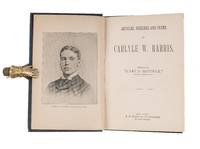
1893rif. 836671893. New York: J.S. Ogilvie 1893. 205 pp. New York: J.S. Ogilvie 1893. 205 pp. Murdered with Poisoned Sleeping Pills: McDade 444 Harris Carlyle 1869-1893. Harris Francis McCreedy Editor. Articles Speeches and Poems of Carlyle W. Harris. Edited by "Carl's Mother" Hope Ledyard. New York: J.S. Ogilvie Publisher 1893. 205 pp. Portrait frontispiece. Octavo 7-1/4" x 4-3/4"; 18.3 x 11.6 cm. Original cloth blind fillets to front board gilt title and blind fillets to spine patterned endpapers. Light soiling and minor shelfwear spine ends and corners bumped. Moderate toning to interior negligible light foxing to a few leaves partial crack in text block after title page all leaves secure. A very good copy. $350. Only edition. This was a famous case in which Harris a medical student murdered his wife with poisoned sleeping pills. He was convicted and executed in the electric chair at Sing Sing Prison. Harris's mother who believed her son to be innocent was the author of several edifying books for children and young women published under the pen-name Hope Ledyard. OCLC locates 1 copy in a law library Harvard. McDade The Annals of Murder 444. unknown books
rif. TK0340London:: Chapman and Hall no date. Small 8vo. 235 1 pp. Early full dark burgundy with gilt stamping Cheltenham Training College on upper cover; extremities worn. Ownership signature of David Thomas Merthyr Lydirl 7/9/47. Good. Printed Robson and Sons printers Pancras Road N.W. Chapman and Hall, [no date]. unknown books
1836rif. 3467031836. Bifolium 2 pp. 8vo. Old folds wax seal remnants very good. Bifolium 2 pp. 8vo. Carlyle writes to John Sterling 1806-1844 for an account of his - famously poor - health offering the help of his wife and quoting from Goethe. Sterling was a Scottish author. A follower of Coleridge he was entrusted to edit his unpublished theological writings. Carlyle much admired Sterling's anonymously-published novel set during the French Revolution Arthur Coningsby 1832 and first met Sterling in person at John Stuart Mill's office in February 1835. In October 1839 Mill published Sterling's a controversial essay on Carlyle. They carried on a correspondence from the time they met until the end of Sterling's short life. Carlyle and Julius Hare were put in joint care of Sterling's papers and Hare published Essays and Tales in 1848 but Carlyle was upset with how it turned out and published his Life of John Sterling in 1851 using most of their correspondence in a highly edited form ODNB. Henry James Sr. who visited Sterling near the end of his life on the Isle of Wight called him "a perfectly delightful man just the antipodes of Carlyle and the only man Carlyle had any sincere attachment to" Boston Sunday Herald 17 April 1881. The full text of the letter: Chelsea Saturday Morning My dear Sterling - If it will not hurt you to write pray send me a little Bulletin with your own hand. I hear nothing but more or less contradictory accounts the average of which is a vague statu-quo. Your Doctors undoubtedly have done well to seclude you; this I must say tho' I suffer by it like others. If at any hour it become medically permissible for you to be talked to pray send me word. But above all things mein Lieher get fast well again. We miss you terribly; it is many long years since I in particular saw a face like yours. Courage Hoffnung und Ergebung! Die Zukunjt decket - Schmerzen und Gliicke. Dock ungeschrecket - Dringen wir vorwdrts I am to be at your Father's to-night seeking my Wife: the answer to this cannot come by post till Monday. Jane bids me say "If there were anything in the world she could do! She is the most disengaged woman in London at present." I believe the message is sincere to the fullest extent. God bless you and keep you my dear Friend! Yours brüderlich T. Carlyle. New Letters of Thomas Carlyle Vol. 1 London: John Lane 1904 p. 1-2 unknown books
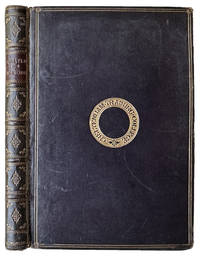
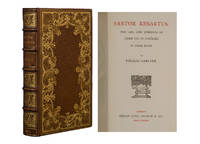
1889rif. 6403London: Kegan Paul Trench & Co 1889. Fine. Sixteenmo 6 3/16 x 3 5/8 inches; 157 x 93 mm. vi 306 1 imprint 5 blank pp. Portrait frontispiece with tissue guard. Title-page printed in red and black. Bound ca. 1920 by Rivière & Son stamp signed in gilt on lower turn-in. Full antelope crushed levant morocco covers decoratively ruled in gilt surrounding a very elaborate floral design in pointillé spine with five raised bands similarly decorated and lettered in gilt in compartments gilt-ruled board edges full dark blue morocco liners elaborately decorated in gilt blue watered silk end-leaves top edge gilt. A wonderful example of the art of 'pointillé'. The Scottish author critic and thinker Thomas Carlyle 1795-1881 was a major influence on Victorian society. His novel Sartor Resartus translated as The Tailor Re-tailored among other variations is a satirical look at the work of a fictional philosopher Diogenes Teufelsdröckh. Intriguing in its form the book is structured from the prospective of a skeptical English reviewer consumed by Teufelsdröckh's book Clothes Their Origin and Influence. In crafting Sartor Resartus Carlyle drew on a range of literary influences: Goethe Hegel Sterne and Switft. Carlyle's complicated text not only critiques academic writing and materialism but offers meditations on the meanings of symbols and the search for truth. Although first started as an essay the project eventually developed into a novel which was first published serially in Fraser's Magazine 1833-34. Fine. Kegan Paul, Trench & Co unknown books
1817rif. 66566Carlisle: printed and sold by B. Scott; sold also by J. Richardson and W. Clarke London; and A. Constable and Co. and Oliver and Boyd Edinburgh 1817. Foolscap 8vo pp. 6 192; original drab paper-covered boards printed paper label on spine upper board stained joints starting spine label chipped; a good copy. A poem on the early history of the area around Gilsland village. The author's only work. printed and sold by B. Scott; sold also by J. Richardson and W. Clarke, London; and A. Constable and Co., and Oliver and Boyd, E unknown books