Geoffrey ChaucerBiblio.com

2 879 résultats
2011réf. 001466London: Folio Society 2011. Limited Edition . Hardcover. Near Fine. Eric Gill. Limited edition of 1250 numbered copies this copy is No.122. Two volumes housed in black buckram clamshell box in near fine condition with a few very small marks. 4tos . Vol 1 commentary volume pp48 bound in blue buckram spine over blue paper covered boards with title label to front board in fine condition. Vol 2 the facsimile volume xi pp310 plus limitation page bound in full black goatskin with illustrated gilt design and titles in fine condition. Inside all pages with full edge gilt and illustrations by Eric Gill in fine condition. This limited edition is a facsimile of the Golden Cockerel Press Edition of 1927 and is accompanied by essays by Barry Windeatt and Roderick Cave . An excellent copy. This is a heavy book and may incur additional postage charges for shipping outside the UK. Folio Society hardcover
2011réf. mon0000075501The Folio Siciety 2011. Hardcover. Like New. in x in x in. Limited edition. The Folio Siciety hardcover
1990réf. FCS17-1 /1BIn a fitted box. Green leatherette spine with gilt title. Green and brown patterned boards. Troilus and Criseyde is a poem by Geoffrey Chaucer which re-tells in Middle English the tragic story of the lovers Troilus and Criseyde set against a backdrop of war during the Siege of Troy. It was composed using rime royale and was written between 1381 and 1386. Many Chaucer scholars regard it as the poet's finest work. As a finished long poem it is more self-contained than the better known but ultimately uncompleted Canterbury Tales. This poem is often considered the source of the phrase: "all good things must come to an end." While the original text was by Chaucer it has here been translated and introduced by Stewart Boston. Chaucer's handling of the traditional tale of Troilus noble warrior at the Seige of Troy and his beautiful but faithless wife Criseyde shows one of our greatest English Poets at the height of his powers. While his other masterpiece The Canterbury Tales remained unfinished Troilus and Criseyde is an intricately crafted whole tracing in its five books the hero's progress from an unrequited passion for Criseyde to its blissful consumation and a tragic conclusion. By presenting the translation side by side with Chaucer's original and supplying any necessary notes hoping to overcome any language problems making this wonderful poem available in all its richness to modern readers. This superb edition is illustrated in full colour by Peter Brookes. Troilus and Criseyde is an epic poem by Geoffrey Chaucer which re-tells in Middle English the tragic story of the lovers Troilus and Criseyde set against a backdrop of war during the siege of Troy. It was written in rime royale and probably completed during the mid-1380s. Many Chaucer scholars regard it as the poet's finest work. As a finished long poem it is more self-contained than the better known but ultimately unfinished The Canterbury Tales. This poem is often considered the source of the phrase: "all good things must come to an end" 3.615. Although Troilus is a character from Ancient Greek literature the expanded story of him as a lover was of Medieval origin. The first known version is from Benoît de Sainte-Maure's poem Roman de Troie but Chaucer's principal source appears to have been Boccaccio who re-wrote the tale in his Il Filostrato. Chaucer attributes the story to a "Lollius" whom he also mentions in The House of Fame although no writer with this name is known. Chaucer's version can be said to reflect a less cynical and less misogynistic world-view than Boccaccio's casting Criseyde as fearful and sincere rather than simply fickle and having been led astray by the eloquent and perfidious Pandarus. It also inflects the sorrow of the story with humour. The poem had an important legacy for later writers. Robert Henryson's Scots poem The Testament of Cresseid imagined a rambunctious fate for Criseyde not given by Chaucer. In historical editions of the English Troilus and Criseyde Henryson's distinct and separate work was sometimes included without accreditation as an "epilogue" to Chaucer's tale. Other texts for example John Metham's Amoryus and Cleopes c. 1449 adapt language and authorship strategies from the famous predecessor poem. Shakespeare's tragedy Troilus and Cressida although much darker in tone was also based in part on the material. Troilus and Criseyde is usually considered to be a courtly romance although the generic classification is an area of significant debate in most Middle English literature. It is part of the Matter of Rome cycle a fact which Chaucer emphasizes. The Folio Society. hardcover
1990réf. 147956New York: Folio Society 1990. First Edition; First Printing. Hardcover. Near Fine in a Near Fine slipcase. Illustrations by Peter Brookes. Folio Society hardcover
réf. 45386094-nnew. unknown
réf. 45386094like new. unknown
réf. 1015615112.Ghardcover. Good. Access codes and supplements are not guaranteed with used items. May be an ex-library book. hardcover
réf. B9781015615113Hardback. New. hardcover
réf. ria9780806134130_inpHardback. New. New Book; Fast Shipping from UK; Not signed; Not First Edition; N/A hardcover
2011réf. 932698Seattle WA: Ouroboros Press / Ars Obscura Bookbinding 2011. NEW / From the Publisher see image : "Trade Cloth Edition : Gilt-stamped cloth over boards in letterpress printed dust jacket. Over thirty alchemical texts in 528 pages. Illustrated bibliography & table of obscure words. This complete edition of the Theatrum Chemicum Britannicum goes beyond the mere reprinting of the original pages as past facsimiles have done. Using the original errata sheets provided by Ashmole the entire text has been corrected and reset in a more readable typeface and features clear reproductions of the original engravings produced by Robert Vaughan. In addition this edition features a more complete version of the Breviary of Natural Philosophy by Thomas Charnock by employing a complete manuscript of the text not available to Ashmole in 1652. This is the most ambitious publishing project embraced by Ouroboros Press in its years of laboring to bring source works of western esotericism to scholars and collectors alike. Over a dozen individuals and institutions worked hard to bring the book into this complete and corrected edition. This is fine esoteric book arts at its best a volume Elias Ashmole himself would be proud of. Robert Vaughan Engravings John Goddard et al. Alchemical Engravings Ornamental Grotesques Dragons Trees and Fleurons. Includes an 11 x 14 Folding Plate Titled George Ripley's Wheel John Goddard's Diagram With Rubricated Title PageThe Theatrum Chemicum Britannicum is a major collection of English alchemical texts which encapsulate the arcana of the Magnum Opus in poetic form. Originally gathered from several rare medieval manuscripts by Elias Ashmole the text represents the largest collection of verse treating of the production of the Philosopher's Stone to be brought together in one volume. Ashmole's pride in English literature is amplified by the consideration he gave to the project. In deciding which texts should be included in the book he details ancient British examples among the Druids & the Bardic Tradition and explains that poesy is much better than mere verse. Here we find well known names in the alchemical corpus among whom are included; Thomas Norton George Ripley Geoffrey Chaucer John Daston Pearce the Black Monke Richard Carpenter Abraham Andrews Thomas Charnock William Bloomefield Edward Kelley John Dee Thomas Robinson William Backhouse John Gower John Lydgate W. Redman and several anonymous authors. This who's who of English alchemists is placed in historical context by a Prolegomena by Ashmole which supports his thesis that England may be proud of its alchemical literary heritage. In addition Ashmole has provided ample annotations and commentary to each of the texts as supplementary material in the concluding chapter of the book. The text has a new introduction by William Kiesel and a full bibliography of alchemical and bibliographic materials used in researching the text". The Complete and Corrected Edition. Hard Cover/Full Cloth/Sewn. New. Illus. by Robert Vaughan Engravings John Goddard et al. Alchemical Engravings Ornamental Grotesques Dragons Trees and Fleurons. Includes an 11 x 14 Folding Plate Titled George Ripley's Wheel John Goddard's Diagram Williams Caslon Text Rubricated Title Page. 8vo size - 9¼" tall. Ouroboros Press / Ars Obscura Bookbinding hardcover
1973réf. 154702San Francisco: Bellerophon Books 1973. Staple Bound. Very Good. Staple-bound book. 8 1/2""w x 10 3/4""h. Approx. 50 pages. Adult coloring book with black and white drawings by Gregory Irons who drew posters for Jefferson Airplane and the Fillmore Auditorium as well as many comics. Keywords: Canterbury Tales Adult Coloring Book Counterculture San Francisco Bellerophon Books Comics Jefferson Airplane Fillmore Auditorium Bellerophon Books unknown
réf. 0883880237.Gpaperback. Good. Access codes and supplements are not guaranteed with used items. May be an ex-library book. paperback
1687réf. 160165London 1687. The last black letter edition Final Speght edition the last to be printed in black letter and the eighth collected edition overall. This is a reprint of Thomas Speght's 1602 edition with the addition on the verso of the last leaf of the first printings of the conclusions to the Cook's and the Squire's Tales then recently discovered. Thomas Speght d. 1621 developed a passion for Chaucer while studying at Cambridge and maintained this interest well after graduating. He worked on several editions of the complete works the first published in 1598; his notes were more elaborate than in any other previous edition and he was the first to provide a glossary. The present 1687 edition "remained in use even after the publication of John Urry's much reviled Chaucer edition of 1721. Thomas Tyrwhitt editing the Canterbury Tales in the 1770s used the 1602 and 1687 editions of Speght taking the latter as his base text. With a period of influence stretching from the late sixteenth century to the late eighteenth then Speght's Chaucer has been the most durable of any Chaucer edition" ODNB. In this edition the list of "Old and Obscure Words in Chaucer explained" is marked with derivations and a gloss has been added translating the Latin and French "not Englished" by Chaucer. Speght's influential biography of Chaucer also included shaped all future descriptions of the poet's life up until the 1840s and notably established the common belief that he was once fined for beating a Franciscan friar in Fleet Street. The imprint here has no mention of printers as the copyright belonged to the Stationers' Company. Folio bound in fours 320 x 201 mm. Engraved frontispiece portrait of Chaucer and his progeny laid down woodcut arms on a2v part title with large woodcut arms; text printed in double columns black Gothic letter. Contemporary calf rebacked with red morocco label and tooling style spine with blind ruled raised bands red morocco label edges red. Early 19th-century armorial bookplate of one John Gordon engraved by W. Deeble artist and engraver active in Cork Ireland; the owner was likely Sir John Gordon d. 1871 surgeon and apothecary appointed Mayor of Cork in 1855. Extremities rubbed some surface crackling and light scuffs to leather spine and corners judiciously refurbished endpapers and inner hinges repaired contents mildly toned with occasional small marks couple of tiny ink burns not affecting text otherwise generally clean. A very good copy. Pforzheimer 179; Wing C3736. hardcover
1907réf. 9951Macmillan and Co. Limited. London. 1907. Reprint of the 1898 edition. 8vo. 7.3 x 5.1 inches. Some foxing to the blank endpapers and to a lesser extent on the first and last couple of pages of text otherwise clean throughout. Fine attractive early twentieth century binding of full dark green morocco by Zaehnsdorf of London. Spine with five raised bands each with gilt piping. Compartments decorated ruled and lettered in gilt. Triple gilt ruled border on boards. Institute of Chartered Accountants in England and Wales arms stamped in gilt to the front board. Gilt inner dentelles. Dark green endpapers. All edges gilt. Spine faded to a mellow brown but overall a fine attractive binding. Macmillan and Co. Limited. London. 1907 hardcover
réf. dola3108London: Folio Society 2008. Second Edition of the Folio Society Facsimile of the original Kelmscott Press edition of 1896. large folio. p. ii. 2 559. printed in red & black on thick paper. wood-engraved frontis. & 87 wood-engraved vignettes after Sir Edward Burne-Jones. numerous decorative initials after designs by William Morris. A fine copy in elaborately gilt-stamped cloth t.e.g. bd. slipcase slipcase slightly scuffed. dola3108 [London: Folio Society, 2008] hardcover
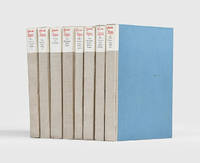
réf. 8754One of 375 numbered sets number 266. The type of the Shakespeare Head Chaucer is Caslon Old Face and the illustrations of the Canterbury pilgrims are adapted from the Ellesmere manuscript. 'The first impression is of care in planning of thought for the reader. A friendly craftsmanship comes from all the pen and brush work in these books. The illustrations enter as a pleasant surprise rather than necessary parts of the plan. The edition seems complete without them but we are delighted to find them' Franklin The Private Presses pp. 149-50. The set comprises The Canterbury Tales in the first four volumes Consolation of Philosophy Troilus and Criseyde The House of Fame The Legend of Good Women later minor poems doubtful poems A Treatise on the Astrolabe and The Romaunt of the Rose. 8 volumes large 4to 285 × 190 mm calligraphic headings by Joscelyne Gaskin printed in red and blue paraphs in red and blue manuscript 70 hand-coloured illustrations by Hugh Chesterman and Lynton Lamb. Original linen-backed boards printed spine labels edges uncut and mostly unopened original spare labels tipped in. A very nice set. Shakespeare Head Press, Basil Blackwell, Oxford.
1928réf. 194391Oxford: Basil Blackwell printed at the Shakespeare Head Press Stratford-upon-Avon 1928-29. With hand-coloured pilgrims wandering along the bottom of the pages First Shakespeare Head edition number 38 of 350 sets for sale on Kelmscott handmade paper with the original publisher's prospectus. Franklin describes Shakespeare Head as "the most mature and sophisticated" private press of the interwar period. This beautiful production was one of its best. "The first impression is of care in planning of thought for the reader. A friendly craftsmanship comes from all the pen and brush work in these books. The illustrations enter as pleasant surprises rather than necessary parts of the plan. The edition seems complete without them but we are delighted to find them" Franklin p. 149. The Shakespeare Head was founded in 1904 by the Elizabethan scholar Arthur Henry Bullen whose goal was to produce the first collected edition of Shakespeare published in the town of his birth. After Bullen's death in 1920 the press was taken over by the Oxford bookseller Basil Blackwell who employed Bernard Newdigate as designer. Under Newdigate the press followed the traditions of William Morris and released its greatest productions. 8 vols quarto. Woodcuts by Lynton Lamb and Hugh Chesterman many hand-coloured text printed in red blue and black in Caslon type. Original cream holland-backed blue boards paper spine labels lettered in red and black fore and bottom edges uncut each volume with inlaid spare spine label. Gatherings mostly unopened. Minor rubbing and marks to bindings inner hinges starting but firm. A near-fine set. Franklin p. 352. hardcover
1958réf. 9033822Cleveland: World 1958. Hardcover. Very good. With the original illustrations by Edward Burne-Jones. Introduction by John T Winterich and a glossary for the oder reader. World hardcover books
1958réf. 106329Cleveland:: World Publishing Company. Fine. 1958. Hardcover. With the original 87 illustrations by Edward Burne-Jones. Introduction by John T. Winterich. First edition thus. Fine in a decorated cream leatherette binding. No dust jacket. Text is clean and binding is sound. An attractive well preserved copy. ; 554 pages . World Publishing Company, hardcover books
2008Large folio, on laid paper, text in red and black throughout, with numerous fine illustrations and borders in the text; full brown buckram boards and backstrip elaborately blocked and lettered in gilt, gilt top, brown endpapers, broad black silk marker, a near fine copy in publisher's board slip-case lettered in gilt. Superb facsimile of the Arts & Crafts classic. Includes an extended essay by William S. Peterson. NOW SCARCE IN ITS OWN RIGHT.
1561réf. 2210201London: John Kyngston for John Wight 1561. Fifth. hardcover. Very good. First issue of the 1561 Stowe edition. Very good in contemporary covers and recent leather spine with gold lettering. Probable first issue of the Stowe Edition with Chaucer's arms dated 1560 and before woodcut additions. As for the differences between the Stowe issues David R. Carlson "The Woodcut Illustrations in Early Printed Editions of Chaucer's Canterbury Tales" in Chaucer Illustrated: Five Hundred Years of The Canterbury Tales in Pictures British Library 2003 states "the most plausible explanation seems to be that the printer and publisher of the Stowe edition came into possession of the woodcuts belatedly after most of the press work for the edition had been done. After obtaining the blocks they ran up a new issue of the beginning of the book incorporating a "General Prologue" illustrated with woodcut. In all documented cases the unillustrated i.e. first"General Prologue" occurs with a title page showing the Chaucer arms dated 1560 at the top of the shield. A different title-page dated 1561 is found in copies incorporating the woodcut illustrated General Prologue." A handsome complete copy without loss of text beautifully printed in fifty-six line two-column black-letter Gothic. The 1561 Stowe edition is probably the one known to William Shakespeare and Edmund Spenser. Folio. More photos available upon request. John Kyngston for John Wight unknown books
1928réf. 308678Oxford: Shakespeare Head Press 1928. hardcover. very good. 8 volumes in the original bindings -- linen backed aqua boards spines are sun-darkened and somewhat stained and covers are partially dis-colored by the sun. Numerous hand colored illustrations original untrimmed edges and paper spine labels new clean spine labels are tipped into each volume. Pages are crisp and clean. Oxford: Shakespeare Head Press Stratford-Upon-Avon 1928-29. Limited Edition. A very good set internally fine. Number 264 of 375 copies of which 350 were for sale with a further 11 copies printed on vellum. Shakespeare Head Press unknown books
réf. 1271682002. Hammersmith: Printed by William Morris at the Kelmscott Press 1896. London: The Folio Society 2002. Large folio 16 3/8 x 11 3/8 inches; 415 x 288 mm. 4 blank ii 2 554 1 limitation 1 blank pp. Printed in black and red in William Morris's Chaucer type with titles of the longer poems in Troy type the text arranged in double columns and edited by F.S. Ellis. Illustrated throughout with eighty-seven magnificent woodcuts after the designs of Sir Edward Burne-Jones redrawn by Robert Catterson-Smith and engraved by W. H. Hooper together with the celebrated woodcut title-page fourteen variously repeated ornamental borders eighteen repeated frames twenty-six large decorative initial words numerous smaller initials and Morris's famous printer's device. The decorative woodcuts were engraved by C. E. Keates W. H. Hooper and W. Spielmeyer. Guard sheet between title and first text leaf. Both volumes housed in the original blue cloth clamshell case with cream morocco spine label lettered in gilt. Clamshell with only minor wear and light soiling to the lower spine; the book itself in fine condition. § An extraordinary achievement in modern fine printing and bookbinding. Printed by Cambridge University Press for The Folio Society and completed on 20 February 2002 this magnificent edition is widely regarded as the finest facsimile ever produced of William Morris's Kelmscott Chaucer. Every aspect of the original masterpiece - its monumental format typography illustrations paper and sumptuous binding-has been recreated with remarkable fidelity. Issued in a strictly limited edition of only 1010 copies of which just 1000 were offered for sale this is copy number 125. The Kelmscott Chaucer occupies a unique position in the history of the printed book. Published in 1896 in an edition of only 425 copies on paper and 13 on vellum it represents the crowning achievement of William Morris's Kelmscott Press and the supreme expression of the Arts and Crafts movement. Morris united typography illustration ornament paper and binding into a harmonious whole unequaled in the history of private press printing. As Gordon N. Ray observed it is "not only the most important of the Kelmscott Press's productions; it is also one of the great books of the world." Rather than producing a simple photographic facsimile The Folio Society undertook one of the most ambitious acts of modern fine printing ever attempted. Every significant feature of Morris's masterpiece was painstakingly recreated-from the specially manufactured laid paper and monumental page size to the intricate Burne-Jones illustrations and the sumptuous Cobden-Sanderson binding. The result is not merely a reproduction but a remarkable tribute to the original preserving with extraordinary fidelity both its visual magnificence and its physical presence. Original Kelmscott Chaucers have long been among the great trophies of nineteenth-century book collecting with fine examples today commanding well into six figures. This magnificent Folio Society edition offers perhaps the closest experience possible to owning Morris's masterpiece without entering that rarified market. Produced with exceptional scholarship craftsmanship and attention to detail it stands not simply as the finest facsimile of the Kelmscott Chaucer ever published but as one of the outstanding achievements of modern book production in its own right. References original 1896 edition: Peterson A40; Ray The Illustrator and the Book in England p. 258; Ransom p. 329; Sparling 40; Tomkinson 40; Waldorf 40; The Clark Library pp. 46-48; The Artist & the Book 45. unknown books
2008réf. 318895London: Folio Society 2008. Limited. hardcover. fine. Edward Burne-Jones & William Morris. A faithful reproduction of William Morris' Kelmscott Chaucer with the famous eighty-seven wood-engraved illustrations by Edward Burne-Jones. 559 pages including an afterword essay on the Kelmscott Chaucer by William S. Peterson. Handsomely printed throughout in red & black on special heavy paper commissioned from the James Cropper Mill; uncut edges top edge gilt. Elephant folio burgundy cloth with elaborate gilt-stamped designs by William Morris protected in a printed board slipcase. London: Folio Society 2008. A fine copy as new. William Morris's masterpiece: The Kelmscott Chaucer. "The most beautiful of all printed books" -- W.B. Yeats Folio Society unknown books
1899réf. RO60139851Macmillan and Co Ltd. 1899. In-8. En feuillets. Etat d'usage, Tâchée, Dos abîmé, Intérieur acceptable. 771 pages. Texte sur 2 colonnes. Reliure d'éditeur verte à titre et motif dorés. Annotation en 1re page de garde (ex-libris). Jaquette manquante.. . . . Classification Dewey : 420-Langue anglaise. Anglo-saxon