Claudel PaulBiblio.com

3 706 résultats
1947réf. 77203Ides et Calendes 1947. Book. Illus. by Henri Matisse. Very Good. Soft cover. 8vo - over 7¾" - 9¾" tall. In-8 broché Très Bon Etat dédicace sur la page de garde ex no 1431/1531 sur vergé. Ides et Calendes Paperback
1970réf. ZB265354Gordon & Breach Science 1970. Price HAS BEEN REDUCED by 10% until Monday Nov. 2 weekend sale item 184 pp. PAPERBACK previous owner's name to front free endpaper else very good. - If you are reading this this item is actually physically in our stock and ready for shipment once ordered. We are not bookjackers. Buyer is responsible for any additional duties taxes or fees required by recipient's country. Photos available upon request. Gordon & Breach Science paperback
réf. HISTORY/BOX45/MH6/150925-Feb 01 2004. Very Good. THE BOOK IS IN GOOD CONDITION PAGES ARE CLEAN Sold by the U.K Charity Kisharon Langdon. Offering Opportunities and Support for People within the Autism and Learning Disability Community. unknown
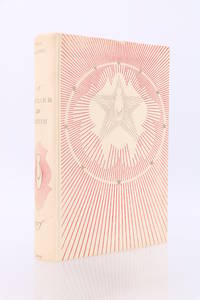
1944réf. 92665Paris: Gallimard 1944. Fine. Gallimard Paris 1944 11.50 x 18 cm reliure de l'éditeur New edition one of 1050 numbered copies printed on alfa paper. Publisher's original illustrated boards designed by Paul Bonet. A fine copy. Gallimard hardcover
1942réf. 89648Paris: Gallimard 1942. Fine. His Daughter ""Chouchettes"" Copy Gallimard Paris 1942 10.7 x 18.8 cm Broché ""New edition with parts in first edition incorporating an unpublished preface; the first edition had appeared in 1927 in Tokyo at the close of Claudels ambassadorship in Japan 19211927 and was issued in three fan-shaped quarto volumes. Work illustrated with Japanese characters calligraphed by Ikuma Arishima. Composed between June 1926 and January 1927 this essay blending traditional calligraphy haiku and short Western-style verse bears witness among Claudels other creations to the influence of the Far East on his poetic practice. Moving and exceptional presentation inscription signed and dated by Paul Claudel to his eldest daughter Marie Claudel known as ""Chouchette"" 19071981 and to his son-in-law Roger Méquillet written at the head of the front endpaper and in pencil on the flyleaf: ""A mes chers enfants Roger et Chouchette de tout mon coeur. claudel. Paris 30 juin 1942 Paul."" Gallimard unknown
2026réf. x-1350434345Bloomsbury Publishing Plc 2026. Hardcover. New. 224 pages. 6.14x0.71x9.21 inches. Bloomsbury Publishing Plc hardcover
1907réf. 87749Paris: Mercure de France 1907. Fine. Mercure de France Paris 1907 12.50 x 18.50 cm relié sous étui First edition one of 12 copies on Holland paper the only deluxe copies. Full red morocco binding spine with five raised bands ornately decorated with double gilt compartments richly decorated with grotesques gilt roulettes on headcaps double gilt fillet frame on boards watered pistachio silk endpapers and pastedowns wide gilt dentelle border on pastedowns covers and spine preserved all edges gilt red morocco-backed slipcase cat's-eye paper boards white felt interior slipcase split at foot very elegant period binding signed by Huser. Autograph inscription dated and signed by Paul Claudel to Henri Burnand. Very fine copy of the deluxe issue with an autograph inscription signed by Paul Claudel in a perfect full morocco binding by Huser one of the most talented binders of his time. Mercure de France hardcover
1926réf. 88064Paris: Auguste Blaizot 1926. Fine. Auguste Blaizot Paris 1926 23 x 28.50 cm broché Rare first edition printed in 200 copies numbered and justified by Paul Claudel. Some foxing to margins of leaves. Auguste Blaizot unknown
1945réf. 88377Paris Paris: s. n. 1945. Fine. s. n. Paris Paris Mars 1945 11 x 14.50 cm une feuille rempliée Autograph note dated and signed by Paul Claudel one page addressed to Thierry Maulnier 12 lines in blue ink on a single sheet. Central folds. Paul Claudel must reschedule a planned meeting with Thierry Maulnier: ""Cher monsieur. Encore un contretemps ! Jeudi toute la matinée je suis pris au Théâtre français pour m'occuper de la matinée poétique qui doit avoir lieu le 17."" He suggests another opportunity to meet: "". Alors viendriez-vous et cette fois j'espère ferme ! Samedi 10-11 heures"" s. n. unknown
1945réf. 88356Paris: s. n. 1945. Fine. s. n. Paris 28 Février 1945 11.50 x 14.50 cm une feuille Autograph note dated and signed addressed to Thierry Maulnier 10 lines in blue ink on a sheet Central folds inherent to postal handling. ""Dear sir an unexpected call makes it impossible for me to be at the hotel as agreed tomorrow at 11 o'clock. Would you postpone the appointment to the next day Friday March 2nd at the same time All my apologies! Your very devoted. Paul Claudel."" s. n. unknown
réf. mon0003768710Lannoo Publishers 2017-03-31. Hardcover. Good. 1.1811 12.8346 12.5984. Cover and edges may have some wear. Loose binding good reading copy. Lannoo Publishers hardcover
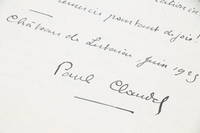
1925réf. 87317Château de Lutaines Cellettes 1925. Fine. And how much this emotion is heightened when the author of this book is our friend when we have conversed familiarly with him and when he is close to us by what has been attributed to him as transient and temporal and close to God by what in him henceforth as eternal has begun! Château de Lutaines Cellettes juin 1925 21 x 27 cm 17 pages sur 5 doubles feuillets Original autograph signed and dated manuscript by Paul Claudel for his preface to Jacques Rivière's 'A la trace de Dieu'. Seventeen and a half pages in black ink on five double leaves. A few words crossed out and rewritten. Horizontal fold some foxing to the first page pencil notes by a bibliographer on the last blank page. The preface dated June 1925 first appeared in Le Correspondant on September 25 1925 then with Rivière's Carnets published the same year by his wife under the title 'A la trace de Dieu' Gallimard pp. 9-24. Complete manuscript of Paul Claudel's moving preface to the notebooks kept by Jacques Rivière during his captivity in WW1. The writer pays homage to a book which would have become a treatise on Christian Apologetics - had its author not met an untimely death at the age of 39. As early as 1907 Claudel had played an important role in his conversion and religious journey. He kept up a correspondence with the young critic now director of Gallimard's prestigious Nrf until his sudden death in 1924. In the manuscript he introduces Rivière's writings from his three years in the Knigsbrück and Hülseberg prison camps after his capture during the Battle of Eton in August 1914. In the form of notes he intended for prisoner reunions it contains a profound reflection on the search for God and the means to encounter Him. Although fo or Jacques Rivière ""God remains a fact"": after a long theological quest and many reversals he had reached the pinnacle of his faith during the war years. The deaths of his friends and writers Alain-Fournier and Péguy piety of his wife Isabelle and feeling of being supported by God during those difficult days all contributed to giving him a living faith which the poet-playwright Claudel celebrates in these beautiful pages. Rivière recognized the presence of a personal God in his life and believed in the value of prayer and self-discipline to which Claudel had urged him from their earliest exchanges. These Carnets are the ultimate proof of Claudel's influence: ""Rivière's end was completely illuminated by the doctrine revealed to him by the great Christian poet"" Paul Beaulieu. Claudel devotes magnificent passages to Rivière's communion on Christmas Day 1913 which publicly marked his return to Catholicism: ""All I can say is that Jacques Rivière's life seems to me to be one of those that cannot be explained solely by itself but by the good or bad teaching it contains because it is the type in which a host of others are realized and informed that it has the value of a parable. It is the best illustration of that Providence whose hand he never ceased to feel upon him that humble gentle Providence always present and always unexpected infinitely patient ingenious and artistic of which he spoke so well. It was this Providence that led this good soul through the pilgrimage of Intelligence from the confusion of adolescence to that Christmas day in 1913 when in an act of deference to the most extravagant theories from Darwin to Freud which presented themselves to them with the character of the latest fashion in which the noble deliberation of judgment had more share than the exigency of feeling he came to kneel at the feet of the holy priest of Clichy"". The preface doubling as a eulogy reflects the dialogue between father and spiritual son. Despite their disagreements Claudel admired Rivière's thinking and his objective vision of the Catholic Church in relation to secular society - without seeing it as the guardian of social conservatism like far-right writers like Maurras or Barrès: ""Among J unknown
réf. 27876423like new. unknown
1941réf. 86528Paris: Morestel Isère 1941. Fine. Morestel Isère Paris 19 Octobre 1941 13.50 x 21 cm une page et demie Autograph letter dated and signed by Paul Claudel 23 lines in black ink on letterhead of Château de Brangues in Isère addressed to his publisher Egloff. Fold marks inherent to mailing. Paul Claudel acknowledges good receipt of the copies of Présence et prophétie that his publisher had sent him: ""J'ai bien reçu les 50 ex. ordinaires et 3 ex. sur fil."" and hopes that despite the difficulties related to the Occupation the booksellers have been well supplied. The poet finally rejoices in the good news that his publisher had conveyed to him: ""Je prends bonne note de ce que vous me dites du supplément de droits que vous pourrez me faire parvenir dans les premiers jours de novembre."" Morestel (Isère) unknown
1946réf. 86873Paris: Gallimard 1946. Fine. Gallimard Paris 1946 12 x 19 cm broché Reprint. Autograph inscription signed by Paul Claudel to Monsieur Julien. Gallimard unknown
1947réf. 85922Paris: Gallimard 1947. Fine. Gallimard Paris 1947 11.50 x 18 cm reliure de l'éditeur New edition one of 1040 numbered copies on alfa paper. Publisher's binding executed after Paul Bonet's original design. Handsome copy. Gallimard unknown
1936réf. 83980Paris: Nrf 1936. Fine. Nrf Paris 1936 12 x 19 cm broché First edition a Service de Presse advance copy. A small tear to the middle of the front cover discreet numbering in the upper right corner of the verso of the front cover Precious autograph inscription signed by Paul Claudel to Ida Rubinstein: ""à Ida Rubinstein son ami. P. Claudel."" ""to Ida Rubinstein his friend. P. Claudel."" Star dancer of the celebrated Ballets Russes icon of the Belle Époque patron of the arts Ida Rubinstein played the role of Joan in Paul Claudel's Joan of Arc at the Stake during the first orchestral version performed in May 1938 in Basel. She also commissioned Maurice Ravel's famous Boléro. After leading a scandalous life for her time notably for her bisexuality she died mystical and solitary forgotten by all. Nrf unknown
1980réf. 81494Paris: Gallimard 1980. Fine. Gallimard Paris 1980-1971 10.50 x 17.50 cm 2 volumes en reliures de l'éditeur First edition published in the Bibliothèque de La Pléiade series. Publisher's full brown grained sheepskin bindings orange top edges smooth spines decorated with gilt fillets. Handsome complete set retaining its cellophane covers but lacking dust jackets and slipcases Gallimard unknown
1914réf. 75520Paris: Georges Cres Coll. coréenne composée sous la direction de Victor Segalen 1914. One of 750 numbered copies. Two octavo volumes paginated continuously. 226 pp. with text printed in two columns and with 61 large opening letters printed in red and black and meant to imitate a Chinese seal. Pages are all french-fold to simulate a Chinese book. String-tied wrappers. Housed in the original folding case with ivory clasps. A bit of wrinkling to the overlay leaf but the entire production by Victor Segalen is quite impressive.Connaissance de L'Est Knowledge of the East first published in 1900 is a collection of prose poems by Paul Claudel almost all composed in China between July 1895 and October 1899 when Claudel was appointed alternate consul in Shanghai. The poems in this collection are grouped into two unequal parts. Published in 1900 at the Mercure de France then in an expanded edition in 1907 the purpose of the book was to allow the newcomer to get to know this eastern country where he had just settled. Hence these texts on what we would today call Chinese culture: gardens theatre ideograms… Hence also the descriptions of exotic trees animals or landscapes. In August of 1913 Claudel gave Victor Segalen whom he had met in Beijing permission to republish his prose poems. The pages of this reissue were printed on one side folded in half and sewn in the oriental fashion. The two volumes were presented in a box covered with blue silk and equipped with tabs.Victor Segalen though largely forgotten today was a real force in his age. "French writer Victor Segalen was born in Brest on January 14 1878. After solid classical studies with the Jesuits he studied medicine in Brest Rennes and Bordeaux and became a naval doctor in 1902. His thesis entitled Les Cliniciens ès lettres in which he studied the medical documentation of certain naturalist writers. He detached a chapter from it: Les Synesthesias et l'école symboliste a vigorous plea in favor of the symbolists was published in the Mercure de France of April 1902.Meeting Joris-Karl Huysmans in 1899 and later Remy de Gourmont gave him access to the environment of the Mercure de France. His first post on the sloop "La Durance" in Tahiti from January 1903 convinced him from the outset that Polynesian civilization was threatened with death by European influence and by the carelessness of its peoples. Seeing the paintings and reading the writings of Paul Gauguin who had died recently in Hiva-Oa made him understand from the inside what the sensual and joyful life of the Polynesians had once been like. An article published in the Mercure de France in June 1904 Gauguin and much later a Tribute to Gauguin in 1918 testify to his admiration. Back in France in February 1905 he published Les Immémoriaux in 1907 under the pseudonym of Max-Anély. In this carefully documented book under a romantic and poetic fabrication Segalen showed how under political and religious pressure from Europe the Polynesians "the Immemorial" had come to forget their sacred words their gods their sensual search for happiness. It was Segalen's way of putting his ideas on exoticism into practice by letting Maori reciters speak pretending to adopt their values. In this he showed himself to be a precursor of modern ethnologists. The book moreover is the expression of his violent revolt against his rigorous moral and religious education. It had begun in Bordeaux but the Tahitian facilities the influence of Nietzsche and the example of Gauguin ranked among the "outlaws" with Rimbaud on whom he published a study Le Double Rimbaud had him singularly reinforced.His passion for music very much fostered by his family and his admiration for Debussy led him to meet the Master to whom he unsuccessfully offered the libretto of Siddhartha inspired by the tenets of Buddhism. However Debussy suggested that he write an Orpheus instead. They worked on it together but Orphée-Roi will only appeared in 1921 after the death of the musician and the poet. It is with China that Segalen according to Jouve quoting Rimbaud "finds the place and the formula". Appointed student interpreter for the navy he arrived in Beijing in June 1909 met Paul Claudel in Tien-Tsin for whom he felt more literary admiration than religious sympathy and undertook a great expedition to central China and Japan which lasted nine months. This lengthy stay in Asia gave rise the great works of Segalen as poet. Steles 1912 and 1914 a collection of forty-eight poems — sixty-four in the second edition — is externally and internally presented in Chinese style. But exoticism here only serves as an alibi. Neither translations nor adaptations these poems actually express the secret universe of the poet his opinions his feelings his travel experiences. By the detour of China by what he calls allegory they suggest notions too pure to fall under the cut of words. The unspeakable the invisible the unheard of haunt the stelae of the "Middle" in particular.With Paintings 1916 leaving behind the dense and concentrated style of lapidary inscriptions Victor Segalen opted to describe or recreate through spoken language Taoist paintings a long roll of silk portraits of decadent emperors. These are prose poems to be put on the same level as Rimbaud's Illuminations and Claudel's Conférence de l'Est. This poet was also a sinologist and an archaeologist. The official archaeological mission formed by Victor Segalen Gilbert de Voisins and Jean Lartigue discovered in 1914 the oldest Chinese monumental statue and identified the burial site of Emperor Ts'in Che-Houang whose exploration was to be sixty years later. the greatest discovery of the century. Georges Cres, Coll. coréenne composée sous la direction de Victor Segalen unknown
1966réf. 82044Paris: Gallimard 1966. Fine. Gallimard Paris 1966 14.50 x 21.50 cm broché First edition one of 39 numbered copies on wove paper the only deluxe copies. Handsome copy. Gallimard unknown
1938réf. 82094Paris: Nrf 1938. Fine. Nrf Paris 1er Février1938 14.50 x 23.50 cm broché First edition one of the few numbered copies on pure linen paper. Other contributions by André Suarès ""Un grand homme en enfer"" Jacques Chardonne ""Le bonheur de Barbezieux Partie II"" Francis Jammes ""Air de décembre"" Jean Grenier ""Sur Charles Maurras"". Spine browned covers marginally and lightly sunned first page and rear endpaper darkened. Nrf unknown
1931réf. 82562Paris: Chez L. Giraud-Badin 1931. Fine. Chez L. Giraud-Badin Paris 1931 20 x 25 cm broché First edition published in 2900 copies ours being one of the copies on Alfa paper. Handsome copy despite some light foxing on the edges. Literary contributions by Paul Claudel: ""Les cinq premières plaies de l'Egypte"" Jacques Prévert: ""Tentative de description d'un dîner de têtes à Paris-France"" Georges Ribemont-Dessaignes: ""Faust"" Robert Desnos ""Siramour"" Rudolf Kassner: ""L'individu ert l'homme collectif"". Commerce a literary review founded by Marguerite Caetani took the form of twenty-nine ""quarterly issues published under the supervision of Valéry Fargue and Larbaud"" between 1924 and 1932. Its publication formed part of the competitive tradition of French reviews of the 1920s and did not merely promote the most prominent authors of French literature: it played the role of ""discoverer"" of young talents and unearthed forgotten seminal texts. Chez L. Giraud-Badin unknown
1929réf. 82624Paris: Chez L. Giraud-Badin 1929. Fine. Chez L. Giraud-Badin Paris 1929 20 x 25 cm broché First edition published in 2900 copies ours being one of the copies on Alfa paper reserved for the press service. Light foxing affecting mainly the edges. Literary contributions by Thomas Stearns Eliot ""Som de l'Escalina"" Paul Valéry ""Le livre de Christophe Colomb"" Léon-Paul Fargue ""Mimes"" Valery Larbaud ""Le patron des traducteurs"". Commerce literary review founded by Marguerite Caetani appears in the form of twenty-nine ""quarterly notebooks published under the care of Valéry Fargue and Larbaud"" between 1924 and 1932. Its publication forms part of the competitive tradition of French reviews of the 1920s and does not simply showcase the most prominent authors of French literature: it plays a role as ""discoverer"" of young talents and unearths forgotten capital texts. Chez L. Giraud-Badin unknown
1896réf. 82558Fou-Tchéou Fictional Place: Foochow Printing Press 1896. Fine. Foochow Printing Press Fou-Tchéou Fictional Place 1896 16 x 21.50 cm broché Rare first edition of which there were no deluxe copies of the French translation established by Paul Claudel. Handsome copy despite some occasional light foxing. Foochow Printing Press unknown
1955réf. 79631Paris: S. n. 1955. Fine. S. n. Paris 1955 17.50 x 12 cm une feuille First edition of this personal invitation ours in the name of Gérard Bauër from the Académie Goncourt to attend the funeral of Paul Claudel at Notre-Dame Cathedral in Paris on February 28 1955 at 10 a.m. A central fold inherent to postal mailing. S. n. unknown