5 743 résultats
réf. 201403153Paris, Imprimerie nationale éditions, 1994 ; grand in-4, 413 pp., cartonnage de l'éditeur. En très bon état - avec sa jaquette belle iconographie en couleurs et en pleine page.
1957réf. 17206Genf, Kundig, 1957. In-128 (lisez 3,8 x 2,8 cm) broché de 96 pages sur papier bible, couverture caramel avec titre doré au premier plat. Petits accrocs en bords. Livré sans la pièce de 1 €, qui ne figure ici que pour l'échelle...
réf. 202000722Paris, Flammarion, 2014 ; in-12, 137 pp., br.
réf. 201803906Paris, Albin Michel , 1981 ; in-8, 593 pp., br. Bon état broché coiffes et coins usures état moyen - traduit de l'anglais par Marianne Véron.
réf. 201216058Paris, Albin Michel - les grandes traduction, 1976 ; in-8, 593 pp., broché (avec sa jaquette). Bon état édition originale de traduction - broché ptes usures.
réf. 201228820Paris, Albin Michel - les grandes traduction, 1976 ; in-8, 593 pp., broché (avec sa jaquette). Bon état édition originale de traduction - broché.
réf. 201002216Paris, Albin Michel - les grandes traduction, 1976 ; in-8, 593 pp., broché (avec sa jaquette). Bon état édition originale de traduction.
réf. 201206446Berlin, GUSTAV HEMPEL, s.d. (vers 1865) ; in-12, cartonnage de l'éditeur. Les 14 volumes. Bon état - (14 volumes en 20 tomes) cartonnage percaline d'éditeur relief dos passé pour certain volume. tous un peu insolé - avec un ex libris du Docteur KEPPLER.
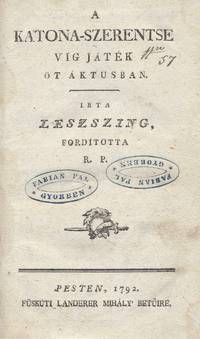
1792réf. 1114Pesten Pest: Füskúti Landerer Mihály’ betűire 1792. First Hungarian edition. Woodcut device on title page and tail piece at end. In somewhat later green cloth with red title vignette on spine. Old double ownership stamp on title page and note in ink. Notes in ink on front endpaper. A light water stain to upper corner that effects the rear of the book. Overall in fine condition. First Hungarian edition. Woodcut device on title page and tail piece at end. In somewhat later green cloth with red title vignette on spine. 8 120 p. First Hungarian edition of Lessing’s 1767 comedy “Minna von Barnhelm oder das Soldatenglück” Minna von Barnhelm or the Soldiers' Happiness.It was premiered in the same year in Hungary as the first Lessing play on stage in the country. Füskúti Landerer Mihály’ betűire unknown
1834réf. 3571buda: Füskúti Landerer Mihály’ betűire 1834. Early Hungarian edition. In later paper. Old ownership stamp on title page Light water stains. Overall in very good condition. Early Hungarian edition. In later paper. 146 p. Early Hungarian edition of Lessing’s 1767 comedy “Minna von Barnhelm oder das Soldatenglück” Minna von Barnhelm or the Soldiers' Happiness.It was premiered in the same year in Hungary as the first Lessing play on stage in the country. Füskúti Landerer Mihály’ betűire unknown
1979réf. 32441979. One-page TLS 24th March 1979 on thin white paper: nine lines in black type featuring Lessing's Kingscroft Road address and signed in black biro "Doris". Folded and heavily creased a few nicks unrelated note in black biro to reverse. Good- A brief but significant 1979 typed letter in which Lessing turns down Mike Shaw of Curtis Brown the literary agency which first represented her: "Well I can only say – and mean most sincerely – that I am very sorry – but I have decided not to". After a line about the handling of her foreign rights she closes by noting that she has "started volume three" and once it "is well and truly under weigh" she will invite him for lunch. The "volume three" is likely The Sirian Experiments the third volume of her five book sci-fi series Canopus in Argos: Archives which was published the following year in 1980. The British agent Jonathan Clowes represented Lessing for most of her writing career. unknown
réf. 0661-13Bln. Christian Friedrich Voß 1769. 8°. 96 S. HLn. d. Zt. EA Goed. IV/I 649 73 - Beiliegend: WYCHERLEY William. Das Landmädchen Lustspiel in fünf Aufzügen. o. O. Vlg. J. 108 S. Tit. fehlt. Brosch. d. Zt. Zusammen in Schuber. Bln., Christian Friedrich Voß 1769. unknown
1984réf. 517145New York: Alfred A. Knopf 1984. Hardcover. Fine/Near Fine. First American edition. Fine in a near fine dust jacket with edgewear. Alfred A. Knopf hardcover
1983réf. 203396Alfred A. Knopf 1983. First Edition. Hardcover. Near Fine. 253 pages. A novel by the Nobel Prize-winning author published under a pseudonym as a stunt to show the treatment of books by unknown authors. ''I wanted to highlight that whole dreadful process in book publishing that 'nothing succeeds like success' '' she said in a recent telephone conversation from London. ''If the books had come out in my name they would have sold a lot of copies and reviewers would have said 'Oh Doris Lessing how wonderful.' As it is there were almost no reviews and the books sold about 1500 copies here and scarcely 3000 copies each in the United States.''--Lessing in the New York Times September 23 1984. Lessing's long-time British publisher declined to publish either of the two 'Jane Somers' novels before they knew the author was Lessing. First American edition first printing. Near fine in a dust jacket with minor scuffing to covers and light fading to spine thus near fine. Signed by the author as Doris Lessing on the title page. Alfred A. Knopf hardcover
1991réf. 5036Washington: Library of Congress 1991. First edition limited to 300 copies. Quarto 427pp. Etched portrait frontis by Toni Rosati signed and numbered 223/300. Facsimile illustrations throughout. Additionally signed by the printer W. Thomas Taylor with a nice inscription describing the project. Quarter green morocco stamped in gilt green patterned paper boards. Nearly fine paper boards rubbed at bottom edges with slight soiling to text block. Included is the 8pp. announcement finely printed by Taylor in gray card wrappers with William Blake frontis in full color. Fine condition. Beautifully printed and designed catalog of the Rosenwald collection issued on the 100th anniversary of his birth. This book was printed letterpress by the great Texas printer W. Thomas Taylor. This copy from his shop contains a nice inscription at the colophon which gives his thoughts on the project: "The special copies of this book are better not only because of the binding but also because the frontispiece etching gives the title page spread a balance that is lacking in the regular copies. Library of Congress unknown
1978réf. 24613AB1978. Leipzig Insel 1978. Folio. 152 Seiten. Hardcover/ Gebundene Ausgabe mit originalem Schutzumschlag in Brodart / Mylar Spezielle Sammler - Schutzfolie für Schutzumschläge. Leinen mit illustriertem Schutzumschlag. Sehr guter Zustand mit nur absolut geringen rein äußerlichen Gebrauchsspuren. Rücken des Umschlags etwas vergilbt. Nathan the Wise original German title: "Nathan der Weise" is a play by Gotthold Ephraim Lessing in 1779. It is a fervent plea for religious tolerance. It was never performed during Lessing's lifetime and was first performed in 1783 at the Döbbelinsches Theater in Berlin. Set in Jerusalem during the Third Crusade it describes how the wise Jewish merchant Nathan the enlightened sultan Saladin and the initially anonymous Templar bridge their gaps between Judaism Islam and Christianity. Its major themes are friendship tolerance relativism of God a rejection of miracles and a need for communication. Wikipedia Anatoli Tankhum Lvovich Kaplan December 26 1902 in Rahachow Belarus- July 3 1980 in Leningrad was a Jewish-Russian painter sculptor and printmaker whose works often reflect his Jewish origins. Kaplan one was one of six children; his father was a butcher in Rahachow which was at that time within the Jewish Pale of Settlement in Russia. His background was therefore not dissimilar to that of Marc Chagall born a generation earlier in 1887 and although their lives were very different their art has much in common. The shtetl figures in many of Kaplan's paintings - autobiographical references are very clear in The Butcher's Shop 1972 and Tailor's Shops 1975 and in the many illustrations which he was to create to the works of Sholem Aleichem. Around 1922 Kaplan came to Leningrad then named Petrograd where he was to base his career for the rest of his life although he often revisited the towns of his childhood. He graduated in 1927 from the Russian Academy of Arts there. In the 1930s he became associated with a group of artists and lithographers in Leningrad which had been instructed to prepare a series of works dedicated to the remote Jewish Autonomous Oblast being created by Stalin in the hope of resettling Russia's Jewish population in a remote area in the Far East of the country. Here Kaplan learnt and took to the skills of printmaking developing many individual techniques. His first cycle of prints 1937-1940 was entitled Kasrilevka the name of the village invented by Sholem Aleichem. During the war Kaplan was at first evacuated to the Urals but returned to Leningrad in 1944. His lithograph cycle of Landscapes of Leningrad during the Days of the Blockade 1948 was widely acclaimed in Russia and was purchased by eighteen State galleries. At one time Kaplan was supervisor of design in a glassware factory and this gave him an interest in the third dimension which was later to blossom in his ceramics and sculptures. From the 1950s onwards Kaplan's artworks concentrated on Jewish themes despite constant and often serious opposition and obstruction from the Soviet cultural authorities. Amongst these works should be mentioned his cover and illustrations to the Jewish Folksongs of Dmitri Shostakovich 1977 illustrations to Aleichem's Tevye the Milkman 3 series 1957-1966 The Enchanted Tailor 1954-57 and Song of Songs 1962 and a magnificent series of coloured lithographs printed in London in 1961 on the old Jewish Passover song Chad Gadya One Kid Goat. Throughout this time Kaplan was also producing paintings though in view of their subject matter they were rarely displayed in the Russia of his time. From 1967 onward he began also to produce ceramics and sculptures including a remarkable set based on the characters of Gogol's Dead Souls. Wikipedia Anatoli Lwowitsch Kaplan 28. Dezember 1902 in Rahatschou Weißrussland; 3. Juli 1980 in Leningrad war ein russisch-jüdischer Maler Bildhauer und Grafiker. Kaplans Umfeld in der Kindheit war nicht unähnlich dem von Marc Chagall der eine Generation früher 1887 geboren wurde. Auch wenn das Leben der beiden Künstler sehr unterschiedlich verlief so haben sie in ihrem Werk doch viel gemeinsam. Vor allem die Stetl-Gestalten und Szenen spielen bei beiden eine große Rolle. Ebenso die autobiographischen Bezüge wie sie in Kaplans Gemälden Metzgerladen 1972 und Schneiderladen 1975 ganz offensichtlich sind ebenso in vielen Illustrationen zu Werken des Schriftstellers Scholem Alejchem. Auf der Akademie wurde Kaplan in erster Linie als Maler ausgebildet. Weil er damit in den Jahren danach sein Brot nicht verdienen konnte musste er alle möglichen Aufgaben übernehmen. Dadurch erwarb er sich Routine auch in dekorativen und plakativen Arbeiten sowie in unterschiedlichsten Techniken samt dem Umgang mit Schrift und Ornamenten. Im Jahr 1937 erhielt er den Auftrag des Leningrader Ethnographischen Museums für die jüdische Sektion eine Serie von Lithographien zu schaffen. Jetzt erst in der Experimentierwerkstatt des Leningrader Künstlerverbandes erlernte Kaplan systematisch die Techniken der Druckgrafik. Er entwickelte auch eigene Verfahren. Seinen ersten Lithographie-Zyklus 19371940 nannte er Kasrilewke nach einem Dorf in einer Erzählung von Scholem Alejchem. Der Krieg brachte einen harten Einschnitt in Kaplans künstlerisches Wirken. Erst 1944 nach der Rückkehr aus der Evakuierung im Ural konnte er seine Arbeit wieder aufnehmen. Er begann sofort mit einem Lithographien-Zyklus über die Leiden seiner Stadt. 1946 erschien die Mappe Leningrad in den Tagen der Blockade. Kaplan führte die Bildfolge bis zum Ende der fünfziger Jahre weiter und bezog den Wiederaufbau ein. Ab 1953 konzentrierte sich Kaplan wieder ganz auf jüdische Themen. Damit eckte er ständig und ernsthaft bei den sowjetischen Kulturbehörden an. Unter den Werken dieser Epoche sind besonders bemerkenswert die Illustrationen zu Jüdische Volkslieder von Dmitri Schostakowitsch zu Scholem Alejchems Tewje der Milchmann Der behexte Schneider und Stempenju und zu Mendele Moicher Sforims Fischke der Lahme. Ab 1967 schuf Kaplan vor allem Keramiken und Skulpturen darunter einen bemerkenswerten Satz von Gestalten aus Gogols Roman Die toten Seelen. In Formen und Farben beweist er einen phantastisch-spielerischen Umgang mit dem Material. Wikipedia hardcover
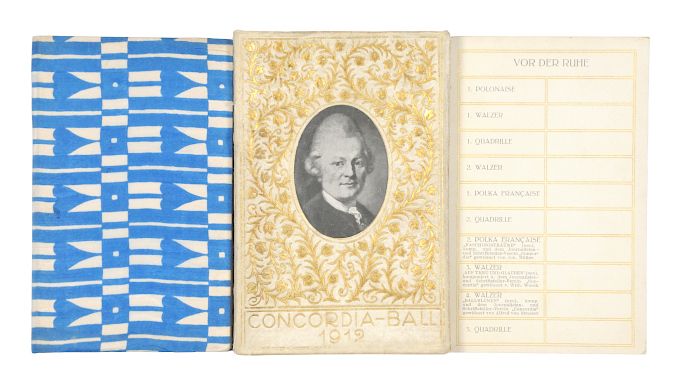
1912réf. 61275Wien, Graphische Kunstanstalt Brüder Rosenbaum, (1912). 12°. Mit zahlr. meist ganzs. Abbildungen. 83 (1) S., Blau gemusteter Orig.-Seidenband, zusammen mit der doppelblattgr. Tanzkarte in illustr. Orig.-Seidenschuber m. reicher ornamentaler Vergoldung (von Josef Hoffmann).
1912réf. 61267Wien, Graphische Kunstanstalt Brüder Rosenbaum, (1912). 12°. Mit zahlr. meist ganzs. Abbildungen. 83 (1) S., Farb. gemusteter Orig.-Seidenband, zusammen mit der doppelblattgr. Tanzkarte in illustr. Orig.-Seidenschuber m. reicher ornamentaler Vergoldung (von Josef Hoffmann).
réf. 202303751Paris, Hatier, 1969 ; in-4, 277 pp., cartonnage de l'éditeur. Avec jaquette sous boitage carton.
1984réf. 26746Cambridge: Cambridge University Press 1984. Very Good/Very Good. Cambridge: Cambridge University Press 1984. First Edition. Octavo; publisher's boards in green printed dust jacket; ix1275pp. Moderate shelf wear to jacket extremities spine a shade sunned corners bumped textblock uniformly toned contemporary ownership signature to front free endpaper else Very Good and sound. Cambridge University Press unknown
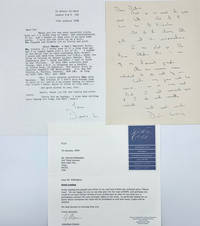
réf. 53906The late Patrick Eddington was a Utah artist and former high school art teacher who had as a goal the desire to create “The Cat Project” where literary and visual artists from around the world were asked to produce original works about cats which would be included in a traveling exhibition and book unfortunately never realized. Doris Lessing 1919-2013 born in what was then Persia now Iran spent her childhood years in southern Africa. The author of nearly 50 books she received the 2007 Nobel Prize in Literature becoming only the eleventh woman to receive literature’s most prestigious award in its 106-year history. Her works are often viewed as in-depth studies of twentieth-century living conditions behavioral patterns and historical progressions. Her masterwork is considered to be The Golden Notebook a postmodern feminist work published in 1962. Interestingly Lessing who was a devoted cat lover throughout her life is also the author of a book which conjures up the subtleties of feline existence On Cats. With regards to this small archive it is significant that this rather busy Nobel-Prize winning author would provide Eddington a high school art instructor and small press printer with a piece of original prose regarding cats supplied specifically for him at a relatively low cost. Included in the archive are the following: TLS. Letter 8” x 10” from Doris Lessing to Patrick Eddington sent from London and dated 17th January 1986. A letter in which Lessing discusses her feelings with regards to one of her earlier works “A Small Personal Voice.” Eddington had recommended it to a friend and Lessing claims “The trouble is I wrote some of it a long time ago and I no longer agree with a lot of it. I wonder if she would like to read something more recent I wrote and read five lectures for C.B.C. under the title of Prisons We Choose to Live Inside. This represents what I think now not what I used to think in the ‘fifties.’” Signed “Yours Doris L.” at the foot. ALS. Letter on a sheet of paper 7” x 9” written by Doris Lessing to Patrick Eddington. Not dated. In the brief letter Lessing thanks Eddington for the book by Barbara Kingsolver and writes “I am glad u sic like Brian Aldiss. He is one of my favorite people.” She closes the letter assuring Patrick that if she writes something suitable regarding the subject of cats she will remember him. TLS. Brief letter 8 ¼” x 11 ¼” from Doris Lessing sent from London and dated January 6 2000 addressed to Patrick. Lessing opens with “OK I’ve done a short piece. It is not a question of being paid but of time- am as usual in the middle of something. I don’t need a thousand dollars… Perhaps 500 I don’t need a Navajo rug….” Signed by Lessing. Typed letter 8 ¼” by 7 ¾” from Lessing’s literary agent Jonathan Clowes to Patrick Eddington dated 10 January 2000 written in reference to the piece written by Doris Lessing titled “About Cats.” Clowes writes “We are happy for you to use this piece for the sum of $500 and perhaps you could let us have further details of your publication so that we can send you a permission contract for non-exclusive rights in the work. In particular please let us know which territories the book will be published in and how many copies will be printed.” Signed by the literary agent at the foot. Typed manuscript signed 8 ¼” x 11 ½”. “About Cats” by Doris Lessing. The original piece that Lessing sent to Patrick Eddington titled “About Cats” containing periodic manuscript corrections made by the author. Cat lovers will immediately recognize this as a keenly insightful succinct piece regarding the precious feline’s nature. Within the work the author muses “People who do not observe their cats but only rely on ‘received’ wisdom miss out. A cat gives back what you put into it returning affection and attention but withdrawing in dignified silence if ignored. No creature is more sensitive to slights and taunts and even teasing. Too much and they will take themselves off in search of a more sympathetic home. And yet one may not generalize: people who have had more than one child know that every baby is born different and similarly in a litter of kittens each one will be an individual. Like humans they are coarsegrained and sensitive stupid and clever clinging and standoffish. They may be talkative and silent show-offs and modest introverts.”. unknown
1970réf. 27896North Hills PA: Printed for the Philobiblion Club Bird & Bull Press 1970. First Thus. Limited to 250 copies of which this is no. 50. Slim quarto 30.5cm.; original brown cloth-backed marbled boards spine lettered in black; 13pp.; 4 mounted facsimile plates; staplebound facsimile catalogue laid into chemise mounted inside rear cover. Fine. Facsimile of the hoax auction catalogue issued in 1840 organized by Belgian bibliophile Renier Chalon. Printed for the Philobiblion Club, Bird & Bull Press unknown
réf. 202003776Paris, Albin Michel, 1995 ; in-8, 489 pp., br. 1er vol.
réf. 202003777Paris, Albin Michel, 1998 ; in-8, 468 pp., br. (1949-1962).
réf. 201414278Paris, Terrail, 1992 ; in-4, 223 pp., br.