5,743 results
1962ref. 19447New York: Simon & Schuster 1962. 1st Edition. Hard Cover. BOOK NEAR FINE/JACKET VERY GOOD. 8vo - over 7¾"" - 9¾"" tall. Signed by Author. SIGNED BY THE AUTHOR on a special decorative bookplate. Just signed -- no inscription. Bookplate is attached to the book. A VERY CLEAN ATTRACTIVE COPY WITH A BRIGHT DUSTJACKET IN NEW GLOSSY BRODART. NO PREVIOUS OWNER MARKINGS. 1ST U.S. PRINTING. HANDSOME COLLECTIBLE COPY. Simon & Schuster hardcover
1912ref. 61267Wien, Graphische Kunstanstalt Brüder Rosenbaum, (1912). 12°. Mit zahlr. meist ganzs. Abbildungen. 83 (1) S., Farb. gemusteter Orig.-Seidenband, zusammen mit der doppelblattgr. Tanzkarte in illustr. Orig.-Seidenschuber m. reicher ornamentaler Vergoldung (von Josef Hoffmann).
1986ref. 44752FISCHER 04/1986. 2. softcover. FISCHER paperback
1825ref. 681L13Berlin: Vossische 1825-28. Hardback. Very Good. 5.5" by 4". Not Stated. The complete thirty-two volumes of Ephraim Gotthold Lessing's works. In a pocket sized format bound over sixteen volumes. A smart uniformly bound set. In the original German. Portrait to volume I six plates to volume III folding table to volume 9. three plates to volume 32. Two pages of music to volume 15. Collated complete. With the full pagination: xii 234 1; vi 4 397; iv 302; vi 320; 244 iv 257; iv 260 294; 235; 296; 266 318; 280; 280; 296; 242; xi 318 1; x 3 298; 278; 344; 304; 254; vi 208; 378; iv 362; 356; 390; 404; xvi 404; xxiv 335; xii 228 284pp Gotthold Ephraim Lessing was a German writer philosopher dramatist publicist and art critic. Lessing's writings were a substantial influence on German Literature. As well as writing he is also regarded to be the first dramaturg in his role at Abel Seyler's Hamburg National Theatre. In uniform full cloth bindings. Externally generally smart with light shelfwear to the head and tail of spines. Repair to the spine label of volume 3-4 and volume 23-24. Internally firmly bound. Pages are slightly age toned. The occasional spots. Very Good Vossische hardcover
ref. 1262-22Stuttgart ab Bd. XII: Leipzig G. J. Göschen'sche Verlagshandlung 1886-1907. Dritte auf's neue durchgesehene und vermehrte Auflage besorgt durch Franz MUNCKER. Bd. 1-21von 23 in 11 Bde. geb. gr.-8°. HMaroquin-Bde. mit goldgeprägtem Rückentitel u. Bd.-Nummer. Kopfgoldschnitt. Rücken minimal lichtrandig. Bd. I/II mit kl. Fehlstelle im Bezugspapier. Zwei Bde. mit kleiner dezenter Kratzspur. hint. Spiegel von Bd. I mit mont. Katalog-Ausschnitt. Hagen 367 1 - Dritte überarbeitete Auflage der historisch-kritische Ausgabe die von Karl Lachmann 1793-1851 dem Begründer der modernen Textkritik erstmals 1838-40 13 Bde. herausgegeben und nun von Karl Muncker 1855-1926 bearbeitet wurde. Laut Hagen gibt sie den genauesten Text wieder es erschienen in den Jahren 1915-1924 noch 2 weitere Bände: 22/I u. II: Stammbuchblätter bzw. Druckverzeichnis sowie 23: Registerband. Ein unveränderter photomechanischer Nachdruck erschien 1968 in Berlin. Stuttgart (ab Bd. XII: Leipzig), G. J. Göschen'sche Verlagshandlung 1886-1907. unknown
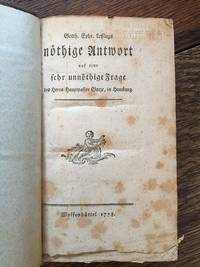
1778ref. H645Wolfenbüttel i.e. Hamburg Braunschweig: Buchhandlung des Fürstl. Waisenhauses various - many without publisher information 1778. Hardcover. Good. Published 1777-1778. Octavo brown library cloth gilt stamped on spine various publications each with its own title page various paginations totalling about 500 pp. Good copy institutional marks including bookplate and due slip on endpapers small embossed blindstamp on first title page once or twice to text otherwise good clean copy. The central publications of the controversy that erupted when Lessing published 'fragments' of the work of Hermann Samuel Reimarus that attacked Lutheran orthodoxy and argued for a rational deism rejecting the theology of revelation. This led to an exchange of polemical pamphlets between Lessing and the principle defender of Lutheranism Johann Melchior Goeze a pastor from Hamburg. These culminated in Lessing's 11 'Anti-Goeze' tracts that contain the seeds of his thoughts regarding religion that became the foundation of 'Nathan the Wise.' The so-called Fragmentes Dispute is considered the most important theological controversy of the 18th century pitting Lessing's Enlightenment philosophy against Lutheran orthodoxy. Buchhandlung des Fürstl. Waisenhauses, various - many without publisher information hardcover
1986ref. SBBI-mon0000133409HarperCollins Publishers Ltd 1986. paperback. Acceptable. Integral damage to binding e.g. cover coming away no spine chunks of pages falling out. Please see the condition note after this for details if this is missing please consider Acceptable to mean poor quality that could include major staining water damage writing missing dustjacket etc etc. Our books are dispatched from a Yorkshire former cotton mill. We list via barcode/ISBN so please note that the images are stock images and may not be the exact copy you receive furthermore the details about edition and year might not be accurate as many publishers reuse the same ISBN for multiple editions and as we simply scan a barcode or enter an ISBN we do not check the validity of the edition data when listing. If you're looking for an exact edition please don't order at least not without checking with us first although we don't always have time to check. We aim to dispatch prompty the service used will depend on order value and book size. We can ship to most countries see our shipping policies. Payment is via Abe only. HarperCollins Publishers Ltd paperback
1998ref. SBBI-mon0000036501Destino Ediciones 1998. paperback. Good. Our good condition books are generally good for reading but not for gifting or collecting. They could have imperfections such as creasing fanning inscriptions margin notes yellowing staining on edge or cover or pages bumps scuffs etc etc sometimes multiple of these. It's a wide category that encompasses anything that isn't almost-new down to anything that is slightly better than poor. We would NOT recommend gifting Good books - these should be considered reading copies. Our books are dispatched from a Yorkshire former cotton mill. We list via barcode/ISBN so please note that the images are stock images and may not be the exact copy you receive furthermore the details about edition and year might not be accurate as many publishers reuse the same ISBN for multiple editions and as we simply scan a barcode or enter an ISBN we do not check the validity of the edition data when listing. If you're looking for an exact edition please don't order at least not without checking with us first although we don't always have time to check. We aim to dispatch prompty the service used will depend on order value and book size. We can ship to most countries see our shipping policies. Payment is via Abe only. Destino Ediciones paperback
1962ref. 1391298New York: Simon and Schuster 1962. First American Edition; First Printing. Hardcover. Octavo 568 pages. In Very Good minus condition with a Good dust jacket. Spine black with white red and yellow lettering. Dust jacket protected with mylar covering. Price uncut: "$9.95". Jacket with light age toning and moderate marking. Moderate shelf wear and creasing to head and tail of jacket spine; moderate shelf wear to jacket edges and corners. Several closed tears to jacket edges including a moderate tear approx. 2 in. to top edge of front of jacket near spine. Light plus bumping to head and tail of book spine and to edges and corners of boards. Cloth of binding with light plus discoloration at edges and corners. Edges of text block with light plus age toning; light smudging through page 10 of text block including title page. Ink ownership inscription of previous owner to front free endpaper. Signed flat by Lessing on title page. DL Consignment. Shelved in Case 7. 1391298. Shelved Dupont Bookstore. Simon and Schuster hardcover
ref. 18867VOLLMER EMIL. 1. hardcover. VOLLMER, EMIL hardcover
1950ref. 18071New York: Michael Joseph 1950. 1st Edition. Hard Cover. BOOK VERY GOOD/JACKET VERY GOOD. 8vo - over 7¾"" - 9¾"" tall. Signed by Author. SIGNED BY THE AUTHOR on a special decorative bookplate. A VERY CLEAN ATTRACTIVE COPY WITH A BRIGHT DUSTJACKET IN NEW GLOSSY BRODART. NO PREVIOUS OWNER MARKINGS. 1ST PRINTING OF AUTHOR'S FIRST BOOK. HANDSOME COLLECTIBLE COPY. Michael Joseph hardcover
1962ref. 18074New York: Michael Joseph 1962. 1st Edition. Hard Cover. BOOK VERY GOOD/JACKET VERY GOOD. 8vo - over 7¾"" - 9¾"" tall. Signed by Author. SIGNED BY THE AUTHOR on a special decorative bookplate. A VERY CLEAN ATTRACTIVE COPY WITH A BRIGHT DUSTJACKET IN NEW GLOSSY BRODART. NO PREVIOUS OWNER MARKINGS. 1ST U.K. PRINTING. HANDSOME COPY. Michael Joseph hardcover
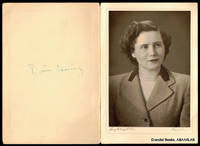
1952ref. 100175London:: Hay Wrightson. 1952. Photograph. 4.25" x 6" original photograph SIGNED by Doris Lessing and by Hay Wrightson the photographer. Includes a typed note to the recipient dated 1952 and with her London address also SIGNED by Lessing and the original mailing envelope addressed in Lessing's hand. . Hay Wrightson,
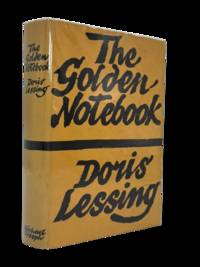
1962ref. 848161962. LESSING Doris. The Golden Notebook. Orig. brown cloth orig. printed dust jacket. London: Michael Joseph 1962. First edition of the author's most famous novel and a catalyst for the feminist movement of the 1960s though Lessing later disputed the feminist readings of her work. Near fine. unknown
1766ref. 62761Berlin, Christian Friedrich Voss, 1766. 8vo. An excellent copy in a late 19th century red half calf with five raised bands and gilt lettering to spine. Fore- and lower edge uncut. Upper edge coloured in red. Spine with a few scratches and a bit of wear. End-papers with annotations in pencil and remains of a removed book-plate. Internally in very nice condition, with light occassional brownspotting. (8), 298 pp.
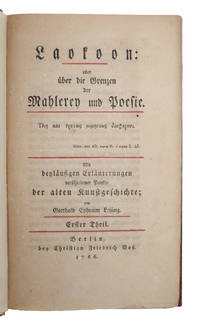
1766ref. 62761Berlin Christian Friedrich Voss 1766. 8vo. An excellent copy in a late 19th century red half calf with five raised bands and gilt lettering to spine. Fore- and lower edge uncut. Upper edge coloured in red. Spine with a few scratches and a bit of wear. End-papers with annotations in pencil and remains of a removed book-plate. Internally in very nice condition with light occassional brownspotting. 8 298 pp. First edition of Lessing’s landmark work in the history of art theory. In Laokoon Lessing argues that each art form operates within its own distinct boundaries that the principles of poetry cannot be applied to sculpture or painting and vice versa. Lessing’s Laokoon was written as a response to Johann Winckelmann's ”Geschichte der Kunst des Alterthums” 1764. Lessing challenges Winckelmann’s interpretation of the famous Laocoon statue arguing that Winckelmann portrays the figure’s suffering as too noble and composed - an expression suitable for poetry but not for sculpture whose medium cannot convey inner emotion in the same way. “Laokoon is perhaps Lessing’s best known work outside Germany and it has had a world-wide influence. It takes its name from the famous statue discovered at Rome in the sixteenth century. It analyses the differences between the sculptor’s treatment of Laocoon wrestling with the serpents and Virgil’s treatment of the same theme and from there goes on to discuss the limits and limitations of all the arts. It contains the first clear statement of the truth which is now considered axiomatic that every art is subject to limitations and can achieve greatness only by a clear understanding of and self-restriction to its proper function. The most telling passages and those which have borne most fruit are those on poetry. Lessing knew more about this than about painting and sculpture for which he was entirely dependent on Winckelmann 210. His exposition of the themes of Homer and Sophocles is especially effective and he opened up a new prospect in the appreciation of Greek literature. Yet perhaps Lessing is best judged by the sum of his achievement. He was one of the principal figures in the Aufklärung the emancipation of German literature from the narrow classicism of the French school. It was he more than any other who laid the foundations of the intellectual primacy of German writers and thinkers in the nineteenth century a debt which they were not slow to acknowledge. Without attaching himself to any special philosophical school he consistently opposed error and dogmatism and in art in poetry in drama and in religion he provided new stimulation. In the words of Macaulay he was ‘beyond all dispute the first critic of Europe’.” PMM 213 PMM 213 hardcover
1982ref. 002925London: Michael Joseph 1982. 2nd Edition 3rd Printing. Hardcover. Fine/Fine. 8vo - over 7¾" - 9¾" tall. July 1982. Later edition same powerful story! With preface by the author dated June 1971. 638 pp. Black cloth covered boards have gilt text on spine only. Tail of spine is slightly rubbed very slight top edge dust soiling ow book is as new. Price clipped DJ has 1/4" surface abrasion on front for edge rubbing at tail of spine. Book is from the collection of Toronto author/poet and Harbourfront Literary Events' host Greg Gatenby. The date of his acquisition of the book together with his signature is on ffep. Lessing's dedication is to him. " For Greg - Sincerely Doris Lessing 28th March 1984." Digital images available on SIGNED by AUTHOR. Bookseller's Inventory # 122925. Michael Joseph hardcover
1962ref. 114758New York: Simon & Schuster 1962. First American edition of the Nobel Prize winning author's magnum opus. Octavo original cloth. Signed by the author on the half-title page "I wish you good fortune- Doris Lessing 17.7.80 24 Gada Garden London." Also with postcard from the British Museum signed by Lessing on the same date. Fine in a near fine dust jacket with light shelfwear. Jacket design by Janet Halverson. "I looked at her and thought: That's my child my flesh and blood. But I couldn't feel it. She said again: `Play mummy.' I moved wooden bricks for a house but like a machine. Making myself perform every movement. I could see myself sitting on the floor the picture of a `young mother playing with her little girl.' Like a film shot or a photograph." These words exemplify the themes Lessing struggled with in The Golden Notebook. They question the notion of identity. In the above quote the protagonist cannot reconcile who she needs to be to remain healthy and whole with what the ideologies of society require her to be. This obsession with constructing a comprehensive sense of identity leads to an infinite fictionalization of the protagonist's life. Lessing's work is not only a significant feminist polemic; it is a multilayered glance into the political climate of the 1960's. Simon & Schuster hardcover books
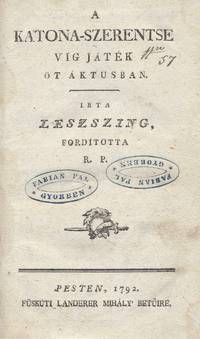
1792ref. 1114Pesten Pest: Füskúti Landerer Mihály’ betűire 1792. First Hungarian edition. Woodcut device on title page and tail piece at end. In somewhat later green cloth with red title vignette on spine. Old double ownership stamp on title page and note in ink. Notes in ink on front endpaper. A light water stain to upper corner that effects the rear of the book. Overall in fine condition. First Hungarian edition. Woodcut device on title page and tail piece at end. In somewhat later green cloth with red title vignette on spine. 8 120 p. First Hungarian edition of Lessing’s 1767 comedy “Minna von Barnhelm oder das Soldatenglück” Minna von Barnhelm or the Soldiers' Happiness.It was premiered in the same year in Hungary as the first Lessing play on stage in the country. Füskúti Landerer Mihály’ betűire unknown
1962ref. 114758New York: Simon & Schuster 1962. First American edition of the Nobel Prize winning author's magnum opus. Octavo original cloth. Signed by the author on the half-title page "I wish you good fortune- Doris Lessing 17.7.80 24 Gada Garden London." Also with postcard from the British Museum signed by Lessing on the same date. Fine in a near fine dust jacket with light shelfwear. Jacket design by Janet Halverson. I looked at her and thought: That's my child my flesh and blood. But I couldn't feel it. She said again: `Play mummy.' I moved wooden bricks for a house but like a machine. Making myself perform every movement. I could see myself sitting on the floor the picture of a `young mother playing with her little girl.' Like a film shot or a photograph." These words exemplify the themes Lessing struggled with in The Golden Notebook. They question the notion of identity. In the above quote the protagonist cannot reconcile who she needs to be to remain healthy and whole with what the ideologies of society require her to be. This obsession with constructing a comprehensive sense of identity leads to an infinite fictionalization of the protagonist's life. Lessing's work is not only a significant feminist polemic; it is a multilayered glance into the political climate of the 1960's. Simon & Schuster hardcover
1951ref. 164596London: Michael Joseph 1951. Her first short story collection First edition of Lessing's first book of short stories inscribed by the author on the front free endpaper: "Yours very sincerely Doris Lessing 6th March 1966". A collection of stories set in Africa this is Lessing's second book following her debut novel The Grass is Singing 1950. Octavo. Original brown cloth spine lettered in gilt. With dust jacket. Neat ownership signature to front free endpaper. Spine slightly cocked and faded lightly chipped at head and foot; jacket slightly rubbed spine chipped and toned a few tiny nicks to extremities unclipped: a very good copy in very good jacket. hardcover
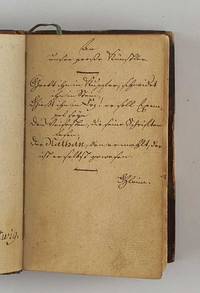
ref. 2126432S.l.: s.n. May 1779. bound with:PFRANGER Johann Georg. Der Monch vom Libanon. Ein Nachtrag zu Nathan der Weise. Dessau: printed at the expense of the publisher Heinrich Heybruch for the Allgemeine Buchhandlung der Gelehrten. 1782. 8vo. Near-contemporary half sheep with pastepaper sides contrasting yellow and green morocco lettering-pieces to spine edges stained red marbled endpapers; Nathan der Weise: pp. 4 276; Der Monch: pp. 296; sporadic light spotting some dampstaining to a few pp. A8 and first few ff. of text subtly reinforced at inner margin; nonetheless very good; early ownership inscription 'Hartwig' to front free endpaper verso near-contemporary German purchase note to title of Nathan der Weise near-contemporary authorial attribution to title of Der Monch manuscript verse to front flyleaf see below nineteenth-century ink stamp 'M. Weller' to title and p. 7 of Nathan der Weise 1950s Slough 'Railways of the World' trading card loosely inserted.The true first edition printed in May 1779 for subscribers in the second state of Lessing's play Nathan der Weise Nathan the Wise promoting religious tolerance and friendship amongst Jews Christians and Muslims set in Jerusalem during the Third Crusade. This copy is bound with Pfranger's sequel printed in the hometown of Moses Mendelssohn Lessing's friend and the inspiration for the character of Nathan.In 1778 whilst working as head librarian in Wolfenbuttel Lessing was banned from publishing theological prose due to the intensity of his theological dispute with Johann Melchior Goeze chief pastor of Hamburg. He consequently decided to see if he could 'preach undisturbed' from his 'old pulpit the stage' as he wrote to his brother in August 1778 - having published no plays since Emilia Galotti in 1772 - in the hope of playing a 'vexatious prank on the theologians' with his masterful Enlightenment treatment of religious tolerance. The first edition was printed anonymously for some 1200 subscribers followed by a trade edition printed in the same year by Christian Friedrich Voss in Berlin.The present edition features several distinguishing features: the quote from Gellius on the title opens 'Jntroite' rather than 'Introite' there is no full stop after 'wiederkommt' on p. 1 p. 123 is mispaginated 233 and p. 95 bears the line 'reichre Mann' instead of 'reicher Mann' corrected in later editions. 'There are copies of this edition that show various corrections even though they were pulled from the same setting of type' Muncker trans. This is Muncker's variant B in which the line 'Der reicher Jude' appears instead of 'Der reichre Jude'.This copy has been bound with the first edition of Der Monch vom Libanon a sequel conceived by the clergyman and friend of Schiller Johann Georg Pfranger 1745-1790 who felt that Lessing had 'undermined the honour of the Christian religion' Deutsche Biographie trans. Heinrich Heybruch printed this edition at Dessau - hometown of prominent Jewish Haskalah philosopher Moses Mendelssohn close friend of Lessing and the model for the sage Jewish protagonist of Nathan der Weise - on behalf of the Allgemeine Buchhandlung der Gelehrten General Bookshop for Scholars established in Dessau during the Enlightenment to promote self-published works. In 1805 Heybruch published a heavily revised edition of Mendelssohn's Be'ur the first Jewish translation of the Torah into German rendered in Hebrew letters. Provenance: Inscribed to the front flyleaf and signed 'Gleim' is the manuscript poem 'An unsere grossen Kunstler' in praise of Lessing and of Nathan der Weise: Grabt ihn in Kupfer schneidet ihn in SteinGiesst ihn in Erz! Er soll Exempel seynDen Weisesten die seine Werke lesen;Der Nathan den er malt der ist er selbst gewesen. Lessing sent fifteen copies of the subscribers' edition to his friend the poet Johann Wilhelm Ludwig Gleim 1719-1803 as well as a specially bound author's copy. For three weeks Gleim wrote to Lessing in July 1779 'Nathan der Weise was my only companion. I have studied it; I have read it aloud. Oh how I would love to prove that you could not have created anything better in a book of twenty-four sheets. Everything is excellent: plot verse expression' trans.Gleim's poem would seemingly not be published until 1783 where it appeared in Issue 112 of the Berliner Zeitung and was reproduced in Winkopp's Bibliothek fur Denker und Manner von Geschmak in the same year. The Frankfurt antiquarian bookselling firm Joseph Baer & Co. recorded a copy of the second edition featuring the same poem in Gleim's hand to the front flyleaf cat. 517 c. 1905 no. 3338. Could ours be one of the fifteen subscriber's copies sent by Lessing to GleimNathan der Weise: VD18 11831499; Goedeke IV/1 Lessing 171; Muncker 22 pp. 458-459 variant B; Wilpert/Guhring Lessing 72. Der Monch vom Libanon: VD18 11867019; Goedeke IV/1 Lessing 171m. unknown
ref. DLIT0711Wien Im Verlage bey Anton Pichler 1801-1807. Kl.-8°. 1 Reihent. gest. Frontisp. Weinrauch fc. Titelbl. 4 nn. Bll. Vorrede S. 129-176 S. 1-16 S. 65-128 S. 17-64; S. 177-180; 2 Reihent. gest. Frontisp. Weinrauch del. et sc. Titelbl. 273 =243 S.; 3 Titelbl. gest. Fontisp. Weinrauch del. et fc. Reihent. 226 = 234 S.; 4 Reihent. Titelbl. 248 S. 2 nn. Bll.Verlagsanzeigen; 8 Reihent. gest. Frontisp. Weinrauch fec. Titelbl. 308 S.; 9 Reihent. gest. Frontisp. Weinrauch fec. Titelbl. 212 S.; 10 Reihent. gest. Frontisp. Weinrauch f. Titelbl. 250 S.; 11 Reihent. gest. Frontisp. Weinrauch fec. Titelbl. 268 S.; 12 Reihent. gest. Frontisp. Weinrauch f. Titelbl. 271 S.; 13 Reihent. gest. Frontisp. Weinrauch fec. Titelbl. 260 S.; 14 Reihent. gest. Frontisp. Weinrauch f. Titelbl. 258 S.; 15 Reihent. gest. Frontisp. Weinrauch fec. Titelbl. 322 S.; 16 Reihent. gest. Frontisp. Titelbl. 192 S.; 17 Reihent. gest. Frontisp. Titelbl. 234 S.; 18 Reihent. gest. Frontisp. Titelbl. 220 S.; 19 Reihent. gest. Frontisp. Titelbl. 201 S.; 20 Reihent. gest. Frontisp. Weinrauch f. Titelbl. 6 nn. Bll. 222 S.; 21 Reihent. gest. Frontisp. F. Weber sc. Titelbl. 198 S. mit 1. gef. Tab.; 22 Reihent. gest. Frontisp. Fr. Weber sc. Titelbl. 234 S.; 23 Reihent. gest. Frontisp. Fr. Weber sc. Titelbl. 255 S.; 24 Reihent. gest. Frontisp. J. Blaschke sc. Titelbl. 195 S.; 25 Reihent. Titelbl. 200 S.; 26 Gest. Frontisp. Weinrauch sc. 20 217 S.; 27 Gest. Frontisp. Weinrauch XXIV 248 S.; 28 7 = 8 S. mit 1 gest. Frontisp. F. Weber sc. 302 S. 1 n. Bl.; 29 XII S. mit 1 gest. Frontisp. Weinrauch del. G. J. Mansfeld sc. 284 S.; 30 Reihent. gest. Frontisp. Weinrauch f. Titelbl. 304 S.; 31 Reihent. gest. Frontisp. F. Weber sc. Titelbl. 290 S.; 32 Reihent. gest. Frontisp. Weinrauch del. J. Mansfeld sc. Titelbl. 324 S.; 33 Reihent. gest. Frontisp. Weinrauch fec. 283 S.; 34 Reihent. gest. Frontisp. Weinrauch f. Titelbl. 239 S.; 35 319 S. mit je zwei Zierleisten auf den Titelblättern u. wenigen Zierleisten im Text. Ansprechende Halblederbändchen d. Zeit mit hellem marmoriertem Rückenleder zwei goldgeprägten Rückenschildchen und geprägten Rückenzierlinien Einbanddeckel mit einfärbig bedrucktem Buntpapier überzogen Buchschnitte rot gesprenkelt mit je e. Lesebändchen insg. wenig fleckig Ecken meist bestoßen teilw. berieben mit mäßigem Wurmfraß. Seiten meist nur wenig vergilbt teilw. stockfleckig oder gebräunt einige wasserrandig mehrere Lagen des 1. Bandes sowie Ss. 129 bis 136 u. 137 bis 144 des 23. Bandes verbunden der 3. Band zählt bei gleichem Textabschluss - nur 234 statt der sonst in den Bibliothekskatalogen genannten 239 Seiten im 4. u. 25. Band fehlt das gestochene Frontispiz. Mit e. Besitzvermerk Unterschriftsstempel auf jedem vorderen fliegenden Vorsatzblatt avers Stefan von Auspitz lediglich der 8. Band trägt an dieser Stelle einen handschriftlichen Besitzvermerk S. von Auspitz und wenigen Bleistiftanmerkungen. Goedeke 4I3443. Muncker 536f. Vgl. ADB 6346f. - 32 Bände eines frühen Wiener Nachdrucks einer Gesamtausgabe der Werke des bedeutenden Dichters der Aufklärung Gotthold Ephraim Lessing 1729-1781 lediglich der fünfte bis siebente sowie der letzte der 36. Band fehlen. Die erste teilw. noch von Lessing selbst besorgte und von J. J. Eschenburg fertiggestellte Gesamtausgabe erschien 1771-1794 in Berlin. Lessing war seit 1770 Bibliothekar in der Herzog August Bibliothek in Wolfenbüttel und korrespondierte mit bedeutenden Persönlichkeiten seiner Zeit. Der Literaturhistoriker J. J. Eschenburg 1743-1820 lehrte am Collegium Carolinum in Braunschweig und gab Teile aus Lessings literarischem Nachlass heraus ""Besonders groß ist sein Verdienst um Sichtung und Herausgabe des Lessingschen Nachlasses zu welcher Arbeit er als Lessings Freund und Studiengenossein hohem Grade geeignet war. ADB"". Die Kupfertafeln der vorliegenden Ausgabe stammen von vielbeschäftigen Wiener Künstlern d. Zeit wie J. C. Weinrauch und J. Mansfeld. Die guterhaltenen Bände stammen aus der Bibliothek des Wiener Bankiers und Kunstsammlers Stefan von Auspitz 1869-1945. Wien, Im Verlage bey Anton Pichler 1801-1807. unknown
ref. 41121Christian Friedrich Voss In-8 4ff-298pp. reliure demi-basane et coins de l'epoque dos orne manques de cuir aux coiffes coins uses papier bruni Edition originale de : Laocoon ou les limites de la peinture et de la poesie Bwx-05 unknown
1767ref. 28757Bln., Voss, 1767. Two nice, cont., uniform full calf w. five raised bands on backs, coloured title- and tome-labels and richly gilt backs. Traces of use, especially to the bands. Some gilding and part of title-label on vol. one worn off. Internally a bit of soiling, but a good copy on good paper. Old owner's name on t-p. (M. Harboe). Woodcut title-pages and vignettes.