GENET, JeanABAA

1 507 résultats
1949réf. 81724Paris: Paul Morihien 1949. First edition limited issue. 50 pp. Very near fine in illustrated wrappers with original printed wrap-around band. One of 50 numbered copies on Marais Crève-Coeur paper. Paris: Paul Morihien unknown books
1949réf. 58733Paris: Paul Morihien 1949. First edition. . 50 pp. Trivially light crease to corner of rear cover else near fine in illustrated wrappers. Paris: Paul Morihien unknown books
1963réf. 56919Paris: Marc Barbezat 1963. First edition. 92 pp. Near fine in printed wrappers. Paris: Marc Barbezat unknown books
1948réf. 54534Lyon France: L'Arbalete 1948. First edition 1/1000 copies. 4to. 107 pp. Outer wrapper is a photographic portrait montage of the author by Douchan Stanimirovitch. Original French-fold illustrated wrappers with publisher's acetate. Head of spine a little chipped but a very good unopened copy. 1429. L'Arbalete unknown books
1970réf. 25407New York: Coward-McCann Inc 1970. Cloth. Near Fine/Near Fine. A very sharp copy of the 1970 1st edition. Clean and Near Fine in a crisp price-intact Near Fine dustjacket with just a touch of light creasing along the spine ends. Thick octavo Introduction by the formidable Jean Genet. An apparent Review Copy as well. Lacking the Review Slip but includes the Press Photograph announcing the October 15th 1970 publication of the book. Coward-McCann, Inc unknown books
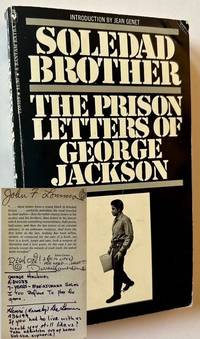
1970réf. 25498New York 1970. Original wraps. Very Good . A one-of-a-kind copy of this October 1970 1st paperback printing published simultaneously with the hardback. This copy is signed by 14 inmates in the California penal system. All of them have proudly signed their names many of them have given their prison ID #s and most of them have identified the length of their sentences and also their crmes "2-10 to Life for Weed -- What!!" "7 Years Marijuana Sales I Too Refuse to Play the Game" etc. A clean very sharp VG copy of this thick Bantam pocketbook with one razor-thin vertical crease running the length of the spine and one other running the length of the front panel's outer hinge. The Introduction to this historic collection of George Jackson prison letters by the formidable Jean Genet himself a renowned inmate for years. unknown books
1964réf. 620825New York: Evergreen Review 1964. Softcover. Near Fine. First edition. Quarto. 90pp. Illustrated. Pictorial wrappers. Light edgewear near fine. Featuring a ten page portfolio by Emil J. Cadoo. Also "The Killer" by Norman Mailer "The Excluded Words" by Wayland Young "The Funambulists" by Jean Genet "They Just Fade Away" by William Burroughs "The Motor Show" by Eugene Ionesco "Cut-Ups: A Project for Disastrous Success" and more. The scarce suppressed issue. District Attorney William Cahn of Nassau County ordered the confiscation of 21000 copies of the magazine on the grounds that the issue contained obscene pictures Cadoo's portfolio of nude figures and text Young's article. The seizure was later declared illegal and a violation of the 14th Amendment. Evergreen Review unknown books
1951réf. 551657Paris: Gargoyle Press 1951. Softcover. Very Good. Magazine. Vol. 1 No. 1. Printed wrappers. Very good with the wrappers toned a chip at the top and bottom of the front wrapper not affecting the text but causing the wrapper to begin to separate from the spine toning and rubbing to the spine staining to the rear wrapper and two chips to the rear wrapper. Contains an excerpt from Our Lady of the Flowers by Jean Genet "The Thief" by Joseph Cowley "The Other Foot" by Ray Bradbury and more. (Gargoyle Press) unknown books
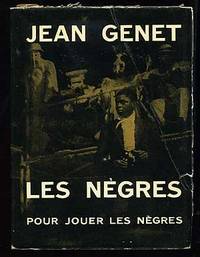
1966réf. 244335New York: Grove Press 1966. Hardcover. Fine/Very Good. First edition. Translate by Bernard Frechtman. Octavo. 344pp. Fine in very good or better price-clipped dust jacket with creasing to the front flap tear and light edge creasing. Grove Press hardcover books
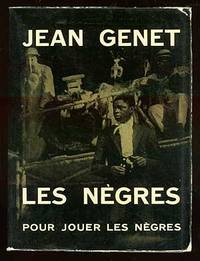
1987réf. 387850New York: Grove Press 1987. Softcover. Near Fine. Reprint. Trade paperback. Originally published as Les Paravents. Translated from the French by Bernard Frechtman. Near fine. Grove Press unknown books
1828réf. 357361Washington: Printed by Duff Green 1828. Softcover. Very Good. Disbound pamphlet. 224pp. plus 5 plates and 1 table. Foxed slight erosion on title-leaf still tight and very good. A manual compiled by Genet including a translation from a German treatise on dying silk by George William Helterhoff published at Erfurt 1809. This copy belonged to Mitchell King with his signature on title page a lawyer principal of Charleston College South Carolina and a founder of the Philosophical Society in 1809. Shaw & Shoemaker 36504. Printed by Duff Green unknown books
1951réf. 368572Paris: Gargoyle Press Inc 1951. Softcover. Very Good. Magazine. Octavo. 133pp. Perfectbound printed wrappers. Very good with ink owner name on first page a bit of wear at the extremities and a few scattered small spot on front wrap. The first issue of this magazine featuring a story from Ray Bradbury "The Other Foot" as well as contributions from Jean Genet Jeanne Rogers John Pierce Joseph Cowley T.L. Berger David Marcus Richard Trudgett. Gargoyle Press Inc unknown books
1951réf. 340652Paris: Gargoyle Press Inc 1951. Softcover. Good. Magazine. Octavo. 133pp. Perfectbound printed wrappers. Toned wraps chipped at the extremities with a several tears and drinkstain good or better. The first issue of this magazine featuring a story from Ray Bradbury "The Other Foot" as well as contributions from Jean Genet Jeanne Rogers John Pierce Joseph Cowley T.L. Berger David Marcus Richard Trudgett. Gargoyle Press Inc unknown books
1963réf. 74037Paris: Marc Barbezat/L'Arbalete 1963. Softcover. Very Good. Reprint. Text in French. Half-title with inked notes and page edges with some light spotting thus very good in very good creased wrappers showing some edge wear. Marc Barbezat/L'Arbalete unknown books
1965réf. 58400New York: Grove 1965. Hardcover. Fine/Fine. First American edition. Fine with stamp on front pastedown fine in dustwrapper. Novel set in a French prison during the war. Translated by Bernard Frechtman. Grove hardcover books
1958réf. 67211New York: Grove Press 1958. Hardcover. Fine/Near Fine. First American trade edition. Fine in a lightly rubbed and soiled near fine dustwrapper. A nice copy of this major expressionist play. Because of the simultaneous paperback issue the hardcover is remarkably uncommon. Grove Press hardcover books
1958réf. 59264London: Faber and Faber 1958. Hardcover. Fine/Very Good. First English edition. Small bookstore label has offset on the bottom of the front fly else fine in very good dustwrapper with a couple of small shallow chips two small internal repairs and a small hole on the spine. A major expressionist play. Faber and Faber hardcover books
1963réf. 46336L'Arbalete: Marc Barbezat 1963. Softcover. Very Good. Text in French. Very good in wrappers. Marc Barbezat unknown books
1956réf. 629160New York: The Paris Review 1956. Softcover. Very Good. Periodical. Pictorial wrappers. Creasing to the spine and one corner as well as some light toning very good or better. Includes an interview with Dorothy Parker and contributions by Nadine Gordimer Daniel Hoffman Richard Yates Jean Genet James Wright and more. The Paris Review unknown books
1966réf. 61831NY: Grove Press 1966. Hardcover. Very good. Hardcover. First American Edition. Some foxing to prelims and edges of textblock else a very good hardback in a darkened rubbed and lightly edgeworn jacket that has a closed tear to the bottom of the front fold. Grove Press hardcover books
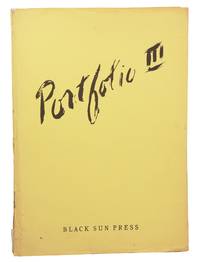
1946réf. 140949984Washington DC: Black Sun Press 1946. First edition. Paperback. Volume III Spring 1946. Complete in 31 broadsides numbered 1-28 with book review sheet plus "Cover Leaf" and "Foreleaf" in fragile yellow wraps with pockets. One of approximately 1000 copies. Krumhansl 1. Wraps show typical wear; they're not particularly strong paper and tended to pop along the seams as this copy did. Chipping lots of short tears repaired with clear tape on verso. Contents Near Fine though with only a little light corner wear. The broadside "20 Tanks from Kasseldown" is Charles Bukowski's first separate publication preceding his first book Flower Fist and Bestial Wail by 14 years. Apart from being a literary magazine composed of beautifully-printed broadsides with Henry Miller as its prose editor this issue is uncommon complete featuring contributions from such 20th Century luminaries as Sartre Boyle Genet Garcia Lorca and Rexroth. Black Sun Press paperback books
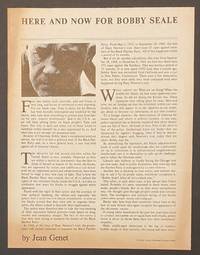
1970réf. 298416New York City: Committee to Defend the Panthers 1970. Handbill. 8.5x11 inch handbill printed front and back toned around the margins. Originally appeared in Ramparts June 1970. Genet's appeal to defend Bobby Seale against murder charges in New Haven CT reprinted by Committee as fundraiser for the case. Committee to Defend the Panthers unknown books
1958réf. 520090New York: Grove Press 1958. Hardcover. Near Fine/Near Fine. First American trade edition. Translated by Bernard Frechtman. Jacket design by Roy Kuhlman. Near fine in a very near fine dust jacket with a small soil spot on rear panel and light general wear. A nice copy of this major expressionist play. Because of the simultaneous paperback issue the hardcover is uncommon. Grove Press hardcover books
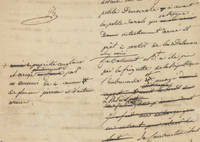
1793réf. 2495809/07/1793. Following the execution of King Louis XVI and Marie Antoinette in January 1793 the French revolutionary government found itself at war with Spain the Netherlands and Great Britain. It dispatched Edmond Charles Genêt as minister to the United States for the purpose of enlisting American assistance to the fullest extent possible. Genêt arrived in Charleston South Carolina on April 8 1793 – calling himself “Citizen Genêt” to emphasize the revolutionary title. He received a warm welcome and immediately began to issue privateering commissions that authorized the bearers regardless of their country of origin to seize British merchant ships and their cargo for personal profit all with the approval and protection of the French Government. President Washington saw this as a dangerous attempt to draw the new United States into a European war and on April 22 issued his Proclamation of Neutrality declaring the U.S. a neutral nation in the conflict and threatening legal proceedings against any American providing assistance to the warring countries. Genet then proceeded to the capital at Philadelphia and was met with acclaim and jubilation everywhere he went as many Americans supported the French Revolution’s goals of liberty equality fraternity. He was officially received by Washington on the afternoon of May 18th but Secretary of State Thomas Jefferson soon informed him that the United States considered the outfitting of French privateers in American ports to be a violation of the U.S. policy of neutrality. Genet ignored this warning and in fact threatened to take his case directly to the American people bypassing official government opposition. Genêt was thus willing to challenge Washington and risk being seen as a foreign meddler in American domestic affairs. Sometime in the spring of 1793 the French frigate Embuscade commandeered the British vessel Little Sarah and dragged it into Philadelphia. The ship was there outfitted as a French privateer and renamed La Petite Démocrate. On June 22nd the Washington administration began to investigate the disturbing claims coming from the nation's capitol. There was talk of sending an armed brigade from the state of Pennsylvania to confront Genet. Secretary of State Thomas Jefferson visited Genet in an attempt to secure his promise that the vessel would not leave Philadelphia before the President’s return. According to Jefferson’s account of the meeting Genet “said he should not be justified in detaining her. I told him it would be considered a very serious offence indeed if she should go away; that the government was determined on that point and thinking it was right would go through with it. After some hesitation he said he could not make any promise it would be out of his duty but that he was very happy in being able to inform me that the vessel was not in readiness and therefore could not sail that day.… And whenever I tried to fix it to the President’s return he gave the same answer that she would not be ready for some time but with the look and gesture which showed he meant I should understand she would not be gone before that time."" On July 8 Washington Hamilton Jefferson and Knox met at Independence Hall. Note of the meeting read: ""The secretary of the Treasury and The secy of War are of opinion that it is expedient that immediate measures should be taken provisionally for establishing a battery on Mud Island under cover of a party of Militia with direction that if the Brig Sarah should attempt to depart before the pleasure of the President shall be known concerning her military coercion be employed to arrest and prevent her progress. The Secretary of State dissents from this opinion."" Jefferson evidently then turned to Genet who was in Philadelphia to write his own rationale that he would send just 2 days later to Washington enclosing this note with a recommendation that armed conflict not be commenced as he had advocated at Independence Hall. He judged Genet's non-committal along with conciliatory language as promise enough that the action would not be taken prior to President Washington's return. Autograph memorandum signed Philadelphia July 9 1793 to Thomas Jefferson Genet's draft pages 1 and 2 signed in the margin. ""Note pertaining to la Petite Démocrate captured by frigate Embuscade heretofore la Petite Sarah that M. Genet has had armed on account of the Republic and to which the exit is being opposed."" ""You have asked me details about the Brigantine la Petite Démocrate heretofore la Petite Sarah found presently armed and ready to leave Delaware. This vessel Sir of English property armed by our enemies with 4 cannons and other arms has been taken by the Frigate of the French Republic l'ambuscade and sent to Philadelphia. The construction being light and strong her body lined with copper her molding superior her rigging and her masts in good shape I have judged to act on the Embuscade Captain's report and that provided by other sailors that the acquisition of this vessel was advantageous to the Republic and this consideration added to the wish I had to procure employment for a rather large amount of French sailors being there exposed to the danger which often comes by being idle and miserable made me determined to take her on behalf of the State. ""I had it repaired right away. I did so using cannons found on board 4 French vessels. I left the command to the Citizen Amiot officer of the Republic. I will have it sent out armed with a commission of the Executive Council along with my instructions as soon as possible. I have to confine Monsieur that relating these facts which are not susceptible for discussion from me and which should not present any difficulties to your government."" On July 11 Jefferson wrote to Washington ""Papers requiring the President’s instant attention"" enclosing the final version of this very note."" unknown books
1993réf. 33514Hopewell NJ: The Ecco Press 1993. xvi 462p. first edition dj. The Ecco Press unknown books