415 résultats
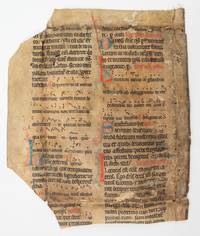
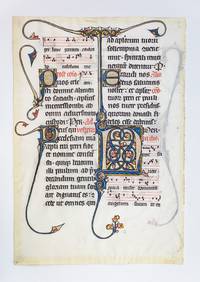
réf. ST20214Northern France perhaps Beauvais or Amiens late 13th or early 14th century. 286 x 199 mm. 11 1/4 x 7 3/4". Double column containing a mixture of staves and text approximately 21 lines in an excellent formal gothic book hand. Attractively matted. Rubrics in red chant text containing black penwork initials with red and yellow geometric elaboration BEAUTIFULLY ILLUMINATED with five two-line initials painted blue or pink with white tracery on a ground in the contrasting color two of the initials filled with grotesques and swirling vines and two with the filler design traced out but never completed each initial with blue and pink extensions terminating in orange leaves or spiky shapes; the verso featuring AN IMPRESSIVE SIX-LINE "N" 58 x 50 mm. in the same style filled with an intricate knotwork design and orange leaves with long extensions including a horizontal extension across the upper margin. Margins with light offsetting of the designs from the facing leaf; remnants of mounting tape on recto corners and bottom edge; verso apparently with a barely visible Medieval "14" in lower margin. An area measuring 5 mm. at edges just faintly yellowed from mat burn but IN FINE CONDITION the vellum otherwise quite bright the paint rich and the gold brightly glittering. This sumptuously decorated leaf--which is beautifully preserved and contains a particularly large and handsome initial--comes from the last volume of a three-volume Missal presented to Beauvais Cathedral by Canon Robert de Hangest d. 1356. The Missal remained at the cathedral at least through the 17th century when it is noted in an inventory but was removed from the church at some point likely in the aftermath of the French Revolution. The parent volume eventually entered the collection of Henri-Auguste Brölemann 1775-1854 of Lyon who passed it to his grand-daughter Etienne Mallet who then sold it at Sotheby's in 1926. It was then acquired for the collection of William Hearst where it remained for the next 25 years. In 1941 it was again sold at auction and subsequently dismembered. Though long thought to have been the work of famed biblioclast Otto Ege recent scholarship suggests that it was actually Phillip Duschnes who was responsible for breaking up the book keeping some leaves for himself and selling others on to his colleague Ege for inclusion in his portfolios of "Fifty Original Leaves from Medieval Manuscripts." The Beauvais Missal has been a subject of interest for many notable scholars chief among them being Christopher de Hamel--see: "Otto Ege and the Beauvais Missal" in "Gilding the Lilly: A Hundred Medieval and Illuminated Manuscripts in the Lilly Library" and it is currently the focus of a major effort to "reconstruct" the manuscript digitally--a project spearheaded by Lisa Fagin Davis. Other leaves from the parent volume are in the collections of the Morgan Library the Metropolitan Museum of Art the Cleveland Museum of Art and the Houghton Library at Harvard among many others. Although there is some dispute among art historians the illumination has been tentatively attributed to the artist of the Hours of Yolande of Soissons produced in Amiens ca. 1280 and now held by the Morgan Library MS M.729. It is worth noting that the town of Hangest home to the original owner is only 10 miles from Amiens and is a likely place of origin for the Missal. The present leaf contains a text for a major feast day and thus contains a large and extravagantly decorated initial for its opening "'Nunc scio vere." It is not too much to say that the decoration here is masterful but curiously--and of special interest to us from a modern perspective--the illuminators seem to have forgotten to put the finishing touches on the two smaller initials above which still contain sketches of the preliminary design. unknown
réf. ST20214Northern France perhaps Beauvais or Amiens late 13th or early 14th century. 286 x 199 mm. 11 1/4 x 7 3/4". Double column containing a mixture of staves and text approximately 21 lines in an excellent formal gothic book hand. Attractively matted. Rubrics in red chant text containing black penwork initials with red and yellow geometric elaboration BEAUTIFULLY ILLUMINATED with five two-line initials painted blue or pink with white tracery on a ground in the contrasting color two of the initials filled with grotesques and swirling vines and two with the filler design traced out but never completed each initial with blue and pink extensions terminating in orange leaves or spiky shapes; the verso featuring AN IMPRESSIVE SIX-LINE "N" 58 x 50 mm. in the same style filled with an intricate knotwork design and orange leaves with long extensions including a horizontal extension across the upper margin. Margins with light offsetting of the designs from the facing leaf; remnants of mounting tape on recto corners and bottom edge; verso apparently with a barely visible Medieval "14" in lower margin. An area measuring 5 mm. at edges just faintly yellowed from mat burn but IN FINE CONDITION the vellum otherwise quite bright the paint rich and the gold brightly glittering. This sumptuously decorated leaf--which is beautifully preserved and contains a particularly large and handsome initial--comes from the last volume of a three-volume Missal presented to Beauvais Cathedral by Canon Robert de Hangest d. 1356. The Missal remained at the cathedral at least through the 17th century when it is noted in an inventory but was removed from the church at some point likely in the aftermath of the French Revolution. The parent volume eventually entered the collection of Henri-Auguste Brölemann 1775-1854 of Lyon who passed it to his grand-daughter Etienne Mallet who then sold it at Sotheby's in 1926. It was then acquired for the collection of William Hearst where it remained for the next 25 years. In 1941 it was again sold at auction and subsequently dismembered. Though long thought to have been the work of famed biblioclast Otto Ege recent scholarship suggests that it was actually Phillip Duschnes who was responsible for breaking up the book keeping some leaves for himself and selling others on to his colleague Ege for inclusion in his portfolios of "Fifty Original Leaves from Medieval Manuscripts." The Beauvais Missal has been a subject of interest for many notable scholars chief among them being Christopher de Hamel--see: "Otto Ege and the Beauvais Missal" in "Gilding the Lilly: A Hundred Medieval and Illuminated Manuscripts in the Lilly Library" and it is currently the focus of a major effort to "reconstruct" the manuscript digitally--a project spearheaded by Lisa Fagin Davis. Other leaves from the parent volume are in the collections of the Morgan Library the Metropolitan Museum of Art the Cleveland Museum of Art and the Houghton Library at Harvard among many others. Although there is some dispute among art historians the illumination has been tentatively attributed to the artist of the Hours of Yolande of Soissons produced in Amiens ca. 1280 and now held by the Morgan Library MS M.729. It is worth noting that the town of Hangest home to the original owner is only 10 miles from Amiens and is a likely place of origin for the Missal. The present leaf contains a text for a major feast day and thus contains a large and extravagantly decorated initial for its opening "'Nunc scio vere." It is not too much to say that the decoration here is masterful but curiously--and of special interest to us from a modern perspective--the illuminators seem to have forgotten to put the finishing touches on the two smaller initials above which still contain sketches of the preliminary design. unknown books
1966réf. 317165New York: Benziger Brothers 1966. New edition. Hardcover. Very Good in boards. 6 silk ribbon page markers. Spine cocked. Foxing on text block edges. Benziger Brothers hardcover
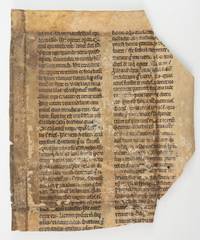
réf. ST21124c-01France or Low Countries 14th century. 270 x 230 mm. 10 3/4 x 9". Double columns 32 lines in a gothic book hand. Rubrics and staves in red several initials measuring two or more lines in red or blue with contrasting penwork. Unevenly trimmed missing at most a line of text at the bottom of each column and several words or part-words at corners of outer columns vellum with soiling browning small holes and paper residue consistent with having been used in a binding one side quite darkened but the text there legible with effort nevertheless and entirely legible on the other side. From a noted Missal with numerous large penwork initials this leaf was once used as the cover for a binding yet remains substantially complete. The text here comes from the Temporale containing the cycle of moveable feasts in the Christian year and includes text for Tuesday and Wednesday Feria III and IV of Passion Week. The musical notation on this leaf is highly developed consisting of a four-line staff clef marker and square neumes. unknown
réf. ST21124c-02France or Low Countries 14th century. 270 x 461 mm. 10 5/8 x 18 1/8". Double columns 32 lines in a gothic book hand. Rubrics and staves in red three two-line initials in red or blue with contrasting penwork now quite faded. Unevenly trimmed missing at most a line of text at the bottom of each column and several words or part-words at corners of outer columns vellum with soiling browning small holes and paper residue consistent with having been used in a binding but the text entirely legible on one side and legible with effort on the other rather darkened side. From a noted Missal with large penwork initials this leaf was once used as the cover for a binding yet remains substantially complete. The text here comes from the Temporale containing the cycle of moveable feasts in the Christian year and includes Wednesday Feria IV after the fourth Sunday of Lent with a long passage from John 9. The musical notation on this leaf is highly developed consisting of a four-line staff clef marker and square neumes. unknown
réf. ST21124c-02France or Low Countries 14th century. 270 x 461 mm. 10 5/8 x 18 1/8". Double columns 32 lines in a gothic book hand. Rubrics and staves in red three two-line initials in red or blue with contrasting penwork now quite faded. Unevenly trimmed missing at most a line of text at the bottom of each column and several words or part-words at corners of outer columns vellum with soiling browning small holes and paper residue consistent with having been used in a binding but the text entirely legible on one side and legible with effort on the other rather darkened side. From a noted Missal with large penwork initials this leaf was once used as the cover for a binding yet remains substantially complete. The text here comes from the Temporale containing the cycle of moveable feasts in the Christian year and includes Wednesday Feria IV after the fourth Sunday of Lent with a long passage from John 9. The musical notation on this leaf is highly developed consisting of a four-line staff clef marker and square neumes. unknown books
réf. ST21124c-01France or Low Countries 14th century. 270 x 230 mm. 10 3/4 x 9". Double columns 32 lines in a gothic book hand. Rubrics and staves in red several initials measuring two or more lines in red or blue with contrasting penwork. Unevenly trimmed missing at most a line of text at the bottom of each column and several words or part-words at corners of outer columns vellum with soiling browning small holes and paper residue consistent with having been used in a binding one side quite darkened but the text there legible with effort nevertheless and entirely legible on the other side. From a noted Missal with numerous large penwork initials this leaf was once used as the cover for a binding yet remains substantially complete. The text here comes from the Temporale containing the cycle of moveable feasts in the Christian year and includes text for Tuesday and Wednesday Feria III and IV of Passion Week. The musical notation on this leaf is highly developed consisting of a four-line staff clef marker and square neumes. unknown books
réf. 73098Maison Alfred Mame 1932 livre missel 14,5*9 1295 pages
1986réf. 306857Sherwood Park: St John's Lutheran Church 1986. First edition. hardcover. very good/no dustjacket. 4to. pp.232 St John's Lutheran Church hardcover
réf. ria9780299229405_inpHardcover. New. New Book; Fast Shipping from UK; Not signed; Not First Edition; Arrows in the Dark recounts and analyzes the many efforts of aid and rescue made by the Jewish community of Palestine--the Yishuv--to provide assistance to European Jews facing annihilation by the Nazis. Tuvia Friling provides a detaile hardcover
réf. 6694627University of Wisconsin Press . Hardback. New. pp. 280 1st edition of Wisconsin Press Shelby Jenkins sjenkins@apa.org University of Wisconsin Press hardcover
réf. 15664Alfred Mame, Tours(1911), IN12 reliure souple,312 pages,dos rond lisse, tranches et gouttières dorées, chasses illustrées de fleurs dorées, texte encadré d"illustrations n&b, illustrations pleine page n&b sous serpentes légendées, intérieur trés frais papier légèrement glacé
1769réf. dk450A Paris, Chez de Hansy, libraire, sur le pont au Change, à Saint-Nicolas Relié 1769 In-12, (9x14.5 cm), relié plein chagrin de la fin du XIXe siècle, dos à 5 nerfs avec titre doré, doubles filets dors sur les coupes et roulettes sur les contre-plats, tranches dorées, 552 pages, frontispice gravé, vignette de titre ; quelques rousseurs, dos et coins légèrement frottés, assez bon état. Livraison a domicile (La Poste) ou en Mondial Relay sur simple demande.
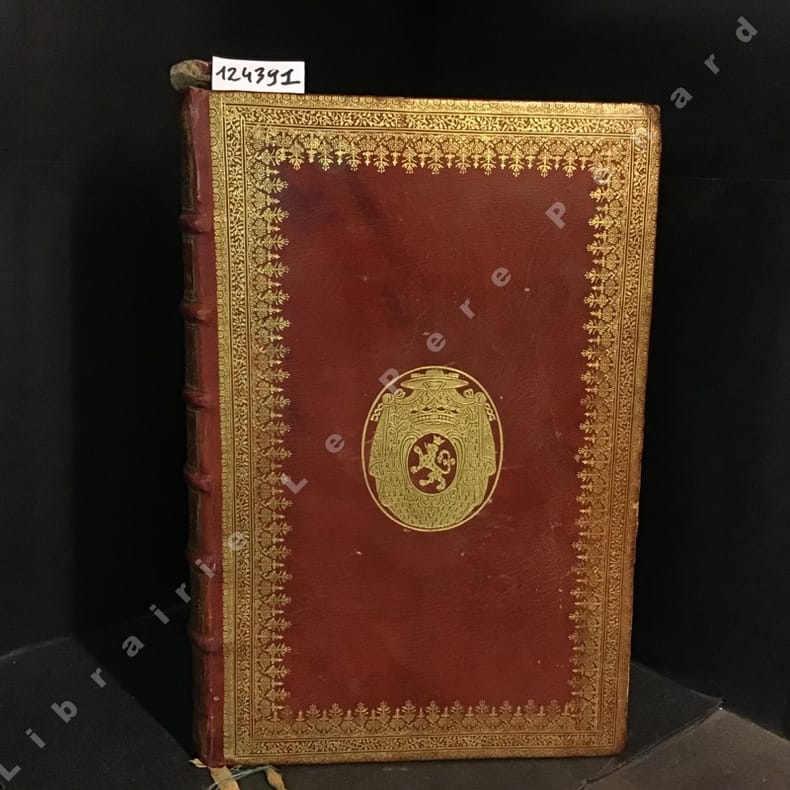
1698réf. 1243911698 Lutetiæ Parisiorum, Apud Johannem Baptistam Coignard, Regis Typographum (Chez Jean-Baptiste Coignard, Imprimeur du Roi, Paris) - M. DC. XCVIII. (1698) - Un volume In-folio (27x40cm), reliure plein maroquin rouge, dos à 6 nerfs avec titre et caissons ornés de fleurons en dorée, encadrement en dorée sur les plats, roulette dorée sur les tranches et les contreplats, coussinet de lecture et signet, onglets en tissus, toutes tranches dorées, reliure armoriée aux armes de Jacques-Nicolas Colbert (archevêque de Rouen) - A-M + 668 + civ pages - Très beaux ornements (vignettes, lettrines, culs-de-lampe, fleurons) et gravures hors-texte en N&B dans l'ouvrage - Texte en N&B et rouge en latin sur deux colonnes
1928réf. gu1216Brepols Relié avec emboîtage 1928 In-12 (8x15 cm), jolie reliure plein veau sous emboîtage (coffret), plats ornés de dorures, roulettes dorées, tranches dorées, 380 pages, une gravure en frontispice, vignettes, texte encadré d'illustrations, traduction de l'Abbé J.-B. Glaire ; état remarquable. Livraison a domicile (La Poste) ou en Mondial Relay sur simple demande.
réf. 25359Zech et Fils, Braine-le-Comte 1902,éditeurs des archevechés de SMYRNE et de QUEBEC, In 12 Reliure en cuir à 5 nerfs , maroquin bordeaux avec découpes et filets soulignant la découpe , motifs floraux dorés . Gardes en papier doré vert avec motifs entrelacés . Trois tranches dorées . Gravures sur toutes les pages imprimées sur papier bible et gravures signées de Ludovic Mouchot hors texte protégées de leur soie . Texte en français et latin . Bien conservé - 582 p.; coffret d'origine vert, bon état, 850 gr.,
1842réf. 1215901842 Librairie Catholique de Perisse Frères, Lyon, Paris - 1842 - In-12, plein veau blond, dos lisse avec titre en doré - 354 pages
réf. 027945Paris L. CURMER, sans date 0 un volume (155 x 115mm), [3] ff. (feuillet blanc, frontispice, titre illustré) CCVIII pp. Reliure en maroquin bleu, dos à nerfs orné du titre estampé, tranches dorées, roulette, filets et dents-de-rat dorés sur les chasses, gardes doublées de soie avec initiales frappées ( mention " L. CURMER " en petits caractères sur le coin supérieur du premier plat). (frottis sur les nerfs, sur les coiffes et sur les coins, frottement de 1cm sur une coupe au premier plat, présence d'auréole sur les gardes, rousseurs sur le haut du frontispice, sur le haut du titre, sur un hors-texte et sur plusieurs feuillets). Ouvrage entièrement monté sur onglet. Frontispice, titre et 7 hors-textes en chromolithographie ( PRALON ). Toutes les pages comportent des lettrines et des frises d'encadrement richement décorées en couleurs. Ex-libris manuscrit. Initiales frappées sur les gardes. Rare.
réf. 028762Paris, Gruel et Engelmann, sans date (1860) 0 un volume (155 x 115mm), [2]ff., 176 pp., [2]ff. (souvenirs de famille), (1) pp. (marque de l'imprimeur). Reliure en plein maroquin gris anthracite à la Bradel, dos lisse orné du titre et de filets d'encadrement estampés à froid, double filet estampé à froid sur les plats, chiffre métallique en coin au premier plat, double filet doré sur les coupes, tranches dorées, roulettes et filets dorés sur les chasses, gardes moirées, signet ( TAFFIN-LEFORT ), accompagné d'un coffret ancien en cuir orné sur le couvercle d'initiales frappées encadrées d'une dentelle dorée et doublé ( " VIGUIER TOULOUSE " ). (chiffre manquant sur le premier plat, coiffes et coins légèrement frottés, légères usures sur les plats, auréoles et piqûres sur les gardes, coffret légèrement frotté). Édition originale de ces heures entièrement réalisées en chromolithographie et inspirées des manuscrits enluminés médiévaux. 176 chromolithographies montées sur onglet, dont le titre, 4 hors-texte en sépia et or, le reste en compositions décoratives (animaux, hommes, fleurs, rinceaux...) autour du texte, chaque page étant différente. 4 pages de souvenirs de famille, la marque de l'éditeur-imprimeur in fine. Intérieur frais. Bon exemplaire et superbe réalisation de Gruel et Engelmann pour ce livre d'heures néo-gothique. Étiquette de librairie en coin de page de garde : " VIGUIER TOULOUSE ".
réf. 024009TURNHOUT ÉTABLISSEMENTS BREPOLS, sans date 0 Un volume in-16°, 400 pp. Reliure éditeur en pleine peau, plats ornés de motifs floraux, dos à nerfs orné du titre en doré, tranches dorées, guirlande sur les chasses, gardes moirées, étui. (mors ouverts, présence de rare rousseurs sur les gardes). Texte encadré de nombreux dessins variés en noir. Quelques illustrations en hors-texte. Bel exemplaire.
réf. 116362Campoduni (Kempten), Ex Typographia olim Ducali, num J. Koeseliana 1846, 380x245mm, CLV - 994 + 303pages, Titre gravé, lettrines, 3 gravures hors texte.Cuir noir, titre et filets au dos dorés, tranches dorées, plats en reliefs avec ornementations dorés, fermoirs et coins en laiton (manque un coin), taches d’eau sur le haut du volume.
réf. 117475Parisiis (Paris), Apud Rolinum Thierry & Eustachium Foucault 1615, 365x230mm, reliure plein veau marbré de l’époque avec ornementations et fleur de Lys dorés (dorrure passée) au dos à six nerfs. Plat encadrements et ornementations dorés avec au centre un écu avec au sommet une chapeau de cardinal et une devise latine inscrite sur un ruban : Non secundun factum (non selon l’apparence). Livre provenant de D. Nicolai Goubile, Decani Cameracén. Plat frotté. Charnière craquelées. Intérieur propre. Bel exemplaire.
1901réf. 022259Dijon ROUX-MARCHET & Cie 1901 un volume in-12° (100 x 140mm), 510 pp. Reliure éditeur à la Bradel en plein maroquin marron, dos lisse titré or, premier plat orné d'un décor floral d'encadrement or, filet doré sur les coupes, riche décor d'encadrement doré sur les chasses, gardes de soie moirée, tranches rouge sous or, signet en trois couleurs, dans sa boîte. (discrète salissure sombre en sommet de dos, fentes à la boîte). Livre de piété orné de dessins de M.L. CHAPUIS, gravures de Johannet, imprimé chez FIRMIN-DIDOT. Très bel exemplaire sans rousseurs.
1891réf. 022277BRAINE-LE-COMTE, PARIS, LYON, ZECH ET FILS 1891 Un volume in-8° (111 x 150mm), 552 pp. Reliure éditeur en plein maroquin vert bronze, premier plat orné d'une plaque en argent, en forme de "L", finement ciselé, dos à nerfs orné du titre doré, double filet sur les coupes, roulette sur les chasses, gardes parées d'un beau papier à décor floral, toutes tranches dorées, signet. (reliure un peu brunie en plusieurs endroits, frottis aux coiffes et aux coins, très faibles ressauts de cahier). Missel accompagné de nombreuses gravures en noir et blanc dans et hors-texte. Intérieur frais.
réf. 473730S.N. S.L. S.D. (XVIe) IMPORTANT ET EXCEPTIONNEL ANTIPHONAIRE in folio ( 635 X 445 mm ) de 244 pages, pleine basane fauve, dos à nerfs janséniste, plats sur ais de bois avec renforts de cuivre cloutés sur les coupes, fermeture par par serrure carrée à clef fixée au premier plat avec un moraillon ( poignée à charnière ) dont l'auberon ( extrémité inférieure de la poignée ) vient s'engager dans le pène de la serrure, clef forgée. 172 feuillets de parchemin ( 595 X 400 mm ) manuscrits recto-verso, lettrage en rouge, notation musicale carrée en noir sur des portées à 5 lignes rouges. Quelques feuillets ont été restaurés en marge, 3 ont été découpés, la reliure a été habilement restaurée par le Centre de Conservation du Livre d'Arles, la couvrure est donc récente, la serrure et les feuillets sont bien d'époque XVIe siècle. Poids: 18 kg.