[BAVARIA - PHARMACOPOEIA].Biblio.com
131 Ergebnisse
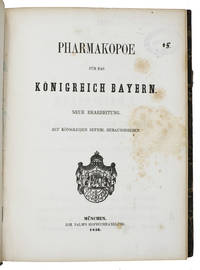
1856Best.-Nr. I14FWQ4I6CYWMünchen: Johann Palm 1856. Half light brown buckram marbled boards gilt-lettered title on spine. Large 8vo. With the royal coat-of-arms of Bavaria on the title-page. First edition of a new Pharmacopeia for the Kingdom of Bavaria ordered by the liberal King Maximilian II 1811-1864 who succeeded his father in the revolutionary year 1848 to replace the obsolete Bavarian Pharmacopeia of 1822. The compilers of the new work were a.o. Prof. Max Pettenkofer Hofapotheker and first German Hygienist 1818-1901 and Dr. Ernst Aug. Buchner. Library stamp on title. Some stains especially on the first leaves otherwise in good condition.l The afterword by Wolgang Schneider in the reprint of the Pharmakopoe of 1988; Neues Repertorium für die Pharmacie vol. 9 1859 3. Abschnitt pp. 39-43. Johann Palm, hardcover
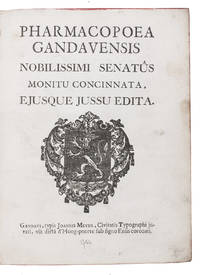
1756Best.-Nr. I17F1HIG4EOQGhent 1756. 4to. Joannis Meyer Contemporary calf richly gold-tooled spine with a tulip in 5 of the 7 compartments red edges. 2 works in 1 volume. 1 1 blank 14 274 30; 54 2 pp. Ad 1: Unrecorded first issue of the rare third edition of the Ghent pharmacopoeia the first to call itself a "pharmacopoea" instead of "antidotarium" in the title.This copy differs slightly from all others recorded in that it contains a somewhat different preface and approval which is signed only by A.C.J. van Rossum and dated 1755. It therefore lacks the more expanded approval from 1756 of the professors of the University of Louvain including that of Van Rossum as well as the subsequent dedication to Empress Maria Theresa. The present variant is therefore almost certainly an earlier issue.Ad 2: New edition of the taxa regulating the prices of pharmacists in Ghent. The previous version dates from 1690 and this new edition was published to reflect the changes made in the pharmacopoeia of 1756.With the binding worn at the spine and somewhat along the extremities. Slightly thumbed with a small tear in the fore-edge margin of pp. 239-248 and a water stain in the fore-edge margin of the final part of ad 1 starting at p. 265; a good copy.l Ad 1: Anet 2 copies; Daems & Vandewiele p. 106 3 copies; STCV 2 copies; WorldCat 1 copy; not in Blake; Wellcome; ad 2: Anet 1 copy; Daems & Vandewiele pp. 106-107; not in STCV; WorldCat. LOW COUNTRIES MEDICINE & PHARMACY Belgium Medicine & Pharmacy 18th Century Pharmacy / Pharmacopaea unknown
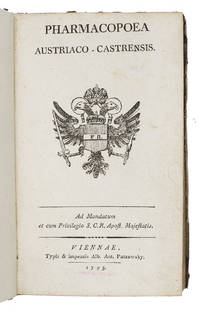
1795Best.-Nr. I17BBOP2JSB6Vienna 1795. 8vo. Albert Anton Patzowsky Half calf spine label lettered in gold red sprinkled edges. 4 102 pp. First edition in Latin of the first military pharmacopoeia for Habsburg Austria with the privilege for 10 years in German dated 29 September 1795 and granted to the publisher Albert Anton Patzowsky on behalf of the last Holy Roman Emperor Franz II Joseph 1768-1835 who was to become Franz I the first Emperor of the Austrian Empire in 1804.Until 1794 the Austrian army met its pharmaceutical needs with help from civilian pharmacists. Problems with the quality of the services provided led to the establishment of a professional military pharmaceutical service in 1794. To provide the medical support that the army needed garrison hospital pharmacies were built. Patzowsky published a German edition of the present pharmacopoeia in the same year: Oestrreichischen Militär-Pharmacopoea zum Gebrauche der Oestrreichischen Fieldärzte Vienna A.A. Patzowsky 1795. In spite of the privilege a pirated edition appeared in the same year in Pavia.Spine slightly worn otherwise in good condition.l Blake p. 347; cf. Wellcome IV p. 356 1795 edition Pavia. MEDICINE & PHARMACY MILITARY HISTORY Military History 18th Century Pharmacy / Pharmacopaea ZZ 003 TITELS GEBRUIKT VOOR 2022 unknown
1812Best.-Nr. LBCCHAC9J5FUAntwerpen 1812. 8vo. Antonius Grangé 19th-century green half sheepskin marbled sides. VIII 208 pp. First and only edition of the pharmacopoeia for the department of Deux-Nèthes in the First French Republic which contained the present-day Belgian province of Antwerp and parts of the Dutch province of North Brabant. Intended to be a revision of the Antwerp pharmacopoeia of 1660! it was heavily inspired by the Pharmacopoea Batava published in Amsterdam in 1805. Jean-Bernard-Joseph van den Zande 1778-1833 doctor and professor of physics and chemistry headed the committee with L.H.J. Francken carrying out experiments and F.M. Verbert editing the book itself Like the Pharmacopoea Batava the Pharmacopoeia manualis Utriusque Nethae shows the ever increasing importance of chemical medicine over natural substances. Its official use proved to be short-lived as the department was incorporated in the United Kingdom of the Netherlands in 1814 which prescribed the Pharmacopoea Batava and from 1823 onward the Pharmacopoea Belgica.With the stamp of the Département des deux Néthes on the verso of the title-page. Binding slightly rubbed bumped edges but still in good condition.l Daems & Vandewiele p. 63; Vandewiele "De farmacie onder koning Willem I" in: Kring voor de geschiedenis van de pharmacie in Benelux no. 56 1978 pp. 35-51; Vandewiele Geschiedenis van de farmacie in België p. 306; Wellcome IV p. 357. LOW COUNTRIES MEDICINE & PHARMACY Belgium Medicine & Pharmacy 19th Century Pharmacy / Pharmacopaea ZZ 003 TITELS GEBRUIKT VOOR 2022 unknown
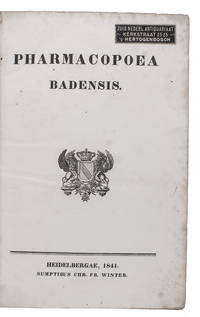
1841Best.-Nr. I14BP0GYACIHHeidelberg 1841. Large 8vo 23.5 x 15.5 cm. Christian Friedrich Winter Near contemporary half calf gold-tooled spine. With the wood engraved arms of Baden on title-page. VIII 353 1 pp. First edition of the official pharmacopoeia of the Duchy of Baden in southwest Germany which replaced the Preußischen Pharmakopöe used there previously. It contains a total of 822 medicines and recipes of which 345 "Simplicia" simple medicines and 477 "Praeparata" compound medicines. The book is entirely interleaved.With bookseller's ticket on title-page. Slightly foxed throughout primarily in the margins. Binding cracked at front hinge otherwise a good copy.l R. Schmitz et al. Geschichte der Parmazie 2005 pp. 577-578. EUROPE MEDICINE & PHARMACY Germany Medicine & Pharmacy 19th Century Pharmacy / Pharmacopaea ZZ History of Medicine & Pharmacy unknown
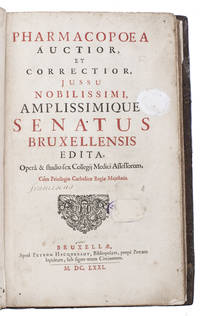
1671Best.-Nr. I17E1NCA7M49Brussels 1671. Folio. Pierre Hacquebaud Contemporary calf; rebacked with part of the original gold-tooled backstrip laid down. 1 1 blank 8 237 15 pp. Second revised and enlarged edition of the Brussels pharmacopoeia. Brussels had begun discussing plans to establish a Collegium Medicum ca. 1605 but failed to do so. A 1636 plague however incited city magistrates to compile a pharmacopoeia and they commissioned four leading city physicians Joannes Jocquet Paulus de Hullegarde Ludovicus Fabri and Joannes De Lau not mentioned on the title-page but acknowledged by name in the preliminaries to compile the present Brussels pharmacopoeia which appeared in 1641. No apothecaries were officially consulted in the compilation of the Brussels pharmacopoeia reflecting the growing status of physicians and declining status of apothecaries. Amsterdam had produced the first official pharmacopoeia in the Low Countries in 1636 based in part on Valerius but the Brussels physicians chose to take the 1638 Paris Codex medicamentarius Parisiensis as their principal model.With an ownership inscription by "Franciscus" dated 1716 on the paste-down and title-page and a another inscription below the colophon possibly in a different hand noting that the book was a gift from Louis Riqueur ca. 1655-1737 apothecary of King Philip V of Spain. Binding damaged at the sides and heavily restored at the spine and extremities. With a few spots and many wormholes throughout; lacking the engraved title-page; a fair copy.l Anet 1 copy; Daems & Vandewiele pp. 71-72 5 copies plus 1 manuscript version; Krivatsy 8908; STCV 2 copies; Wellcome IV p. 357. LOW COUNTRIES MEDICINE & PHARMACY Belgium Medicine & Pharmacy 17th Century Pharmacy / Pharmacopaea ZZ 003 TITELS GEBRUIKT VOOR 2022 unknown
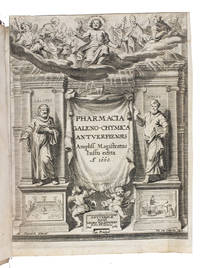
1661Best.-Nr. JC5F71XARFAUAntwerp 1661. 4to. Joris Willemsens I 18th-century vellum faded manuscript title on spine. With an integral engraved architectural title page by Petrus van Caukercken after Abraham van Diepenbeeck with the title on a drapery held by 2 putti in an arch and flanked by figures of Claudius Galenus and Masawaih al-Mardini views of a botanical garden and an apothecary's shop below and Jesus with numerous religious and allegorical figures above in a cloud letterpress title page with a woodcut decoration a divisional title for part 2 woodcut tailpieces woodcut decorated initials 5 series. Set in roman and italic with incidental Greek textura and pharmacological signs. 1 1 blank 46 285 = 281 32 1 blank pp. Rare first and only edition in Latin of the first and only official pharmacopoeia for Antwerp containing hundreds of medicinal recipes and throwing a great deal of light on 17th-century medical practice in the Low Countries. The work's separate part with the title "Selectiora chymica" shows the rising importance of chemistry in the production of medicines. Although Plantin published an important and influential 1568 Antwerp edition of Valerius Cordus's Dispensatorium first published posthumously at Nürnberg in 1546 it was not produced by order of any official municipal body. In 1624 the magistrates of Antwerp set up a Collegium Medicum which did declare that medicines were to be prepared following Cordus until further notice. In 1659 the Antwerp Collegium Medicum decided to produce their own pharmacopoeia primarily at the impetus of their secretary and future director Michiel Boudewijns 1591-1681 best known as the father of modern medical ethics. Although his name does not appear on the title-page the book does attribute the 18-page preface to him and he was probably the principal compiler of the book. The decision to compile it makes explicit reference to those published at Augsburg 1564 Rome 1583 Amsterdam 1636 and Brussels 1641 but Valerius may have remained the most important source. No apothecaries were officially consulted in the compilation of the pharmacopoeia reflecting the growing status of physicians and declining status of apothecaries.Although the letterpress title-page is dated 1660 the engraved title-page when present is apparently always dated 1661 and in some copies the 1660 has been corrected to 1661. The work has extensive preliminaries with dedications notes to the reader laudatory verses etc. but some copies include an unsigned bifolium inserted after a2 containing an additional dedication not present here. The present copy does have the rarer addendum leaf at the end and an addendum slip on Q3r supplying the omitted last line of that page with the quire signature and catchword below it. The addendum leaf has three blind impressions of the type for this addendum slip in its head margin.With minimal wear at the edges. With a brown spot in the outer margin of the first two gatherings; a very good copy.l Anet 6 copies; Daems & Vandewiele pp. 62-63 5 copies; STCV 12879911 5 copies incl. 1 defective; not in Krivatsy; Wellcome. LOW COUNTRIES MEDICINE & PHARMACY Antwerp Belgium Medicine & Pharmacy 17th Century Pharmacy / Pharmacopaea hardcover
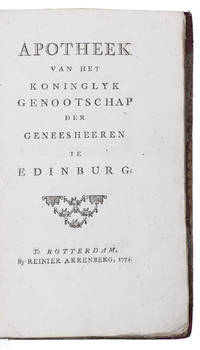
1774Best.-Nr. IAEEAKGVMQPTRotterdam 1774. 8vo. Reinier Arrenberg Contemporary red half sheepskin marbled paper sides. VI 5 1 blank "184" = 182 46 pp. Rare first edition of the Dutch translation of the standard pharmacopoeia of Edinburgh first published in 1699 as Pharmacopoea Collegii Regii Medicorum Edinburgensis. The present translation was based on the sixth edition of 1774. Its "materia medica" starts with the "simples": the non-compounded medicines and ingredients from vegetable animal and mineral sources. The compound medicines follow including oils syrups wines waters powders ointments plasters and more. The work closes with an index an appendix and a short list with the translations of some Latin words and terms.With the bookplate of "D.A. Wittop Koning" on the pastedown. Only very slightly browned some occasional small spots and a few marginal water stains near the end of the book. Overall in good condition and virtually untrimmed. Binding rubbed along the extremities sides scratched.l Blake p. 348; STCN 303373520 3 copies; WorldCat 1131720437 6 copies incl. 3 also in STCN; not in Wellcome. EUROPE MEDICINE & PHARMACY NATURAL HISTORY / Botany Medicine & Pharmacy 18th Century Pharmacy / Pharmacopaea Scotland UK - United Kingdom unknown
1817Best.-Nr. I14D1P7W8M5HLondon 1817. 12mo. Longman Hurst Rees Orme and Brown colophon: printed by G. Woodfall Contemporary half calf title label on spine marbled sides. XXXVI 198 pp. "Editio altera" of the seventh edition of the London pharmacopoeia. The sixth edition of 1788 had been the first edition influenced by enlightenment science including the adoption of Linnaeus's system of binomial plant nomenclature. In the seventh edition of 1809 more recent insights were incorporated which had often appeared earlier in the Edinburgh and Dublin pharmacopoeias. The modern French chemical nomenclature based on the work of Lavoisier was finally incorporated and several other nomenclatures were reviewed and replaced. Nevertheless the use of nomenclature and weights and the contents of recipes in the pharmacopoeia were heavily criticized. The most outspoken critique came from the London chemist Richard Phillips 1778-1851 who in an 1810 review citized 73 recipes and found 20 ambiguous measurements. Several of Philips's suggestions as well as those of other commentators were adopted for a revised edition which appeared in 1815 but nevertheless contained numerous errors. The 1815 edition was reprinted in 1816 1817 1818 1821 and 1823.With a contemporary annotation on the back flyleaf and a second loosely inserted. Some spotting throughout; binding worn most notably at the hinges; a good copy.l Bell Historical sketch of the progress of pharmacy in Great Britain pp. 41-43; Wellcome IV p. 364; Worldcat 3 copies. EUROPE MEDICINE & PHARMACY SCIENCE & TECHNOLOGY Medicine & Pharmacy 19th Century Pharmacy / Pharmacopaea Physics & Chemistry UK - United Kingdom unknown
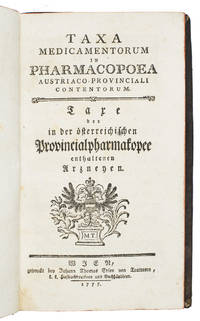
1777Best.-Nr. I14F46A1C75MVienna: Johann Thomas Edlen von Trattner 1777. Mottled calf gold-tooled spine brown morocco spine label marbled endpapers red edges. 8vo. Medical ordinances and a list of the new taxes on nearly 2000 named medicinal components. As the Habsburgs in the 1770s attempted to strengthen their control over the professional standards and business activity of pharmacists and medical personnel in their realms the authorities imposed new taxes on behalf of Empress Maria Theresa covering all components of medicaments described and prescribed in the Pharmacopoea Austriaco-Provinciali the official book of pharmacological recipes for the entire Habsburg empire with editions published almost every year from 1776 to ca. 1822. The ordinance on the subject was promulgated on 25 November 1775 and took affect on 1 January 1776 so the 1776 edition was clearly the first but the 1790 edition calls itself the second. It is therefore not certain whether the present copy is the true second edition or a reissue of the first. The ordinance pp. 3-8 of the preliminaries is signed by Christian August Graf von Seilern Statthalter and Thomas Ignaz Freiherr von Pöct Kanzler and contains seven points including sanctions and criminal procedures in case of fraud. Trattner was printer and bookseller to the Imperial Court.Foot of spine damaged otherwise in good condition.l Cf. Blake p. 24 1776 ed. Johann Thomas Edlen von Trattner, unknown
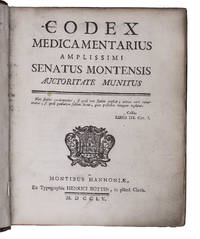
1755Best.-Nr. JC4CQCORXW8DMons: Henri Bottin 1755. Contemporary calf richly gold-tooled spine red edges. 4to. Rare first and only edition of the Mons pharmacopoeia. Although the Vienna pharmacopoeia had been officially designated as the standard for the Austrian Netherlands the city of Mons published its own pharmacopoeia in 1755 making it the last city in the Low Countries to create a new pharmacopoeia.With early owner's inscriptions. Title-page detached but otherwise in very good condition. Binding worn at the spine and extremities and spine-label lost.l Daems & Vandewiele pp. 65-66 3 copies; Wellcome IV p. 368; WorldCat 1415310759 901322034 690213096 1482660956 7 copies; not in Blake; STCV. Henri Bottin, unknown
1775Best.-Nr. JBS8N69TDKIEAmsterdam: Johannes van Seggeren 1775. Contemporary wrappers rebacked. 8vo. With an engraved title page showing an apothecary shop the preparation of medicines and a botanical garden and 2 folding engravings identifying alchemical symbols and measurements. Rare second edition of the Dutch translation of the Brussels pharmacopoeia. Like the first Dutch edition of 1742 the translation was based on the second Latin edition originally published in 1671. Interestingly when this edition was published in 1775 the Viennese pharmacopoeia had been the official pharmacopoeia of Brussels since 1747.With the bookplate of the Gouda pharmacist Elize Grendel 1899-1986. Binding somewhat worn and crudely rebacked. Dog-eared and some spots; a good copy.l Anet 1 copy; Daems & Vandewiele pp. 82-83 1 copy; STCN 2 copies including 1 incomplete; WorldCat 3 copies; not in Wellcome; NLM. Johannes van Seggeren, unknown
1800Best.-Nr. I14DVA32F2X0Leiden: Abraham and Jan Honkoop 1800. Contemporary mottled boards. 12mo. Rare second edition of "the first general as distinguished from hospital 'pharmacopoeia' compiled by an American" Cowen first published at Paris in 1798. The first part of the book is a classification of diseases and is taken word for word from the influential 1769 nosology by the Scottish physician William Cullen. The second part is a pharmacopoeia divided into materia medica and composite medicines. The introduction notes that it is based on the author's notes made at the University of Edinburgh the London pharmacopoeia and Joseph Townsend's The physicians' vade mecum 1794 p. x. Between the two parts can be found a list translating the Latin names of the chemical preparations "which not all readers will view as sufficiently legitimate" p. 77 into the modern English and French nomenclature.William Tazewell d. 1832 was an American physician who had studied in Edinburgh and in 1797-1800 was secretary to Elbridge Gerry in Paris. After returning to the United States Tazewell set up a medical practice in Williamsburg and later moved to Virginia. In 1803 he presented copies of his Vade-mecum to George Washington and Thomas Jefferson the latter writing that "it has really brought the whole science of diseases & remedies within the shortest compass possible and not meddling with the details of the science himself it presents exactly such a general view of every part of it as Jefferson often wishes to take" Cowen.With a small price in pen on the first flyleaf. Only some thumbing on the last 30 pages otherwise in very good condition and wholly untrimmed. Boards slightly worn and spine cracked but still structurally sound.l Cowen America's pre-pharmacopoeial literature pp. 21-22; STCN 1 copy; Founders online letters to Tazewell from Washington and Jefferson; Wellcome V p. 241; WorldCat 2 copies. Abraham and Jan Honkoop, hardcover
Best.-Nr. 185460London John Dale & Sons. ca 1900. Original publisher's brown cloth hardback gilt title frontcover 16mo: 40pp. 20 pages printed. Interleaved. Fine copy. Very scarce. London, John Dale & Sons. ca 1900 hardcover
2015Best.-Nr. 019634Istanbul: Kesit Yayinlari 2015. 1st Edition . Dust jacket. New/New. 8vo - over 7¾ - 9¾" tall. Original bdg. Dust wrapper. Roy. 8vo. 24 x 17 cm. In Turkish. Lxvii 1080 p. Codex Cumanicus. Prep. by Mustafa Argunsah - Galip Güner. First Edition. The Codex Cumanicus was a linguistic manual of the Middle Ages designed to help Catholic missionaries communicate with the Cumans a nomadic Turkic people. TURKOLOGY Kuman / Kypchak Reference Turkic language Philology Linguistica Lexicon Siberia Central Asia. Kesit Yayinlari unknown
Best.-Nr. BN251130tredition. Hardcover. Rom und die Jagd auf die Weltmaschine Rom und die Jagd auf die Weltmaschine Codex Regius tredition hardcover
Best.-Nr. BN378039Wiesbaden Ludwig Reichert 1983. Teilfaksimile-Ausgabe des Ms Teilfaksimile-Ausgabe des Ms Codex Egberti der Stadtbibliothek Trier Wiesbaden, Ludwig Reichert 1983. unknown
Best.-Nr. BN377722Bern Francke 1982. Bearbeitet von Elisabeth Kully Bearbeitet von Elisabeth Kully Codex Weimar Q 565 Bern, Francke 1982. unknown
Best.-Nr. H563Graz Akademische Druck- u. Verlagsanstalt 1972. 295x20 cm. 46 n.n. S. Faksmile. Ohne den kommentarband. Ganzlederband: Kopie des Originaleinbandes unter Verzicht auf die Metallbeschläge. Faksimile der Limburger Ausgabe aus dem 14. Jahrhundert. - Mit 2 ganzseitigen Miniaturen. unknown
2016Best.-Nr. BN40601Chrobock Vitaminum ProLife Codex Humanus 2016. 2016. Hardcover. Erfahren Sie verheimlichte Studien sowie Insider-Wissen zu den erfolgreichsten Naturheilsubstanzen aus allen Kontinenten und Kulturkreisen dieser Welt in 2 Bänden auf knapp 2000 Seiten! Das Beste mir bekannte Werk bzgl. Fakten zu wirksamer Naturmedizin und medizinischer Selbsthilfe Rezension aus Deutschland vom 30. Juni 2019 Dieses komplette Kompedium über naturbasierte Behandlungsmöglichkeiten gibt jedem Menschen im Interesse der eigenen Gesundheit alle Informationen selbst in die Hand. Eine Faktenlage gegen die Interessen der Pharmaindustrie und schlecht ausgebildete Schulmediziner gehen damit -unbeabsichtigt aber völlig logisch- Hand in Hand. Wir erfahren so viel über natürliche Heilsubstanzen von A-Z wie ich eszumindest noch nie an einem Ort in einem Buch oder im Internet an einer Stelle versammelt gefunden habe. Wir kriegen verständliche Erklärungen wie die Substanzen Pflanzenextrakte etc. wirken und in welchem Teil der Welt sie oft schon Jahrhunderte Bestandteil der regionalen Medizin sind oft sogar einfach nur Teil der alltäglichen Kost waren und bis heute noch sind. All das kann ja nun nicht im Sinne der Pharmaindustrie sein. Wir kriegen eine pralle detaillierte Information undwer mag erfährt bespielsweise über den Narayana Verlag gebündelt wo und wie wir sehr günstig an einzelne Substanzen herankommen getrocknete Reiki-Pilze aus der chinesischen Medizin OPC nach Dr. Masquelier der bereits in den 50er Jahren des verganenen Jahrunderts die OPCs bim Randen seiner medizinischen Forschung entdeckt hat. Dass die Pharmaindustrie davon definitiv gar nichts wissen will weil sie an den Naturstoffen nicht verdienen kann denn diese sind nicht ohne weiteres patentierbar wenn es auch schonmal Versuche gegeben hat seitens der Pharma -erwähnt wird im Codex H.- das Beispiel Brokkoli. Fraglos scheuen die Lobbyisten der Lebensmittelkonzerne der Landwirtschaftsspezies der Pharma und der Schulmedizin dabei vor kaum etwas zurück das den Menschen schadet. So werden hochwirksame Natursubstanzen ein bewährtes Herz- und Blutdruckmittel wie Strophanthin das auch im Infarkszenario Menschenleben retten würde vom deutschen Markt weg zu intrigieren obwohl es erwiesenermaßen über Jahrzehnte schnelle Hilfe und Lebensrettung geboten den vom Infarktszenario betroffenen Patienten selbst direkt als Hilfe in die eigene Hand verfügbar gewesen ist und heute genauso wäre. Die Interessenlage der betroffenen Patientenschaft einfach zu ignorieren und fadenscheinig ein bewährtes Medikament so in Verruf zu bringen um es letztlich vom Markt nehmen zu können und durch eigene unnatürliche Substanzen zu ersetzen die die Patientenschaft nicht gesünder machen sondern sie nebenwirkunsgschwanger an den eigenen Tropf zu bringen. Deren fragloses Interesse ist es nicht Menschlichkeit Gesundheit und mündige Patientenschaft zu etablieren sondern vorwiegend dem eigenen Nutzen und dem der Aktionäre zu dienen und höchstmögliche stetig steigende Gewinne zu machen. Patentierbare profitmaximierte Pillen der Natur im günstigeren Falle für die Patientenschaft hanebüchen nachentwickelte Chemieversionen sind das Handwerkszeug. Die Ärzteschaft ist oft genug gar nicht in der Lage einzuschätzen welche Naturmittel es gibt die wirkungsvoll ABER nebenwirkungsfrei Hilfe bieten und ihre inzwischen allzuz wackelige Autorität führt dazu dass sie im Motzeckchen sitzen wenn Patienten sich über Google etc. inzwischen selbst informieren. Hier liegt mit dem Codex Humanus die Zeitenwende zum Guten aus meiner Sicht in einer gut verständlichen Form vor. Der Codex Humanus bietet da eine Menge u.a. informiert er auch über den Wahnsinn der Vitaminempfehlungen die kursieren speziell für den Vitamin C mit 70 mg pro Tag. Ein Mehrfaches von dem braucht der Mensch um voll im Saft zu stehen und die körpereigene Abwehr auf Touren zu halten. Wir erfahren dass der Vitamin- und Mineralgehalt von Obst und Gemüse in den letzten Jahrzehnten dramatischin den Keller geht. Ein klar gegliedertes alphabetisches Register der Naturheilmittel wird unmittelbar mit vielen nützlichen und einfach verständlichen Tabellen den Einsatzbereichen gegenübergestellt nach Beschwerdebildern Erkrankungen auf zwei Bände aufgeteilt durchgehalten. Das Buch ist wirklich hilfreich für jede/-n Menschen sich selbst zu informieren und etwas auszuprobieren. Was gibt es da zu verlieren Dieses 2000 Seiten Codex Humanus Das Buch der Menschlichkeit ist ein wirkliches Geschenk. Ich finde Kritik ist konstruktiv formuliert eigentlich immer bereichernd das bedeutet auch sie sollte sich inhaltlich auseinandersetzen und die Art der Einsterneverteilerei dient dann wohl nur dem Zweck etwas in Mißkredit zu bringen das offensichtlich als bedrohlich erlebt wird. So erlebe ich das hier bei Amazon leider zu oft das irgendwelche Leute die sich nicht als reale Personen zu erkennen geben sich hier ins Geschehen einmischen indem sie ein Produkt abwerten was deren Motive grundsätzlich in Frage stellt. Der Codex Humanus stellt in Frage indem er Alternativen zahlreich bietet und für das Geld ist er wahres ein Schnäppchen und ich habe zugegebenermaßen selbst sehr lange gebraucht bis ich mich entschlossen habe die beiden Bände zu bestellen weil mir die Präsentation des Buches zu reißerisch erschienen ist. Nachdem mir die Geschichte um den Wirkstoff Strophanthin in den Blick geraten war und ich das Buch von Rolf-Jürgen Petry mit einem Vorwort von Prof. Hans Schaefer einem renommierten Heidelberger Schulmediziner gelesen hatte habe ich meine Vorbehalte hinsichtlich der Anpreisung des Buches Codex Humanus einfach hintangestellt. Das Buch hat einen sehr sehr guten Wert und ist viel zu günstig bezahlt angesichts dem was es uns an Handlungsfähigkeit und Selbstverantwortung endlich wieder in eigene Hände zurückgibt. 4 Menschen hier selbsternannte Kritiker meinen ein Stern sei hierfür zur Bewertung angebracht das müssen diese Menschenkinder mit ihrem Gewissen ausmachen weil wer heilt hat Recht und wer das selbst für sich wieder kann für den geht das Leben nicht nur weiter sondern wieder neu los. Ich finde das fantastisch und möchte auch nicht verschweigen dass es ein Lebenstiefpunkt für den Autor war an dem er den Entschluss getroffen hat sich für mehr Gesundheitswissen stark zu machen auch gegen einen Pakt aus Schulmedizin Pharmaindustrie etc. Wer wie der Autor Thomas Chrobok seine geliebte und verehrte Mutter Aniela unnötig in einem Martyrium verloren hat der reagiert zum Glück für uns alle nach der Trauer indem er etwas von Größe und Würde schafft als ein Geschenk an uns alle die wir vom Codex Humanus Kenntnis gewinnen ihn lesen darin schwelgen und von ihm für unsere Gesundheit gewinnen dürfen. Dafür bin ich der Familie Chrobok dankbar! Naturheikunde Naturmedizin natürliche Heilsubstanzen Erfahren Sie verheimlichte Studien sowie Insider-Wissen zu den erfolgreichsten Naturheilsubstanzen aus allen Kontinenten und Kulturkreisen dieser Welt in 2 Bänden auf knapp 2000 Seiten! Das Beste mir bekannte Werk bzgl. Fakten zu wirksamer Naturmedizin und medizinischer Selbsthilfe Rezension aus Deutschland vom 30. Juni 2019 Dieses komplette Kompedium über naturbasierte Behandlungsmöglichkeiten gibt jedem Menschen im Interesse der eigenen Gesundheit alle Informationen selbst in die Hand. Eine Faktenlage gegen die Interessen der Pharmaindustrie und schlecht ausgebildete Schulmediziner gehen damit -unbeabsichtigt aber völlig logisch- Hand in Hand. Wir erfahren so viel über natürliche Heilsubstanzen von A-Z wie ich eszumindest noch nie an einem Ort in einem Buch oder im Internet an einer Stelle versammelt gefunden habe. Wir kriegen verständliche Erklärungen wie die Substanzen Pflanzenextrakte etc. wirken und in welchem Teil der Welt sie oft schon Jahrhunderte Bestandteil der regionalen Medizin sind oft sogar einfach nur Teil der alltäglichen Kost waren und bis heute noch sind. All das kann ja nun nicht im Sinne der Pharmaindustrie sein. Wir kriegen eine pralle detaillierte Information undwer mag erfährt bespielsweise über den Narayana Verlag gebündelt wo und wie wir sehr günstig an einzelne Substanzen herankommen getrocknete Reiki-Pilze aus der chinesischen Medizin OPC nach Dr. Masquelier der bereits in den 50er Jahren des verganenen Jahrunderts die OPCs bim Randen seiner medizinischen Forschung entdeckt hat. Dass die Pharmaindustrie davon definitiv gar nichts wissen will weil sie an den Naturstoffen nicht verdienen kann denn diese sind nicht ohne weiteres patentierbar wenn es auch schonmal Versuche gegeben hat seitens der Pharma -erwähnt wird im Codex H.- das Beispiel Brokkoli. Fraglos scheuen die Lobbyisten der Lebensmittelkonzerne der Landwirtschaftsspezies der Pharma und der Schulmedizin dabei vor kaum etwas zurück das den Menschen schadet. So werden hochwirksame Natursubstanzen ein bewährtes Herz- und Blutdruckmittel wie Strophanthin das auch im Infarkszenario Menschenleben retten würde vom deutschen Markt weg zu intrigieren obwohl es erwiesenermaßen über Jahrzehnte schnelle Hilfe und Lebensrettung geboten den vom Infarktszenario betroffenen Patienten selbst direkt als Hilfe in die eigene Hand verfügbar gewesen ist und heute genauso wäre. Die Interessenlage der betroffenen Patientenschaft einfach zu ignorieren und fadenscheinig ein bewährtes Medikament so in Verruf zu bringen um es letztlich vom Markt nehmen zu können und durch eigene unnatürliche Substanzen zu ersetzen die die Patientenschaft nicht gesünder machen sondern sie nebenwirkunsgschwanger an den eigenen Tropf zu bringen. Deren fragloses Interesse ist es nicht Menschlichkeit Gesundheit und mündige Patientenschaft zu etablieren sondern vorwiegend dem eigenen Nutzen und dem der Aktionäre zu dienen und höchstmögliche stetig steigende Gewinne zu machen. Patentierbare profitmaximierte Pillen der Natur im günstigeren Falle für die Patientenschaft hanebüchen nachentwickelte Chemieversionen sind das Handwerkszeug. Die Ärzteschaft ist oft genug gar nicht in der Lage einzuschätzen welche Naturmittel es gibt die wirkungsvoll ABER nebenwirkungsfrei Hilfe bieten und ihre inzwischen allzuz wackelige Autorität führt dazu dass sie im Motzeckchen sitzen wenn Patienten sich über Google etc. inzwischen selbst informieren. Hier liegt mit dem Codex Humanus die Zeitenwende zum Guten aus meiner Sicht in einer gut verständlichen Form vor. Der Codex Humanus bietet da eine Menge u.a. informiert er auch über den Wahnsinn der Vitaminempfehlungen die kursieren speziell für den Vitamin C mit 70 mg pro Tag. Ein Mehrfaches von dem braucht der Mensch um voll im Saft zu stehen und die körpereigene Abwehr auf Touren zu halten. Wir erfahren dass der Vitamin- und Mineralgehalt von Obst und Gemüse in den letzten Jahrzehnten dramatischin den Keller geht. Ein klar gegliedertes alphabetisches Register der Naturheilmittel wird unmittelbar mit vielen nützlichen und einfach verständlichen Tabellen den Einsatzbereichen gegenübergestellt nach Beschwerdebildern Erkrankungen auf zwei Bände aufgeteilt durchgehalten. Das Buch ist wirklich hilfreich für jede/-n Menschen sich selbst zu informieren und etwas auszuprobieren. Was gibt es da zu verlieren Dieses 2000 Seiten Codex Humanus Das Buch der Menschlichkeit ist ein wirkliches Geschenk. Ich finde Kritik ist konstruktiv formuliert eigentlich immer bereichernd das bedeutet auch sie sollte sich inhaltlich auseinandersetzen und die Art der Einsterneverteilerei dient dann wohl nur dem Zweck etwas in Mißkredit zu bringen das offensichtlich als bedrohlich erlebt wird. So erlebe ich das hier bei Amazon leider zu oft das irgendwelche Leute die sich nicht als reale Personen zu erkennen geben sich hier ins Geschehen einmischen indem sie ein Produkt abwerten was deren Motive grundsätzlich in Frage stellt. Der Codex Humanus stellt in Frage indem er Alternativen zahlreich bietet und für das Geld ist er wahres ein Schnäppchen und ich habe zugegebenermaßen selbst sehr lange gebraucht bis ich mich entschlossen habe die beiden Bände zu bestellen weil mir die Präsentation des Buches zu reißerisch erschienen ist. Nachdem mir die Geschichte um den Wirkstoff Strophanthin in den Blick geraten war und ich das Buch von Rolf-Jürgen Petry mit einem Vorwort von Prof. Hans Schaefer einem renommierten Heidelberger Schulmediziner gelesen hatte habe ich meine Vorbehalte hinsichtlich der Anpreisung des Buches Codex Humanus einfach hintangestellt. Das Buch hat einen sehr sehr guten Wert und ist viel zu günstig bezahlt angesichts dem was es uns an Handlungsfähigkeit und Selbstverantwortung endlich wieder in eigene Hände zurückgibt. 4 Menschen hier selbsternannte Kritiker meinen ein Stern sei hierfür zur Bewertung angebracht das müssen diese Menschenkinder mit ihrem Gewissen ausmachen weil wer heilt hat Recht und wer das selbst für sich wieder kann für den geht das Leben nicht nur weiter sondern wieder neu los. Ich finde das fantastisch und möchte auch nicht verschweigen dass es ein Lebenstiefpunkt für den Autor war an dem er den Entschluss getroffen hat sich für mehr Gesundheitswissen stark zu machen auch gegen einen Pakt aus Schulmedizin Pharmaindustrie etc. Wer wie der Autor Thomas Chrobok seine geliebte und verehrte Mutter Aniela unnötig in einem Martyrium verloren hat der reagiert zum Glück für uns alle nach der Trauer indem er etwas von Größe und Würde schafft als ein Geschenk an uns alle die wir vom Codex Humanus Kenntnis gewinnen ihn lesen darin schwelgen und von ihm für unsere Gesundheit gewinnen dürfen. Dafür bin ich der Familie Chrobok dankbar! Chrobock Vitaminum ProLife Codex Humanus hardcover
1711Best.-Nr. I17ERD520PLVLisbon 1711. Small folio 29 x 21 cm. Monastery of São Vicente de Fóra Modern sheepskin gold-tooled spine red morocco title-label. With engraved arms as fronstipiece and a title-page printed in red and black. 28 494 29 1 blank pp. Rare second edition of the first Portuguese pharmacopoeia first published in 1704 by the friar D. Caetano de Santo António d. 1730 an apothecary of the Monastery of Santa Cruz of the city of Coimbra who upon publication of the second volume was working at Lisbon in the Monastery of São Vicente de Fora. "The Pharmacopeia Lusitana shows how important the convent pharmacy was at that time in Portugal. The Portuguese religious apothecaries were very knowledgeable on pharmaceutical matters" Pita. With a few manuscript annotations in the margins. Ca. 50 leaves with a waterstain at the head of the gutter margin an occasional smudge and two leaves with a small hole and small tears otherwise in very good condition.l J.R. Pita Brief history of Portuguese pharmacopoeias pp. 1-5; Porbase 1 copy; Wellcome IV p. 369 incomplete; WorldCat 5 copies. EUROPE MEDICINE & PHARMACY Pharmacy / Pharmacopaea Portugal unknown
Best.-Nr. 0983163308.Gpaperback. Good. Access codes and supplements are not guaranteed with used items. May be an ex-library book. paperback
Best.-Nr. DG-4New. unknown
Best.-Nr. DG-5-2Fine. New and factory sealed. unknown
Best.-Nr. 697184123Council of Europe . Hardback. New. pp. 1380 3rd Edition Council of Europe hardcover