Terrasse (Henri ; 1895-1971) :Livre Rare Book

8.031 resultados
1937ref. 21634Grenoble, Arthaud (Bellegarde Ain, gravure et impression Sadag), 1937 ; in-8, demi-veau rouge à coins, dos à quatre nerfs encadrant les pièces d’auteur et de titre vert foncé, premier plat et dos en couleurs conservés, non rogné (reliure de l’époque) ; 168 pp., 5 planches hors-texte en couleurs, y compris la couverture et de très nombreuses illustrations de toutes tailles tirées en sépia.
1881ref. 21761Lyon, Imprimerie Générale, 1881 ; in-8 (200 mm), demi-chagrin bleu marine, dos à nerfs soulignés de filets à froid, titre doré (reliure de l’époque) ; XV, [1bl.], 340 pp., [1] f. de Table, 1 reproduction photographique hors-texte de l’entrée du château de l’Aubépin.
ref. 12251952 IMPRIMERIE LAFOSSE Avant propos de Monsieur Clovis BRUNEL illustration de Jean SGARD L'edition comprend 100 exemplaires , celui ci est le numero 18 specialement imprimé pour Mr DECAUX Agent general de la caisse D'EPARGNE d'ABBE VILLE composé de six feuillet sur papier de rives doubles pages comprenant un poeme et une illustration de J SGARD en face L' PICARD -CHES MOAIS-CHES GLENEUSES-DINS NO VIN PLATCHU -AU DJIGNEL ! DINS NO VIEILL' BOUTIQUE Parfait etat , extremement rare
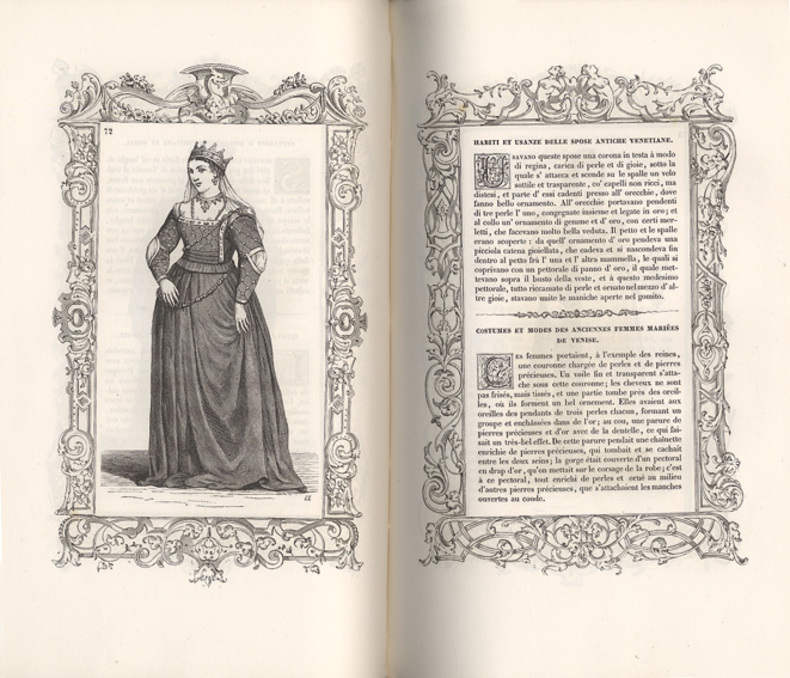
ref. 87331860. Relié avant : Essai typographique et bibliographique sur l'histoire de la gravure sur bois par Ambroise Firmin Didot. 1863. Paris, Typographie de Firmin Didot Frères Fils ; trois tomes reliés en deux volumes ; demi-chagrin maroquiné bordeaux, dos à quatre nerfs encadrant l'auteur et le titre dorés, date en queue, les couvertures illustrées et les dos, jaune paille, ont été conservés (reliure postérieure) ; XIV col., (1) p. bl., 316 col., (1) f. bl. ; 9 pp., (1 bl.), (1) p. faux-titre, (234 au tome 1er), 513 planches en tout : les planches de costumes, gravées sur bois, sont présentées sur la page de gauche et le texte qui les accompagne, en italien et en français, en face sur la page de droite, costumes et texte sont dans de grands encadrements décoratifs gravés sur bois ; 18 et 19 pp. de table des matières finissent les tomes 1 et 2.
Second edition, 2 vols., 8vo (215 x 130 mm), xxvii, [9], 522, [10]; xiv, [14], 462, [x]pp., ownership signature torn away from outer upper bank margin of title page, final 3 leaves to vol. I and a couple of gathering from vol. II with waterstain tide mark (not unsightly), recent red half morocco, marbled boards, contrasting green morocco title label to spine, five raised bands, tooled in gilt. Robert Dossie (1717-1777) was a rigourous advocate for the advantages of improved public knowledge. With the publication of this work he provided information and instruction to the reader in a multitude of trades, many never before disclosed outside there trades. As a resource, it was well regarded by eighteenth- and early nineteenth-century artisans and became the standard work for practical techniques of that era.
4to, [xii],14,[2],142pp., engraved portrait on title and 1 engraved headpiece, nineteenth century half calf by Corfmat, marbled covers, spine gilt, t.e.g. uncut, a good copy in nice condition. The second of two editions published in 1789, though according to Brooks it was actually published in 1792. It is almost identical to the first 1789 edition which Renouard described as "l'une des plus belles ?ditions de Bodoni." Beautifully printed, partly in italic type. Brooks 379.
First Edition, 2 parts in one, xiv,[ii],308pp., title printed in red and black, enraged vignette of cherubs and type trays, engraved folding plate, 19th-century marbled boards, morocco label on spine. Reviewing the origin of printing in Italy, he provides a chronological list of books printed in Rome during the fifteenth century. "A folding-plate contains specimens of the types of Sweynheym and Pannartz, two of the earliest Roman printers... Laire was one of the most learned bibliographers of France during the 18th century... At one time he was the librarian of Cardinal Brienne; subsequently he became librarian at the Ecole centrale de l'Yonne, in which position he remained up till his death." ?Bigmore & Wyman, I. p. 416. Brunet III: 774.
First edition, 12mo (154 x 93 mm), 148pp., endpapers renewed, re-cased with new leather spine and corners, original printed boards, uncut, a very good copy. One of the great rarities of local natural history, printed on a home-made printing press at Llanrwst, Conway, Wales. John Jones (1786-1865), printer and inventor, "He kept a paper and bookshop, and printed much miscellaneous work for the locality. Sometime (? before 1817) he constructed three presses to the Ruthven design, so called after its inventor, Alexander Ruthven, which he then used for all his printing work. He also learnt to cast his own type and used many of his own letters and characters for the rest of his life."?(DWB). In 1936 the Science Museum acquired John Jones' press and equipment. Provenance: From the botanical library of Michael Walpole with his bookplate. Freeman, 4015.
ref. ORD-10950Edition dédiée aux Amateurs de l'Art Typographique. Jules Didot. Dufour et Cie. 1827-1829. 4 volumes in-8 dos basane cerise à 4 nerfs ornés, tranches marbrées. Portrait en frontispice, 5552pp. (pagination continue). Impression minuscule sur 2 colonnes et sur papier Bible. Petits défauts à la reliure et rousseurs parfois importantes. Assez rare complet.
1878ref. 58315Paris: V.L. Quetin ca. 1878. Oblong 4to. 11.5 x 7.75 in. 1 leaf lithograph title 94 i.e. 110 lithographed plates 1 leaf of index on blue-tinted paper stock. Quarter-green leather over pebbled green cloth raised bands embossed borders in blind gilt lettering on spine minor scuffing & wear rubbing bumping & wear to couple corners w/o ffep. still VG- copy w/ bright plates from the library of Victor Colas 256 13d Voltaires Paris notation on front marbled pastedown. A well-illustrated printer’s specimen book issued to depict the varieties of Second Empire French furniture featuring styles such as Louis XV Louis XVI and the decorative styles of Napoleon III’s designers. Victor Joseph Quetin 1822-1877 was an entrepreneurial printer who began producing these Furniture style books for Parisian craftsmen cabinetmakers and would sell these volumes of specimen sheets to manufacturers to show their prospective clients. The furnishings shown in these leaves encompass tables chairs toilettes some with bidets built in many with attached mirrors bed frames armoires buffets desks and desks with built-in bookcases. The index which is often missing provides an excellent quick reference to the styles types of furnishings as well as the specific plate. Demand increased as Paris & France underwent tremendous renovations and progress during the Second Empire and many of the furnishings inspired by the designs of Carlin Weisweiler and Riesener were presented to the public at the 1867 Exposition Universelle. His son Victor Leon Quetin b. 1852 would later in the 1870’s take up the family business released the albums under a new imprint of “V.L. Quetin” and also began issuing colour chromolithograph specimen catalogues of elaborate draperies bed curtains window treatments and casements. Also issued was a newspaper Journal le magasin de meubles” which offered details of the specimen catalogues he would assemble subscriptions and pricing with details on colour lithography and hand-colouring as well. His designs were dependent upon using a specialized machine which would enlarge reduce or even alter lithographic designs for clients. See: Victor Quetin De la papeterie a la lithographie D’Avoise a Meung-sur-Loire en passan par les Moulins de Paillard 16e-18e siecle; Alfred Lemercier La lithographie francaise de 1796 a 1896 et les arts qui s’y rattachent: manuel pratique p. 344. V.L. Quetin, hardcover
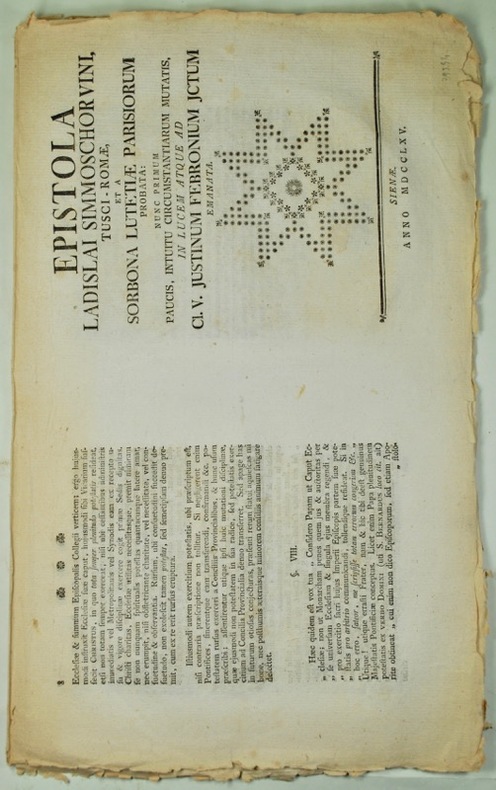
1765ref. 39594Sienne, , 1765. 1 feuille (45 x 36 cm) pliée en deux et 1 feuillet (22 x 36 cm), les deux imprimés recto verso.
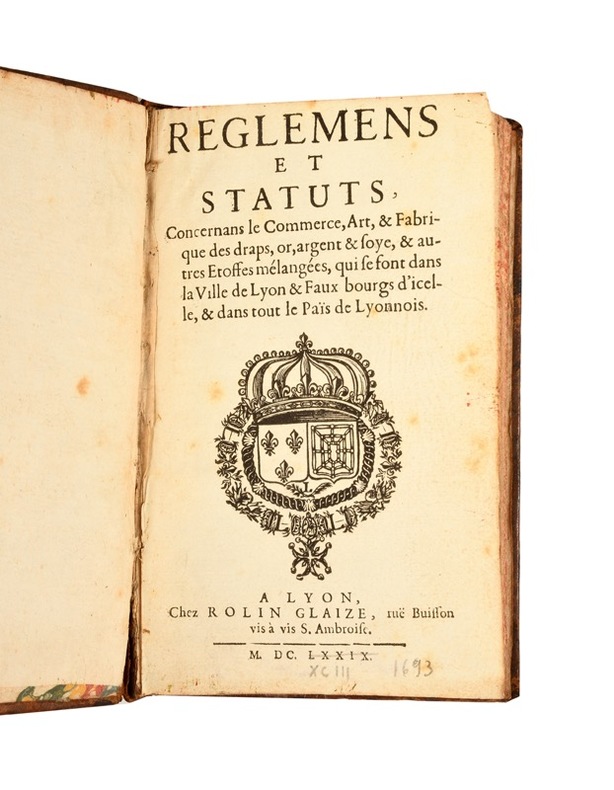
1693ref. 21679Lyon, Rolin Glaize, 1693 (i.e. 1679) ; in-8, veau épidermé de l’époque, dos à nerfs décoré et doré, sans pièce de titre ; 88, [7] pp. de Table.
15594to. (24) ff. (last blank). With large title woodcut (catafalque, signed C.S.) and one heraldic woodcut initials. Papered spine. One of two printings of the first German edition; a report by the Imperial councillor Staphylus about the exequies, funeral procession and festivities arranged at Augsburg in February 1559 by Ferdinand I, following the death of Emperor Charles V at the monastery of San Jerónimo de Yuste in September 1558. First published as "De exequiis Caroli V. quas Ferdinandus freatri suo carissimo Augustae Vindelicorum fecit fieri" (Augsburg 1559). Charles had abdicated in 1556 in favour of his brother Ferdinand. - Dusty and with edge defects; one large tear restored with Japanese paper. Rare. VD 16, ZV 14661; cf. E 707. BMC German 300. Bucher (Dillingen) 111.
2023ref. 16762023 Couverture souple Paris, Gallimard, domaine de Chaumont sur Loire, 2023. Un volume in-8 (24 x 17 cm), broché, couverture illustrée, dans son étui cartonné avec motif gaufré au centre, tranches bleutées. 198 pages, illustrées de nombreuses reproductions d'oeuvres de l'artiste en noir et en couleurs. Cette édition de luxe comprend une eau-forte sous serpente, signée et numérotée par Alechinsky, imprimée à l'atelier Clot à Paris. Un des 99 exemplaires numérotés du tirage de tête (n°44). Ouvrage publié à l'occasion de l'exposition du 1er avril au 29 octobre 2023 au Centre d'arts et de nature du Domaine de Chaumont-sur-Loire. En tête d'ouvrage, texte d'Alechinsky "Vadrouille à l'âge lithique", dans lequel l'artiste revient sur son rapport concret à l'imprimerie. « Aller à l'imprimerie, c'est comme pousser la porte du bistrot, quitter l'égocentrisme de l'atelier d'artiste pour retrouver les mordus, les habitués du comptoir lithographique. On respire l'odeur de l'encre. On piétine le même plancher » (Ambidextre, 2019). Né en 1927 en Belgique, Pierre Alechinsky est une figure marquante de l'art contemporain, membre fondateur du groupe Cobra. Bel exemplaire, comme neuf, de cette édition originale.
1932ref. 20834Port Louis - Ile Maurice, Général Printing and Stationery, 1932 ; in-4° (285 mm), broché ; [4], 37 pp., [1] f. achevé d’imprimer, [1] f. photographie tirage collé, [5] f. de reproduction photographique, couverture crème illustrée.
1823ref. 20873Le Puy, J.B. La Combe, (imprimerie Pasquet père et fils), 1823 ; in-8, demi-veau marron, dos lisse à faux nerfs dorés, roulettes et fleurons dorés, fleuron à froid (reliure de l’époque) ; X-303, [1], XV pp., [1]f. d’Errata.
(8), 139 Bll., l. w. Bl. Mit gr. Holzschnittvignette am Titel. Flexibler Pergamentband der Zeit auf 3 durchzogenen Doppelbünden mit Resten eines hs. Rückenschildchens. Bindebänder fehlen. Gr.-4to. Erste Ausgabe der Verteidigungsschrift gegen Jakob Heerbrands "De vera ecclesia Christi militante" (1575) und "Contra assertiones Jesuiticas de ecclesia Christi" (1577). Der Kölner Jesuit Heinrich Blissem (1526-86), ein Vertrauter des Ignatius v. Loyola, bezieht sich hier auf seinen 1575 veröffentlichten Vortrag vom 30. Jänner 1575 in Graz, in dem er sich um eine Rechtfertigung des Jesuitenordens, der sog. "Ecclesia militans" bemühte. - Kl. Fehlstelle am Hinterdeckel. Innen teils leicht braunfleckig bzw. schwach wasserrandig; vereinzelt im w. Rand auch etwas wurmspurig. Vorsätze und letztes w. Bl. von alter Hand beschrieben; am Titel hs. Besitzvermerk der Kapuziner in Celje. VD 16, B 5798. Adams B 2107. BM-STC German 129. De Backer/Sommervogel I, 1551, 3. Stalla 1342. Vgl. Jöcher I, 1132.
75 Bll., l. w. Bl. Mit Wappenholzschnitt am Titel. Halbpergamentband. Dreiseitiger Farbschnitt. 4to. Seltene zweite Ausgabe (die erste in Deutschland gedruckte) des oft aufgelegten und übersetzten Werks: eine Geschichte des sogenannten Mailändischen Kriegs, der zunächst zur Vertreibung, schließlich aber zur Wiedereinsetzung Francesco Sforzas II. als Herzog von Mailand führte. Der italienische Schriftsteller und Staatsmann (1487-1537) Capella war Sekretär des Herzogs und zeitweise auch Minister; er berichtet hier als intimer Kenner der Ereignisse und Hintergründe. - Stellenweise unbedeutend braunfleckig; es fehlen die Vorsatzblätter. Gutes Exemplar. VD 16, C 792. BNHCat C 204. BM-STC German 179. Adams C 582. IA 131.486.
15732 Bde. in einem. (8) SS., 1074 Spp., (1) S., l. w. Bl. 762 Spp., (53) SS. (ohne das l. w. Bl.). Mit 2 Holzschnittdruckermarken am Titel. Lederband des 17. Jhs. (stark lädiert) auf 5 Doppelbünden mit Resten von Rückenvergoldung. Folio. Zweite lateinische Ausgabe bei Sonnius (zuvor kollationsgleich im Vorjahr erschienen), aus dem Griechischen übersetzt und ediert von Gentian Hervet (1499-1584; vgl. Gamillscheg/Harlfinger: Repertorium der griechischen Kopisten 800-1600). - Beide Deckel stark berieben (Oberschicht des Leders abgerieben); Kapitale defekt; Ecken und Kanten stärker bestoßen mit kl. Fehlstellen im Lederbezug. Innen insgesamt sauber und wohlerhalten; Titel unbedeutend fingerfleckig; vereinzelte hs. Anstreichungen und Notizen des 17. Jhs. Am vorderen Vorsatz verso kl. Provenienzvermerk: "Ex biblioth. P. Fabri". Recht selten; lt. OCLC kein Exemplar in USA (Nachweise für Nijmegen, Maastricht, Utrecht); ferner in Berlin, München, Köln (nicht in BnF). Adams C 3171. OCLC 63813114. Nicht bei BM-STC French.
1920ref. 31712Paris, Fonderie de caractères d'imprimerie, s.d. [circa 1920]. Un fort vol. au format in-8 (248 x 162 mm) non paginé. Reliure d'édition de plein cartonnage crème imprimé, dos lisse.
155670, (2) SS. Mit Holzschnittdruckermarke am Titel und kleinerer Druckermarke am letzten Bl. verso. Mod. Pappband. 4to. Zweite, erweiterte Ausgabe des seltenen, erstmals 1548 erschienenen Werks zur griechischen Prosodie und Metrik. Das neue Druckprivileg ist datiert mit 13. September 1555. René Guillonius (1500-70) war Schüler der großen Gräzisten Guillaume Budé (1467-1540) gewesen. - Am Titel zeitgenöss. hs. Besitz- und Kaufvermerk sowie darunter Persius-Motto "Sum Thomae [...] constat 1 fl. | Vive memor lethi fugit hora. Persius". Der Nachname des Besitzers kaum später getilgt und von einem wohl ebenfalls Thomas (Bauer) genannten Nachbesitzer des 16. Jhs. in roter Tinte ersetzt: "Agricola". Durchgehend mit kl. Wurmgang (etwas Textverlust). Adams G 1581. BM-STC French 213. OCLC 65708718.
2 Tle. in 1 Bd. 527, (1) SS. (2. Teil mit eigenem Titelblatt:) Conciones de praecipuis sanctorum festis, a festo beatissimae Mariae Magdalenae, usque ad finem anni. Ebda., 1580. 542 SS. Beide Teile mit Holzschnittdruckermarke am Titel. Blindgepr. Schweinslederband der Zeit über Holzdeckeln auf 3 erhabenen Doppelbünden mit Resten von Schließen. Hs Rückenschildchen. 8vo. Luís de Granadas Festtagspredigten über das gesamte Kirchenjahr. Der spanisch-portugiesische asketische Schriftsteller Luis von Granada (1504-88) trat insbesondere als Kanzelprediger hervor. "Ludwigs Werke gelten nach Form und Inhalt als klassisch; Franz von Sales nennt ihn 'Fürst der geistlichen Schriftsteller'" (LThK VI, 698). - Durchgehend etwas gebräunt bzw. braunfleckig; zu Beginn auch mit kl. Wurmspuren. Am Titel montierter Besitzvermerk der Kapuziner zu Gmunden. Nicht bei Adams und BM-STC Dutch.
1897ref. 42406Paris, Imprimerie de Paul Radiot, 1897. 2 exemplaires du même ouvrage reliés en 1 vol. in-8 de 52 pp. 8 planches hors texte, 52 pp. 8 planches hors texte, feuillets vierges intercalaires, basane fauve, dos à nerfs orné à la grotesque, ex-libris doré en pied de dos, couvertures conservées (reliure de l'époque).
1634ref. 40475Leyde, Abraham et Bonaventure Elzevier, 1634. Petit in-12 (126 x 67 mm) de (20) pp. dont 1 titre-frontispice et 1 figure gravée, 786-(30) pp. (sig.*10 A-Z12 Aa-Ll12), maroquin bleu, dos lisse orné, roulette dorée d'encadrement sur les plats, frise intérieure dorée, gardes de tabis rose, tranches dorées (reliure du XVIIIe siècle).
1953ref. 007470New York Pellegrini & Cudahy 1953 In-4 Cartonnage, jaquette illustrée Edition originale