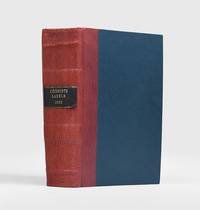
MERLIN (Jacques).Livre Rare Book
8.031 resultados
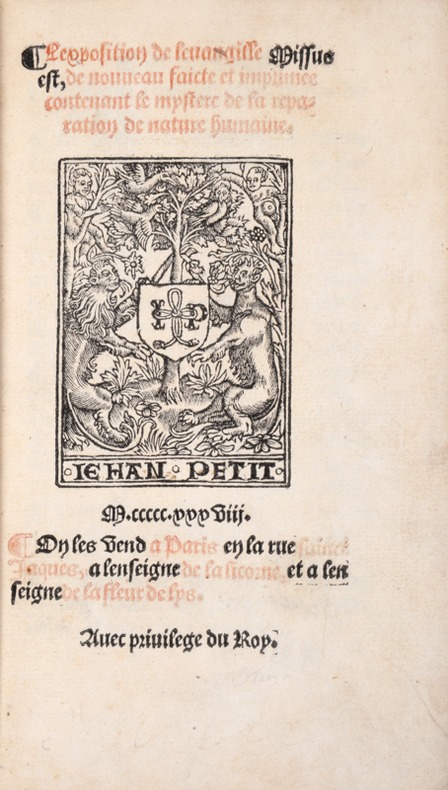
1538ref. 16626Paris, Yolande Bonhomme pour Jean Petit, 1538-1539. In-8 gothique (16 x 10 cm) de (8)-CLXX-(1) ff., (sign. A8, A-X8, Y3), maroquin brun, dos à nerfs, dentelle intérieure, tranches dorées (Petit).
4to (150 x 208 mm). XCIII, (6) ff. Late 19th century half vellum over papered boards with author's name and publication date stamped to spine in gilt. A fine post-incunable from the press of Wilhelm Schaffner from Rapperswyl, famous for having printed the first edition of the "Hortulus animae" in 1498. All of his productions are rare. The present collection of sermons had first appeared in 1501. - The eighteen essays, which form a single treatise, warn the various classes of human society to guard against sin in its many forms. "Much of this is the common, dry stuff of scholasticism, but several passages prove that the author cannot have been lacking in the gift of wit when he preached from the pulpit. Among these paragraphs is the fourth, directed against wives, widows, and virgins: some women (writes Morgenstern) will beautify themselves when they visit public houses or other places where they may meet strangers, and say they do so only to please their husband. Yet this is but a lie, for when they return home, they will remove their jewelry and sit by their husband like a hairy night owl, caring little about their adornment" (R. Cruel, Geschichte der deutschen Predigt im Mittelalter [1879], p. 569 ff., also citing several methods how women are said to contrive to obtain beautiful objects at their lovers' expense). - Spine a little duststained. Interior shows light worming, more pronounced near the end. Lower corner of fol. G5 torn away without loss to text; a more substantial edge defect to final leaf of index remargined (likewise without loss to printed text, but some loss to contemporary manuscript notes in Latin on blank verso). A final blank leaf has been appended, using old paper. A contemporary annotation to fol. a5v. In all a good copy. - Provenance: from the library of the noted economist Oskar Morgenstern (1902-77), whose purchase of the volume (probably prior to his emigration in 1938) may have been occasioned by the author's name. In collaboration with the mathematician John von Neumann, the German-born Morgenstern, who taught at Princeton University, founded the mathematical field of game theory and its application to economics. VD 16, M 6348. BM-STC German 628. Proctor 10163. Panzer IX, 357, 142b. Muller II, 53, 3. Ritter 1593. Schmidt IV, 11, 2. BNHCat M 799. Not in Adams.
(8), 290, (2 [statt 30]) SS. Mit großer Holzschnittdruckermarke am letzten Bl. verso. Neurer brauner Pappband. 4to. In maßgefertigter Leinenkassette. Die zweite Ausgabe dieser berühmten Grammatik, erstmals 1542 erschienen. "Der Brief des Baillivius ist weggefallen. Ebenso ist das - nunmehr undatierte - Vorwort nicht mehr an diesen, sondern allgemein, wie üblich, an die Hebraicae Linguae Studiosi gerichtet. Gleichzeitig sind infolgedessen die persönlich gehaltenen Stellen am Anfang und Schluß in Wegfall gekommen. Jene sind ersetzt durch einen Hinweis auf des Verfassers Leistungen für das Studium der hebräischen und chaldäischen Sprache während eines Zeitraums von über 20 Jahren" (Prijs). "[E]nthält die Summe des grammatischen Wissens Münsters, die Summe einer 30jährigen Arbeit, die er mit diesem Werk zum Abschluß brachte. Aber das Werk enthält nicht nur das eigene Wissen Münsters, sondern berücksichtigt fast die gesamte Forschung seit Reuchlin, sowohl die christliche als auch die jüdische, die deutsche und die ausländische [...] Nach bewährtem Beispiel wurde wieder ein Übungstext angehängt, und zwar das apokryphe Buch Tobias [...] Münster sah diese Grammatik als endgültig an und arbeitete fortan keine neue mehr aus [...] Das Opus grammaticum consummatum erwies sich auch tatsächlich als eine perfektionierte Arbeit, die zahlreiche Auflagen erlebte" (Burmeister, Biogr. Gesamtbild, S. 69). "Als Hebraist nimmt [Münster] in Deutschland nach Reuchlin eine der ersten Stellen ein" (ADB XXIII, S. 30). - Etwas gebräunt und wasserrandig; die Seitenränder teils leicht unregelmäßig bzw. alt hinterlegt. Einige wenige Marginalien der Zeit zu Beginn. Am letzten Textblatt Lochstempelung der Philadelphia Divinity School. Ohne die letzten 14 Blätter Anhang. Sehr selten; zuletzt 1971 im Handel; über VD 16 nur drei Standortnachweise (Leipzig, Wien, Wolfenbüttel). VD 16, ZV 11220. Burmeister 12. Adams M 1937. Steinschneider 2015, 21. Prijs 68. Fürst II, 407. OCLC 48902972. Nicht im BM-STC.
Folio [31 x 20 cm], (8), 551 pp, (13), including terminal blank. Title-page printed in red and black with large woodcut partially handcolored; large woodcut header on iir; and 3 large woodcuts in text on pp. 1, 199, and 527 (repeated from title). Late 19th century marbled boards. First few leaves a little creased in gutters; minor loss to blank margin of P4 affecting a handful of letters; repaired closed tear to corner of Xx1 with no loss of text. A few early marginal markings.p Extremely rare sole edition of this voluminous ‘Volksbuch’ bringing together nearly a thousand satirical tales in a rich vernacular, all here of course ‘enlarged and improved’, with additions ‘never before appearing in print’. Like Boccacio’s original, it seems that even in the late 16th century such tales were intended to be recited orally for the amusement of an audience of both sexes: Sigmund Feyerabend’s preface (iir-iiir) makes it clear that he intends the book for “jeden person, Mann oder Weib, jungen Gesellen und Jungkfrauwen zu lessen oder zu hören”, while the title-page specifically confirms that the book can be read unabashedly by ‘virtuous women and maidens, without deleterious offense”. Evidently surviving poorly, we have located just a few copies of the Kurtzweilige und Lächerliche Geschichte und Historien in libraries worldwide, with just one in the US (Illinois). - The compendium begins with Johannes Pauli’s famous collection Schimpf und Ernst, first printed in 1522 in the midst of the Reformation. Like his contemporary Luther, Pauli (ca. 1455-1535) was a monk himself (Franciscan) but here pokes endless fun the clergy of all levels, for example in his tale of a pope who ceremoniously washes the feet of paupers but is accused of looking for money between their toes (# 339). By some accounts an apostate Jew, Pauli became a friend of Geiler von Kaiserberg, and his oft-reprinted collection influenced an entire generation of Protestant German satirists including Hans Sachs. - Following Schimpf und Ernst is Arigo’s German translation of the Decameron (ca. 1473), which is here curiously called “der neuwen Zeitung”. Finally, at the end we find three extracts from original works of further German satirists: Jörg Wickram (ca. 1505-1560)’s Rollwagen (pp. 527-542); Jakob Frey (ca. 1520-1562)’s Gartengesellschaft (pp. 543-551); and Martin Montanus (ca. 1537-1566)’s Wegkürtzer (pp. 543-551). As the titles suggest, these jocular tales were expressly intended for the entertainment of travelers, as depicted in their ‘Rollwagen’ in the woodcut on p. 527. - VD16 shows just 5 copies in German and Austrian libraries; OCLC adds the British Library, Illinois, and the National Library of Sweden only. Individual 16th-century printings of each of the constituent parts also prove to be very rare in census. VD 16 P 969; Bacchi della Lega, Serie delle edizioni delle opere di Giovanni Boccaccio (1995), p. 72; cf also Monostory, Der Decamerone und die deutsche Prosa des 16 Jahrhunderts (1971); Florence N. Jones, Boccaccio and his imitators in German (1910), pp. 1-2; and Hawley (ed.), Reform and Counterreform: Dialectics of the Word in Western Christianity (1994), pp. 1-14.
4to. 57, (1) pp., final bl. f. With 2 large figurated initials. Half vellum (c. 1900). First edition; rare. "One of the earliest monographs on ophthalmology in which the author attempts to explain the cause of the variety of colors of eyes. The positions of the eyes and the opinions of Aristotle and Galen on the structure of the eye are also discussed. The author lectured on medicine at Pisa from 1546 to 1552 and was also known as a scientist and philosopher" (Becker). - Strong, wide-margined paper; slightly browned and waterstained near beginning, otherwise clean. 17th-c. ownership to t. p. ("Josephus Simonellius Carfaminius [?] emit"; i. e. possibly the Neapolitan painter Giuseppe Simonelli [1648-1710?; cf. Nagler XVI, 438). Adams P 1959. BM-STC Italian 537. Edit 16, CNCE 34577. Becker 303. Bird 1989. Durling 3742. Graesse V, 419. Hirsch/Hübotter IV, 660 (misdated: "1551"). Osler 3725. Not in Brunet, Ebert, Hirschberg or Waller.
8vo. (24), 168, 26, (5), (1 blank) pp. With woodcut device on title-page and a woodcut portrait of Rondelet at the last page of the preliminaries. Contemporary limp sheepskin parchment. Very rare first edition of an early pharmalogical book by the famous French phycisian, naturalist and botanist Guillaume Rondelet (1507-66), professor at the university of Montpellier, best known for his work on fishes De piscibus marinis (1554), the standard work on ichtyology for over a century. He was a good friend of Rabelais, whose character Rondibilis is said to be based on Rondelet, and among his students appear prominent names such as Clusius, Lobel, Gesner and Belon. The present work primarily deals with weights and measures used in medicine, with at the end a 26-page index with about 35 entries per page, listing both herbs and medicines. A second edition was published a year later by Plantin, followed by other editions in 1563 and 1564. - With owner's inscription of Pierre Gauthier (late 19th century?) on flyleaf. Waterstain at the head and fore-edge margin and the binding slightly soiled and rubbed along the extremities, otherwise in good condition. USTC 113136 (5 copies). Cf. Durling 3925 (1563 ed.); Voet (1561 Plantin edition); Wellcome 551 (1561 and 1564 eds.); for Rondelet: DSB XI, 527f.; Hagelin, Old and rare books on materia medica, p. 102.
1600Folio. 2 vols. With figural titble borders and 13 woodcuts in the text. (7), 663 [but: 661], (15) ff. (17), 546 [but: 545], (10) ff. Contemporary vellum; spines and covers attractively gilt; gilt supralibros. First edition of the collected works of the Tyrol Jesuit Scherer (1559-1605), rector of the Viennese college and a fervent preacher of counter-reformation. His polemics against Osiander, Heerbrand, and other Lutherans occasioned a long series of printed refutations. Scherer's writings prove that he was "ein rühriger, gewandter, schlagfertiger Schriftsteller [...] und sich zugleich durch einen für jene Zeit ganz vorzüglichen Stil auszeichnete [...] Darunter sind von bleibendem Werthe namentlich 'Neun und zwaintig Predigen ... von Notis, Merck- und Kenn-Zeichen der wahren und falschen Kirchen', eine gründliche, durchaus praktische, für das Volk leicht verständliche Abhandlung über die Kirche" (Wetzer/W.). Part 2 contains (at the end) the famous children's catechism. - Printed at the first and only 16th and 17th century press in Bruck an der Thaya (Louckem pod Znojmem) in Moravia, established in 1595 by abbot Sebastian II from Baden near Vienna. The printer was probably Bartholomäus Albert Fuhrmann; until the press was closed in 1608, it produced merely 22 known works. - Title page with contemp. ms. note by Johann Rupert Hegemüller, to whom the author himself had presented the volumes as a gift. Later in the collection of the Austrian local historian Candid von Engelshofen (1803-66; with his library stamp and shelfmark on title page); then in the library of the Bohemian nobleman Franz Graf Thun-Hohenstein (1809-70; with his heraldic bookplate on the front pastedown). Last in the collection of the Austrian industrialist Dr. Friedrich Petrina (1911-2004; with his etched bookplate on front pastedown). - Title page with insignificant defects to upper edge. Spine of vol. 2 with slight defects to upper spine-end; attractive giltstamping largely oxydized. Altogether a fine and clean copy with interesting provenance. VD 16, S 2677 und 2678 (pt. 2 of BSB copy incomplete). De Backer/Sommervogel VII, 761, 38 (pt. 2 incomplete: ends with p. 335). Wetzer/Welte 10, 1786. Cf. Benzing 69.
250 SS. Halblederband der Zeit mit aufkaschierter Originalillustration. 4to. Der Komponist trug sich im vorliegenden Exemplar am 11. Juni 1944 in Wien ein. Anlass war eine Aufführung der Oper zu Ehren des Komponisten, der an diesem Tag seinen 80. Geburtstag beging. Nicht nur die Wiener Staatsoper ehrte den Tondichter, der zusammen mit Franz Schalk das Haus von 1919 bis 1924 geführt hatte, sondern auch die NS-Führung in Berlin, die ihm ein offizielles Glückwunschtelegramm hatte zukommen lassen, obwohl Strauss sich zu Beginn des Jahres mit einer regimekritischen Äußerung den Unmut derselben zugezogen hatte.
15708vo. (9), 251, (26) pp., last blank f. With woodcut printer's device on reverse of last index leaf. (Bound with) II: Goede, Henning. Iudicarii ordinis processus. Item, Domini Odofredi summa de libellis formandis. Cologne, Arnold Birckmann's heirs, 1563. (352) pp. With woodcut printer's device on t.p. (Bound with) III: Justinianus. Novellarum constitutionum libri duo. Lyons, Louis Pesnot, 1556. (2), 286, (8) pp. With woodcut printer's device on t.p. Contemp. blindstamped pigskin on four raised double bands with ms. title to spine. Wants ties. Fine legal sammelband with three standard works, all in rare editions. - I: A manual of procedural law, first published in 1565. "Termineus's 'Processus' is written in Latin, but the margins contain German extracts; German forms are inserted in great number. At least 10 editions were printed until 1622" (cf. Stintzing/L.). - II: Henning Goede (c. 1450-1521) did not publish anything during his lifetime. His works, printed posthumously, were not intended for publication. The present treatise, based on notes dictated in his lectures, is a "clear and well-arranged account of the Canon trial, occasionally treating - and occasionally attacking - legal practice in Saxony" (cf. Stintzing/L.). - III: Latin Novella collection (limited to 98 tituli, as are all early vulgate editions). - Slightly browned; small tear to f. s4 of the Novellae. Long contemporary Latin note on front flyleaf. Front pastedown has contemp. autogr. acquisition note by the Upper Palatinate jurist and Electoral councillor Wolfgang Haller (d. 1593; cf. Jöcher/Adelung II, 1756): "Vvulphgangi Halleri Studiis inscr[...] Emptus Tubingae Anno 71 mense Julii." The attractive binding, apparently created for Haller or personalized for him somewhat later with his initials and the year of acquisition, shows the Seven Liberal Arts (front: plate-stamp of Grammatica - Dialectica - Retorica - Arithmetic; back: Musica - Geometria - Astrologia: Haebler I, 459, plates VII and VI) within a roll-tooled border of generals; horizontal bars of front cover stamped "WHD" ("Wolfgang Haller Doctor") and "1571". The bookbinder "HVM", who used these plates according to Haebler, "probably worked in the border area between Baden und Wuerttemberg" (ibid., p. 460). Binding slightly rubbed; minute traces of worming to front cover; altogether very attractively preserved. Later in the library of the Vienna Discalced Augustinians with their ms. shelfmark on front pastedown. I: VD 16, T 550. BM-STC German, Suppl., 62. Cf. Stintzing/Landsberg I, 564. Not in Adams. - II: VD 16, G 2479 and O 278. Cf. Stintzing/Landsberg I, 264. Not in BM-STC German or in Adams. - III: Baudrier III, 167. Not in BM-STC French or in Adams.
ref. ST15039cBMcMinnville Oregon: Phillip J. Pirages 2019. ONE OF 47 COPIES numbered I-XLVII bound in flexible vellum from a total edition of 165 COPIES. Text: 244 x 154 mm. 9 1/8 x 6 1/8"; Case: 502 x 372 mm. 19 3/4 x 14 5/8". ii 75 pp. Bound in flexible vellum with ties inspired by Kelmscott Press bindings by Amy Borezo who also constructed the case holding the volume and leaves. The book printed letterpress on Zerkall Book Laid Vellum paper by Arthur Larson at Horton Tank Graphics. Book layout by Jill Mann. EACH COPY WITH FIVE LEAVES: ONE FROM THE KELMSCOTT CHAUCER WITH woodcut borders and initials and A WOODCUT SCENE DESIGNED BY EDWARD BURNE-JONES AND ONE EACH FROM THE PRESSES OF FOUR GERMAN PRINTERS FROM THE 1470s--PETER SCHOEFFER JOHANN MENTELIN GÜNTHER ZAINER AND ANTON KOBERGER. ◆The incunabular leaves consistently excellent with only minor defects and the Kelmscott leaves which were never part of a bound volume in entirely fine condition. This is a unique leaf book in the way that it combines three elements: a significant private press production involving people at the top of their craft a scholarly commentary that contributes to a further understanding of the history of printing and--most important--five leaves: one from the Kelmscott Press "Works" of Geoffrey Chaucer and four from books issued by German printers at work in the 1470s. The book has been printed and bound by hand by gifted professionals; the essay addresses a topic of significance to typophiles in a considerably more thoroughgoing way than has been done before; and the assemblage of leaves represents a powerful visual reinforcement of the text as well as an opportunity to share in the ownership of four important incunabula along with the extraordinary Kelmscott Chaucer. The story of the production is heavy on serendipity: in the winter of 2012 after purchasing a very incomplete copy of the Kelmscott Chaucer at auction we considered the possibility of producing a leaf book but because the Chaucer--universally considered to be one of the most beautiful books ever printed--had been written about by so many different people in so many different ways we didn't know what aspect was left for us to explore. The one topic we fastened on as thus far inadequately examined is the origin of the work's typeface. We soon learned that Morris who is known to have owned more than 500 incunables most admired--and was consequently most likely to have been influenced in his typographic design by--Peter Schoeffer of Mainz Johann Mentelin of Strassburg Günther Zainer of Augsburg and Anton Koberger of Nuremberg. Over the course of the years succeeding the purchase of the defective Chaucer we were fortunate beyond all expectation to acquire incomplete books from each of these four eminent printers. As a result the present leaf book will allow the reader not only to read in the accompanying essay about the influence on Morris of his typographic forebears but also to compare with his or her own eyes the resemblances between the Kelmscott leaf and the leaves from four centuries earlier. We have additional copies of this binding available at different price points. Please contact us directly for more details. Phillip J. Pirages unknown
ref. ST15039cBMcMinnville Oregon: Phillip J. Pirages 2019. ONE OF 47 COPIES numbered I-XLVII bound in flexible vellum from a total edition of 165 COPIES. Text: 244 x 154 mm. 9 1/8 x 6 1/8"; Case: 502 x 372 mm. 19 3/4 x 14 5/8". ii 75 pp. Bound in flexible vellum with ties inspired by Kelmscott Press bindings by Amy Borezo who also constructed the case holding the volume and leaves. The book printed letterpress on Zerkall Book Laid Vellum paper by Arthur Larson at Horton Tank Graphics. Book layout by Jill Mann. EACH COPY WITH FIVE LEAVES: ONE FROM THE KELMSCOTT CHAUCER WITH woodcut borders and initials and A WOODCUT SCENE DESIGNED BY EDWARD BURNE-JONES AND ONE EACH FROM THE PRESSES OF FOUR GERMAN PRINTERS FROM THE 1470s--PETER SCHOEFFER JOHANN MENTELIN GÜNTHER ZAINER AND ANTON KOBERGER. ◆The incunabular leaves consistently excellent with only minor defects and the Kelmscott leaves which were never part of a bound volume in entirely fine condition. This is a unique leaf book in the way that it combines three elements: a significant private press production involving people at the top of their craft a scholarly commentary that contributes to a further understanding of the history of printing and--most important--five leaves: one from the Kelmscott Press "Works" of Geoffrey Chaucer and four from books issued by German printers at work in the 1470s. The book has been printed and bound by hand by gifted professionals; the essay addresses a topic of significance to typophiles in a considerably more thoroughgoing way than has been done before; and the assemblage of leaves represents a powerful visual reinforcement of the text as well as an opportunity to share in the ownership of four important incunabula along with the extraordinary Kelmscott Chaucer. The story of the production is heavy on serendipity: in the winter of 2012 after purchasing a very incomplete copy of the Kelmscott Chaucer at auction we considered the possibility of producing a leaf book but because the Chaucer--universally considered to be one of the most beautiful books ever printed--had been written about by so many different people in so many different ways we didn't know what aspect was left for us to explore. The one topic we fastened on as thus far inadequately examined is the origin of the work's typeface. We soon learned that Morris who is known to have owned more than 500 incunables most admired--and was consequently most likely to have been influenced in his typographic design by--Peter Schoeffer of Mainz Johann Mentelin of Strassburg Günther Zainer of Augsburg and Anton Koberger of Nuremberg. Over the course of the years succeeding the purchase of the defective Chaucer we were fortunate beyond all expectation to acquire incomplete books from each of these four eminent printers. As a result the present leaf book will allow the reader not only to read in the accompanying essay about the influence on Morris of his typographic forebears but also to compare with his or her own eyes the resemblances between the Kelmscott leaf and the leaves from four centuries earlier. We have additional copies of this binding available at different price points. Please contact us directly for more details. Phillip J. Pirages unknown books
8vo. (36) ff., including final blank; collation: A-D8, E4. Printed title within broad woodcut ornamented border with five dancing putti in the lower section; 2 woodcut historiated initials. Modern boards covered with brown marbled paper. Rare first edition of this interesting treatise, printed throughout in Italic, on the geography of Germany, including large parts of Europe: the Netherlands, Austria, Switzerland, and parts of eastern Europe, where 'Germans' lived or had been living. At the end is an account of Hispaniola and the newly discovered continent of America, which is here called 'Santa Martha'. Mexico and Temistitan are mentioned and not far from there, the island Yucatan and other newly found islands ('à qua etiam non longe remota est insula Iucatan cum aliis nuper repertum'). - At the same time an edition was published in Nürnberg by Petreius (VD 16, P 2905); at least 10 further editions appeared in the course of the 16th century. - Willibald Pirckheimer (1470-1530) was a German Renaissance lawyer, author and Renaissance humanist, a wealthy and prominent figure in Nuremberg in the 16th century, and a member of the governing City Council for two periods. He was the closest friend of the artist Albrecht Dürer who made a number of portraits of him, and a close friend of the great humanist and theologian Erasmus. Pirckheimer was educated in Italy, studying law at Padua and Pavia for seven years. He was a member of a group of Nuremberg humanists including Conrad Celtis, Sebald Schreyer, and Hartmann Schedel (author of the Nuremberg Chronicle). He also was consulted by the Holy Roman Emperor Maximilian I on literary matters. He translated many classical texts into German (as well as Greek texts into Latin), and was a believer in translating 'by the sense' rather than over-literally, a great question of the day. Among other works, he edited and had published an edition of Ptolemy's Geographia in 1525 (reprinted in 1535, 1540 and 1541), which greatly impressed Erasmus: a good preparation for this treatise in which Pirckheimer tries to located the cities, rivers and mountains in Europe, mentioned by classical authors like Ptolemy, Plinius, Caesar, Tacitus and others, and to identify them with 16th-century names. - Good copy.- (Title-page restored (no loss of text or title border); id. the corner at top of f. 2; some marginal duststaining in first leaves). VD 16, P 2904. Contemporaries of Erasmus III, pp. 90-94. Sabin 63017.
1527ref. 42528Basileae (Bâle), Johann Froben, 1527. Petit in-4 (154 x 204 mm) de (8)-434-(2) pp. (sign. a-z4 A-Z4 Aa-Hh4 Ii6), titre avec encadrement gravé, demi-basane blonde à petits coins, dos lisse orné de roulettes et palettes dorées, pièce de titre verte, tranches mouchetées (reliure du XIXe siècle).
1900ref. 185953Leeds: Harrison & Waide c. 1900. Cough syrup hair dye tooth tincture and poison. An extensive collection of designs ranging from the 1870s through to the Edwardian era demonstrating the development of styles. The labels primarily refer to chemists' and druggists' products but also include advertisements and packaging for food and drink such as whiskey lemonade and curry powder. Operating as printers bookbinders and stationers Alfred Harrison and Thomas Waide commenced trading in 1878. They were based in Leeds an important printing hub of the period that was "second only to London. Leeds firms specialized in quality colour printing of everything from postcards to calendars and posters on tinplate as well as card and paper" Fraser p. 164. That "quality" is very much in evidence here exhibited by the huge range of styles for a vast array of products: rheumatic pellets and kidney pills hair restorer and wart paste castor oil and poisons with much else besides including wine and beer labels photographic developer and furniture polish. Harrison and Waide's firm was well-respected and they moved to successively larger premises until around 1909 when their partnership ended. The expansive nature of the business is indicated by the huge number of chemists who are named on the labels from all parts of Britain Ireland and even as far afield as India. Quarto 254 x 180 mm. Approximately 2000 printed labels mounted on 502 pp. of pink paper thumb index lettered in manuscript at front. With 8 "ordinary slip labels" loosely inserted. Recent dark brown quarter morocco black label dark green cloth sides. With 20th-century bookplate of Robert J. Hayhurst Lancashire pharmacist and businessman. Contents lightly soiled else in very good condition. Derek Fraser ed. A History of Modern Leeds 1980. hardcover
Small 8vo (145 x 100 mm). (4), "269" (= 367), (1) ff. With a title-page containing only the author's name, but with the title in the heading to liber I, Giunti's woodcut device (a decorated fleur-de-lis, in this case on a platform and supported by 2 figures with cornucopias) on the verso of the otherwise blank final leaf, a roman capital used as a 2-line initial for the dedication, another as a 3-line initial for the preamble to the main text and a space (with a guide letter) left for a manuscript initial (mostly 6-line) opening each of the 12 libri, not filled in. Set entirely in an Aldine-style italic (with upright capitals).Vellum (ca. 1850?), sewn on 4 cords, with a hollow back, blind-tooled double fillets, gold-tooled red morocco spine label, headbands in blue and white, Stormont marbled endpapers (grey spots with brown and white veins). The first and only Giunta edition (one of the first in small format), in the original Latin, of the standard classical textbook on oratory and rhetoric by Quintilian (ca. 35-ca. 95/100 AD), in many respects the greatest orator between Cicero and Quintilian's own student Pliny the younger. It is refreshing today for its emphasis on the importance of the speaker's integrity, arguing that to speak well for a good cause requires character and morality. The Cicero-Quintilian-Pliny school was critical of orators they saw as promoting causes using clever tricks or florid language, or by appealing to the listener's worst qualities. They criticised Hortensius, Seneca and Regulus. Quintilian's Institutiones oratoriae, his only surviving work, also serves as one of our most important sources of information about education and culture in Roman antiquity. It not only teaches the theory and practice of rhetoric in speaking and writing, but also discusses the education and life-long development that an orator needs. Quintilian also advises the reader on the best authors on the subject, providing a critical examination of the history of rhetoric. - Quintilian was born in Córdoba in Andalusia, but his father sent him to Rome to study rhetoric early in the reign of Nero. He returned to Spain for a few years around 60-68 AD but returned to Rome as part of the retinue of the Emperor Galba, Nero's short-lived successor. After Galba's death, during the chaotic Year of the Four Emperors that followed, Quintilian opened a public school of rhetoric. He gave up teaching and presenting pleas in 88 AD and devoted himself to writing his Oratoria. - Though contemporaries recognized Quintilian's quality and influence, the modern world knew his work only from fragments and by reputation until Poggio found a complete manuscript of the Oratoria in 1416. It was first published at Rome in 1470 and Nicolas Jenson produced a better edition in 1471. Although more than a dozen editions appeared before 1515, most were folios or large quartos that only a limited audience could afford. The first small format edition, an octavo, appeared at Lyon in 1510, one of only two smaller than quarto before the present. The Lyon edition clearly owned much to the Aldine approach, setting the text in an Aldine-style italic, but Aldus himself produced no edition until his small quarto of 1514, a few months before his death. Nicolò Angeli dal Bucine edited the present edition, but Giunta clearly took Aldus's 1514 small quarto, edited by Andrea Navagero, as model for the text and layout (both are set entirely in a single size of italic type, a style Aldus introduced in 1501). He printed it well: Dibdin singled out the present edition for its presswork, mentioning no other except Jenson's. As in all early italics the capitals are upright, so occasional lines or words set entirely in capitals (sometimes letterspaced, but not as consistently as in Aldus's edition) provide graphic distinction without a second size or style. The compositors accidentally followed page 199 with page "100", continuing from there but skipping 253-254 and making a few other errors. We transcribe the title as it appears in the heading to liber I. In most libri it appears as Oratoriarum institutionarum. - With some transparent stains in the upper outside corner, barely visible after the first 3 leaves, and occasional minor foxing or browning, also mostly in the first few leaves, but otherwise in very good condition and including the final leaf with only Giunta's woodcut device, often lacking. The binding is rubbed and slightly loose, with the front hinge split, but the bookblock remains structurally sound. One of the earliest small-format editions of a classic of rhetoric and of the history of education. Adams Q 53. BM-STC Italian 546. Dibdin, Bibliogr. Decameron, p. 275. Edit 16, 28736. USTC 851766. Cf. Ahmanson-Murphy 106 (1514 Aldus ed.); for Navagero: Lowry, The world of Aldus Manutius (1979), pp. 204, 233.
2 Vols., in one, small 4to (260 x 160 mm), 103 leaves including title and two advertisement leaves; 22 leaves including title and advert leaf (ornaments numbered 1-103), all printed on rectos only, printed on thick paper stock, 'Lepard' watermark, orig. boards with marbled covers, printed paper title label to spine (rubbed), inner hinges expertly repaired, a very good uncut copy with wide margins. The Fry's were a Bristol family, and Joseph Fry (1728-87) established the foundry at Bristol in 1764, in partnership with William Pine and Isaac Moore as manager and type-designer. By 1766 the foundry had moved to London, with Moore retiring in 1776 and Pine shortly after. In 1782 Fry took his sons Edmund (especially interested in exotic founts) and Henry into partnership, and made considerable purchases of Greeks and Orientals at the sale of James' foundry. Joseph retired in 1787 and in 1794 Isaac Steele joined as partner until 1808, when Edmund Fry was left in sole control until he admitted his son to partnership. In 1829 the foundry was acquired by William Thorowgood. A very good copy of this extremely rare and substantial specimen book. Berry & Johnson, p. 45; Mosley, 118 & 119.
Small 4to (250 x 155 mm), title with vignette, 2 ff. adverts, 126 ff. (i.e., 100ff. type specimens, 26 ff. ornaments, numbered 1-130) all printed on rectos only, printed on thick paper stock, 'Lepard' watermark, occasional spotting and turned corners, cont. calf, rubbed, joints cracked, black morocco spine label. The Fry's were a Bristol family, and Joseph Fry (1728-87) established the foundry at Bristol in 1764, in partnership with William Pine and Isaac Moore as manager and type-designer. By 1766 the foundry had moved to London, with Moore retiring in 1776 and Pine shortly after. In 1782 Fry took his sons Edmund (especially interested in exotic founts) and Henry into partnership, and made considerable purchases of Greeks and Orientals at the sale of James' foundry. Joseph retired in 1787 and in 1794 Isaac Steele joined as partner until 1808, when Edmund Fry was left in sloe control until he admitted his son to partnership. In 1829 the foundry was acquired by William Thorowgood. A very good copy of this extremely rare and substantial specimen book. Following an introduction, the specimens proceed from Ten line Pica to Diamond: 'the smallest Letter in the World. It gets in considerably more than the famous Dutch Diamond.' There are type in Hebrew and Greek, ornamental, Blacks, Exotics, Ships, Bands, frames, & decorative pieces composed of flowers continuing to a priced section of cast ornaments. This edition not listed by ESTC, Berry & Johnson and Mosley both cite the St. Bride copy only. Berry & Johnson, p. 46; Mosley, 122.
1558ref. 8703Paris, Galliot du Pré, 1558. In-12 de (8)-152 ff., maroquin rouge, dos orné à nerfs, triple filet doré sur les plats, tranches dorées (reliure du XIXe siècle).
15688vo. (16), 302 pp. With woodcut printer's device on t. p. 18th-c. marbled calf with label to richly gilt spine. Edges gilt. First and only edition of Hulsbusch's collection of ribald tales. Contains, among other anecdotes, ten stories from Martinus Montanus's "Wegkürzer" and 43 items from Jakob Frey's "Gartengesellschaft", translated into Latin. Among those written by himself is the story of a girl who showed herself naked at her window during a pageant in Augsburg. - The present copy is that of the Méon library described by Brunet: it was auctioned in 1803 at the Meón sale (no. 2446) and was regarded as rare even then. The front flyleaf bears Méon's purchasing memo: he had bought the book for 37 francs at the sale of the library of the great German scientist Johann Heinrich Lambert in 1780. At the Méon sale, it was knocked down to the French veterinarian Jean Baptiste Huzard (1755-1838), whose library stamp is on the reverse of the title page. In the 20th century, the book belonged to the French writer and collector of erotic literature Pierre Lous, whose pencil note is on the front flyleaf. Cf. Brunet III, 1639 (Méon cat.) and auctions catalog of the collection of Pierre Louys, vol. III, 1927, no. 3003. - Title page remargined (no loss to text); somewhat browned throughout. - Very rare; no copy at German auctions since 1950; only 3 copies established in USA via OCLC (Stanford; Univ. of Illinois; Univ. of Maryland). VD 16, H 5864. Adams H 1149. Not in BM-STC German. Goedeke II, 129. Killy VIII, 275. Brunet V, 608. Graesse VI, 537.
1543Folio (280 x 410 mm). (12), 75 pp., final blank. - (Bound with:) Sánchez, Martin. Conspicua et adprime frugifera dividui et individui arbor. [Ibid.], 1538. XVIII pp. With a wide woodcut title border, printer's device, and a full-page woodcut on the reverse of the title. Modern marbled boards. First edition. Principal work of the Padovan legal scholar Marcus Antonius Blancus (1498-1548), dealing with family and contract law. Rare; only 5 copies listed in Edit 16. - Bound at the end is the third known copy of the rare second edition of the "Arbor dividui et individui" by Martin Sanz (Sánchez) Bascolet, first published at Toulouse in 1519: a discussion of various kinds of contractual clauses governing divisible and indivisible objects. The only other known copies are in the Library of the Association of the Bar of the City of New York, Yale (bound at the end of Luca da Penne's "Lectura super tribus libris Codicis" [Lyon, Jacques Myt, 1538]) and in the Tübingen University Library. The title page shows Pinzi's fine device. - Some waterstaining throughout, slight edge damage and occasional worming to margins. Several 17th century marginalia. Edit 16, CNCE 5724. Adams B 2102. Cf. Leidenfrost I, 441. Not in BM-STC Italian. - II: OCLC 311252940. Not in Edit 16, Adams or BM-STC Italian.
1649ref. 42429Langres, Jean Boudrot, 1649. In-4 (19,7 x 14,7) de 1 feuillet gravé (armes de Sébastien Zamet, évêque de Langres), (16) pp. 8-561-(1) pp. (16) pp. (table, index), 1 feuillet non chiffré (deux errata), nombreuses erreurs de pagination (saut de chiffrage de 549 à 559), veau porphyre, triple filet doré sur les plats, dos orné à nerfs, pièce de titre en maroquin rouge (reliure du XVIIIe siècle).
4to. (40), 700 (but: 698), (2) pp. With armorial title woodcut and half-page woodcut portrait on fol. B1. Contemporary full vellum with marbled edges. Second edition, the earliest one obtainable and usually considered the first altogether (a single copy of an edition published by Da Ponte in 1582 has been discovered in the Biblioteca della Collegiata S. Pietro Apostolo in Broni near Pavia). The principal work of the Milan artist and theoretician of art, Giampaolo Lomazzo, has been called "the most complete treatise on the art theory, design, and iconography of the Mannerist period" (Arntzen/R.); indeed, "the true Bible of Mannerism" (cf. Schlosser). Purposefully divided into the mystical number of seven books, Lomazzo's treatise describes first proportions (with a discussion of Dürer, who was much-received in Italy), then the expression of feelings, colours, light and shade, linear perspective, and practical painting; the seventh and final book treats matter and substances, touching upon - and greatly expanding on - Armenini. "These last two chapters are of the greatest importance for understanding the essence of Mannerism, providing quite simply one of the most extensive accounts" (ibid.). - Some occasional browning and waterstaining near beginning; slight paper flaw to fol. E3 (not affecting legibility). Numerous errors in pagination; quire Y jumbled but complete. A small perforation to the spine; textblock curled. Old ownership on front flyleaf obliterated in ink. A single copy in German auction records. Edit 16, CNCE 24452 (Var. A). Adams L 1419. BM-STC Italian 391. Cicognara 159. Schlosser 352 Arntzen/Rainwater H 43. Kat. der Ornamentstichslg. Berlin 4612. Chamberlin 2015. Bibl. Trivulziana 261. Cf. Haym, Libri rari 265; Fowler 185 (1585 ed.).
1789ref. 43026Neapoli, Ex Typographia Vincentii Ursini, 1789. In-folio de 1 frontispice gravé (2)-XX-668 pp.MABILLON (Jean). De Re diplomatica Librorum supplementum. In quo archetypa in his libris, pro regulis proposita, ipsaeque regulae denuo consirmantur, novisque speciminibus & argumentis asseruntur & illustrantur. Opera & studio Domni Johannis Mabillon, presbyteri & monachi Ordinis S. Benedicti e Congregatione S. Mauri. Tertia atque nova editio…tisque nunc primum illustrata a marchione Bumbae Johanne Adimari. Neapoli, Ex Typographia Vincentii Ursini, 1789. In-folio de In-folio de VIII-116-CLXXX pp.Ensemble 2 vol. grand in-folio, vélin, titre doré sur les dos (reliure de l'époque).
(8), LXXIII Bll. Mit großer Holzschnittillustration am Titel (am Schluss des Registers wiederholt). Moderner marmorierter Pappband. 4to. Frühe Ausgabe von Vogtherrs zweitem volksmedizinischen Werk; Steiner hatte schon 1531 die Erstausgabe besorgt. "A very rare book on distilling" (Duveen) mit entsprechendem Holzschnitt. Bartholomäus (oder Balthasar) Vogtherr (oder Vogter) war Augenarzt in Dilingen und beim Bischof von Augsburg. - Durchgehend etwas gebräunt bzw. wasserrandig; teils knapp beschnitten. Selten. VD 16, V 2156. Durling 4690. Wellcome 6667. Neu 4246. Vgl. Duveen 606; Rosenthal 3269 (Ausg. 1541). Nicht bei Waller, BM-STC German oder Adams.
ref. 10426Tacoma WA 2020. Limited Edition. Hardcover. Fine in Fine Archival Box. Limited Edition. Hardcover. Quiet sophisticated and remarkably powerful Gabby's newest work is an exquiste blend of book art and binding. Gabby has from early in her career gone beyond her roots in design binding creating the text art and printing for several books now. Just as her design bindings push limits and explore possibilities so does her art and print work. It is a remarkable evolution. "Ralph Emerson wrote this poem "Blight" in July of 1843. He spoke out on climate change and the ways we could shift course by not blindly following others. In describing his travels to Europe while writing on life and nature Emerson said "same faces under new caps and jackets another turn of the old kaleidoscope." I took some liberties with Emerson's poem surrounding his words with photographs captured at Owen Beach in Washington state on a rainy winter day in 2019. This public beach in the middle of an urban old-growth forest will close for a year beginning in fall of 2020 to mitigate the effects of climate change and rising sea levels. Emerson's words of anger and disappointment at environmental destruction only resonate more with our current climate of melting glaciers and raging fires. As we continue to twist the kaleidoscope I remain optimistic we will find a way to rearrange these fragments and improve the view for future generations." "The words were written by Ralph Emerson in 1843 about the perils of human influence on the world around us. I match his words with my photographs of Owen beach here in Tacoma WA that is about to be renovated because of rising tides and erosion from climate change. The text goes in and out the clear border mimics the tide or erosion and the paper was scrubbed with a brillo pad to feel used. I feel optimistic about our chances to help parts of our planet with more exposure to what is going on. The words were written by Ralph Emerson in 1843 about the perils of human influence on the world around us. I match his words with my photographs of Owen beach here in Tacoma WA that is about to be renovated because of rising tides and erosion from climate change. The text goes in and out the clear border mimics the tide or erosion and the paper was scrubbed with a brillo pad to feel used. I feel optimistic about our chances to help parts of our planet with more exposure to what is going on." artist statement. Tight bright and unmarred. Brown textedup paper boards by Hook Pottery Paper in a modified case binding letterpress printed with handset type on inkjet photo transfers silkscreen printed panels and acrylic painted Kozuke paper printing completed at Springtide Press with assistance from Jessica Spring; housed in an archival dropspine box. 4to. np. Illus. color plates. Numbered limited edition of 28 this being 21. Signed by the artist. hardcover