8.041 resultados
4to (158 x 198 mm). (106) ff. Title-page with large woodcut vignette of St. Francis receiving the stigmata, 57 woodcuts in total (including duplicates) by Wolf Traut, 5 of which full-page, all with fine contemporary hand-coloring. Contemporary full pigskin over wooden boards with bevelled edges, panelled and decorated in blind. Spine with raised bands in four compartments. Remains of clasps. Edges stained blue. The rare first German edition of Bonaventura's life of St Francis ("Legenda major beati Francisci"), printed by Höltzel on behalf and at the expense of the Tyrolean benefactor of the Franciscan church in Schwaz, Caspar Rosenthaler. - This volume, a remarkable copy in contemporary colour, is also the first to incorporate Wolf Traut's striking woodcuts, ranking among the artist's masterpieces (while some are dated, none are signed). The Nuremberg artist, a student of Albrecht Dürer's, completed 51 woodcuts for this work, which would prove to be his greatest contribution to illustrated books. Traut was in Dürer's workshop from 1505, or possibly earlier, when he produced woodcuts for Pinder's "Der beschlossen Gart des Rosenkrantz Marie". - Binding somewhat rubbed and bumped. F3 and V1 with marginal repairs, L1, O1, and T4 torn and restored with loss of text. Some minor spotting or staining, one or two instances of marginal worming. - Provenance: Paul Kramer (contemporary ink signature and motto, "Omnia cum deo", to front free endpaper). Virtue and Cahill Library of Portsmouth Cathedral (oversized bookplate to front pastedown, with number 8363), dispersed in 1941 after German bombing and subsequently preserved in the Presbytery at Winchester; deaccessioned by the Bishop and Cathedral Chapter "for better care and to the advantage of scholars" in 1967 (stamped over bookplate). - A masterpiece of German book illustration, rarely encountered complete even in an uncoloured state. VD 16, B 6559. BM-STC German 140. Dodgson I, 502f., 1. Not in Adams. Cf. Einhorn, "Die Holzschnitte des Wolf Traut zur 'Legend des heyligen vatters Francisci' nach Bonaventura, Nürnberg 1512", in: Franziskanische Studien 60 (1978), pp. 1-24.
4to (155 x 217 mm). (72) ff. With woodcut printer's device to title-page. Contemporary blindstamped full calf on 5 raised bands. All edges faded red. First edition of this Latin translation, from the original Arabic, of books II, VI, and VII of the collection of medical texts referred to under the title of "Colliget" (from its Arabic title "Kulliyyât"), written by the great Muslim physician Ibn Rushd (1126-98, Averroes in the Latin tradition). - This translation is important not only for being the first Averroes version given by a French translator, namely the physician and humanist Jean-Baptiste Bruyerin Champier, but also for containing one of the first defences of the part taken by Al-Andalus Arab intellectuals in the transmission of Greek philosophy in Europe. In his introduction, Champier writes: "When the great flourishing of learning collapsed in Athens, and Gothic barbarity invaded the Roman empire, some Greek books of both the philosophers and the physicians migrated to the Arabs, including the Moors and the Spanish ... especially the books of Aristotle and Galen ... Then it happened that the Arabs translated many volumes of both authors from Greek into their own language. For it is known that the Arabs were most zealous in the study of the humanities, with the result that Averroes, Alfarabi, Avicenna and innumerable others of the same period philosophized on the basis of these books ... and they wholly concentrated on this effort and poured all the force of their intellect into writing interpretations and explanations of both authors. But when Spain was ruled by Alfonso, who had a great thirst for texts, especially in mathematics, since the Moors still held Andalusia, it was easy ... for the books of Averroes and others ... to be brought to Northern Spain where they were put into Latin" (fol. A3v, transl. C. Burnett). - The first part contains the description of the human body's functions and organs (with chapters dedicated to the brain and the spinal cord). The second part deals with the rules of healthy life, while the third exposes the principles of curing diseases. - Some foxing and wrinkling. First leaves slightly loosened. A good, appealingly bound copy of a rarely seen book, last offered at auction in 1984. Adams A 2312. Durling 373. Wellcome I, 568 (lacking last leaf). Baudrier VIII, 101. Gültlingen, Bibliographie des livres imprimés à Lyon V, 74. Atkinson, Medical Bibliography (1834), p. 67. Not in Osler, Cushing, or Waller. For the role of Arabs in the transmission of Greek philosophy see Charles Burnett, "Mont Saint-Michel or Toledo: Greek or Arabic Sources for Medieval European Culture?" (2009).
Folio (215 x 310 mm). (2), XXXII, (2) ff. With a fine full-page title woodcut (210 x 185 mm) by Hans Burgkmair (repeated on verso), incorporating a xylographic title showing the 'Sancta Mater Ecclesia' enthroned with a complex allegory depicted below her, both woodcuts boldly and skilfully highlighted in red. Initials, underlining and rubrication throughout in red. 20th century binding using older vellum. First edition of Stamler's dramatic dialogue comparing the religions of the Tartars, Turks, Saracens and Jews, superbly illustrated by Hans Burgkmair. A prefatory letter contains a very early reference to Columbus and Vespucci. - Hans Burgkmair's magnificent woodcut is an ambitious attempt to reproduce the ideas of the author graphically: it shows a seated female figure representing the Church with the globe as a footstool; she sits before a tent, surrounded by the banners of the Papacy and the Empire. The Pope and Emperor kneel before her, and on a lower step sit four queens representing the four non-Christian religions, each bearing a banner with a broken staff. Below them are the figures of the disputants who take part in the dialogue: Dr. Oliverius, theologian; Balbus, historian; Rudolphus, a layman; Arnestes, an apostate; Samuel, a Jew; and Triphon, natural philosopher. - Burgkmair (1473-1531) was the foremost woodcut designer of the early 16th century in Augsburg and became the chief designer for most of Emperor Maximilian's print projects. "With the year 1508, which shows him at the full height of his power in separate woodcuts, Burgkmair's real period as an illustrator of books begins [...] The frontispiece of Stamler's 'Dialogus' shows an unusual delicacy of feeling in the rhythmical articulation and distribution of the masses and the way in which the difficult allegorical subject is controlled and visualized" (Rupe, "Hans Burgkmair as an Illustrator of Books", Print Quarterly 10.2 [1923], p. 177). - In a letter to Jacob Locher dated 1506 on fol. a3v, Stamler refers to the New World discoveries: "I do not make any mention of the newly discovered islands, but of Christopher Colom, their discoverer, and of Albericus Vespucius; on the discovery of the New World (to whom our age is chiefly indebted) behold what treatise I send you" (transl. from Latin). - Later 16th century ownership inscriptions on otherwise blank last verso. A scattering of small wormholes affecting one or two letters, else very well preserved. VD 16, S 8527. Alden/Landis 508/19. Sabin 90127. Harrisse 51. Church 26. JCB I, 47-48. Burgkmair: Hollstein V, 68.81. Dodgson II, 57.1; 70.7. Muther 858.
1951ref. 2091202133203574Published by Sonkeikaku Series Published by Maeda Ikutoku Zaien 1951. Soft Cover. Fine. Number of books: 3 volumes Published by Sonkeikaku Series Published by Maeda Ikutoku Zaien paperback
THE ONLY COPY PRINTED ON VELLUM OF ANY BOOK ISSUED BY POULET-MALASSIS. In this monograph, Langlois (1829-1869), a leading Orientalist of his time (despite his short life), ingeniously uses archeological, historical, and scriptural evidence to prove the true location of Jesus' tomb. 48 pp. PRINTED ENTIRELY ON FINE VELLUM BY JOUAUST, ONE OF THE GREAT PRINTERS OF THE SECOND HALF OF THE 19TH CENTURY. to. Attractively bound in contemporary quarter morocco and decorated boards. Spine in five compartments with fleurons and raised bands. Tiny traces of wear to binding, else FINE AND BRIGHT. Launay 152; Contades, p. 39; OberlÈ 594 (this copy: "PrÈcieux exemplaire imprimÈ sur peau de vÈlin. Il est probablement unique. C'est le seul volume publiÈ par notre Èditeur qui ait ÈtÈ tirÈ sur peau de vÈlin.") Copies of this book on paper are very rare; this unique copy on vellum is A PIECE OF PUBLISHING HISTORY. Provenance: Jean-Jacques Launay, the comprehensive bibliographer of Poulet-Malassis, acquired this book after compiling his bibliography, and thus while he cites the book in his bibliography, he does not describe it (obviously because he was unable to locate any copy at all.) From him it passed to Gerard OberlÈ.
4to. 162 pp., fol. 163-164, (2) pp. (a-s4 t6 u6, without the 'Epigrammata' announced on the title). With woodcut title border and a border in the text by Hans Holbein the younger, 2 woodcuts in the text (1 full-page) by Ambrosius Holbein, and 6 woodcut initials; printer's device on final page. Modern giltstamped full calf. Rare third, revised edition (the first one printed in Basel) of the famous "ideal state" novel that gave its name to a whole literary genre. Edited by Erasmus of Rotterdam, whom More had sent the manuscript in 1516. The second part, about the ideal constitution for a state, was written first, while More was an envoy in Flanders in 1515, while part one was written only in 1516, after his return to England. The two woodcuts by Ambrosius Holbein, Hans's elder brother, include the famous bird's-eye view of the island of Utopia (a full-page illustration) and the charming scene showing the story's fictional traveller, Raphael Hythlodaeus, in discussion with More himself and his Antwerpian friend Peter Gilles (Aegidius), with More's young assistant John Clement (later to become a Royal Physician and More's son-in-law) approaching them. Like 'Gulliver's Travels', Utopia was written "as a tract for the times, to rub in the lesson of Erasmus; it inveighs against the new statesmanship of all-powerful autocracy and the new economics [...], just as it pleads for religious tolerance and universal education [...] More had all Swift's gift for utterly convincing romance: the beginning, when Rafael Hythlodaye recounts his voyages, has a vividness which draws the reader on into the political theory. [More] is a saint to the Catholic, and a predecessor of Marx to the Communist. His manifesto is and will be required reading for both, and for all shades of opinion between" (PMM). - Insignificant browning; endpapers somewhat fingerstained, but a beautiful, clean copy. Handwritten ownership of Gerard van Assendelft, dated 1603, at the top edge of the title-page. VD 16, M 6299. Adams M 1756. Panzer VI, 205, 222. Isaac 14177. Heckethorn 100, 90. Bezzel (Erasmusdrucke) 912. Hieronymus 260. Kat. Basel 1960, 343, 341, 120f. Gibson 3. Van der Haeghen III, 41. Cf. PMM 47.
ref. 5759Haguenau, Henri Gran, pour Jean Rynman, 1500. In-folio gothique à deux colonnes de (264) ff., le dernier blanc [Collation: cahier signé de chiffres 8, a-g8, h6, i-k8, l6, m-n8, o6, p-q8, r6, s8, t6, cahier signé de chiffres 6, v-x8, y6, z8, A-B8, C6, D-K8]. Relié à la suite : PELBARTUS DE THEMESWAR. Sermões quadragesimales pomerii fratris Pelbarti de Themeswar diui ordinis sancti Francisci incipiut feliciter. Haguenau, Henri Gran, pour Jean Rynman, 10 juillet 1500. In-folio gothique à deux colonnes de (110) ff. [Collation: a-b8, c6, d-e8, f6, g-h8, c6, k-l8, m6, n10, o6, p6]. 2 ouvrages en 1 fort vol. in-folio, aies de bois recouverts de peau de truie estampée à froid de motifs de Vierge à l'Enfant, de lion, d'oiseau et de fleur, dans de grands croisillons, dos à quatre nerfs, fermoirs de cuirs avec attaches en laiton (reliure de l'époque).
Folio. 136 leaves. 17th century calf (rebacked). Latin translation of an Arabic treatise on simple drugs, traditionally attributed to "Pseudo-Serapion" (or Serapion the Younger), but recently identified as the "Kitab al-adwiya almufrada" (Book on Simple Drugs) by Ibn Wafid (d. 1067), a pharmacologist and physician from Toledo. Ibn Al-Wafid was a man of immense knowledge in all medical matters and therapeutics, with the skills to treat grave and insidious diseases and affliction. He preferred dietetic measures; if drugs were needed, he gave precedence to the simplest ones over compound drugs, and among these, he recommended the least complex, to be used only sparingly and in the lowest dosage possible. While the original Arabic version of the book is considered lost, a manuscript written in Hebrew-Arabic as well as partial translations in Latin and Catalan are preserved. This translation was prepared around 1290 by Simon Januensis (Simon of Genoa) and Abraham ben Shem-Tob of Tortosa. Very rare: a single copy in postwar auction records (Sotheby's, 1977: £1500). HC 14692*. Goff S468. GW M41691. Proctor 4433. BMC V 255. BSB-Ink S-300. GAL S I, 887. P. Dilg, "The Liber aggregatus in medicinis simplicibus of Pseudo Serapion: An Influential Work of Medical Arabism", in: Islam and the Italian Renaissance, ed. by C. Burnett and A. Contadini, Warburg Institute Colloquia 5 (London, 1999), pp. 221-231. P. E. Pormann, "Yuhanna ibn Sarabiyun: Further Studies into the Transmission of his Works", in: Arabic Sciences and Philosophy 14 (2004), 233-262.
Folio (224 x 318 mm). 255 unnumbered ff. (last blank). Gothic type, 2 cols., 46 lines. Rubricated throughout. With title border painted in red and orange, large initial "S" in several colours with pretty flower and tenril designs, red colophone border and numerous red and blue initials. Contemp. blindstamped pigskin over wooden boards with 2 metal clasps (wants fittings). Ms. spine label. Probably the editio princeps of this collection of homiletic samples by Martin von Troppau (d. after 22 June 1278), rubricated and with pretty initials throughout. The alleged earlier edition cited by Hain, supposedly printed in Strasbourg in 1480 (H 10853), appears to be a ghost. - Martinus Polonus (also known as Martin von Troppau or Martinus Oppaviensis) is regarded as one of the most respected chroniclers of the Middle Ages. - Some 6 ff. remargined at bottom, 2 more leaves show loss to corners. Somewhat browned and brownstained; several contemporary marginalia. Worming to beginning and end (touching text in final third). Binding rubbed and bumped; defect to back cover and numerous wormholes. The pretty Gothic blindstamping shows hunting scenes, floral designs, and the Agnus Dei (not recorded in Schunke, Schwenke collection). Splendid hand-painted armorial bookplate of Wolfgang Crener von Sulzbach (fl. c. 1510), a scholar of canon law; several later ownership entries, stamps, bookplate. Hain 10854. Goff M-329. GW M 21433. ISTC im00329000. Pellechet 7628. IGI 6245. Proctor 591. BMC I, 132. Walsh 221. CIBN M-184. BSB M-238. Wierzbowski III, 2013. Estreicher XXII, 201.
ref. 42926Paris, Thielman Kerver, 1498. In-8 gothique sur peau de vélin (115 x 175 mm) de (112) ff. (sig. A-O8), 25 lignes à la page, veau brun sur ais à large décor estampé à froid, dos orné à nerfs, tranches dorées, fermoirs (reliure de l’époque).
Folio (275 x 175 mm). 2 ff., 12 ff. Recently bound using an old musical manuscript on vellum. Extremely rare account of Cornelis de Houtman's voyage to the East Indies, undertaken in 1595-97: a pioneering enterprise that initiated Dutch presence in the East Indies and set the standard for Dutch exploration, being organized by the "Company of Distant Lands", the immediate predecessor to the more famous Dutch East India Company (VOC), established in 1602. - This anonymous, first-hand journal, originally published in Dutch as "Verhael vande Reyse de Hollandtsche schepen ghedaen naer Oost Indien" (Middelburg, Barent Langenes, 1597), was the first printed account of the voyage. Two versions of the text appeared, of which the "Verhael" was the shorter, but also the earlier (cf. Rouffaer). Two editions of the German translation, by Conrad Löw, were printed in Cologne in 1598. No priority has been established, but both are now extremely rare: four copies of the edition published by Peter Reschedt are listed in USTC, while none of this Bertram Buchholtz imprint are recorded in USTC or elsewhere. - Houtman's voyage was motivated by the precariousness of Dutch access, as a result of the Dutch Revolt, to the largely Iberian-controlled spice and bullion markets. The Dutch therefore examined the possibility of sailing directly to the East in their own ships, and Houtman was first sent to Portugal in 1592 to investigate the spice trade. He returned two years later, urging direct voyages to the East, and in 1595 led the first such venture. - Houtman's fleet crossed the Atlantic to Brazil before rounding the Cape of Good Hope on 7 February 1595, then sailing across the Indian Ocean from Madagascar to the Sunda Straits. En route they touched on Sumatra, traded for a time in Bantam, a famously wealthy spice port, and made several other stops on the north coast of Java and on Bali. On the homeward journey, the fleet sailed along the south of Java. Houtman's brother Frederick, a talented astronomer who also participated in the voyage, greatly contributed (along with the Dutch navigator Pieter Dirkszoon Keyser) to mapping the southern skies, recording a great number of new constellations. "The voyage was not a financial success, and barely recovered its expenses. The nearly empty holds held only 245 bags of pepper, 45 tons of nutmeg, 30 bales of mace, and a selection of Chinese porcelain. The backers were aghast at the terrible loss of life [only 87 out of 249 men returned, and those who survived were too weakened even to bring their ships into anchorage]. But the voyage was, in another sense, a resounding success in that it showed to the Dutch that they might successfully reach the Indies. In the following year no fewer than 22 ships distributed over six expeditions ventured out, and the rush to the East had begun" (F. Swart, "Lambert Biesman (1573-1601) of the Company of Trader-Adventurers, the Dutch Route to the East Indies, and Olivier van Noort's Circumnavigation of the Globe", Journal of the Hakluyt Society, Dec. 2007). The Compagnie van Verre, which Houtman helped create, merged to form the Dutch East India Company. Houtman's voyage is now known for providing the initial impetus for the Dutch spice trade and colonization of Indonesia. - Lach notes that "firsthand reports of insular Southeast Asia arrived in the Netherlands with Cornelis de Houtman's fleet in August 1597. An anonymous 'Verhael vande reyse' was published [...] in 1597; it went through six editions in that year and the next, including translations into French, German, English and Latin". The published journals of the voyage "provided European readers with the most detailed descriptions of Java to date and with the first continuous description of Bali in any language. By sailing around Java, De Houtman's men were able to ascertain its true size and shape. They discovered that it was not nearly as wide from north to south as it appeared on Portuguese maps, and this was reported in the 'Verhael vande reyse'. This work also contains a detailed description of Bantam, its harbor, fortifications, buildings, people, and trade, the prices of products, and the foreigners who traded there" (Lach). The author of this account is an unidentified shipmate of Houtman's who describes in his own words what was the first incursion into the spice trade by the Dutch. - "The failure of the Barents expedition to open up a route to the East by way of the North East Passage led the Dutch to attempt reaching the East by way of the Cape Route. The Expedition consisting of 4 ships under the command of Cornelis Houtman arrived at Bantam in Java in 1596, where they tried to get a cargo of spices. But hostilities with the Portuguese arose and the fleet was compelled to sail on. The circumnavigation of Java was the first recorded attempt of this kind by any European vessel. Much knowledge of the regions later to become the exclusive territory of the Dutch resulted from the voyage" (Cox I, 262). - Rare institutionally, no copy of this edition is listed in any institution. Of the Reschedt edition, there are four copies, according to USTC (Staatsbibliothek Berlin; BSB Munich; Austrian National Library; New York Public Library). - A tall copy with light toning. In excellent condition. Tiele 122. G. P. Rouffaer, ed., De eerste schipvaart der Nederlanders naar Oost-Indië onder Cornelis de Houtman ('s-Gravenhage, 1915-29) II, pp. [xix-xx], 106-109. D. F. Lach, "Asia in the Making of Europe" (Chicago, 1993) II.1, p. 437f.
Folio. [10], 306 ff. With about 320 mostly botanical woodcuts in the text (3 botanical illustrations repeated on the title-page and a few of the non-botanical illustrations including repeats in the text), about 70 woodcut decorated initials plus a few repeats (4 series, the largest pictorial and the others white on black, often with multiple blocks for the same letter), many cut by Sebald Beham. Set in roman types with Greek and Schwabacher for the Greek and German names. 16th-century sheepskin parchment (extensively reworked), sewn on 5 supports. First edition of Theodor Dorsten's Latin adaptation of Eucharius Rösslin's extensive and beautifully illustrated German herbal, Kreutterbuch, first published (also by Egenolff) in 1535. It includes about 284 botanical illustrations originally cut for the Rösslin edition, many based on the pioneering naturalistic illustrations cut by Hans Weiditz for Otto Brunfels's Herbarium vivae eicones (1530-1536). Most show complete plants including roots, some show fruits or other parts of plants, and about 36 mostly smaller woodcuts (including a few repeats) show containers for the medicines or other relevant objects. Egenolff clearly saw the importance of the new and more accurate style of illustration, and engaged the best woodblock cutters to produce his blocks. While Brunfels's Herbarium had no text beyond the names of the plants, Egenolff saw the importance of combining the images with detailed botanical medical texts, first in German by Rösslin and here in Latin by Theodor Dorsten (1492-1552), a physician and professor in Marburg, Germany. The book therefore played a considerable role in bringing botanical medical knowledge to a wider public, both in Germany and abroad. Dorsten's adaptation was also further developed in German for Adam Lonitzer's Kreutterbuch in 1557. The present first edition of Dorsten is a nice piece of book production, the roman type (following the "Venetian" style of Nicolaus Jenson, but in the variant form prevalent north of the Alps) perfectly complements the woodcuts, and the presswork is excellent. The present edition appeared in two simultaneous issues, the present issue repeating three of the botanical illustrations on the title-page and the other instead showing Egenolff's woodcut burning heart device (USTC 616902 & VD16 D2443): most catalogues do not distinguish the two. - Signed above the colophon by "Remigius Ruffius" (Rémy Roussel), a French humanist active 1517-40. He is said to have come from Loudun and been active in Paris; we suppose he is the canon of that name recorded at Tours, near Loudun, in 1539. With the title-page somewhat worn and with a small hole restored, a few small worm holes in the first few leaves (1 in the head margin continuing through the first third of the book), but still in very good condition. The binding has been extensively restored but is now structurally sound. First edition of one of the earliest herbals to provide scientifically accurate botanical images. VD 16, D 2442. Adams D 589. BM-STC German 253. Anderson, Herbals, p. 156. Durling 1203. Nissen, BBI 522. Pritzel 2378. Plesch, p. 206. USTC 616903. Wellcome I, 1861. Not in Hunt.
4to (164 x 208 mm). XCVI ff. (fol. Z4 blank). With numerous woodcut initials, many hand-coloured. Gothic type. 19th century full armorial calf, rebacked, with giltstamped red morocco spine label. First collected Latin edition of the astrological works of Abraham Ibn Ezra. "A versatile genius with a charming Hebrew style, Ibn Ezra disseminated rationalistic and scientific Arabic learning in France, England and Italy [... He] wrote a number of astrological works (Steinschneider lists more than fifty) that were very popular and were translated into many languages. Two were printed in Latin in 1482 and 1485, respectively; and all of them appeared in Latin in 1507 [...] They are rich in original ideas and in the history of scientific subjects" (DSB). "Of an eclectic bent, he inclined towards Neoplatonism and does not entirely disavow astrology [...] Ezra had considerable knowledge of astronomy, and he produced numerous horoscopes and chronological calculations" (cf. Jüdisches Lexikon II, 526f.). - Born in Tudela, in Moorish Spain, Ibn Ezra traveled extensively throughout the Middle East, and had a great outpouring of written works after about 1140, comprising poetry, commentary on the Torah, works on Hebrew grammar, philosophy, and science. His scientific works on astrology were written when he lived in Beziers, France, between 1147 and 1148. - Extensive early ink marginalia, underlinings and manicules throughout. Light dampstaining to outside lower corners, light scattered browning and spotting. - Provenance: Bound in the later 19th century for Robert Loyd-Lindsay, 1st Baron Wantage (1832-1901), co-founder of the British Red Cross, with his arms stamped in gilt to both covers. Subsequently acquired by the Danish-born astronomer Johan Ludvig Emil Dreyer (1852-1926), long established as an historian of science in Ireland and later at Oxford (his bookplate to the front pastedown). Latterly in the library of the noted Russian-American photographer and biologist Roman Vishniac (1897-1990). Adams A 38. BM-STC Italian 2. Steinschneider I, col. 687f., no. 77. Fürst I, 256. DSB IV, 502. Isaac 12998. OCLC 233860948.
252, (12); 125, (1) ff. With a woodcut caduceus device on title-page and several woodcut initials. Set in roman types. With: (2) [Thorer, Alban]. [De re medica]. (Basel, Andreas Cratander, 1528). With the first leaf of the main text in a 4-piece woodcut border (3 initalled I.F.), Cratander's woodcut device on the last otherwise blank leaf, showing Occasio, the goddess of chance, and dozens of charming woodcut initials. Set in roman types. 2 works in 1 volume. Small folio (300 x 220 mm). 20th-century half parchment. (1): First edition of an ancient compendium of pharmacological preparations by the Gallo-Roman physician Marcellus Empiricus, originally composed ca. 410 AD. "An extraordinary mixture of traditional knowledge, popular (Celtic) medicine, and rank superstition. Interesting also for the historian of botany, because of the great number of plants mentioned" (Sarton). Marcellus was born in Bordeaux and magister officiorum under Theodosius I (379-395). - (2): First edition of a collection of four medical works, compiled by the Swiss physician Albanus Torinus (1489-1550). The main part of the work consists of "De re medica", also known as Medicina Pliniana, a very popular medical text during the Middle Ages. Compiled in the fourth century by an anonymous author, it is generally ascribed to Plinius Valerianus, also called pseudo-Plinius, since it mainly derived from Pliny the Elder's "Historia naturalis". Consisting of five books, it gives various medicines and treatments for different diseases, ailments, wounds, tumours etc. - The work also contains three other medical works from different authors. "The contents are all either spurious works or later compilations from genuine works of the authors to whom they are attributed" (Durling). It starts with an introduction to "the art of healing", ascribed to Soranus of Ephesus. The second text is by Oribasius, a Greek medical writer from the fourth century BC. According to Durling, the text is an extract from the first chapter of his Euporista ad Eunapium. The work closes with a botanical text, De virtutibus herbarum, ascribed to Lucius Apuleius Madaurensis, but written by an anonymous author from the fourth century, known as Pseudo-Apuleius. In one of the manuscripts Torinus used, the text was ascribed to the famous Italian physician Antonio Musa Brassavola (1500-55), an expert on the works of Galen and heavily influenced by his work. - The editor of the work, Torinus, was appointed professor of practical medicine at the University of Basel after receiving the degree of doctor in medicine in Montpellier. He translated many Greek texts into Latin, or Latin works into the vernacular, including Vesalius's De humani corporis fabrica. - With a bookseller's ticket on pastedown and many sentences marked in pencil in the fore-edge margins. The Marcellus Empiricus was originally published together with a work by Galen, here replaced by Thorer's De re medica, lacking the first 12 leaves (title-page and preliminaries). With a minor water stain at the head of the first 25 leaves and the title-page of (1) slightly browned. (1): Durling 2951. USTC 604332. Wellcome I, 4043. Cf. Sarton, Introduction to the hist. of science I, p. 391. - (2): Durling 4351. Parkinson 2410. USTC 605590. Not in Wellcome.
1515ref. 14800Imprimé à Paris, par la veufve feu Jehan Trepperel et Jehan Jehannot, [1515 ca]. In-4 gothique à deux colonnes (180 x 120 mm) de 101 ff. mal chiffrés CVII et (1) f. de table (sign. A8 B4 C8 D4 E4 F8 G4 H8 I4 K4 L8 M4 N8 O4 P8 Q4 R4 S6), maroquin janséniste olive, dos à nerfs orné à froid, coupes filetées, frise intérieure, tranches dorées sur marbrure (reliure du XIXe siècle).
4to. 3 parts in one vol. (8), 358, (2), (56) pp. (= 28 double-page maps of the ancient world); (56), (72) pp. (= 36 double-page maps of the modern world); 47, (49) pp. A total of 64 double-page engraved maps. Contemporary limp vellum with hand-lettered blue spine label; wants ties. First edition of Girolamo Ruscelli's Italian translation of Ptolemy's "Geography": "a new and important edition in Italian, with a new series of maps" (Stevens). Apart from the 27 traditional Ptolemaic maps, this edition boasts 37 new ones, including three maps of the world, showing the earth according to the description of Ptolemy ("tutta la terra conosciuta fin' à tempi di Tolomeo") and as it was viewed after the discovery of America ("Tavola universal nuova", in two hemispheres - "the first time that such a representation had been used in an atlas", Shirley 110), with a separate navigation map ("carta marina nuova tavola"). Among the "new" maps, the most remarkable ones are those of India, South-East Asia and of America, offering some of the earliest depictions of the newly-discovered continent; other maps include Arabia, Asia Minor, Greece, Italy, Germany, France, Spain, and North and South Africa. Ten of the old Ptolemaic series show Europe, four show Africa, and twelve Asia. Most of the maps are based on the Gastaldi maps from the 1548 Venice edition made by Giulio and Livio Sanuto, but maps not found there include Scandinavia (after Jacob Ziegler, 1532); Brasil (after Ramusio); the Arctic regions; South Africa; and the navigational chart of the World (Shirley 111). - Title-page a little stained and remargined in the lower corner. A few insignificant lower edge flaws to the first quires. Printed on strong paper, all maps in stark, excellent impressions. A fine copy in its first binding. Edit 16, CNCE 38126. BM-STC Italian 543. Adams P 2235. Shirley 110f. Alden/Landis 561/42. Burden 29-31. Norderskiöld Collection 2:216. Stevens p. 50. Phillips (Atlases) 371. Le Gear 5915. Sabin 66503.
4to. (24) pp. With armorial woodcut to title page and printer's device to verso of final leaf. Modern half vellum with handwritten spine title and marbled covers using old material. Exceptionally rare first publication of the libretto of the first opera in musical history, also the first opera libretto ever printed. The music by Jules Caccini and Jacopoto Peri, composed for the first performance on the occasion of a carnival soirée at the Palazzo Corsi in Florence in 1598, is lost. Ottavio Rinuccini (1562-1621), who also wrote the textbook for "Euridice", was not an occasional librettist, but a court poet among who also composed sonnets and verse drama (cf. Honolka, Geschichte des Librettos, p. 22). The present libretto was probably published for a later performance at the Corsis' in August 1600 (for the history of genesis and performance history cf. the extensive account in Sonneck I, p. 339-345). Rinuccini's "Dafne" was again performed, with new music by Marco da Gagliano (1582-1643), in 1608: this score is preserved to this day, and the opera has been performed repeatedly on European stages throughout the 20th century. - Marescotti's fine woodcut device on the final page shows a naval emblem with the motto "Et vult et potest". Very occasional slight browning. On leaf C2v the setting error "DEL" has been corrected by "AL" pasted over the erroneous word. A fine copy. Edit 16, CNCE 29328. BM-STC Italian 556. Sartori 7015. Sonneck 339. Wotquenne 47. Wolffheim II, 1083. Fuld 61.
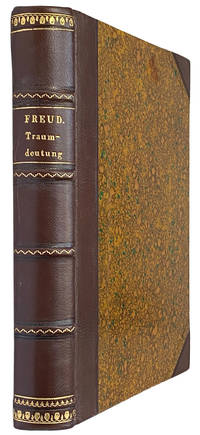
1900ref. 42501Leipzig und Wien: Franz Deuticke 1900. tall8vo. 23.3cm The First Edition 371iv1p. colophon in plain contemporary dust worn wrappers spine cap frayed and the center of the panel is mostly wanting wrappers loose early pencil notation in Germany on the cover see below text is shaken but holding the text is clean the rare first edition of this most important of books in contemporary style clam shell box designed by Red Bone Bindery in crushed brown morocco grain calf gilt decorated raised bands and spine borders gilt titles matched marbled boards fine. Provenance: The first recorded owner was Dr. Robert Drill. The following is written in pencil now faded in German: "Elgen. Von Dr. Drill mit der Bemerkung übergeben es sei wert aufbewahrt zu werden. Mitte der 30er Jahre". Elgen. By Dr. Drill handed over with the comment that it was worth keeping. mid 30s. The present owner found an article published in 1927 that quotes something Drill wrote in the Frankfurter Zeitung undated praising Freud. In der "Frankfurter Zeitung" schreibt Dr. Robert Drill: "Freud ist ein Entdecker und Wiederentdecker. Großen Formats. Seine Enträtselung des. Traumes ist von menschheitsgeschichtlicher Bedeutung. Hier ist ein Wissen -wiedergefunden das mit der Antike untergegangen war. Freud ist ein Geschenk der Natur an die seelisch Leidenden."- In the "Frankfurter Zeitung" Dr. Robert Drill: "Freud is an explorer and rediscoverer. Large format. His unraveling of the dream is of significance for human history. Here is some knowledge-rediscovered which had disappeared with antiquity. Freud is a gift from nature to those who suffer mentally.". Mid-1930s: Wilhelm & Elizabeth Hollbach received the book from Dr Robert Drill who was Jewish and fleeing Germany with minimal possessions moving to South Africa. Dr Drill and Wilhelm Hollbach were colleagues and friends. Dr Robert Drill worked at the Frankfurter Zeitung newspaper with Reiner Hollbach's father Wilhelm Hollbach link is to wikipedia page about Wilhelm - he was editor of the newspaper and acting mayor of Frankfurt immediately after the war. Post-WW II: In Germany Elgen Hollbach received the book from their mother Elizabeth Hollbach after the Second World War when she Elgen became interested in psychotherapy and later became a licensed psychotherapist. The inscription see above is assumed to be written by Elizabeth Hollbach. Mid-1990s: The book was received by Canadian relatives from Elgen Hollbach from Germany. Franz Deuticke unknown
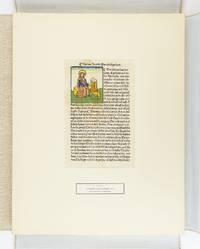
1929ref. ST17493München: Weiss & Co. Antiquariat 1929. No. 21 OF 50 SETS issued with accompanying German text; there were also 50 with accompanying English text. 480 x 375 mm. 19 x 14 3/4". With an 87-pp. volume of commentary in German. Loose as issued in a linen-covered chemise titling in black on front cover. Commentary volume in original paper wrapper. WITH 55 LEAVES FROM INCUNABULA issued by German Swiss Dutch Czech and Italian presses ALL WITH ONE OR MORE WOODCUTS 32 OF THESE HAND-COLORED. ◆Front cover of commentary volume with thin six-inch brown stain along head edge but the volume otherwise clean and fresh the leaves with occasional browning or minor staining but excellent specimens overall the hand coloring often quite attractive. Arranged according to the city in which they were printed this is a wonderful collection of 55 incunabular leaves all illustrated with woodcuts. The group includes important early images large and small with 32 of them hand painted often with brilliant memorable color. Although every leaf here is of interest there are some leaves that deserve special mention: the 1471 Zainer printing of "Heiligenleben" the earliest leaf included; a number of leaves from herbals Bibles and lives of the saints; leaves representing two different editions of Brant's "Stultifera Navis" a Basel 1500 edition of Aesop and the celebrated 1499 Aldine "Hypnerotomachia Poliphili." A full-page woodcut from Koberger's "Schatzbehalter" "Treasure Book" 1491 shows Korah Dathan and Abiram being swallowed up by the Earth for their rebellion against God while Moses and Aaron pray as God sends fire to destroy the rebels. Among the hand-painted woodcuts are several that are outstanding both for the composition of large complex images and for exuberant coloring. These include Pharoah's daughter rescuing the baby Moses as well as the adult Moses with the burning bush both from the German Bible printed by Koberger in 1483; a view of the city of Perugia in Schedel's "Weltchronik" 1493; and another Schedel leaf depicting the martyrdoms of the Apostles Andrew and Thomas. The 55 specimens included here would serve very well either as a final capstone in an advanced collection or else an outstanding nucleus for a beginning collector of illustrated incunabular leaves. Several of the books represented are difficult to obtain and most of the ones that can be procured are very expensive. Weiss & Co. Antiquariat unknown
1929ref. ST17493München: Weiss & Co. Antiquariat 1929. No. 21 OF 50 SETS issued with accompanying German text; there were also 50 with accompanying English text. 480 x 375 mm. 19 x 14 3/4". With an 87-pp. volume of commentary in German. Loose as issued in a linen-covered chemise titling in black on front cover. Commentary volume in original paper wrapper. WITH 55 LEAVES FROM INCUNABULA issued by German Swiss Dutch Czech and Italian presses ALL WITH ONE OR MORE WOODCUTS 32 OF THESE HAND-COLORED. ◆Front cover of commentary volume with thin six-inch brown stain along head edge but the volume otherwise clean and fresh the leaves with occasional browning or minor staining but excellent specimens overall the hand coloring often quite attractive. Arranged according to the city in which they were printed this is a wonderful collection of 55 incunabular leaves all illustrated with woodcuts. The group includes important early images large and small with 32 of them hand painted often with brilliant memorable color. Although every leaf here is of interest there are some leaves that deserve special mention: the 1471 Zainer printing of "Heiligenleben" the earliest leaf included; a number of leaves from herbals Bibles and lives of the saints; leaves representing two different editions of Brant's "Stultifera Navis" a Basel 1500 edition of Aesop and the celebrated 1499 Aldine "Hypnerotomachia Poliphili." A full-page woodcut from Koberger's "Schatzbehalter" "Treasure Book" 1491 shows Korah Dathan and Abiram being swallowed up by the Earth for their rebellion against God while Moses and Aaron pray as God sends fire to destroy the rebels. Among the hand-painted woodcuts are several that are outstanding both for the composition of large complex images and for exuberant coloring. These include Pharoah's daughter rescuing the baby Moses as well as the adult Moses with the burning bush both from the German Bible printed by Koberger in 1483; a view of the city of Perugia in Schedel's "Weltchronik" 1493; and another Schedel leaf depicting the martyrdoms of the Apostles Andrew and Thomas. The 55 specimens included here would serve very well either as a final capstone in an advanced collection or else an outstanding nucleus for a beginning collector of illustrated incunabular leaves. Several of the books represented are difficult to obtain and most of the ones that can be procured are very expensive. Weiss & Co. Antiquariat unknown books
4to. (16), 265, (1) pp. With a large woodcut on the title-page showing a gardener at work with his tools, and about 800 woodcut illustrations in the text. About 700 show trees, fruit, edible and medicinal plants, while the rest show insects, a tick, coral, shells, various sea and land animals and a view of a pond with plants and birds. It includes a two-headed snake, dragon, griffin, and a few other mythical creatures. With all woodcuts coloured by a contemporary hand. Contemporary pigskin over wooden boards, richly blind-tooled in a panel design with two rolls (one alternating heads and coats of arms, the other with standing figures), a large acorn and other stamps; brass clasps and catch-plates with engraved decoration. Rare first dated edition of an extensively illustrated early herbal in contemporary hand-colour, with the title and most of the plant and animal names in Latin and German. The title-page is followed by a 13-page index of the Latin and German names. About 200 of the woodcuts are about half-page, while the last six pages show 16 small animal woodcuts per page. The Folger Library notes that F. W. E. Roth attributes this herbal to Adam Lonicer (1528-86) of Marburg and Frankfurt, who married Egenolph's daughter and became a partner in the firm after Egenolph died in 1555. The firm published herbals and related works under his name beginning in 1551. Egenolph published all three editions of the present herbal. VD 16 lists the undated one as ca. 1545 (citing only the Wellcome Library copy), which would make the present 1546 edition the second. Another appeared in 1552. Egenolph's successors were to become famous not only as printers but also as one of the largest and most important early typefoundries. The present book uses Roman and Italic for the Latin, but Fraktur and Schwabacher for the German, giving a good overview of the firm's stock of type at this early date. - This copy has early owner's inscriptions by the Nuremberg pharmacist Georg Volland (d. 1631) in Latin at the foot of the title-page and in Greek on the facing endleaf. - Binding worn; some browning and stains to interior, especially to the first and last leaves. VD 16, H 2193 (4 copies). Adams H 294 (1 copy). Nissen, BBI 2345. Cf. Klebs, Early Herbals 71 (undated Egenolph ed.). Wellcome I, 1983 (same undated Egenolph ed.). Not in Stiftung Botanik.
Small folio (278 x 185 mm). 3 vols. (8), 294, (16) ff. (1), 308 (but: 310), (8) ff. (2), CXVII ff. 19th century full calf with giltstamped spine (but spine of 3rd volume rebacked). Marbled endpapers. Extremely rare first edition of this important 16th century description of Muslim Africa, complete with the frequently missing third volume, printed at Malaga. "Ouvrage toujours fort recherché" (Brunet). A native of Granada, Luis Marmol Carvajal (1520-1600) took part in the 1535 Tunis campaign of King Charles V against the Ottoman Empire's Mediterranean forces. He was taken prisoner and spent more than 22 years in North Africa, including seven or eight years as a captive in Morocco, Fez and Tunis, where he learned Arabic. In his work, he gives an historical account of Christian-Muslim conflict, as well as of inter-Muslim strife, from the time of Muhammad until 1571, when Pope Pius V created the "Holy League" to drive Ottoman forces from the eastern Mediterranean. However, Marmol discusses not only military aspects, but also and more specifically Muslim North Africa, the Moorish militias, institutions, and customs, paying particular attention to Spanish commercial interests in these territories. He provides descriptions of many Maghreb cities as well of their various sieges and sacks by the Spanish, Portuguese, Genoese, and the Ottomans. - Corners slightly bumped; the first sheets of the third volume have been washed and pressed. A good copy splendidly rebound in the 19th century, with fine provenance: from the library of the great Spanish historian Emilio Lafuente y Alcántara (1825-68), with his signature in vols. 1 and 2. Later in the library of Feliciano Ramirez de Arellano, Marqués de la Fuensanta del Valle (1826-96), founder of the Society of Spanish Libraries, with his armorial bookplate to all pastedowns; additional bookplate of the bibliographer Antonio Moreno Martin of Almería (d. 1990) to the third volume. Auction records list only two appearances of the present work, both copies lacking the third volume (present here). Ibrahim-Hilmy II, 18. Brunet III, 1439f. Heredia 3294. Palau 152.431, 152.432 & 152.433. Salvá 3356. For Acuña cf. Ticknor, History of Spanish Literature I, 497; S. Cory, Reviving the Islamic Caliphate in Early Modern Morocco, p. 6; D. Thomas, Christian-Muslim Relations. A Bibliographical History VI, 284.
Folio (220 x 328 mm). (24), 474, (4), 475-476 pp, 477-480 ff., 481-608 pp., 609-612 ff., 613-1162, (2) pp. (complete thus). With woodcut title border, Münster's portrait on the verso, printer’s device on the final page by Urs Graf, 14 maps (11 double-page and 3 triple-page) as well as 37 double-page views and approximately 970 woodcuts in the text (including repeats). Contemporary full calf on six raised double bands with gilt central oval ornaments and corner fleurons to both covers; spine sparsely gilt. An early edition of Münster’s monumental work. The Cosmographia by Sebastian Münster (1488-1552), the German cartographer and cosmographer, was one of the most successful and popular books of the 16th century. The most highly valued of all cosmographies, it passed through 24 editions within 100 years and was of principal importance for reviving the interest in geography in 16th century Europe. In spite of its numerous maps, Münster's Cosmography is largely a work of historical geography and history, and it was thus that it soon became the most popular work of its kind throughout Europe - not only in Germany, but also in France (where it saw several editions), Italy, and Bohemia. "The Latin edition, more scientific in many respects, was intended for the scholars in all of Europe" (cf. Burmeister, p. 14). - In good condition, with some frequent but slight waterstaining. A few near-contemporary underlinings and annotations, some in red ink. Binding rubbed, chafed and bumped. Provenance: handwritten ownership of Carl Isaak Rothovius, dated 1649 (possibly related to Isaacus Rothovius [1572-1652], the bishop of Turku, who oversaw the first complete translation of the Bible into Finnish). Late 18th century engraved armorial bookplate of the naturalist and Swedish civil servant Mathias Benzelstierna (1713-91), who studied with Carl Linné and became a member of the Royal Swedish Academy of Sciences in 1786. VD 16, M 6718. Burmeister 90. Hantzsch 77.33. Adams M 1911. Sabin 51382. Graesse IV, 622. Cf. Borba de Moraes II, 90f. Not in BM-STC German.
4to (142 x 196 mm). 119 ff. (of 122, without initial blank and two final blanks). 38 lines, single column, roman type. With 38 woodcut illustrations in the text showing constellations. Modern full calf with double blind rules to covers, spine on five raised bands with gilt title "Aratus". All edges red. First edition of Avienus's translation of this influential astronomical poem, rarely found complete, pre-dating the editio princeps of the Greek text by 11 years. Based on Eudoxus of Cnidus, Aratus's didactic poem about celestical phenomena (written soon after 276 BC, probably at the Macedonian court) enjoyed immense success and was frequently translated in Roman times - an interest occasioned by the increasing degree to which men viewed their fates tied to astrology and the stars. Avienus's 4th-century Latin text, informed by the Neoplatonic tradition, is expanded considerably from the original. The volume includes additional translations of Aratus by Cicero and by Germanicus Caesar, who offer earlier viewpoints. The latter version is accompanied by 38 zodiacal woodcuts, almost all of which were designed and executed for this volume and thus are present in brilliant early proofs. Four beautiful cuts in the Venetian manner are especially remarkable (cf. Essling, 431). - The "Ora maritima", on the other hand, is a short poetic account of early sea routes used by Greek and Carthaginian traders along the coasts of the Mediterranean, Caspian, and Black Seas. A few scholars have speculated that one of Avienus's sources for his work was the now-lost Massiliote Periplus, a conjectural sailing guide from the 6th century BC, although this idea is controversial. The final text in the volume constitutes the first dated edition of the most popular Roman medical work (by Serenus Samonicus), likewise couched as a didactic poem. The collective volume is thus of the greatest interest for the history of science. The editor, Vettore Pisani, was a pupil of Giorgio Valla. - Folio a4 remargined at foot and p6 (the final leaf present) repaired at head (both barely touching text). A few contemporary manicules. A very clean copy (entirely complete save for 3 blank leaves) of an edition usually encountered only in parts or even fragments, even in institutional collections. - Provenance: from the library of the surgeon, meteorologist, and antiquarian Charles Leeson Prince (1821-99) of Crowborough, Sussex, with his large bookplate (dated 1882) to front pastedown. Later in the collection of the meteorologist George James Symons (1838-1900); bequeathed to the Royal Meteorological Society with the Symons bequest bookplate (dated 1900) on lower pastedown. HC 2224* (= H 2223). Goff A-1432. GW 3131. Proctor 4593. Klebs 137.1. Sander 718. Essling 431. Pellechet 1673. Bod-inc A-639. Sheppard 3709-3711. BMC V 294. BSB-Ink A-969. Stillwell A 1277. ISTC ia01432000.
4to (193 x 252 mm). (8), X-LXXIII, (46 [instead of 49]) ff. With 9 full-page (instead of 11 full-page and 1 double-page-sized) woodcuts (2 by Albrecht Dürer) and small printer's device, all in contemporary hand colour. Later brown leather over wooden boards, using parts of the original blind-and gold-tooled binding. Upper cover has giltstamped title "Conrad Cel. Amores / Norimb. Scrip.". Rare first edition of one of the finest and most interesting German woodcut books of its age. "Als Frucht der Erlebnisse während der zehnjährigen Wanderungen 1487/97 durch Deutschland erschien 1502 das Kaiser Maximilian I. gewidmete lyrische Hauptwerk des Celtis, 'Quatuor libri Amorum secundum quattuor latera Germaniae': vier kleine in sich geschlossene lyrische Liebesromane, zyklisch verbunden in architektonisch-gesetzmäßigem Aufbau, bebildert mit Holzschnitten Dürers und aus der Schule Michael Wolgemuts [...] Celtis gilt als der deutsche Erzhumanist. Er war die stärkste poetische Begabung der humanistischen Bewegung um 1500" (NDB III, 182f.). - The "Amores" are the second of only two verified products of the "Sodalitas Celtica", the society founded by Celtis with the support of Willibald Pirckheimer (the printer remains unidentified). Two of the woodcuts are by Dürer: an allegory of Philosophy and the dedication (showng Celtis presenting the book to the emperor). "Die Seltenheit erhaltener Exemplare wie das Fehlen eines Faksimiles erklären, warum die 'Amores' als herausragendes Werk der Buchkunst im Sinne der Dürerschen 'Wiedererwachung' erst in neuerer Zeit wirklich gewürdigt worden sind" (Schoch/M./Sch.). Occasionally even the title woodcut has been ascribed to Dürer; the remaining, somewhat less delicate but no less impressive woodcuts are variously attributed to the workshops of Wolgemut, both Peter Vischers, Hans Süss von Kulmbach, or simply a "Celtis master". - Wants fol. IX (b1) with the Elegia prima (replaced by a blank leaf), the unnumbered bifolium between m2 and m3 with a view of Nuremberg after Schedel and the city's three coats of arms on the reverse, and the final leaf r6 with a full-page woodcut of Daphne and Apollo (replaced by a blank leaf). The contained woodcuts are all in especially fine contemporary colour, as are the colophon and printer's device. Printed on strong, very wide-margined laid paper. A few leaves near the end show light waterstains in the margins, otherwise a nearly spotless copy. Title has old stamp "EB"; lower corner remargined with slight loss to woodcut; fols. p8r and r5v also stamped in the blank margin. Insignificant worming to gutter of final gatherings. - The present variant of the first quire departs in several details from the copy of Hartmann Schedel kept at the BSB in Munich: a3r, headline "Ad Maxmil. Regem" (BSB: "Ad Maxmyl. Regem:"); a4v, headline: "Panegyri: Pars Prima" (BSB: "Panegyr. Prima Pars"); a5v, first line: "interuisse carmia & quae castas inoce[n]tu[m] adolesce[n]tiu[m]" (BSB: "centuadolesce[n]tiu[m] aures ledat & iebriet. Fatebimur"), etc. The present variant corresponds to the copy in the SSB Augsburg, formerly owned by Daniel Carnerius. - Provenance: Hartung & Karl, sale 53 (1986), lot 617. VD 16, C 1911. IA 135.114. Brunet I, 1730 & Suppl. I, 231. Dodgson I, 264 & 279ff. Ebert 3903. Graesse II, 101. Meder 244f. Murray 106. Muther 459 & 835. Panzer VII, 441, 17. Proctor 11029. Reske/Benzing 660. Schoch/M./Sch. 269. Strauss 66-68. Not in Adams.