[IMAGERIE D'EPINAL] PELLERIN.Livre Rare Book

8.031 resultados
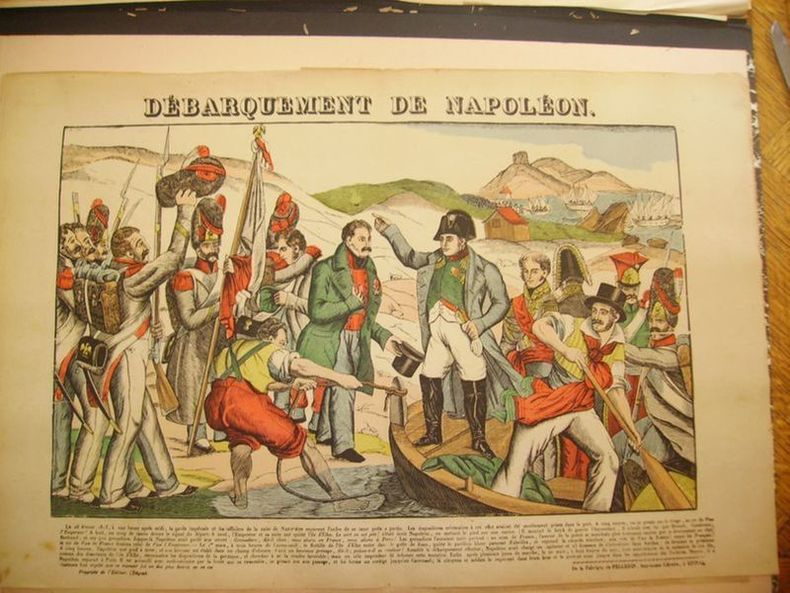
ref. 16917Epinal, Pellerin, s.d. (fin XIXe), signée Georgin.. Gravure originale sur bois de fil coloriée au pochoir sur papier fin ( 64 x 42 cm, Image: 54;5 cm x 32 cm).Très bon état.
ref. 16918Epinal, Pellerin, s.d. (fin XIXe), signée Thiébault. Gravure originale sur bois de fil coloriée au pochoir sur papier fin ( 64 x 42 cm, Image: 54 cm x 33cm).Très bon état.
ref. 16919Epinal, Pellerin, s.d. (fin XIXe). Gravure originale sur bois de fil coloriée au pochoir sur papier fin ( 64 x 42 cm, Image: 53 cm x 31 cm).Très bon état.
ref. 16920Epinal, Pellerin, s.d. (fin XIXe), signée Georgin.. Gravure originale sur bois de fil coloriée au pochoir sur papier fin ( 64 x 42 cm, Image: 52,5 cm x 31 cm). Déchirure marginale.
ref. 16921Epinal, Pellerin, s.d. (fin XIXe). Gravure originale sur bois de fil coloriée au pochoir sur papier fin ( 64 x 42 cm, Image: 53,5 cm x 31,5 cm). Déchirure dans la marge supérieure.
ref. 16922Epinal, Pellerin, s.d. (fin XIXe) signée Georgin. Gravure originale sur bois de fil coloriée au pochoir sur papier fin ( 64 x 42 cm, Image: 54,5 cm x 31 cm). Très bon état.
ref. 16923Epinal, Pellerin, s.d. (fin XIXe) signée Georgin. Gravure originale sur bois de fil coloriée au pochoir sur papier fin ( 64 x 42 cm, Image: 53,5 cm x 31 cm). Très bon état.
ref. 16924Epinal, Pellerin, s.d. (fin XIXe). Gravure originale sur bois de fil coloriée au pochoir sur papier fin ( 64 x 42 cm, Image: 54 cm x 33 cm). Très bon état.
ref. 16925Epinal, Pellerin, s.d. (fin XIXe), signée F. G. Gravure originale sur bois de fil coloriée au pochoir sur papier fin ( 64 x 42 cm, Image: 55 cm x 33 cm). Très bon état.
ref. 16926Epinal, Pellerin, s.d. (fin XIXe). Gravure originale sur bois de fil coloriée au pochoir sur papier fin ( 64 x 42 cm, Image: 52,5 cm x 30cm). Très bon état.
ref. 16927Epinal, Pellerin, s.d. (fin XIXe), signée Georgin. Gravure originale sur bois de fil coloriée au pochoir sur papier fin ( 64 x 42 cm, Image: 54 cm x 33,5 cm). Très bon état.
ref. 16928Epinal, Pellerin, s.d. (fin XIXe), signée Georgin. Gravure originale sur bois de fil coloriée au pochoir sur papier fin ( 64 x 42 cm, Image: 52,5 cm x 31 cm). Très bon état.
ref. 16930Epinal, Pellerin, s.d. (fin XIXe). Gravure originale sur bois de fil coloriée au pochoir sur papier fin ( 64 x 42 cm, Image: 51,5 cm x 32 cm). Très bon état.
ref. 16931Epinal, Pellerin, s.d. (fin XIXe), signée Georgin. Gravure originale sur bois de fil coloriée au pochoir sur papier fin ( 64 x 42 cm, Image: 53,5 cm x 32 cm). Très bon état.
ref. 16932Epinal, Pellerin, s.d. (fin XIXe). Gravure originale sur bois de fil coloriée au pochoir sur papier fin ( 64 x 42 cm, Image: 54,5 cm x 32,5 cm). Très bon état.
ref. 16933Epinal, Pellerin, s.d. (fin XIXe), signée Georgin. Gravure originale sur bois de fil coloriée au pochoir sur papier fin ( 64 x 42 cm, Image: 53,5 cm x 31 cm). Très bon état.
ref. 16934Epinal, Pellerin, s.d. (fin XIXe). Gravure originale sur bois de fil coloriée au pochoir sur papier fin ( 64 x 42 cm, Image: 53 cm x 31 cm). Très bon état.
ref. 16935Epinal, Pellerin, s.d. (fin XIXe). Gravure originale sur bois de fil coloriée au pochoir sur papier fin ( 64 x 42 cm, Image: 56 cm x 32 cm). Déchirure à la marge inférieure.
1527ref. 15642Parisiis, Apud Simonem Colinaeum, 1527. In-8 (160 x 100 mm) de 235-(9) ff. (sig. a-z, &, A-E8, F4, G8), caractères romains, initiales sur bois à fond criblé, veau brun, dos à quatre nerfs et plats estampés à froid, traces de lacets (reliure de l'époque).
1838Very Good Turkish, Ottoman (1500-1928) Original full leather bdg. with its miklep (traditional flap), embossed shamsa (mystical sun) on boards. Roy. 8vo. (24 x 17 cm). In Ottoman script. [8], 263 p. Sarlavla page decorated with traditional ornaments. First edition of this extremely rare and the first translation of the Anabasis of Alexander in the Ottoman / Turkish literature. One of 1010 copies. The Anabasis of Alexander was composed by Arrian of Nicomedia in the second century AD, most probably during the reign of Hadrian. The Anabasis (which survives complete in seven books) is a history of the campaigns of Alexander the Great, specifically his conquest of the Persian Empire between 336 and 323 BC. Both the unusual title "Anabasis" (literally "a journey up-country from the sea") and the work's seven-book structure reflect Arrian's emulation (in structure, style, and content) of the Greek historian Xenophon, whose own Anabasis in seven books concerned the earlier campaign "up-country" of Cyrus the Younger in 401 BC. The Anabasis is by far the fullest surviving account of Alexander's conquest of the Persian Empire. It primarily revolves around the military history, reflecting the content of Arrian's model, Xenophon's Anabasis; the work begins with Alexander's accession to the Macedonian throne in 336 BC and has nothing to say about Alexander's early life (in contrast, say, to Plutarch's Life of Alexander). Nor does Arrian aim to provide a complete history of the Greek-speaking world during Alexander's reign. Arrian's chief sources for his writing of the Anabasis were the lost contemporary histories of the campaign by Ptolemy and Aristobulus and, for his later books, Nearchus. One of Arrian's main aims in writing this work on history seems to have been to correct the standard "Vulgate" narrative of Alexander's reign that was dominant in his own day, primarily associated with the lost writings of the historian Cleitarchus. The Anabasis gives a broadly chronological account of the reign of Alexander the Great of Macedonia (336-323 BC), with a particular focus on military matters. George Rhasis (Yorgaki Razi) translated Anabasis Alexandrou = "History of Alexander the son of Philip" the work of Xenophon under the title "Târîh-i Iskender bin Filipos". This is the first translation of an ancient Greek historian into Turkish. Georgios Rhasis, who was one of the first writers of the French-Turkish dictionary in the early period, was an Ottoman intellectual who worked as an instructor and translator in Ottoman and French languages. He also taught at the Eastern Languages School in Paris and continued her studies in Corfu and Paris. In 1821 he came to be in Istanbul as a famous orientalist. Rhasis left the city and the homeland he lived in to settle in Tsarist Russia due to concerns during the Greek Revolution in 1821. The Bulaq or El-Amiriya Press is the first official and governmental printing press to be established in Egypt, and functions according to industrial printing basis, causing not just a qualitative but also a quantitative and knowledgeable leap in science throughout the Arab region. It's established in 1820 by Muhammad Ali Pasha of Egypt and Sudan (1769-1849) and it was part of Muhammad Ali's inclusive development plans for the modernization of Egypt. Library of Congress, Karl Süssheim Collection, no. 129. (OCLC: 966315151). Only 6 copies in OCLC: 27236333.; Alex II 25.; BM e15.; Cairo FKT 166.; IstUKT 802.; Bianchi CD 155.; Bulaq IF 8:21.; Bulaq FK 7:8.; Ridwan 162.; Özege 19837 (No author and no translator in Özege record).
1558ref. 8703Paris, Galliot du Pré, 1558. In-12 de (8)-152 ff., maroquin rouge, dos orné à nerfs, triple filet doré sur les plats, tranches dorées (reliure du XIXe siècle).
1535ref. 42543Lyon, Denys de Harsy, 1535-1536. In-4 gothique de CXXV-(11) ff. (sign. A-R8), 4 feuillets liminaires manuscrits, maroquin brun janséniste, dos à nerfs, frise dorée intérieure, tranches dorées sur marbrure (Chambolle-Duru).
ref. 42926Paris, Thielman Kerver, 1498. In-8 gothique sur peau de vélin (115 x 175 mm) de (112) ff. (sig. A-O8), 25 lignes à la page, veau brun sur ais à large décor estampé à froid, dos orné à nerfs, tranches dorées, fermoirs (reliure de l’époque).
15864to ; 1st edition thus. 18th Century Full Leather, 4to, 4 parts in 1 volume: [148] + [112] + [119] + [128] leaves, with four sectional woodcut title pages within elaborately decorated architectural framework, their first appearance. Steinschneider, M. Cat. librorum hebraeorum, 47, 277; Cowley, 83; VD 16; ZV 17573. The Pentateuch with the Early and Later Prophets and Hagiographa. Pointed Hebrew with cantillation. Title and further information on colophon. Some opening words have woodcut decorated frames. The title page designs were so impressive that they were used again in later editions such as the Frankfurt am Oder Hebrew Bible of 1595. With extensive scholarly notations in Latin in a 17th Century hand to margins and blank rectos of well over 400 pages. Signatures in Arabic and Roman numerals: Pts. 1-2. 1-654 (334 blank, 654 verso blank) -- pt. 3. 1-304 (303 verso blank, 304 blank) -- pt. 4. 1-324 (11 verso blank, 324 verso blank). Haftarot and Pesukim are recorded in the margins. Place of printing from colophon, which is on verso of last leaf: "Nidpas be-mitsvat Yohanan u-Khonrad Ruihl ha-ahim." SUBJECT(S): Bible. Hebrew -- Versions. Haftarot. OCLC: 123017672. OCLC-Worldcat lists copies worldwide (HUC, Yale, Cambridge, Edinburgh Univ, Oxford, British Lib, NLI, Bar Ilan), with only two in the US. Eight leaves missing (91-104). In the final volume, Ketuvim, four leaves show a touch of outer margin loss, with an additional seven leaves showing substantial margin loss but touching only a letter or two of text. Thirteen leaves show enough margin loss that text is affected though never more than the outer portion of the top six lines of any leaf. Three leaves with margin notes are affected. Margin notes predate the 18th century binding and in many cases appear to have suffered some loss with trimming and rebinding in the 18th Century. 16th Century rag paper and internal binding remain very nice. Beautiful 18th Century British binding with leather spine label and armorial bookplate on front pastedown remain outstanding. Very Good Condition thus. No copies appearing at auction in the last 25 years. Rare and important, with significant period marginalia. (KH-10-7)
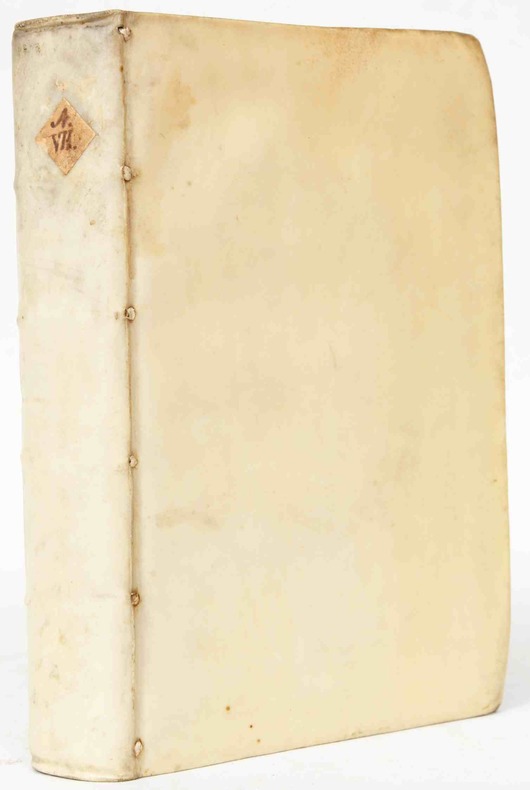
1544ref. 14383Parisiis, Ex officina Rob. Stephani, 1544. In-8 de 394-(14) pp. (sign. aa-zz, AA, BB8, CC4), vélin ivoire, étiquette ancienne sur le dos (reliure de l'époque).