KŌFUKUJI 興福寺 PRINTING, SUTRABiblio.com
7,211 results
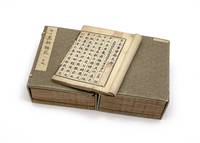
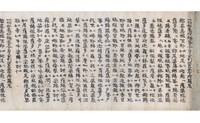
ref. 11486Scroll on paper 24 lines per dharani 17 characters per line body of the woodblock text: 240 x 494 mm. consisting of two joined sheets r: 553 mm. l: 585 mm. in length sutra text printed twice. Scroll 290 x 1138 mm. with later endpaper 68 mm. at beginning total length: 1206 mm. on a wooden roller some worming to text faint staining at foot. Most certainly Kofukuji Temple Nara: late Heian late 11th or early 12th century. An extremely early Kasuga-ban printing from the KÅfukuji temple. Our printed scroll appears to be a unique survival; we find no example in any library and it is unrecorded in all bibliographies. The earliest printed texts in Japan were dharani issued between 764 and 770; nothing more was printed until the late Heian period. "The first unequivocal record of textual printing in the Heian period 794-1185 comes from 1009 when Fujiwara no Michinaga recorded in his diary that 1000 copies of the Lotus Sutra had been printed although no copies of this seem to survive.The oldest extant example bearing a date is the Joyuishikiron which was printed in Nara by monks of the KÅfukuji temple in 1088."-Kornicki The Book in Japan pp. 118-19. In the Heian period of the "Six Temples" of Nara only KÅfukuji is known to have produced any printed books or scrolls. Our scroll was therefore most certainly printed at the KÅfukuji temple. The sutra has the general visual characteristics of late Heian printing: paler ink noticeably less jet-black than the ink usually found in Kamakura-era impressions but it should be said less pale than at least some of the surviving Heian impressions; slightly angular less brush-like letter-strokes; some noticeable variation in the firmness of the impression of the woodblock caused by uneven inking very typical of Heian-era printing; and fine-quality thin pale kÅzo paper. Kamakura-era printings tend to be characterized by jet-black sumi ink very even and well-inked impressions thick gampi paper stained a light yellow-brown with kÅryÅ clove and thick rounded letter-strokes in imitation of brush calligraphy. None of these typical Kamakura-era characteristics are present in this scroll. See Gardner Descriptive Catalogue of Japanese Books in the British Library Printed before 1700 London: 1993 p. 157. The sutra was translated from Sanskrit to Chinese by Amoghavajra ä¸ç©º C: Bukong; J: Fukū 705-74 a prolific and important translator of Esoteric scriptures and Esoteric versions of old scriptures. Born in southern India he went to China at age ten and was ordained. In 741 he went to study in Sri Lanka and India returning to China in 746 with some 500 Buddhist manuscript texts. In the following years he became one of the most politically powerful Buddhist monks in Chinese history and one of the Eight Patriarchs of the Doctrine in Shingon Buddhism. We know that this particular dharani sutra was one of the very earliest to be printed in East Asia - the oldest surviving complete printed scrolls today in both Chinese and Korean institutions are examples of the Treasure Chest Seal Dharani. A copy of the Sutra of the Whole-Body Relic Treasure Chest Seal Dharani dating from 975 is the earliest printed book in the collection of the National Library of China. The oldest surviving substantive Korean woodblock printing is a copy of the Sutra of the Whole-Body Relic Treasure Chest Seal Dharani published in 1007 year 10 of King Mokjong now kept at Chongjisa temple in Gaesong. The production of this scroll is most interesting. The two sheets of paper were first joined together and then the same woodblock was printed twice side by side. The two sheets are of slightly uneven length and part of the woodblock text on the right extends onto the left-hand sheet. The repeated recitation of the dharani was a meritorious act of faith for the followers of Buddha. Heian printing was - at least initially - characterized by repetitive printing for devotional purposes as an alternative to hand copying rather than for practical reading or study. In other words the first printed scrolls were really just longer and more elaborate versions of the suributsu multiple woodblock impressions periodically found rolled up inside Buddhist temple statues. This accords with our scroll which consists of two consecutive identical impressions of the Treasure Chest Seal Dharani. In the absence of other evidence to the contrary the repetitive printing and purely devotional nature of this scroll would tend to place its production more likely in the late 11th century or first years of the 12th rather than in the last decade or two of the Heian era - by which time scrolls clearly intended for study often with commentaries had become much more common. PROVENANCE: Ownership sumi in black seal of the "Horyuji issaikyo" 法隆寺一切経 at end of scroll and on verso where the two sheets of paper are joined. This particular seal is a variant of the seal used to mark the Horyuji's ownership of the Horyuji issaikyo manuscript sutra collection executed 1099-1131. Our variant seal was used to simply denote Horyuji ownership. As suggested in Nihon shakyo sokan our seal is of early Kamakura manufacture which means our printed scroll must predate that period. There is an early inscription on the outside of the front endpaper stating "hokyoin dharani." Our scroll was offered for sale by the Isseido Book Company in 1993 in its 90th anniversary catalogue describing it as a printing of the late Heian period. In remarkably fine condition. The outer blank margin of the left-hand sheet is somewhat dusty or smoky except for a large white circle where clearly a candle stand once was present. Preserved in two wooden boxes one fitting inside the other. ⧠We thank Prof. Peter Kornicki of Cambridge University for his essential help. unknown
ref. 11486Scroll on paper 24 lines per dharani 17 characters per line body of the woodblock text: 240 x 494 mm. consisting of two joined sheets r: 553 mm. l: 585 mm. in length sutra text printed twice. Scroll 290 x 1138 mm. with later endpaper 68 mm. at beginning total length: 1206 mm. on a wooden roller some worming to text faint staining at foot. Most certainly Kofukuji Temple Nara: late Heian late 11th or early 12th century. An extremely early Kasuga-ban printing from the KÅfukuji temple. Our printed scroll appears to be a unique survival; we find no example in any library and it is unrecorded in all bibliographies. The earliest printed texts in Japan were dharani issued between 764 and 770; nothing more was printed until the late Heian period. "The first unequivocal record of textual printing in the Heian period 794-1185 comes from 1009 when Fujiwara no Michinaga recorded in his diary that 1000 copies of the Lotus Sutra had been printed although no copies of this seem to survive.The oldest extant example bearing a date is the Joyuishikiron which was printed in Nara by monks of the KÅfukuji temple in 1088."-Kornicki The Book in Japan pp. 118-19. In the Heian period of the "Six Temples" of Nara only KÅfukuji is known to have produced any printed books or scrolls. Our scroll was therefore most certainly printed at the KÅfukuji temple. The sutra has the general visual characteristics of late Heian printing: paler ink noticeably less jet-black than the ink usually found in Kamakura-era impressions but it should be said less pale than at least some of the surviving Heian impressions; slightly angular less brush-like letter-strokes; some noticeable variation in the firmness of the impression of the woodblock caused by uneven inking very typical of Heian-era printing; and fine-quality thin pale kÅzo paper. Kamakura-era printings tend to be characterized by jet-black sumi ink very even and well-inked impressions thick gampi paper stained a light yellow-brown with kÅryÅ clove and thick rounded letter-strokes in imitation of brush calligraphy. None of these typical Kamakura-era characteristics are present in this scroll. See Gardner Descriptive Catalogue of Japanese Books in the British Library Printed before 1700 London: 1993 p. 157. The sutra was translated from Sanskrit to Chinese by Amoghavajra ä¸ç©º C: Bukong; J: Fukū 705-74 a prolific and important translator of Esoteric scriptures and Esoteric versions of old scriptures. Born in southern India he went to China at age ten and was ordained. In 741 he went to study in Sri Lanka and India returning to China in 746 with some 500 Buddhist manuscript texts. In the following years he became one of the most politically powerful Buddhist monks in Chinese history and one of the Eight Patriarchs of the Doctrine in Shingon Buddhism. We know that this particular dharani sutra was one of the very earliest to be printed in East Asia - the oldest surviving complete printed scrolls today in both Chinese and Korean institutions are examples of the Treasure Chest Seal Dharani. A copy of the Sutra of the Whole-Body Relic Treasure Chest Seal Dharani dating from 975 is the earliest printed book in the collection of the National Library of China. The oldest surviving substantive Korean woodblock printing is a copy of the Sutra of the Whole-Body Relic Treasure Chest Seal Dharani published in 1007 year 10 of King Mokjong now kept at Chongjisa temple in Gaesong. The production of this scroll is most interesting. The two sheets of paper were first joined together and then the same woodblock was printed twice side by side. The two sheets are of slightly uneven length and part of the woodblock text on the right extends onto the left-hand sheet. The repeated recitation of the dharani was a meritorious act of faith for the followers of Buddha. Heian printing was - at least initially - characterized by repetitive printing for devotional purposes as an alternative to hand copying rather than for practical reading or study. In other words the first printed scrolls were really just longer and more elaborate versions of the suributsu multiple woodblock impressions periodically found rolled up inside Buddhist temple statues. This accords with our scroll which consists of two consecutive identical impressions of the Treasure Chest Seal Dharani. In the absence of other evidence to the contrary the repetitive printing and purely devotional nature of this scroll would tend to place its production more likely in the late 11th century or first years of the 12th rather than in the last decade or two of the Heian era - by which time scrolls clearly intended for study often with commentaries had become much more common. PROVENANCE: Ownership sumi in black seal of the "Horyuji issaikyo" 法隆寺一切経 at end of scroll and on verso where the two sheets of paper are joined. This particular seal is a variant of the seal used to mark the Horyuji's ownership of the Horyuji issaikyo manuscript sutra collection executed 1099-1131. Our variant seal was used to simply denote Horyuji ownership. As suggested in Nihon shakyo sokan our seal is of early Kamakura manufacture which means our printed scroll must predate that period. There is an early inscription on the outside of the front endpaper stating "hokyoin dharani." Our scroll was offered for sale by the Isseido Book Company in 1993 in its 90th anniversary catalogue describing it as a printing of the late Heian period. In remarkably fine condition. The outer blank margin of the left-hand sheet is somewhat dusty or smoky except for a large white circle where clearly a candle stand once was present. Preserved in two wooden boxes one fitting inside the other. ⧠We thank Prof. Peter Kornicki of Cambridge University for his essential help. unknown books
Folio (302 x 220 mm). 68 ff. Gothic letter, two columns, 65 lines plus headline. With 5- and 13-line white-on-black woodcut initials, numerous woodcut illustrations of surgical equipment, and woodcut printer's device beneath colophon. Contemporary vellum over carta rustica, lettered in manuscript on upper cover together with the name of the owner, Hieronymus Tattus. Stored in modern black cloth solander case with spine label. The earliest printing of the Surgery of Abu al-Qasim al-Zahrawi, a section of his great "Al-Tasrif": the "first rational, complete and illustrated treatise on surgery and surgical instruments. During the Middle Ages it was the leading textbook on surgery until superseded by Saliceto" (Garrison/M. 5550). This publication pre-dates by nearly two decades the first independent printing. It includes nearly 200 woodcut illustrations of surgical instruments, including a forceps for extracting a dead fetus - a device of the author's own invention, still in use in modified form. - Abu al-Qasim, hailed as the "father of modern surgery", specialized in curing disease by cauterization and designed several surgical devices. He described how to ligature blood vessels almost 600 years before Ambroise Paré and was also the first to describe a surgical procedure for ligating the temporal artery for migraine. His use of catgut for internal stitching is still practised in modern surgery. - Al-Qasim's treatise, by far the longest of the four contained in this volume, is accompanied by two ophthalmological works, the first by the tenth-century oculist 'Ali Ibn Isa of Baghdad, known as Haly Jesus in the Western tradition. In his principal work, "Kitab Tadhkirat al-kahhalin" (GAL S I, 884), which long remained the classical training manual for ophthalmologists, Ibn Isa describes 130 eye diseases and discusses 141 treatments. The Latin translation, available to Western medicine since the 13th century, continued in use by medical schools as late as the early 18th century. - The other work "De oculis", ascribed to Canamusali, is in fact a compilation by David Armenicus (Sack). Prefixed to these is the surgery treatise of Guy de Chauliac (Guido de Cauliaco), physician to several popes in Avignon in the 14th century and "the most eminent surgeon of his time" (Garrison/M. 5556). Locatellus had previously issued the text of Chauliac's treatise in 1498, after this highly important work had first been printed at Lyon in 1478. - A few small wormholes in gutter. Binding soiled and scraped at foot of upper cover, vellum covering shrunk and lacking two pairs of ties. - Provenance: owned by the 16th-century Milanese physician Girolamo Tattus, "vir ... in medicina facienda clarissimi nominis" (Della Torre di Rezzonico, Disquisitiones Plinianae II [Parma, 1767], p. 224), with his inscription on the title-page and upper cover, as well as several autograph annotations to the text. The son of Francesco Tatti, a member of the College of the Physicians of Milan, Girolamo flourished around 1570. His writings have remained unpublished (cf. Argelati, Bibliotheca Scriptorum Mediolanensium [Milan, 1745], col. 1821). He is known to have owned and annotated an illuminated manuscript of Pliny's "Naturalis Historiae", written by Hieronymus Baliocus of Novara in 1479 for Gian Matteo Bottigella of Pavia and his wife Bianca Visconti, later owned by Matteo Luigi Canonici (1727-1805) and acquired in 1817 by the Bodleian Library, Oxford (now Canon. Class. Lat. 295). - Extremely rare: this is the only copy ever to have appeared in the trade, sold at Sotheby's in 1988. Hain 4810 (I). Copinger 1550. Goff G-564. GW 11707. Klebs 497.1. Essling 1247. Ohly-Sack 1330. Oates 2005. Bod-Inc. G-275. Sheppard 4244, 4245, 4246. Proctor 5100. BMC V, 453. BSB-Ink. G-430. Döring-Fuchs G-173. Wellcome 3017. Cf. DSB XIV, 585. GAL I, 239 (276), 24, no. 1.
4to (148 x 208 mm). 40 ff. 34 lines, Gothic type. Title-page with full-page woodcut of an anatomical scene. Modern full calf, bound to style with covers stamped in black. Housed in a custom-made cloth solander case with morocco spine label. First illustrated edition of the first dedicated anatomy book. "The first modern book devoted solely to anatomy [...] Mundinus re-introduced human dissection, which had been neglected for 1500 years before him; he was the most noted dissector of his period. The medieval anatomical vocabulary, well set forth by Mundinus, was derived mainly from Arabic" (Garrison/M.). Mondino de' Luzzi, professor at Bologna, is considered the founder of anatomy in the Middle Ages. His treatise remained popular until the beginning of the 16th century and appeared in multiple editions. - "The subject of anatomy was not taught either by lectures or by dissection in the universities at the middle of the 15th century. An occasional 'anatomy' was held, but the neglect of the subject is well illustrated by the absence of anatomical books. There is only one in the list, that of Mundinus [...]. Mundinus was a professor at Bologna from 1306 to 1326, and was the first to teach anatomy from the subject, usually the corpse of a condemned criminal; but there is the record of a procedure in 1319 against four medical students for body-snatching. His 'Anatomia', written in 1316, was for two hundred years the popular text book" (Osler). - The work "met a need universally felt just at that time and commended itself for its brevity, conciseness, and completeness, as well as for the fact that it taught for each separate organ the necessary anatomic technique" (Choulant, p, 88). The title woodcut shows a man on a chair, "with coat and high cap, in his left hand an open book, on the left side of the picture a rock and six linden trees, below, on a table, a dissected cadaver, beside its left foot lies a curved knife, to the right of the cadaver stands a young man in a short garment, bare-headed and with long curls, grasping the intestines of the cadaver with both hands" (p. 93). - Inner margin of title-page neatly reinforced; illegible old library stamp to lower margin and old handwritten number "6" to upper corner. Tiny repair to blank outer margin of final leaf. Scattered light browning, mostly marginal. Very rare: a single copy in auction records since 1979). From the library of the noted Russian-American photographer and biologist Roman Vishniac (1897-1990). H 11633. Goff M-874. GW M-25670. Bod-inc M-330. Sheppard 2122. Proctor 2994. Wellcome I, 4484. Poynter 392. Klebs 688.6. Choulant, History and Bibliography of Anatomic Illustration, p. 93, no. 4. Cf. Garrison/M. 361; Osler, Incunabula Medica 156 (for the 1478 edition).
4to (140 x 195 mm). (96) ff., numbered in an early hand (omitting f. 77). Elaborate woodcut border on title-page, featuring elephant and cherubim, and with several large woodcut initials in text. Bound in early limp vellum with manuscript title on spine; edges stained red. 17th century portrait of Vives added to inner cover. Lengthy, exegetical early annotations to the first book 'De Instituenda Virgine' along with readership markings. A very good copy from the Harrach Library (Austria/Madrid), with 19th century stamp on title. Very rare first edition of "the first systematic study to address explicitly and exclusively the universal education of women", commissioned by Henry VIII's wife, Catherine of Aragon, who was at the time rearing her own daughter, Mary Tudor. Translated and adapted by numerous followers, Vives' treatise would go on to be read in almost every European vernacular, often by women themselves. The first edition, however, is rare in census and in commerce - and contains passages, particularly on chastity and intellectual capacity, which were entirely re-written in later incarnations. A fundamental document for the role of women in Early Modern society - and particularly in Early Modern England - this copy is especially remarkable for its state of preservation. An early reader of Vives has here added his own comments to the chapters on the seclusion of maidens and examples of feminine virtue. - "De Institutione Foeminae Christianae" consists of 3 books, one for each stage of woman's life: maidenhood, marriage, and widowhood. In his preface to Queen Catherine, Vives quotes Aristotle to the effect that states which do not provide for the education of women deprive themselves of a great source of their prosperity; yet as Charles Fantazzi points out, Vives is in fact here caught in a delicate double bind, "insistent on a subordinate, submissive role for women, the text must take care to expound its message not only without alienating the queen but rather, indeed, with the goal of winning her favour." Despite its dedication and although Vives specifically adapts his prose style for a female readership, the treatise is hardly pro-woman: "the 'Education' is determined to be both a reference book for men on how to control their women, as well as an edifying treatise for women to absorb as a source of proper behaviour" (Kolsky). Nevertheless, Vives' praise of women's intellectual capacity and his advocation of some form of universal learning for females are viewed as landmarks for modern historians of women and gender. - According to Fantazzi, "'De Institutione' enjoyed an enormous popularity and was generally regarded as the most authoritative statement on this subject throughout the sixteenth century, especially in England, where it found favor with Catholics and Protestants alike. There can be no denying that merely by attaching such importance to the education of women, Vives laid the groundwork for the Elizabethan age of the cultured woman." It was rapidly translated into English, enjoying some nine editions in that language during the 16th century alone (cf. Higginbotham, p. 69). According to Pollie Bromilow, the dozens of vernacular translations were partly aimed at women themselves, who had no knowledge of Latin; and thus a large segment of its readership during the 16th century was in fact female. Appearing in an undated edition as early as 1528 or 1529, the English translation is rather an adaptation of Vives' text begun by Thomas More but completed by his household tutor, William Hyrde, who must have used the present edition in its preparation. - In 1538 Vives brought out a revised Latin edition reflecting many changes to the original text. This is the edition most commonly cited by scholars, probably thanks to its greater availability. The sections on maidens and the preservation of maidenhood (in all its meanings), however, were substantially re-written - notably, treating many of the same subjects which interested the annotator of the present copy! Chapter 6, on virginity, for example, "was subjected to a complete revision, so that it bears little resemblance to the first published version. It is obvious that Vives struggled over the proper approach to this topic. In the original version, he suddenly abandons his more discursive style for a rather personal and, one might add, paternalistic tête-á-tête with a young woman" (Fantazzi, p. 18). Vives' views on women's intellectual capacities also develop between the two editions. - At the outbreak of the Reformation Vives was a close friend of Erasmus, who had commissioned him to write a commentary on Augustine's "City of God" in 1521. Perhaps seeking refuge from the political and religious turmoil of Europe, Vives turned his attention to England from this point onward. He dedicated his edition of "De Civitate Dei" to Henry VIII in 1522, and already in May of 1523 was able to present a manuscript of his "De Institutione Foeminae Christianae" to Queen Catherine in person. At Henry's court he grew close to the circle of Thomas More and produced a further educational treatise, "De Ratione Studii Puerilis". Thanks to his growing opposition to Henry VIII's divorce proceedings, however, Vives was placed under house arrest by Cardinal Wolsley from February to April 1528, and upon his release sensibly fled the country - only to return briefly later that year in the role of Catherine's legal adviser. - Provenance: later stamp of the Harrach Library on title-page. The collection originated as the personal library of Graf Ferdinand Bonaventura von Harrach, Austrian envoy to Spain (1637-1707), and explains the characteristically Spanish binding on the present example. Ferdinand's son Aloys followed in his father's footsteps; but after his death in 1742 the collection was transferred back to the remaining Harrach family in Vienna. Finally, the collection wound up in the family castle 'Schloss Bruck an der Leitha', in Lower Austria. We have handled numerous other Harrach copies, which seem to have formed a cohesive 'personal reference library' of 16th and 17th century works for this seventeenth century statesman. - A very good copy. OCLC shows just four copies in American institutions: Harvard, the Massachusetts Center for Renaissance Studies, Yale, and the Huntington. Nijhoff/Kronenberg 2167. Adams V 951. Brunet V, 1333. Estelrich 136. Cf. also Fantazzi's introduction to a modern translation, The Education of a Christian Woman: A Sixteenth-Century Manual (U Chicago, 2007). Kolsky, Making Examples of Women: Juan Luis Vives' The Education of a Christian Woman. Higginbotham, The Girlhood of Shakespeare's Sisters: Gender, Transgression, Adolescence (U Edinburgh, 2013). Bromilow, "An Emerging Female Readership of Print in Sixteenth-Century France?", French Studies (2013) Vol. 67, pp. 155-169.
ref. 11212Collected & edited by Jiang Shaoyu 江少虞. Complete in 78 parts plus table of contents bound in 15 vols. full collation supplied in the Hyde catalogue. Large 8vo 286 x 215 mm. early paper wrappers new stitching. Japan: chokuban privately published by the Emperor Go-Mizunoo’s order 1621. First edition and a fine complete set of one of the very few surviving “imperial editions” printed with movable type kokatsujiban å¤æ´»å—版. There is considerable modern debate with no definitive conclusion whether this book was printed with metal or wooden type see below. It is of very great rarity and we find no printed copy in WorldCat. This enormous publication is by far the largest of the eight surviving chokuban imperial printings and the only surviving Gen’na chokuban 元和勅版 — imperial printing during the reign 1611-29 of Emperor Go-Mizunoo 後水尾天皇 1596-1680. The production of this large work was a very complex and difficult project employing the recently imported technology of movable type from Korea. The Song dynasty editor Jiang Shaoyu active 12th century compiled the substantial encyclopedia Huang Song shi shi lei yuan 皇宋事實類苑 of the writings of Chinese courtly scholars completed in 1145. Encouraging the preservation of Chinese traditions long valued by aristocrats Emperor Go-Mizunoo continued the project initiated by his father Emperor Go-YÅzei of printing imperially commissioned volumes of Chinese literary classics with the present work a collection of Confucian texts that were considered both an ethical and a literary legacy of the court. Some of the many topics include music medicine painting calligraphy supernatural events safeguarding the border and controlling the unruly. “The earliest surviving books printed in Korea with movable type date from the late fourteenth century…During the invasion of the Korean peninsula undertaken by Toyotomi Hideyoshi in the closing years of the sixteenth century…large numbers of printed books were looted and printing type was removed from the Printing Office and taken to Japan…It appears that Korean type was immediately put to use to print the text of the…Kobun kokyo Classic of Filial Piety in 1593 although no copies of this appear to have survived. In 1597 in the postface to another work printed in Japan with movable type a monk who was present at Hideyoshi’s headquarters acknowledged that typography in Japan had come from Korea. It was not clear whether any Korean printing artisans came to Japan as well as a result of the invasion but in any event the impact on Japan of Korean typography both technologically and intellectually was far greater than that of the Jesuit Mission Press principally because the imported Korean typography was much closer to the centres of power in Japan than the increasingly precarious Jesuit missions.”–Kornicki The Book in Japan p. 129. Emperor Go-YÅzei who nominally ruled Japan from 1586 to 1611 “displayed great enthusiasm for the new process and not content with the original type brought back from Korea ordered a new set of wooden type to be made. This was engraved between 1597 and 1602 and the books printed from this new type are generically known as choku-han or ‘imperial printings.’ Indeed ‘imperial’ is a fitting description of these works for they are among the finest unillustrated books ever produced in Japan. Not only was the typeface larger but the best-quality paper and the finest ink were used to achieve effect. Very few choku-han works were actually printed between 1597 and 1603 actually 1621 and if we exclude the 1593 edition of Kobun kokyÅ almost all the titles were copies of Chinese philosophical classics… “One other choku-han is known to have been printed by order of Emperor Go-Mino-o Emperor Go-YÅzei’s son and successor in 1621 and that is the Horuien the present work although one or two other titles were printed and have been lost. All these works are considerable examples of the printer’s art and show how quickly the Japanese were able to make full and aesthetic use of movable type.”–Chibbett The History of Japanese Printing and Book Illustration p. 69. At the time of the writing of the Hyde sale catalogue it was believed that the present work was printed with copper type; the latest research has suggested that wooden type was used. No final conclusion has been reached. See Kornicki Printing Technologies and Book Production in Seventeenth-Century Japan Cambridge: 2025 p. 26 for a discussion. Very fine and fresh set. Minor worming carefully repaired. Final volume with some dampstaining. Preserved in two chitsu. From the RokuÅ-in 鹿王院 temple in Kyoto and the library of Donald and Mary Hyde their sale Christie’s NY 7 October 1988 lot 87. With the provenance seal å¼˜æ–‡è˜ “KÅbunshÅ” the trade name of Sorimachi Shigeo å町茂雄 1901-91 the “H.P. Kraus of Japan.”. unknown
ref. 11212Collected & edited by Jiang Shaoyu 江少虞. Complete in 78 parts plus table of contents bound in 15 vols. full collation supplied in the Hyde catalogue. Large 8vo 286 x 215 mm. early paper wrappers new stitching. Japan: chokuban privately published by the Emperor Go-Mizunoo’s order 1621. First edition and a fine complete set of one of the very few surviving “imperial editions” printed with movable type kokatsujiban å¤æ´»å—版. There is considerable modern debate with no definitive conclusion whether this book was printed with metal or wooden type see below. It is of very great rarity and we find no printed copy in WorldCat. This enormous publication is by far the largest of the eight surviving chokuban imperial printings and the only surviving Gen’na chokuban 元和勅版 — imperial printing during the reign 1611-29 of Emperor Go-Mizunoo 後水尾天皇 1596-1680. The production of this large work was a very complex and difficult project employing the recently imported technology of movable type from Korea. The Song dynasty editor Jiang Shaoyu active 12th century compiled the substantial encyclopedia Huang Song shi shi lei yuan 皇宋事實類苑 of the writings of Chinese courtly scholars completed in 1145. Encouraging the preservation of Chinese traditions long valued by aristocrats Emperor Go-Mizunoo continued the project initiated by his father Emperor Go-YÅzei of printing imperially commissioned volumes of Chinese literary classics with the present work a collection of Confucian texts that were considered both an ethical and a literary legacy of the court. Some of the many topics include music medicine painting calligraphy supernatural events safeguarding the border and controlling the unruly. “The earliest surviving books printed in Korea with movable type date from the late fourteenth century…During the invasion of the Korean peninsula undertaken by Toyotomi Hideyoshi in the closing years of the sixteenth century…large numbers of printed books were looted and printing type was removed from the Printing Office and taken to Japan…It appears that Korean type was immediately put to use to print the text of the…Kobun kokyo Classic of Filial Piety in 1593 although no copies of this appear to have survived. In 1597 in the postface to another work printed in Japan with movable type a monk who was present at Hideyoshi’s headquarters acknowledged that typography in Japan had come from Korea. It was not clear whether any Korean printing artisans came to Japan as well as a result of the invasion but in any event the impact on Japan of Korean typography both technologically and intellectually was far greater than that of the Jesuit Mission Press principally because the imported Korean typography was much closer to the centres of power in Japan than the increasingly precarious Jesuit missions.”–Kornicki The Book in Japan p. 129. Emperor Go-YÅzei who nominally ruled Japan from 1586 to 1611 “displayed great enthusiasm for the new process and not content with the original type brought back from Korea ordered a new set of wooden type to be made. This was engraved between 1597 and 1602 and the books printed from this new type are generically known as choku-han or ‘imperial printings.’ Indeed ‘imperial’ is a fitting description of these works for they are among the finest unillustrated books ever produced in Japan. Not only was the typeface larger but the best-quality paper and the finest ink were used to achieve effect. Very few choku-han works were actually printed between 1597 and 1603 actually 1621 and if we exclude the 1593 edition of Kobun kokyÅ almost all the titles were copies of Chinese philosophical classics… “One other choku-han is known to have been printed by order of Emperor Go-Mino-o Emperor Go-YÅzei’s son and successor in 1621 and that is the Horuien the present work although one or two other titles were printed and have been lost. All these works are considerable examples of the printer’s art and show how quickly the Japanese were able to make full and aesthetic use of movable type.”–Chibbett The History of Japanese Printing and Book Illustration p. 69. At the time of the writing of the Hyde sale catalogue it was believed that the present work was printed with copper type; the latest research has suggested that wooden type was used. No final conclusion has been reached. See Kornicki Printing Technologies and Book Production in Seventeenth-Century Japan Cambridge: 2025 p. 26 for a discussion. Very fine and fresh set. Minor worming carefully repaired. Final volume with some dampstaining. Preserved in two chitsu. From the RokuÅ-in 鹿王院 temple in Kyoto and the library of Donald and Mary Hyde their sale Christie’s NY 7 October 1988 lot 87. With the provenance seal å¼˜æ–‡è˜ “KÅbunshÅ” the trade name of Sorimachi Shigeo å町茂雄 1901-91 the “H.P. Kraus of Japan.”. unknown books
Folio. 159, (1 blank) ff. Text set in two columns in a gothic rotunda type with the headings of different capitals ("CAP. ...") set in roman type. With spaces (left blank) for hand-drawn initials and with some woodcut initials throughout. With the woodcut printer's device of Octavianus Scotus at the end of the work. 18th-century brown goatskin, blind-tooled double fillet frame on both boards, gilt-ruled spine with red morocco spine label lettered in gold, gold-tooled board edges and inner dentelles, red edges, orange ribbon marker, marbled endpapers. Extremely rare second edition of Al-Razi's "Kitab al-Mansuri" (Book of Medicine dedicated to Mansur): a short general textbook on medicine in ten chapters, which he dedicated to the Samanid prince Abu Salih al-Mansur ibn Ishaq, governor of Ray, in 903. The work was rendered into Latin as "Liber ad Almansorem" by Gerard de Sabloneta, a 13th-century Italian who specialized in translating Arab medical texts and is said to have translated the work of the great Islamic scholar Ibn Sina (Avicenna, 980-1037) by order of Emperor Frederick II. The first Latin printed edition of "Al-Mansuri" was produced in Italy in 1481. This incunabular edition contains all ten books of the "Liber ad Almansorem", which were seldom printed together: usually only parts of the book were published, most frequently Book 9, which was a popular text under the Latin title "Liber nonus ad Almansorem", and numerous editions were printed in Renaissance Europe with commentaries by prominent physicians of the day, containing descriptions and treatments for a wide range of physical ailments, including epileptic fits, gall stones, ulcers, and toothaches. The ten books present here are considered one of the first medical textbooks printed, covering a range of medical subjects: (1) anatomy and physiology, (2) the tempers, (3) simple remedies, (4) health, (5) skin diseases, (6) diet, (7) surgery, (8) poisons, (9) diseases of the various organs, and (10) fevers. This edition also includes the author's famous treatise titled "De aegritudinibus puerorum", the first treatise entirely devoted to childhood diseases. He clearly discusses the etiology and semeiology of 24 such ailments (including smallpox and measles) with their mostly herbal remedies, each one in a separate chapter. This is followed by additional short treatises by various authors, including Musa ibn Maymun (Maimonides), Yuhanna ibn Masawaih (Mesue the Elder), and ibn Zuhr of Seville (Avenzoar). - This is one of the main works in mediaeval and Renaissance medicine, written by the Persian physician Abu Bakr Muhammad bin Zakariyya al-Razi (854-925, often known as Razi, Rhazes or Rhasis), arguably the most celebrated and most original of the mediaeval writers during the Islamic Golden Age. He is widely regarded as one of the most important figures in the history of medicine and had a widespread influence on both the Islamic world and late mediaeval European medicine. A comprehensive thinker, al-Razi made fundamental and enduring contributions to various fields, which he recorded in over 200 manuscripts, and is particularly remembered for numerous advances in medicine through his observations and discoveries. An early proponent of experimental medicine, he became a successful doctor and served as chief physician of Baghdad and Shahr-e Rayy hospitals. As a teacher of medicine, he attracted students of all backgrounds and interests and was said to be compassionate and devoted to the service of his patients, whether rich or poor. He was the first to clinically distinguish between smallpox and measles, and suggested sound treatments for the former. - In translation, al-Razi's medical works and ideas became known among mediaeval European practitioners and thus profoundly influenced medical education in the Latin West. Some parts of his "Liber ad Almansorem", namely "On Surgery" and "A General Book on Therapy", became part of the medical curriculum in Western universities. Edward Granville Browne considers him "probably the greatest and most original of all the Muslim physicians, and one of the most prolific as an author". He has also been described as the father of paediatrics and as a pioneer of obstetrics and ophthalmology. Notably, he became the first human physician to recognize the reaction of the eye's pupil to light. - Early editions of al-Razi’s "Liber ad Almansorem" are extremely uncommon on the market, with only two auction records on RBH for this second edition of 1497 (in 1955 and 1994), the first 1481 edition being equally rare, if not rarer. - With some 17th century marginal annotations (partly cut off). Binding slightly worn around the edges, boards very slightly shaved. Some very light staining to the first and last leaves, otherwise in good condition. HC 13893. Goff R-176. GW M38002. BMC V, 448. BSB-Ink R-161. IDL 3908. ISTC ir00176000. Proctor 5082. Schuman, From Hammurabi to Gesell 12. Stillwell R 170. Not in Bod-Inc. Cf. Hamel, Bibliographie der astronomischen Literatur bis 1700, p. 367 (1500 ed.); Sarton, Introduction to the History of Science I, 609.
Folio (215 x 294 mm). 129 ff. (wants final blank). 48 lines, double-columned, gothic type. Rubricated, with lombardic initials in red and blue, occasional pen flourishes, paragraph marks at beginning of chapter headings, some capital strokes. 19th-c. white paper boards with printed paper spine label. Stored in custom-made full green morocco gilt clamshell box. First edition of the notorious "Hammer of Witches", which laid down procedures for finding out and convicting witches. Due to the innovation of the printing press, it contributed significantly to the early modern witch craze. "The most important and most sinister work on demonology ever written. It crystallized into a fiercely stringent code previous folklore about black magic with church dogma on heresy, and, if any one work could, opened the floodgates of the inquisitorial hysteria [... it was] the source, inspiration, and quarry for all subsequent treatises on witchcraft" (Robbins, Encyclopaedia of Witchcraft and Demonology). The book was published and republished in at least 13 editions up to 1520, then revived from the late 16th century, undergoing at least 16 editions between 1574 and 1669, as well as numerous editons in German, French and English. Complete copies of the first edition are rare, and only a few copies are found in American institutions. - Upper cover stained and soiled, first three pages of text with some soiling and staining, neat repair to final printed leaf. All in all, a remarkably fine, clean copy from the famous Donaueschingen library of the princes of Fürstenberg with their printed spine title and shelfmark "298" on the spine label (repeated in pencil on recto of f. 1). HC* 9238. Goff I-163. British Library IB.8581 (acquired in 1867 but not recorded in BMC). ISTC ii00163000. Coumont I4.2. Danet 16. Graesse III, 425.
Folio (240 x 342 mm). 375 leaves (of 376, without initial blank). Double column, 49 lines plus headline, gothic type, 3- to 12-line initial spaces. Contemporary blind-tooled full leather over wooden boards; traces of brass clasps and catches. "La prima edizione commentata della Divina Commedia" (Mambelli), published only five years after the editio princeps (Foligno 1472). An exceptionally large and crisp copy, completely unsophisticated in its first binding. - This seventh edition altogether is the first to contain extensive commentary, "a heavyweight volume both literally and metaphorically, edited by Cristoforo Berardi of Pesaro. The text does not follow a single previous edition, and it seems likely that Berardi's independence (as a Pesarese) from northern Italy led him to use a manuscript". The editor also included supplementary information, such as Boccaccio's Life of Dante (its first appearance in print) and rubriche at the start of every cantica. "Berardi's edition thus marked a new approach to the presentation in print of the major literary works in the vernacular" (B. Richardson, Print Culture in Renaissance Italy, 1994, p. 37). - Binding somewhat stained and rubbed; covers re-attached with professional repairs to inner hinges; some traces of worming. Fore-edge has manuscript title "DANTES". First and last few leaves a little foxed and soiled. Provenance: duplicate of the Austrian National Library with their deaccession stamp to terminal blank PP12v ("Aus der National Bibliothek in Wien als Doublette ausgeschieden ..."). Pencil collation mark of B. Quaritch Ltd. on recto of the same leaf. Later sold by the Libreria Antiquaria Hoepli, Milan, with their description tipped in to terminal blank ("E' la prima edizione assoluta della Divina Commedia commentata [...] Bellissimo esemplare, integralmente originale"), their seller's bookplate to inside front cover and their certificate of authenticity, dated 31 October 1961, to inside lower cover. Bookplate of the Swiss art collector Albert Natural (1918-1959) to inside upper cover. - Rare: only three complete copies recorded at auction, all in considerably later bindings. According to Rarebookhub and ABPC, the present volume is the only incunabular edition of Dante's "Commedia" still preserved in its first binding to have appeared on the market since 1960. HC 5942. Goff D-27. GW 7964. Proctor 4414. Pellechet 4112. Stillwell D 21. Sheppard 3546. BMC V, 248. BSB-Ink D-8. Delisle 586. Mambelli, 7. Cf. PMM 8.
Folio (319 x 456 mm). 355 leaves and two folding sheets. Roman and italic types, occasional use of Greek and Hebrew types, printed shoulder notes. Woodcut pictorial title, author portrait, and printer’s device; 7 large, 186 mid-sized, and 22 small woodcut initials; more than 200 woodcut illustrations, including 3 full-page skeletons, 14 full-page muscle men, 5 large diagrams of veins and nerves, 10 mid-sized views of the abdomen, 2 mid-sized views of the thorax, 13 mid-sized views of the skull and brain, and numerous smaller views of bones, organs and anatomical parts. All woodcuts and initials up to page 165 in full contemporary hand colour. Contemporary blindstamped leather over wooden boards with bevelled edges, on five raised double bands, with two clasps. In custom-made solander box. A truly outstanding copy of one of the greatest and most appealing books in the history of science. Preserved in its original binding with the blindstamped initials of its first owner, the German physician Caspar Neefe (1514-79), and with his handwritten annotations throughout, the present copy is partly coloured by a contemporary artist (including the iconic woodcut used as title-page and all anatomical illustrations up to page 165). Caspar Neefe, who later served as personal physician to Duke Albert I of Saxony, acquired the precious volume only a year after its publication and obviously consulted it extensively throughout his career as a medical practitioner. - With the publication of "De humani corporis fabrica" (when he was only twenty-eight) Vesalius revolutionized both the science of anatomy and how it was taught. In his preface he describes his disappointing experiences as a student in Paris and Louvain, stating his intention to reform the teaching of anatomy by giving in this book a complete description of the structure of the human body, thereby drawing attention "to the falsity of Galen’s pronouncements". Vesalius also broke with tradition by performing dissections himself instead of leaving this task to assistants: the striking and dramatic title illustration shows him conducting such a dissection, his hand plunged into a female cadaver (striking in itself, as only the cadavers of executed criminals could be dissected legally and female criminals were rarely executed), surrounded by a seething mass of students. - The "Fabrica" is also revolutionary for "its unprecedented blending of scientific exposition, art and typography" (Norman). The woodcuts by artists of the school of Titian are both iconographically and artistically important. The series of fourteen muscle men show landscapes that, when assembled in reverse order, form a panorama of the Euganean Hills near Padua, a scenery well known to Vesalius while he was at work on the Fabrica. - Of the few copies of the first edition to have come to the market in recent decades, only two were in a contemporary binding. Apart from Vesalius's dedication copy to Emperor Charles V (Christie's New York, 18 March 1998, lot 213: $1,652,500), only a single other partly coloured copy was previously known, a list to which ours must now be added as the third known copy in contemporary colour. - Acquired in 2017; previously in a Tyrolean private medical collection, where the book rested for three generations (erased circular library stamp in the blank lower margin of the title-page). An outstanding copy hitherto unknown to scholarship (cf. the recent census published by Dániel Margócsy, University of Cambridge, below; further relevant correpondence with Dr Margócsy is available upon request). Occasional waterstaining to margins, the splendid binding a little rubbed and bumped, but altogether a wonderfully crisp, wide-margined copy of the first edition. Unquestionably the most desirable copy of a milestone in the history of science still in private hands, and likely the most important medical book obtainable for decades to come. PMM 71. VD 16, V 910. Durling 4577. Cushing VI.A.1. Eimas 281. Norman 2137. Wellcome 6560. Graesse VI.2, 289. Cf. D. Margócsy, M. Somos, S. N. Joffe: "Vesalius' Fabrica: A Report on the Worldwide Census of the 1543 and 1555 Editions", in: Social History of Medicine Vol. 30, No. 1, pp. 201–223. For Neefe cf. A. Lesser, Die albertinischen Leibärzte (Petersberg 2015), p. 71-74.