Livre Rare Book
8,123 results
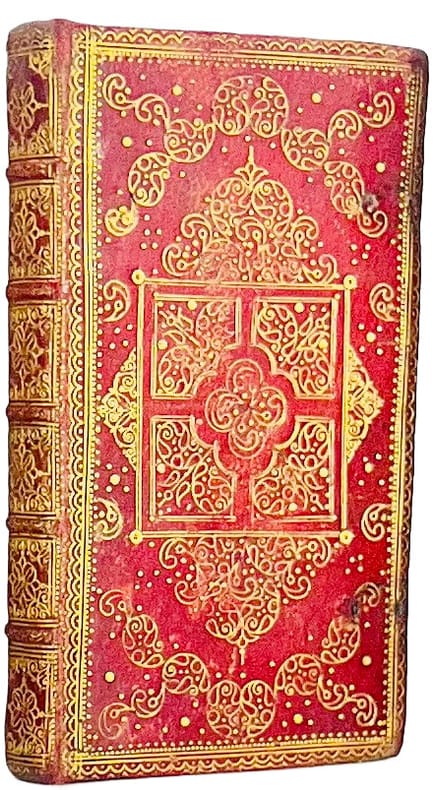
1656ref. 44519Charenton, Antoine Cellier, 1656-1659. 2 parties en 1 vol. in-12 à deux colonnes de (156) ff., frontispice, (104) ff., musique notée, maroquin rouge, décor doré à petits fers sur les plats dans un encadrement de filets et roulettes, traces de fermoirs, dos orné à nerfs, tranches dorées (reliure de l'époque).
1698ref. 44493Paris, Élie Josset, 1698. In-12 à trois colonnes de (6)-497-(11) pp., frontispice, tables, maroquin rouge, fine roulette dentelée dorée encadrant les plats, dos à nerfs ornés de caissons frappés des initiales M et H alternées, doublure de maroquin rouge encadrée d'une large roulette dentelée dorée, chiffre couronné au centre, gardes de papier dominoté, tranches dorées sur marbrure (reliure de l'époque).
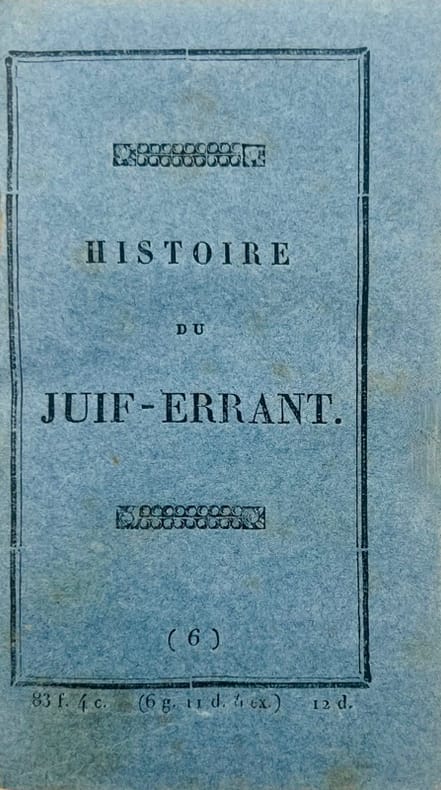
1827ref. 44385Montbéliard, Imprimerie de Th.-Fréd. Deckherr, sans date, (1827). In-12 (100 x 144 mm) de 24 pp. sur papier bleu, entièrement interfolié, percaline Bradel moutarde, pièce de titre en long de maroquin rouge, couverture bleue imprimée conservée (reliure postérieure du XIXe siècle).
1767ref. 39595Augsburg, Innsbruck, Joseph Wolff, 1767. 21 feuilles (43 x 36 cm) pliées en deux, imprimées recto verso.
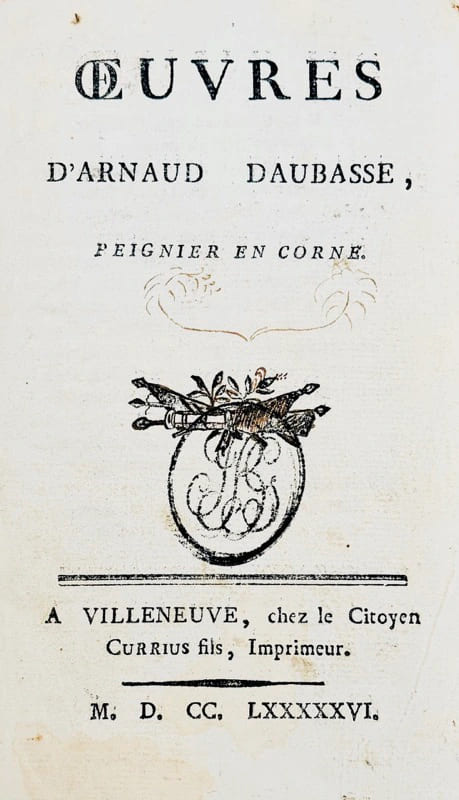
1796ref. 44815Villeneuve, chez le citoyen Currius fils, imprimeur M. CC. LXXXXXVI, (1796). In-8 de (4)-153-[1 bl.] basane marbrée, dos lisse orné, pièce de titre rouge, tranches rouges (reliure de l'époque).
1782ref. 16064A Paris, de l'Imprimerie de Monsieur, 1782. In-8 de 232 pp., veau marbré, dos lisse orné, pièce de titre en maroquin rouge, armes et triple filet doré d'encadrement sur les plats, tranches dorées (reliure de l'époque).
1547(32) SS. Mit 2 verschiedenen großen Holzschnittdruckermarken am Titel und am letzten Bl. recto. Mehrere figurale Holzschnittinitialen. - (Beigebunden) II: Ders. De proportione papae ad concilium, et de utroque eiusdem principatu, ad sanctiss. D. N. Iulium III Pon. Max. [Parma, Seth Viotti, nicht vor 1550]. (84) SS. Mit großer Holzschnittdruckermarke am Titel. - (Beigebunden) III: Muzio, Girolamo. De Romana ecclesia tractatus. Pesaro, [Erben nach Bartolomeo Cesano], 1563. (30) SS., l. w. Bl. Mit großer Holzschnittdruckermarke am Titel. Flexibler Pergamentband der Zeit. 4to. Jeweils erste Ausgabe dieser kirchenrechtlichen Traktate. Der aus Parma gebürtige italienische Philosoph, Mediziner und Theologe Cesare Delfini (gest. 1566 in Rom) betätigte sich auch als Astronom (vgl. Hoefer XIII, 462); der italienische Humanist und Polemiker Girolamo Muzio (1496-1576) "widmete sich seit 1551 ganz dem Studium der religiösen Fragen" (LThK). - Die Vorsätze etwas stärker gebräunt; am Titel zeitgenöss. hs. Besitzvermerk der Wiener Jesuiten; am vorderen Innendeckel späterer hs. Signaturvermerk der Wiener Unbeschuhten Augustiner (18. Jh.). I: BM-STC Italian 212. IA 151.044. Bongi I, 200. Edit 16, CNCE 16420. - II: IA 151.046. Edit 16, CNCE 16421. - III: BM-STC Italian 458. Adams M 2078. Edit 16, CNCE 47054. Vgl. LThK VII, 400.
2 Bde. in 1 Band. 575, (1) SS. 542, (2) SS. Mit wdh. Holzschnittdruckermarke an den Titeln. Reich blindgepr. Schweinslederband der Zeit auf 3 Bünden über Holzdeckeln mit abgeschrägten Deckelkanten. Am Vorderdeckel Plattenstempel mit Wappen des Römischen Reichs, am Hinterdeckel des Kurfürsten August von Sachsen, jeweils oben und unten begrenzt von Querriegeln mit Fleuronstempeln; die Rückenfelder dicht gefüllt mit Rankenwerksstempeln. Eine mittige Messingschließe. Vorsätze fehlen. Kl.-8vo. Schön blindgeprägter, ungewöhnlich gut erhaltener Schweinsleder-Wappenstempelband. Der Vorderdeckel zeigt zwischen Säulen "Des Heiligen Romisen Keisertums Wappen" (unten so in der Platte bezeichnet, mit Signatur "T. Kruger"); am Hinterdeckel das 12-teiige Wappen des "Augustus Churfurst" (an der Helmzierde bezeichnet "T.K."). Wohl noch früher Einband des Wittenberger Buchbinders Thomas Krüger (gest. 1591), Sohn des Buchbinders Nikolaus Krüger. "Seine ältesten datierten Stempel [...] tragen die Jahrzahl 1562" (Haebler I, 252). Krüger führte die in Wittenberg noch häufiger nachgemachte Mode ein, mehrere Platten auf jeweils einer Deckelseite anzubringen - ein Verfahren, das beim Kleinoktav-Format des vorliegenden Bandes außer Betracht blieb. - Gelenke unbedeutend berieben; altes Bibliotheksetikett und Signaturvermerke am Titel. Die originale ziselierte Schließe intakt. Insgesamt prächtig erhaltener Wittenberger Kurfürsteneinband mit sehr prägnanter Prägung, darin ein Klassiker des Humanismus in einem Lyonnaiser Druck. Zum Stempelmaterial: Haebler I, 250 V und 251, XV (= Herbst 9; Weale B 192 E). Vgl. Schweiger II, 129.
1581245 [recte: 246], (17) Bll. Titel sowie Titelholzschnitt in rot und schwarz gedruckt. Flexibler schwarzer Pappband der Zeit mit oxydierter Deckelinitiale "F". 8vo. Dritte Ausgabe (EA 1579); eine von zwei Titelvarianten im selben Jahr. - Das Pamphlet gegen die katholische Kirche; eine genaue, ohne Streichungen und Änderungen, aber mit zahlreichen Zusätzen durchgeführte Übertragung des niederländischen "Byencorf" von Philipp van Marnix. "In der Gesinnung angeregt durch Calvin, in der Weltanschauung durch Erasmus, im Stil durch Rabelais" (Neufforge). Das Titelblatt - mit der Variante "durchziert" im Titel (vgl. Goed.) - und der Titelholzschnitt in rot und schwarz gedruckt. Der Titelholzschnitt zeigt einen Bienenkorb in Form der Tiara mit Kirche und Windmühle. Dieser im Text wiederholt (Bl. 235v), ferner am letzten Textblatt ein weiterer Textholzschnitt, der die Kirche in Form einer Karikatur der "Veritas" verunglimpft. - Papierbedingt durchgehend schwach gebräunt; gelegentl. kl. Wurmgänge im Rand (teils Berührung der Marginalien). Einband etwas berieben; Vordergelenk angeplatzt. VD 16, M 1050. Ritter 855. Neufforge 112f. Goedeke II, 499, 37c. Graesse II, 587f. Weller (Druckorte) 6. Stammler III, 213. Hauffen II, 123. Seebaß/Edelmann NF 308.
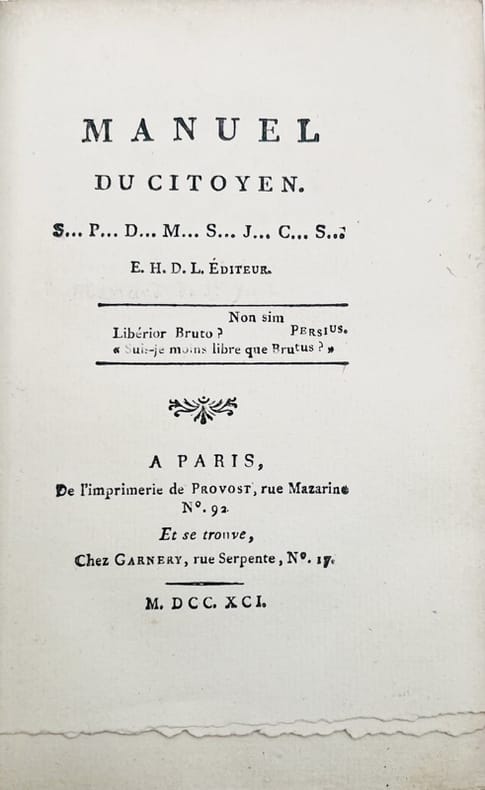
1791ref. 44407Paris, Imprimerie de Provost, Garnery, 1791. In-12 de (8)-260 pp., demi-maroquin noir à petits coins, dos à nerfs orné de filets dorés, entièrement non rogné (Bauzonnet).
1671ref. 5887Villefranche, Antoine Baudrand, 1671 ; petit in-4 ; plein veau havane marbré, dos à nerfs très décoré et doré, deux pièces de titre rouges, triple filet doré d'encadrement des plats, roulette décorative dorée d'intérieur, tranches rouges (reliure façon ancienne de Bruyère, relieur lyonnais de la mi-XIXe siècle) ; 187, (3) pp., frontispice gravé représentant cinq blasons, 3 planches gravées hors-texte représentant l'église de Villefranche, le tombeau d'Eléonore de Savoie et Edouard Prince de Beaujeu jouant aux échecs avec la fille de la Bessée, grand bois gravé aux armes de Villefranche sur le titre.
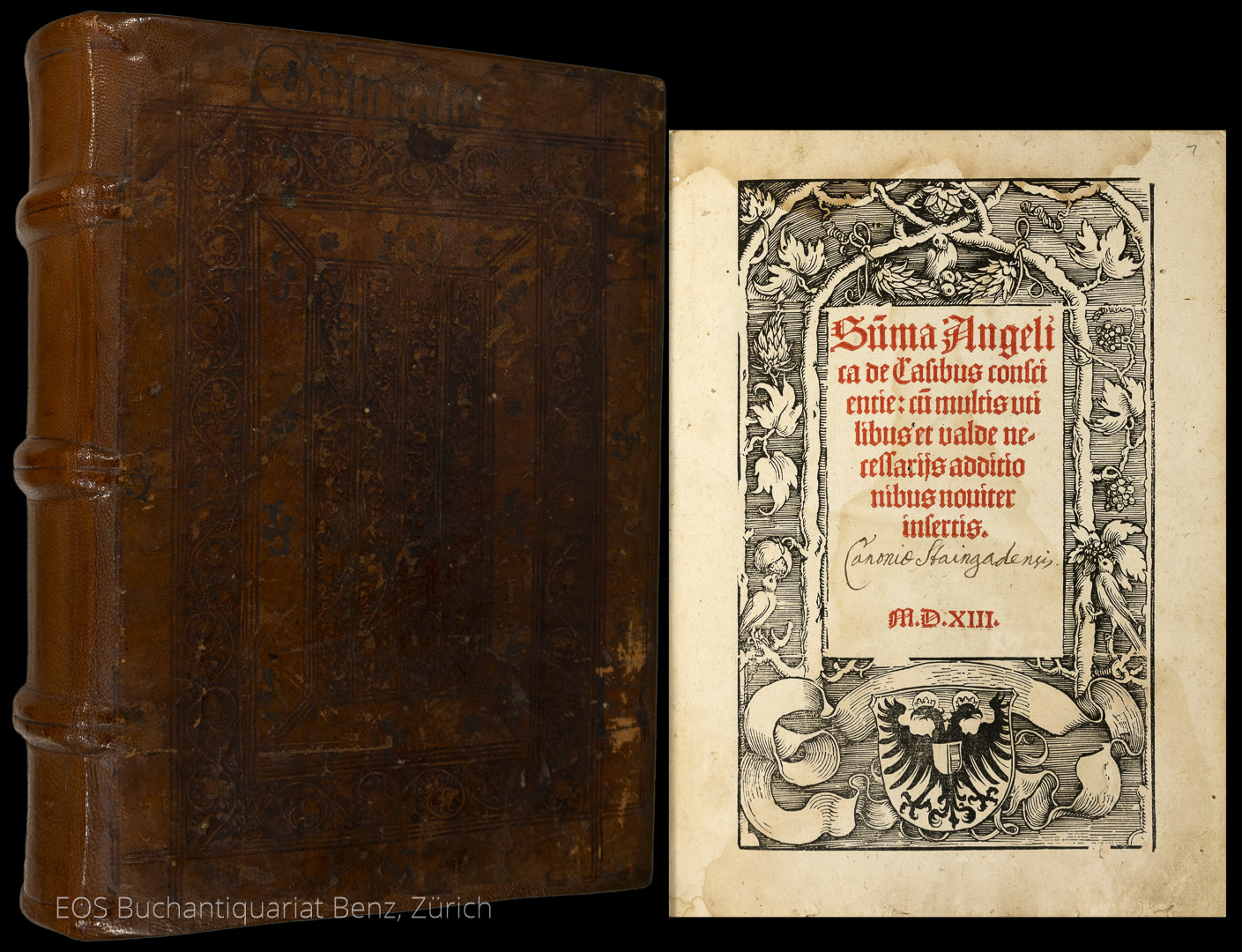
1513ref. 7674CB(Strassburg), Renato Beck für Johannes Rymann und Johannes Knobloch, 1513. 4°. (28 x 20 cm). Mit Holzschnitt-Titelbordüre, grosser Initiale von Hans Baldung Grien und Druckermarke am Schluss sowie drei weitere kleinere Initialen. Lederband der Zeit über Holzdeckeln, geprägt mit Platten- und Rollstempeln. Einbandkanten, Rücken und Vorsätze erneuert. + Wichtig: Für unsere Kunden in der EU erfolgt der Versand alle 14 Tage verzollt ab Deutschland / Postbank-Konto in Deutschland vorhanden +, 7674CB|7674CB_2|7674CB_3 [3 Warenabbildungen]
1588Small 8vo. 4 parts in one volume. VIII, 285, (3) ff. With medallion portrait (legend: "D. Petrus Aretinus Flagellum Principum") on title (repeated three times). 19th c. calf (slightly worn). Pirated edition of Aretino's "comedie" (the first appeared 1553 in Venice) printed by one of the most rebellious and outspoken of all the Elizabethan printers. Wolfe's production was in all probability chiefly destined for the European continent, as all of Aretino's works had been on the Roman Index since 1558; copies were offered for sale at the Frankfurt Book Fair of 1589. Aretino's comedies are considered the best of his works. They rank among the great works of Renaissance drama, and many of their leading characters were prototypes for later playwrights. ‘La Talanta’, for example, prepared the way for Shakespeare’s character Falstaff. "[U]n frontespizo particolare ad ogni comedia [...] ha al fine una Lettera dell'Aretino a Daniele Barbaro" (Gamba). - One gathering misbound, but a nice complete copy. Edit 16, CNCE 2486. Index Aureliensis 107.120. BM-STC Italian 517. Adams A 1562. Gamba 1204 note. Brunet I, 408. Pforzheimer 800. Woodfield, Surreptious Printing in England 43.
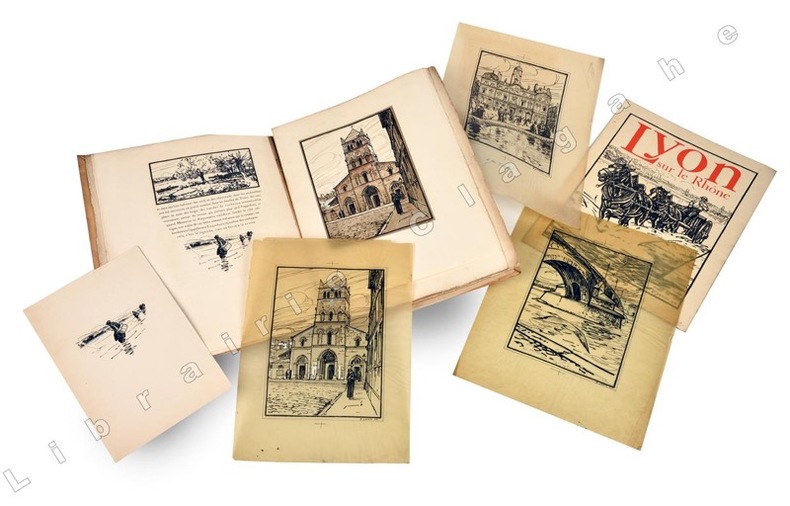
1924ref. 20812Lyon, Pierre Masson (imprimerie Marius Audin), 1924 ; in-4° (352 x 273 mm), broché ; [94] pp., 11 dessins hors texte en noir et blanc ou en deux ou trois tons, 84 en-têtes, 10 culs-de-lampe ; douze lettrines et couverture ocre avec une grande illustration et le titre en rouge.
(32) Bll. (d. l. w.), 284, 121, (15) Bll. Titel in rot und schwarz gedruckt. Mit Titelholzschnitt und -bordüre sowie mehreren Holzschnittinitialen. Blindgepr. Lederband der Zeit. 8vo. Etwas spätere Ausgabe. Der aus Verona gebürtige Jurist Cepolla (1420-75) war Professor für Zivilrecht in Ferrara und Padua. - Einband beschabt und bestoßen; Ecken und Kapitale mit kleinen Fehlstellen. Titelblatt mit altem hs. und gestemp. Besitzvermerk ("V. Engelshofen"). Teilweise etwas fleckig und gebräunt, wenige Wurmspuren. Einige Blätter mit kleinen Randläsuren. Nicht bei Adams oder BM-STC German.
4to. (4), 86, (1) ff. With small woodcut device on title, several woodcut initials and head-pieces and fine printer's device to verso of last leaf. Contemporary limp vellum. First edition. A treatise on political theory exposing liberal if not democratic principles for a republican city government, with much attention devoted to public administration, economic policy, the advancement of agricultural production, etc. Cavalcanti (1503-62), a Florentine scholar, historian and diplomat, is best known for his compendium of classical rhetoric (Retorica, 1559) in which he emphasized its practical rather than its literary meaning. After the assassination of Alessandro de' Medici in 1537 he left Florence and lived in Ferrara and Rome, serving as a diplomat for Pope Paul III, and died in Padua. This treatise was posthumously published by Sebastiano Erizo and reprinted several times, with at least three editions in the 19th century. - Handwritten ownership of Andrea da Verrazzano on flyleaf. Stitching slightly defective, wanting the final part (14 leaves). Small waterstain in upper and lower part of inner margin. A nice copy. Edit 16, CNCE 10438. Adams C 1178. BM-STC Italian 162.
1861ref. 21393Lyon, Imprimerie de Louis Perrin, 1861 ; in-4° oblong (270 x 360 mm), demie-percaline vert-foncé à coins, dos lisse à faux nerfs dorés, fleurons et titre dorés (reliure de l’époque) ; [3] ff. (Faux-titre, Titre illustré gravé par I. Séon, dédicace à Auguste Caristie), 15 planches gravées par Dubouchet (9), I. Séon (5) et Thomassin (1), comportant chacune une serpente légendée d’un feuillet ; [1] f. de Table.
4to. 88 ff. With woodcut printer's device on reverse of final leaf. 18th-c. Italian vellum with two giltstamped spine labels. First edition. - Giasone De Nores (c. 1530-90), a friend of Paolo Manuzio, is best known for his criticism of Guarini's "Pastor Fido" (which, as he believed, offended Aristotelian poetic principles). His 1574 "Brief Treatise for the Orator" has a "clear and practical aim: it is addressed to the young heirs of noble Venetian families, that is, to those who will later practise the art of eloquence in politics and judicial administration. In order to enhance the efficacy of the work, he published with it an 'essay ... on the distinctions, definitions, and divisions of rhetoric articulated in multiple tables for easy classification'." (Lina Bolzoni, The Gallery of Memory. Toronto 2001, p. 34f.). De Nores was exceedingly fond of such tables: indeed, he was among the first to identify the importance of structure and methodology as key to the art of memory. - Some browning and waterstaining throughout. Bookplate of the Hilding Hjelmberg Collection, Katrineholm, Sweden. Edit 16, CNCE 16811. BM-STC Italian 469. Not in Adams.
1607ref. 15242Sur les Hasles, Montbéliard, Jacques Foillet, 1607. In-8 de (32)-546-(30) pp., vélin à rabats, nom de l’auteur manuscrit sur le dos, traces de lacet (reliure de l'époque).
1680ref. 39565Laon et Paris, Rennesson, Couterot, 1680. 2 parties en 1 vol. in-4 de (18)-105-(2)-202 pp., veau brun, dos orné à nerfs, tranches jaspées (reliure de l’époque).
Small 8vo. (16), 644, (4) pp. With woodcut printer's device to verso of final leaf. Modern full mottled calf with giltstamped title label to gilt spine. All edges red. A fine pocket-sized humanist edition from Basel: the Greek text, with Latin translation, printed in two columns, of this collection of works by Hippocrates of Kos, the founder of medicine as a science. Includes Galen's "Ars medicinalis" (the translation is by Nicolò Leoniceno, whose version of the Aphorisms is also the one here printed). - Occasional attractive humanist ink annotations in Greek and Latin in the margins, more extensive on front pastedown (recovered from the contemporary binding), both flyleaves, and final page. 17th century ownership of the lawyer Vincent Monsigot to front flyleaf and last page; additional early ownership of Claude Fournel at the top of the title-page. 20th century drystamped library stamp of Nitza and Robert Rousseau to flyleaf. Adams H 578. Bruni Celli 4102. Hoffmann II, 273. Not in Schweiger, Wellcome or Durling. NLM 233.
1733ref. 39849Parisiis, Typographia regia, 1733. In-24 de 224 pp., maroquin rouge, dos orné de fleurs de lys, tranches dorées sur marbrure (reliure de l'époque).
4to. (40) pp. With large heraldic woodcut (Elector Frederick of Saxony) on t. p. and woodcut printer's device on last f. recto. Modern boards. First separate edition; Froben was to publish his own Latin edition in the following year. The Greek text was already contained in the Venetian 1493 incunable and in the 1513 Aldus edition; it was not to be printed again until Froben's 1522 Libanius edition; the first separate edition of the original text was to be printed by Wechel in Paris in 1529. - Isocrates (436-338), the most highly esteemed and successful teacher of rhetorics of his time, continued to exert a great influence on artistic prose for centuries. - Rare; no copy in BSB. VD 16, I 563. Hoffmann 486. BM-STC German 433. Not in Adams or Schweiger.
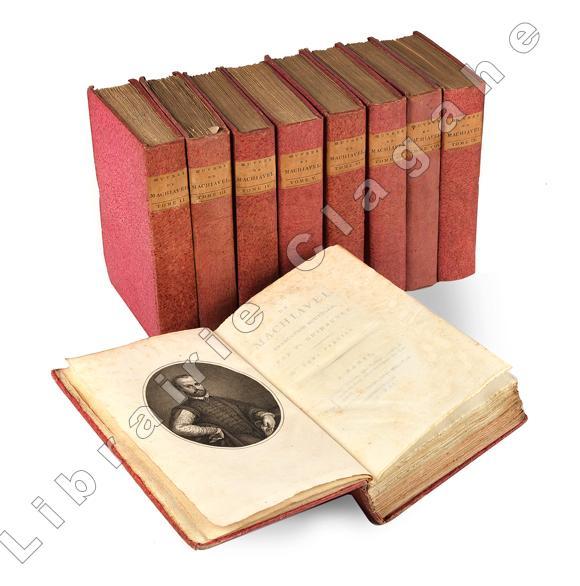
1799ref. 20337Paris, Potey, Pochard, (imprimerie de Laran), an VII (1799) ; 9 tomes in-8 (210 mm), cartonnage rigide de papier rose à l’éponge, pièce de titre imprimée au dos, non rogné (reliure strictement d’époque) ; CXVII, [1 bl.], [2], 408 ; 384 ; 403 ; 416 ; 448 ; 455 ; 394 pp., [1] ff. bl. ; 370 pp, [1] ff. bl. ; 524 pp., portrait ovale en frontispice ; 7 planches dans “l’Art de la Guerre”, dont deux dépliantes et 2 doubles.
1561(24), 1048, (60) SS. Mit 2 Holzschnitt-Druckermarken am Titel und letztem Bl. verso sowie einigen Holzschnittinitialen. Blindgepr. englischer Lederband um 1750. Dreiseitiger gesprenkelter Rotschnitt. Folio. Spätere Ausgabe der von Ficinus kommentierten lateinischen Übersetzung. "Neue Uebersetzung aus einem Manuscript, dessen Lesarten Cornarius in den Eclogis angegeben hat. Die Uebersetzung ist aber sehr frei" (Schweiger). - Etwas gebräunt und teils auch braunfleckig; zu Beginn mit Wurmlöchern. Am Titel hs. Besitzvermerke "Borris Library" und "Alexd. McNaghten" (um 1800). Vereinzelte Textanstreichungen. Vordergelenk leicht angeplatzt, der schöne Einband jedoch intakt. VD 16, P 3280. BM-STC German 702. Adams P 1448. Schweiger I, 248. Hoffmann III, 302.