8,232 results
4to. (12) ff. With the woodcut Papal arms on the title-page. Modern half vellum over marbled boards. Papal bull deposing Cardinals Bernardino Carvajal, Guillaume Briçonnet, and Francesco Borgia for having convoked the schismatic second Council of Pisa. After the death of Julius II and the election of Leo X in 1513, the surviving rebel cardinals apologized and were once more received into the church. - According to the HAB Wolfenbüttel, the author was Adriano Castellesi (1458-1518). The printer is identified by F. Barberi, Tipografi romani del Cinquecento (S. 49). - Some waterstaining throughout; an old handwritten shelfmark to the title-page (trimmed). Edit 16, CNCE 51375.
Frankfurt am Main: No Date (1845) . Cloth, 8vo, 72 pages. 20 cm. In Hebrew. Orthdox booklet attacking Holdheim and the radical Reform. SUBJECT(S) : Reform Judaism -- Controversial literature. OCLC lists 8 institutions with copies (Harvard, Stanford, UCLA, GWU, Florida, Penn, Washington U, NYPL) . Library blind stamp on title page, some wear & staining, Good Condition. (GH-4-6)
1926Hardcover, 21-39 pages, Folio, 33 x 25 cm. In German. Contents: Zur einfuhrung. --In memoriam Rafael Frank. --Uber hebraische typen und schriftarten, von Rafael Frank. --Die renaissance des hebraischen, von dr. Jacques Adler. SUBJECT (S) : Hebrew type. Hebrew language. "Sechzehnter Bertholddruck. " "Hergestellt in einer beschrankten auflage fur einem kreis von freunden. "--Leaf at end. Reprinted from Archiv fur buchgewerbe, 48. Jg. , hft. 11. Ex-library. Water stain to front and back cover. Slight browning on edges of pages. Hinge repair. Otherwise, good condition. (BIB-11-7)xx
1943Large 8vo; 154 + 10 pages; 1 essay (10 pages) by Moses Marx in English: The Last Hebrew Books Printed in the Fifteenth Century: The Second Edition of the Mashal Ha-Kadmoni and the Quarto Tur Orah Hayyim (on Gershom Soncino and includes 6 photo plates of the book) ; remainder of essays are in Hebrew. Bottom of spine bumped, Good Condition (FEST-6-6b) xx
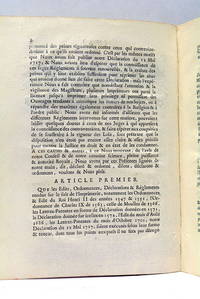
ref. 48210à la fin: Grenoble Veuvre André Giroud 1769. 7 pages. 23x18 Cm. Dérelié. Cette publication concernant lexercice du métier dimprimeur reprend un texte publié en 1728. Il contient 12 dispositions fixant l'impression et la vente de livres. Quelques traces de plis. Sinon; document très bien conservé. (à la fin:) Grenoble, Veuvre André Giroud, 1769. unknown
1989ref. 125041989 Belleville, Clos du moulin, (1989); in-4 non paginé (environ 150pp). Illustré en couleurs des productions de l'imprimerie pour les différentes marques et commerces (étiquettes, affiches, lettres, menus, courrier de soutien et félicitations reçus). Reliure de toile écrue, titre doré au 1er plat et dos, jaquette crème, avec titre doré au 1er plat et dos.
ref. ORD-5259Carte postale non datée. 4 clichés au recto, texte imprimé de la Librairie Plon au verso. Vue extérieure des bâtiments et 3 vues animées des ateliers. Trace de pli vertical sinon bon état.
1931ref. 109251931 (Paris, 1931); in - 8° broché , couverture rempliée crème, dos muet, titre illustré en bleu et argent au 1er plat; 24pp. et 5 planches hors texte d'illustrations en couleurs contrecollées sur des feuillets de papier beige. Chaque page de texte est encadrée d'un filet bleu et orné en pied d'un décor géométrique bleu. Travail des élèves de l'Ecole Estienne.
4to. (8), 231, (1) pp. With a large figurated woodcut "C" initial by Hans Holbein. 18th century half vellum with ms. spine title. First edition of Hus's principal work, commonly known in English as "Treatise on the Church", ascribed to Adam Petri's Basel printshop on the basis of typographical features. Written in 1413 at the castle of one of Hus's protectors in Kozí Hrádek, near Sezimovo Ústí, the book evidences the author's strong intellectual and spiritual ties with the English reformer John Wyclif, whose like-titled "De ecclesiae" has been written in 1378 (Hus however, unlike Wyclif, did not reject the notion of transsubstantiation). "This treatise became Huss's 'apologia pro sua vita', the defense of the views which he had drawn from Wyclif and advocated. [... It] has a place of first importance among works on the church [...] It is the best known work on the subject issued from Augustine to the Reformation period [and] has had a permanent influence upon the development of the idea of the church" (Schaff, Introduction to the 1915 edition, p. xi-xxxi). - A little more than a century after Hus was burned at the stake in Constance, Luther was sent a manuscript copy of the work and, upon reading it, enthusiastically embraced Hus's central tenets, famously writing to Georg Spalatin in February 1520 that "without knowing it, we are all Hussites". But half a year later, two printed versions appeared almost simultaneously in 1520 - one under the original title used here, the other entitled "De causa Boemica" (printed by Anshelm in Hagenau; the precise order of publication remains unclear). These first printings "enabled others to evaluate (or even emulate) Luther's conclusion [... The text was presented] in a disinterested manner, thus allowing an unbiased judgment of its contents"; it was published without polemical introduction or prologue, and the title page, "which did not mention Hus by name, contained the simple epigraph: 'I beg you, my kind reader, to attend not to who speaks, but to what is said'" (Haberkern). - Occasional slight brownstaining; a few insignificant wormholes to blank lower margin near end; old library shelfmark in ink to front pastedown. Quires M and Q bound out of order (3-4-1-2), but a complete, well-preserved and wide-margined copy. Quite scarce: only three copies in auction records internationally since 1975. VD 16, H 6173. BM-STC German 438. Adams H 1210. BNHCat H 630. Haberkern, Patron Saint and Prophet: Jan Hus in the Bohemian and German Reformations [Oxford 2016], p. 158.
ref. B115108-4Cambridge 1968. 64pp. Prof. illus. Sm. 4to. Boards 1/4 cloth. Edition limited to 500 numbered copies. Cambridge, 1968. hardcover books
1789ref. 372509Nuremberg: Grattenauer 1789. First edition. 16 178 5 iindex pp. 1 vols. 4to. Near contemporary glazed brown calf spine gilt paste paper endleaves edges red. Some rubbing very good overall an attractive copy. First edition. 16 178 5 iindex pp. 1 vols. 4to. Important chroncile of the early printers of Nuremberg. Bigmore & Wyman II 114 Grattenauer unknown books
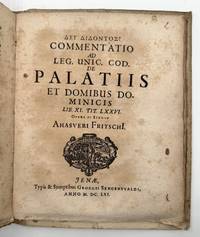
1661ref. 372198Cologne: Kinchium 1661. Mallinckrot: Engraved additional title dated 1639. 20 125 11pp. Kortholt: 8 56pp. Fritsch: 6 74 2pp. 4to. Early drab paper boards alla rustica binding on three cords manuscript title on spine text uncut. Foxing and heavily toned. Provenance: Princes of Liechtenstein armorial bookplate. Mallinckrot: Engraved additional title dated 1639. 20 125 11pp. Kortholt: 8 56pp. Fritsch: 6 74 2pp. 4to. Mallinckrot's monograph published on the occasion of the celebration of the second centenary of Gutenberg's invention is the first thorough investigation of the early testimonies to the discovery of printing with the author in favor of Mainz against Haarlem. The work contains the first use of the word "incunabula" in connection with printing. The additional title engraved by Loeffler includes portraits of Gutenberg Faust and Shakespeare and a scene in a printing shop. The second work here bound following Mallinckrot is Protestant theologian Kortholt's study on the origins of mathematics and astronomy asserting the Greeks were taught by Chaldeans and Egyptians. Bigmore & Wyman 2:16 Kinchium unknown books
1799ref. 214620Brussels: Emmanuel Plon 1799. First edition. 2 engraved plates 5 text engravings. 1 vols. 8vo. Half morocco and marbled boards. Slight foxing. First edition. 2 engraved plates 5 text engravings. 1 vols. 8vo. Bigmore & Wyman I 418 "One of the monument of typographical bibliography" Emmanuel Plon unknown books
1740ref. 36937La Haye: La Veuve Le Vier et Pierre Paupie 1740. First edition. Engraved allegorical frontispiece by Schley. 2 parts in one volumes. 1 vols. 4to. Contemporary French mottled calf gilt spine marbled endpapers. Upper joint starting at bottom and apart from some minor toning this is a lovely unsophisticated copy in contemporary dress. First edition. Engraved allegorical frontispiece by Schley. 2 parts in one volumes. 1 vols. 4to. Printed by Prosper Marchand a Huguenot publisher and journalist who fled France in 1709 the work appeared at the 300th anniversary of the invention of printing. Marchand writes that he produced the book "a la sollicitation de quelques amis qui ont cru que le troisième jubile ou la troisième année séculaire de l'imprimerie reveilleroit infailliblement la curiosité du publique touchant l'origine de ce bel art at the request of some friends who believed that the third jubilee or the tercentenary of printing would infallibly wake the public curiosity concerning the origin of this beautiful art." The allegorical frontspiece by J.V. Schley show Minerva and Mercury descending from Heaven granting the gift of printing to Germany who in turn gives it to England Holland France and Italy. Bigmore & Wyman II p. 22 La Veuve Le Vier et Pierre Paupie unknown books
1769ref. 36938Leipzig; Wien: Johan Paul Krauss 1769. First Edition. With 24 folding plates. xxv 436 12 index & errata; xl 524 18 index & errata. 1 vols. 8vo. Contemporary three quarter red morocco and marbled boards spine label. Exterior worn tear at foot of spine internally tight and clean. A very good copy. First Edition. With 24 folding plates. xxv 436 12 index & errata; xl 524 18 index & errata. 1 vols. 8vo. Includes notices of Berlin artists graphic arts engravers early woodcuts & woodcut books history of printing and account of a journey through Lower Saxony Westphalia & and Holland. Part Two with striking images from early printed books such as the "Eagle of John" from Ars Memorandi includes "a dissertation on the earliest forms of wood-cutting as applied to the illustration . Heinecken conjectures that Gutenberg took the idea of printing from the playing-card makers who are said to have been the first engravers of historical subjects intermingled with texts. . Heinecken is of opinion that their first productions were taken from wooden blocks." Bigmore & Wyman. Bigmore & Wyman p.320 Johan Paul Krauss unknown books
1789ref. 372509Nuremberg: Grattenauer 1789. First edition. 16 178 5 iindex pp. 1 vols. 4to. Near contemporary glazed brown calf spine gilt paste paper endleaves edges red. Some rubbing very good overall an attractive copy. First edition. 16 178 5 iindex pp. 1 vols. 4to. Important chroncile of the early printers of Nuremberg. Bigmore & Wyman II 114 Grattenauer unknown
1661ref. 372198Cologne: Kinchium 1661. Mallinckrot: Engraved additional title dated 1639. 20 125 11pp. Kortholt: 8 56pp. Fritsch: 6 74 2pp. 4to. Early drab paper boards alla rustica binding on three cords manuscript title on spine text uncut. Foxing and heavily toned. Provenance: Princes of Liechtenstein armorial bookplate. Mallinckrot: Engraved additional title dated 1639. 20 125 11pp. Kortholt: 8 56pp. Fritsch: 6 74 2pp. 4to. Mallinckrot's monograph published on the occasion of the celebration of the second centenary of Gutenberg's invention is the first thorough investigation of the early testimonies to the discovery of printing with the author in favor of Mainz against Haarlem. The work contains the first use of the word "incunabula" in connection with printing. The additional title engraved by Loeffler includes portraits of Gutenberg Faust and Shakespeare and a scene in a printing shop. The second work here bound following Mallinckrot is Protestant theologian Kortholt's study on the origins of mathematics and astronomy asserting the Greeks were taught by Chaldeans and Egyptians. Bigmore & Wyman 2:16 Kinchium unknown
1740ref. 36937La Haye: La Veuve Le Vier et Pierre Paupie 1740. First edition. Engraved allegorical frontispiece by Schley. 2 parts in one volumes. 1 vols. 4to. Contemporary French mottled calf gilt spine marbled endpapers. Upper joint starting at bottom and apart from some minor toning this is a lovely unsophisticated copy in contemporary dress. First edition. Engraved allegorical frontispiece by Schley. 2 parts in one volumes. 1 vols. 4to. Printed by Prosper Marchand a Huguenot publisher and journalist who fled France in 1709 the work appeared at the 300th anniversary of the invention of printing. Marchand writes that he produced the book "a la sollicitation de quelques amis qui ont cru que le troisième jubile ou la troisième année séculaire de l'imprimerie reveilleroit infailliblement la curiosité du publique touchant l'origine de ce bel art at the request of some friends who believed that the third jubilee or the tercentenary of printing would infallibly wake the public curiosity concerning the origin of this beautiful art." The allegorical frontspiece by J.V. Schley show Minerva and Mercury descending from Heaven granting the gift of printing to Germany who in turn gives it to England Holland France and Italy. Bigmore & Wyman II p. 22 La Veuve Le Vier et Pierre Paupie unknown
1769ref. 36938Leipzig; Wien: Johan Paul Krauss 1769. First Edition. With 24 folding plates. xxv 436 12 index & errata; xl 524 18 index & errata. 1 vols. 8vo. Contemporary three quarter red morocco and marbled boards spine label. Exterior worn tear at foot of spine internally tight and clean. A very good copy. First Edition. With 24 folding plates. xxv 436 12 index & errata; xl 524 18 index & errata. 1 vols. 8vo. Includes notices of Berlin artists graphic arts engravers early woodcuts & woodcut books history of printing and account of a journey through Lower Saxony Westphalia & and Holland. Part Two with striking images from early printed books such as the "Eagle of John" from Ars Memorandi includes "a dissertation on the earliest forms of wood-cutting as applied to the illustration . Heinecken conjectures that Gutenberg took the idea of printing from the playing-card makers who are said to have been the first engravers of historical subjects intermingled with texts. . Heinecken is of opinion that their first productions were taken from wooden blocks." Bigmore & Wyman. Bigmore & Wyman p.320 Johan Paul Krauss unknown
1799ref. 214620Brussels: Emmanuel Plon 1799. First edition. 2 engraved plates 5 text engravings. 1 vols. 8vo. Half morocco and marbled boards. Slight foxing. First edition. 2 engraved plates 5 text engravings. 1 vols. 8vo. Bigmore & Wyman I 418 "One of the monument of typographical bibliography" Emmanuel Plon unknown
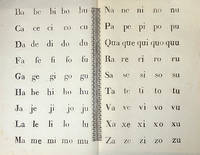
1850ref. 102955No place no date but Nancy Hinzelin c. 1850. One large folio sheet size 44 x 55 cm showing 90 large syllables with a vertical typographical border in the middle of the sheet. Scarce and curious sheet that was printed to help children to learn the alphabet and read. Was it used to hang on the wall in schools
Folio (208 x 307 mm). (16), 244, 299, (1) pp. 18th century full calf with double gilt rules to covers, giltstamped label and date to richly gilt floral spine. Leading edges gilt. Marbled endpapers. All edges gilt. Very rare first edition. "One of the earliest collections of alchemical writers, containing 53 texts [...] A very important item" (Duveen). Among the authors of these treatises highly sought after by 16th century disciples of the hermetic sciences are Geber (Jabir ibn Hayyan), Avicenna, Roger Bacon, Arnaldus de Villanova, Albertus Magnus, Ramon Llull, Johannes de Rupescissa, Richardus Anglicus, Robertus Tauladanus, Giovanni Battista da Monte, Aristotle, Giovanni Braccesco, and Giovanni Aurelio Augurelli, as well as the editor himself. Grataroli (1510-68), a native of Bergamo, studied philosophy and medicine at Padua and lectured on Avicenna from 1537 to 1539. After his conversion to Calvinism he had to flee the Inquisition. He arrived in Basel in 1552, where he practiced and taught medicine and wrote and edited works on medicine and alchemy, of which this is his most famous effort. He also briefly held the chair of medicine at Marburg. - A substantial part of the first section is devoted to the works of the great Arab alchemist Abu Musa Jabir ibn Hayyan, known as Geber in the Latin tradition. Jabir, who was active at the court of Caliph Harun al-Rashid, was inspired to study alchemy by his master Ja'far al-Sadiq, one of the greatest authorities on the esoteric sciences. One of Jabir's most famous works is the "Kitab al-Zuhra" ("Book of Venus", or the Noble Art of Alchemy) written for Harun al-Rashid. His works are commented on by Braccesco, like Grataroli a Lombard, in his "Dialogus ... cui titulus est Lignum vitae", and by the French alchemist Tauladanus in his "In eundem Braceschum Gebri interpretem, animadversio", presented here in their only edition. - The second part contains four texts attributed to Arnaud de Villeneuve, whose "Practica ad quendam Papam" is published here for the first time. This is followed by several apocryphal treatises attributed to Albert the Great, to Raymond Llull, to Avicenna and to Aristotle. Of these, the most notable are the first edition of one of the most important texts of early alchemy, the "De perfecto magisterio" of Pseudo-Aristotle, and the first edition of Johannes de Rupescissa's "Liber lucis", as well as several medieval texts attributed to the monk Ferrarius or Efferarius, most importantly his "Thesaurus philosophiae". - Near-contemporary faded ownership inscription "... ex dono D. D. Flanet R.P." on the title-page, with some 18th century bibliographical notes in more distinct ink. A few minute wormholes in the blank lower margin (some professionally repaired), otherwise an uncommonly fine copy, sumptuously bound in the 18th century, probably in France. VD 16, G 2915. BNHCat G 379. BM-STC German 366. Adams A 575 (s. v. Alchemy). Wellcome I, 2920. Duveen 268. Ferguson I, 341. Neu 1747. Dorbon 1976. Rosenthal 403. Thorndike V, 545ff. & 600ff. Bolton I, 989. Caillet 4746 (Biogr.). Brüning 333. Manly P. Hall coll. 79 (first part only). Soltesz G 379. USTC 602851. Not in Machiels.
1852ref. ST20768London: Simpkin & Marshall 1852. FIRST EDITION. 153 x 102 mm. 6 x 4". 64 pp. Publisher's deluxe red pebble-grain morocco gilt covers with graceful Romantic-style frame central panel of upper cover with gilt lettering that of lower cover with gilt ornament spine blind-stamped to resemble raised bands panels with gilt ornament gilt turn-ins pale yellow endpapers all edges gilt. With title page vignette frontispiece portrait of Wellington and three full-page engravings of battles. Printed entirely in gilt on "enamel" gloss paper. Front free endpaper with faint pencilled signature. Binding very slightly soiled joints and extremities a little rubbed trivial soiling to front endpapers otherwise quite a fine copy the text entirely clean fresh and bright with sparkling gold. This now-scarce luxuriously produced little volume celebrates the life and military achievements of Arthur Wellesley Field Marshall and 1st Duke of Wellington perhaps the most widely admired Briton of the 19th century--and does so in glittering fashion. The key facts of Wellington's life and the decisive battles of his storied career are related here in sparkling gold text and images on alabaster white pages. Poet laureate Tennyson's funerary ode described Wellington 1769-1852 as "the last great Englishman" and his death evoked great mourning in response to his life of public service. DNB notes that his defeat of Napoleon at Waterloo crushing the emperor's ambition for European dominance put him in a class of his own: "No man certainly no Briton had ever been in such a situation before in Europe the object of universal hero-worship and gratitude." Wellington was particularly notable among senior military officers for his determination to lead his troops on the frontline in battle. The three battles depicted in the illustrations here attest to this: in "The Battle of Assaye" we see him on horseback two horses were shot from under him during the conflict wielding his sword as he bears down on enemy cannon. At the "Battle of Vittoria" he is shown leading the infantry to face the enemy with bayonet fixed. And in the decisive "Battle of Waterloo" scene he is once again with the cavalry wheeling to attack the advancing French. The frontispiece shows Wellington astride his famed horse Copenhagen who was his mount at Waterloo. Our volume concludes with a chronology of principal events in the duke's life. It is notable that such a handsome memorial work was produced so quickly after Wellington's sudden death on 14 September 1852: a contemporary ad in Bent's Literary Advertiser notes our title was published on 15 November three days before Wellington's state funeral on the 18th. Copies of this work are rare: we could trace no auction sales and OCLC records only seven copies just one in North America. Simpkin & Marshall unknown books
1852ref. ST20768London: Simpkin & Marshall 1852. FIRST EDITION. 153 x 102 mm. 6 x 4". 64 pp. Publisher's deluxe red pebble-grain morocco gilt covers with graceful Romantic-style frame central panel of upper cover with gilt lettering that of lower cover with gilt ornament spine blind-stamped to resemble raised bands panels with gilt ornament gilt turn-ins pale yellow endpapers all edges gilt. With title page vignette frontispiece portrait of Wellington and three full-page engravings of battles. Printed entirely in gilt on "enamel" gloss paper. Front free endpaper with faint pencilled signature. Binding very slightly soiled joints and extremities a little rubbed trivial soiling to front endpapers otherwise quite a fine copy the text entirely clean fresh and bright with sparkling gold. This now-scarce luxuriously produced little volume celebrates the life and military achievements of Arthur Wellesley Field Marshall and 1st Duke of Wellington perhaps the most widely admired Briton of the 19th century--and does so in glittering fashion. The key facts of Wellington's life and the decisive battles of his storied career are related here in sparkling gold text and images on alabaster white pages. Poet laureate Tennyson's funerary ode described Wellington 1769-1852 as "the last great Englishman" and his death evoked great mourning in response to his life of public service. DNB notes that his defeat of Napoleon at Waterloo crushing the emperor's ambition for European dominance put him in a class of his own: "No man certainly no Briton had ever been in such a situation before in Europe the object of universal hero-worship and gratitude." Wellington was particularly notable among senior military officers for his determination to lead his troops on the frontline in battle. The three battles depicted in the illustrations here attest to this: in "The Battle of Assaye" we see him on horseback two horses were shot from under him during the conflict wielding his sword as he bears down on enemy cannon. At the "Battle of Vittoria" he is shown leading the infantry to face the enemy with bayonet fixed. And in the decisive "Battle of Waterloo" scene he is once again with the cavalry wheeling to attack the advancing French. The frontispiece shows Wellington astride his famed horse Copenhagen who was his mount at Waterloo. Our volume concludes with a chronology of principal events in the duke's life. It is notable that such a handsome memorial work was produced so quickly after Wellington's sudden death on 14 September 1852: a contemporary ad in Bent's Literary Advertiser notes our title was published on 15 November three days before Wellington's state funeral on the 18th. Copies of this work are rare: we could trace no auction sales and OCLC records only seven copies just one in North America. Simpkin & Marshall unknown
1796ref. ST12327Paris: P. Didot l'aîné 1796. ONE OF 100 COPIES. 330 x 235 mm. 13 x 9 1/4". 2 p.l. 165 1 pp. Original gray boards flat spine dark gray paper title label two-thirds of the leaves UNOPENED. Engraved printer's device on title page and SEVEN FINE COLOR-PRINTED ENGRAVINGS AFTER PEYRON BY CHAPUY AND LAVALLÉE SOME FINISHED BY HAND. Cohen-de Ricci 730; Brunet III 1860. ◆A couple of very small brown spots and just a hint of soiling as well as minor abrasions to covers corners somewhat mashed as expected isolated trivial foxing to text but A VERY FINE COPY clean and bright internally with vividly colored plates and in a surprisingly sturdy and generally well-preserved original temporary publisher's binding. This is the fine Levy copy of a strictly limited Large Paper edition of a handsomely illustrated work offered here in what seem to be the publisher's temporary boards mostly unopened and virtually untouched internally. Attractively printed with enormous margins the text of the first and by far the most important work here is a prose poem on love supposedly translated from the Greek by one of the great political philosophers of the Enlightenment Charles de Secondat Baron de Montesquieu 1689-1755. In its own day the work was popular largely because of its racy content; today it is considered as a more serious accomplishment by modern scholars who are inclined to see it as a philosophical fable. The colophon informs us that this limited edition was printed with a new type cut and cast by Firmin Didot "with such perfection that up to this moment none other can equal it." The dramatic and animated plates are strikingly different from the Eisen engravings in other editions of this work and are more modern in sensibility than the usual 18th century French engravings. The colophon notes that the plates were broken after the 100 copies of this edition were printed. Our copy was in the outstanding library of American bibliophile Jacques Levy 1905-80 a man of wide-ranging interests who assembled an eclectic collection over 40 years always with a discriminating eye toward visually pleasing and historically important bindings and illustration. In his sale Sotheby's described our binding as being publisher's boards and although the volume seems almost too well preserved to be original we are persuaded by the collector's reputation that this is the correct characterization. P. Didot l'aîné unknown books