N C Bureau of Labor and PrintingBiblio.com

8,165 results
ref. 0243002564.Gpaperback. Good. Access codes and supplements are not guaranteed with used items. May be an ex-library book. paperback
ref. 0656714832.Ghardcover. Good. Access codes and supplements are not guaranteed with used items. May be an ex-library book. hardcover
ref. 1334822093.Gpaperback. Good. Access codes and supplements are not guaranteed with used items. May be an ex-library book. paperback
ref. 133466028X.Gpaperback. Good. Access codes and supplements are not guaranteed with used items. May be an ex-library book. paperback
ref. 0259029858.Gpaperback. Good. Access codes and supplements are not guaranteed with used items. May be an ex-library book. paperback
ref. 0666332126.Ghardcover. Good. Access codes and supplements are not guaranteed with used items. May be an ex-library book. hardcover
(6) Bll. (d. l. w.). Antiqua (Type 10:80R), 37-38 Zln. Mit einer schwarzgrundigen Initiale in Holzschnitt. Spätere Broschur. Dreiseitiger Rotschnitt. 4to. Erste Ausgabe dieser fingierten Huldigung König Maximilians durch sechs antike Städte. Vermutlich in Pordenone verfaßt, wo Caviceo mehrere Jahre lebte und 1489 vom dort anwesenden Kaiser Friedrich III. zum iuris utriusque doctor promoviert wurde. Das Werk beginnt mit einer Erwähnung der Vertreibung der Ungarn aus Österreich bis Stuhlweißenburg/Székesfehérvár: "Die 6 Städte sind Babylon, Troya, Byzanz, Athen, Carthago und Jerusalem. Sie alle huldigen Maximilian und flehen um seinen Schutz [...] Eingestreut zahlreiche Hinweise auf zeitge[nö]ssische Begebenheiten" (Apponyi). Der Theologe J. Caviceus (1443-1511) studierte zu Bologna und trat in die Dienste des Piermaria Rossi, Herrn von Berceto, und seines Sohnes Guido, des Capitano der Republik Venedig. Seit 1492 wirkte er nacheinander als Generalvikar der Diözesen Rimini, Ferrara, Florenz und Siena. - Druckerzuschreibung nach GW (von BMC und Indice generale VI bestritten). Das erste Blatt recto alt mit Einfassungslinie umrahmt; bei der Neubindung im Bug verstärkt; am vorderen Vorsatz eine englische Notiz zum Verfasser aufgezogen (um 1880). - Sehr selten, auf deutschen Auktionen der letzten Jahrzehnte nur die zweite Ausgabe nachweisbar (Hartung & Hartung, 98 [2000], Nr. 103, EUR 4346). HC 4805. Goff C-355. GW 6433. BSB-Ink C-204. Pellechet 3455. Proctor 7374. BMC VII, 1146. IGI 2655. Sajó-Soltész 955. Apponyi 1551.
8vo. (8), 216 ff. Stipple-engraved printer's device on title page and several prettily historiated initials. Contemporary blindstamped pigskin on 3 raised bands. Wants ties. Well-printed Paris edition of the "Liber Sextus Bonifacii", the collection of medieval canon law that formed the third part of the Corpus Iuris Canonici. One of the last productions from the press of the Parisian stationer, printer, and bookbinder Claude Chevallon (1479-1537). - Early ink ownership "Joan. Christoph Schwarz" to title page and notes to final flyleaf. Wants first flyleaf; upper pastedown shows traces of a removed bookplate. Some browning; corners wrinkled; a few thumb indexes torn out. The blind-stamped roll tools on the binding are signed "H.S.", possibly with the date "[15]14" (not recorded in Haebler). This edition not in Adams or BM-STC French.
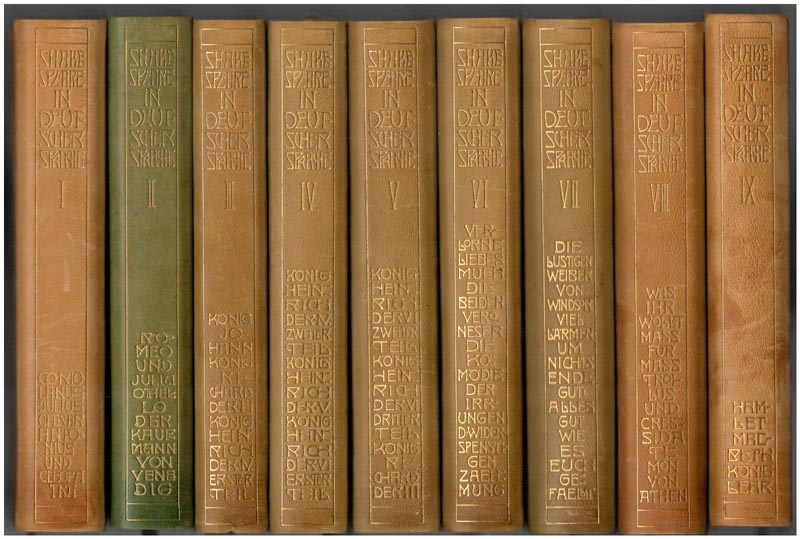
1908ref. 56714BBBerlin, Georg Bondi, 1908. 4°. 26,5 cm. 409, 382, 324, 358, 403, 394, 423, 433, 390 Seiten. Grüne Original-Saffian-Ganzlederbände mit goldgeprägtem Rücken- und Deckeltitel, goldgeprägte Fileten und Innenkantenfileten sowie Initialen ML (Melchior Lechter) auf Vorderdeckel.
1981pp. 219 p. 8vo. Original full cloth binding. DJ. Illus. The scribe and compositor in the print shop made changes - including addition and/or deletion of words and whole phrases to resolve problems of page make-up. An essential reference in Shakespeare scholarship. REF 8
1983ref. 001422London: Jonathan Cape 1983 1983 First Edition First Impression. Rushdie's best novel in the opinion of many is here offered in a rare UK first hardback edition. The jacket is spruce not torn or clipped and is now protected. Book is very clean and looks unread. An immaculate copy of a superb book from this great and brave writer. Hugely collectable. 0.0 0.0 0.0. 1st Edition. Hardcover. Fine/Fine. London: Jonathan Cape, 1983 hardcover
1964ref. 20478La Bastide-de-Goudargues (Gard), Guy Chambelland, 1964 ; in8, broché (249 mm), 22, [2] pp., 2 hors-texte de Luc Maize tirés sur papier glacé.
1943ref. 2083002116206283Naikaku Printing Bureau Information Bureau 1943. Soft Cover. Fine. The book is in fine condition. Naikaku Printing Bureau Information Bureau paperback
1990ref. 6469Eugene: University of Oregon 1990. First edition of 17 copies. Oblong quarto. Title page eleven poems with tipped-in woodblock silk screen or inkjet color illustrations and colophon. Printed burgundy wrappers near fine. Beautifuly printed book with images and poems by Darryla Green-McGrath Oregon based artist. This project was seemingly completed to satisfy requirements from the Fine Arts Department as well as the Center for Study of Women in Society both at the University of Oregon. We note another artist's book by Green-McGrath held at the University of Oregon according to OCLC but this one is unlisted. . University of Oregon unknown
1974171p. Line drawings by John Lawrence. 8vo. Original full pictorial cloth binding. Slipcase. Hardbound. Crisp copy. PRESS/W74
1976ref. 2080302106807380Not Available 1976. Soft Cover. Fine. The book is in fine condition. Not Available paperback
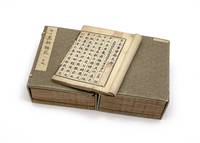
ref. 11212Collected & edited by Jiang Shaoyu 江少虞. Complete in 78 parts plus table of contents bound in 15 vols. full collation supplied in the Hyde catalogue. Large 8vo 286 x 215 mm. early paper wrappers new stitching. Japan: chokuban privately published by the Emperor Go-Mizunoo’s order 1621. First edition and a fine complete set of one of the very few surviving “imperial editions” printed with movable type kokatsujiban å¤æ´»å—版. There is considerable modern debate with no definitive conclusion whether this book was printed with metal or wooden type see below. It is of very great rarity and we find no printed copy in WorldCat. This enormous publication is by far the largest of the eight surviving chokuban imperial printings and the only surviving Gen’na chokuban 元和勅版 — imperial printing during the reign 1611-29 of Emperor Go-Mizunoo 後水尾天皇 1596-1680. The production of this large work was a very complex and difficult project employing the recently imported technology of movable type from Korea. The Song dynasty editor Jiang Shaoyu active 12th century compiled the substantial encyclopedia Huang Song shi shi lei yuan 皇宋事實類苑 of the writings of Chinese courtly scholars completed in 1145. Encouraging the preservation of Chinese traditions long valued by aristocrats Emperor Go-Mizunoo continued the project initiated by his father Emperor Go-YÅzei of printing imperially commissioned volumes of Chinese literary classics with the present work a collection of Confucian texts that were considered both an ethical and a literary legacy of the court. Some of the many topics include music medicine painting calligraphy supernatural events safeguarding the border and controlling the unruly. “The earliest surviving books printed in Korea with movable type date from the late fourteenth century…During the invasion of the Korean peninsula undertaken by Toyotomi Hideyoshi in the closing years of the sixteenth century…large numbers of printed books were looted and printing type was removed from the Printing Office and taken to Japan…It appears that Korean type was immediately put to use to print the text of the…Kobun kokyo Classic of Filial Piety in 1593 although no copies of this appear to have survived. In 1597 in the postface to another work printed in Japan with movable type a monk who was present at Hideyoshi’s headquarters acknowledged that typography in Japan had come from Korea. It was not clear whether any Korean printing artisans came to Japan as well as a result of the invasion but in any event the impact on Japan of Korean typography both technologically and intellectually was far greater than that of the Jesuit Mission Press principally because the imported Korean typography was much closer to the centres of power in Japan than the increasingly precarious Jesuit missions.”–Kornicki The Book in Japan p. 129. Emperor Go-YÅzei who nominally ruled Japan from 1586 to 1611 “displayed great enthusiasm for the new process and not content with the original type brought back from Korea ordered a new set of wooden type to be made. This was engraved between 1597 and 1602 and the books printed from this new type are generically known as choku-han or ‘imperial printings.’ Indeed ‘imperial’ is a fitting description of these works for they are among the finest unillustrated books ever produced in Japan. Not only was the typeface larger but the best-quality paper and the finest ink were used to achieve effect. Very few choku-han works were actually printed between 1597 and 1603 actually 1621 and if we exclude the 1593 edition of Kobun kokyÅ almost all the titles were copies of Chinese philosophical classics… “One other choku-han is known to have been printed by order of Emperor Go-Mino-o Emperor Go-YÅzei’s son and successor in 1621 and that is the Horuien the present work although one or two other titles were printed and have been lost. All these works are considerable examples of the printer’s art and show how quickly the Japanese were able to make full and aesthetic use of movable type.”–Chibbett The History of Japanese Printing and Book Illustration p. 69. At the time of the writing of the Hyde sale catalogue it was believed that the present work was printed with copper type; the latest research has suggested that wooden type was used. No final conclusion has been reached. See Kornicki Printing Technologies and Book Production in Seventeenth-Century Japan Cambridge: 2025 p. 26 for a discussion. Very fine and fresh set. Minor worming carefully repaired. Final volume with some dampstaining. Preserved in two chitsu. From the RokuÅ-in 鹿王院 temple in Kyoto and the library of Donald and Mary Hyde their sale Christie’s NY 7 October 1988 lot 87. With the provenance seal å¼˜æ–‡è˜ “KÅbunshÅ” the trade name of Sorimachi Shigeo å町茂雄 1901-91 the “H.P. Kraus of Japan.”. unknown
ref. 11212Collected & edited by Jiang Shaoyu 江少虞. Complete in 78 parts plus table of contents bound in 15 vols. full collation supplied in the Hyde catalogue. Large 8vo 286 x 215 mm. early paper wrappers new stitching. Japan: chokuban privately published by the Emperor Go-Mizunoo’s order 1621. First edition and a fine complete set of one of the very few surviving “imperial editions” printed with movable type kokatsujiban å¤æ´»å—版. There is considerable modern debate with no definitive conclusion whether this book was printed with metal or wooden type see below. It is of very great rarity and we find no printed copy in WorldCat. This enormous publication is by far the largest of the eight surviving chokuban imperial printings and the only surviving Gen’na chokuban 元和勅版 — imperial printing during the reign 1611-29 of Emperor Go-Mizunoo 後水尾天皇 1596-1680. The production of this large work was a very complex and difficult project employing the recently imported technology of movable type from Korea. The Song dynasty editor Jiang Shaoyu active 12th century compiled the substantial encyclopedia Huang Song shi shi lei yuan 皇宋事實類苑 of the writings of Chinese courtly scholars completed in 1145. Encouraging the preservation of Chinese traditions long valued by aristocrats Emperor Go-Mizunoo continued the project initiated by his father Emperor Go-YÅzei of printing imperially commissioned volumes of Chinese literary classics with the present work a collection of Confucian texts that were considered both an ethical and a literary legacy of the court. Some of the many topics include music medicine painting calligraphy supernatural events safeguarding the border and controlling the unruly. “The earliest surviving books printed in Korea with movable type date from the late fourteenth century…During the invasion of the Korean peninsula undertaken by Toyotomi Hideyoshi in the closing years of the sixteenth century…large numbers of printed books were looted and printing type was removed from the Printing Office and taken to Japan…It appears that Korean type was immediately put to use to print the text of the…Kobun kokyo Classic of Filial Piety in 1593 although no copies of this appear to have survived. In 1597 in the postface to another work printed in Japan with movable type a monk who was present at Hideyoshi’s headquarters acknowledged that typography in Japan had come from Korea. It was not clear whether any Korean printing artisans came to Japan as well as a result of the invasion but in any event the impact on Japan of Korean typography both technologically and intellectually was far greater than that of the Jesuit Mission Press principally because the imported Korean typography was much closer to the centres of power in Japan than the increasingly precarious Jesuit missions.”–Kornicki The Book in Japan p. 129. Emperor Go-YÅzei who nominally ruled Japan from 1586 to 1611 “displayed great enthusiasm for the new process and not content with the original type brought back from Korea ordered a new set of wooden type to be made. This was engraved between 1597 and 1602 and the books printed from this new type are generically known as choku-han or ‘imperial printings.’ Indeed ‘imperial’ is a fitting description of these works for they are among the finest unillustrated books ever produced in Japan. Not only was the typeface larger but the best-quality paper and the finest ink were used to achieve effect. Very few choku-han works were actually printed between 1597 and 1603 actually 1621 and if we exclude the 1593 edition of Kobun kokyÅ almost all the titles were copies of Chinese philosophical classics… “One other choku-han is known to have been printed by order of Emperor Go-Mino-o Emperor Go-YÅzei’s son and successor in 1621 and that is the Horuien the present work although one or two other titles were printed and have been lost. All these works are considerable examples of the printer’s art and show how quickly the Japanese were able to make full and aesthetic use of movable type.”–Chibbett The History of Japanese Printing and Book Illustration p. 69. At the time of the writing of the Hyde sale catalogue it was believed that the present work was printed with copper type; the latest research has suggested that wooden type was used. No final conclusion has been reached. See Kornicki Printing Technologies and Book Production in Seventeenth-Century Japan Cambridge: 2025 p. 26 for a discussion. Very fine and fresh set. Minor worming carefully repaired. Final volume with some dampstaining. Preserved in two chitsu. From the RokuÅ-in 鹿王院 temple in Kyoto and the library of Donald and Mary Hyde their sale Christie’s NY 7 October 1988 lot 87. With the provenance seal å¼˜æ–‡è˜ “KÅbunshÅ” the trade name of Sorimachi Shigeo å町茂雄 1901-91 the “H.P. Kraus of Japan.”. unknown books
1814ref. 2111902160200379Bunemon Maruya 1814. Soft Cover. Fine. Number of books: 1 Bunemon Maruya paperback
4to, x,690pp., ex-library, orig. cloth.
2 Vols., viii, 491; viii, 156pp., orig. cloth, upper hinge to mail work slightly torn.
2 Vols., viii,992; [viii],156pp., orig. cloth.
viii,275pp., from the library of Professor Birrell, orig. cloth, d.w.
3 Vols., 301; 302-638; 182pp., 6 plates, orig. cloth, fine copy.
xvi,169pp., from the library of Professor Birrell, orig. cloth, d.w.