1 484 résultats
1962réf. 015771Paris Les Editions de Minuit 1962 In-8 Broché
réf. 015736Gallimard NFR 0 In-12 Broché
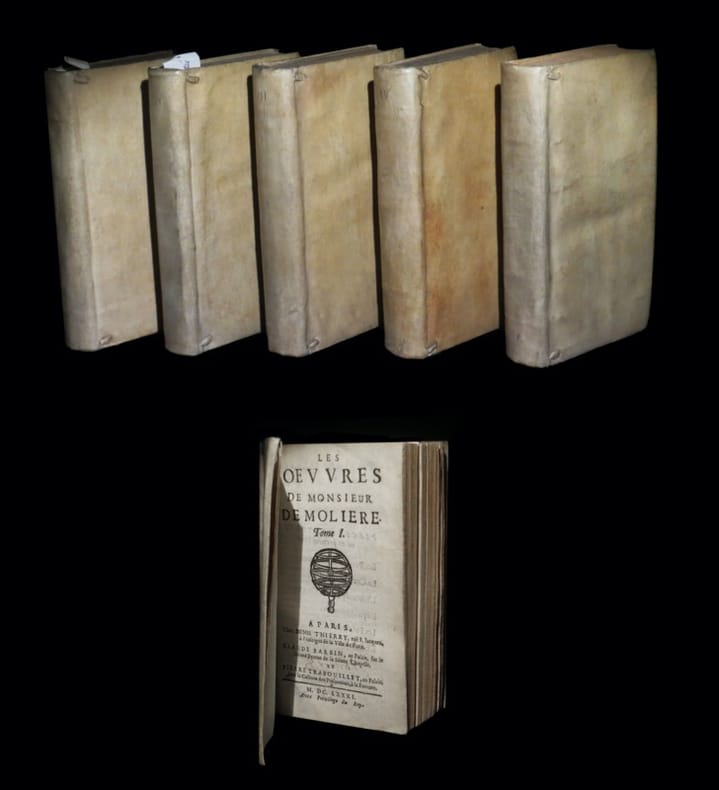
1681réf. 27543A Paris, chez Denis Thierry / Claude Barbin et Pierre Trabouillet, 1681. 5 vol. au format pt in-12 (148 x 92 mm) de 428 pp. et 1 f. bl. ; 400 pp. ; 436 pp. ; 466 pp. ; 402 pp. et 2 ff. de Privilège n.fol. Reliures ''à la hollandaise'' uniformes de l'époque de plein vélin ivoire à rabats rempliés et coutures apparentes, plats jansénistes, dos lisses, indication de tomaison à l'encre anciennement calligraphié en tête, tranches mouchetées.
1617réf. LCPCLIT-0044(Les Essais de Montaigne en reliure strictement de l'époque. L'exemplaire d'un membre de la famille De Calonne) MONTAIGNE MICHEL EYQUEM DE. (Bordeaux, 1533 - Saint-Michel-de-Montaigne, 1592) "LES ESSAIS DE MICHEL SEIGNEUR DE MONTAIGNE. EDITION NOUVELLE ENRICHIE DANOTATIONS EN MARGE : CORRIGEE ET AUGMENTEE D'UN TIERS...". 1617, Rouen, I. Osmont (N. L'Oyselet sur la dernière page). 1 fort volume in-8° (173x115 mm) (dimensions pages 166x107 mm) (1) titre frontispice gravé par E. Charpy, (2) pp. (avis), (3) pp. (table des chapitres), (7) pp. (biographie), (1) f. avec le portrait de Montaigne, non signé, gravé par Thomas de Leu, 1129 (i.e. 1087 pp.), (1) pp. (fautes et sauts de numération aux pp. 698-609 et 739-740), (17) ff. (table). (a8, A-Z8, Aa-Zz8, Aaa-Yyy8, Aaaa-Bbbb8, Cccc2) Reliure strictement de l'époque en vélin rigide à rabats. Rare et jolie édition, réimpréssion des éditions de Paris de 1608 et 1611. Tout petit manque de papier à l'angle inférieur du f. M1 sans atteinte. Cahier Aa très très légèrement et partiellement dérelié. Traces de lacets en soie sur les plats. Très bel exemplaire, frais et en reliure du temps. "Cette édition a été partagée entre plusieurs libraires rouennais" (Tvili, 421). Provenance : Un ex libris manuscrit "De Calonne" sur le premier f. de garde. Très probablement l'exemplaire d'un membre de la famille du célèbre ministre des finances de Louis XVI. (Tchémerzine, IV, 889)
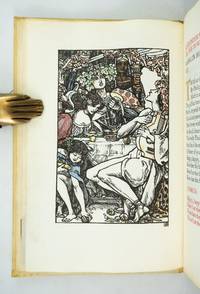
1904réf. ST20796London: Essex House Press 1904. No. 1 OF 140 COPIES all on vellum. 195 x 131 mm. 7 3/4 x 5 1/8". 1 p.l. frontispiece 3-11 2 pp. Original stiff vellum over thin boards front cover with embossed rose design. In custom-made linen clamshell box with red morocco label on spine. Hand-colored woodcut frontispiece and final tailpiece both by Reginald Savage hand-painted initials in burnished gold red blue or green. Printed in black and red. Front pastedown with red morocco bookplate of William Andrews Clark Jr.; front endleaves with evidence of bookplate and inscription removal. Tomkinson p. 76; Ransom p. 268; Franklin p. 200. A VERY FINE COPY clean bright and free of the splaying that very frequently afflicts the boards of this work. This is a most appealing example of the luxurious hand-crafted volumes produced under the auspices of the Essex House Press with our copy coming from the library of a noted Dryden collector. The book is the 11th from the Essex House series of 14 "Great Poems in the English Language" a group of lovely little works all printed on vellum and with delightful colored illustrations and historiated initials. Generally considered to be the best example in English of the choric hymn the present work is set at a feast given by Alexander the Great who finds himself entranced by the poet and lyrist Timotheus. The great leader is lost in reveries of exploits and victory he sighs and cries over battles lost and warriors slain and he finds inspiration for new conquests. Our printer C. R. Ashbee founded the Essex House Press in 1898 by purchasing the presses and other production equipment though not the type formerly owned by the Kelmscott Press which had shut down at the death of William Morris. Ashbee printed books for 12 years with vellum ink and paper identical to that used by Kelmscott in an effort to carry on the tradition Morris had established. But the Essex House Press because it was conceived of and continued as part of a larger enterprise involving various artisans at work in a group of workshops at Ashbee's Guild of Handicrafts located at Essex House in London's Mile End Road always had its own special identity a fact which Cave reflects when he calls it the "Arts and Crafts press 'par excellence.'" The illustrator here Reginald Savage fl. 1886-1904 is deemed by Houfe "a talented and imaginative designer and woodcut artist" and Houfe notes that he was also commended by his fellow illustrator Walter Crane 1845-1915 for his "weird designs." Former owner William Andrews Clark Jr. 1877-1934 put together one of the most distinguished collections of English and French literature of his day. He had strong holdings in many areas but especially in Shakespeare and the other Elizabethans in Dryden in Oscar Wilde and in the French drama. After a fire in his home in 1923 Clark constructed a separate fireproof building to house his collection; in 1926 this library building with its distinguished collection was deeded to the University of California and now serves as a prominent center for literary research. Essex House Press unknown
1904réf. ST20796London: Essex House Press 1904. No. 1 OF 140 COPIES all on vellum. 195 x 131 mm. 7 3/4 x 5 1/8". 1 p.l. frontispiece 3-11 2 pp. Original stiff vellum over thin boards front cover with embossed rose design. In custom-made linen clamshell box with red morocco label on spine. Hand-colored woodcut frontispiece and final tailpiece both by Reginald Savage hand-painted initials in burnished gold red blue or green. Printed in black and red. Front pastedown with red morocco bookplate of William Andrews Clark Jr.; front endleaves with evidence of bookplate and inscription removal. Tomkinson p. 76; Ransom p. 268; Franklin p. 200. A VERY FINE COPY clean bright and free of the splaying that very frequently afflicts the boards of this work. This is a most appealing example of the luxurious hand-crafted volumes produced under the auspices of the Essex House Press with our copy coming from the library of a noted Dryden collector. The book is the 11th from the Essex House series of 14 "Great Poems in the English Language" a group of lovely little works all printed on vellum and with delightful colored illustrations and historiated initials. Generally considered to be the best example in English of the choric hymn the present work is set at a feast given by Alexander the Great who finds himself entranced by the poet and lyrist Timotheus. The great leader is lost in reveries of exploits and victory he sighs and cries over battles lost and warriors slain and he finds inspiration for new conquests. Our printer C. R. Ashbee founded the Essex House Press in 1898 by purchasing the presses and other production equipment though not the type formerly owned by the Kelmscott Press which had shut down at the death of William Morris. Ashbee printed books for 12 years with vellum ink and paper identical to that used by Kelmscott in an effort to carry on the tradition Morris had established. But the Essex House Press because it was conceived of and continued as part of a larger enterprise involving various artisans at work in a group of workshops at Ashbee's Guild of Handicrafts located at Essex House in London's Mile End Road always had its own special identity a fact which Cave reflects when he calls it the "Arts and Crafts press 'par excellence.'" The illustrator here Reginald Savage fl. 1886-1904 is deemed by Houfe "a talented and imaginative designer and woodcut artist" and Houfe notes that he was also commended by his fellow illustrator Walter Crane 1845-1915 for his "weird designs." Former owner William Andrews Clark Jr. 1877-1934 put together one of the most distinguished collections of English and French literature of his day. He had strong holdings in many areas but especially in Shakespeare and the other Elizabethans in Dryden in Oscar Wilde and in the French drama. After a fire in his home in 1923 Clark constructed a separate fireproof building to house his collection; in 1926 this library building with its distinguished collection was deeded to the University of California and now serves as a prominent center for literary research. Essex House Press unknown books
Large 12mo (150 x 80 mm), xxviii, 306, [2]pp., ONE OF TWO COPIES PRINTED ON VELLUM, etched frontispiece by Felix Bracquemond, foliated initials and head-pieces, some light spotting to half-title, marbled endpapers, superbly bound in later full blue morocco by Reimann/Dormont, triple gilt fillet border to covers, with gilt supralibros of Isidoro Fernandez added to centre of both covers, gilt spine compartments exquisitely tooled with small flowers and stars, gilt turn-ins and edges, joints lightly rubbed otherwise in fine condition. Good edition of the works of Mathurin Regnier (1573-1613), French satirical poet. This being number one of two copies printed on vellum in a total limitation of 171. Provenance: Jean de La Fontaine Toqu? (bookplate); I. Fernandez (bookplate); purchased from Giraud, 1926 (pencil note to rear endpaper). Vicaire VI, 1002.
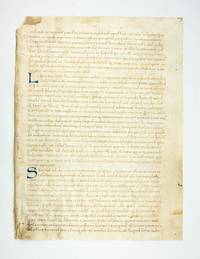
réf. ST12778-0082South Germany or more probably Austria second half of the 12th century. 429 x 304 mm. 16 7/8 x 12". Double column 36 lines of text in a fine proto-gothic hand. ◆Text a bit faded on one side an upper corner slightly defective minor soiling and with the grain of the vellum apparent on verso but with the beautiful text entirely legible and the leaf as a whole quite pleasing. The hand here is memorable featuring wide upright letters that could not be more regular. Elected pope in 590 Gregory ca. 540-604 was one of the most influential pontiffs in the history of the Church. In addition to revising liturgical worship he wrote extensively on theology offering homespun wisdom rather than esoteric debates. He was declared a saint immediately upon his death. unknown
réf. ST12778-0082South Germany or more probably Austria second half of the 12th century. 429 x 304 mm. 16 7/8 x 12". Double column 36 lines of text in a fine proto-gothic hand. ◆Text a bit faded on one side an upper corner slightly defective minor soiling and with the grain of the vellum apparent on verso but with the beautiful text entirely legible and the leaf as a whole quite pleasing. The hand here is memorable featuring wide upright letters that could not be more regular. Elected pope in 590 Gregory ca. 540-604 was one of the most influential pontiffs in the history of the Church. In addition to revising liturgical worship he wrote extensively on theology offering homespun wisdom rather than esoteric debates. He was declared a saint immediately upon his death. unknown books
réf. ST20981Italy 15th century. 264 x 200 mm. 10 3/8 x 7 7/8". Single column 41 lines in a neat humanist hand. With two two-line initials in blue. One corner torn away not affecting text a few marginal wormholes vellum a bit soiled and with a few small stains but a very good example the text entirely legible and overall clean and presentable. Containing text by an author who was much admired during the Renaissance this leaf is a lovely example of the humanistic script that emerged in Italy during the 15th century. The elegance and legibility of humanistic script derives from Caroline miniscule the predominant style of writing in Western manuscripts from the ninth through 12th centuries. Both scripts favor clear rounded letter forms wider spacing between letters and few abbreviations resulting in manuscripts that are extremely attractive and easy to read. The text here comes from a work titled "De Opificio Dei" exploring the handiwork of God with a concentration on the marvels of the human body and soul. The present leaf includes chapters 8-10 which discuss the human head including especially the seats of the senses: eyes ears nose and tongue. Our author Lactantius ca. 260-340 was a late-in-life Christian who became one of the ablest defenders of the faith in its early centuries. He was held in high esteem by Renaissance intellectuals and was one of the earliest authors to be printed first appearing in 1465. unknown
réf. ST20981Italy 15th century. 264 x 200 mm. 10 3/8 x 7 7/8". Single column 41 lines in a neat humanist hand. With two two-line initials in blue. One corner torn away not affecting text a few marginal wormholes vellum a bit soiled and with a few small stains but a very good example the text entirely legible and overall clean and presentable. Containing text by an author who was much admired during the Renaissance this leaf is a lovely example of the humanistic script that emerged in Italy during the 15th century. The elegance and legibility of humanistic script derives from Caroline miniscule the predominant style of writing in Western manuscripts from the ninth through 12th centuries. Both scripts favor clear rounded letter forms wider spacing between letters and few abbreviations resulting in manuscripts that are extremely attractive and easy to read. The text here comes from a work titled "De Opificio Dei" exploring the handiwork of God with a concentration on the marvels of the human body and soul. The present leaf includes chapters 8-10 which discuss the human head including especially the seats of the senses: eyes ears nose and tongue. Our author Lactantius ca. 260-340 was a late-in-life Christian who became one of the ablest defenders of the faith in its early centuries. He was held in high esteem by Renaissance intellectuals and was one of the earliest authors to be printed first appearing in 1465. unknown books
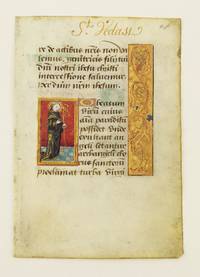
réf. ST12668bKNortheastern France probably Arras late 15th century. 146 x 95 mm. 5 3/4 x 3 3/4". Single column 15 lines in a pleasing bâtarde hand. Rubrics in red one- and two-line initials in brushed gold on a red or blue ground EACH SIDE OF EACH LEAF WITH A BRUSHED GOLD PANEL BORDER WITH VERY PRETTY ILLUSIONISTIC FLOWERS and one panel with acanthus apparently unfinished; EACH LEAF WITH ONE SMALL MINIATURE measuring approximately 40 x 25 mm. DEPICTING SAINTS. Headlines written in French in a later 18th century calligraphic hand. ◆Light soiling otherwise excellent specimens generally clean and smooth with ample margins and attractive decoration. From a charmingly decorated 15th century prayer book these lovely leaves offer the opportunity to acquire a miniature andconsiderable gold ornamentation at an attainable price. One leaf depicts Sts. Peter and Paul in a single frame and the other shows St. Vedast or Waast--a saint that was particularly venerated in France especially in the Arras region whence we be believe these leaves originated. For other leaves from this same manuscript please check our website. unknown
réf. ST12668bKNortheastern France probably Arras late 15th century. 146 x 95 mm. 5 3/4 x 3 3/4". Single column 15 lines in a pleasing bâtarde hand. Rubrics in red one- and two-line initials in brushed gold on a red or blue ground EACH SIDE OF EACH LEAF WITH A BRUSHED GOLD PANEL BORDER WITH VERY PRETTY ILLUSIONISTIC FLOWERS and one panel with acanthus apparently unfinished; EACH LEAF WITH ONE SMALL MINIATURE measuring approximately 40 x 25 mm. DEPICTING SAINTS. Headlines written in French in a later 18th century calligraphic hand. ◆Light soiling otherwise excellent specimens generally clean and smooth with ample margins and attractive decoration. From a charmingly decorated 15th century prayer book these lovely leaves offer the opportunity to acquire a miniature andconsiderable gold ornamentation at an attainable price. One leaf depicts Sts. Peter and Paul in a single frame and the other shows St. Vedast or Waast--a saint that was particularly venerated in France especially in the Arras region whence we be believe these leaves originated. For other leaves from this same manuscript please check our website. unknown books
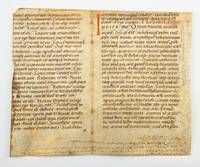
réf. ST20509a-bGermany Late 11th or early 12th century. Largest bifolium measures 221 x 275 mm. 8 7/8 x 10 3/4". Single column 25-27 lines in a late Caroline hand. Rubrics in orange each bifolium with one or more one one-line initial in orange and one or more large four- to five-line initials in orange. With marginal notations in a later hand. Recovered from a binding and thus with some soiling abrasions glue residue and other small problems; the pages nearly complete but with a couple of letters and/or lines cut away from one side of each bifolia with more extensive abrasions on one side affecting legibility but very good specimens overall the better side in each case quite clear and readable. Once part of a Lectionary a collection of scriptural readings appropriate for Masses through the year and other ceremonial occasions these attractive mostly legible binding fragments display an excellent transitional script with both Caroline minuscule and proto-gothic characteristics. The present examples include short lessons or "lectiones" taken from the Old and New Testaments including among other passages excerpts from John in which Christ casts the sellers out of the temple and Daniel relating the prayers of the three men who refused to bow to Nebuchadnezzar's golden idol. The lovely script here shares much in common with the pure Caroline miniscule of earlier centuries--particularly in the overall legibility of the text the space between individual letters and the limited use of ligatures and abbreviations; also of note is the exclusive use of the long "s" unless at the beginning of a sentence and the ampersand as a general abbreviation for the letters "et" occurring anywhere in a word e.g. "propheta" written "proph&a" here. Evidence of a progression toward proto-gothic script can also be observed here in the appearance of certain letter forms such as the closed "g" a more oval "o" and the use of two forms of "d" both upright and Uncial the latter with a sloping shaft. There is added interest here in the form of marginal notations in a later hand--probably dating from the time these bifolia were in situ as binding waste. unknown
réf. ST20509a-bGermany Late 11th or early 12th century. Largest bifolium measures 221 x 275 mm. 8 7/8 x 10 3/4". Single column 25-27 lines in a late Caroline hand. Rubrics in orange each bifolium with one or more one one-line initial in orange and one or more large four- to five-line initials in orange. With marginal notations in a later hand. Recovered from a binding and thus with some soiling abrasions glue residue and other small problems; the pages nearly complete but with a couple of letters and/or lines cut away from one side of each bifolia with more extensive abrasions on one side affecting legibility but very good specimens overall the better side in each case quite clear and readable. Once part of a Lectionary a collection of scriptural readings appropriate for Masses through the year and other ceremonial occasions these attractive mostly legible binding fragments display an excellent transitional script with both Caroline minuscule and proto-gothic characteristics. The present examples include short lessons or "lectiones" taken from the Old and New Testaments including among other passages excerpts from John in which Christ casts the sellers out of the temple and Daniel relating the prayers of the three men who refused to bow to Nebuchadnezzar's golden idol. The lovely script here shares much in common with the pure Caroline miniscule of earlier centuries--particularly in the overall legibility of the text the space between individual letters and the limited use of ligatures and abbreviations; also of note is the exclusive use of the long "s" unless at the beginning of a sentence and the ampersand as a general abbreviation for the letters "et" occurring anywhere in a word e.g. "propheta" written "proph&a" here. Evidence of a progression toward proto-gothic script can also be observed here in the appearance of certain letter forms such as the closed "g" a more oval "o" and the use of two forms of "d" both upright and Uncial the latter with a sloping shaft. There is added interest here in the form of marginal notations in a later hand--probably dating from the time these bifolia were in situ as binding waste. unknown books
réf. 13379CONSTANTIN contre MAXENCE. La bataille du pont MILVIUS Estampe gravée au burin, à l’eau forte, en 4 feuilles, d’après le tableau de C. LE BRUN. Girard AUDRAN graveur. En marge inférieure Ludovico XIII Francorum rég à Potentssimo. C. LEBRUN cum priv. Regis 1666. Format 1640x7120mm et 1725x745mm avec marges Belle épreuve bien contrastée, sur vélin fort. Marge inférieure et pliures renforcées, pâle mouillure en marge inférieure. La victoire de CONSTANTIN consacre le début d’une nouvelle ère pour l’Empire, elle doit son nom au pont qui enjambe le Tibre à quelques kilomètres au nord-est de ROME.RARE. "Maxence aligne face à Constantin une armée comparable. Soit que le pont est en mauvais état soit qu’il est trop étroit ; les troupes de Maxence traversent le Tibre sur un pont provisoire constitué de bateaux accolés l’un contre l’autre, une fois de l’autre coté, elles se trouvent trop à l’étroit sur la plaine pour pouvoir manœuvrer. Constantin en profite, il lance sa cavalerie à l’assaut et désorganise les troupes ennemies. Dans la confusion, chacun tente de s’enfuir par le fleuve, Maxence le premier. Son corps est retrouvé le lendemain dans le lit du fleuve. Vainqueur, Constantin entre à Rome et s’impose comme seul maître de l’occident"
réf. 13373La bataille d’ARBELLE. La vertu est digne de l’Empire du Monde. Estampe gravée au burin, à l’eau forte et la pointe sèche, en quatre feuilles, d’après le tableau de Charles LE BRUN. 1674- format 710 x1587 mm à la cuvette. 1670 x730mm avec marges (courtes) Marge inférieure renforcée long. Belle épreuve, bien contrastée, sur vélin fort. Marge inférieure et pliures renforcées. RARE « DARIUS sur un char, Alexandre à cheval, environnés de gens d’élite. Soit illusion, soit réalité, ceux qui étaient près d’Alexandre crurent avoir vu un peu au dessus de la tête du Prince, un aigle voler paisiblement, sans être effrayé, ni du bruit des armes, ni du gémissement des mourants, dans le feu de l’action, le devin Alexandre revêtu de sa robe blanche et montrant une branche de laurier, montra –t-il cet oiseaux aux soldats comme un augure infaillible de leur victoire… l’ardeur et la confiance la plus grande renaît alors, elle redoubla surtout quand le conducteur de Darius ayant été percé d’une javeline, ni Perses, ni Macédoniens ne doutèrent que ce ne fût le Roi lui-même qui avait été tué… Ce n’était déjà plus un combat mais une boucherie, lorsque Darius tourna aussi son char pour prendre la fuite. » (Quint-Curse liv IV)
réf. 13394AUDRAN Gérard Le palais soleil d’après Charles LE BRUN. Estampe gravée à l’eau forte et au burin. 1680. Epreuve sur vélin fort, en 5 feuilles, une feuille pour le texte en latin,( 200x420mm), dans la partie inférieure, 1680 . 810mmx1050mm. G. AUDRAN sculpsit , en marge extérieure droite. C. Le BRUN jn. Et cum privil. Régis en marge extérieure droite ainsi qu’en marge inférieure et en marge extérieure gauche. Fragilité à la pliure inférieure, avec renforts. Pâle mouillure en marge inférieure, ainsi qu’en bordure de la marge extérieure. RARE. Belle et imposante épreuve, bien contrastée. "Apollon traverse sur son char l’année, les mois, les semaines, les jours et l’ensemble du zodiaque, entouré des différentes planètes et des vents. Le BRUN s’inspira de l’histoire de Phaêton dans les métamorphoses d’Ovide (symbole du désir ardent de FOUQUET) .Les personnages sont placés sur un immense serpent qui fait le tour de la gravure et qui se mord la queue. Il s’agit de la représentation de l’ourobos (sceau purificateur, il symbolise l’éternelle unité de toutes choses et le cycle de la vie, de la naissance à la mort)"
réf. 13370AUDRAN Gérard le plafond de la chapelle de Sceaux Estampe en tondo, gravée au burin, à l’eau forte et la pointe sèche, en cinq feuilles, d’après Charles LE BRUN 1681. Diamètre 1170mm. Marge courte. Pliures (estampe à l’origine dans une imposante reliure) Le peintre a représenté le triomphe du nouveau testament sur l’ancien. Le Père éternel porté sur les ailes des anges, venant de l’Arche d’alliance, le chandelier à 7 branches, et divers instruments de musique, une balustrade fit le tour de la composition Charles Brun 1681. En marge : peint à fraisque dans la voûte de la chapelle du chasteau de Sceaux par m. Le BRUN premier peintre du Roy et gravé par Girard AUDRAN 1681. Belle épreuve bien contrastée. Epreuve en cinq pièces se réunissant. L’épisode est relaté sur les évangiles de Matthieu, Marc et Luc. Alors qu’il vient d’être baptisé dans les eaux du Jourdain. Jésus voit le saint esprit descendre sur lui sous la forme d’une colombe. Symboliquement cette vision annonce la rédemption grâce au futur sacrifice du Christ soit la réouverture du royaume des cieux fermé aux mortes depuis le pêché original.
réf. 13371AUDRAN Gérard le plafond de la chapelle de Sceaux Estampe en tondo, gravée au burin, à l’eau forte et la pointe sèche, en cinq feuilles, d’après Charles LE BRUN 1681. Diamètre 1170mm. Marge courte. Pliures (estampe à l’origine dans une imposante reliure) Le peintre a représenté le triomphe du nouveau testament sur l’ancien. Le Père éternel porté sur les ailes des anges, venant de l’Arche d’alliance, le chandelier à 7 branches, et divers instruments de musique, une balustrade fit le tour de la composition Charles Brun 1681. En marge : peint à fraisque dans la voûte de la chapelle du chasteau de Sceaux par m. Le BRUN premier peintre du Roy et gravé par Girard AUDRAN 1681. Belle épreuve bien contrastée. Epreuve en cinq pièces se réunissant. L’épisode est relaté sur les évangiles de Matthieu, Marc et Luc. Alors qu’il vient d’être baptisé dans les eaux du Jourdain. Jésus voit le saint esprit descendre sur lui sous la forme d’une colombe. Symboliquement cette vision annonce la rédemption grâce au futur sacrifice du Christ soit la réouverture du royaume des cieux fermé aux mortes depuis le pêché original.
réf. 13378Estampe gravée au burin, à l’eau forte et la pointe sèche, en marge inférieure cum priviliegio regit 1666, belle épreuve, bien contrastée, en 4 feuilles sur vélin fort 740x1680 avec marges courtes marge inférieure et pliures renforcées. Constantin assis sur un char de triomphe est couronné par la victoire, il est entouré de licteurs, précédés de soldats portant les dépouilles opimes et suivi de prisonniers ;
réf. 13372AUDRAN Gérard. Le passage du GRANIQUE. La Vertu surmonte l’obstacle. Estampe gravée au burin, à l’eau forte et la pointe sèche, en quatre feuilles, d’après le tableau de Charles LE BRUN 1672. Format 710x1395mm. 1450x718mm Marges courtes. Dans la marge inférieure : LA VERTU Surmonte l’obstacle. Alexandre ayant passé le Granique, attaque les Perses a forces inégales et met en fuite leur innombrables multitude. Virtus omni obice maior. Marge inférieure gauche on lit Ger. Audran sculpt 1672. Gravé par Ger. Audran sur le tableau de M. Le Brun premier peintre du Roy. Le tableau est dans le cabinet de sa Majesté. Il a 16 pieds de hault sur 30 pieds de long. Marge inférieure et pliures renforcées, avec traces de mouillures, plus visibles au verso. Belle épreuve bien contrastée, sur vélin fort RARE« Alexandre traversant le Granique à la tête de son armée en vue des milliers d’hommes de cavalerie et d’infanterie qui couvraient le rivage opposé, parut le premier à l’autre bord. Les ennemis se précipitèrent sur lui et sur ceux qui l’avaient suivi, sans leur laisser le loisir de se mettre en bataille. Alexandre fut d’abord frappé d’un javelot qui ne traversa pas sa cuirasse. Deux capitaines Perses : Roesaces et Spithridates l’attrapèrent à la fois, s’apprêtant à lui fendre la tête d’un coup de hache, lorsque Clytus détourna le coup fatal et le tua. Alexandre, l’épée à la main, vient frapper Roesaces derrière Clytus, armé d’une hache par le coup que Spithridates va asséner sur le casque d’Alexandre. On aperçoit dans le fond l’armée Macédonienne qui traverse le fleuve à gué »
1955réf. 009647Paris (Gretry Wols) 1955 En feuilles, sous chemise cartonnée bleue éditeur.
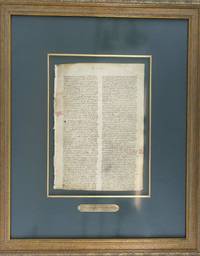
réf. ST12778-0799Italy ca. 1275. 272 x 193 mm. 10 3/4 x 7 1/2". Double column 67 lines of text in a pleasing regular gothic hand. In a very attractive 21 1/2 x 17 1/2" walnut frame of antique design with the leaf in a sunken compartment with a gold lip a brass label below the compartment. Once purchased from Quaritch with their description on the back. ◆Formerly used as the flyleaf in a binding so slightly soiled text with minor fading a very small portion perhaps one or two lines of the text trimmed off at bottom half a dozen small round wormholes but still an attractive legible example of an unusual text. The Quaritch description says that the leaf is from "a Medieval medical work based on Galen concerned with fevers especially those that last a single day 'febres ephemerae'; the present leaf contains the text of chapters 4-7. The author speaks about bloodletting not . . . for the young or elderly baths honey the better kind is clean clear and of sharp odor and delicate Roman women. He cites Hippocrates and the 'Regimen Sanitatis' of Salerno as well as his own writings 'Quisquis igitur se non exercet in meis libris non poterit intelligere' 'Whoever then does not train himself in my own books will not be able to understand'. The text has a strong Galenic tone although it is not a translation of Galen's 'De Differentiis Febrium' and suggests a Medieval work based on Galen and possibly from the great Salerno medical school. The vocabulary includes post-classical words such as 'acetositas' acidity and even some words unrecorded in the massive 'Thesaurus Linguae Latinae' Oxford Medieval Latin Dictionary and Du Cange such as 'crapulositas' drunkenness and 'indigestabilitas.'" The leaf has obvious interest for its content and it is well presented in its attractive frame. unknown
réf. ST12778-0799Italy ca. 1275. 272 x 193 mm. 10 3/4 x 7 1/2". Double column 67 lines of text in a pleasing regular gothic hand. In a very attractive 21 1/2 x 17 1/2" walnut frame of antique design with the leaf in a sunken compartment with a gold lip a brass label below the compartment. Once purchased from Quaritch with their description on the back. ◆Formerly used as the flyleaf in a binding so slightly soiled text with minor fading a very small portion perhaps one or two lines of the text trimmed off at bottom half a dozen small round wormholes but still an attractive legible example of an unusual text. The Quaritch description says that the leaf is from "a Medieval medical work based on Galen concerned with fevers especially those that last a single day 'febres ephemerae'; the present leaf contains the text of chapters 4-7. The author speaks about bloodletting not . . . for the young or elderly baths honey the better kind is clean clear and of sharp odor and delicate Roman women. He cites Hippocrates and the 'Regimen Sanitatis' of Salerno as well as his own writings 'Quisquis igitur se non exercet in meis libris non poterit intelligere' 'Whoever then does not train himself in my own books will not be able to understand'. The text has a strong Galenic tone although it is not a translation of Galen's 'De Differentiis Febrium' and suggests a Medieval work based on Galen and possibly from the great Salerno medical school. The vocabulary includes post-classical words such as 'acetositas' acidity and even some words unrecorded in the massive 'Thesaurus Linguae Latinae' Oxford Medieval Latin Dictionary and Du Cange such as 'crapulositas' drunkenness and 'indigestabilitas.'" The leaf has obvious interest for its content and it is well presented in its attractive frame. unknown books