(VELLUM PRINTING). DELILLE, JACQUESBiblio.com
1 404 résultats
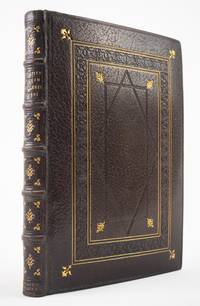
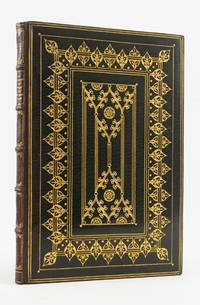
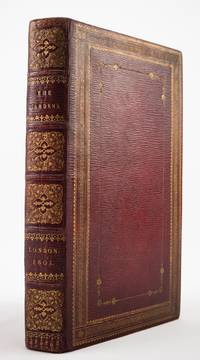
1805réf. ST21016London: Printed by T. Bensley 1805. APPARENTLY THE ONLY COPY PRINTED ON VELLUM. 260 x 152 mm. 10 x 1/4 x 6". 2 p.l. 146 pp. 1 leaf notes. Translated by Maria Henrietta Montolieu. Very pleasing contemporary straight-grain scarlet morocco gilt by Charles Hering binder's ticket on verso of front flyleaf covers bordered with a wide frame of multiple patterned rolls with rosette cornerpieces enclosing a delicate frame of a dotted roll cornered small floral tools raised bands spine gilt in compartments wide turn-ins sumptuously gilt cream silk endleaves with gilt borders and fleuron cornerpieces all edges gilt. WITH EIGHT ENGRAVINGS BY FRANCESCO BARTOLOZZI IN TWO STATES one on gold silk and the second on paper. EXTRA-ILLUSTRATED with two engravings depicting Princess Izabela Czartoryska and her daughter Zofia. A Large Paper Copy. Henrey 624. See also Clemens Alexander Wimmer "The Princess and the Poles" Historic Gardens Review no. 10 2002: 14-17. Spine slightly darkened joints and edges with minor barely noticeable wear vellum a bit and naturally rumpled and consequently the book yawning a bit a handful of light spots but still an extremely appealing copy with fine impressions of the plates vast margins and a special story to tell. Printed on vellum richly bound and illustrated with attractive plates on silk this is an extraordinarily luxurious copy of Delille's famous poem on gardens that almost certainly belonged to a noblewoman whose gardens are mentioned in the text. First published in 1780 our poem condemns formal gardens and broad promenades in favor of a gardening art which hides its artistry by reproducing the asymmetrical groupings of nature and careless bounty of the countryside. This view accords with the translation of Virgil's "Georgics" done by Delille 1738-1813 in 1769 a version that brought him great acclaim for its supple and sonorous versification. In fact it so pleased the Count of Artois the future Charles X that he named Delille abbot of Saint-Séverin; however revolution disrupted things and the poet for a time led a wandering life in Switzerland Germany and England where this updated and expanded version of "Gardens" was published in 1801. The present special edition includes the plates which had appeared as head- and tailpieces in the first edition but now used as stand-alone plates in two states. These were executed by Bartolozzi after originals by Portuguese neoclassical painter Francisco Vieira. In addition to the called-for suite of illustrations our copy includes two inserted plates portraits of Princess Izabela Czartoryska 1745-1835 and her daughter Zofia. Czartoryska was a major figure in the Polish Enlightenment as a writer and patron of the arts as well as an advocate for improving the lives of the poor. She is best remembered for the sprawling gardens at her palace in Pu awy which included a formal garden a "wild promenade" or landscape park and multiple structures including the neoclassical Temple of the Sibyl which became one of Poland's first museums. She made the acquaintance of the author while travelling through Paris in 1791 and the two struck up a friendship. She financially backed the second edition of the work in exchange for a mention of her gardens which duly appears in heightened verse on pp. 11-13: "Favoured Pulhavi! You from Heaven obtain / Each separate charm Earth's choicest scenes contain; / Bright glow thy features fresh from Nature's hand / Excite our wonder and our praise command." The presence of this poetic tribute--and especially the inserted plates showing the princess and her daughter-- clearly suggest that the our apparently unique luxury edition must have been a presentation copy to Czartoryska herself. The present copy is as striking outside as it is inside. Charles Hering was the most distinguished and influential English binder of the first decade of the 19th century and although his career was brief from about 1795-1812 Ramsden focuses on his work as representing the transition in binding styles from those of the German émigrés of the late 18th century to the new generation of binders headed by Charles Lewis. Dibdin states that until "the star of Charles Lewis rose above the bibliopegistic horizon no one could presume to 'measure business' with Hering. There was a strength squareness and a good style of work about his volumes which rendered him deservedly a great favourite." We have been unable to trace any other copies of the present edition on vellum. Printed by T. Bensley unknown
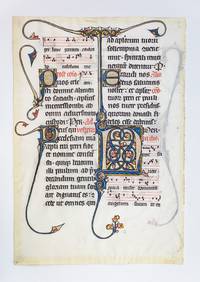
réf. ST20214Northern France perhaps Beauvais or Amiens late 13th or early 14th century. 286 x 199 mm. 11 1/4 x 7 3/4". Double column containing a mixture of staves and text approximately 21 lines in an excellent formal gothic book hand. Attractively matted. Rubrics in red chant text containing black penwork initials with red and yellow geometric elaboration BEAUTIFULLY ILLUMINATED with five two-line initials painted blue or pink with white tracery on a ground in the contrasting color two of the initials filled with grotesques and swirling vines and two with the filler design traced out but never completed each initial with blue and pink extensions terminating in orange leaves or spiky shapes; the verso featuring AN IMPRESSIVE SIX-LINE "N" 58 x 50 mm. in the same style filled with an intricate knotwork design and orange leaves with long extensions including a horizontal extension across the upper margin. Margins with light offsetting of the designs from the facing leaf; remnants of mounting tape on recto corners and bottom edge; verso apparently with a barely visible Medieval "14" in lower margin. An area measuring 5 mm. at edges just faintly yellowed from mat burn but IN FINE CONDITION the vellum otherwise quite bright the paint rich and the gold brightly glittering. This sumptuously decorated leaf--which is beautifully preserved and contains a particularly large and handsome initial--comes from the last volume of a three-volume Missal presented to Beauvais Cathedral by Canon Robert de Hangest d. 1356. The Missal remained at the cathedral at least through the 17th century when it is noted in an inventory but was removed from the church at some point likely in the aftermath of the French Revolution. The parent volume eventually entered the collection of Henri-Auguste Brölemann 1775-1854 of Lyon who passed it to his grand-daughter Etienne Mallet who then sold it at Sotheby's in 1926. It was then acquired for the collection of William Hearst where it remained for the next 25 years. In 1941 it was again sold at auction and subsequently dismembered. Though long thought to have been the work of famed biblioclast Otto Ege recent scholarship suggests that it was actually Phillip Duschnes who was responsible for breaking up the book keeping some leaves for himself and selling others on to his colleague Ege for inclusion in his portfolios of "Fifty Original Leaves from Medieval Manuscripts." The Beauvais Missal has been a subject of interest for many notable scholars chief among them being Christopher de Hamel--see: "Otto Ege and the Beauvais Missal" in "Gilding the Lilly: A Hundred Medieval and Illuminated Manuscripts in the Lilly Library" and it is currently the focus of a major effort to "reconstruct" the manuscript digitally--a project spearheaded by Lisa Fagin Davis. Other leaves from the parent volume are in the collections of the Morgan Library the Metropolitan Museum of Art the Cleveland Museum of Art and the Houghton Library at Harvard among many others. Although there is some dispute among art historians the illumination has been tentatively attributed to the artist of the Hours of Yolande of Soissons produced in Amiens ca. 1280 and now held by the Morgan Library MS M.729. It is worth noting that the town of Hangest home to the original owner is only 10 miles from Amiens and is a likely place of origin for the Missal. The present leaf contains a text for a major feast day and thus contains a large and extravagantly decorated initial for its opening "'Nunc scio vere." It is not too much to say that the decoration here is masterful but curiously--and of special interest to us from a modern perspective--the illuminators seem to have forgotten to put the finishing touches on the two smaller initials above which still contain sketches of the preliminary design. unknown
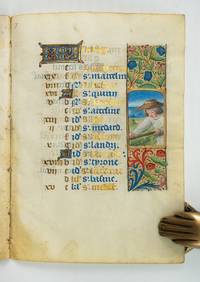
1500réf. ST20810SParis ca. 1500. 163 x 115 mm. 6 1/2 x 4 1/2". 12 leaves. Single column 18 lines in a gothic book hand. Feast days in alternating blue and burnished gold script two-line "KL" initials painted blue with white tracery and embellished with orange and blue ivy on a burnished gold ground each with a spray of gilt leaves and painted flowers one-line "A" initials in burnished gold over a pink and blue ground each page with a panel border of colorful flowers berries and acanthus over a painted gold ground with 24 SMALL MINIATURES depicting the labor of the month on rectos and zodiacal signs on versos. Some moderate smudging and soiling in bottom and fore margins January and February with tiny wormhole in head margin the miniature for January conceivably improved by a later hand but all in all a very lovely Calendar the high-quality paintings very well preserved and the whole with vibrant colors and brightly gleaming gold. Vibrantly illustrated and shimmering with gold this is an excellent example of a complete Calendar that would have appeared at the beginning of a luxuriously appointed Book of Hours. Each month is illustrated with the labor or occupation appropriate for the moment. These are in turn: warming by the fire feasting pruning picking flowers courting threshing hay harvesting wheat baking bread treading grapes sowing feeding hogs and slaughtering a hog. Our artist chose to compose these scenes more as portraits than depictions of actual tasks framing the image around each figure's face and sometimes only including small details that might indicate their occupation. In the month of June for example which depicts threshing hay we see only a sliver of the farmer's sickle and nothing at all of the hay. Instead the farmer himself is the primary focus here: and he is particularly well-executed with gentle shading on his downcast features careful brushstrokes highlighting the gleam of his hair and brushed gold suggesting the sun beating down on a bright June day. In addition to the labor or occupation of the month on the recto the 12 signs of the zodiac are depicted on the verso of each leaf these executed with equal charm and care. In cheerful bright colors our artist has depicted Leo's preening pose and glimmering mane the drama of Sagittarius' drawn bow and the cherubic plumpness of Aquarius molded in bluish shadows. In addition to the aesthetic achievements of its various parts the whole is desirable as a so-called composite Calendar with the name of a saint or special celebration occupying every day of the year. The origin of the composite Calendar is uncertain but the general opinion is that it was formalized in the early 14th century. The Parisian Hours of Jeanne d'Evreaux copied in ca. 1330 has been put forth as an early example. In any case the Calendar was subject to numerous changes in the course of time as various saints were canonized and supplanted those who while still recognized as saintly were deemed to be less favored residents for a particular calendar date. The saints' days on this Calendar are fairly typical for the Use of Paris and given the high-quality illumination liberal use of gold and robust borders it is likely that the parent manuscript was produced by an accomplished atelier in that city. Although single Calendar leaves regularly come on the market complete Calendars--particularly ones with extensive visual programs as here--are much more difficult to acquire. unknown
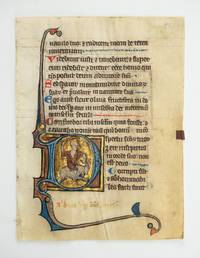
réf. ST20846GSouthern Netherlands ca. 1280. 110 x 83 mm. 4 3/8 x 3 1/4". Single column 19 lines in a gothic hand. Rubrics in red simple line fillers in red or blue each leaf with multiple one-line initials in red or blue one leaf also with a two-line gilt initial on blue and pink ground and with bar border extensions in gold blue and pink EACH LEAF WITH A LARGE HISTORIATED INITIAL measuring seven to nine lines long 28-34 mm. the initial in pink or blue inhabited by figures painted on a gilt ground all this on a blue or pink ground framed in gilt with spiky pink and blue marginal extensions studded with gilt bezants and painted leaves. Small corrections to text one leaf with marginal notation in a later hand; each leaf with a small stub mounted on fore edge. One leaf with marginal embellishment slightly trimmed away just a hint of use but in very fine condition with the initials beautifully preserved right down to their hair-line detail. Featuring large historiated initials with some unusual iconography these leaves come from a charming Psalter-Hours attributed to the Morgan 183 Group. Active in the late 13th and early 14th centuries and so-named for a highly decorative manuscript once owned by J. Pierpont Morgan the artists of this group are considered important purveyors of the gothic style from Paris into Liege and the Southern Netherlands. Our parent manuscript was probably executed in Brabant or Hainault based on the presence of certain saints associated with these cities that appear in the Litany for example Sts. Waldetrudis of Mons and Amalberga of Maubeuge. Clues from other extant leaves containing additions and alterations to the text suggest that it was initially made for non-monastic use but later may have been adapted for a Benedictine community. The present leaves each contain a large historiated initial to punctuate the beginning of a Psalm or major section and each provides a narrative for contemplation. The subjects include: a Crucifixion opening the Hours of the Passion with the Virgin Mary and John the Evangelist on either side of the Crucified Christ. Above them on either side of the Cross is the sun and moon--an allusion to the three hours of darkness enveloping the land during the Crucifixion. b The fool riding a goat opening Psalm 52 "Dixit insipiens". This is a particularly unusual though very apt piece of iconography for the Psalm that famously begins "The fool has said in his heart: 'There is no God.'" Pictured astride a goat the fool holds onto a horn with one hand and brandishes a club with the other as his steed charges ahead. Although historiated initials with fools can occasionally be found in Psalters and Bibles of this same period they are usually shown only with a club and often a piece of bread; the addition of the goat is quite extraordinary. c David in the water praying to God opening Psalm 68 "Salvum me fac Deus". This initial makes excellent use of the compositional space provided by the curving "S" shape placing God the father in the compartment above and King David up to his belly in flowing water in the compartment below. Both figures raise their arms upward with the Lord holding a globus cruciger and making the sign of benediction while David naked except for his crown extends his prayerful arms so wide they nearly reach from one side of the initial to the other. The latter is clearly referencing Christ's eventual sacrifice on the Cross as well as highlighting the familial connection between the two. These leaves are exceptional examples of the French high gothic style outside of Paris and offer multiple avenues for further research and comparison. unknown
réf. 122866Naples: late 15th century. A cutting 173 mm x 182 mm with historiated initial 'E' doubtless the introit 'Ecce advenit. for Mass at Epiphany 147 mm x 152 mm. Slight spots of rubbing. In an elaborate gold frame. § The Virgin and Child seated on the right with Joseph behind set among green and yellow hills painted in full colors and liquid gold the initial itself in elaborate leafy design in dark red with pink and white heightening entwined with green leaves at the top and bottom set on a burnished gold ground with colored trefoils in each corner flecked blue surround traces of text and music to the right of the initial verso with parts of 2 lines each of text and of music on a 4-line red stave. Large miniature in the style of the Neapolitan illuminator Cristoforo Majorana documented in Naples from 1480 until 1492 cf. F. Avril Dix siecles d'enluminure italienne 1984 pp. 176-7 no. 156. The standing kinds are painted with splendid robes fringed with pearls. The blue flecked border giving the effect of the whole initial hovering above the vellum derived from the classicising illumination of Mantua and Padua and became a feature of Neapolitan manuscripts of the late fifteenth century. late 15th century. A cutting hardcover books
1626réf. ST21074Antwerp: Balthasar Moretus 1626. ONE OF 50 COPIES ON VELLUM PRINTED FOR THE KING OF SPAIN and 25 copies on paper. 257 x 185 mm. 10 1/4 x 7 1/4". 8 p.l. 91 pp.Translated by Nicolas Grudius. Handsome dark brown crushed morocco tooled in gilt and blind by the Club Bindery for Robert Hoe stamp-signed and dated 1903 on front turn-in and with Hoe's monogram on front pastedown covers with frame of double gilt rules enclosing repeated blind-stamped medallions central panel with blind-ruled lozenge and rectangle the latter with oblique gilt fleurons at corners raised bands spine compartments ruled in blind with gilt fleuron centerpiece and gilt floral buds at corners gilt lettering vellum endleaves all edges gilt tiny invisible repairs at top of spine and front joint. With two full-page armorial engravings by Cornelius Galle one the arms of the Spanish monarch the other the insignia of the Order engraved head- and tailpieces. Front pastedown with morocco bookplate of Robert Hoe as well as engraved bookplates of Arthur & Charlotte Vershbow and David Godine. Bibl. Belg. I 692; Voet II 1017; Van Praet V:161-2; Brunet Supp. I:291; USTC 1007848. Boards slightly bowed as almost inevitable with vellum books text a bit wavy also as expected occasional faint smudges or dustsoiling at edges but AN EXTREMELY PLEASING COPY the vellum creamy and bright the binding very lustrous. This is the luxurious vellum printing of the rules of the Order of the Golden Fleece bound in 16th century style for the renowned bibliophile Robert Hoe by the workshop he co-founded and supervised for much of its existence. Founded in 1429 by Philip Duke of Burgundy the exclusive Order of the Golden Fleece was the most distinguished knighthood in the Holy Roman Empire being limited to just 24 members. Its primary purpose was to preserve and protect the Catholic faith as well as to uphold the 12 knightly virtues outlined by Philip: Faith Charity Justice Sagacity Prudence Temperance Resolution Truth Liberality Diligence Hope and Valor. Those deserving to be collared with the order's golden necklace featuring an appended ram that gave the group its name swore to support their monarch militarily and in return they were exempt from taxes as well as being entitled to be tried for any crimes by a jury restricted to their fellow knights. The "Rules" or "Statutes" that make up the text here dictate the very strict obligations and behavioral guidelines for its members including proscriptions against such things as fleeing a battle out of cowardice or embracing beliefs antithetical to the Church along with a number of procedural decrees governing for example how exactly to participate in ceremonial occasions. The earliest Latin edition of the "Constitutiones" translated from the French by the secretary of the Order Flemish poet Nicolaus Grudius 1504-70 was printed by Guillaume Silvius at the Plantin Press in 1566. In total four vellum editions were issued over the next 200 years all now rare. The present copy collates as the 1626 edition issued by Balthasar Moretus which the Belgian national bibliography tells us was printed for the king of Spain with 50 copies on vellum and 25 on paper. Our copy was bound in 1903 for Robert Hoe 1839-1909 a founder of the Grolier Club and one of the world's great book collectors. After Grolier was established in 1884 it soon became apparent that the country's few established hand binders were overtaxed in providing repairs and rebinding for the club members' rapidly accumulating acquisitions. As a consequence in 1895 Grolier members along with Edwin Holden and other wealthy collectors established the Club Bindery in order to attract European craftsmen to provide close to home fine quality binding work rivalling what was available abroad. The Club Bindery was in operation until 1909 with Hoe being its most influential manager and client. It provided bindings that tended to be traditional in style--though frequently with elaborate decoration--and that lived up to its patrons' expectations in terms of excellence. Our volume later passed into the hands of another Grolier Club member Arthur Vershbow 1922-2012 and his wife Charlotte 1924-2000. All early editions of this work are scarce; we were able to trace just one other copy of our vellum-printed edition at auction sold for 11700 at van de Wiele in 2024. Balthasar Moretus unknown
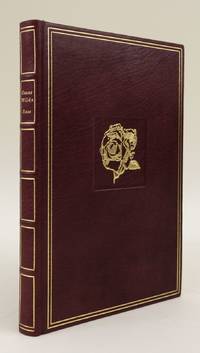
1982réf. ST16482Bayreuth: Printed by Chr. Scheufele Offizin Stuttgart for Bear Press 1982. No. 1 OF 10 COPIES ON VELLUM plus a "special" edition of 25 copies and 185 copies on Kochi Japanese paper. 223 x 148 mm. 8 7/8 x 5 3/4". 50 pp. 2 leaves.Translated and with an afterword by Wolfram Benda. Publisher's fine burgundy morocco by Erwin Lehr upper cover with gilt rose in recessed square flat spine with gilt titling turn-ins with gilt fillet frame pale yellow silk pastedowns. In the original burgundy suede slipcase. With three large initials in burnished gold and four signed and numbered original etchings by Peter Klitsch. Printed in red and black. Signed in the colophon by the artist the binder and the publisher/translator. In mint condition. This is the splendid deluxe version of a finely crafted private press edition of Wilde's fairy tales "The Nightingale and the Rose" "The Happy Prince" and "The Selfish Giant." It is the third work issued by the Bear Press founded in 1979 by literary scholar Wolfram Benda and still in operation. According to the firm's website "at a time when the craftsmanship and ethos of the artisan in bookmaking have been damaged by ever-increasing industrialization and neglect . . . The Bear Press . . . tries to achieve the highest possible degree of technical and artistic perfection in its printed works." The font used to print the text and the artist chosen to illustrate each work are carefully selected to express "the individual author's personality and intention." Even the discriminating aesthete Wilde 1854-1900 would be pleased with the choices here especially for the luxurious vellum printing: the type is set in refined Walbaum Antiqua and shown off with special effect by the creamy leaves; the etchings by Austrian artist Peter Klitsch b. 1934 are meticulous detailed and reminiscent of the work of Wilde's friend Aubrey Beardsley; and the binding is the epitome of tasteful restraint flawlessly executed with premium materials. The three tales here first appeared in 1888 and are bittersweet in their themes of love and self-sacrifice. His stories for children were one of Wilde's early successes and DNB notes "Their permanent place in child affections refutes the vulgarism that Wilde's literary reputation arose from his legal notoriety. In all cases the fairy tales are on the child's side celebrating the courage and generosity of the poor and vulnerable while their satire mocks the kind of pomposity and hypocrisy children can recognize." We have been able to trace just two other copies of the vellum printing at auction in ABPC and RBH. [Printed by Chr. Scheufele Offizin, Stuttgart, for] Bear Press unknown
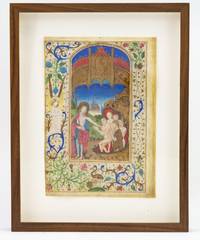
1470réf. ST17764Delft ca. 1470. Leaf: 175 x 122 mm. 6 7/8 x 4 3/4"; Frame: 250 x 195 mm. 9 3/4 x 7 3/4". No text on recto or verso. In an attractive wooden frame. A FINELY PAINTED MINIATURE OF THE HARROWING OF HELL within an arch-topped compartment the mouth of hell depicted on the left with a fiery red interior and five people emerging from it the figure of Christ on the left holding a cross on a long staff and half-clothed in a pink and blue robe the background with a castle in the distance ALL OF THIS BENEATH A VERY DETAILED ARCHITECTURAL CANOPY suspended in the sky AND THE WHOLE WITHIN A FULL BORDER of acanthus leaves and other foliage and flowers in reds blues greens yellows and brushed gold along with very many small burnished gold ivy leaves and buds on hairline stems a small stork in the bottom border and a large delicately shaded angel in the left border. ◆Left margin trimmed very close to decoration just escaping loss and the other three margins ample mild darkening right at fore and tail edge but not reaching into borders otherwise IN FINE CONDITION the colors rich and true and the burnished gold still shimmering. This extraordinary miniature notable for its uncommon subject matter memorable imagery and fine workmanship was produced by a talented artist belonging to the stylistic group known as the Masters of the Delft Half-Length Figures. The subject here is infrequently depicted in Books of Hours: the Harrowing of Hell appears as a full-page miniature in only three of the 119 prayer books described by Roger Wieck in his "Time Sanctified" and three others contain a Harrowing depiction inside an initial. Christian theological tradition tells us that after his crucifixion Christ went to liberate souls from Limbo--a location inhabited by those barred from entry into Heaven because they died before the Redemption. In our scene Christ wrapped in a regal cloak and carrying a long staff his hands and feet still bleeding from the wounds he received on the Cross reaches into an absolutely wonderful Hellmouth to extricate Adam and Eve and other naked souls while the recently deceased and original saint John the Baptist still clad in an animal skin garment waits patiently for his turn to emerge. The great maw of Hell as depicted here has bulging eyes a distended snout thickly matted hair and a bad complexion; his gaping mouth punctuated by sharp gray teeth glows red hot and one can tell from the creature's expression that he is loath to comply with this rescue of souls. In addition to its compelling subject matter there is a high level of artistic achievement here including delicately molded figures impressively detailed architectural elements and a lovely color palette. The elegance and quiet sophistication observed in this miniature distinguishes the artist responsible for this work as a particularly talented member of his circle. Active from about 1450-80 the Masters of the Delft Half-Length Figures were named by James Marrow after the angels and other figures whose upper bodies are typically found emerging from a cloud within the borders. Although the present leaf uncharacteristically contains a full-length angel in the border it shares other stylistic similarities such as the elaborate architectural canopy hovering over the main composition; and it particularly resembles the work of the artist of Keble College MS 77 an illuminator described in "The Golden Age of Dutch Manuscript Illumination" as "one of the more articulate of the group" whose "figures are more fully modelled and his palette . . . deeper and brighter" than that of his contemporaries. Because the subject of the present miniature goes beyond the standard image program seen in routine productions and because of the high level of artistic accomplishment seen here this leaf was almost certainly part of an elaborate Book of Hours produced in response to an important commission. unknown
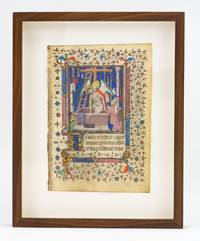
1415réf. ST17763Paris ca. 1415-20. Leaf: 160 x 110 mm. 6 1/4 x 3/8"; Frame: 232 x 185 mm. 9 1/8 x 7 1/4". Recto with three lines single column in a gothic book hand verso not inspected due to frame. Mounted in a wooden frame. Recto with a three-line initial in blue on gold ground embellished with ivy leaves A HALF-PAGE MINIATURE DEPICTING THE MASS OF ST. GREGORY the recently crucified Christ depicted emerging from a tomb supported by an angel and surrounded by the Arma Christi St. Gregory kneeling at the corner of the image the text and miniature framed by thick bar borders of pink blue and gold on three sides all SURROUNDED BY A FULL BORDER of hairline vines gilt ivy leaves and bezants and a few colorful flowers and acanthus. A little faint smudging in top and bottom borders very small scarcely noticeable area of blue background retouched not affecting the figures but A BEAUTIFUL LEAF the colors bright and the detail in the miniature very well preserved. Featuring carefully realized detail intriguing iconography and artistry that shows a very high degree of skill this is an important and early example of the work of the Master of the Harvard Hannibal. The subject of the present work is a well-known story about the sixth century Pope Gregory ca. 540-604 commonly known as St. Gregory the Great. According to legend Gregory was saying Mass when one of his deacons expressed a doubt in the doctrine of Transubstantiation whereby the communion bread actually becomes the body of Christ. Gregory prayed to God for a verifying sign whereupon Christ appeared in the guise of the Man of Sorrows clad in a loincloth and displaying the bloody wounds he incurred during the Crucifixion. Most Medieval miniatures depict Gregory kneeling before an altar as he says Mass accompanied by one or more deacons or assistants who bear witness to the miraculous event. In a notable departure from this norm the present miniature depicts the saint alone at the edge of the picture plane; in place of the chalice host and altar that would normally occupy the center of the scene is a considerable open tomb from which a larger-than-life-size Christ emerges. With blood still rushing from his wounds he places one hand on the edge of the tomb to steady himself while an angel supports him from behind. Christ's expression conveys both physical and mental pain as he struggles to support his own bodyweight; the angel who assists him spreads his wings protectively around the body of Christ while looking down at Gregory with a sorrowful expression knitted into his brow. The fine detail work seen in the figures' faces the angel's wings and the careful delineation of each slender finger is also carried over into more than a dozen objects crammed into the spaces in and around the tomb the rope is especially remarkable in the representation of its detail. Known as the "Arma Christi" or "Instruments of the Passion" these objects are meant to symbolize Christ's suffering. Seen here are: the cross nails and hammer that were used to crucify Christ the ladder used in the Deposition the disembodied hand symbolizing the one which slapped Christ's face the dice used by soldiers to see who would claim his seamless robe a lantern used by the soldiers who arrested Christ the 30 pieces of silver from Judas' betrayal a purple robe used in the mockery of Christ and other items that appear as part of the Passion narrative. It is also interesting to note that although a St. Gregory miniature usually appears at the beginning of the Hours of the Cross the Penitential Psalms or before the Seven Prayers of St. Gregory here rather unusually it opens a reading from John chapter 19 beginning "In illo tempore adprehendit Pilatus Iesum et flagellavit" describing the events of the Passion. This miniature can be attributed to an artist known as the Master of the Harvard Hannibal so-named for a splendid miniature painting of the "Coronation of Hannibal" prefacing a Livy in the Harvard College Library. Active from about 1415-30 in Paris and later possibly Rouen it is believed that our illuminator was a pupil of the Boucicaut Master with whom he is thought to have collaborated on several manuscripts both secular and religious. The present miniature would probably have been executed early in his career and while it certainly shows the influence of his teacher it also reveals certain stylistic tendencies that would become staples of the Master of the Harvard Hannibal's more mature work such as his preference for rich colors heavy molding of the faces and interest in decorative details. With its clever composition meticulous detail work and emotive figures that engage the viewer the present miniature is not only a beautiful work of art it also documents the precocious talent of an emerging master early in his professional career. unknown
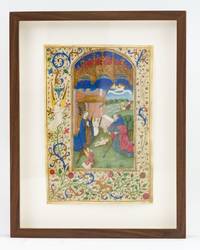
1470réf. ST17765Delft ca. 1470. Leaf: 172 x 115 mm. 6 3/4 x 4 1/2". Frame: 242 x 190 mm. 9 1/2 x 7 1/2". In an attractive wooden frame. A FINELY PAINTED MINIATURE OF THE NATIVITY within an arch-topped compartment the parents of the Christ Child kneeling before him as he lies on the ground outside the stable Joseph uncharacteristically supporting himself with a cane in his left hand and holding a long burning candle in his right two diminutive angels in attendance the head of an ass sticking out of the stable window in the background to the left AND IN THE RIGHT BACKGROUND A CHARMING DEPICTION OF THE ANNUNCIATION TO THE SHEPHERDS ALL OF THIS BENEATH A VERY DETAILED ARCHITECTURAL CANOPY suspended in the sky AND THE WHOLE WITHIN A FULL BORDER of acanthus leaves and other foliage and flowers in reds blues greens yellows and brushed gold along with very many small burnished gold ivy leaves and buds on hairline stems a small stag in the bottom border and a large delicately shaded angel who mirrors the Virgin's pose in the left border verso blank. ◆A hint of soiling to edges of vellum but IN VERY FINE CONDITION without any paint erosion with the colors rich and true and with the burnished gold still shimmering. Notable for its attractive color scheme fine craftsmanship and unusual composition this vibrant leaf was produced by a talented artist belonging to the stylistic group known as the Masters of the Delft Half-Length Figures. The lack of text and blank back of this leaf clearly suggest that it was produced as a singleton intended for insertion in a Book of Hours and its subject matter indicates that it would have faced the opening for the third hour of the day Prime. The present depiction of the Nativity is out of the ordinary in that it is combined with another scene the Annunciation to the Shepherds a subject that usually begins Terce in the Hours of the Virgin. It is a testament to the artist's ingenuity and compositional skills that he has managed to incorporate these two scenes so seamlessly; in fact rather than pulling focus from the main subject celebrating the birth of Christ this secondary scene adds additional interest to the picture and amplifies the storyline. Though the Annunciation to the Shepherds takes place at a distance from the Nativity we immediately grasp their connection and can see how arrival of humanity's savior was felt far beyond the manger. It is also interesting to note how much the artist has emphasized the figure of Joseph. Not only does he take up as much space as the Virgin but the candle and cane he holds frame the Christ child and communicate a strong suggestion of a protective parent the Virgin is doing her part by praying hard but she is more passive. In addition to its engaging subject matter there is a high level of artistic achievement here including delicately molded figures impressively detailed architectural elements and a lovely color palette. The elegant hand seen in this miniature manifests a quiet sophistication that distinguishes this artist as a particularly talented member of his circle. Active from about 1450-80 the Masters of the Delft Half-Length Figures were named by James Marrow after the angels and other figures whose upper bodies are typically found emerging from a cloud within the borders. Although the present leaf uncharacteristically contains a full-length angel in the border it shares other stylistic similarities such as the elaborate architectural canopy hovering over the main composition; and it particularly resembles the work of the artist of Keble College MS 77 an illuminator described in "The Golden Age of Dutch Manuscript Illumination" as "one of the more articulate of the group" whose "figures are more fully modelled and his palette . . . deeper and brighter" than that of his contemporaries. Because of the complexity of the subject matter and the high level of artistic accomplishment seen here this leaf was probably part of an elaborate Book of Hours produced in response to an important commission. unknown
1811réf. 10857Paris, Didot l'aîné, 1811. In-folio de 48 feuillets et 35 planches hors-texte, demi-veau chamois à coins, dos à nerfs, coiffes, mors et coins frottés. Reliure moderne. Exemplaire non rogné. Quelques rousseurs aux feuillets initiaux et finaux. Voici la collation des 96 pages de texte: [8] pages soit 1ff. blanc, faux-titre, titre, 1 ff. de table des planches, 6p. pour le Tableau général du lac de Genève (dernière bl.), [8]p. pour la description des planches, 10p. pour le Tableau général du Valais (dernière bl.), [8]p. pour la description des planches, 4p. pour le Tableau général du Simplon, [34]p. pour la description des planches, 2p. pour le Tableau général du lac Majeur, [12]p. pour la description des planches, [2]p. pour 1 ff. blanc.
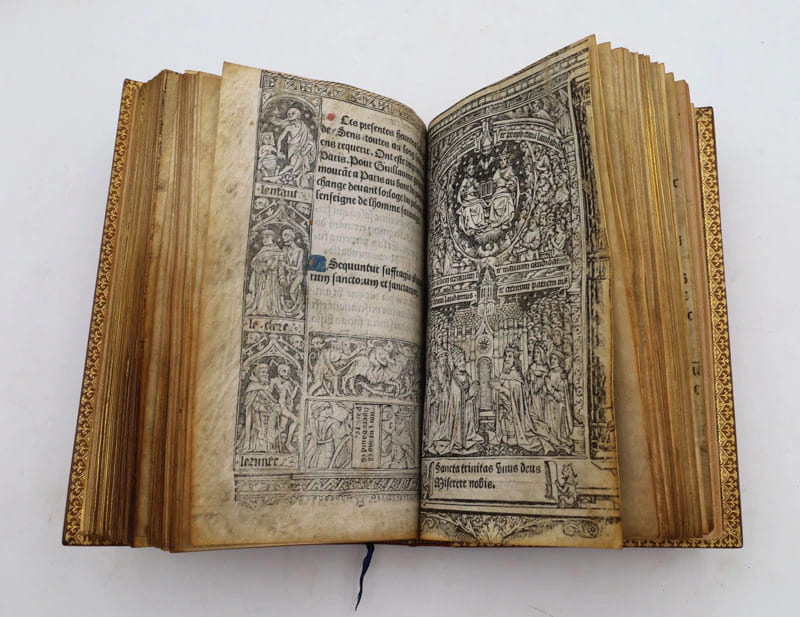
réf. 103646Paris, Guillaume Godard, post-incunable, s.d. [c. 1510-1520], in-8, [133] ff, [4] ff. manuscrits. (deux premiers feuillets manquants), Reliure pastiche en veau havane, décor à froid sur les plats, dos à nerfs orné à froid, pièce de titre rouge, roulette dorée en bordure intérieure, tranches dorées, Signatures : [A]6, B4, Ab6, a-k8, [n.s.]8, B8, D8, D8. Introuvables Heures à l'usage de Sens, imprimées par Guillaume Godard, sur vélin, illustrées de bordures et de grands bois issus du fonds du libraire parisien Antoine Vérard. Cet exemplaire est vraisemblablement un UNICUM : aucun exemplaire survivant n'est connu. Seul Brunet signale en avoir vu un ? et qui est apparemment le nôtre, les même feuillets en tête de volume étant manquants. Le texte est en gothique, en latin sur une colonne : il est orné de lettrines et bouts-de-ligne enluminés sur fonds rouges ou bleus. Les feuillets du calendrier sont réglés en rouge. L'ouvrage ouvre sur le calendrier (le f. de titre et celui du mois de janvier sont manquants), composé d'un feuillet par mois et d'une maxime s'y rapportant sous la forme de quatrains dans le style de Nostradamus ou Matthieu Lansbert*, en français moyen. Suivent enfin les prières liturgiques. L'usage de ce livre d'heure est donné au feuillet K8 v, avec le nom de l'imprimeur : "Ces présentes heures à l'usaige de Sens toutes au long sans rient requerir. Ont esté imprimées à Paris. Pour Guillaume Godar demeur[an]t à Paris au bout du pont au change devant l'horloge du palays. A l'enseigne de l'homme sauvaige". L'adresse réapparait au colophon. Les pages imprimées déploient leur texte dans des encadrements de motifs végétaux Renaissance, habités d'animaux fantastiques et de figures anthropomorphes. Certains sont compartimentés de vignettes historiées issues de l'histoire religieuse et, sur d'autres, se déroule la Danse macabre du libraire-imprimeur Antoine Vérard : ces 48 jolis blocs avaient été utilisés par Vérard lui-même pour les marges des livres d'heures qu'il fit imprimer à partir de 1500, avant d'être remployés par Guillaume Godard, au moins à partir de 1517, date à laquelle il fait imprimer des Heures à l'usage de Rome par Nicolas Higman**. Les prières liturgiques sont illustrées de dix-sept bois à pleine page, qui proviennent eux aussi du fonds d'Antoine Vérard : précisément, il s'agit des copies des gravures sur métal que Jean Pichore avait réalisées pour les frères Hardouin et Simon Vostre***, dont l'emploi par Godard est attesté dès 1514 pour une édition des Heures à l'usage de Rome****. L'iconographie est issue de l'Ancien et du Nouveau Testament, ainsi que les Apocryphes : Saint Jean l'évangéliste et l'épreuve de la coupe empoisonnée; l'Arrestation de Jésus et le baiser de Judas; l'Arbre de Jessé; l'Annonciation; La Sibylle de Tibur annonçant à Auguste la naissance du Christ; la Crucifixion; la Pentecôte; l'Adoration des bergers; l'Annonce aux bergers; l'Adoration des mages; la Présentation au temple; le Massacre des Innocents; la Dormition de la Vierge; Urie convoqué par David; la Résurrection de Lazare; la Sainte Trinité, avec une foule de dévots; et la Messe de saint Grégoire. Au verso du dernier feuillet figure enfin la célèbre marque typographique de l'imprimeur Guillaume Godard, sous la forme d'un rébus, et son explication en vers français ("Saluons Marie priant Jésus en croix..."). Le volume se clôt sur quatre feuillets manuscrits en français, rédigés à la même époque, n'appartenant pas à l'ouvrage, intitulés "Oraison à notre seigneur bien devote laquelle contient huit couplets". Les initiales et les bouts-de-ligne sont rehaussés de motifs de chaînettes à l'encre jaune. Titre et premier feuillet du calendrier (A1 et A2) manquants. Volume rogné court, en particulier dans la marge de tête, avec atteintes aux encadrements typographiques. Infimes épidermures, quelques taches. Petit manque Couverture rigide
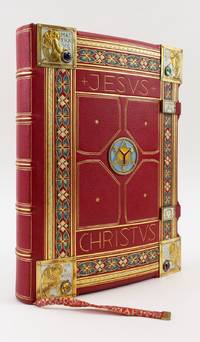
1925réf. ST16974Flensburg ca. 1925. 325 x 240 mm. 12 7/8 x 9 1/2". 4 p.l. first two blank 4 leaves 144 pp. 4 leaves last blank. Single column 31 lines in a fine calligraphic hand. FLAMBOYANT DEEP RED MOROCCO ELABORATELY INLAID AND GILT BY W. A. PETERSEN stamp-signed on rear turn-in covers framed by inlaid white morocco strip tooled with gilt triangles enclosing sides in a bead-and-lozenge pattern of gilt-outlined mandorlas containing a red cross on a blue background alternating with an inlaid white lozenge upper cover with brass and enamel cornerpieces featuring the symbols of the four Evangelists each of these set with a colored glass gem central panel divided into four compartments each containing a small star tool central brass and enamel medallion with a six-pointed star emblazoned with a sun and a red enamel "Y" two straps with brass and enamel clasps marked with Alpha and Omega lower cover with brass cornerpieces raised bands spine with gilt-ruled compartments turn-ins tooled with plain and dotted gilt rules and gilt stars deep pink moiré silk doublures shot with gold thread all edges gilt. In a box with a velvet-lined maroon buckram base and green marbled paper lid. With many initials of various sizes painted blue red green purple maroon or gilt three three-line initials in gold on a colored ground with the shape of a cross one two-line initial and 13 four- to six-line initials in gold on a multi-colored ground in a geometric design SEVEN HISTORIATED INITIALS each measuring seven to 11 lines in length FIVE MINIATURES MEASURING A THIRD TO THREE-QUARTERS OF THE PAGE each featuring a scene from the life of the Virgin or the life of Christ SIX FULL-PAGE ILLUMINATIONS incorporating text of different sizes and fonts many colors and patterns five of which contain a large central gilt circle the first of these completely filled with gold the others with a religious symbol in pen on bare vellum every page with a unique border composed of a thin frame with different geometric designs in gold and color some pages with an additional column of floral and foliate designs running down the left side of the text within the border plus additional flourishes elsewhere. Text in multiple sizes and fonts occasional words or phrases penned in color or gold. Boards somewhat bowed as often with bindings on vellum works occasional naturally occurring variations in the grain of the vellum a few instances of faint thumb smudging in corners but A BEAUTIFUL MANUSCRIPT IN ESPECIALLY FINE CONDITION the vellum smooth and fresh the illuminations shimmering and the binding unworn. Replete with gold illumination and bright colors evoking the appearance of Medieval manuscripts and stained glass this is an exquisitely produced work relating the life and words of Christ divided into five thematic parts: Light Word Spirit Death and Resurrection. Each part opens with a sumptuous full-page illumination reminiscent of the "carpet page" painting found in early Insular manuscripts; in the present work our artist fills the frame with a dazzling mixture of text and decorative patterns around a lustrous gilt medallion calling to mind the sun a resplendent halo or the Host. Although much of the decoration both on these full-page illuminations and elsewhere in this work remind one of Medieval manuscripts and are often composed of geometric designs and colors suggestive of stained glass the overall style here is decidedly modern. The palette is fresh and bold while the emphasis on strong lines and patterns shows the influence of the reigning Art Deco movement with echoes of the Art Nouveau movement that preceded it. Traditional biblical narratives in the form of historiated initials and miniatures are also presented here in refreshing ways: the image of the Sermon on the Mount for example places the viewer directly among the masses; we experience the event as a member of the audience would looking over the shoulders of the people in front of us to see Christ orating from a small hill silhouetted against a bright pink sky. Another memorable image--and the largest figural composition in this manuscript--is the Crucifixion. Though he has used a fairly standard composition the artist plays with our perception of space by setting the scene on a dark blue ground that envelopes the figures in a shadowy void; the only light source seems to come from the gold lettering immediately above the cross radiating off the face of Christ and to a lesser degree off the grief-stricken faces of John the Evangelist and the Virgin. All are pictured without haloes thus emphasizing the humanity of Christ over his divinity. As a whole this manuscript is extremely impressive in terms of artistry and technical execution and the prolific decoration and calligraphic variety hold the viewer's interest page after page. The equally impressive binding--modelled after the look of a Medieval Gospel book complete with enamel-like bosses and jewels--is fitting for a work that pays homage to the past while celebrating contemporary art and style. The life and work of calligrapher and illuminator Johann Holtz 1875-1944 is poorly documented but he seems to have been active in Flensberg Germany; he also worked as a graphic artist. Binder W. A. Petersen has proven equally illusive but we know that his workshop was also located in Flensburg. Given the town's close proximity to Denmark we might speculate whether Petersen was somehow related to the Copenhagen-based binder Immanuel Petersen who took over from master binder D. L. Clément in 1877. Despite the lack of biographical information on our artist and binder the work here needs no provenance information to be pleasing in every way from the gleaming binding to the beautifully preserved and magnificently illuminated contents. unknown
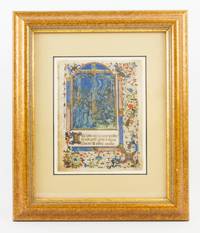
1440réf. ST19540aMetz ca. 1440. Leaf: 162 x 124 mm. 6 3/8 x 4 7/8". Frame: 308 x 258 mm. 12 1/8 x 10 1/8". Single column three lines of text under the miniature obverse with 18 ruled lines five of which contain text in a gothic book hand. Attractively matted and framed. Recto with one three-line initial in gold on pink and blue ground WITH A LARGE MINIATURE OF THE CRUCIFIXION WASHED IN BLUE Christ on a painted gold cross flanked by two thieves on painted gold crosses surrounded by throngs of people including the Virgin St. John Mary Magdalene and numerous soldiers all in an arched gold frame inside a three-sided painted and gilt baguette and a FULL BORDER of colorful vine sprays and flowers inhabited by a peacock. See: "The Jeanne Miles Blacburn Collection of Manuscript Illuminations" nos. 29-38; Avril & Reynaud pp. 182 & 190. Minor soiling/browning right at inner edge away from border and image otherwise IN VERY FINE CONDITION THE MINIATURE REMARKABLY WELL PRESERVED WITHOUT ANY LOSS OF PAINT. This stunning miniature with its memorable nocturnal scene comes from a very fine Book of Hours probably executed by Henri d'Orquevaulz or d'Orquevaulx or a member of his workshop. D'Oquevaulz was active during the second quarter of the 15th century in Metz the cultural and commercial capital of Lorraine during the period and the center of a growing book trade. According to the catalogue of the Jeanne Miles Blackburn Collection in the Cleveland Museum of Art which owns 10 leaves from the original manuscript the parent Book of Hours can be localized based on the Lorraine dialect found in the French text on some of the leaves including the present example and because the calendar singled out two bishop-saints of Metz Clement and Arnoul. Although little is known about d'Orquevaulz his dated signature in the colophon of a Livy manuscript that he illuminated for an alderman of Metz indicates that he was active in that city in 1440. Artistic affinities with northern European styles make it possible that d'Orquevaulz had emigrated from the Netherlands or Germany to Lorraine; another possibility one that Avril and Renaud suggest is that the master himself was from Metz but that he had German associates perhaps from the Rhineland area. According to these two scholars the painter's use of large flat areas of colors is more typical of the Rhineland the Netherlands or Bohemia than of France; in any case they praise his "exquisite color harmonies." The artist has outdone himself in the present miniature rising to the height of pathos and making it one of the most extraordinary leaves we have ever offered for sale. In contrast to the bright colors used in Books of Hours even to depict the most serious scenes the present leaf presents a remarkable visual nocturne with the figures and buildings painted in the same shades of blue as the sky suggesting that heaven itself is darkening at the death of Christ. Mary Magdalen kneels at the foot of the cross while St. John supports the devastated Virgin as a soldier pierces the Savior's side with a lance. The miniature is crowded with figures we see well-defined faces of no fewer than 18 persons and two horses but the artist has not lost his dramatic focus as Christ on his cross of brushed gold dominates the scene. In choosing to make this a darkened composition the artist has risked obscuring detail but his skill has been equal to his concept here as he has used a diluted blue paint that allows for a very successful delineation in various shades almost like grisaille this technique not incidentally has prevented the cracking and erosion so commonly seen with the normal thick applications of typical cobalt blue. The result of the decision to show the world in eclipse at Christ's death is to heighten and universalize the drama here to such an extent that the scene leaves a powerful and lasting impression. The text on this leaf is entirely in French in rhyming verse. Roughly it translates as: "Jesus on the cross did hang / And took upon himself our sins / Gave to humankind redemption / Rendered up his soul to God. / The sunshine lost its glowing light / The earth did tremble and did crack / Grieving for the bitter death / Suffered by the son of God." Although the original Book of Hours was dismembered some time in the 20th century extant leaves suggest that its visual program was much bigger than usual and probably the result of an important commission by a wealthy patron--something likely to be painted by one of the chief artists in the workshop. Illuminated manuscripts from Metz--let alone examples of this quality--are uncommonly seen on the market. unknown
THE ONLY COPY PRINTED ON VELLUM OF ANY BOOK ISSUED BY POULET-MALASSIS. In this monograph, Langlois (1829-1869), a leading Orientalist of his time (despite his short life), ingeniously uses archeological, historical, and scriptural evidence to prove the true location of Jesus' tomb. 48 pp. PRINTED ENTIRELY ON FINE VELLUM BY JOUAUST, ONE OF THE GREAT PRINTERS OF THE SECOND HALF OF THE 19TH CENTURY. to. Attractively bound in contemporary quarter morocco and decorated boards. Spine in five compartments with fleurons and raised bands. Tiny traces of wear to binding, else FINE AND BRIGHT. Launay 152; Contades, p. 39; OberlÈ 594 (this copy: "PrÈcieux exemplaire imprimÈ sur peau de vÈlin. Il est probablement unique. C'est le seul volume publiÈ par notre Èditeur qui ait ÈtÈ tirÈ sur peau de vÈlin.") Copies of this book on paper are very rare; this unique copy on vellum is A PIECE OF PUBLISHING HISTORY. Provenance: Jean-Jacques Launay, the comprehensive bibliographer of Poulet-Malassis, acquired this book after compiling his bibliography, and thus while he cites the book in his bibliography, he does not describe it (obviously because he was unable to locate any copy at all.) From him it passed to Gerard OberlÈ.
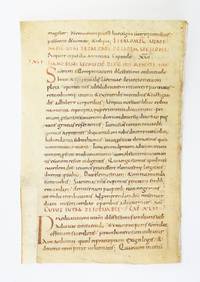
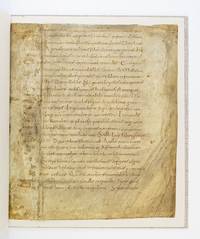
réf. ST17767BEGermany second quarter of ninth century. Each leaf approximately 305 x 205 mm 12 x 8". Single column 29-30 lines in a large and extremely legible Caroline minuscule. Rubrics in red each leaf with one or more large initials in red. Text with a few contemporary corrections and erasures. Accompanied by a copy of a letter from Bernhard Bischoff dating the manuscript leaves. ◆Vellum a little toned and soiled one leaf with an old repair to the bottom third of the outer margin minor folds small stains and other trivial imperfections but IN EXTREMELY FINE CONDITION the lettering clear and legible the vellum in excellent shape and the margins surprisingly comfortable. These are nothing short of magnificent specimens and remarkable survivals with wide borders all around with entirely clear and distinct script with only minimal overall dust soiling and with strength and freshness to the vellum; the leaves present a powerful redolence of a time as far in the past as one could optimistically hope to encounter among Western manuscript artifacts in the marketplace. The script here is an outstanding example of the highly legible Caroline minuscule that dominated Europe in the ninth century characterized by clear letter forms ample spacing between letters and between lines and very few abbreviations the most common occurrence being "&" for "et" occurring anywhere in a word. The parent manuscript was almost certainly a Homiliary containing sermons by various Christian authors to be said throughout the year with the present leaves containing passages from part of Leo I Sermo XCV and parts of a tractatus on Luke by Ambrose as well as other lections readings for the Vigil of the Feast of St Peter and the Feast of the Octave of Pentecost and the opening of a sermon of Leo I for Feria IV mensis IV; four other sister leaves are known and contain additional passages from Leo I and Ambrose as well as Pope Gregory I and readings for various feast days. The presence of these texts suggest that the leaves might have come from a Homiliary originally composed by Paul the Deacon at the behest of Charlemagne a version that was widely circulated throughout the Carolingian Empire in the eighth and ninth centuries. Although the scriptorium in which these leaves were produced has yet to be determined we can say with confidence that they date to the second quarter of the ninth century due to the style of the script as stated in the accompanying letter by esteemed paleographer Bernard Bischoff. Much of their history over the last 12 centuries remains a mystery but we do know that three of the extant leaves were in the possession of dealer Bruce Ferrini by 1989 with his stock number beginning "VM" and two bear the stock numbers and price codes of Quaritch. All were acquired by Martin Schøyen and became part of the renowned Schøyen collection MS 587. Very early leaves such as these often survive only because they come from manuscripts that were dismembered with the leaves then being reused as binding scrap; when later recovered they are typically in lamentable condition. The present leaves by contrast met no such fate--they have always been intact and untouched by the binder and so show none of the staining and trimming that are almost always present with repurposed leaves from demolished manuscripts. This notably fine state of preservation is rarely seen on the market. As a consequence these specimens are not only among the earliest leaves we have ever offered for sale but also some of the most extraordinary survivals we have ever acquired. We have bought and sold only a handful of ninth century leaves in our 45 years in business; in the present case because we were extremely lucky to acquire a small collection of six leaves from a single source we are able to offer them here at an advantageous price point. unknown
réf. ST16379-036Rome 2 December 1210. 206 x 293 mm. 8 1/8 x 11 1/2". 12 lines in a papal documentary script. Attractively framed. Lead bulla suspended on silk threads. Very light rubbing to ink in places one horizontal and three vertical creases each with a tiny hole where the folds meet lead seal showing a bit of wear around edges and to protuberances of the faces but these faults all quite minor and on the whole an excellent specimen. Beautifully preserved and with the original lead bulla still attached this document issued by one of the most powerful popes of the Middle Ages resolves a dispute between the monastery attached to the Lateran Palace and the priory of Santi Quattro Coronati Four Holy Martyrs. The two groups seem to have been in conflict over their respective parish boundaries and the inclusion or exclusion of certain churches and therefore the tithes and legal dues stemming from those churches within their particular networks of influence. According to this bull the cardinal priest of Sts. Peter and Paul was charged with hearing their petitions; based on his report Pope Innocent III decrees that the boundaries of the priory's parish will extend to the church of St. Nicholas "de formis" on one side and the arch of John the Baptist "intra formis" on the other side with "de formis" and "intra formis" possibly referring to their relative position to certain aqueducts in the city. The document also notes that it does not alter parish boundaries as formerly defined by Pope Calixtus II r. 1119-24. The present item falls into a category of papal documents known as "litterae solemnes" comprising solemn letters and simple privileges. Though somewhat shorter and less formal than the so-called "Great Bulls" which were very large and included many marks and signatures for authentication "litterae solemnes" still followed strict rules in terms of format and appearance and included a lead seal displaying the pope's name on one side and the visages of Sts. Peter and Paul on the other as here. For a full overview of papal bulls and their various formats see Clemens & Graham "Introduction to Manuscript Studies" pp. 230-36. Innocent III born Lotario dei Conti di Segni 1160 or 1161-1216 was considered the most powerful person in Europe during his reign 1198-1216 having done much to consolidate the power of the Holy See and exert influence over the affairs of nations near and far. Notably he proclaimed the supremacy of the church over secular authority launched the Fourth Crusade which ended in the sacking of Constantinople presided over the Fourth Lateran Council excommunicated King John of England and nullified the Magna Carta and vigorously suppressed heretical sects such as the Cathars. Papal bulls issued by Innocent III seem to be of the utmost rarity on the market; we could find just one other example recorded by ABPC and RBH as sold in the past 100 years going for a hammer price of €9000 $10999 in 2013. unknown
réf. ST17766Probably Germany third quarter of ninth century. 285 x 245 mm. 11 1/4 x 9 3/4". Single column 25 lines in a Caroline minuscule book hand. Tipped into a paper folder and presented in a tan cloth binding with ink notation on spine and a small sticker on upper cover. Rubrics in red. Front pastedown of folder with the bookplate of the Schøyen collection. With several pages of typed and handwritten notes including Bernard Rosenthal's cataloguing and a copy of a letter from Bernhard Bischoff to Rosenthal concerning the dating of the leaf. ◆Recovered from a binding and thus with some expected browning staining and wrinkling a long vertical fold through the text touching a couple letters of each line recto with the first few words of each line roughened and somewhat obscured a couple of other words a bit hard to make out but the vast majority of text very legible with fore and tail margins very ample and in all quite a good specimen representing a remarkable survival. Featuring a lovely Caroline miniscule hand this very early leaf from a Lectionary may have been made for the use of a particular church or individual and comes with recent distinguished scholarship and provenance. Although the text here contains familiar passages from the Old and New Testaments their juxtaposition in this context presents a bit of a conundrum: as the enclosed cataloguing explains the story of the wicked husbandmen from Matthew followed by the story of Esau surrendering his birthright to Jacob from Genesis "is an irregular and indeed unrecorded liturgical sequence of texts and suggests that this particular collection of lections was compiled for a particular church or private chapel." It is also possible that the Lectionary was made for the use of an individual rather than an institution with certain needs or preferences—perhaps a scholar or theologian or even a Carolingian nobleman many of whom were literate and educated. The hand here is an excellent example of the legible and elegant Caroline minuscule that dominated Western Europe in this period; distinctive letter forms include clubbed ascenders such as on the letters "b" "d" and "l" a long "s" with the shaft on the line and the use of the ampersand as a general abbreviation for the letters "et" occurring anywhere in a word for example "conter&" for "conteret". Termed the "integrated ampersand" this usage is especially characteristic of Caroline minuscule manuscripts of the late eighth and ninth centuries. Our leaf comes with bookseller Bernard M. Rosenthal's catalogue description noting that it was "Purchased from Schab New York Feb. 1969." William H. Schab was a book and art dealer in the firm of Gilhofer and & Ranschburg in Vienna before fleeing Austria in 1938 and settling in New York where he founded his own business. Also included here is a copy of a handwritten note regarding the date of the present leaf from renowned paleographer Bernard Bischoff. The leaf was also featured in Quaritch's 1991 catalogue 1147 Bookhands of the Middle Ages V no. 25.5 and was until recently part of the Schøyen Collection their MS 623. Four additional pages of cataloguing are also included here. Despite having been used as binding scrap at some point in its life this leaf is very well preserved with no words lost from trimming with distinctly visible ink and in a clear and very pleasing hand. unknown
1915réf. ST20770London: Especially written out and illuminated by Alberto Sangorski ca. 1915. 249 x 165 mm. 9 3/4 x 6 1/2". 18 2 pp. 2 leaves blank colophon. Attractive dark green crushed morocco gilt by Riviere & Son stamp-signed on front turn-in covers with wide frame and central panel tooled in gothic architectural motifs raised bands spine compartments with double gilt rules gilt lettering turn-ins framed by gilt fillets and dots scarlet watered silk pastedowns and endleaves all edges gilt old repair to head of spine. With one burnished gold initial "A" with intricate penwork embellishment in red and blue THE WORD "FOR" WRITTEN IN LARGE BURNISHED GOLD LETTERS SIX TIMES all with delicate penwork embellishment in blue or green TWO WITH A FAIRY-WINGED PUTTO perched on the crossbar of the "F" another "FOR" written in blue THE "F" IN BURNISHED GOLD ON A BACKGROUND OF BRUSHED GOLD WITH A PINK ROSE SPRIG a tailpiece of white jasmine blossoms entwined with a spray of lilac blooms FOUR ESPECIALLY FINE BRIGHT OVAL VIGNETTES approximately 90 mm. across SHOWING LOVELY GARDENS one of these accompanied by A HALF BORDER OF HUCKLEBERRY VINE another at the front as part of A SUPERB DOUBLE-PAGE OPENING FEATURING A PROFUSION OF PINK ROSES forming a frame around a gilt-edged cartouche bearing the title in blue surrounded by delicately blue and brown tendrils on the left AND A FRAME OF GRAPEVINES BEARING SUCCULENT PURPLE FRUIT ON A BRUSHED GOLD BACKGROUND on the right an oval view of a lake and mountains at its foot this frame enclosing text beginning with the words "GOD ALMIGHTY" in thickly burnished gold accented with curling blue and brown acanthus leaves and blue penwork. One page with trivial thumb smudge faint variations in shade of the vellum but A SUPERB SPECIMEN the vellum smooth and creamy the paint and gold bright and the virtually unworn binding with shining gilt. Featuring several gorgeous moments this is a luxurious and appropriately luxuriant illuminated manuscript of Bacon's prescription for the ideal princely garden. The most prominent modern creator of illuminated manuscripts our artist Alberto Sangorski 1862-1932 started his professional life as secretary to a goldsmith's firm before being attracted to the book arts at the age of 43. He began doing illuminated manuscripts that were then bound by his brother Francis' firm Sangorski & Sutcliffe with the colophon crediting the manuscript to the firm rather than acknowledging Alberto's contribution. Partly because of this failure to recognize his work Alberto had a falling out with Francis sometime around 1910 at which time he took his talents to Riviere the chief competitor to his brother's bindery. Robert Riviere began as a bookseller and binder in Bath in 1829 then set up shop as a binder in London in 1840; in 1881 he took his grandson Percival Calkin into partnership at which time the firm became known as Riviere & Son and the bindery continued to do business until 1939. Riviere was happy to allow Albert to add a colophon proclaiming as here that "This manuscript . . . was designed written out and illuminated by Alberto Sangorski." The decoration in the present work has an airy light-hearted aura with the bright gold lettering the delicate intricate penwork and the whimsical fairies conveying considerable joy and playfulness. And the beauty of the manuscript is heightened by the extremely fine condition here. Especially written out and illuminated by Alberto Sangorski unknown
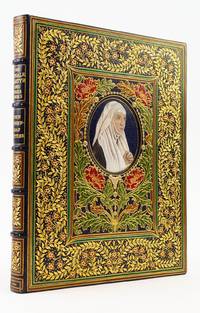
1914réf. ST18714London 1914. 265 x 207 mm. 10 1/2 x 8 1/4". 41 3 blank pp. 1 leaf colophon. RESPLENDENT IN DARK BLUE MOROCCO RICHLY GILT AND ONLAID BY RIVIERE & SON stamp-signed on front doublure covers with wide frame of swirling gilt vines bearing red morocco blossoms and blue and green berries bordered by strips of green and tan morocco central panel of upper cover with recessed oval containing a portrait of a young nun sculpted in leather with painted details this encircled by an onlaid ivory morocco rosary and surrounded by an exuberant spray of red morocco poppies with green and tan leaves central panel of lower cover with an arch-backed black morocco cat beneath the arch of a gray morocco horseshoe at center a black and red witch's hat above the horseshoe and the whole on a very densely stippled gilt ground incised with calligraphic curls and set with nine silver stars around the cat this centerpiece surrounded by curling gilt vines bearing red morocco and gilt posies raised bands spine compartments framed with tan morocco and containing a gilt and onlaid floral sprig TAN MOROCCO DOUBLURES bordered by a strip of purple morocco this with onlaid green morocco frame adorned with gilt latticework densely stippled gilt cornerpieces set with purple morocco passionflowers all accented with inlaid circles of purple navy and green in varying sizes leather hinges apricot watered silk endleaves all edges gilt. In the original silk- and velvet-lined green morocco box. Numerous two- to three-line initials in red blue or burnished gold three three-line illuminated initials 11 five- to six-line initials in shades of purple blue and green with highlights of pink and burnished gold two of these with extensions running the length of the text and two incorporated into full borders four very large initials 12 lines or more in colors and gold five full borders that on title page incorporating a small oval miniature of Whittier and TWO FULL-PAGE MINIATURES one of a young nun at prayer the other of two lovers walking in a forest. Calligraphed colophon SIGNED by Sangorski stating: "This manuscript . . . was designed written out and illuminated by Alberto Sangorski for Messrs. R. Rivière & Son Bookbinders & Booksellers to his Majesty King George V. London. This manuscript will not be duplicated. This manuscript was executed by me." From the collection of Phoebe A. D. Boyle her sale at Anderson Galleries 19-20 November 1923 lot 368. Front flyleaf with engraved bookplate of comic book pioneer M. C. Gaines 1894-1947; typed description from "Kolb Collection" Louis Kolb laid in. Ratcliffe "Albert Sangorski Bibliography" SJR 245. Vellum a bit wavy as is typical but A BEAUTIFUL COPY the leaves creamy and bright being painted with rich colors and glittering gold and IN A FLAWLESS BINDING. This is an outstanding example of the artistry of Alberto Sangorski and that of the binders gilders and finishers of Riviere & Son the volume being executed at the zenith of their creative powers and formerly owned by the most important collector of Sangorski's manuscripts. Sangorski has written out and illuminated three poems by American author John Greenleaf Whittier: "The Female Martyr" inspired by an 18-year-old nun from the Sisters of Charity who died nursing cholera victims; "The Witch's Daughter" set in Puritan New England; and "Memories" a lover's touching reminiscences of youthful romance. In addition to elaborate initials and borders in his preferred palette of blues purples and greens brightened with burnished gold Sangorski has created two full-page paintings one of the beautiful young nun at prayer the other of youthful sweethearts strolling arm-in-arm through a wood. Alberto Sangorski 1862-1932 started his professional life as secretary to a goldsmith's firm became attracted to the book arts at the age of 43 and began doing illuminated manuscripts that were then bound by his brother Francis' firm Sangorski & Sutcliffe. Sometime around 1910 Alberto and Francis had a falling out and the artist went to work for Riviere the chief competitor to his brother's firm. Like the manuscript here our binding by Riviere is the work of many months with hundreds of individual inlays onlays and applications of gilt. Robert Riviere began as a bookseller and binder in Bath in 1829 then set up shop as a binder in London in 1840; in 1881 he took his grandson Percival Calkin into partnership at which time the firm became known as Riviere & Son and the bindery continued to do business until 1939. New York collector Phoebe A. D. Boyle was the widow of a canvas manufacturer who had made a fortune providing tents to the U.S. Army in the Civil War. George Sutcliffe described this important client as "rivalling the Medici in her patronage of the production of beautiful books." Stephen Ratcliffe deems the Boyle collection as "unrivalled" for its jewelled bindings and modern illuminated manuscripts; 33 of Alberto Sangorski's creations appeared in her sale at Anderson Galleries in 1923 and during World War I she was one of the only customers for extravagant productions like the present item. Any book from the Boyle collection which was put together with the greatest taste and discrimination is recognized as desirable beyond its intrinsic literary merit. unknown
1930réf. ST19362England ca. 1930. 268 x 190 mm. 10 1/2 x 7 1/2". 31 1 pp. 1 leaf colophon. LOVELY ROSE-BROWN CRUSHED MOROCCO GILT INLAID AND BEJEWELLED front turn-in stamped in gilt "Made in England" but almost certainly by Sangorski & Sutcliffe covers framed by multiple plain and dotted gilt rules sprays of tulips at corners central panel of upper cover with animated floral design of onlaid white morocco flowers each set with a petite rose-cut diamond and of onlaid lilac and green morocco thistles all on a stippled ground raised bands spine compartments with spray of onlaid purple morocco berries green morocco label turn-ins framed with gilt ribbon roll and other decorative rolls ivory watered silk endleaves all edges gilt. In the original black pebble-grain morocco case with cushioned velvet lining upper cover detached. WITH ILLUMINATED TITLE PAGE FEATURING A VIGNETTE of the Tower of London and a border with knights on chargers SIX ADDITIONAL VIGNETTES AND FOUR FULL-PAGE MINIATURES AS WELL AS 10 FULL BORDERS THREE THREE-QUARTER BORDERS two half borders AND 13 LARGE ILLUMINATED INITIALS all executed with great imagination and skill. Pages with miniatures separated by silk guards others separated by paper. Leather with very slight naturally occurring variations in hue otherwise the volume IN PRISTINE CONDITION. This is a beautifully bound and exceptionally attractive modern illuminated manuscript celebrating English poetry and culture executed by the 20th century's undisputed master of illumination Alberto Sangorski. The text contains three early English poems: "While a Prisoner" by James I of Scotland; "Merciless Beauty" by Geoffrey Chaucer; and "The Nymph's Reply" by Sir Walter Raleigh. Each poem is followed by a brief section of biographical information about the author. In addition to the many beautiful decorated initials and sparkling borders Sangorski has also painted a total of seven vignettes and four full-page miniatures. The latter include an image of a woman dressed in Medieval garb reading a small book in a courtyard; an intimate portrait of the "Merciless Beauty" herself caught in a state of half-dress; the meeting of three young peasant women in a lush rural setting; and the boldly painted coat of arms of Scotland. Complex knotwork designs and precise gilt tooling among the borders demonstrate Sangorski's range and abilities and the text and capitals could not be more perfectly executed. The color scheme in this manuscript is particularly attractive featuring dark greens dusky blues and rich purples that contrast beautifully with the bright gold applications and white highlights. Most important the vignettes and full-page miniatures are painted with exquisite taste and exacting skill; they reward repeated and protracted viewing. Alberto Sangorski 1862-1932 started his professional life as secretary to a goldsmith's firm became attracted to the book arts at the age of 43 and began doing illuminated manuscripts that were then bound by his brother Francis' firm Sangorski & Sutcliffe. Sometime around 1910 Alberto and Francis had a falling out and the artist went to work for Riviere the chief competitor to his brother's firm. The lovely jewelled binding here is not described in Ratcliffe and the signature "Made in England" offers no indication of the binder's identity. The design however clearly suggests that the creator at work here must have been familiar with the work of both Sangorski and Riviere and it is possible that our binder may have been previously employed by one of these firms. The work is clearly on par with what those workshops were producing. Whatever the case may have been the binding is an appropriately fine addition to an already beautiful manuscript. unknown
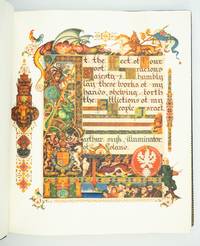
1939réf. ST20331London: Beaconsfield Press 1939. No. 72 OF 125 COPIES SIGNED BY THE ARTIST AND THE EDITOR for sale in the British Empire. 292 x 248 mm. 11 1/2 x 9 3/4". xxvi pp. 46 leaves all leaves French fold. Edited by Cecil Roth. Elegant original blue crushed morocco by Sangorski & Sutcliffe signed on front turn-in covers with gilt French fillet border and large intricate central figure designed by Szyk of a patriarch holding a goblet and book raised bands spine gilt in double ruled compartments with ornate crown centerpiece gilt titling turn-ins with double gilt-ruled and scalloped border surrounding an illustrated silk doublure featuring a Szyk portrait of Moses with the Ten Commandments done in shades of gray within a frame of elaborate design. In an excellent velvet-lined box of blue half morocco over lighter blue cloth upper cover with central lion's head in gilt on blue morocco spine like that of the book. WITH 14 FULL-PAGE AND 32 SMALLER COLOR REPRODUCTIONS OF DESIGNS BY SZYK. English translation printed in black commentary printed in red. Front flyleaf inscribed in ink: "To Mr. and Mrs. Solomon Brachman / very cordially / Arthur Szyk / New York. April 1945." Very faint naturally occurring variations in the grain of the vellum otherwise a pristine copy. With an important Holocaust-related authorial inscription this is a very fine copy of what the London Times described as "a book worthy to be placed among the most beautiful of books that the hand of man has produced." Arthur Szyk 1894-1951 a Polish Jew is considered by scholars to be the greatest 20th century illuminator. Using the style of the Medieval illuminated manuscript artists he has here created a Haggadah for Passover that is at once a beautiful book of devotion a political protest against the rise of Nazism and a plea for England's help for the Jews of Europe. By 1939 Szyk's anti-Nazi cartoons had caused Hitler to put a price on his head forcing him to flee to England. His original illustrations for his "Haggadah" featuring the villains of the Exodus with the heads of Hitler Goebbels and other leading Nazis had to be toned down before publication. All 46 pages of the Hebrew text are illustrated with scenes from the Passover story as well as vignettes of Jewish life in modern Europe—sometimes Szyk mixes the two to great effect. Perhaps the most moving illustration in the book is the elaborately illustrated dedication to King George VI of England appealing for his mercy to European Jews. The great symbols of the British Empire—the lion and unicorn St. George defeating the dragon—surround Szyk's plea to the king: "At the feet of your most gracious majesty I humbly lay these works of my hands shewing forth the affliction of my people Israel." In the lower right corner of the painting we see Jewish refugees beside one of the ships which were usually turned away from British shores while Szyk depicts himself leaning against the painting his brush and easel in hand. The text here is enriched by the historical introduction and the commentary contributed by Cecil Roth 1899-1970 the preeminent British expert on Jewish history. This crowning achievement of Szyk's life was four years in the making and has proved to be an enduring treasure. Szyk presented this copy to Texas oilfield supply magnate Solomon "Sol" Brachman 1896-1974 and his wife Etta. The son of a Latvian Jew Brachman was the founding president of the Jewish Federation of Fort Worth in 1936 and helped arrange an emergency $100000 bank loan for Israel on the eve of statehood in 1948. His wife who served as president of the National Council of Jewish Women was known as "the mother of Hadassah." Szyk's 1945 inscription was no doubt especially meaningful to this devout family whose Latvian relatives were among the 90 percent of that country's Jews who perished in the Holocaust. Beaconsfield Press unknown
1920réf. ST16608London: Designed written out and illuminated by Alberto Sangorski Colophon 1920. 255 x 212 mm. 10 1/8 x 8 1/2". 25 3 pp. ELEGANT LIGHT OLIVE GREEN CRUSHED MOROCCO GILT AND INLAID by Riviere for London bookseller Charles J. Sawyer stamp-signed "Chas. J. Sawyer Ltd. London" on front turn-in upper cover with inlaid mahogany-brown morocco lyre at head "strung" with gilt fillets and surrounded by dense gilt stippling six gilt fillets emanating from the top of this ornament and curling extravagantly below it with inlaid green morocco leaves at the tips of its extensions and inlaid red dots accenting the perimeter raised bands spine compartments with gilt and inlaid leaf sprig gilt titling turn-ins framed with five gilt fillets stippled and inlaid cornerpieces ivory moiré silk doublures and endleaves. In a fine full morocco plush-lined box with raised bands and gilt titling. ILLUSTRATED THROUGHOUT WITH EIGHT LARGE MINIATURES within extraordinarily elaborate illuminated borders FIVE FINE ROUNDELS FOUR LARGE HISTORIATED INITIALS a portrait of a young woman a leaping stag a skull and a landscape with a castle tower AND 25 ILLUMINATED INITIALS all with burnished gold. New expertly matched silk guards. SIGNED by Sangorski in the colophon following the statement: "This manuscript will not be duplicated." With an early typescript list of the contents laid in at front. Ratcliffe "Alberto Sangorski" SJR 338 attributing the binding to Riviere. ◆Spine slightly sunned to olive brown just a hint of sunning to head and fore edges of boards spine with half a dozen barely perceptible tiny dark spots but A VERY FINE COPY OF AN EXTRAORDINARILY BEAUTIFUL MANUSCRIPT the binding unworn and lustrous and the interior pristine with vellum clean and bright and the paintings perfectly preserved. Written out decorated and painted by one of the most accomplished illuminators of the modern era this attractively bound work celebrates some of Shakespeare's best-known plays with sumptuous miniatures that are in a perfect state of preservation. Songs from "The Tempest" "As You Like It" "Hamlet" "A Midsummer Night's Dream" and other works provide the inspiration for the many delightful miniatures seen here which display an impressive variety of portraits outdoor views and figural scenes--everything from reclining nudes to a particularly lush scene in which a group of spirited hunters return from the woods. The illustrations are all painted with exquisite attention to detail and demonstrate the artist's innate understanding of color rendering each composition delicate yet vigorous and vibrantly hued. All Sangorski manuscripts with miniatures are painted with great skill but this one is particularly arresting. Alberto Sangorski 1862-1932 started his professional life as secretary to a goldsmith's firm became attracted to the book arts at the age of 43 and began doing illuminated manuscripts that were then bound by his brother Francis' firm Sangorski & Sutcliffe. Sometime around 1910 Alberto and Francis had a falling out and the artist went to work for Riviere the chief competitor to his brother's firm. The gracefully tooled binding here was commissioned by London bookseller Charles J. Sawyer 1876-1931 who opened his shop in 1894. According to Brown and Brett's "The London Bookshop" Sawyer provided "anything suitable for a gentleman's library" with specialties in "rare items early English literature fine bindings and sporting and colour-plate books." While the binder fulfilling the commission did not sign this work Sangorski bibliographer Stephen Ratcliffe attributes it to Riviere & Son and there are examples of Riviere bindings decorated in this Art Nouveau style. But the design here with its delicate curving lines creating uncommon shapes also resembles the work done by members of the Guild of Women Binders. Whoever the artisans involved the binding is attractively designed and executed using premium materials and it provides a pleasing cover for the glorious illuminations within. [D]esigned, written out, and illuminated by Alberto Sangorski [Colophon]
1450réf. ST20835Flanders ca. 1450. 109 x 81 mm. 4 1/4 x 3 1/8". Single column 14 lines in a gothic book hand. 161 leaves. COMPLETE. Contents: Calendar f. 1r; Mass of the Holy Spirit f. 14r; Mass of the Holy Cross f. 23r; Requiem Mass f. 30r; Prayer on the Seven Last Words of Christ by the Venerable Bede f. 36v; Passion according to John f. 40v; blank f. 53; Hours of the Holy Cross f. 55r; Mass of the Virgin Mary f. 60r; Gospel Lessons f. 66v; Hours of the Virgin f. 73r; Penitential Psalms f. 126r; Litany f. 138r; Office of the Dead f. 144r. PLEASING NEAR-CONTEMPORARY BLIND-ROLLED CALF apparently with some old skilled restoration to joints spine and corners covers with rolled vine border surrounding a panel of three columns bearing a roll with parts of the inscription "AVE MARIA GRACIA PLENA" each word separated by one of four small motifs a flower a human profile the lamb of god and a sitting animal--perhaps a lion raised bands compartments with part of the same inscription roll. Lacking the original ties. Housed in a very attractive custom-made brown calf folding case with blind-stamped lettering on the spine interior lined in suede the whole within a calf-lipped suede-lined matching slipcase. Rubrics in red numerous one-line initials in blue with red penwork or gold with dark blue penwork many two-line initials in burnished gold on pink and blue ground with white embellishments several larger "I" initials between four and 11 lines in burnished gold on pink and blue ground with white embellishments 12 six- to seven-line initials some painted pink or blue with white embellishments and filled with flowers and tendrils on a gold ground or the initial in burnished gold on pink and blue ground with white embellishments EIGHT LARGE MINIATURES each inside a thin gold frame and with a three-quarter border of gilt leaves hairline vines and floral spays each facing page with a similar three-quarter border the subjects of the miniatures being: the Holy Spirit in the form of a dove f. 13v; St. Helena and the True Cross f. 22v; Raising of Lazarus f. 29v; Crucifixion f. 54v; Virgin and Child Enthroned f. 59v; Annunciation f. 72v; Last Judgment f. 125v; Funeral Mass f. 143v. Prickings visible in fore margins. See: Defoer et. al "The Golden Age of Dutch Manuscript Illumination" pp. 75-86. Just minor wear to the solid very pleasing early binding. A little chipping almost always mild to four of the miniatures with square frames the fifth the Annunciation somewhat rubbed and faded the three domed miniatures perfectly intact vellum with minor soiling and thumbing in places especially in lower corners of leaves in second half other trivial imperfections but overall a very well-preserved manuscript with no major issues. This enchanting little prayer book features eight attractive miniatures large gleaming burnished gold initials and a pleasing period binding--all in an excellent state of preservation. The miniature program here can be attributed to the so-called Masters of Otto van Moerdrecht the name given to a variety of Dutch artists active in the 1430s and '40s all working in a similar mode rather than to a specific master or workshop. According to Defoer et al. the work of these miniaturists "exhibit varied compositional formulas and bright highly contrasting colors . . . . The small somewhat doll-like figures appear rather wooden but their expressive gestures give the scenes a varied and vivid character." Two artistic hands are responsible for the present miniatures. The artist behind the first three miniatures all set within domed gilt frames the Holy Spirit St. Helena and Raising of Lazarus shows particular skill with a very smooth application of color figures with long eloquent hands and faces with subtle white highlighting. A second artist was responsible for the remaining five miniatures set within square golden frames Crucifixion Virgin and Child Enthroned Annunciation Last Judgment and Funeral Mass. Though this hand is less polished and the miniatures slightly smaller in size the scenes are all quite charming and attractively colored with vivid splashes of bright orange bubblegum pink sky blue and pale green. It is worth noting that the miniatures differ not only because of the artists' degree of success but also because of their condition: whereas the five are generally well preserved the other three are in a virtually perfect state. In addition to the central text of the Hours of the Virgin this manuscript contains several Masses each of which is preceded by a miniature. Perhaps the most interesting of these is the Mass of the Holy Cross which is paired with a miniature of St. Helena mother of Constantine the Great. According to Christian tradition Helena found the wooden cross used in the Crucifixion while she was travelling in Jerusalem in the fourth century. Constantine built the Basilica of the Holy Sepulchre in its honor and installed the relic there to be venerated. Britannica says that the adoration of the True Cross led to wide-spread sale of its fragments sought after as objects of devotion. It is unusual to find St. Helena depicted in a Book of Hours and this image is especially appealing with Helena in a beautiful red robe crown and halo embracing a large wooden cross in the center of the composition. The background is reminiscent of the work of the Gold Scrolls group with small swirls of liquid gold swimming in a scarlet sky the same scrolling motif graces the Holy Dove miniature. There is no indication of former ownership in this manuscript although the Calendar presents a few unusual saints that confirm a Flanders connection. These include St. Amandus in red known as the "Apostle of Flanders" on 2 February; St. Guido known as the "Poor Man of Anderlecht" on 9 September; St. Bavo in red patron saint of Ghent where a Cathedral is named in his honor on 10 October; and St. Eligius patron saint of goldsmiths and metalworkers on 1 December. The binding here is very close to contemporary and probably dates to the late 15th century. Neither the floral roll nor the "Ave Maria" roll seems to appear in EBDB. Similar rolls include r001954 r000623 and r000670 but ours is the only one with four different and charming tools one of each used between every "Ave" and "Maria." For a manuscript only slightly bigger than the palm of one’s hand this Book of Hours has a great deal to offer. In addition to its early binding and lovely illumination by an influential group of artists great care has been put into its preservation so that it resolutely endures for our pleasure and for owners in the centuries to come. unknown
1516réf. ST20620Northern France late 15th or early 16th century. 176 x 128 mm. 7 x 5". Single column 23 lines in a neat batârde hand. i blank 101 ii blank leaves. Lacking one leaf after f. 87 possibly containing a miniature otherwise complete. Contents: Calendar f. 1r; Gospel Lessons f. 7r; Passion according to John f. 10v; Hours of the Virgin f. 15v; Penitential Psalms and Litany f. 45r; Office of the Dead f. 54v; Hours of the Cross f. 68v; Hours of the Holy Spirit f. 70v; Prayers to the Trinity St. Veronica "Obsecro Te" "O Intemerata" and "Stabat Mater" f. 72v; Suffrages f. 79r; Prayers in French to be said on various occasions f. 86v; verse prayer in French beginning "Royne des cieulx glorieuse" f. 90r; additional prayers in French and Latin f. 93v. Attractive 19th century vellum with lacy gilt border raised bands ruled in gilt gilt lettering tan silk endleaves all edges gilt. Housed in a felt-lined reddish-brown pebbled morocco clamshell box with gilt lettering on spine. Rubrics in red numerous one- and two-line initials in painted gold on burgundy or blue ground WITH 27 SMALL MINIATURES one miniature of Christ Carrying the Cross measuring 60 x 68 mm. the rest depicting saints and measuring between eight and nine lines each surrounded by a full border of acanthus flowers and small dots on bare or painted vellum and 14 LARGE MINIATURES EACH OPENING WITH A FULL BORDER either with acanthus and flowers as before or architectural some borders embellished with figures animals or hybrids two with a small scene in the lower margin and about a dozen with the added coats of arms and/or mottos of Jean Boutin. The subjects of the large miniatures include the following: St. John of Patmos f. 7r; Annunciation f. 15v; Visitation f. 23r; Nativity f. 27v; Annunciation to the Shepherds f. 29v; Adoration of the Magi f. 31v; Presentation in the Temple f. 33v; Flight into Egypt f. 35v; Death of the Virgin f. 38v; Bathsheba bathing f. 45r; Funeral Mass f. 54v; Crucifixion f. 68v; Pentecost f .70v; Trinity f. 72v. See: Fairfax-Murray "French" p. 265-266. Vellum binding soiled but perfectly sound. Small portions of some border figures and perhaps three or four miniatures touched up in the 16th century see below occasional chipping to white paint small hole in the border of ff. 11 & 29 light scattered spotting fading thumb soiling and other minor issues but an attractive and substantially complete manuscript the illumination extensive and mostly well preserved. This heavily illustrated Book of Hours is a lovely example of provincial illumination; it calls attention in an interesting way to the influence of printed books on manuscript art; and it contains intriguing traces of an early prominent owner. Our manuscript contains a total of 41 large and small miniatures by a skilled artist who clearly had some training and familiarity with the prevailing styles of the time. The overall appearance of the work suggests the artist or workshop was located in Northern France and although the figures and backgrounds are indicative of a provincial hand the rich colors profuse use of liquid gold and sumptuous borders are unmistakable marks of luxury. The image of the Trinity is particularly lovely demanding the viewer's attention with God the Father's piercing gaze and conveying the majesty of the subject with a patterned throne set against a starry sky. Of special interest here are the compositions of the large miniatures many of which seem to have been copied from printed Books of Hours of the period. When we talk about the transition from manuscripts to print culture in the late-15th and 16th centuries the discussion often focuses on how the art of manuscripts influenced the appearance of printed works. There is no better example than Books of Hours which in printed editions often mimic the look of their manuscript predecessors in appearance and the way many were finished by hand. However as the present example demonstrates the opposite was also true as printed works inevitably made their way into the hands of manuscript artists. Some even worked simultaneously both as illustrators for publishers working with metal- and woodcuts and as manuscript painters. As a reflection of this point in the present work we find distinct similarities between our miniatures and a series of metalcuts used by Philippe Pigouchet for the publisher Simon Vostre beginning in 1496 Fairfax-Murray's set 2. According to Fairfax-Murray "These cuts . . . were evidently very favourably received by Pigouchet's rivals and imitators for one finds several close copies and adaptations in the various productions of other presses" including a very close imitation of woodcut images commissioned by the publisher Antoine Vérard. Evidently the popularity of these plates extended to manuscript artists and it is fascinating to see the adaptation of each composition to suit the painter's own style and the patron's needs. Most of the compositions in our manuscript are essentially simplified versions of the printed miniatures retaining the central figures their gestures garments and props but with complex backgrounds eschewed as are extra figures deemed unnecessary to fulfill the narrative. The resulting miniatures are far less busy than their printed counterparts allowing the viewer to focus on the central story. In a few instances the artist has added small scenes beneath the large miniatures. An example on f. 35 depicts the so-called "Miracle of the Wheat" featuring harvesters misleading Herod's soldiers by truthfully saying that the fleeing Holy Family passed by when their now miraculously matured crop was just being sown. This kind of inclusion may have been influenced by the copious small metalcut scenes that decorate the borders of numerous printed Books of Hours of this period. The text here follows a fairly typical structure but includes prayers in French to be said for each day of the week and on various occasions such as when one awakens or when one leaves a house. Also in French are additional verses to the Virgin--one of which is credited to the Franciscan preacher Jean Tisserand d. 1497 who founded an order for repentant women. Another accessory prayer included here f. 98 appeared in both prayer books and conjuring manuals of the period straddling the line between religion and popular magic. Based on an apocryphal encounter between Pope Leo III and Charlemagne during the Battle of Roncevaux this prayer was often used as a protective amulet against all manner of evil; here it is said to "conquer demons and one's enemies." Although we do not know for whom this manuscript was originally made the book shows a number of marginal customizations in the form of different coats of arms the motto "Soit avenu" "Let it come to pass" and the name of Jean Boutin written on ff. 23 and 35. This owner could have been Jean Boutin Sieur de la Court et de Chamballan and Mayor of Nantes from 1575-76. In addition to the marginal customizations the manuscript may possibly have some very neat replenishing of white facial paint in a handful of marginal figures and perhaps in a very small number of the miniatures. Using magnification and strong light we are unable to find convincing evidence that this retouching took place at least in the miniatures and if it was we think it was done quite early perhaps in the 16th century. Worst case it would necessarily be termed subtle and skillful enough to cause uncertainty now and whatever the verdict is in this respect the manuscript remains very fresh and attractive features attractively executed paintings is complete but for one leaf and would provide ample room for additional research. unknown