1.484 Ergebnisse
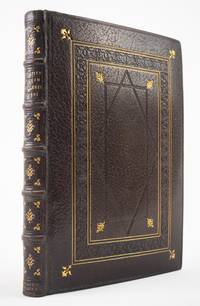
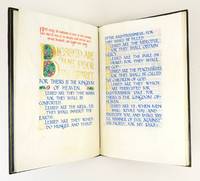
1939Best.-Nr. ST17129-020Wimbledon Surrey September 1939. 373 x 255 mm. 14 3/4 x 10". 12 vellum leaves seven with text and illuminations. Single column approximately 30 lines in a fine calligraphic hand. Attractive contemporary dark blue crushed morocco covers with gilt and blind rules raised bands with gilt rules gilt-ruled turn-ins vellum pastedowns. Text in blue black green and red a few lines with larger lettering in gilt several two-line initials in colored ink five two-line initials in red or blue with floral decorations opening pages with eight two-line initials in gold the lines here of a larger size than rest of text six three-line initials in gold filled and surrounded by floral decoration three four- to six-line gilt initials with more intricate floral decorations one of these with gilt stippling and two surrounded by a gilt frame and ONE VERY LARGE 80 x 45 mm GILT "B" decorated with stippling filled with two-tone green leaves pink flowers and large gold bezants. First leaf with ink inscription "Presented by Dr. W J Pearson / in appreciation of the work of / Ashridge Hospital 1939-1946"; two silk guards. Boards with a hint of soiling but A BEAUTIFUL MANUSCRIPT IN OUTSTANDING CONDITION the paint lovely and bright and the gold sparkling. This beautifully executed manuscript by a notable female calligrapher and illuminator features the oft-quoted and much-loved biblical text known as the "Sermon on the Mount" in which Matthew relates various moral teachings attributed to Christ. The text is written in an extremely pleasing and regular upright script throughout but the first opening listing the nine Beatitudes in capital letters is especially striking. Opening with the largest and most attractive initial in the manuscript it begins with "Blessed are the poor in spirit" in prominent gilt lettering; this is followed by the other blessings each beginning with a smaller gilt "B" initial written entirely in blue capital letters. The rest of the text penned primarily in black ink but accented with cheerful gilt initials and occasional colored lettering exudes a sense of order and simple elegance befitting the contents. Illuminator and calligrapher Violet Wilson was born in Wimbledon in 1902. She studied calligraphy under Claire G. M. Evans who had been a pupil of Graily Hewitt known for his work with the Ashendene Press and one of the principal British calligraphers and teachers of lettering in the first half of the 20th century. Wilson became a member of the Society of Scribes and Illuminators in the U.K. in the 1930s. The San Francisco Public Library has examples of her work in its Harrison Collection of Calligraphy and another illuminated copy of the "Sermon on the Mount" made in 1957 was included in the Baltimore Art Museum's 1965 exhibition and catalogue titled "Two Thousand Years of Calligraphy." The catalogue entry no. 213 notes that Wilson preferred to work on books and decorative maps and exhibited her work in many countries. According to the presentation inscription in the present work this manuscript was given to Ashridge Hospital--formerly a monastery and royal residence--by the distinguished physician Dr. Wilfred John Pearson 1884-1957 who had headed one of the London sectors of the Emergency Medical Service during World War II. His obituary in the "British Medical Journal" declared him "one of the striking figures of his time.". unknown books
Best.-Nr. ST17236Germany mid- to late 12th century. 290 x 217 mm. 11 3/8 x 8 1/2". Single column 21 lines in an attractive proto-gothic book hand. Rubrics in red several one-line initials in red five red initials measuring two to four lines long and with penwork embellishment A LOVELY SEVEN-LINE WHITE-VINE INITIAL outlined in red and with a pale yellow wash along the edge the lower half of the ground filled with green wash. Lower margins with notations in later Medieval hands. ◆A handful of original holes in the vellum no doubt from stretching the skin during processing with the scribe writing around the flaws where necessary a little soiling to lower outside corner one or two negligible spots otherwise IN FINE CONDITION the ink unusually rich and the paint very bright. From a Sacramentary a service book that contained the prayers said during Mass subsumed by the Missal in the 13th century this early leaf was once part of an attractive manuscript of very high quality. The very large and superb "F" opens the Mass for the Feast of the Assumption and the other readings here include Masses for Sts. Hippolytus and Cassian celebrated on 13 August; St. Eusabius 14 August; Vigil of the Assumption of the Virgin 14 August; Assumption of the Virgin 15 August; St. Agapitus 18 August; and the beginning of the Mass for Sts. Timothy Hippolytus and Symphorian 22 August. Sister leaves from this same manuscript have previously appeared in Sam Fogg Cat. 16 "Text Manuscripts and Documents 2200BC to 1600AD" 1995 nos. 30 and 31; Maggs Bros. European Bulletin 20 1995 no. 37; Quaritch Cat. 1270 "Bookhands of the Middle Ages VI" 2000 nos. 69 and 70; Sotheby's 6 December 2001 lot 8; and Bloomsbury 6 December 2017 lot 16. The Fogg description notes that similar initials can be seen in French German and Flemish manuscripts of the period "but very few manuscripts have the special characteristics of this one." For example the initials on the sister leaves described by Fogg contain atypically mauve and green as well as an "unusual . . . exterior contoured ground which is not confined by any geometric form." This means there is no line or shape to box in or define the capital's form; rather it appears as if surrounded by an aura or gentle shadow. Our initial contains a green ground only no mauve but the same unusual and attractive yellow aura. It is rare to find Romanesque leaves of this size and caliber in such fine condition and the present leaf with its beautiful regular proto-gothic hand exceptional white-vine initial and several large decorative initials in red is especially desirable. unknown books
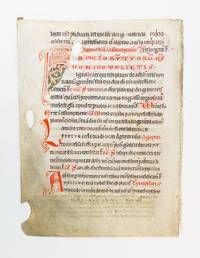
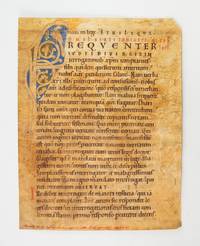
Best.-Nr. ST20617cAustria Salzburg second half of 12th century. 319 x 244 mm. 12 1/2 x 9 1/2". Single column 27 lines in a lovely proto-gothic hand. Rubrics in red two one-line initials and one two-line initial in red WITH A LARGE 140 mm. WHITE-VINE INITIAL INHABITED BY A BIRD outlined in red and filled in with blue and green. Lower margin of recto with a 20th century note in red ink identifying the text. Recovered from a binding and thus with overall darkening top half of verso somewhat soiled with top line obscured though with all other letters on both sides very distinct cut a little close to the thin red extension of the initial a few minor holes inlcuding one elongated one through the top part of the initial with minimal loss. Even with these defects a powerfully attractive leaf with memorable decoration and script. Containing a beautiful proto-gothic script and an exceptional Romanesque initial this leaf is a particularly desirable example of early Austrian manuscript production. The opening initial "F" is formed with foliate designs outlined in red given shape by coloring in the negative space with an intense azure blue and moss green. Adding to the initial's charm is a large bird perched on one of the curving branches turning its head to the right as if to read the text like the initial it is also outlined in red. The white-vine style seen here would later become a model for the Italian Humanist scribes and illuminators of 15th and 16th centuries who substituted glistening gold leaf for the vibrant yellow paint favored by some artists of the Romanesque period. The text here is from St. John Chrysostom's homily on St. Matthew 22:34-40 an account of the Pharisees questioning Jesus on God's law asking "which commandment in the law is the greatest" Jesus famously replies with the key tenets of the Christian faith: "You must love the Lord your God with all your heart with all your soul and with all your mind. This is the greatest and the first commandment. The second resembles it: You must love your neighbor as yourself. On these two commandments hang the whole Law and the Prophets." This text was the Gospel reading for the 19th Sunday after Pentecost preceded by the incipit "Frequenter iudei diversis interrogationibus" "The Jews repeatedly tested him with various questions". The present leaf almost certainly belonged to a Lectionary owned by a Romanesque church in Salzburg a manuscript that was later dismembered for use in bookbinding. According to the source from which we purchased this leaf it was shown in 1893 to the Medieval historian and later the Abbot of St. Peter's Salzburg Willibald Hauthaler 1843-1922 who wrote the identification in red ink along the lower edge. It was later owned by the Salzburg-based merchant artist and collector Carl von Frey 1826-96. It appeared at Christie's in 2010 where along with five sister leaves it sold for £13970. unknown
Best.-Nr. ST20617cAustria Salzburg second half of 12th century. 319 x 244 mm. 12 1/2 x 9 1/2". Single column 27 lines in a lovely proto-gothic hand. Rubrics in red two one-line initials and one two-line initial in red WITH A LARGE 140 mm. WHITE-VINE INITIAL INHABITED BY A BIRD outlined in red and filled in with blue and green. Lower margin of recto with a 20th century note in red ink identifying the text. Recovered from a binding and thus with overall darkening top half of verso somewhat soiled with top line obscured though with all other letters on both sides very distinct cut a little close to the thin red extension of the initial a few minor holes inlcuding one elongated one through the top part of the initial with minimal loss. Even with these defects a powerfully attractive leaf with memorable decoration and script. Containing a beautiful proto-gothic script and an exceptional Romanesque initial this leaf is a particularly desirable example of early Austrian manuscript production. The opening initial "F" is formed with foliate designs outlined in red given shape by coloring in the negative space with an intense azure blue and moss green. Adding to the initial's charm is a large bird perched on one of the curving branches turning its head to the right as if to read the text like the initial it is also outlined in red. The white-vine style seen here would later become a model for the Italian Humanist scribes and illuminators of 15th and 16th centuries who substituted glistening gold leaf for the vibrant yellow paint favored by some artists of the Romanesque period. The text here is from St. John Chrysostom's homily on St. Matthew 22:34-40 an account of the Pharisees questioning Jesus on God's law asking "which commandment in the law is the greatest" Jesus famously replies with the key tenets of the Christian faith: "You must love the Lord your God with all your heart with all your soul and with all your mind. This is the greatest and the first commandment. The second resembles it: You must love your neighbor as yourself. On these two commandments hang the whole Law and the Prophets." This text was the Gospel reading for the 19th Sunday after Pentecost preceded by the incipit "Frequenter iudei diversis interrogationibus" "The Jews repeatedly tested him with various questions". The present leaf almost certainly belonged to a Lectionary owned by a Romanesque church in Salzburg a manuscript that was later dismembered for use in bookbinding. According to the source from which we purchased this leaf it was shown in 1893 to the Medieval historian and later the Abbot of St. Peter's Salzburg Willibald Hauthaler 1843-1922 who wrote the identification in red ink along the lower edge. It was later owned by the Salzburg-based merchant artist and collector Carl von Frey 1826-96. It appeared at Christie's in 2010 where along with five sister leaves it sold for £13970. unknown books
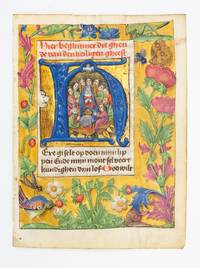
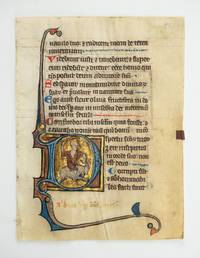
1470Best.-Nr. ST19885Netherlands ca. 1470-80. 164 x 123 mm. 6 1/2 x 4 7/8". Single column 17 lines in a gothic hand. Capitals touched with red rubrics in red one-line initials in red or blue one two-line initial in blue A VERY LARGE HISTORIATED INITIAL approximately 60 mm. square DEPICTING PENTECOST the initial painted blue with white tracery on a burnished gold ground surrounded by A FULL BORDER decorated with colorful acanthus large flowers strawberries insects including a grasshopper fly moth and mosquito all on a liquid gold ground. See: Marrow et al. "The Golden Age of Dutch Manuscript Illumination" nos. 79-81. ◆Margins just faintly soiled gold very slightly rubbed but IN FINE CONDITION the initial and border beautifully preserved. This is an extraordinarily handsome leaf featuring an oversized historiated initial depicting Pentecost attributed to the circle of the Master of the London Jason. Our artist has made remarkable use of space fitting 13 clearly defined people within an initial opening measuring 45 x 32 mm. The Virgin sits enthroned directly in the center encircled by the Apostles dressed in blue violet green and orange robes. Our artist cleverly adds a notch at the top of initial--like a cupola inside a chapel--in order to fit an image of a dove inside the scene. The figures show an impressive degree of individualization and emotional response as they witness the descent of the Holy Spirit; a few gesture in surprise two lower their gaze and some look up in awe. The work is stylistically like that of the Master of the London Jason named for his work on the "Historie van Jason" manuscript now housed at the British Library. As Marrow et al. note the Master's style is characterized by "somewhat short heavy figures that are well formed and have unusual slightly broad yet expressive faces with deep sunken eyes." Our leaf's enclosing border is of very considerable interest featuring as it does naturalistic flowers strawberry plants insects and a small brightly colored bird all painted in colors that perfectly complement the main scene. A very fine production all around this distinctive energetic leaf would make a notable addition to any collection. unknown
1470Best.-Nr. ST19885Netherlands ca. 1470-80. 164 x 123 mm. 6 1/2 x 4 7/8". Single column 17 lines in a gothic hand. Capitals touched with red rubrics in red one-line initials in red or blue one two-line initial in blue A VERY LARGE HISTORIATED INITIAL approximately 60 mm. square DEPICTING PENTECOST the initial painted blue with white tracery on a burnished gold ground surrounded by A FULL BORDER decorated with colorful acanthus large flowers strawberries insects including a grasshopper fly moth and mosquito all on a liquid gold ground. See: Marrow et al. "The Golden Age of Dutch Manuscript Illumination" nos. 79-81. ◆Margins just faintly soiled gold very slightly rubbed but IN FINE CONDITION the initial and border beautifully preserved. This is an extraordinarily handsome leaf featuring an oversized historiated initial depicting Pentecost attributed to the circle of the Master of the London Jason. Our artist has made remarkable use of space fitting 13 clearly defined people within an initial opening measuring 45 x 32 mm. The Virgin sits enthroned directly in the center encircled by the Apostles dressed in blue violet green and orange robes. Our artist cleverly adds a notch at the top of initial--like a cupola inside a chapel--in order to fit an image of a dove inside the scene. The figures show an impressive degree of individualization and emotional response as they witness the descent of the Holy Spirit; a few gesture in surprise two lower their gaze and some look up in awe. The work is stylistically like that of the Master of the London Jason named for his work on the "Historie van Jason" manuscript now housed at the British Library. As Marrow et al. note the Master's style is characterized by "somewhat short heavy figures that are well formed and have unusual slightly broad yet expressive faces with deep sunken eyes." Our leaf's enclosing border is of very considerable interest featuring as it does naturalistic flowers strawberry plants insects and a small brightly colored bird all painted in colors that perfectly complement the main scene. A very fine production all around this distinctive energetic leaf would make a notable addition to any collection. unknown books
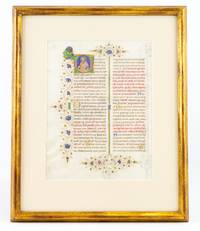
1441Best.-Nr. ST19880Italy Ferrara 1441-48. Visible leaf: 245 x 187 mm. 9 5/8 x 7 3/8"; Frame: 380 x 315 mm. 15 x 12 1/4". Double column 30 lines in a very fine rounded gothic hand a few lines of text in the same hand but smaller. Mounted and in a simple but pleasing gold frame. Visible side with rubrics in red one-line initials in burnished gold or painted blue one two-line initial in burnished gold on a pale pink ground with white tracery a lovely illuminated bar between the columns with a central plant knot AND SPROUTING IN UPPER AND LOWER MARGINS CLUSTERS OF FLOWERS AND LEAVES IN VARIOUS COLORS AS WELL AS GOLD BEZANTS outer margin with swirling penwork studded with gilt bezants running the length of the column each penwork swirl enclosing a painted and gilt flower with ONE FIVE-LINE HISTORIATED INITIAL DEPICTING ST. PAUL HOLDING A SWORD AND BOOK the initial painted pink with green leaves and a blue and green acanthus extension on a gilt ground. ◆Not examined outside of frame but in very fine condition: vellum slightly wavy text in the bottom margin just a bit faded but by all appearances A VERY CLEAN BRIGHT LEAF SPARKLING WITH GILT. Executed with great skill and delicacy and in sensitive Italianate colors highlighted especially by spring green and pink the present leaf is from a manuscript intended for a powerful aristocrat. It comes from the celebrated Breviary illuminated for the chapel of the Marquises of Este rulers of Ferrara and Mantua a manuscript commissioned by Leonello d'Este duke of Ferrara from 1441-50. Because the d'Este family kept excellent records we have confidence that this manuscript was done for Leonello by Giorgio d'Alemagna Bartolomeo de Benincà Guglielmo Giraldi and Matteo de' Pasti see Toniolo "La Miniatura a Ferrara dal Tempo di Cosmè Tura all'eredità di Ercole de' Roberti" 1998 pp. 19-20 and 76-77. The leaves show subtle variations in the style of the illuminations a result of work done by a team of artists doing variations on a theme. At one time in a Spanish library the manuscript was brought to Britain during the Peninsular War and came to be owned by the Rolls family later Lords Llangattock of Monmouth in Wales from whom it takes its name. By the time the work reached Britain most of the miniatures had already been cut out. The Breviary sold at Christie's on 8 December 1958 lot #190 to Goodspeed's of Boston who broke it up. The intact first quire of 10 leaves was purchased by Philip Hofer and given to Harvard cf. Wieck "Late Medieval and Renaissance Illuminated Manuscripts" p. 130 and fig. 74 and individual leaves appeared in 1967 in the catalogues of Folio Fine Art "the quality of the leaves is extremely high" Maggs Brothers "of a very high quality" and Alan Thomas "of exquisite quality". The present example is especially desirable for the portrait of St. Paul who is depicted holding a sword and book and whose carefully molded features reflect the growing interest in realistic portraiture in Renaissance Italy. unknown
1441Best.-Nr. ST19880Italy Ferrara 1441-48. Visible leaf: 245 x 187 mm. 9 5/8 x 7 3/8"; Frame: 380 x 315 mm. 15 x 12 1/4". Double column 30 lines in a very fine rounded gothic hand a few lines of text in the same hand but smaller. Mounted and in a simple but pleasing gold frame. Visible side with rubrics in red one-line initials in burnished gold or painted blue one two-line initial in burnished gold on a pale pink ground with white tracery a lovely illuminated bar between the columns with a central plant knot AND SPROUTING IN UPPER AND LOWER MARGINS CLUSTERS OF FLOWERS AND LEAVES IN VARIOUS COLORS AS WELL AS GOLD BEZANTS outer margin with swirling penwork studded with gilt bezants running the length of the column each penwork swirl enclosing a painted and gilt flower with ONE FIVE-LINE HISTORIATED INITIAL DEPICTING ST. PAUL HOLDING A SWORD AND BOOK the initial painted pink with green leaves and a blue and green acanthus extension on a gilt ground. ◆Not examined outside of frame but in very fine condition: vellum slightly wavy text in the bottom margin just a bit faded but by all appearances A VERY CLEAN BRIGHT LEAF SPARKLING WITH GILT. Executed with great skill and delicacy and in sensitive Italianate colors highlighted especially by spring green and pink the present leaf is from a manuscript intended for a powerful aristocrat. It comes from the celebrated Breviary illuminated for the chapel of the Marquises of Este rulers of Ferrara and Mantua a manuscript commissioned by Leonello d'Este duke of Ferrara from 1441-50. Because the d'Este family kept excellent records we have confidence that this manuscript was done for Leonello by Giorgio d'Alemagna Bartolomeo de Benincà Guglielmo Giraldi and Matteo de' Pasti see Toniolo "La Miniatura a Ferrara dal Tempo di Cosmè Tura all'eredità di Ercole de' Roberti" 1998 pp. 19-20 and 76-77. The leaves show subtle variations in the style of the illuminations a result of work done by a team of artists doing variations on a theme. At one time in a Spanish library the manuscript was brought to Britain during the Peninsular War and came to be owned by the Rolls family later Lords Llangattock of Monmouth in Wales from whom it takes its name. By the time the work reached Britain most of the miniatures had already been cut out. The Breviary sold at Christie's on 8 December 1958 lot #190 to Goodspeed's of Boston who broke it up. The intact first quire of 10 leaves was purchased by Philip Hofer and given to Harvard cf. Wieck "Late Medieval and Renaissance Illuminated Manuscripts" p. 130 and fig. 74 and individual leaves appeared in 1967 in the catalogues of Folio Fine Art "the quality of the leaves is extremely high" Maggs Brothers "of a very high quality" and Alan Thomas "of exquisite quality". The present example is especially desirable for the portrait of St. Paul who is depicted holding a sword and book and whose carefully molded features reflect the growing interest in realistic portraiture in Renaissance Italy. unknown books
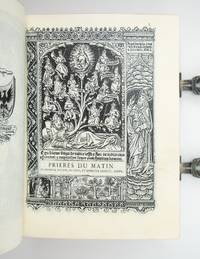
1858Best.-Nr. ST21120Paris: Printed by J. Claye for Gruel & Engelman 1858. 155 x 117 mm. 6 1/8 x 4 5/8". 703 1 pp. VERY FINE GOTHIC-STYLE BLIND-STAMPED BROWN MOROCCO BY LÉON GRUEL stamp-signed at foot of spine covers with central panel showing the Tree of Jesse surrounded by the words "Egredietur virga de radice Iesse et flos deradice eius ascendet et requiescat super eum" A rod shall come forth from the root of Jesse and a flower shall grow out of his root and rest upon him" this framed by a roll of grapevines and floral vines oblique fleur-de-lys at each corner two silver square knot fore-edge clasps one catchplate replaced raised bands densely gilt turn-ins marbled endpapers and flyleaves all edges stained red. In a very fine brown morocco-backed buckram drop-back box with padded plush interior gilt lettering on spine. Title page and colophon with large device of Gruel & Engleman featuring two angels verso of title with printer's device of J. Claye each page with elaborate woodcut border featuring biblical scenes modelled on those in printed 15th century French Prayer books and seven miniatures Tree of Jesse Crucifixion Deposition Pentecost Trinity Conception of the Virgin Annunciation to the Virgin. Front flyleaf with a lengthy ink inscription to Mademoiselle Jeanne Ansart from printer Jules Claye in elegant calligraphic hand dated 1 December 1876. With three contemporary prayer cards and two commemorative cards--one for the ordination of a priest one for a nun professing her initial vows--laid in. See Judge "Léon Gruel: Master of Medieval Revival in Bookbinding" Encyclopedia of Design 2021 online: https://encyclopedia.design/2024/03/21/leon-gruel-master-of-medieval-revival-in-bookbinding/; Jeremy Norman "Master Printer Jules Claye Inscribes a Copy of a Book of Hours that He Printed on Vellum" History of Information online: https://www.historyofinformation.com/detail.phpid=5590. Faint rubbing to joints and extremities isolated trivial thumbing one small red smudge but A VERY FINE COPY--clean fresh and bright internally in a very lustrous binding with sharp impressions of the stamps. A luxurious volume in every way this is the only known copy printed on vellum of a 15th century-style prayer book created by distinguished Parisian publishers Gruel et Engelmann; it was bound by a celebrated craftsman who was an expert on the history of his craft and presented by the printer to a young woman perhaps to commemorate her taking religious vows. The firm that became Gruel et Engelmann had a complex evolution. It was founded as a bindery by Isidore Desforges in 1811 and after Desforges' daughter Catherine married Paul Gruel 1800-46 the latter took over the business in 1825. Following his death Catherine kept the bindery going for five years before marrying Parisian publisher Jean Engelmann d. 1875. The spouses merged their firms and combined their specialties to produce beautiful devotional books inspired by Medieval manuscript Books of Hours and early printed prayer books bound in appropriately historic styles. Catherine's son Léon Gruel 1840-1923 joined the firm as a binder and after his stepfather's death Gruel et Engelmann was run by Léon who headed the binding division and his stepbrother Edmond Engelmann who was in charge of the design and printing of books. In her "Bookbinders and their Craft" Prideaux says that the Gruel firm "always had the highest reputation . . . for initiative in artistic matters as well as for irreproachable execution in the detail of its many-sided achievements." The productions of Gruel et Englemann were informed by the collecting enthusiasms of the brothers--Léon's for historical bindings and Edmond's for illuminated manuscripts. Under their direction Gruel et Engelmann published and bound numerous works of devotion like the present "Paroissien" a service book that includes the texts and prayers in Latin and French used to celebrate Mass throughout the year. The author of "Manuel Historique et Bibliographique de l'Amateur de Relieure" and an expert on historical bindings Léon Gruel was adept at replicating any number of antiquarian bindings styles. As he noted in an interview with "The Bookman" in 1900 "Modern book binding has discovered nothing to equal the old designs and at best we can only copy." For this volume he chose the very appropriate Gothic style a particular favorite of his. According to the "Encyclopedia of Design" Gruel's "blend of reverence for the past with innovative application in the present allowed him to recreate historical styles with unparalleled accuracy and creativity." According to the former owner of this book distinguished bibliophile and rare book dealer Jeremy Norman Gruel et Engelmann never advertised a vellum printing of this title leading him to believe that their printer Jules Claye 1806-86--whom he considers "one of the great French trade printers of the mid-19th century"--printed this copy on vellum for himself. The sturdy vellum leaves make the text block here 63 mm. thick--a considerable bulk for a volume of this size. Claye recognized this and even concluded his lengthy and elegantly calligraphed inscription to Mlle. Jeanne Ansart with a graceful apology for the weight of the book: "As you approach the hour when God shall bless you / I offer prayers for you though we have never met / And I come to consecrate with a devout remembrance / The day you shall behold this new dawn. / This work of my handsI must admit / Is heavy for yours to bear yet it shall endure. / Forgive me remembering that our Divine Master / Climbed Golgotha beneath the burden of His cross." While it is possible that "the hour when God shall bless you" and "this new dawn" might indicate a marriage it seems more likely that this refers to Mlle. Ansart's taking the veil. The presence here of a Mass card that depicts a young woman professing her initial vows as a nun would seem to support this theory. Whatever path she chose Jeanne Ansart and successive owners cherished and carefully protected this luxurious volume over the years leaving it for us to savor visually and tactilely. [Printed by J. Claye for] Gruel & Engelman unknown
1858Best.-Nr. ST21120Paris: Printed by J. Claye for Gruel & Engelman 1858. 155 x 117 mm. 6 1/8 x 4 5/8". 703 1 pp. VERY FINE GOTHIC-STYLE BLIND-STAMPED BROWN MOROCCO BY LÉON GRUEL stamp-signed at foot of spine covers with central panel showing the Tree of Jesse surrounded by the words "Egredietur virga de radice Iesse et flos deradice eius ascendet et requiescat super eum" A rod shall come forth from the root of Jesse and a flower shall grow out of his root and rest upon him" this framed by a roll of grapevines and floral vines oblique fleur-de-lys at each corner two silver square knot fore-edge clasps one catchplate replaced raised bands densely gilt turn-ins marbled endpapers and flyleaves all edges stained red. In a very fine brown morocco-backed buckram drop-back box with padded plush interior gilt lettering on spine. Title page and colophon with large device of Gruel & Engleman featuring two angels verso of title with printer's device of J. Claye each page with elaborate woodcut border featuring biblical scenes modelled on those in printed 15th century French Prayer books and seven miniatures Tree of Jesse Crucifixion Deposition Pentecost Trinity Conception of the Virgin Annunciation to the Virgin. Front flyleaf with a lengthy ink inscription to Mademoiselle Jeanne Ansart from printer Jules Claye in elegant calligraphic hand dated 1 December 1876. With three contemporary prayer cards and two commemorative cards--one for the ordination of a priest one for a nun professing her initial vows--laid in. See Judge "Léon Gruel: Master of Medieval Revival in Bookbinding" Encyclopedia of Design 2021 online: https://encyclopedia.design/2024/03/21/leon-gruel-master-of-medieval-revival-in-bookbinding/; Jeremy Norman "Master Printer Jules Claye Inscribes a Copy of a Book of Hours that He Printed on Vellum" History of Information online: https://www.historyofinformation.com/detail.phpid=5590. Faint rubbing to joints and extremities isolated trivial thumbing one small red smudge but A VERY FINE COPY--clean fresh and bright internally in a very lustrous binding with sharp impressions of the stamps. A luxurious volume in every way this is the only known copy printed on vellum of a 15th century-style prayer book created by distinguished Parisian publishers Gruel et Engelmann; it was bound by a celebrated craftsman who was an expert on the history of his craft and presented by the printer to a young woman perhaps to commemorate her taking religious vows. The firm that became Gruel et Engelmann had a complex evolution. It was founded as a bindery by Isidore Desforges in 1811 and after Desforges' daughter Catherine married Paul Gruel 1800-46 the latter took over the business in 1825. Following his death Catherine kept the bindery going for five years before marrying Parisian publisher Jean Engelmann d. 1875. The spouses merged their firms and combined their specialties to produce beautiful devotional books inspired by Medieval manuscript Books of Hours and early printed prayer books bound in appropriately historic styles. Catherine's son Léon Gruel 1840-1923 joined the firm as a binder and after his stepfather's death Gruel et Engelmann was run by Léon who headed the binding division and his stepbrother Edmond Engelmann who was in charge of the design and printing of books. In her "Bookbinders and their Craft" Prideaux says that the Gruel firm "always had the highest reputation . . . for initiative in artistic matters as well as for irreproachable execution in the detail of its many-sided achievements." The productions of Gruel et Englemann were informed by the collecting enthusiasms of the brothers--Léon's for historical bindings and Edmond's for illuminated manuscripts. Under their direction Gruel et Engelmann published and bound numerous works of devotion like the present "Paroissien" a service book that includes the texts and prayers in Latin and French used to celebrate Mass throughout the year. The author of "Manuel Historique et Bibliographique de l'Amateur de Relieure" and an expert on historical bindings Léon Gruel was adept at replicating any number of antiquarian bindings styles. As he noted in an interview with "The Bookman" in 1900 "Modern book binding has discovered nothing to equal the old designs and at best we can only copy." For this volume he chose the very appropriate Gothic style a particular favorite of his. According to the "Encyclopedia of Design" Gruel's "blend of reverence for the past with innovative application in the present allowed him to recreate historical styles with unparalleled accuracy and creativity." According to the former owner of this book distinguished bibliophile and rare book dealer Jeremy Norman Gruel et Engelmann never advertised a vellum printing of this title leading him to believe that their printer Jules Claye 1806-86--whom he considers "one of the great French trade printers of the mid-19th century"--printed this copy on vellum for himself. The sturdy vellum leaves make the text block here 63 mm. thick--a considerable bulk for a volume of this size. Claye recognized this and even concluded his lengthy and elegantly calligraphed inscription to Mlle. Jeanne Ansart with a graceful apology for the weight of the book: "As you approach the hour when God shall bless you / I offer prayers for you though we have never met / And I come to consecrate with a devout remembrance / The day you shall behold this new dawn. / This work of my handsI must admit / Is heavy for yours to bear yet it shall endure. / Forgive me remembering that our Divine Master / Climbed Golgotha beneath the burden of His cross." While it is possible that "the hour when God shall bless you" and "this new dawn" might indicate a marriage it seems more likely that this refers to Mlle. Ansart's taking the veil. The presence here of a Mass card that depicts a young woman professing her initial vows as a nun would seem to support this theory. Whatever path she chose Jeanne Ansart and successive owners cherished and carefully protected this luxurious volume over the years leaving it for us to savor visually and tactilely. [Printed by J. Claye for] Gruel & Engelman unknown books
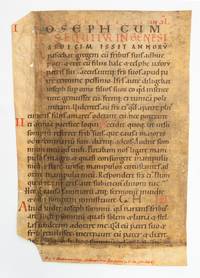
Best.-Nr. ST20617dAustria Salzburg second half of 12th century. 321 x 218 mm. 12 5/8 x 8 5/8". Single column 27 lines in a lovely proto-gothic hand top two lines in red or black uncials. Rubrics and numbers in red two one-line initials in red with A LARGE 115 mm. IMAGE OF JOSEPH WEARING HIS COAT OF MANY COLORS the body outlined in brown ink and the coat outlined in red. Lower margin of recto with a 20th century note in red ink see below. Recovered from a binding and thus with overall darkening on the recto and with nothing readable on the verso bottom line of text a bit damaged because of crease through it a few small holes two corners trimmed one or two letters of final line of text lost but more than half of the Joseph figure including the face still visible and the text on the recto entirely legible. Containing a beautiful proto-gothic script and a rare figurative Romanesque initial this leaf is a particularly desirable example of early Austrian manuscript production. The text here is as neatly noted in German at the tail edge of the recto Genesis 37:2-10 the beginning of the story of Joseph the 17-year-old son of Jacob here called Israel and his second wife Rachel. In the well-known biblical account Joseph is his father's favorite of 12 sons and the patriarch gives him a beautiful coat of many colors making his brothers jealous. Joseph here intensifies their dislike of him by recounting to his brothers two of his dreams in which sheaves of grain and then various celestial bodies bowed down to him. Dream or reality the images did not sit well with the brothers who sold Joseph into slavery. Although once the leaf was reused as binding material we can nevertheless make out an historiated "I" in the form of Joseph as a young man including an outline of his multi-colored coat. It is difficult to say with certainty whether the initial would originally have been washed with color or composed solely as a line drawing but whatever the case we are lucky to have so much of it intact. With his long flowing hair semi-nude body and hand placed delicately on his hip Joseph is depicted in quite a seductive manner and the simple line-drawing further emphasizes the body's curves and lithe appearance. Romanesque initials with historiation are not nearly as common as decorative ones and the present depiction is especially unusual. While illustrations of Joseph do appear in other manuscripts of this period they tend to focus on specific events from the biblical narrative--particularly those that lend themselves to the tradition of Joseph as a prefiguration of Christ such as Joseph being thrown into the pit or revealing his identity to his brothers. The present example by contrast is all about the presentation of the figure. This leaf almost certainly belonged to a Lectionary owned by a Romanesque church in Salzburg a manuscript that was later dismembered for use in bookbinding. According to the source from which we purchased this leaf it was shown in 1893 to the Medieval historian and later the Abbot of St. Peter's Salzburg Willibald Hauthaler 1843-1922 who wrote the identification in red ink along the lower edge. It was later owned by the Salzburg-based merchant artist and collector Carl von Frey 1826-96. It appeared at Christie's in 2010 where along with five sister leaves it sold for £13970. unknown
Best.-Nr. ST20617dAustria Salzburg second half of 12th century. 321 x 218 mm. 12 5/8 x 8 5/8". Single column 27 lines in a lovely proto-gothic hand top two lines in red or black uncials. Rubrics and numbers in red two one-line initials in red with A LARGE 115 mm. IMAGE OF JOSEPH WEARING HIS COAT OF MANY COLORS the body outlined in brown ink and the coat outlined in red. Lower margin of recto with a 20th century note in red ink see below. Recovered from a binding and thus with overall darkening on the recto and with nothing readable on the verso bottom line of text a bit damaged because of crease through it a few small holes two corners trimmed one or two letters of final line of text lost but more than half of the Joseph figure including the face still visible and the text on the recto entirely legible. Containing a beautiful proto-gothic script and a rare figurative Romanesque initial this leaf is a particularly desirable example of early Austrian manuscript production. The text here is as neatly noted in German at the tail edge of the recto Genesis 37:2-10 the beginning of the story of Joseph the 17-year-old son of Jacob here called Israel and his second wife Rachel. In the well-known biblical account Joseph is his father's favorite of 12 sons and the patriarch gives him a beautiful coat of many colors making his brothers jealous. Joseph here intensifies their dislike of him by recounting to his brothers two of his dreams in which sheaves of grain and then various celestial bodies bowed down to him. Dream or reality the images did not sit well with the brothers who sold Joseph into slavery. Although once the leaf was reused as binding material we can nevertheless make out an historiated "I" in the form of Joseph as a young man including an outline of his multi-colored coat. It is difficult to say with certainty whether the initial would originally have been washed with color or composed solely as a line drawing but whatever the case we are lucky to have so much of it intact. With his long flowing hair semi-nude body and hand placed delicately on his hip Joseph is depicted in quite a seductive manner and the simple line-drawing further emphasizes the body's curves and lithe appearance. Romanesque initials with historiation are not nearly as common as decorative ones and the present depiction is especially unusual. While illustrations of Joseph do appear in other manuscripts of this period they tend to focus on specific events from the biblical narrative--particularly those that lend themselves to the tradition of Joseph as a prefiguration of Christ such as Joseph being thrown into the pit or revealing his identity to his brothers. The present example by contrast is all about the presentation of the figure. This leaf almost certainly belonged to a Lectionary owned by a Romanesque church in Salzburg a manuscript that was later dismembered for use in bookbinding. According to the source from which we purchased this leaf it was shown in 1893 to the Medieval historian and later the Abbot of St. Peter's Salzburg Willibald Hauthaler 1843-1922 who wrote the identification in red ink along the lower edge. It was later owned by the Salzburg-based merchant artist and collector Carl von Frey 1826-96. It appeared at Christie's in 2010 where along with five sister leaves it sold for £13970. unknown books
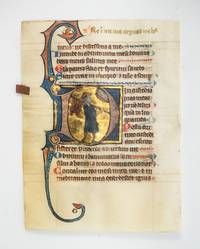
Best.-Nr. ST20846ESouthern Netherlands ca. 1280. 110 x 83 mm. 4 3/8 x 3 1/4". Single column 19 lines in a gothic hand. Rubrics in red simple line fillers in red or blue each leaf with multiple one-line initials in red or blue one leaf also with three two-line gilt initials on blue and pink ground and with bar border extensions in gold blue and pink EACH LEAF WITH A LARGE HISTORIATED INITIAL measuring seven to eight lines long 27-30 mm. the initial in pink and the figures painted on a gilt ground all this on a blue ground framed in gilt with spiky pink and blue marginal extensions studded with gilt bezants one of the leaves with a small hybrid creature with a human face incorporated into the extension. One leaf with early marginal notation; each leaf with a small leather tab marking major text on fore edge. One leaf with tip of marginal extension just grazed the other with vellum vaguely soiled and thinned in one spot resulting in tiny hole but attractive leaves in very pleasing condition overall. Featuring large historiated initials with some unusual iconography these leaves come from a charming Psalter-Hours attributed to the Morgan 183 Group. Active in the late 13th and early 14th centuries and so-named for a highly decorative manuscript once owned by J. Pierpont Morgan the artists of this group are considered important purveyors of the gothic style from Paris into Liege and the Southern Netherlands. Our parent manuscript was probably executed in Brabant or Hainault based on the presence of certain saints associated with these cities that appear in the Litany for example Sts. Waldetrudis of Mons and Amalberga of Maubeuge. Clues from other extant leaves containing additions and alterations to the text suggest that it was initially made for non-monastic use but later may have been adapted for a Benedictine community. The text of the present leaves come from the so-called "Seven Penitential Psalms" which are traditionally credited to King David and associated with his lamentations and atonement. The beginning of each Psalm is punctuated by a large historiated initial which marks the opening and provides a visual narrative to aid contemplation. The subjects include: a "Noli me tangere" for Psalm 6 "Domine ne in furore tuo arguas me". A full-length Christ in blue robes appears before a kneeling Mary Magdalene after his Resurrection. Between them is a tree with a bulbous red growth at the top acting as a symbolic divider between the earthly and spiritual realms. b David fleeing Saul for Psalm 38 "Dixi custodiam vias meas". This initial depicts David wearing a simple hat and tunic as opposed to a crown and robes as he escapes King Saul's murderous jealousy. He balances a staff holding a bundle of belongings on one shoulder see Morgan MS M.183 fol. 54v for a similar depiction as he is confronted by the disembodied head of God on the right. These leaves are excellent examples of the French high gothic style outside of Paris and offer multiple avenues for further research and comparison. unknown
Best.-Nr. ST20846ESouthern Netherlands ca. 1280. 110 x 83 mm. 4 3/8 x 3 1/4". Single column 19 lines in a gothic hand. Rubrics in red simple line fillers in red or blue each leaf with multiple one-line initials in red or blue one leaf also with three two-line gilt initials on blue and pink ground and with bar border extensions in gold blue and pink EACH LEAF WITH A LARGE HISTORIATED INITIAL measuring seven to eight lines long 27-30 mm. the initial in pink and the figures painted on a gilt ground all this on a blue ground framed in gilt with spiky pink and blue marginal extensions studded with gilt bezants one of the leaves with a small hybrid creature with a human face incorporated into the extension. One leaf with early marginal notation; each leaf with a small leather tab marking major text on fore edge. One leaf with tip of marginal extension just grazed the other with vellum vaguely soiled and thinned in one spot resulting in tiny hole but attractive leaves in very pleasing condition overall. Featuring large historiated initials with some unusual iconography these leaves come from a charming Psalter-Hours attributed to the Morgan 183 Group. Active in the late 13th and early 14th centuries and so-named for a highly decorative manuscript once owned by J. Pierpont Morgan the artists of this group are considered important purveyors of the gothic style from Paris into Liege and the Southern Netherlands. Our parent manuscript was probably executed in Brabant or Hainault based on the presence of certain saints associated with these cities that appear in the Litany for example Sts. Waldetrudis of Mons and Amalberga of Maubeuge. Clues from other extant leaves containing additions and alterations to the text suggest that it was initially made for non-monastic use but later may have been adapted for a Benedictine community. The text of the present leaves come from the so-called "Seven Penitential Psalms" which are traditionally credited to King David and associated with his lamentations and atonement. The beginning of each Psalm is punctuated by a large historiated initial which marks the opening and provides a visual narrative to aid contemplation. The subjects include: a "Noli me tangere" for Psalm 6 "Domine ne in furore tuo arguas me". A full-length Christ in blue robes appears before a kneeling Mary Magdalene after his Resurrection. Between them is a tree with a bulbous red growth at the top acting as a symbolic divider between the earthly and spiritual realms. b David fleeing Saul for Psalm 38 "Dixi custodiam vias meas". This initial depicts David wearing a simple hat and tunic as opposed to a crown and robes as he escapes King Saul's murderous jealousy. He balances a staff holding a bundle of belongings on one shoulder see Morgan MS M.183 fol. 54v for a similar depiction as he is confronted by the disembodied head of God on the right. These leaves are excellent examples of the French high gothic style outside of Paris and offer multiple avenues for further research and comparison. unknown books
1861THE ONLY COPY PRINTED ON VELLUM OF THIS IMPORTANT AND BEAUTIFUL PUBLICATION. Two volumes, complete. FIRST AND ONLY COMPLETE EDITION, and first and only critical edition of the works of Pierre de Brach, an important 16th-century poet from Bordeaux, a close friend of Montaigne and many other key French Renaissance literary figures. ABOUT HALF THE WORKS ARE PUBLISHED HERE FOR THE FIRST TIME: Dezeimeris had discovered an important manuscript which included many texts thought lost forever, including the "Tombeau et regrets funebres sur la mort d'Aymee" and the second book of the "Amours". Extensive scholarly apparatus, notes, and index. Edition limited to 260 copies, of which this is THE UNIQUE COPY beautifully printed (by Gounouilhou of Bordeaux) on FINE VELLUM, with numerous woodcut ornaments, headpieces, and tailpieces. Title-pages printed in red and black, with large woodcut printer's device. Text in Italic type, notes in Roman type. Two engraved portraits on chine applique and two wood-engraved plates. 4to. Attractively bound in contemporary half red morocco. Top edge gilt, other edges uncut. Minimal traces of wear to bindings, else a fine set. Vicaire I, 919 (citing this copy); Brunet supp. I, 167 (citing this copy): "Belle publication." Viollet le Duc (I, 333): "C'etait un ecrivain correct, un versificateur elegant et harmonieux, bien superieur sous ce rapport a tous les poetes ses contemporains. On peut lui reprocher de manquer de la verve et de l'entrainement de Ronsard, par exemple; mais comme forme de langage, c'est un auteur des plus remarquables et assurement digne d'Ítre etudiÈ." 19th century French books printed on vellum are rare, and in such a large format they are extremely rare.
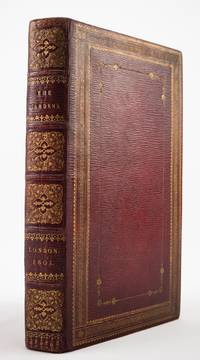
1805Best.-Nr. ST21016London: Printed by T. Bensley 1805. APPARENTLY THE ONLY COPY PRINTED ON VELLUM. 260 x 152 mm. 10 x 1/4 x 6". 2 p.l. 146 pp. 1 leaf notes. Translated by Maria Henrietta Montolieu. Very pleasing contemporary straight-grain scarlet morocco gilt by Charles Hering binder's ticket on verso of front flyleaf covers bordered with a wide frame of multiple patterned rolls with rosette cornerpieces enclosing a delicate frame of a dotted roll cornered small floral tools raised bands spine gilt in compartments wide turn-ins sumptuously gilt cream silk endleaves with gilt borders and fleuron cornerpieces all edges gilt. WITH EIGHT ENGRAVINGS BY FRANCESCO BARTOLOZZI IN TWO STATES one on gold silk and the second on paper. EXTRA-ILLUSTRATED with two engravings depicting Princess Izabela Czartoryska and her daughter Zofia. A Large Paper Copy. Henrey 624. See also Clemens Alexander Wimmer "The Princess and the Poles" Historic Gardens Review no. 10 2002: 14-17. Spine slightly darkened joints and edges with minor barely noticeable wear vellum a bit and naturally rumpled and consequently the book yawning a bit a handful of light spots but still an extremely appealing copy with fine impressions of the plates vast margins and a special story to tell. Printed on vellum richly bound and illustrated with attractive plates on silk this is an extraordinarily luxurious copy of Delille's famous poem on gardens that almost certainly belonged to a noblewoman whose gardens are mentioned in the text. First published in 1780 our poem condemns formal gardens and broad promenades in favor of a gardening art which hides its artistry by reproducing the asymmetrical groupings of nature and careless bounty of the countryside. This view accords with the translation of Virgil's "Georgics" done by Delille 1738-1813 in 1769 a version that brought him great acclaim for its supple and sonorous versification. In fact it so pleased the Count of Artois the future Charles X that he named Delille abbot of Saint-Séverin; however revolution disrupted things and the poet for a time led a wandering life in Switzerland Germany and England where this updated and expanded version of "Gardens" was published in 1801. The present special edition includes the plates which had appeared as head- and tailpieces in the first edition but now used as stand-alone plates in two states. These were executed by Bartolozzi after originals by Portuguese neoclassical painter Francisco Vieira. In addition to the called-for suite of illustrations our copy includes two inserted plates portraits of Princess Izabela Czartoryska 1745-1835 and her daughter Zofia. Czartoryska was a major figure in the Polish Enlightenment as a writer and patron of the arts as well as an advocate for improving the lives of the poor. She is best remembered for the sprawling gardens at her palace in Pu awy which included a formal garden a "wild promenade" or landscape park and multiple structures including the neoclassical Temple of the Sibyl which became one of Poland's first museums. She made the acquaintance of the author while travelling through Paris in 1791 and the two struck up a friendship. She financially backed the second edition of the work in exchange for a mention of her gardens which duly appears in heightened verse on pp. 11-13: "Favoured Pulhavi! You from Heaven obtain / Each separate charm Earth's choicest scenes contain; / Bright glow thy features fresh from Nature's hand / Excite our wonder and our praise command." The presence of this poetic tribute--and especially the inserted plates showing the princess and her daughter-- clearly suggest that the our apparently unique luxury edition must have been a presentation copy to Czartoryska herself. The present copy is as striking outside as it is inside. Charles Hering was the most distinguished and influential English binder of the first decade of the 19th century and although his career was brief from about 1795-1812 Ramsden focuses on his work as representing the transition in binding styles from those of the German émigrés of the late 18th century to the new generation of binders headed by Charles Lewis. Dibdin states that until "the star of Charles Lewis rose above the bibliopegistic horizon no one could presume to 'measure business' with Hering. There was a strength squareness and a good style of work about his volumes which rendered him deservedly a great favourite." We have been unable to trace any other copies of the present edition on vellum. Printed by T. Bensley unknown
1805Best.-Nr. ST21016London: Printed by T. Bensley 1805. APPARENTLY THE ONLY COPY PRINTED ON VELLUM. 260 x 152 mm. 10 x 1/4 x 6". 2 p.l. 146 pp. 1 leaf notes. Translated by Maria Henrietta Montolieu. Very pleasing contemporary straight-grain scarlet morocco gilt by Charles Hering binder's ticket on verso of front flyleaf covers bordered with a wide frame of multiple patterned rolls with rosette cornerpieces enclosing a delicate frame of a dotted roll cornered small floral tools raised bands spine gilt in compartments wide turn-ins sumptuously gilt cream silk endleaves with gilt borders and fleuron cornerpieces all edges gilt. WITH EIGHT ENGRAVINGS BY FRANCESCO BARTOLOZZI IN TWO STATES one on gold silk and the second on paper. EXTRA-ILLUSTRATED with two engravings depicting Princess Izabela Czartoryska and her daughter Zofia. A Large Paper Copy. Henrey 624. See also Clemens Alexander Wimmer "The Princess and the Poles" Historic Gardens Review no. 10 2002: 14-17. Spine slightly darkened joints and edges with minor barely noticeable wear vellum a bit and naturally rumpled and consequently the book yawning a bit a handful of light spots but still an extremely appealing copy with fine impressions of the plates vast margins and a special story to tell. Printed on vellum richly bound and illustrated with attractive plates on silk this is an extraordinarily luxurious copy of Delille's famous poem on gardens that almost certainly belonged to a noblewoman whose gardens are mentioned in the text. First published in 1780 our poem condemns formal gardens and broad promenades in favor of a gardening art which hides its artistry by reproducing the asymmetrical groupings of nature and careless bounty of the countryside. This view accords with the translation of Virgil's "Georgics" done by Delille 1738-1813 in 1769 a version that brought him great acclaim for its supple and sonorous versification. In fact it so pleased the Count of Artois the future Charles X that he named Delille abbot of Saint-Séverin; however revolution disrupted things and the poet for a time led a wandering life in Switzerland Germany and England where this updated and expanded version of "Gardens" was published in 1801. The present special edition includes the plates which had appeared as head- and tailpieces in the first edition but now used as stand-alone plates in two states. These were executed by Bartolozzi after originals by Portuguese neoclassical painter Francisco Vieira. In addition to the called-for suite of illustrations our copy includes two inserted plates portraits of Princess Izabela Czartoryska 1745-1835 and her daughter Zofia. Czartoryska was a major figure in the Polish Enlightenment as a writer and patron of the arts as well as an advocate for improving the lives of the poor. She is best remembered for the sprawling gardens at her palace in Pu awy which included a formal garden a "wild promenade" or landscape park and multiple structures including the neoclassical Temple of the Sibyl which became one of Poland's first museums. She made the acquaintance of the author while travelling through Paris in 1791 and the two struck up a friendship. She financially backed the second edition of the work in exchange for a mention of her gardens which duly appears in heightened verse on pp. 11-13: "Favoured Pulhavi! You from Heaven obtain / Each separate charm Earth's choicest scenes contain; / Bright glow thy features fresh from Nature's hand / Excite our wonder and our praise command." The presence of this poetic tribute--and especially the inserted plates showing the princess and her daughter-- clearly suggest that the our apparently unique luxury edition must have been a presentation copy to Czartoryska herself. The present copy is as striking outside as it is inside. Charles Hering was the most distinguished and influential English binder of the first decade of the 19th century and although his career was brief from about 1795-1812 Ramsden focuses on his work as representing the transition in binding styles from those of the German émigrés of the late 18th century to the new generation of binders headed by Charles Lewis. Dibdin states that until "the star of Charles Lewis rose above the bibliopegistic horizon no one could presume to 'measure business' with Hering. There was a strength squareness and a good style of work about his volumes which rendered him deservedly a great favourite." We have been unable to trace any other copies of the present edition on vellum. Printed by T. Bensley unknown books
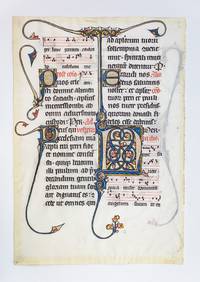
Best.-Nr. ST20214Northern France perhaps Beauvais or Amiens late 13th or early 14th century. 286 x 199 mm. 11 1/4 x 7 3/4". Double column containing a mixture of staves and text approximately 21 lines in an excellent formal gothic book hand. Attractively matted. Rubrics in red chant text containing black penwork initials with red and yellow geometric elaboration BEAUTIFULLY ILLUMINATED with five two-line initials painted blue or pink with white tracery on a ground in the contrasting color two of the initials filled with grotesques and swirling vines and two with the filler design traced out but never completed each initial with blue and pink extensions terminating in orange leaves or spiky shapes; the verso featuring AN IMPRESSIVE SIX-LINE "N" 58 x 50 mm. in the same style filled with an intricate knotwork design and orange leaves with long extensions including a horizontal extension across the upper margin. Margins with light offsetting of the designs from the facing leaf; remnants of mounting tape on recto corners and bottom edge; verso apparently with a barely visible Medieval "14" in lower margin. An area measuring 5 mm. at edges just faintly yellowed from mat burn but IN FINE CONDITION the vellum otherwise quite bright the paint rich and the gold brightly glittering. This sumptuously decorated leaf--which is beautifully preserved and contains a particularly large and handsome initial--comes from the last volume of a three-volume Missal presented to Beauvais Cathedral by Canon Robert de Hangest d. 1356. The Missal remained at the cathedral at least through the 17th century when it is noted in an inventory but was removed from the church at some point likely in the aftermath of the French Revolution. The parent volume eventually entered the collection of Henri-Auguste Brölemann 1775-1854 of Lyon who passed it to his grand-daughter Etienne Mallet who then sold it at Sotheby's in 1926. It was then acquired for the collection of William Hearst where it remained for the next 25 years. In 1941 it was again sold at auction and subsequently dismembered. Though long thought to have been the work of famed biblioclast Otto Ege recent scholarship suggests that it was actually Phillip Duschnes who was responsible for breaking up the book keeping some leaves for himself and selling others on to his colleague Ege for inclusion in his portfolios of "Fifty Original Leaves from Medieval Manuscripts." The Beauvais Missal has been a subject of interest for many notable scholars chief among them being Christopher de Hamel--see: "Otto Ege and the Beauvais Missal" in "Gilding the Lilly: A Hundred Medieval and Illuminated Manuscripts in the Lilly Library" and it is currently the focus of a major effort to "reconstruct" the manuscript digitally--a project spearheaded by Lisa Fagin Davis. Other leaves from the parent volume are in the collections of the Morgan Library the Metropolitan Museum of Art the Cleveland Museum of Art and the Houghton Library at Harvard among many others. Although there is some dispute among art historians the illumination has been tentatively attributed to the artist of the Hours of Yolande of Soissons produced in Amiens ca. 1280 and now held by the Morgan Library MS M.729. It is worth noting that the town of Hangest home to the original owner is only 10 miles from Amiens and is a likely place of origin for the Missal. The present leaf contains a text for a major feast day and thus contains a large and extravagantly decorated initial for its opening "'Nunc scio vere." It is not too much to say that the decoration here is masterful but curiously--and of special interest to us from a modern perspective--the illuminators seem to have forgotten to put the finishing touches on the two smaller initials above which still contain sketches of the preliminary design. unknown
Best.-Nr. ST20214Northern France perhaps Beauvais or Amiens late 13th or early 14th century. 286 x 199 mm. 11 1/4 x 7 3/4". Double column containing a mixture of staves and text approximately 21 lines in an excellent formal gothic book hand. Attractively matted. Rubrics in red chant text containing black penwork initials with red and yellow geometric elaboration BEAUTIFULLY ILLUMINATED with five two-line initials painted blue or pink with white tracery on a ground in the contrasting color two of the initials filled with grotesques and swirling vines and two with the filler design traced out but never completed each initial with blue and pink extensions terminating in orange leaves or spiky shapes; the verso featuring AN IMPRESSIVE SIX-LINE "N" 58 x 50 mm. in the same style filled with an intricate knotwork design and orange leaves with long extensions including a horizontal extension across the upper margin. Margins with light offsetting of the designs from the facing leaf; remnants of mounting tape on recto corners and bottom edge; verso apparently with a barely visible Medieval "14" in lower margin. An area measuring 5 mm. at edges just faintly yellowed from mat burn but IN FINE CONDITION the vellum otherwise quite bright the paint rich and the gold brightly glittering. This sumptuously decorated leaf--which is beautifully preserved and contains a particularly large and handsome initial--comes from the last volume of a three-volume Missal presented to Beauvais Cathedral by Canon Robert de Hangest d. 1356. The Missal remained at the cathedral at least through the 17th century when it is noted in an inventory but was removed from the church at some point likely in the aftermath of the French Revolution. The parent volume eventually entered the collection of Henri-Auguste Brölemann 1775-1854 of Lyon who passed it to his grand-daughter Etienne Mallet who then sold it at Sotheby's in 1926. It was then acquired for the collection of William Hearst where it remained for the next 25 years. In 1941 it was again sold at auction and subsequently dismembered. Though long thought to have been the work of famed biblioclast Otto Ege recent scholarship suggests that it was actually Phillip Duschnes who was responsible for breaking up the book keeping some leaves for himself and selling others on to his colleague Ege for inclusion in his portfolios of "Fifty Original Leaves from Medieval Manuscripts." The Beauvais Missal has been a subject of interest for many notable scholars chief among them being Christopher de Hamel--see: "Otto Ege and the Beauvais Missal" in "Gilding the Lilly: A Hundred Medieval and Illuminated Manuscripts in the Lilly Library" and it is currently the focus of a major effort to "reconstruct" the manuscript digitally--a project spearheaded by Lisa Fagin Davis. Other leaves from the parent volume are in the collections of the Morgan Library the Metropolitan Museum of Art the Cleveland Museum of Art and the Houghton Library at Harvard among many others. Although there is some dispute among art historians the illumination has been tentatively attributed to the artist of the Hours of Yolande of Soissons produced in Amiens ca. 1280 and now held by the Morgan Library MS M.729. It is worth noting that the town of Hangest home to the original owner is only 10 miles from Amiens and is a likely place of origin for the Missal. The present leaf contains a text for a major feast day and thus contains a large and extravagantly decorated initial for its opening "'Nunc scio vere." It is not too much to say that the decoration here is masterful but curiously--and of special interest to us from a modern perspective--the illuminators seem to have forgotten to put the finishing touches on the two smaller initials above which still contain sketches of the preliminary design. unknown books
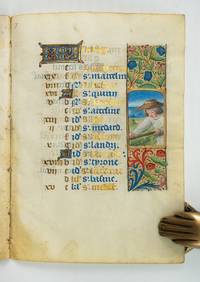
1500Best.-Nr. ST20810SParis ca. 1500. 163 x 115 mm. 6 1/2 x 4 1/2". 12 leaves. Single column 18 lines in a gothic book hand. Feast days in alternating blue and burnished gold script two-line "KL" initials painted blue with white tracery and embellished with orange and blue ivy on a burnished gold ground each with a spray of gilt leaves and painted flowers one-line "A" initials in burnished gold over a pink and blue ground each page with a panel border of colorful flowers berries and acanthus over a painted gold ground with 24 SMALL MINIATURES depicting the labor of the month on rectos and zodiacal signs on versos. Some moderate smudging and soiling in bottom and fore margins January and February with tiny wormhole in head margin the miniature for January conceivably improved by a later hand but all in all a very lovely Calendar the high-quality paintings very well preserved and the whole with vibrant colors and brightly gleaming gold. Vibrantly illustrated and shimmering with gold this is an excellent example of a complete Calendar that would have appeared at the beginning of a luxuriously appointed Book of Hours. Each month is illustrated with the labor or occupation appropriate for the moment. These are in turn: warming by the fire feasting pruning picking flowers courting threshing hay harvesting wheat baking bread treading grapes sowing feeding hogs and slaughtering a hog. Our artist chose to compose these scenes more as portraits than depictions of actual tasks framing the image around each figure's face and sometimes only including small details that might indicate their occupation. In the month of June for example which depicts threshing hay we see only a sliver of the farmer's sickle and nothing at all of the hay. Instead the farmer himself is the primary focus here: and he is particularly well-executed with gentle shading on his downcast features careful brushstrokes highlighting the gleam of his hair and brushed gold suggesting the sun beating down on a bright June day. In addition to the labor or occupation of the month on the recto the 12 signs of the zodiac are depicted on the verso of each leaf these executed with equal charm and care. In cheerful bright colors our artist has depicted Leo's preening pose and glimmering mane the drama of Sagittarius' drawn bow and the cherubic plumpness of Aquarius molded in bluish shadows. In addition to the aesthetic achievements of its various parts the whole is desirable as a so-called composite Calendar with the name of a saint or special celebration occupying every day of the year. The origin of the composite Calendar is uncertain but the general opinion is that it was formalized in the early 14th century. The Parisian Hours of Jeanne d'Evreaux copied in ca. 1330 has been put forth as an early example. In any case the Calendar was subject to numerous changes in the course of time as various saints were canonized and supplanted those who while still recognized as saintly were deemed to be less favored residents for a particular calendar date. The saints' days on this Calendar are fairly typical for the Use of Paris and given the high-quality illumination liberal use of gold and robust borders it is likely that the parent manuscript was produced by an accomplished atelier in that city. Although single Calendar leaves regularly come on the market complete Calendars--particularly ones with extensive visual programs as here--are much more difficult to acquire. unknown
1500Best.-Nr. ST20810SParis ca. 1500. 163 x 115 mm. 6 1/2 x 4 1/2". 12 leaves. Single column 18 lines in a gothic book hand. Feast days in alternating blue and burnished gold script two-line "KL" initials painted blue with white tracery and embellished with orange and blue ivy on a burnished gold ground each with a spray of gilt leaves and painted flowers one-line "A" initials in burnished gold over a pink and blue ground each page with a panel border of colorful flowers berries and acanthus over a painted gold ground with 24 SMALL MINIATURES depicting the labor of the month on rectos and zodiacal signs on versos. Some moderate smudging and soiling in bottom and fore margins January and February with tiny wormhole in head margin the miniature for January conceivably improved by a later hand but all in all a very lovely Calendar the high-quality paintings very well preserved and the whole with vibrant colors and brightly gleaming gold. Vibrantly illustrated and shimmering with gold this is an excellent example of a complete Calendar that would have appeared at the beginning of a luxuriously appointed Book of Hours. Each month is illustrated with the labor or occupation appropriate for the moment. These are in turn: warming by the fire feasting pruning picking flowers courting threshing hay harvesting wheat baking bread treading grapes sowing feeding hogs and slaughtering a hog. Our artist chose to compose these scenes more as portraits than depictions of actual tasks framing the image around each figure's face and sometimes only including small details that might indicate their occupation. In the month of June for example which depicts threshing hay we see only a sliver of the farmer's sickle and nothing at all of the hay. Instead the farmer himself is the primary focus here: and he is particularly well-executed with gentle shading on his downcast features careful brushstrokes highlighting the gleam of his hair and brushed gold suggesting the sun beating down on a bright June day. In addition to the labor or occupation of the month on the recto the 12 signs of the zodiac are depicted on the verso of each leaf these executed with equal charm and care. In cheerful bright colors our artist has depicted Leo's preening pose and glimmering mane the drama of Sagittarius' drawn bow and the cherubic plumpness of Aquarius molded in bluish shadows. In addition to the aesthetic achievements of its various parts the whole is desirable as a so-called composite Calendar with the name of a saint or special celebration occupying every day of the year. The origin of the composite Calendar is uncertain but the general opinion is that it was formalized in the early 14th century. The Parisian Hours of Jeanne d'Evreaux copied in ca. 1330 has been put forth as an early example. In any case the Calendar was subject to numerous changes in the course of time as various saints were canonized and supplanted those who while still recognized as saintly were deemed to be less favored residents for a particular calendar date. The saints' days on this Calendar are fairly typical for the Use of Paris and given the high-quality illumination liberal use of gold and robust borders it is likely that the parent manuscript was produced by an accomplished atelier in that city. Although single Calendar leaves regularly come on the market complete Calendars--particularly ones with extensive visual programs as here--are much more difficult to acquire. unknown books
Best.-Nr. ST20846GSouthern Netherlands ca. 1280. 110 x 83 mm. 4 3/8 x 3 1/4". Single column 19 lines in a gothic hand. Rubrics in red simple line fillers in red or blue each leaf with multiple one-line initials in red or blue one leaf also with a two-line gilt initial on blue and pink ground and with bar border extensions in gold blue and pink EACH LEAF WITH A LARGE HISTORIATED INITIAL measuring seven to nine lines long 28-34 mm. the initial in pink or blue inhabited by figures painted on a gilt ground all this on a blue or pink ground framed in gilt with spiky pink and blue marginal extensions studded with gilt bezants and painted leaves. Small corrections to text one leaf with marginal notation in a later hand; each leaf with a small stub mounted on fore edge. One leaf with marginal embellishment slightly trimmed away just a hint of use but in very fine condition with the initials beautifully preserved right down to their hair-line detail. Featuring large historiated initials with some unusual iconography these leaves come from a charming Psalter-Hours attributed to the Morgan 183 Group. Active in the late 13th and early 14th centuries and so-named for a highly decorative manuscript once owned by J. Pierpont Morgan the artists of this group are considered important purveyors of the gothic style from Paris into Liege and the Southern Netherlands. Our parent manuscript was probably executed in Brabant or Hainault based on the presence of certain saints associated with these cities that appear in the Litany for example Sts. Waldetrudis of Mons and Amalberga of Maubeuge. Clues from other extant leaves containing additions and alterations to the text suggest that it was initially made for non-monastic use but later may have been adapted for a Benedictine community. The present leaves each contain a large historiated initial to punctuate the beginning of a Psalm or major section and each provides a narrative for contemplation. The subjects include: a Crucifixion opening the Hours of the Passion with the Virgin Mary and John the Evangelist on either side of the Crucified Christ. Above them on either side of the Cross is the sun and moon--an allusion to the three hours of darkness enveloping the land during the Crucifixion. b The fool riding a goat opening Psalm 52 "Dixit insipiens". This is a particularly unusual though very apt piece of iconography for the Psalm that famously begins "The fool has said in his heart: 'There is no God.'" Pictured astride a goat the fool holds onto a horn with one hand and brandishes a club with the other as his steed charges ahead. Although historiated initials with fools can occasionally be found in Psalters and Bibles of this same period they are usually shown only with a club and often a piece of bread; the addition of the goat is quite extraordinary. c David in the water praying to God opening Psalm 68 "Salvum me fac Deus". This initial makes excellent use of the compositional space provided by the curving "S" shape placing God the father in the compartment above and King David up to his belly in flowing water in the compartment below. Both figures raise their arms upward with the Lord holding a globus cruciger and making the sign of benediction while David naked except for his crown extends his prayerful arms so wide they nearly reach from one side of the initial to the other. The latter is clearly referencing Christ's eventual sacrifice on the Cross as well as highlighting the familial connection between the two. These leaves are exceptional examples of the French high gothic style outside of Paris and offer multiple avenues for further research and comparison. unknown
Best.-Nr. ST20846GSouthern Netherlands ca. 1280. 110 x 83 mm. 4 3/8 x 3 1/4". Single column 19 lines in a gothic hand. Rubrics in red simple line fillers in red or blue each leaf with multiple one-line initials in red or blue one leaf also with a two-line gilt initial on blue and pink ground and with bar border extensions in gold blue and pink EACH LEAF WITH A LARGE HISTORIATED INITIAL measuring seven to nine lines long 28-34 mm. the initial in pink or blue inhabited by figures painted on a gilt ground all this on a blue or pink ground framed in gilt with spiky pink and blue marginal extensions studded with gilt bezants and painted leaves. Small corrections to text one leaf with marginal notation in a later hand; each leaf with a small stub mounted on fore edge. One leaf with marginal embellishment slightly trimmed away just a hint of use but in very fine condition with the initials beautifully preserved right down to their hair-line detail. Featuring large historiated initials with some unusual iconography these leaves come from a charming Psalter-Hours attributed to the Morgan 183 Group. Active in the late 13th and early 14th centuries and so-named for a highly decorative manuscript once owned by J. Pierpont Morgan the artists of this group are considered important purveyors of the gothic style from Paris into Liege and the Southern Netherlands. Our parent manuscript was probably executed in Brabant or Hainault based on the presence of certain saints associated with these cities that appear in the Litany for example Sts. Waldetrudis of Mons and Amalberga of Maubeuge. Clues from other extant leaves containing additions and alterations to the text suggest that it was initially made for non-monastic use but later may have been adapted for a Benedictine community. The present leaves each contain a large historiated initial to punctuate the beginning of a Psalm or major section and each provides a narrative for contemplation. The subjects include: a Crucifixion opening the Hours of the Passion with the Virgin Mary and John the Evangelist on either side of the Crucified Christ. Above them on either side of the Cross is the sun and moon--an allusion to the three hours of darkness enveloping the land during the Crucifixion. b The fool riding a goat opening Psalm 52 "Dixit insipiens". This is a particularly unusual though very apt piece of iconography for the Psalm that famously begins "The fool has said in his heart: 'There is no God.'" Pictured astride a goat the fool holds onto a horn with one hand and brandishes a club with the other as his steed charges ahead. Although historiated initials with fools can occasionally be found in Psalters and Bibles of this same period they are usually shown only with a club and often a piece of bread; the addition of the goat is quite extraordinary. c David in the water praying to God opening Psalm 68 "Salvum me fac Deus". This initial makes excellent use of the compositional space provided by the curving "S" shape placing God the father in the compartment above and King David up to his belly in flowing water in the compartment below. Both figures raise their arms upward with the Lord holding a globus cruciger and making the sign of benediction while David naked except for his crown extends his prayerful arms so wide they nearly reach from one side of the initial to the other. The latter is clearly referencing Christ's eventual sacrifice on the Cross as well as highlighting the familial connection between the two. These leaves are exceptional examples of the French high gothic style outside of Paris and offer multiple avenues for further research and comparison. unknown books
1626Best.-Nr. ST21074Antwerp: Balthasar Moretus 1626. ONE OF 50 COPIES ON VELLUM PRINTED FOR THE KING OF SPAIN and 25 copies on paper. 257 x 185 mm. 10 1/4 x 7 1/4". 8 p.l. 91 pp.Translated by Nicolas Grudius. Handsome dark brown crushed morocco tooled in gilt and blind by the Club Bindery for Robert Hoe stamp-signed and dated 1903 on front turn-in and with Hoe's monogram on front pastedown covers with frame of double gilt rules enclosing repeated blind-stamped medallions central panel with blind-ruled lozenge and rectangle the latter with oblique gilt fleurons at corners raised bands spine compartments ruled in blind with gilt fleuron centerpiece and gilt floral buds at corners gilt lettering vellum endleaves all edges gilt tiny invisible repairs at top of spine and front joint. With two full-page armorial engravings by Cornelius Galle one the arms of the Spanish monarch the other the insignia of the Order engraved head- and tailpieces. Front pastedown with morocco bookplate of Robert Hoe as well as engraved bookplates of Arthur & Charlotte Vershbow and David Godine. Bibl. Belg. I 692; Voet II 1017; Van Praet V:161-2; Brunet Supp. I:291; USTC 1007848. Boards slightly bowed as almost inevitable with vellum books text a bit wavy also as expected occasional faint smudges or dustsoiling at edges but AN EXTREMELY PLEASING COPY the vellum creamy and bright the binding very lustrous. This is the luxurious vellum printing of the rules of the Order of the Golden Fleece bound in 16th century style for the renowned bibliophile Robert Hoe by the workshop he co-founded and supervised for much of its existence. Founded in 1429 by Philip Duke of Burgundy the exclusive Order of the Golden Fleece was the most distinguished knighthood in the Holy Roman Empire being limited to just 24 members. Its primary purpose was to preserve and protect the Catholic faith as well as to uphold the 12 knightly virtues outlined by Philip: Faith Charity Justice Sagacity Prudence Temperance Resolution Truth Liberality Diligence Hope and Valor. Those deserving to be collared with the order's golden necklace featuring an appended ram that gave the group its name swore to support their monarch militarily and in return they were exempt from taxes as well as being entitled to be tried for any crimes by a jury restricted to their fellow knights. The "Rules" or "Statutes" that make up the text here dictate the very strict obligations and behavioral guidelines for its members including proscriptions against such things as fleeing a battle out of cowardice or embracing beliefs antithetical to the Church along with a number of procedural decrees governing for example how exactly to participate in ceremonial occasions. The earliest Latin edition of the "Constitutiones" translated from the French by the secretary of the Order Flemish poet Nicolaus Grudius 1504-70 was printed by Guillaume Silvius at the Plantin Press in 1566. In total four vellum editions were issued over the next 200 years all now rare. The present copy collates as the 1626 edition issued by Balthasar Moretus which the Belgian national bibliography tells us was printed for the king of Spain with 50 copies on vellum and 25 on paper. Our copy was bound in 1903 for Robert Hoe 1839-1909 a founder of the Grolier Club and one of the world's great book collectors. After Grolier was established in 1884 it soon became apparent that the country's few established hand binders were overtaxed in providing repairs and rebinding for the club members' rapidly accumulating acquisitions. As a consequence in 1895 Grolier members along with Edwin Holden and other wealthy collectors established the Club Bindery in order to attract European craftsmen to provide close to home fine quality binding work rivalling what was available abroad. The Club Bindery was in operation until 1909 with Hoe being its most influential manager and client. It provided bindings that tended to be traditional in style--though frequently with elaborate decoration--and that lived up to its patrons' expectations in terms of excellence. Our volume later passed into the hands of another Grolier Club member Arthur Vershbow 1922-2012 and his wife Charlotte 1924-2000. All early editions of this work are scarce; we were able to trace just one other copy of our vellum-printed edition at auction sold for 11700 at van de Wiele in 2024. Balthasar Moretus unknown
1626Best.-Nr. ST21074Antwerp: Balthasar Moretus 1626. ONE OF 50 COPIES ON VELLUM PRINTED FOR THE KING OF SPAIN and 25 copies on paper. 257 x 185 mm. 10 1/4 x 7 1/4". 8 p.l. 91 pp.Translated by Nicolas Grudius. Handsome dark brown crushed morocco tooled in gilt and blind by the Club Bindery for Robert Hoe stamp-signed and dated 1903 on front turn-in and with Hoe's monogram on front pastedown covers with frame of double gilt rules enclosing repeated blind-stamped medallions central panel with blind-ruled lozenge and rectangle the latter with oblique gilt fleurons at corners raised bands spine compartments ruled in blind with gilt fleuron centerpiece and gilt floral buds at corners gilt lettering vellum endleaves all edges gilt tiny invisible repairs at top of spine and front joint. With two full-page armorial engravings by Cornelius Galle one the arms of the Spanish monarch the other the insignia of the Order engraved head- and tailpieces. Front pastedown with morocco bookplate of Robert Hoe as well as engraved bookplates of Arthur & Charlotte Vershbow and David Godine. Bibl. Belg. I 692; Voet II 1017; Van Praet V:161-2; Brunet Supp. I:291; USTC 1007848. Boards slightly bowed as almost inevitable with vellum books text a bit wavy also as expected occasional faint smudges or dustsoiling at edges but AN EXTREMELY PLEASING COPY the vellum creamy and bright the binding very lustrous. This is the luxurious vellum printing of the rules of the Order of the Golden Fleece bound in 16th century style for the renowned bibliophile Robert Hoe by the workshop he co-founded and supervised for much of its existence. Founded in 1429 by Philip Duke of Burgundy the exclusive Order of the Golden Fleece was the most distinguished knighthood in the Holy Roman Empire being limited to just 24 members. Its primary purpose was to preserve and protect the Catholic faith as well as to uphold the 12 knightly virtues outlined by Philip: Faith Charity Justice Sagacity Prudence Temperance Resolution Truth Liberality Diligence Hope and Valor. Those deserving to be collared with the order's golden necklace featuring an appended ram that gave the group its name swore to support their monarch militarily and in return they were exempt from taxes as well as being entitled to be tried for any crimes by a jury restricted to their fellow knights. The "Rules" or "Statutes" that make up the text here dictate the very strict obligations and behavioral guidelines for its members including proscriptions against such things as fleeing a battle out of cowardice or embracing beliefs antithetical to the Church along with a number of procedural decrees governing for example how exactly to participate in ceremonial occasions. The earliest Latin edition of the "Constitutiones" translated from the French by the secretary of the Order Flemish poet Nicolaus Grudius 1504-70 was printed by Guillaume Silvius at the Plantin Press in 1566. In total four vellum editions were issued over the next 200 years all now rare. The present copy collates as the 1626 edition issued by Balthasar Moretus which the Belgian national bibliography tells us was printed for the king of Spain with 50 copies on vellum and 25 on paper. Our copy was bound in 1903 for Robert Hoe 1839-1909 a founder of the Grolier Club and one of the world's great book collectors. After Grolier was established in 1884 it soon became apparent that the country's few established hand binders were overtaxed in providing repairs and rebinding for the club members' rapidly accumulating acquisitions. As a consequence in 1895 Grolier members along with Edwin Holden and other wealthy collectors established the Club Bindery in order to attract European craftsmen to provide close to home fine quality binding work rivalling what was available abroad. The Club Bindery was in operation until 1909 with Hoe being its most influential manager and client. It provided bindings that tended to be traditional in style--though frequently with elaborate decoration--and that lived up to its patrons' expectations in terms of excellence. Our volume later passed into the hands of another Grolier Club member Arthur Vershbow 1922-2012 and his wife Charlotte 1924-2000. All early editions of this work are scarce; we were able to trace just one other copy of our vellum-printed edition at auction sold for 11700 at van de Wiele in 2024. Balthasar Moretus unknown books