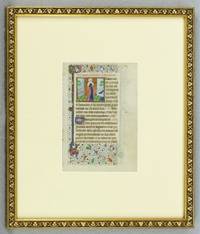
A MEDIEVAL ILLUMINATED VELLUM MANUSCRIPT LEAF FROM A BOOK OF HOURS, WITH A MINIATURE OF PENTECOSTBiblio.com
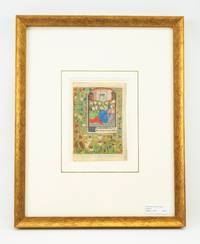
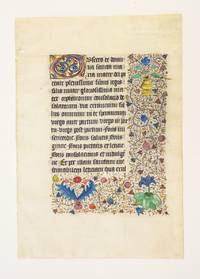
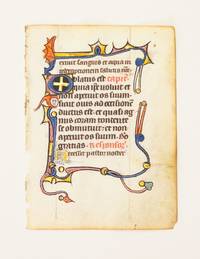
1490rif. ST20853France ca. 1490. 144 x 99 mm. 5 5/8 x 3 3/4". Single column recto with 14 lines in a gothic book hand. Attractively matted and framed. Rubrics in red two two-line initials one painted pink on blue ground with flowers the other painted blue and inhabited by a rampant lion on pink and gold ground recto with a panel border featuring long-stemmed flowers and owls on a pink ground verso WITH A HALF-PAGE ARCH-TOPPED MINIATURE DEPICTING PENTECOST WITH A FULL BORDER featuring a plethora of different flowers berries greenery songbirds an owl and a butterfly all ON A RICHLY PAINTED GOLD GROUND. Trimmed close on one side and just grazing a border on the opposite side very minor chipping to faces trivial signs of rubbing or wear otherwise a fine leaf--colorful bright and very pleasing to the eye. This leaf contains the customary Pentecost miniature associated with the Hours of the Holy Spirit but with several attributes that set it apart from other examples we have encountered. The miniature here depicts a densely crowded scene with the Virgin at the center surrounded by the apostles each of whom wears a burnished gold halo. Packed tightly together they gaze up at a white dove who emanates small red tongues of fire above their heads. According to biblical tradition this visitation by the Holy Ghost in the form of a dove enabled Christ's disciples to start preaching marking the beginning of the Christian Church. The artist favors an unusual pastel palette choosing pale pink for the walls and eggshell blue for some of the floor tiles as well as bright yellow muted lilac rose and lime green for the robes of the apostles. Looking more closely at the figures we see that each face is carefully individualized each with its own features and expressions. Although most crane their necks to get a view of the miracle unfolding one of the apostles looks directly out at the viewer as if surprised by our presence. Moving outside the miniature we note that the leaf features a particularly exuberant border with tangles of flowers fruit acanthus leaves and several birds including an owl in one corner. There is additional interest on the verso with another bright border painted an intense pink and filled with more flowers and owls. unknown
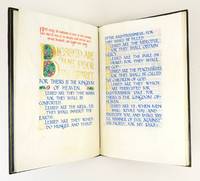
1939rif. ST17129-020Wimbledon Surrey September 1939. 373 x 255 mm. 14 3/4 x 10". 12 vellum leaves seven with text and illuminations. Single column approximately 30 lines in a fine calligraphic hand. Attractive contemporary dark blue crushed morocco covers with gilt and blind rules raised bands with gilt rules gilt-ruled turn-ins vellum pastedowns. Text in blue black green and red a few lines with larger lettering in gilt several two-line initials in colored ink five two-line initials in red or blue with floral decorations opening pages with eight two-line initials in gold the lines here of a larger size than rest of text six three-line initials in gold filled and surrounded by floral decoration three four- to six-line gilt initials with more intricate floral decorations one of these with gilt stippling and two surrounded by a gilt frame and ONE VERY LARGE 80 x 45 mm GILT "B" decorated with stippling filled with two-tone green leaves pink flowers and large gold bezants. First leaf with ink inscription "Presented by Dr. W J Pearson / in appreciation of the work of / Ashridge Hospital 1939-1946"; two silk guards. Boards with a hint of soiling but A BEAUTIFUL MANUSCRIPT IN OUTSTANDING CONDITION the paint lovely and bright and the gold sparkling. This beautifully executed manuscript by a notable female calligrapher and illuminator features the oft-quoted and much-loved biblical text known as the "Sermon on the Mount" in which Matthew relates various moral teachings attributed to Christ. The text is written in an extremely pleasing and regular upright script throughout but the first opening listing the nine Beatitudes in capital letters is especially striking. Opening with the largest and most attractive initial in the manuscript it begins with "Blessed are the poor in spirit" in prominent gilt lettering; this is followed by the other blessings each beginning with a smaller gilt "B" initial written entirely in blue capital letters. The rest of the text penned primarily in black ink but accented with cheerful gilt initials and occasional colored lettering exudes a sense of order and simple elegance befitting the contents. Illuminator and calligrapher Violet Wilson was born in Wimbledon in 1902. She studied calligraphy under Claire G. M. Evans who had been a pupil of Graily Hewitt known for his work with the Ashendene Press and one of the principal British calligraphers and teachers of lettering in the first half of the 20th century. Wilson became a member of the Society of Scribes and Illuminators in the U.K. in the 1930s. The San Francisco Public Library has examples of her work in its Harrison Collection of Calligraphy and another illuminated copy of the "Sermon on the Mount" made in 1957 was included in the Baltimore Art Museum's 1965 exhibition and catalogue titled "Two Thousand Years of Calligraphy." The catalogue entry no. 213 notes that Wilson preferred to work on books and decorative maps and exhibited her work in many countries. According to the presentation inscription in the present work this manuscript was given to Ashridge Hospital--formerly a monastery and royal residence--by the distinguished physician Dr. Wilfred John Pearson 1884-1957 who had headed one of the London sectors of the Emergency Medical Service during World War II. His obituary in the "British Medical Journal" declared him "one of the striking figures of his time.". unknown
rif. ST17060PFrance probably Besançon 3rd quarter of 15th century. 239 x 165 mm. 9 3/8 x 6 1/2". Single column 15 lines in an elegant gothic book hand. Rubrics in dark pink line enders in pink and blue with white tracery and gold bezant each leaf with a three- or four-line initial painted pink or blue with white tracery filled with pink and blue vines and flowers all on a burnished gold ground ONE SIDE OF EACH LEAF WITH A HALF OR THREE-QUARTER BORDER featuring hairline vines gold ivy and bezants colorful acanthus various flowers fleshy plants and vases with floral arrangements the other side of each leaf with a panel border similarly decorated. ◆Vellum slightly yellowed minor smudging to hairline vines and slight rubbing to paint on a few of the border decorations one leaf with some small stains in the border largely masked by the hairline vines but these issues quite minor and the leaves IN FINE CONDITION overall--very clean bright and well-preserved. From a large Book of Hours probably produced in Besançon these leaves feature exceptionally pretty borders each with unique decoration that includes vases of different shapes sizes and hues each containing a different flower arrangement fleshy vegetation and colorful floral accents. The large initials here coupled with the expansive border decoration indicate that these leaves marked the openings of major prayers including "Obsecro te" "O Intemerata" the "Joys of the Virgin" and the "Seven Requests to Our Lord." Luxurious touches such as the several dozen gilt bezants and ivy leaves in each border and the unusually wide margins point to this manuscript having been quite a costly production. For additional leaves from this same manuscript at different price points please check our website. unknown
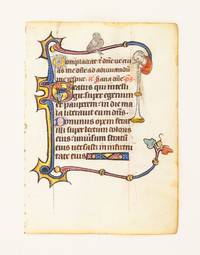
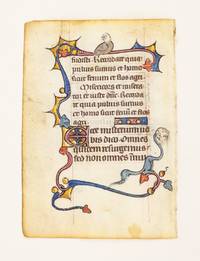
rif. ST16985QFrance first half of 14th century. 110 x 82 mm. 4 3/8 x 3 1/4". Single column 12 lines in a gothic book hand. Line enders in pink and blue with gold accents each leaf with one or more one-line initials in blue with red penwork or gold with blue penwork each leaf with one two line initial painted pink or blue ONE INHABITED BY HUMAN FACE others filled with painted floral motifs all on a gold ground one side of each leaf with A FULL BORDER composed of pink and blue tendrils accompanied by spikey gold decoration and gold accents often terminating in ivy leaves and incorporating EXTRAORDINARILY CHARMING EXAMPLES OF MARGINALIA INCLUDING ANIMALS HUMAN HEADS AND HUMAN-BEAST HYBRIDS. ◆Vellum with a little soiling and a few small stains slightly more noticeable on one leaf where it is touching the text though not obscuring meaning a few instances of rubbing to gold and decoration including one bird with its detailing rubbed away other minor imperfections but none of these flaws egregious and the most desirable imagery here still very well preserved. Though diminutive in size these leaves contain enormously appealing marginal decoration in the form of humans animals and hybrid creatures inventively incorporated into the lively borders in manners that range from adorable to bizarre. Especially popular in Flanders Northern France and England during the 13th and 14th centuries marginalia such as these comprise some of the most memorable and entertaining images to be found in any Medieval manuscripts. Despite being found largely in religious books such as Psalters and Books of Hours the images are often strange humorous or even outrageous and they provide us with consistent delight. Being by definition outside of the central text or miniature the margins seem to have been a place where illuminators felt more at ease to experiment resulting in highly imaginative and unique artistic expressions. The present specimens come from a fragmentary manuscript with many leaves either missing or rendered defective where portions of the vellum were cut away. Fortunately this group of leaves is intact and retains much marvelous imagery including an owl and two other birds one apparently holding a worm in its mouth human heads and torsos capping off the ends of border tendrils including a trumpeter blowing into a particularly long instrument and a man reaching both arms straight into the air as if trying to grab the head attached to the tendril above him and a hybrid with the head of a human in a gold hood and the body of a hare perched gingerly on an ivy branch. For additional leaves from this same manuscript at different price points please check our website. unknown
rif. 3752831928.Gpaperback. Good. Access codes and supplements are not guaranteed with used items. May be an ex-library book. paperback
rif. ST16985LFrance first half of 14th century. 110 x 82 mm. 4 3/8 x 3 1/4". Single column 12 lines in a gothic book hand. Line enders in pink and blue with gold accents each leaf with one or more one-line initials in blue with red penwork or gold with blue penwork each leaf with one two line initial painted pink or blue filled with painted floral motifs and on a gold or blue ground one side of each leaf with A NEAR-FULL BORDER composed of pink and blue tendrils accompanied by spikey gold decoration and gold accents often terminating in ivy leaves and incorporating EXTRAORDINARILY CHARMING EXAMPLES OF MARGINALIA INCLUDING ANIMALS HUMANS AND HYBRIDS. ◆Vellum a little soiled and lightly stained and wrinkled in places some of the gold a bit rubbed one leaf with some noticeable smudging affecting some of the text and decoration including the head of one of the hybrids but the other examples of marginalia quite well preserved and still retaining much of their original charm. Though diminutive in size these leaves contain enormously appealing marginal decoration in the form of humans animals and hybrid creatures inventively incorporated into the lively borders in manners that range from adorable to bizarre. Especially popular in Flanders Northern France and England during the 13th and 14th centuries marginalia such as these comprise some of the most memorable and entertaining images to be found in any Medieval manuscripts. Despite being found largely in religious books such as Psalters and Books of Hours the images are often strange humorous or even outrageous and they provide us with consistent delight. Being by definition outside of the central text or miniature the margins seem to have been a place where illuminators felt more at ease to experiment resulting in highly imaginative and unique artistic expressions. The present specimens come from a fragmentary manuscript with many leaves either missing or rendered defective where portions of the vellum were cut away. Fortunately this group of leaves is intact and retains much marvelous imagery including a particularly annoyed-looking bird two human-beast hybrids with long necks and bushy tails and a trumpeter emerging from the border decoration blowing into a long instrument decorated with gold accents. For additional leaves from this same manuscript at different price points please check our website. unknown
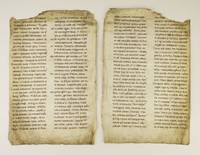
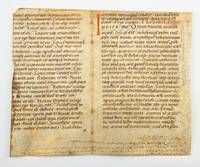
rif. ST15769aPerhaps France mid-12th century. Each leaf measures approximately 370 x 240 mm. 14 1/2 x 9 1/2". Double column 32 lines in a fine proto-gothic hand. See: Thompson "An Introduction to Greek and Latin Paleography" p. 436. ◆Recovered from a binding and thus with one side of each leaf somewhat browned soiled and with a few creases one leaf with several small blotches of red paint in the text not affecting overall legibility one corner of each leaf torn away affecting running title and one to two lines of text other trivial defects but still very nice specimens with clear and legible script and one side of each leaf quite clean and well preserved. Once part of a large and elegant Romanesque Bible these leaves are excellent examples of a high quality proto-gothic book hand. Sometimes referred to as "praegothica" or "late Caroline" the proto-gothic script is characterized by letterforms that are more or less unchanged from Caroline minuscule but with a number of traits starting to show elements of gothic script--most notably the addition of feet appearing here as an upward flick of the pen on the bottom of minims but also including the use of more abbreviations the fusion of certain letter combinations a more elongated "o" and a straight-backed "a." Whatever the level of its evolution the script here has very pleasing rounded letterforms that are highly legible and generously spaced. Though the vellum is not unmarred by its former life as binding material the script here has not lost any of its beauty revealing a hand that is practiced regular and distinctly pleasing to the eye. As Thompson notes "In the twelfth century the scribes seem to have vied with each other in producing the best types of book-writing of which they were capable with the result that remarkable precision in the formation of the letter was attained and that the century may be named as excelling all others for the beauty of its MSS." Our leaves come from Deuteronomy the Old Testament book consisting primarily of three sermons made by Moses just before entering the Promised Land. One leaf contains brief summaries of chapters 2-18 with some chapters numbered in the margins while the other leaf contains part of the first of Moses' speeches in which he recalls the Israelites' 40-year journey through the wilderness. unknown
1602rif. 82392In Venetia: Appresso Gio. Battista Ciotti 1602. Due parti in un volume di cm. 30 pp. 12 524; 395. Frontespizio in rosso e nero con marchio tipografico. Leg. del tempo in cart. alla rustica e dorso ricoperto posteriormente in carta marmorizzata. Esemplare genuino e ben conservato. Edizione originale di quest'opera considerata il più importante e fortunato dei vocabolarî italiani anteriori a quello della Crusca ed il primo dizionario europeo moderno fornito di definizioni. Nel corso del xvii secolo si ebbero tre ristampe ampliata. Cfr. Gamba 2757 che cita la successiva edizione del 1617. Edizione Originale. Appresso Gio. Battista Ciotti unknown
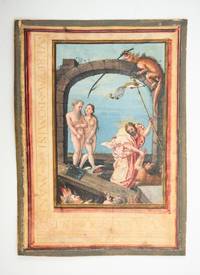
1540rif. ST20622Germany ca. 1540. 183 x 133 mm. 7 1/8 x 5 1/4". WITH A FULL-PAGE MINIATURE DEPICTING THE HARROWING OF HELL featuring a naked Adam and Eve on the left and on the right Christ bending down to rescue John the Baptist the figures framed by a stone archway supporting a hairy creature who aims the point of a spear directly at Adam and Eve the miniature in a thin brown frame with gilt lines surrounded on two sides by the words "VERBUM DOMINI MANET IN ETERNUM" in gilt all framed in gray and red washes with double rules of black and gilt. Light soiling to frame a little flaking to the gray border and a couple of small scuffs and smudges elsewhere verso with spotting but the miniature vibrant and well preserved with only very trivial imperfections. A close copy of an early 16th century engraving by Albrecht Dürer this powerful miniature depicting the Harrowing of Hell is an intriguing artifact that ties together manuscript art print culture and the Reformation. The image depicts an apocryphal tale in the Gospel of Nicodemus in which Christ following his death but before his Resurrection descends into Limbo in order to save righteous souls who had passed away before him particularly figures from the Old Testament. Christ appears here in pale pink robes carrying a long staff with a cross and banner adorning the top. Having just brought down the gates of Hell he stoops to rescue John the Baptist here dressed in furs from its depths. A naked Adam and Eve covering their loins stand at the left of the composition--Adam now a gray-bearded old man as a reflection of sin and mortality but Eve still as she was at the Expulsion in keeping with the period's inclination to retain the classically idealized youthful feminine form. Above them is a stone arch upon which a dog-like demon perches stealthily aiming a spear directly at the oblivious couple. Another demon snaps its jaws at the feet of Christ and we can see a lick of flames below the broken gate as more captive souls clamor to escape. The painting is skillfully done showing the artist's facility with anatomy proportion and foreshortening. The bodies of Adam and Eve are particularly excellent with lovely skin tones and convincing molding. The composition is clearly based on an engraving by Dürer published in 1513 as part of a major series of 16 images known as the "Engraved Passion." In translating a black & white print into a full-color painting the artist here dispensed with a few details seen in Dürer's work such as the shadowy figure behind Adam and Eve and the stigmata on Christ's hand; however the overall composition deviates little from the original suggesting that the artist may have been working from an actual engraving. Although this leaf contains just a few words in the form of a border inscription--"Verbum Domini manet eternum" "the Word of the Lord endures forever"--they are monumentally important. This line from Isaiah 40:8 and 1 Peter 1:25 became the motto of the Lutheran Reformation appearing on art clothing coins and even armor of the 16th century. The Schmalkaldic League an influential group of allied Lutheran principalities in the Holy Roman Empire at the time also adopted it as their motto. Given the dominance of print materials during the Reformation period our hand-painted miniature--possibly produced as a frontispiece--must have been a very special commission. It is also an object that is prime for further study touching on aspects of book production religious art and the transmission of images and ideas in the early modern period. unknown
1902rif. 3402F. Lumachi publisher. 1902. Florence. Full vellum limp with leather ties. This is a nice example of one of the Florence gift bindings done around the turn of the century. The front cover is hand painted titling and decoration in a fine hand. A slight bit of discoloration to the vellum otherwise a clean unmarked copy. Yapp edges all ties present. F. Lumachi hardcover
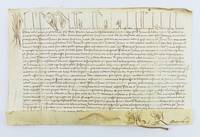
1614rif. ST12778-0352Rome 1614. 203 x 319 mm. 8 x 12 5/8". Single column 25 lines in a papal chancery hand. With braided cloth tie for appended seal now gone. Elaborate lettering all across top line of text especially the first 8-line initial and at lower right corner. Lower margin with several signatures in ink behind the fold; verso with brief notes in ink; remains of hemp tie for appended seal which has been cut away. Three vertical and one horizontal fold creases faint overall yellowing to verso possible erasure correction in second line of text otherwise the page bright and the hand clear. Addressed to the Archbishop of Naples this Papal Bull grants a marriage dispensation between Pietro Palladino and Giovanna Cabalone. An online search finds nothing about the couple named in the present document but they were apparently high-ranking Neapolitan citizens who had the means to procure a Papal intercession. Likewise the particular impediment prohibiting the marriage is not apparent here. This type of document takes its name from the lead seals called "bullae" that were issued with official documents of the papacy as a way of ensuring their authenticity. Apart from the very rare Solemn Privilege like Innocent III's famous granting of England in 1214 to his involuntary vassal King John there are three categories of Papal Bulls: Simple Privileges also called Solemn Letters Letters of Grace which confirm privileges and rights but are somewhat smaller and Mandates which are differentiated by their use of hemp ties as opposed to silk as here. A member of the influential Borghese family Pope Paul V born Camillo Borghese 1550-1621 reigned as head of the Catholic Church for 16 years from 1605 until his death. As a staunch defender of the rights and privileges of the church he often came into conflict with secular leaders. He is perhaps best remembered for financing the completion of St. Peter's Basilica and for his involvement in the Galileo controversy in which he warned the scientist against advocating heliocentrism. unknown
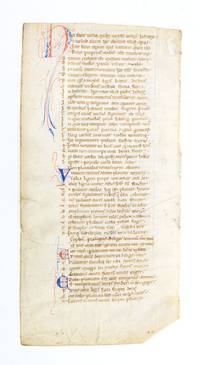
rif. ST18250bEngland first half of 13th century. 235 x 117 mm. 9 1/4 x 4 1/2". Single column 49-50 lines in a gothic hand. Rubrics in dark brown ink three two-line initials in red or blue with contrasting penwork one four-line puzzle initial in red and blue with red and blue penwork decorations and long marginal extenders. With a few contemporary corrections in a different hand verso with scant remnants of mounting tape. Gwara Handlist no. 7. ◆Top edge trimmed cutting into the large initial's ascender one corner cut away not affecting text a couple of wrinkles and a bit of soiling to vellum but in excellent condition overall quite clean and entirely legible. Noticeably different in appearance from the Medieval leaves more commonly encountered on the market such as Books of Hours Bibles liturgical books etc. this leaf features a tall thin "ledger" format and offset initials spaced slightly apart from the rest of the line. The text here comes from the "Aurora" a commentary on the Bible in verse form written in the late 12th century by French poet Petrus Riga 1140-1209 a canon of Rheims cathedral. Although little is known about the author's life Riga's text became immensely popular throughout Europe and was routinely studied in Medieval universities. In fact it is likely that the present leaf came from a manuscript intended for a student or academic as its dimensions suggest it was made for easy transport and could even have been slipped into a pocket. In the 20th century the parent manuscript was owned and dismembered by biblioclast Otto Ege and leaves appeared as specimen no. 7 in his "Fifty Original Leaves from Medieval Manuscripts Western Europe XII to XVI Century." Single leaves from this manuscript appear at auction very rarely. The last example we were able to track on RBH and ABPC sold at Bloomsbury in 2016 for an all-in price of £3100. unknown
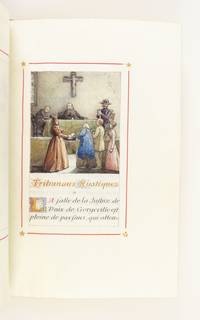
1896rif. ST17129-026Paris 1896. 200 x 135 mm. 7 7/8 x 5 3/8". 11 leaves. Single column 16 lines plus headline in a thin graceful italic script. Attractive red crushed morocco by Marcellin Lortic stamp-signed on front doublure covers framed by multiple-rule gilt strapwork raised bands spine compartments with gilt French fillet gilt titling vellum doublures with gilt frame in the Romantic style leather hinges vellum endleaves all edges gilt. In matching morocco-trimmed slipcase. Title in burnished gold embellished with red and blue penwork text with red-ruled border and burnished gold stars at corners numerous one-line burnished gold initials with red or blue penwork two-line opening initial in burnished gold on a blue white and pink background and A HALF-PAGE MINIATURE measuring 71 x 64 mm. SHOWING A COURTROOM SCENE. Front free endleaf with morocco bookplate of Robert Hoe. ◆Just the slightest hint of rubbing to joints but A VERY FINE SPECIMEN entirely fresh bright and clean inside and out. This elegant little manuscript in French recounts Guy de Maupassant's satirical tale of a trial in the provinces; it was created by a man who knew the inside of a courtroom all too well. Bouton 1819-1901 was a young rebel during the 1848 Revolution who spent five years in jail for his participation in a bombing in Paris. Oddly enough the dedicated republican was also an expert on heraldry and paleography publishing pamphlets on those subjects as well as on politics and producing manuscripts like the present one. De Maupassant 1850-1893 is generally acknowledged as one of the great masters of the short story. In the present tale a wealthy older woman who had tried to buy a young peasant's love by giving him land sues unsuccessfully for the return of her property when the object of her affection forsakes her for a younger woman. According to Beverly Chew the library of Robert Hoe 1839-1911 founding member and first president of the Grolier Club was "the finest America has ever contained." Hoe acquired illuminated manuscripts early printing he owned a Gutenberg Bible on paper and one on vellum fine bindings French and English literature and Americana and when his library was sold in 1911-12 it fetched nearly $2 million a record that held until the Streeter sale more than 50 years later. Hoe owned several Bouton manuscripts of de Maupassant stories and the Morgan Library also has Bouton creations. The Lortic name was made famous in the history of French binding by Pierre Marcellin Lortic 1822-92 a leading Parisian binder for 40 years; the binder here was Lortic's son Marcellin or "Lortic Fils" 1852-1928. unknown
rif. ST16985PFrance first half of 14th century. 110 x 82 mm. 4 3/8 x 3 1/4". Single column 12 lines in a gothic book hand. Line enders in pink and blue with gold accents each leaf with one or more one-line initials in blue with red penwork or gold with blue penwork each leaf with one two line initial painted pink or blue--filled with painted floral motifs or a gold cross and ONE INHABITED BY HUMAN FACE--all on a gold ground one side of each leaf with A FULL BORDER composed of pink and blue tendrils accompanied by spikey gold decoration and gold accents often terminating in ivy leaves and incorporating EXTRAORDINARILY CHARMING EXAMPLES OF MARGINALIA INCLUDING ANIMALS HUMAN HEADS AND HUMAN-BEAST HYBRIDS. ◆Occasional minor smudging vellum a little soiled and with a few small stains one leaf with noticeable staining affecting some of the text and decoration but with extremely appealing imagery making up for it another leaf with some marginal offsetting and the inhabited initial slightly rubbed but all other examples of marginalia VERY WELL PRESERVED. Though diminutive in size these leaves contain enormously appealing marginal decoration in the form of humans animals and hybrid creatures inventively incorporated into the lively borders in manners that range from adorable to bizarre. Especially popular in Flanders Northern France and England during the 13th and 14th centuries marginalia such as these comprise some of the most memorable and entertaining images to be found in any Medieval manuscripts. Despite being found largely in religious books such as Psalters and Books of Hours the images are often strange humorous or even outrageous and they provide us with consistent delight. Being by definition outside of the central text or miniature the margins seem to have been a place where illuminators felt more at ease to experiment resulting in highly imaginative and unique artistic expressions. The present specimens come from a fragmentary manuscript with many leaves either missing or rendered defective where portions of the vellum were cut away. Fortunately this group of leaves is intact and retains much marvelous imagery including two very alert hares an owl and a wonderful stork with a long beak grabbing the equally long beard emanating from a human-beast hybrid in the upper margin and the heads of humans some in the guise of a fool and storks with long beaks each holding a gold bezant incorporated into the border tendrils. One leaf shows more damage than the others here but contains some very desirable marginalia: a human-beast hybrid with an orange speckled body and a long tail in a stand-off with a snail in the upper margin and the torso of a trumpeter emerging from one of the border tendrils blowing into an extremely long gold instrument held vertically in the fore margin. For additional leaves from this same manuscript at different price points please check our website. unknown
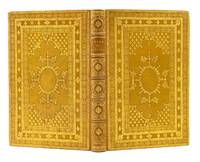
1882rif. ST16453Glasgow: Printed by Robert Anderson for Private Circulation 1882. ONE OF ONLY 50 COPIES. 195 x 122 mm. 7 3/4 x 4 7/8". 1 p.l. x 103 1 pp.From George Bannatyne's manuscript compiled A.D. 1568. BEAUTIFUL CITRON CRUSHED MOROCCO ELABORATELY TOOLED IN GILT BY RAMAGE stamp-signed on front turn-in covers with six concentric frames--intricate filigree roll pointillé-tooled floral vine and alternating small ornaments--enclosing a central panel with cornerpieces semé with rows of fleurs-de-lys large oval medallion at center radiating ornate fleurons raised bands spine compartments with large central medallion containing a vase of flowers delicate tooling in corners gilt titling turn-ins framed by filigree roll and alternating small ornaments brown and tan silk jacquard endleaves patterned in a Medieval motif top edge gilt. Printer's device on title page decorative woodcut initials and headpieces. Spines evenly sunned to a warm honey brown corners lightly rubbed short faint scratch to lower board but the binding virtually unworn and happily free of the splaying that plagues vellum books. Leaves lightly rumpled but A VERY FINE COPY the vellum leaves creamy clean and bright and the binding glittering with gold. Printed on luxurious vellum and limited to just 50 copies presumably for private circulation among friends of the printer this is a lovely edition of 16th century poems by a mysterious author believed to have been a poet and musician associated with the court of Mary Queen of Scots. This work contains all 36 extant poems attributed to Scott ca. 1520-82/3 including what is considered to be his most historically important work "Ane New Yeir Gift to Quene Mary" 1562 written in support of the young Scottish queen caught between Catholic and Protestant agendas. His other poems consist largely of lyric verses on love and sexuality which DNB describes as possessing "exceptional metrical variety and vernacular directness" with "a musician's ear for rhythm and melody." Scott's poems are known to us via the Bannatyne manuscript now held in the National Library of Scotland which ranks among the most important documents of Scottish Medieval literature. Written by George Bannatyne in 1568 during a period of confinement due to an outbreak of plague it contains a mixture of both secular and religious material including the sole extant copies of several texts. In the preface to the present work the publisher notes that Scott's poetry has been faithfully reproduced from that manuscript and thus "for the first time accurately printed." Very little is known regarding the life of Alexander Scott but he seems to have been attached to the court of Mary Stuart through John Erskine a guardian and counselor to the queen. Given the very limited number of copies made it is not surprising that this work is extremely rare on the market. Printed [by Robert Anderson] for Private Circulation unknown
1465rif. ST11151bBruges ca. 1465. 181 x 127 mm. 7 1/8 x 5". Single column 19 lines in a careful pleasing gothic book hand. In a very attractive new gilt wooden frame. Rubrics in pink or faded red one two-line initial in blue magenta and burnished gold two lines with undulating line fillers in blue and gold both sides of the leaf with a three-quarter panel border incorporating foliage blossoms and ivy leaves on hairline stems the vertical part of this frame with a bar border composed of colors and burnished gold terminating at top and bottom in colorful acanthus leaves and WITH TWO SMALL BUT VERY PLEASING MINIATURE PAINTINGS SAINT ELIZABETH ON THE RECTO AND SAINT GERTRUDE ON THE VERSO. ◆Tiny wormhole in fore edge where it has done negligible damage small portions of the blue paint in the Elizabeth miniature eroded gray paint slightly smeared as well but apparently at the time of painting otherwise in fine clean fresh condition. This leaf is characteristic work from the circle of Willem Vrelant the leading purveyor of books of private devotion in Bruges during the third quarter of the 15th century. His leading position among Flemish illuminators of the time is indicated by the considerable number of manuscripts illustrated in his manner by other miniaturists both in Bruges and in nearby cities in Flanders. The illuminator of our Book of Hours shows a number of distinctive stylistic traits. Among these are a preference for boldly patterned cloth backdrops tessellated flooring landscapes filled with stylized bushes and trees and persisting prominent architectural constructions that frame the subject frequently in a corner in these leaves it is a waist-high outdoor wall or an indoor feature resembling wainscoting. The inclination for strong geometrical patterning is manifested in the artist's angular treatment of human figures and their garments. Dressed in pink and blue Elizabeth is depicted with a sweet round face. She is saluted here as the woman worthy to be the mother of John the Baptist the forerunner of the Redeemer. Gertrude is dressed in monastic black although a pink undergarment is visible and her inky habit is trimmed in gold. This shimmering feature is a reminder that Gertrude 626-59 was the daughter of Pepin I of Landen Mayor of the Palace for the Frankish realm of Austrasia and the forebear of Charlemagne. Gertrude is a natural choice for illustration by an artist of Bruges since she was the patron of nearby Nivelles. The saint was routinely invoked for aid in coping with mice and is here shown surrounded by four animated rodents as black as her habit. No legend survives to explain why she had such power over the creatures who seem here to be more her pets one climbs her staff of office than her victims. unknown
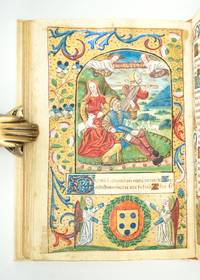
1516rif. ST20620Northern France late 15th or early 16th century. 176 x 128 mm. 7 x 5". Single column 23 lines in a neat batârde hand. i blank 101 ii blank leaves. Lacking one leaf after f. 87 possibly containing a miniature otherwise complete. Contents: Calendar f. 1r; Gospel Lessons f. 7r; Passion according to John f. 10v; Hours of the Virgin f. 15v; Penitential Psalms and Litany f. 45r; Office of the Dead f. 54v; Hours of the Cross f. 68v; Hours of the Holy Spirit f. 70v; Prayers to the Trinity St. Veronica "Obsecro Te" "O Intemerata" and "Stabat Mater" f. 72v; Suffrages f. 79r; Prayers in French to be said on various occasions f. 86v; verse prayer in French beginning "Royne des cieulx glorieuse" f. 90r; additional prayers in French and Latin f. 93v. Attractive 19th century vellum with lacy gilt border raised bands ruled in gilt gilt lettering tan silk endleaves all edges gilt. Housed in a felt-lined reddish-brown pebbled morocco clamshell box with gilt lettering on spine. Rubrics in red numerous one- and two-line initials in painted gold on burgundy or blue ground WITH 27 SMALL MINIATURES one miniature of Christ Carrying the Cross measuring 60 x 68 mm. the rest depicting saints and measuring between eight and nine lines each surrounded by a full border of acanthus flowers and small dots on bare or painted vellum and 14 LARGE MINIATURES EACH OPENING WITH A FULL BORDER either with acanthus and flowers as before or architectural some borders embellished with figures animals or hybrids two with a small scene in the lower margin and about a dozen with the added coats of arms and/or mottos of Jean Boutin. The subjects of the large miniatures include the following: St. John of Patmos f. 7r; Annunciation f. 15v; Visitation f. 23r; Nativity f. 27v; Annunciation to the Shepherds f. 29v; Adoration of the Magi f. 31v; Presentation in the Temple f. 33v; Flight into Egypt f. 35v; Death of the Virgin f. 38v; Bathsheba bathing f. 45r; Funeral Mass f. 54v; Crucifixion f. 68v; Pentecost f .70v; Trinity f. 72v. See: Fairfax-Murray "French" p. 265-266. Vellum binding soiled but perfectly sound. Small portions of some border figures and perhaps three or four miniatures touched up in the 16th century see below occasional chipping to white paint small hole in the border of ff. 11 & 29 light scattered spotting fading thumb soiling and other minor issues but an attractive and substantially complete manuscript the illumination extensive and mostly well preserved. This heavily illustrated Book of Hours is a lovely example of provincial illumination; it calls attention in an interesting way to the influence of printed books on manuscript art; and it contains intriguing traces of an early prominent owner. Our manuscript contains a total of 41 large and small miniatures by a skilled artist who clearly had some training and familiarity with the prevailing styles of the time. The overall appearance of the work suggests the artist or workshop was located in Northern France and although the figures and backgrounds are indicative of a provincial hand the rich colors profuse use of liquid gold and sumptuous borders are unmistakable marks of luxury. The image of the Trinity is particularly lovely demanding the viewer's attention with God the Father's piercing gaze and conveying the majesty of the subject with a patterned throne set against a starry sky. Of special interest here are the compositions of the large miniatures many of which seem to have been copied from printed Books of Hours of the period. When we talk about the transition from manuscripts to print culture in the late-15th and 16th centuries the discussion often focuses on how the art of manuscripts influenced the appearance of printed works. There is no better example than Books of Hours which in printed editions often mimic the look of their manuscript predecessors in appearance and the way many were finished by hand. However as the present example demonstrates the opposite was also true as printed works inevitably made their way into the hands of manuscript artists. Some even worked simultaneously both as illustrators for publishers working with metal- and woodcuts and as manuscript painters. As a reflection of this point in the present work we find distinct similarities between our miniatures and a series of metalcuts used by Philippe Pigouchet for the publisher Simon Vostre beginning in 1496 Fairfax-Murray's set 2. According to Fairfax-Murray "These cuts . . . were evidently very favourably received by Pigouchet's rivals and imitators for one finds several close copies and adaptations in the various productions of other presses" including a very close imitation of woodcut images commissioned by the publisher Antoine Vérard. Evidently the popularity of these plates extended to manuscript artists and it is fascinating to see the adaptation of each composition to suit the painter's own style and the patron's needs. Most of the compositions in our manuscript are essentially simplified versions of the printed miniatures retaining the central figures their gestures garments and props but with complex backgrounds eschewed as are extra figures deemed unnecessary to fulfill the narrative. The resulting miniatures are far less busy than their printed counterparts allowing the viewer to focus on the central story. In a few instances the artist has added small scenes beneath the large miniatures. An example on f. 35 depicts the so-called "Miracle of the Wheat" featuring harvesters misleading Herod's soldiers by truthfully saying that the fleeing Holy Family passed by when their now miraculously matured crop was just being sown. This kind of inclusion may have been influenced by the copious small metalcut scenes that decorate the borders of numerous printed Books of Hours of this period. The text here follows a fairly typical structure but includes prayers in French to be said for each day of the week and on various occasions such as when one awakens or when one leaves a house. Also in French are additional verses to the Virgin--one of which is credited to the Franciscan preacher Jean Tisserand d. 1497 who founded an order for repentant women. Another accessory prayer included here f. 98 appeared in both prayer books and conjuring manuals of the period straddling the line between religion and popular magic. Based on an apocryphal encounter between Pope Leo III and Charlemagne during the Battle of Roncevaux this prayer was often used as a protective amulet against all manner of evil; here it is said to "conquer demons and one's enemies." Although we do not know for whom this manuscript was originally made the book shows a number of marginal customizations in the form of different coats of arms the motto "Soit avenu" "Let it come to pass" and the name of Jean Boutin written on ff. 23 and 35. This owner could have been Jean Boutin Sieur de la Court et de Chamballan and Mayor of Nantes from 1575-76. In addition to the marginal customizations the manuscript may possibly have some very neat replenishing of white facial paint in a handful of marginal figures and perhaps in a very small number of the miniatures. Using magnification and strong light we are unable to find convincing evidence that this retouching took place at least in the miniatures and if it was we think it was done quite early perhaps in the 16th century. Worst case it would necessarily be termed subtle and skillful enough to cause uncertainty now and whatever the verdict is in this respect the manuscript remains very fresh and attractive features attractively executed paintings is complete but for one leaf and would provide ample room for additional research. unknown
1622rif. ST12778-0281Rome 1622. 295 x 410 mm. 11 5/8 x 16 1/8". Single column 23 lines in a papal chancery hand. Elaborate lettering across top line of text. Lower margin with several signatures in ink; verso with brief notes in ink; lacking the original hemp tie and lead seal. Two tears at bottom of the document where ties were removed not affecting text vellum lightly soiled but in excellent condition overall. Addressed to the Archbishop of Naples this Papal Bull grants a marriage dispensation between Fabritio Virgopia and Judith Cuono. An online search finds nothing about the couple named here but the document reveals that they were petitioning for a dispensation because they fell into the second and third degrees of consanguinity meaning that they shared at least one common ancestor. Although marrying within four degrees of consanguinity was prohibited by the church it was not uncommon for the Holy See to issue dispensations as here allowing such marriages to take place—particularly for the privileged classes. The Papal Bull takes its name from the lead seals called "bullae" lacking in the present example that were issued with official documents of the papacy as a way of ensuring their authenticity. Apart from the very rare Solemn Privilege like Innocent III's famous granting of England in 1214 to his involuntary vassal King John there are three categories of Papal Bulls: Simple Privileges also called Solemn Letters Letters of Grace which confirm privileges and rights but are somewhat smaller and Mandates which are differentiated by their use of hemp ties as opposed to silk as would have been the case here. Pope Gregory XV born Alessandro Ludovisi 1554-1623 ruled for just over two years from 1621-23. His brief papacy was marked by efforts to support the Catholic Counter-Reformation including the establishment of the Congregation for the Propagation of the Faith to oversee missionary work. He also played a key role in the election of Holy Roman Emperor Ferdinand II canonized notable saints such as Ignatius of Loyola and Francis Xavier and issued the last papal mandate concerning witchcraft. Documents issued by Gregory XV are unsurprisingly rare given the shortness of his rein: we could trace just one sold at auction since 1995. unknown
1415rif. ST19350-056Germany and Low Countries 14th & 15th centuries. Smallest piece: 209 x 152 mm. 8 1/8 x 5 7/8"; largest piece: 372 x 235 mm. 14 3/4 x 9". Recovered from bindings and thus with uneven trimming and occasional small holes resulting in loss staining and toning to vellum some leaves with remnants of pastedowns obscuring the script but generally the leaves quite legible substantially complete and in presentable condition. This packet contains five vellum manuscript leaves all complete or nearly so all with musical notation and all serving as linings or covers of a binding when reused in their second lives. Prepared with an academic audience in mind the group presents an excellent opportunity for libraries teachers and students to develop or expand their teaching or personal collections. In addition to their obvious value as manuscripts containing the text and music of the Medieval period these leaves are also of educational importance as physical artifacts demonstrating the reuse of manuscript material in the production of later bindings. The shape of each binding is still easily discernable and a few of these specimens even include early spine labels and ink notations as well as paper remnants used in the bookbinding process. unknown
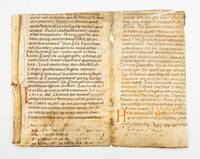
rif. ST20509a-bGermany Late 11th or early 12th century. Largest bifolium measures 221 x 275 mm. 8 7/8 x 10 3/4". Single column 25-27 lines in a late Caroline hand. Rubrics in orange each bifolium with one or more one one-line initial in orange and one or more large four- to five-line initials in orange. With marginal notations in a later hand. Recovered from a binding and thus with some soiling abrasions glue residue and other small problems; the pages nearly complete but with a couple of letters and/or lines cut away from one side of each bifolia with more extensive abrasions on one side affecting legibility but very good specimens overall the better side in each case quite clear and readable. Once part of a Lectionary a collection of scriptural readings appropriate for Masses through the year and other ceremonial occasions these attractive mostly legible binding fragments display an excellent transitional script with both Caroline minuscule and proto-gothic characteristics. The present examples include short lessons or "lectiones" taken from the Old and New Testaments including among other passages excerpts from John in which Christ casts the sellers out of the temple and Daniel relating the prayers of the three men who refused to bow to Nebuchadnezzar's golden idol. The lovely script here shares much in common with the pure Caroline miniscule of earlier centuries--particularly in the overall legibility of the text the space between individual letters and the limited use of ligatures and abbreviations; also of note is the exclusive use of the long "s" unless at the beginning of a sentence and the ampersand as a general abbreviation for the letters "et" occurring anywhere in a word e.g. "propheta" written "proph&a" here. Evidence of a progression toward proto-gothic script can also be observed here in the appearance of certain letter forms such as the closed "g" a more oval "o" and the use of two forms of "d" both upright and Uncial the latter with a sloping shaft. There is added interest here in the form of marginal notations in a later hand--probably dating from the time these bifolia were in situ as binding waste. unknown
rif. ST20509c-dGermany Late 11th or early 12th century. Larger bifolium measures 221 x 275 mm. 8 7/8 x 10 3/4".; smaller bifolium measures 207 x 275 mm. 8 1/8 x 10 3/4". Single column 25-27 lines in a late Caroline hand. Rubrics in orange each bifolium with one or more one-line initial in orange and one or more large four- to five-line initials in orange. With marginal notations in a later hand. Recovered from a binding and thus with some soiling abrasions glue residue and other small problems as well as limited loss of legibility in a few places; the pages nearly complete but with a couple of letters and/or lines cut away from one side of each bifolium; even with the problems very good specimens overall the letters on the better side quite clear and readable in each case. Once part of a Lectionary a collection of scriptural readings appropriate for Masses and other ceremonial occasions through the year these attractive mostly legible binding fragments display an excellent transitional script with both Caroline minuscule and proto-gothic characteristics. The present examples include short lessons or "lectiones" taken from the Old and New Testaments including among other passages excerpts from John in which Christ casts the sellers out of the temple and Daniel relating the prayers of the three men who refused to bow to Nebuchadnezzar's golden idol. The lovely script here shares much in common with the pure Caroline miniscule of earlier centuries--particularly in the overall legibility of the text the space between individual letters and the limited use of ligatures and abbreviations; also of note is the exclusive use of the long "s" unless at the beginning of a sentence and the ampersand as a general abbreviation for the letters "et" occurring anywhere in a word e.g. "propheta" written "proph&a" here. Evidence of a progression toward proto-gothic script can be observed here in the appearance of certain letter forms such as the closed "g" a more oval "o" and the use of two forms of "d" both upright and Uncial the latter with a sloping shaft. There is added interest here in the form of marginal notations in a later hand--probably dating from the time these bifolia were in situ as binding waste. The price given here is for one bifolium. unknown
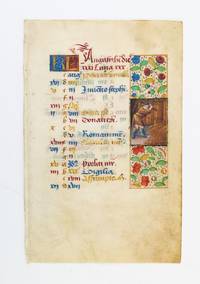
1470rif. ST17245-09Northern France probably Rouen ca. 1470. 180 x 117 mm. 7 x 4 5/8". Single column 18 lines text in a bâtarde hand. Text in red blue and gold two-line "KL" in shell gold on blue and red ground both sides with panel border composed of flowers and ink dots WITH TWO SMALL MINIATURES each centered in the middle of the panel borders featuring the labor of the month Threshing and the zodiac sign a young woman for Virgo. Vellum a bit soiled and slight wrinkling in margins small area of rubbing at bottom of the Virgo miniature but in excellent condition overall the fine details in the miniatures well preserved. Situated among the flowers of the panel borders here are two small but charming miniatures depicting the labor of the month "Threshing" and the zodiac sign for August. According to Roger Wieck far fewer than half the Books of Hours of the period contain illustrated calendars "even in manuscripts with otherwise lavish cycles of miniatures"; when they do appear they are invariably charming as is the case here. In the threshing scene a young layman brings down his grain flail two hinged pieces of wood the longer one called a helve and the other a beater joined by a thong in an effort to separate the grain while neatly gathered bushels of straw appear just behind him. On the verso we see a representation of Virgo as a young woman holding appropriately two long stalks of grain in her hands. The rich palette used in these miniatures allows the delicate gold highlighting on the harvested crop and garments to shine through adding a fine sense of detail to each image. unknown
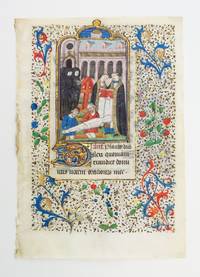
rif. ST17060VFrance probably Besançon 3rd quarter of 15th century. 239 x 165 mm. 9 3/8 x 6 1/2". Single column 15 lines in an elegant gothic book hand. Rubrics in dark pink line-enders in dark pink and blue with a gilt bezant several one-line initials in burnished gold on dark pink and blue ground with white tracery one three-line initial in blue with white tracery filled with flowers painted pink or blue all on a gold ground verso with panel border of delicate hairline vines terminating in gilt bezants and ivy and with a spray of blue flowers and a red bud recto with A FULLY-REALIZED HALF-PAGE MINIATURE OF A BURIAL in an arch-topped gilt frame with two laymen lowering a shrouded corpse into the ground a small group of hooded monks to the left and two ecclesiastical figures reading from a book to the right all in front of a gothic church painted pink with a blue roof SURROUNDED BY A FULL BORDER consisting of hairline vines terminating in gold bezants and ivy colorful acanthus strawberries and blue flowers the text below the miniature further framed with a thin "U"-shaped line extending the full height of the miniature. A very few trivial imperfections quite minor wear to paint on clothing a little insignificant smudging one small light stain in the blank margin of verso but these defects not the least distracting and overall the miniature in fine condition with rich well-preserved color. This is a splendid miniature from a particularly large Book of Hours showing a detailed rendering of a scene from contemporary Medieval life--that of a burial in a churchyard involving clergy mourners and laymen. Apart from those relatively few copies with illustrated calendars the miniatures found in Books of Hours are almost entirely devoted to retrospective Bible scenes that are obviously outside the experience of the illuminator; it is only in the present kind of scene at the beginning of the Office of the Dead that we can see a contemporaneous image that would have come directly from the Medieval experience. While our painting is fairly typical in subject matter and design it offers a number of interesting details about the Medieval rites and rituals surrounding death. The present scene represents the final stage preceded by the funeral procession Requiem Mass prayers Absolution and the procession into the graveyard in which the body is actually laid to rest in the ground. Though the corpse would have been encased in a coffin during the aforementioned rites and processions it was customary to bury the dead in only a shroud in the present example the artist has even thought to show the stitching along the length of the shroud. Three groups of people each serving a different function appear in this miniature: in the foreground are two laborers lowering the body into an earthen grave a small group of mourners in black cloaks stand off to the left and a duo of clergy members stand to the right. The latter have tonsured heads and each wears a black cope donned prior to administering Absolution to the deceased; together they hold a manuscript containing the Rites for Burial. The background is composed of a grand church or cathedral containing a number of fine architectural details including several windows including a clerestory level an arched entrance a dome and decorative touches. Stylistically this leaf can be localized to the Franche-Comté region in eastern France and is closely related if not directly attributable to an atelier specializing in Books of Hours made for the Use of Besançon and most likely situated in that city see Avril and Reynaud p. 197. The similarities are especially apparent in the figures' faces which are slightly puffy in appearance and have distinct slit-like eyes. As noted by Avril and Reynaud the unnamed master of this atelier was deeply indebted to the Master of Morgan 293 a talented Burgundian illuminator active in the second quarter of the 15th century whose name derives from a particularly lovely Book of Hours made for the Use of Besançon. Whoever the artist responsible for the present miniature this work is an excellent representation of a distinct regional style extremely attractive and replete with interesting details that connect us to the Medieval experience. unknown
1891rif. ST15049London: Seeley and Co 1891. No. 85 OF 160 COPIES ON LARGE PAPER. 382 x 275 mm. 15 x 10 3/4". 4 p.l. 111 1 pp. Publisher's gilt-stamped vellum upper cover with titling and the Tennyson coat of arms BOTH COVERS WITH LOVELY HAND-PAINTED DESIGN BY JOHN T. BEER upper cover with urn at foot and blooming rose branches emanating from a medallion bearing the date 1902 and curving around the title and escutcheon lower cover with branches of apple blossoms dividing the board into quadrants each inhabited by a bird in flight smooth spine with gilt titling edges untrimmed. With frontispiece photographic portrait of Tennyson 31 vignettes in the text and 14 copper-plate engravings after drawings by Edward Hull. Verso of title page and limitations page with ink stamp of Gloucester County Library. Weber "The Fore-Edge Paintings of John T. Beer" 195. Small scratch near head of front joint minor soiling and rubbing to edges of boards mild foxing mostly marginal and not affecting copper engravings otherwise an excellent copy clean and fresh internally with wide margins the binding especially bright the pretty decoration perfectly preserved. AN EXTREMELY ATTRACTIVE COPY. This very large format deluxe illustrated work describing the places associated with England's beloved Poet Laureate Alfred Lord Tennyson is enhanced by former owner John T. Beer's Arts & Crafts-style embellishments to the vellum binding. After retiring from a successful career as a clothier Merseyside book collector Beer ca. 1826-1903 occupied himself decorating books from his library mostly with fore-edge paintings but in a score of instances with painted bindings. Jeff Weber considers Beer "one of the most highly skilled artists of fore-edge paintings" noting that he was the first artist to put his signature to such works. Weber's catalogue raisonnée of Beer's works lists 189 fore-edge paintings 22 painted bindings including this one #195 and three bindings designed by Beer and executed by Fazakerley of Liverpool. The design here is clearly influenced by the Arts & Crafts movement and Beer owned several works by William Morris including a Kelmscott Press "Godefrey of Bologne" on the vellum covers of which he had painted a design of tulips and lilies. Among the locations discussed and pictured in the "The Laureate's Country" are Tennyson's childhood homes in Somersby and Bag Enderby Trinity College Cambridge where he matriculated and his estates Farringford on the Isle of Wight and Aldworth in West Sussex. Seeley and Co unknown
rif. ST12083fItaly ca. 1150. 406 x 273 mm. 16 x 10 3/4". Double column 42 lines in a fine rounded early proto-gothic hand. With rubrics in red one three-line initial "I" and A PANELLED 13-LINE INITIAL "F" all of these on the very faded recto and consequently indistinct. Formerly used in a binding with text on the recto unreadable the verso with a narrow band of darkening along one edge not obscuring text edges very wormed but 90 percent of the worming in the margin with very little damage to the text; some obvious condition problems but the large and beautiful script on one of the sides entirely legible and certainly very pleasing. This leaf comes from a very large copy of one of the major texts by one of the great popes of the early Middle Ages and it is notable for the spaciousness and elegance of its script. The sermon here is based on the Gospel reading for Easter Sunday John 20:1-9 which reports Mary Magdalene's discovery of the empty tomb and her running to tell the apostles what she had--and hadn't--found. Given the fact that the passage under discussion celebrates the most critical event in Christianity the opening phrase "Fractus longa molestia stomachus" is unexpected who would have thought it appropriate to mention protracted gastrointestinal problems and probably more effective as a result. Gregory says he is so weakened that he had given up explaining the Gospel to his flock but now he must resume. He recounts how Mary Magdalene told John and Peter about the empty tomb how John arrived first but did not enter the sepulcher and how Peter the tardier one did. Gregory then gives an allegorical interpretation of this episode: John he says represents the Synagogue Peter the Church; the Jews were prior to the Christians but they hesitated on the brink of belief in the Son of God while the Christians entered into full belief. unknown