Illuminated manuscript leaf on vellumBiblio.com

1 528 résultats
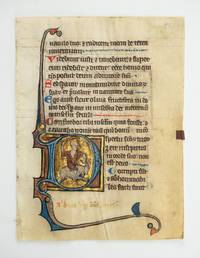
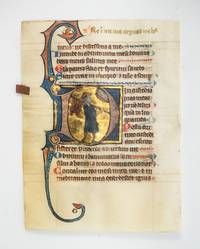
réf. 87191250. Central Italy c.1250. Matted in fine condition. § A well-painted initial of a man in flowing blue and pink robes holding a book to which he gestures probably Saint Paul. Italian miniature paintings of this period are known to be difficult to localize with any accuracy but as the face is strongly drawn with well-proportioned features it might well hail from central Italy. unknown
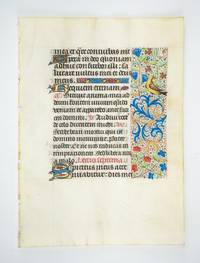
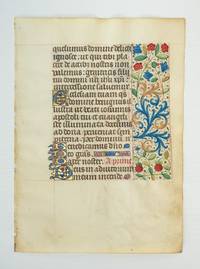
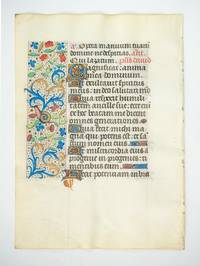
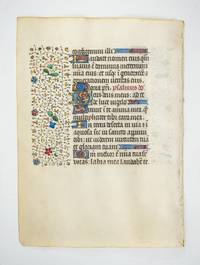
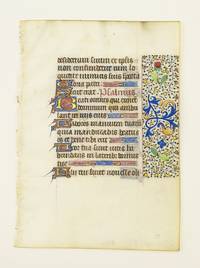
1500réf. ST20810FParis ca. 1500. 165 x 115 mm. 6 1/2 x 4 1/2". Single column 18 lines in a gothic book hand. Rubrics in red line fillers in pink and blue with gilt bezants and white embellishment most leaves with one or more one-line initials in burnished gold on pink and blue ground with white embellishments and some with one or more two-line initials in blue or pink with white embellishments enclosing leaves or flowers on burnished gold ground each side with panel border of acanthus sprays of flowers and/or fruit and gilt bezants five with a well-realized bird or insect in the borders two with with small mounds of fruit or flowers emerging from a golden vase. Some leaves with small marks smudges or other minor imperfections but generally in excellent condition being quite clean fresh and altogether attractive. Featuring high-quality illuminated initials a fine border on every page and the liberal use of painted and burnished gold these leaves clearly come from a luxurious Book of Hours produced by an accomplished workshop. Although a common element is the appearance of prominent blue acanthus every panel border shows a slightly different design including those with flowers emanating from golden chalices mounds of grape vines or charming well-realized birds or bees. These leaves are especially delightful carefully painted and very well preserved. unknown
1500réf. ST20810BParis ca. 1500. 165 x 115 mm. 6 1/2 x 4 1/2". Single column 18 lines in a gothic book hand. Rubrics in red line fillers in pink and blue with gilt bezants and white embellishment most leaves with one or more one-line initials in burnished gold on pink and blue ground with white embellishments many leaves with one or more two-line initials in blue or pink with white embellishments enclosing leaves or flowers on burnished gold ground each side with panel border of acanthus flowers and/or fruit and gilt bezants one leaf with a small bird perched in the border sold at this price level due to an ink smear. The odd smudge of small stain but generally quite clean fresh and well preserved. Featuring high-quality illuminated initials a fine border on every page and the liberal use of painted and burnished gold these leaves clearly come from a luxurious Book of Hours produced by an accomplished workshop. Although a common element is the appearance of prominent blue acanthus every panel border shows a slightly different design with varying flower combinations a fact that may make selecting a single favorite quite difficult!. unknown
1740réf. ST12778-0377Rome 1740. 180 x 312 mm. 7 x 12 1/4". Single column 18 lines in an arcane "scrittura bollatica." Elaborate lettering across top line of text and at lower right corner. Lower margin with several signatures in ink; verso with brief notes in ink; remains of hemp tie for appended seal which has been cut away. With faint folds a little natural yellowing to vellum but in fine condition. Appearing almost as a dancing musical score this is Papal Bull that leaves a lot to be deciphered. The document is written in the so-called "scrittura bollatica" which the Catholic Encyclopedia calls "an archaic and very artificial type of writing . . . with manifold contractions and an absence of all punctuation which was practically undecipherable by ordinary readers." The script was used from after the Reformation until it was discontinued through papal edict by Leo XIII in 1878. Apart from the name of the issuing pope and the date the only readily identifiable part of the text here is the name of the Archbishop of Naples the addressee on the top line. We acquired this document along with several other bulls addressed to this archbishop all having to do with marriage dispensations and we suspect that the present item probably contains similar content. The esteemed polymath Pope Benedict XIV born Prospero Lorenzo Lambertini 1675-1758 headed the Catholic Church from 1740 until his death. A scholar and reformer he worked to modernize church administration promote scientific study and improve relations with secular rulers. unknown
2019réf. BN540217M & M Limitless Online Inc. 2019. 2019. Trauma Toolbox: Techniques Your Doctor Won't Tell You About Healing Trauma Trauma Toolbox: Techniques Your Doctor Won't Tell You About Healing Trauma Vitela Michael und Lawrence Conley M & M Limitless Online Inc. unknown
réf. BN635448Befreit - Vereint Befreit - Vereint Sofia Velin unknown
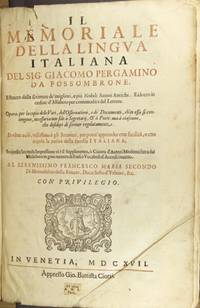
1617réf. 43152Venetia: Apresso Gio. Battista Ciotti 1617. Seconda impressione two parts in one folio pp. 12 609 1 8 236; a6 A-2N8 2O-2p6 †4 A-O8 P6; V4 of the first section missigned R4 with manuscript cancellation; woodcut printer's device initials and head- and tail-pieces; title page printed in red and black; text in double columns; full contemporary vellum soiling calf bands manuscript spine title and ornamentation; vertical hatch marks to upper cover edges quite rubbed and worn; endpapers supplied title page edges rather ragged minor worming to preliminaries else textblock mostly very good. Small period manuscript paper label "Ad usum A.M.L. Parm." mounted to bottom of title page. Zaunmüller p. 209. OCLC does not locate any copies in the United States. Apresso Gio. Battista Ciotti unknown
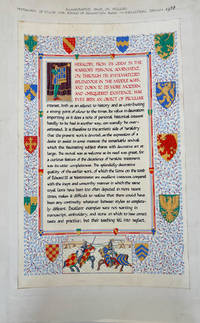
1928réf. 120551928. Original illuminated large manuscript page on vellum comprising a central panel of calligraphic text in red and black ink with a miniature of a young herald surrounded by a decorative border of larger armorial shields set within a stylised foliate background in blue red green and gilt with a fine miniature of a knight’s tournament at the foot. 41 x 25.5cm. Mounted on card with ink title to the head: “Illuminated page on vellum. / Testimony of study for Board of Education Exam in industrial design 1928.” In very good condition.WITH: Two further pencil drawings by the same artist the first of an elderly gentleman the second of a classical sculpture measuring 57.5 x 38cm and 56 x 39cm respectively each signed “Bate” and dated 1927. The pencil drawings have a few short tears to the edges otherwise they are in very good condition. A fine example of 1920s illumination hardcover
1500réf. ST20810GParis ca. 1500. 165 x 115 mm. 6 1/2 x 4 1/2". Single column 18 lines in a gothic book hand. Rubrics in red line fillers in pink and blue with gilt bezants and white embellishment each leaf with one or more one-line initials in burnished gold on pink and blue ground with white embellishments and one two-line initial in blue or pink with white embellishments enclosing leaves or flowers on burnished gold ground EACH SIDE WITH A PANEL BORDER INCORPORATING AN ANIMAL OR HYBRID CREATURE and filled with acanthus flowers and/or fruit and gilt bezants. Light soiling or thumbing to some leaves but in uniformly excellent condition almost entirely clean fresh and bright. Whether you prefer your marginalia in the form of beautiful peacocks murderous-looking bunnies or fantastic hybrids these leaves feature pleasing creatures fanciful and charming. Featuring high-quality illuminated initials a fine border on every page and the liberal use of painted and burnished gold the leaves clearly come from a luxurious Book of Hours produced by an accomplished workshop. The marginal creatures are prominent executed with considerable skill and exhibit a great deal of personality. unknown
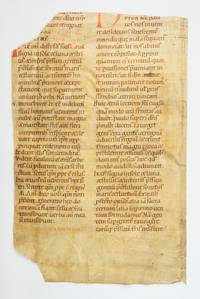
réf. ST20617bAustria Salzburg second half of 12th century. 298 x 232 mm. 11 3/4 x 9 1/4". Single column 26 lines in a lovely proto-gothic hand with two lines of uncials. Rubrics in red two two-line initials in red one four-line initial in red. Lower margin of recto with a 20th century note in very small letters in red ink see below. Recovered from a binding and thus with overall darkening though the recto much less affected by this four lines of contemporaneous annotations slightly trimmed though good margins all the way around vertical crease with small wormholes and tears touching text but not affecting legibility other minor defects but on the whole quite well preserved and entirely legible. Containing a large elegant initial and a beautiful proto-gothic script featuring two rows of uncials this leaf is an excellent example of early Austrian manuscript production. The text here includes the end of a homily by the Venerable Bede followed by the rubric for the Feast of the Birth of Mary Magdalene July 22 commencing with St. Gregory the Great's Homily 33 beginning "Ad Pharisei prandium dominus discumbebat" from his "Homilies on the Gospels." The homily played an important role in Christian understanding of Mary Magdalene as a penitent sinner identifying her for the first time as the unnamed "sinful woman" who comes to anoint Christ's feet at the house of a Pharisee Luke 7:36-50 and conflating her with Mary of Bethany sister to Martha and Lazarus. Although modern scholarship now differentiates these three women Gregory's interpretation of Mary Magdalene as a reformed prostitute has persisted for centuries. The present leaf almost certainly belonged to a Lectionary owned by a Romanesque church in Salzburg a manuscript that was later dismembered for use in bookbinding. The script is particularly pleasing being large and dignified with extremely regular letterforms executed by a steady hand. According to the source from which we purchased this leaf it was shown in 1893 to the Medieval historian and later the Abbot of St. Peter's Salzburg Willibald Hauthaler 1843-1922 who wrote the identification in red ink along the lower edge. It was later owned by the Salzburg-based merchant artist and collector Carl von Frey 1826-96. It appeared at Christie's in 2010 where along with five sister leaves it sold for £13970. unknown
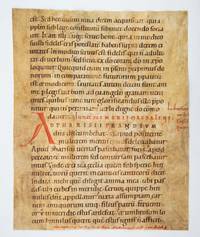
réf. ST20617fAustria Salzburg second half of 12th century. Unfolded: 350 x 296 mm. 13 3/4 x 11 3/4 mm. Double column 30 extant lines in a lovely proto-gothic hand. Rubrics in red two four-line initials in red. Recovered from a binding and thus with top margin and a small part of text trimmed away verso rather darkened with soil and glue part of the text readily legible the rest recoverable with effort negligible wormholes and small cuts but still a pleasing leaf with the recto rather clean and quite easy to read. This lectionary fragment which contains extracts from patristic writings for the season of Advent demonstrates a majestic highly regular and graceful proto-gothic book hand. The oval-shaped elongation of Caroline letter forms that are characteristic of 12th century book hands along with the mixture of rustic and uncial capitals our scribe has used for section titles appear particularly pleasing in the lovely uncramped hand at work here. The majority of the text is from St. Augustine of Hippo's "Quaestiones Evangeliorum" which provides a series of questions and answers regarding the Gospels of Luke and Matthew. The section of the work here XLIV discusses Luke 17:34-35 in which Jesus tells of the coming Kingdom of God. This text is preceded by Pope Gregory the Great's homily for the second Sunday of Advent. The final column of text on the verso is unfortunately rather rubbed and therefore difficult to identify but the headline indicates that it originates from a sermon of Pope Leo the Great. The present leaf almost certainly belonged to a Lectionary owned by a Romanesque church in Salzburg a manuscript that was later dismembered for use in bookbinding. According to the source from which we purchased this leaf it was shown in 1893 to Willibald Hauthaler 1843-1922 the Medieval historian and later the Abbot of St. Peter's Salzburg who wrote the identification along the lower edge. It was later owned by the Salzburg-based merchant artist and collector Carl von Frey 1826-96. It appeared at Christie's in 2010 where along with five sister leaves it sold for £13970. unknown
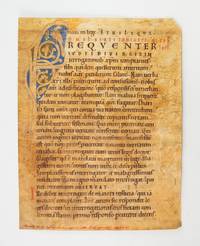
réf. ST20617cAustria Salzburg second half of 12th century. 319 x 244 mm. 12 1/2 x 9 1/2". Single column 27 lines in a lovely proto-gothic hand. Rubrics in red two one-line initials and one two-line initial in red WITH A LARGE 140 mm. WHITE-VINE INITIAL INHABITED BY A BIRD outlined in red and filled in with blue and green. Lower margin of recto with a 20th century note in red ink identifying the text. Recovered from a binding and thus with overall darkening top half of verso somewhat soiled with top line obscured though with all other letters on both sides very distinct cut a little close to the thin red extension of the initial a few minor holes inlcuding one elongated one through the top part of the initial with minimal loss. Even with these defects a powerfully attractive leaf with memorable decoration and script. Containing a beautiful proto-gothic script and an exceptional Romanesque initial this leaf is a particularly desirable example of early Austrian manuscript production. The opening initial "F" is formed with foliate designs outlined in red given shape by coloring in the negative space with an intense azure blue and moss green. Adding to the initial's charm is a large bird perched on one of the curving branches turning its head to the right as if to read the text like the initial it is also outlined in red. The white-vine style seen here would later become a model for the Italian Humanist scribes and illuminators of 15th and 16th centuries who substituted glistening gold leaf for the vibrant yellow paint favored by some artists of the Romanesque period. The text here is from St. John Chrysostom's homily on St. Matthew 22:34-40 an account of the Pharisees questioning Jesus on God's law asking "which commandment in the law is the greatest" Jesus famously replies with the key tenets of the Christian faith: "You must love the Lord your God with all your heart with all your soul and with all your mind. This is the greatest and the first commandment. The second resembles it: You must love your neighbor as yourself. On these two commandments hang the whole Law and the Prophets." This text was the Gospel reading for the 19th Sunday after Pentecost preceded by the incipit "Frequenter iudei diversis interrogationibus" "The Jews repeatedly tested him with various questions". The present leaf almost certainly belonged to a Lectionary owned by a Romanesque church in Salzburg a manuscript that was later dismembered for use in bookbinding. According to the source from which we purchased this leaf it was shown in 1893 to the Medieval historian and later the Abbot of St. Peter's Salzburg Willibald Hauthaler 1843-1922 who wrote the identification in red ink along the lower edge. It was later owned by the Salzburg-based merchant artist and collector Carl von Frey 1826-96. It appeared at Christie's in 2010 where along with five sister leaves it sold for £13970. unknown
réf. 1713268612.Gpaperback. Good. Access codes and supplements are not guaranteed with used items. May be an ex-library book. paperback
1475réf. ST19653LNorthern France ca. 1475. 155 x 110 mm. 6 x 4 1/4". Single column 16 lines in a gothic book hand. Rubrics in red line fillers in pink and blue with gilt bezants and white embellishment most leaves with one or more one-line initials in burnished gold on pink and blue ground with white embellishments and some with one or more two-line initials in blue or pink with white embellishments enclosing leaves or flowers on burnished gold ground each side with panel border of acanthus sprays of flowers and/or fruit and gilt bezants five with a well-realized bird or insect in the borders two with small mounds of fruit or flowers emerging from a golden vase. In fine fresh condition very clean and with wide margins. Undoubtedly the work of a top atelier these lovely manuscript leaves have been written and decorated with a high degree of skill. Each leaf features multiple glittering initials and the delicate panel borders add a bit of extra sparkle to the page. The price is meant to be as attractive as the decoration. unknown
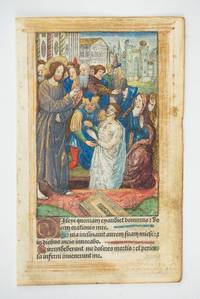
1520réf. ST12778-0887cParis: Gilles Hardouyn ca. 1520. 177 x 110 mm. 7 x 4 1/4". Single column 33 lines in an attractive gothic type. With hand-illuminated initials and a FULL-PAGE MINIATURE DEPICTING THE RAISING OF LAZARUS ILLUMINATED IN COLORS AND GOLD BY A CONTEMPORARY HAND. See Hilary Maddocks "A Book of Hours by Anthoine Vérard" University of Melbourne Collections issue 16 2015 pp. 19-20. One quarter-inch repair to the center of the leaf which on the recto slightly affects Lazarus' neck and on the verso affects three letters which have been neatly touched up a handful of small chips to the paint the architectural border somewhat rubbed in the lower right corner mild soiling to the margins; not without flaws but a richly and carefully colored leaf that is still pleasing. Richly painted and amply highlighted with brushed gold this leaf from a printed Book of Hours includes a large miniature depicting the raising of Lazarus. Christ stands arm extended in benediction over the newly reawakened Lazarus who gazes up at him standing upright in his grave. A crowd looks on with a well-dressed man crouched in front of the grave apparently having helped Lazarus to stand. Our illuminator has enhanced the drama of the moment with the rosy cheeks of the bystanders emphasizing Lazarus' deathly pallor and with Jesus' shimmering robe distinguishing him from the crowd. The faces and folds of cloth are delicately shaded and the minutely detailed lines of gold carefully applied stylistically tying this printed leaf to the fully hand-painted Books of Hours that printed versions were slowly replacing during the early years of the 16th century. The composition seems to come from a suite of illustrations designed by illuminator Jean Pichore fl. 1490-1521 done for the printer Gilles also Gillet Hardouyn. Gilles Hardouyn (?) unknown
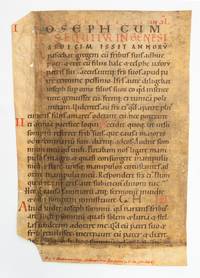
réf. ST20617dAustria Salzburg second half of 12th century. 321 x 218 mm. 12 5/8 x 8 5/8". Single column 27 lines in a lovely proto-gothic hand top two lines in red or black uncials. Rubrics and numbers in red two one-line initials in red with A LARGE 115 mm. IMAGE OF JOSEPH WEARING HIS COAT OF MANY COLORS the body outlined in brown ink and the coat outlined in red. Lower margin of recto with a 20th century note in red ink see below. Recovered from a binding and thus with overall darkening on the recto and with nothing readable on the verso bottom line of text a bit damaged because of crease through it a few small holes two corners trimmed one or two letters of final line of text lost but more than half of the Joseph figure including the face still visible and the text on the recto entirely legible. Containing a beautiful proto-gothic script and a rare figurative Romanesque initial this leaf is a particularly desirable example of early Austrian manuscript production. The text here is as neatly noted in German at the tail edge of the recto Genesis 37:2-10 the beginning of the story of Joseph the 17-year-old son of Jacob here called Israel and his second wife Rachel. In the well-known biblical account Joseph is his father's favorite of 12 sons and the patriarch gives him a beautiful coat of many colors making his brothers jealous. Joseph here intensifies their dislike of him by recounting to his brothers two of his dreams in which sheaves of grain and then various celestial bodies bowed down to him. Dream or reality the images did not sit well with the brothers who sold Joseph into slavery. Although once the leaf was reused as binding material we can nevertheless make out an historiated "I" in the form of Joseph as a young man including an outline of his multi-colored coat. It is difficult to say with certainty whether the initial would originally have been washed with color or composed solely as a line drawing but whatever the case we are lucky to have so much of it intact. With his long flowing hair semi-nude body and hand placed delicately on his hip Joseph is depicted in quite a seductive manner and the simple line-drawing further emphasizes the body's curves and lithe appearance. Romanesque initials with historiation are not nearly as common as decorative ones and the present depiction is especially unusual. While illustrations of Joseph do appear in other manuscripts of this period they tend to focus on specific events from the biblical narrative--particularly those that lend themselves to the tradition of Joseph as a prefiguration of Christ such as Joseph being thrown into the pit or revealing his identity to his brothers. The present example by contrast is all about the presentation of the figure. This leaf almost certainly belonged to a Lectionary owned by a Romanesque church in Salzburg a manuscript that was later dismembered for use in bookbinding. According to the source from which we purchased this leaf it was shown in 1893 to the Medieval historian and later the Abbot of St. Peter's Salzburg Willibald Hauthaler 1843-1922 who wrote the identification in red ink along the lower edge. It was later owned by the Salzburg-based merchant artist and collector Carl von Frey 1826-96. It appeared at Christie's in 2010 where along with five sister leaves it sold for £13970. unknown
réf. ST20846GSouthern Netherlands ca. 1280. 110 x 83 mm. 4 3/8 x 3 1/4". Single column 19 lines in a gothic hand. Rubrics in red simple line fillers in red or blue each leaf with multiple one-line initials in red or blue one leaf also with a two-line gilt initial on blue and pink ground and with bar border extensions in gold blue and pink EACH LEAF WITH A LARGE HISTORIATED INITIAL measuring seven to nine lines long 28-34 mm. the initial in pink or blue inhabited by figures painted on a gilt ground all this on a blue or pink ground framed in gilt with spiky pink and blue marginal extensions studded with gilt bezants and painted leaves. Small corrections to text one leaf with marginal notation in a later hand; each leaf with a small stub mounted on fore edge. One leaf with marginal embellishment slightly trimmed away just a hint of use but in very fine condition with the initials beautifully preserved right down to their hair-line detail. Featuring large historiated initials with some unusual iconography these leaves come from a charming Psalter-Hours attributed to the Morgan 183 Group. Active in the late 13th and early 14th centuries and so-named for a highly decorative manuscript once owned by J. Pierpont Morgan the artists of this group are considered important purveyors of the gothic style from Paris into Liege and the Southern Netherlands. Our parent manuscript was probably executed in Brabant or Hainault based on the presence of certain saints associated with these cities that appear in the Litany for example Sts. Waldetrudis of Mons and Amalberga of Maubeuge. Clues from other extant leaves containing additions and alterations to the text suggest that it was initially made for non-monastic use but later may have been adapted for a Benedictine community. The present leaves each contain a large historiated initial to punctuate the beginning of a Psalm or major section and each provides a narrative for contemplation. The subjects include: a Crucifixion opening the Hours of the Passion with the Virgin Mary and John the Evangelist on either side of the Crucified Christ. Above them on either side of the Cross is the sun and moon--an allusion to the three hours of darkness enveloping the land during the Crucifixion. b The fool riding a goat opening Psalm 52 "Dixit insipiens". This is a particularly unusual though very apt piece of iconography for the Psalm that famously begins "The fool has said in his heart: 'There is no God.'" Pictured astride a goat the fool holds onto a horn with one hand and brandishes a club with the other as his steed charges ahead. Although historiated initials with fools can occasionally be found in Psalters and Bibles of this same period they are usually shown only with a club and often a piece of bread; the addition of the goat is quite extraordinary. c David in the water praying to God opening Psalm 68 "Salvum me fac Deus". This initial makes excellent use of the compositional space provided by the curving "S" shape placing God the father in the compartment above and King David up to his belly in flowing water in the compartment below. Both figures raise their arms upward with the Lord holding a globus cruciger and making the sign of benediction while David naked except for his crown extends his prayerful arms so wide they nearly reach from one side of the initial to the other. The latter is clearly referencing Christ's eventual sacrifice on the Cross as well as highlighting the familial connection between the two. These leaves are exceptional examples of the French high gothic style outside of Paris and offer multiple avenues for further research and comparison. unknown
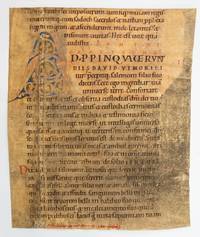
réf. ST20617aAustria Salzburg second half of 12th century. 300 x 243 mm. 11 5/8 x 9 1/2". Single column 27 lines in a lovely proto-gothic hand including lines in red and black uncials. Rubrics in red two one-line initials in red AN EIGHT-LINE 83 mm. tall WHITE-VINE INITIAL outlined in red and filled in with blue and green. Lower margin of recto with a 20th century note in red ink see below. Recovered from a binding and thus the vellum on one side noticeably darkened with a large lighter patch where a label may have been removed the other side faded with half the text illegible top edge trimmed close vertical crease going through initial much of the white in the capital now a light gray other minor issues but still an impressive leaf the once beautiful initial largely well preserved with its blue paint still rich. Containing an elegant proto-gothic script and a striking white-vine initial this leaf is an excellent example of early Austrian manuscript production. The large initial "A" is formed with foliate designs outlined in red given shape by coloring in the negative space with an intense azure blue and moss green. This style would later become a model for the Italian Humanist scribes and illuminators of 15th and 16th centuries who substituted glistening gold leaf for the vibrant yellow paint favored by some artists of the Romanesque period. The text of this leaf mainly includes readings for the seventh Sunday after Pentecost consisting of III Kings 2:1-17 beginning "Adpropinquauerunt dies David" according to the Vulgate numbering. It describes the Death of King David who instructs his son Solomon to keep the ways of God. With large and elegant letterforms executed by a steady hand this leaf almost certainly belonged to a Lectionary owned by a Romanesque church in Salzburg. According to the source from which we purchased this leaf it was shown in 1893 to the Medieval historian and later the Abbot of St. Peter's Salzburg Willibald Hauthaler 1843-1922 who wrote in very small letters the identification in red ink along the lower edge. It was later owned by the Salzburg-based merchant artist and collector Carl von Frey 1826-96. It appeared at Christie's in 2010 where along with five sister leaves it sold for £13970. Despite some condition issues related to its reuse in a later binding this leaf is still very impressive because of its beautiful calligraphy and decoration. unknown
réf. ST20846BSouthern Netherlands ca. 1280. 110 x 83 mm. 4 3/8 x 3 1/4". Single column 19 lines in a gothic hand. Rubrics in red simple line fillers in red or blue each leaf with multiple one-line initials in red or blue and one two-line gilt initial on blue and pink ground with bar border extensions in gold blue and pink. Occasional contemporary or later marginal notations; upper corners with modern foliation in pencil. Gold occasionally just a little dulled some leaves with small smudges light soiling or other minor issues but generally in extremely pleasing condition. Featuring restrained but elegant decoration these leaves come from a charming little Psalter-Hours attributed to the Morgan 183 Group. Active in the late 13th and early 14th centuries and so-named for a highly decorative manuscript once owned by J. Pierpont Morgan the artists of this group are considered important purveyors of the gothic style from Paris into Liege and the Southern Netherlands. Our parent manuscript was probably executed in Brabant or Hainault based on the presence of certain saints associated with these cities that appear in the Litany for example Sts. Waldetrudis of Mons and Amalberga of Maubeuge. Psalter-Hours are not nearly as common on the market as their later descendants Books of Hours; and the present leaves are quite lovely examples being neatly executed and in very nice condition. unknown
1450réf. ST11774EParis ca. 1450. 159 x 108 mm. 6 1/4 x 4 1/4". Single column 15 lines per page in an excellent gothic book hand. Rubrics in red each leaf with line fillers and multiple one- and two-line initials in burinshed gold on red and blue ground with white tracery one or both sides with swirling panel border featuring flowers leaves strawberries and many burnished gold ivy leaves on hairline stems. Isolated trivial stains or imperfections but VERY BRIGHT CLEAN AND FRESH. In fine condition beautifully decorated and sparkling with gold these leaves are marvelous examples of a high-quality Parisian Book of Hours made for a person of means. The borders here are especially pleasing with skeins of hairline vines accented by burnished bezants and ivy bright blue and gold acanthus pale green leaves and cheerful red blossoms. For leaves at other price points please check our website. unknown
réf. 41667G. Deydier - Eds Elegance In-8 70pp. illustr. dessins cartes et planches photos hors-texte hommage autographe de Jean Meunier organisateur avec sa carte de visite jointe unknown
réf. ST20846ESouthern Netherlands ca. 1280. 110 x 83 mm. 4 3/8 x 3 1/4". Single column 19 lines in a gothic hand. Rubrics in red simple line fillers in red or blue each leaf with multiple one-line initials in red or blue one leaf also with three two-line gilt initials on blue and pink ground and with bar border extensions in gold blue and pink EACH LEAF WITH A LARGE HISTORIATED INITIAL measuring seven to eight lines long 27-30 mm. the initial in pink and the figures painted on a gilt ground all this on a blue ground framed in gilt with spiky pink and blue marginal extensions studded with gilt bezants one of the leaves with a small hybrid creature with a human face incorporated into the extension. One leaf with early marginal notation; each leaf with a small leather tab marking major text on fore edge. One leaf with tip of marginal extension just grazed the other with vellum vaguely soiled and thinned in one spot resulting in tiny hole but attractive leaves in very pleasing condition overall. Featuring large historiated initials with some unusual iconography these leaves come from a charming Psalter-Hours attributed to the Morgan 183 Group. Active in the late 13th and early 14th centuries and so-named for a highly decorative manuscript once owned by J. Pierpont Morgan the artists of this group are considered important purveyors of the gothic style from Paris into Liege and the Southern Netherlands. Our parent manuscript was probably executed in Brabant or Hainault based on the presence of certain saints associated with these cities that appear in the Litany for example Sts. Waldetrudis of Mons and Amalberga of Maubeuge. Clues from other extant leaves containing additions and alterations to the text suggest that it was initially made for non-monastic use but later may have been adapted for a Benedictine community. The text of the present leaves come from the so-called "Seven Penitential Psalms" which are traditionally credited to King David and associated with his lamentations and atonement. The beginning of each Psalm is punctuated by a large historiated initial which marks the opening and provides a visual narrative to aid contemplation. The subjects include: a "Noli me tangere" for Psalm 6 "Domine ne in furore tuo arguas me". A full-length Christ in blue robes appears before a kneeling Mary Magdalene after his Resurrection. Between them is a tree with a bulbous red growth at the top acting as a symbolic divider between the earthly and spiritual realms. b David fleeing Saul for Psalm 38 "Dixi custodiam vias meas". This initial depicts David wearing a simple hat and tunic as opposed to a crown and robes as he escapes King Saul's murderous jealousy. He balances a staff holding a bundle of belongings on one shoulder see Morgan MS M.183 fol. 54v for a similar depiction as he is confronted by the disembodied head of God on the right. These leaves are excellent examples of the French high gothic style outside of Paris and offer multiple avenues for further research and comparison. unknown
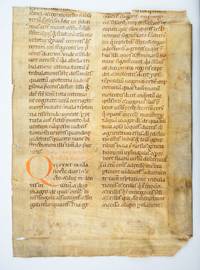
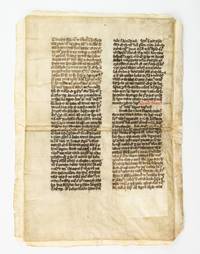
réf. ST20837eFrance mid-13th century. 321 x 230 mm. 12 5/8 x 9". Double column 39 lines in a dense gothic hand. Rubric in red. Recovered from a binding and so the vellum a bit creased and soiled though less soiled than is often seen some tiny remnants of later printed text from reuse but the text almost entirely legible and the leaf surprisingly well preserved overall with its very substantial margins fully intact. Once serving as a cover for a later book this leaf seems to come from an unpublished collection of sermons incorporating biblical excerpts such as Revelation 12:1 "A great sign appeared in heaven: A woman clothed with the sun and the moon under her feet and on her head a crown of twelve stars". The lack of decoration and simple rubrication suggest that the parent manuscript was made for utilitarian purposes at a time when a need for such books increased due in part to the rise of mendicant orders like the Franciscans and Dominicans. Members of these orders rejected traditional monastic isolation and instead settled in urban centers to preach and minister to the people. It is unusual and very lucky that this leaf survives completely intact as Medieval manuscripts used in later bindings were often cut down in size to make smaller covers or used as waste paper for pastedowns or other binding elements. Considerable rewarding research remains to be done to identify the content here along with its various religious and social contexts. unknown
réf. ST20617eAustria Salzburg second half of 12th century. Unevenly trimmed but approximately 362 x 234 mm. 14 1/4 x 9 1/8". Double column 31 extant lines in a lovely proto-gothic hand. Rubrics in red remains of two large multi-line initials in red. Lower margin of recto with modern note in red ink in very small letters identifying the text. Recovered from a binding and thus unevenly trimmed top margin and a small part of text trimmed away at the top a handful of tiny cuts and holes of no significance vellum a little brownish but the leaf rather smooth and the majestic text entirely legible. This lectionary fragment which contains two important patristic sermons for the season of Advent demonstrates a highly regular graceful and majestic proto-gothic book hand. The oval-shaped elongation of Caroline letter forms characteristic of 12th century book hands and the mixture of rustic and uncial capitals our scribe has used for section titles appear particularly pleasing in the lovely uncramped hand at work here. The text on the recto is from St. Augustine's second Advent sermon one of a series of homilies written for the liturgical seasons. The verso contains St. Gregory's homily for the first Sunday of Advent preceded by Luke 21:25-33 a rehearsal of the signs of the end of days. The homily draws on this gospel passage to exhort the faithful to prepare themselves for the second coming. The present leaf almost certainly belonged to a Lectionary owned by a Romanesque church in Salzburg a manuscript that was later dismembered for use in bookbinding. According to the source from which we purchased this leaf it was shown in 1893 to Willibald Hauthaler 1843-1922 the Medieval historian and later the Abbot of St. Peter's Salzburg who wrote the identification along the lower edge. It was later owned by the Salzburg-based merchant artist and collector Carl von Frey 1826-96. It appeared at Christie's in 2010 where along with five sister leaves it sold for £13970. unknown
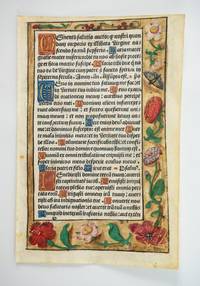
réf. ST20972b-cParis: Nicolas Vivien early 16th century. 197 x 130 mm. 7 3/4 x 5 1/8". Single column 28 lines gothic typeface. Ruled in red two one-line initials and two three-line initials painted in gold on red or blue ground and A LOVELY ANIMATED FULL PAINTED BORDER done by hand with trompe-l'oeil flowers one leaf also with a moth on painted gold ground. Top margin a little small light soiling to vellum borders with a couple superficial scratches and tiny smudges but in excellent condition overall. These beautifully embellished leaves from a printed Book of Hours demonstrate the enduring demand for manuscript illumination in the incunabular period and beyond. While the text here was completed on a printing press the initials and borders were done entirely by hand adding luxury and luster to otherwise unadorned pages. Although these leaves likely belonged to a Book of Hours printed in Paris possibly an edition printed for Nicolas Viven in or around 1503 the trompe-l'oeil style seen in the borders was particularly popular among Flemish and Netherlandish illuminators of the period. Because of the artist's use of subtle shading to indicate shadows the large blossoms here seem to pop off the page and one of the leaves contains a delicate little moth--attracted perhaps by the gleaming painted gold ground. Nicolas Vivien(?) unknown