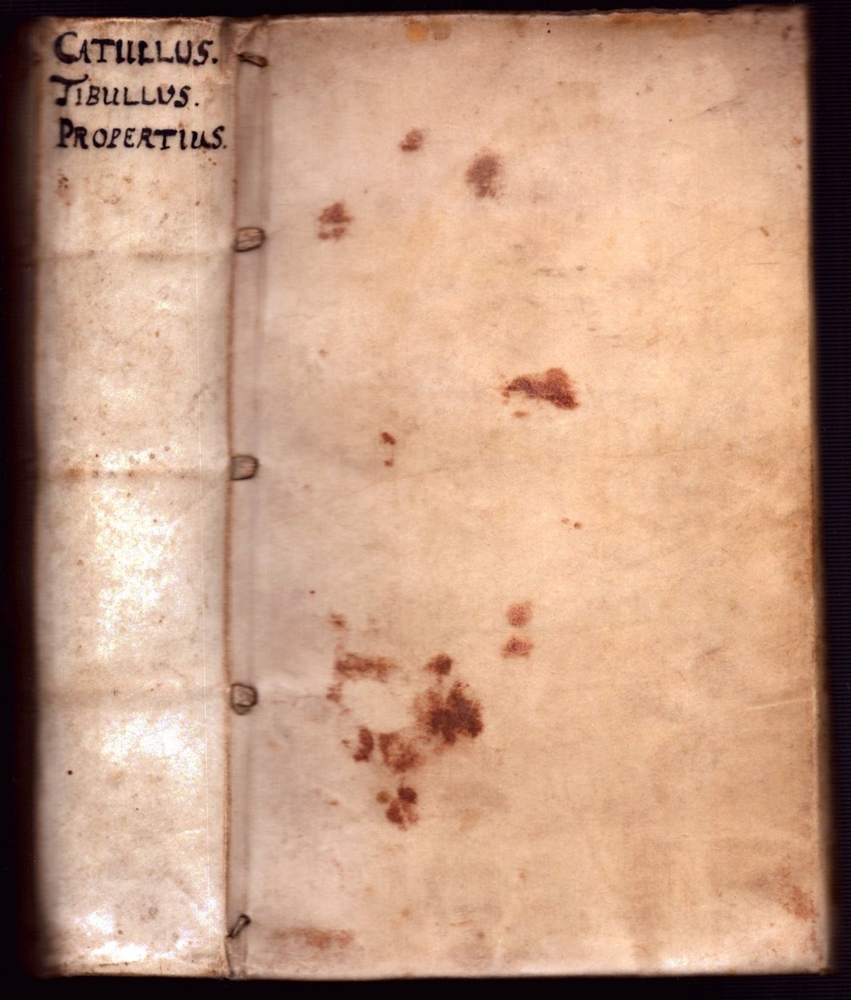
1949rif. 015004Eynard 1949 In-12 Broché, couverture rempliée
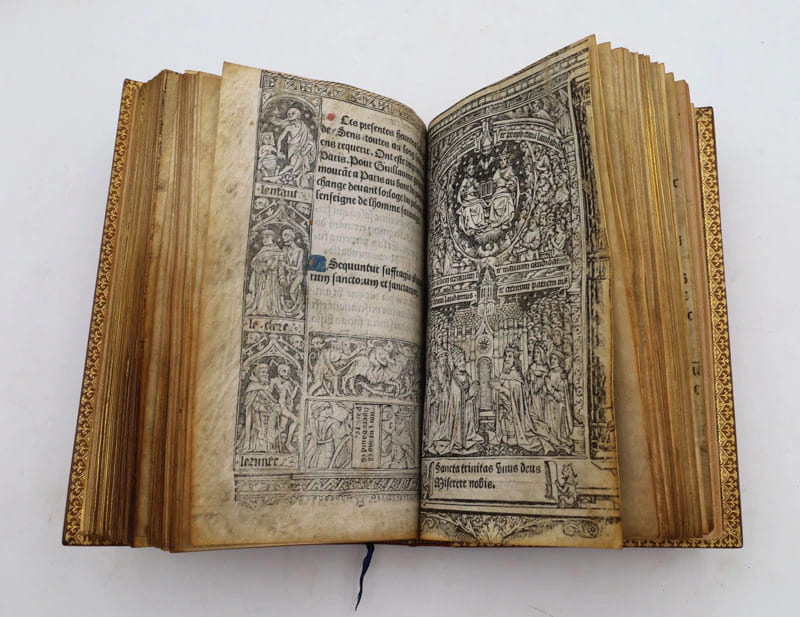
rif. 103646Paris, Guillaume Godard, post-incunable, s.d. [c. 1510-1520], in-8, [133] ff, [4] ff. manuscrits. (deux premiers feuillets manquants), Reliure pastiche en veau havane, décor à froid sur les plats, dos à nerfs orné à froid, pièce de titre rouge, roulette dorée en bordure intérieure, tranches dorées, Signatures : [A]6, B4, Ab6, a-k8, [n.s.]8, B8, D8, D8. Introuvables Heures à l'usage de Sens, imprimées par Guillaume Godard, sur vélin, illustrées de bordures et de grands bois issus du fonds du libraire parisien Antoine Vérard. Cet exemplaire est vraisemblablement un UNICUM : aucun exemplaire survivant n'est connu. Seul Brunet signale en avoir vu un ? et qui est apparemment le nôtre, les même feuillets en tête de volume étant manquants. Le texte est en gothique, en latin sur une colonne : il est orné de lettrines et bouts-de-ligne enluminés sur fonds rouges ou bleus. Les feuillets du calendrier sont réglés en rouge. L'ouvrage ouvre sur le calendrier (le f. de titre et celui du mois de janvier sont manquants), composé d'un feuillet par mois et d'une maxime s'y rapportant sous la forme de quatrains dans le style de Nostradamus ou Matthieu Lansbert*, en français moyen. Suivent enfin les prières liturgiques. L'usage de ce livre d'heure est donné au feuillet K8 v, avec le nom de l'imprimeur : "Ces présentes heures à l'usaige de Sens toutes au long sans rient requerir. Ont esté imprimées à Paris. Pour Guillaume Godar demeur[an]t à Paris au bout du pont au change devant l'horloge du palays. A l'enseigne de l'homme sauvaige". L'adresse réapparait au colophon. Les pages imprimées déploient leur texte dans des encadrements de motifs végétaux Renaissance, habités d'animaux fantastiques et de figures anthropomorphes. Certains sont compartimentés de vignettes historiées issues de l'histoire religieuse et, sur d'autres, se déroule la Danse macabre du libraire-imprimeur Antoine Vérard : ces 48 jolis blocs avaient été utilisés par Vérard lui-même pour les marges des livres d'heures qu'il fit imprimer à partir de 1500, avant d'être remployés par Guillaume Godard, au moins à partir de 1517, date à laquelle il fait imprimer des Heures à l'usage de Rome par Nicolas Higman**. Les prières liturgiques sont illustrées de dix-sept bois à pleine page, qui proviennent eux aussi du fonds d'Antoine Vérard : précisément, il s'agit des copies des gravures sur métal que Jean Pichore avait réalisées pour les frères Hardouin et Simon Vostre***, dont l'emploi par Godard est attesté dès 1514 pour une édition des Heures à l'usage de Rome****. L'iconographie est issue de l'Ancien et du Nouveau Testament, ainsi que les Apocryphes : Saint Jean l'évangéliste et l'épreuve de la coupe empoisonnée; l'Arrestation de Jésus et le baiser de Judas; l'Arbre de Jessé; l'Annonciation; La Sibylle de Tibur annonçant à Auguste la naissance du Christ; la Crucifixion; la Pentecôte; l'Adoration des bergers; l'Annonce aux bergers; l'Adoration des mages; la Présentation au temple; le Massacre des Innocents; la Dormition de la Vierge; Urie convoqué par David; la Résurrection de Lazare; la Sainte Trinité, avec une foule de dévots; et la Messe de saint Grégoire. Au verso du dernier feuillet figure enfin la célèbre marque typographique de l'imprimeur Guillaume Godard, sous la forme d'un rébus, et son explication en vers français ("Saluons Marie priant Jésus en croix..."). Le volume se clôt sur quatre feuillets manuscrits en français, rédigés à la même époque, n'appartenant pas à l'ouvrage, intitulés "Oraison à notre seigneur bien devote laquelle contient huit couplets". Les initiales et les bouts-de-ligne sont rehaussés de motifs de chaînettes à l'encre jaune. Titre et premier feuillet du calendrier (A1 et A2) manquants. Volume rogné court, en particulier dans la marge de tête, avec atteintes aux encadrements typographiques. Infimes épidermures, quelques taches. Petit manque Couverture rigide
1924rif. 2668Paris, G. Crès ; Nancy, Victor Berger, 1924 ; grand in-8, demi-maroquin rouge-cerise à coins, dos lisse, pièce de titre fauve au dos, filets dorés, important décor doré au dos de fleurs mosaïquées, rinceaux et un centaure dorés, tête dorée, couverture et dos conservés (reliure de l'époque) ; (4) ff. (2 bl., faux-titre, titre), 218 pp. (3) ff. (table, justification, bl.) ; 6 gravures sur cuivre en noir hors-texte dont une en frontispice, 16 bois gravés en noir in-texte.
1834rif. 251111834 Planche 420 de La Caricature N° 201.La Caricature, 28 aout 1834. Lithographie originale sur Velin blanc. . Delteil 85. épreuve en noir ; lithographie en noir sur velin blanc pli médian vertical,bon tirage bien noir,petite tache brune en marge - Delteil 82 ,
1945rif. 005937Paris Seghers "collection des 150" 1945 In-16 Broché
1600rif. 97208[Heidelberg], Commelinus [Hieronymus Commelinus Erben], 1600. [7] Bll., 274 S.; 1 Vakatbl., 291 S. Mit Druckermarke aT, einig. Holzschnitt-Vignetten u. -Initialen. 17 cm. Geflecktes Pergament d. Zt. m. eingeschlagenen Vorderkanten, und hs. Rückentitel.
1910rif. ST14374England ca. 1910. 392 x 287 mm. 15 3/8 x 11 1/4". 32 leaves with text in an attractive italic hand all separated by tissue guards. SUMPTUOUS OLIVE GREEN STRAIGHT-GRAIN MOROCCO ELABORATELY GILT BY ZAEHNSDORF stamp-signed on front doublure and with their exhibition stamp on rear turn-in covers with densely stippled floral roll border enclosing a large frame formed by drawer handle tools and floral tools on a stippled ground; central panel with large cornerpieces rampant with flower tools circlets volutes and much stippling; raised bands spine compartments heavily gilt in a similar style gilt titling RED MOROCCO DOUBLURES with opulent dentelle frame surrounded by gilt-tooled green morocco turn-ins red watered silk endleaves with gilt edging all edges gilt.ma WITH 76 BLACK & WHITE PHOTOGRAPHIC REPRODUCTIONS OF PORTRAIT MINIATURES BY RICHARD COSWAY ANDREW PLIMER AND OTHERS mounted and enclosed by hand-painted burnished gold frames EACH PORTRAIT WITH HAND-ILLUMINATED TITLE in red blue green and burnished gold. Verso of front endleaf with book label of Thomas Agnew & Sons Old Bond Street Library. A bit of wear to front joint a little rubbing to extremities occasional mild rumpling to head or tail of vellum leaves isolated small marginal smudges otherwise a fine specimen the vellum creamy and bright the illuminations shining and the binding quite sound and lustrous with gold. Composed of vellum leaves this is a unique luxurious catalogue of a miniatures collection with delicate script lovely illumination and a stately binding by one of London's foremost workshops. State-of-the-art photographic reproductions of mostly 18th century miniatures are juxtaposed here with calligraphy and illuminations harking back to Medieval bookmaking. Each portrait is surrounded by a gold frame and accompanied by a hand-written description with an illuminated title giving biographical details of known subjects and a physical description of the miniatures whenever they are labelled simply "Portrait of a Lady" or "Portrait of a Gentleman." The scale of this production--which is nearly twice the size of most illuminated manuscripts of the early 20th century--and the splendor of the binding point to a patron of considerable means likely either the proprietors of or a client of the Agnew art dealers. The Agnew firm began as printsellers in Manchester in 1817 but over the course of the 19th century became one of the principal British galleries under the leadership of the founder's son William. A London branch opened in 1860 and the Bond Street flagship in 1875. William Agnew 1825-1910 did much to foster the careers of British artists Holman Hunt Frederick Leighton and Edward Burne-Jones and his clients included Henry Tate whom he encouraged to found the celebrated Tate Gallery. The binding here is a superb example of the work of the Zaehnsdorf firm long a top-ranked English bindery. Born in Pest Hungary Joseph Zaehnsdorf 1816-86 served his apprenticeship in Stuttgart worked at a number of European locations as a journeyman and then settled in London where he was hired first by Westley and then by Mackenzie before opening his own workshop in 1842. His son and namesake took over the business at age 33 when the senior Joseph died and the firm flourished under the son's leadership becoming a leading West End bindery. Over the years Zaehnsdorf employed a considerable number of distinguished binders including the Frenchman Louis Genth who was chief finisher from 1859-84 and trained a number of others including Roger de Coverly and Sarah Prideaux. A family-run business until 1947 the Zaehnsdorf bindery continued to produce consistently attractive and innovative designs executed with unfailing skill. It is generally understood that the firm reserved the use of its oval stamp showing a binder at work seen here for their finest bindings including those entered in exhibitions. unknown books
4to, vi, [143]-207, [1]pp., coloured frontis., 44 plates (some double-page), printed list of prices and buyers' names, gathering a little loose, cont. buckram, uncut, 32 lots. The third sale from this highly important collection of Illuminated Manuscripts and Early Printed Books.
1824rif. 46970Paris, Crapelet für De Bure frères, 1822 bzw. 1824. Gr.-8°. XI, IV, 348 S.; 2 Bll., II, 120; VI, 84; VIII, 332 S.; 2 Bll., 380 S. - XVI, 291; VIII, 264; VII, 314 S., Einheitliche HLdr.-Bde. d. Zt. m. Rückenverg., je zwei goldgepr. Rückenschildern u. dreiseitig marmor. Schnitt.
1960In 4°; 10 tomi in 9 volumi, completo. Riedizione, anastatica, della prima edizione parigina delle due opere uscite nel 1822-8 e nel 1824-8. Legatura editoriale in piena tela nera con titolo impresso in oro al dorso. Ottime condizioni di conservazione di questa importante opera bibliografica dedicata alle opere stampate su pergamena conservati nella Biblioteca Reale, nella Biblioteca Nazionale di Francia e nelle altre biblioteche francesi. Completo ed in ottime condizioni di conservazione.
9 Vols., small 4to, orig. cloth. "The first bibliography of books printed on vellum; it describes 1,750 books owned by what is now the Biblioth?que Nationale, Paris, and 2,750 works which the author traced in other public and private libraries. But it is much more than a mere bibliography of books printed on that precious material; the copious notes make it a valuable bibliography of rare books in many fields." - Breslauer & Folter, Grolier Club, Bibliography, 123.
1910rif. ST14374England ca. 1910. 392 x 287 mm. 15 3/8 x 11 1/4". 32 leaves with text in an attractive italic hand all separated by tissue guards. SUMPTUOUS OLIVE GREEN STRAIGHT-GRAIN MOROCCO ELABORATELY GILT BY ZAEHNSDORF stamp-signed on front doublure and with their exhibition stamp on rear turn-in covers with densely stippled floral roll border enclosing a large frame formed by drawer handle tools and floral tools on a stippled ground; central panel with large cornerpieces rampant with flower tools circlets volutes and much stippling; raised bands spine compartments heavily gilt in a similar style gilt titling RED MOROCCO DOUBLURES with opulent dentelle frame surrounded by gilt-tooled green morocco turn-ins red watered silk endleaves with gilt edging all edges gilt.ma WITH 76 BLACK & WHITE PHOTOGRAPHIC REPRODUCTIONS OF PORTRAIT MINIATURES BY RICHARD COSWAY ANDREW PLIMER AND OTHERS mounted and enclosed by hand-painted burnished gold frames EACH PORTRAIT WITH HAND-ILLUMINATED TITLE in red blue green and burnished gold. Verso of front endleaf with book label of Thomas Agnew & Sons Old Bond Street Library. A bit of wear to front joint a little rubbing to extremities occasional mild rumpling to head or tail of vellum leaves isolated small marginal smudges otherwise a fine specimen the vellum creamy and bright the illuminations shining and the binding quite sound and lustrous with gold. Composed of vellum leaves this is a unique luxurious catalogue of a miniatures collection with delicate script lovely illumination and a stately binding by one of London's foremost workshops. State-of-the-art photographic reproductions of mostly 18th century miniatures are juxtaposed here with calligraphy and illuminations harking back to Medieval bookmaking. Each portrait is surrounded by a gold frame and accompanied by a hand-written description with an illuminated title giving biographical details of known subjects and a physical description of the miniatures whenever they are labelled simply "Portrait of a Lady" or "Portrait of a Gentleman." The scale of this production--which is nearly twice the size of most illuminated manuscripts of the early 20th century--and the splendor of the binding point to a patron of considerable means likely either the proprietors of or a client of the Agnew art dealers. The Agnew firm began as printsellers in Manchester in 1817 but over the course of the 19th century became one of the principal British galleries under the leadership of the founder's son William. A London branch opened in 1860 and the Bond Street flagship in 1875. William Agnew 1825-1910 did much to foster the careers of British artists Holman Hunt Frederick Leighton and Edward Burne-Jones and his clients included Henry Tate whom he encouraged to found the celebrated Tate Gallery. The binding here is a superb example of the work of the Zaehnsdorf firm long a top-ranked English bindery. Born in Pest Hungary Joseph Zaehnsdorf 1816-86 served his apprenticeship in Stuttgart worked at a number of European locations as a journeyman and then settled in London where he was hired first by Westley and then by Mackenzie before opening his own workshop in 1842. His son and namesake took over the business at age 33 when the senior Joseph died and the firm flourished under the son's leadership becoming a leading West End bindery. Over the years Zaehnsdorf employed a considerable number of distinguished binders including the Frenchman Louis Genth who was chief finisher from 1859-84 and trained a number of others including Roger de Coverly and Sarah Prideaux. A family-run business until 1947 the Zaehnsdorf bindery continued to produce consistently attractive and innovative designs executed with unfailing skill. It is generally understood that the firm reserved the use of its oval stamp showing a binder at work seen here for their finest bindings including those entered in exhibitions. unknown
rif. 32636Burt Franklin New York. Reprint of the 1822 Edition 1969. 9 Vols. small 4to orig. cloth. "The first bibliography of books printed on vellum; it describes 1750 books owned by what is now the Bibliothèque Nationale Paris and 2750 works which the author traced in other public and private libraries. But it is much more than a mere bibliography of books printed on that precious material; the copious notes make it a valuable bibliography of rare books in many fields." - Breslauer & Folter Grolier Club Bibliography 123. Burt Franklin, New York. (Reprint of the 1822 Edition) 1969 hardcover
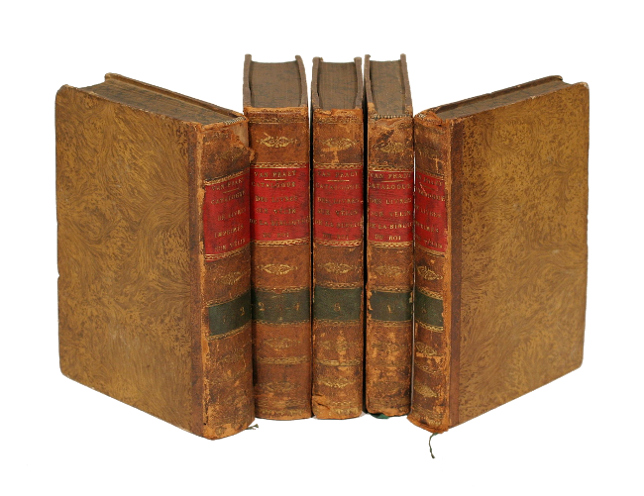
1822rif. mon0003529457Chez de Bure Freres 1822. Paperback. Good. . Extremely scarce in any condition. 5 volumes in 4 physical books II and III in one. Fragile but fully intact. Some chipping at edges. Pages clean. Chez de Bure Freres paperback
1958rif. 001347New York Findlay Galleries 1958 In-8 à l'italienne En feuilles, couv. illustrée Ed. originale
rif. 17255LE CHARIVARI,19.04.1842,texte au dos , découpé , marges consevées , ..
1954rif. boz_002041Auteur : Donald Windham. Titre : Canicule (The Dog Star) Édition : Gallimard, coll. « Du Monde Entier », Paris, 1954 Tirage : Édition originale. L’un des 66 exemplaires sur vélin pur fil Lafuma Navarre (celui-ci portant le n 53). Seul tirage. Reliure : Volume broché, sous couverture souple d'éditeur. Dos lisse avec titre et auteur en rouge et noir. Exemplaire non coupé. Dimensions : 12 x 19,1 cm État : Bel exemplaire. Intérieur très frais, marges non coupées. Dos insolé. Nombre de pages : 238 pages.
1902rif. 10924Paris, P. Sevin et E. Rey (Tours, Imprimerie Deslis Frères), 1902 ; in-8 ; demi-maroquin à coins vert foncé, dos à quatre nerfs encadrant les pièces d'auteur et de titre mandarine, tête dorée, couverture prune illustrée d'un hibou sur fond de lune dorée, et dos conservés.
rif. 014421Paris Maeght 0 En feuilles, couverture illustrée rempliée, chemise éditeur
1948rif. 1001478081948 in8. 1948. Broché. Les 'Cahiers Charles de Foucauld' sont une publication périodique collectif dédiée à la vie et à l'œuvre de Charles de Foucauld éditée par Arthaud à partir de 1947. Le second volume traite spécifiquement de Charles de Foucauld et de sa 'mission'. Il s'agit d'une édition originale numérotée sur vélin de Rives B.F.K
1987rif. 007167Balbec L'Initiale 1987 In-4 En feuilles, emboitage
1939rif. 010255Paris Glm - Collection" Poètes d'aujourd'hui" n° 3 1939 plaquette in-4 Broché, couverture à rabats
rif. 1787Paris, Flammarion, 1920 12 x 19, 246 pp., non coupé, très bon état
rif. 369Paris, Grasset, 1935 14 x 20, 267 pp., non coupé, très bon état
rif. 9471Paris, Grasset, 1935 15 x 20, 267 pp., reliure dos/coins cuir, tête dorée, couverture conservée, très bon état